
Sound and Curation; or, Cruisin’ through the galleries, posing as an audiophiliac
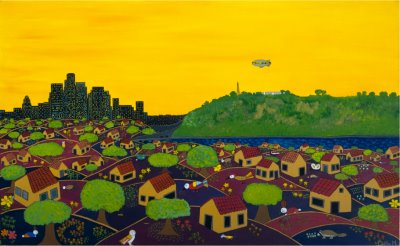
“L.A. Reimagined” by Dalila Paola Mendez (c), Mendez’ work will be featured in re:present LA, opening 5/3/12
But to love this turf is love hard and unrequited.
…
To love L.A. is to love more than a city
It’s to love a language.
–“L.A. Love Cry” (1996) by Wanda Coleman
Los Angeles, an enigmatic metropolis to many who arrive here with a dream in hand and hope for a better tomorrow, still challenges historians, artists, and troubadours on how to best represent it. Poet Wanda Coleman, born in Watts, captures the pain and wonder of loving this city in “L.A. Love Cry.” Because the city is “hard and unrequited” one must also be willing to love its nuances and see it as“more than a city.” To love this city, “it’s to love a language,” a cultural immersion that goes beyond the seeming ease of words into the complexities of sound and rhythm.
Through a Museum Studies course I teach at Claremont Graduate University entitled Welcome to L.A., I introduce students to varied texts in which scholars and artists challenge the imaginaries created by outsiders, boosters, and apocalyptic cinema. Instead, the course readings present how we in L.A. actively engage with one another by fostering communities of creative praxis. For the students’ final project, they curate and develop educational programming for an exhibition at a local museum or art center. On May 3, 2012, this semester’s project, re : present L.A., opens at the newly-renovated Vincent Price Art Museum (VPAM) located on the East Los Angeles College Campus. Showing works from over thirty artists from May 3-July 27, re : present L.A serves as an extension of the conversations we had in class, not only celebrating the interconnectedness of our communities but encouraging new associations and encounters within the visual and resonant space of VPAM’s Community Focus Gallery. For a look at the Virtual Exhibit Catalogue, click here.
In each exhibition for Welcome to L.A., I try to include something that challenges myself to think outside the white-box, per se, of the gallery. Given that we had read several texts that highlighted in the importance of music to build and uplift communities of color in Los Angeles, it was both important and necessary for me to include sonic elements in re: present LA that exhibits L.A.s vibrant musical legacy as intermingled with and fundamental to its visual culture. Among the challenges to document the cross-cultural connections between ethnic communities in Los Angeles is how to unpack what Anthony Macias calls “the cultural networks” that facilitated these exchanges through the music scenes at music halls, clubs, youth centers and record stores in Mexican American Mojo (10-11). Studies done by George Lipsitz, Macias, and Victor Viesca, provide readers a means to understand how the music in Los Angeles is much more than entertainment; it is political; it is a lifestyle; it defines spaces of multicultural interactions. In How Racism Takes Place, Lipsitz points out how integral the reclamation of space defined the political outlook and music in Horace Tapscott’s Arkestra based in South L.A. Viesca’s research documents the rise of an East L.A. rock sound, post-Los Lobos, that was defined by the activism of the Zapatista Movement and California’s Prop 187 through the work done at the Peace & Justice Center, Self-Help Graphics, and Regeneración.
Therefore, in order to engage both the history and the sound of Los Angeles’s musics with the city’s visual representations, I invited Rubén Funkhuatl Guevara from Ruben & The Jets, is a multi-threat musician, performer, writer, and producer, and Jennifer Stoever-Ackerman (of Binghamton University, Sounding Out!, and of course, Riverside, CA) to curate playlists for a “sound booth,” which will consist of a stationary iPod™ Nano that gallery visitors can use at their leisure. The classic circular wheel allows the viewer to advance tracks or play the playlists on shuffle. Headphones will be set up so that the viewer can either focus on their listening experience or, listen while viewing the artwork around them. Since the gallery is relatively small, the pieces on the opposite wall are recognizable though are distant. In addition, Maya Santos of Form Follows Function will screen their short documentary on Radiotron, a youth center that presented Hip-Hop shows during the 1980s.
Guevara’s playlist Los Angeles Chicano Rock & Roll is included in the exhibition thanks to the Museum of Latin American Art. Stoever-Ackerman’s playlist Off the 60, unites the two spaces of East L.A. and Riverside through a mix of intra- and trans-cultural musical experiences. Guevara’s rock & roll selections highlight many of the bands that emerged in East L.A. Both the musical listings and the liner notes for the sound presentations will be accessible on the re:present L.A website when the exhibit goes live on May 3rd, 2012.

Juan Capistran’s The Breaks (2000), Courtesy of the Artist
.
My sonic intervention in the white, often silent, spaces of the gallery was especially inspired by two recent precedents: the inclusion of the iPod™ in MEX/LA (2011) at the Museum of Latin American Art and Phantom Sightings (2008) at the Los Angeles County Art Museum. Both experiences invited me as a viewer to see the artwork through another sensory experience. The first time I saw music included in an exhibition not specifically about music (such as the Experience Music Project’s 2007 American Sabor: Latinos in U.S. Popular Music, or Marvette Peréz’s curation of ¡Azúzar! The Life and Music of Celia Cruz at the Smithsonian National Museum of American History) was LACMA’s Phantom Sightings, which garnered much critical acclaim and criticism due to the premise of presenting contemporary Chicano Art inspired ‘after’ the Chicano Movement. However, I want to focus on one aspect of the exhibition, a corner display with books that informed the curators’ conceptual approach and on the bookshelf was an iPod™. The iPod™ included playlists from some of the artists reflecting their inspiration for their artwork. I enjoyed listening and reminiscing while sitting in the gallery. However, I wanted the music to take more of a central role in the exhibition, especially because much of the artwork so obviously revealed traces of Los Angeles’ musical influences, partly due to the recent generation of artists who actively engaged in subcultural expressions and referenced it in their art. For example, as Ondine Chavoya describes in the Phantom Sightings catalogue, Juan Capistran’s The Breaks (2000) is a giclée print documenting the artist break-dancing on Carl Andre’s minimalist floor pieces. The guerilla performance then is presented through a series of twenty-five still images showing the various movements seen in how to break-dance books (125). Shizu Saldamando’s ink on fabric portraits of Siouxsie (2005) and Morrissey (2005) showcase how post-punk and new wave music from England is part of her life as an Angeleno (and that of her friends), yet the medium is reminiscent of pinto drawings. Saldamando also does portraits of her friends at clubs, backyard bbqs “documenting a world where identity is fluid” as Michele Urton describes in the catalog (197).

Shizu Saldamando’s Siouxsie (2005), Courtesy of the Artist
It would be another three years before MEX/LA would further marry music with art, now casting it in relation to the politics of Chicano and Mexican presence in Los Angeles. MEX/LA, among the many Pacific Standard Time exhibitions presented throughout Los Angeles, was among the best curated due to the range of artifacts representative of the city and the cultural production emerging in post-war L.A. Another striking element was the influence of Méxicano popular culture among Chicanos and vice-versa. As curator Rubén Ortiz-Torres, and associate curator Jesse Lerner write on the MoLAA website: “The purpose of the construction of a ‘Mexican’ identity in the South of California is not to consolidate the national unity of a post-revolutionary Mexico, but to recognize and be able to participate in an international reality, with all its contradictions and conflicts that this entails.” One of the ways this cultural exchange was embodied was in the playlists curated by Rubén Funkhuatl Guevara and Josh Kun that were prominently displayed alongside the artwork and heard in the interactive iPod™ “sound booths,” that invited viewers to sit on beanbags and listen. The music served to contextualize the art in relation to popular culture of the time. For example, Guevara presents a Chicano rock & roll genealogy that followed the chronology of the visual exhibit, 1930-1980, that begins with boogaloo and swing of the 1940s era culminating with the punk rock sounds of The Bags.
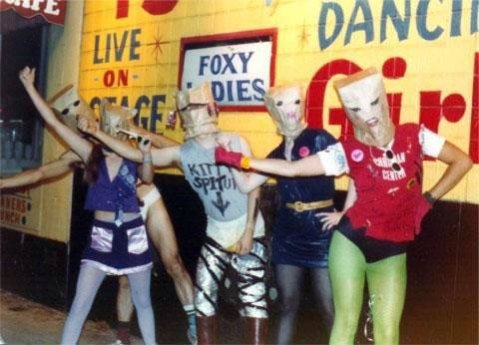
“Bag Parade,” 1977, Courtesy of Alice Bag
In both these exhibitions, the music served to complement the artistic elucidations of identity, race, and American popular culture seen in much of the artwork. The simplicity of the presentation was due to the inclusion of a familiar object like the iPod™. What is surprising is that more exhibitions have not incorporated more sonic elements to engage viewers’ other sensory experiences beyond the podcasts, or cell-phone audio listening tours set up at most major museums. While musical playlists can serve as another didactic component of an exhibition like the more established audio tours, I am arguing for a different use of sound in museum space, one that provides a wider sense of agency, connection, and encounter with the visual elements on display rather than a one-way transmission of information. In the cases of MEX/LA and Phantom Sightings, the inclusion of iPods™ provided a tool to understand the cultural production of a “post-Chicano movement” generation of artists while at the same time enabling an experience that recognized—and resonated with—my bicultural experience.

“Ancient Mexico in Ancient Mexico” by Yvonne Estrada (c), is featured in re:present LA, opening 5/3/12
Being that L.A. is a car culture moving to the rhythms of the radio waves, I’m always seeking to find synchronicity between music that feels me with joy and my work as a cultural worker. Part of my impetus to locate Los Angeles sonically in re : present L.A. was driven by the question: is it possible to capture my sonic landscape growing up in the city of Los Angeles that ranges from Hip-Hop – British Rock – Mexican Pop? The playlists curated by Guevara and Stoever-Ackerman are familiar to me personally. Stoever-Ackerman’s Off the 60, reminds me of the sounds of my youth, when KDAY and KROQ rocked the radio waves and my students banded together in my high school quad according to their favorite music – metal-heads, b-boys, alternative rock, and the cha-chas, who traveled across town every Friday night to Franklin High, where DJs spun L.A. disco. At home, the music was different. My mom and tías used to reminisce about their homeland every Sunday night through the variety show Siempre en Domingo, binding us to the t.v., religiously following the rising stars. Through the bi-lingual selections in Guevara’s Los Angeles Rock & Roll, there’s a familiarity of home and the music heard at backyard parties and quinceañeras.
By including my iPod™ nano, I bring together my lived experience as a cultural worker through the sounds of L.A. and activate the white walls of the museum. The playlists created by Guevara and Stoever-Ackerman serve to reflect the history of the community surrounding VPAM, as well capture the diversity of the city sonically re:presenting L.A. to our audiences. While the playlists can stand alone as audio curations in their own rights, I hope that they will engage audiences to rethink the relationship between music and art, and feel their lived experience inclusive within the museum.
—-
reina alejandra prado saldivar is an art historian, curator, and an adjunct lecturer in the Social Science Division of Glendale Community College in Glendale, California and in the Cultural Studies Program at Claremont Graduate School. As a cultural activist, she focused her earlier research on Chicano cultural production and the visual arts. Prado is also a poet and performance artist known for her interactive durational work Take a Piece of my Heart as the character Santa Perversa (www.santaperversa.com) and is currently working on her first solo performance entitled Whipped!
Share this:

“The Happiest Day of the Year”: A Reparative (I Hope) Approach to Record Store Day
 Editor’s Note: This post, by media scholar Norma Coates, was originally published on May 9, 2011, by the excellent folks over at Flow TV, a critical forum on television and media culture published by theDepartment of Radio, Television, and Film at the University of Texas at Austin. We thank them for permission to give this gem another spin for Record Store Day 2012. It was modified only infinitesimally to fit the SO! stylesheet. Enjoy! And don’t forget put the virtual needle on Sounding Out!‘s new Record Store Day 2012 Podcast, produced by Multimedia Editor Aaron Trammell and featuring interviews with Eric Lott, Damien Keene, Benjamin Gold, Rebecca Berkowitz, Quinn Bishop, Dave Truesdell, Miranda Taylor, and yours truly. –JSA, Editor-in-Chief
—-
Several of my graduate students, in separate meetings, have shared their recent inspiration from the late Eve Kosofsky Sedgwick’s work on affect, especially as compiled in her book Touching Feeling. After the third student talked about it, I figured that I’d better read it. I was instantly plunged back into that wonderful feeling, or more appropriately affect, of discovering something compelling and useful, that could change the ways in which I think about certain things, or at least complicate my approaches. Hence this post about Record Store Day is going to be a bit different than my first drafts. I must proceed with the caveat that although my reading of Sedgwick’s theory of affect is still shallow and my approach necessarily speculative, I’m going to jump into it and use it anyway, in the hope of jumpstarting more careful thought and theorizing for later projects.
 On April 16, this year’s Record Store Day [2012’s Record Store Day is April 21st], I proclaimed it to my family as “the Happiest Day of the Year.” My reading of Record Store Day was at the same time, in Sedgwick’s terminology, paranoid and reparative. Implicit in my paranoid stance, and in the first draft of this post, was my deep suspicion of and sadness about its commercial and consumerist co-optation. What began as a celebration of the continuing economic health and vibrancy of some independent record stores four years ago now has a glossy web site and sponsorship by major labels and industry players. Special “one-day-only” releases, usually on vinyl, sell for somewhat exorbitant prices and end up, unsealed and resold for even more exorbitant prices on Ebay the next day. This in turn feeds the “baseball card” collector mentality that in turn perpetuates gendered discourses and practices of inclusion and exclusion, as well as the vinyl fetishism that separates the “real” music fan from the poseur. I could go on and on with this paranoid reading, one laden with negative affect that critical theorists use to ward off any surprises and to comfort ourselves with the knowledge that the sources of our cultural oppression can be exposed. Sedgwick asks us to think about what such knowledge or exposure does for us. Perhaps it justifies a cynical and critical fatalism that ultimately goes nowhere.
The path that Sedgwick offers out of this conundrum is reparative reading, one open to surprises rather than to sureties. Record Store Day is, for me, a happy day. I even anticipate it. It celebrates several things that I love: music, community, independent cultural production and businesses, browsing racks of records and CDs, talking about music, hearing live music, and more. Despite the presence of corporate logos on the slick website, Record Store Day does manage to retain an element of, in the immortal words of Jack Black in School of Rock, “sticking it to the man.” That is, Tower Records and Virgin Megastores are gone, but a few local record stores are still thriving. That there are “few” is indeed problematic, as they are perhaps the last left standing after a ferocious cull over the past decade, with an uncertain future despite their alleged economic health.
A reparative reading, according to Sedgwick lacks the tight control of a paranoid reading, in which we fatalistically intuit or even call into being what we expect to find or expose. Record Store Day makes me, and I assume the others who were responsible for a 30-minute long check-out line at 10:30 am, feel good, even if we “shouldn’t.” For example, record stores and record collecting are assumed by scholars and laypeople to be space dominated by males, often but not always young ones. What to make, then, of the more than a handful of older women in the store? Or the general sense of camaraderie and celebration that seemed to transcend age and gender, at least? (Race and class weren’t as well-represented in my local record store.) What brought the biggest smile to my face was a woman, perhaps in her late twenties, whose arms were over-flowing with records and CDs. My initial, paranoid reading saw her as both an aberration or a updated version of one of Adorno’s “rhythmic obedients” [from “On Popular Music], blithely purchasing the tools of her own oppression. Or perhaps she was generally caught up in the celebration and needing to catch up on purchases. Maybe, like myself, she was genuinely caught up in the tactile and aural pleasures of music, especially that available in tangible form. I, too, succumbed to the lure of special editions, one-day only availability, and contests that tested my knowledge of rock trivia.

While in the middle of it Record Store Day tapped into what are for me dense layers of affective pleasure made available by listening to and otherwise interacting with recorded music. The hunt is itself enjoyable. Ripping the plastic off a CD provides the joyful and familiar sound of anticipation. The smell of vinyl, the crackle of the needle in the groove, even the preparatory cleaning of a record before playing all provide pleasurable feelings of positive affect. All of these things fit neatly into my original paranoid reading of Record Store Day. Special editions that are only available on record store day feed into two consumer economies: that of the major labels who produce some of these instant rarities, and those who buy them to take advantage of collectors on Ebay later. Plus, these affective “pleasures” could all be reduced to fetishism, or to false consciousness, but my reading of Sedgwick causes me to argue that they don’t have to be either of these things (or other negative things). Through a reparative lens, these feelings, the affect, generated by Record Store Day, could lead to different questions and answers that linger alongside and are equally valid as the set we already ask and the conclusions that we draw from them.
The paranoid critic in me wonders, though, if reparative approaches of media texts are nothing more than the return of 1980s and 1990s ideas about producerly consumption, theories roundly, if sometimes unfairly criticized for a lack of political efficacy. Moreover, affect theory can also return to a possibly problematic return to some notion of something innate, in this case affect or more simply, feeling. I do wonder, though, with Sedgwick, whether our existing critical tools may lead to the triumph of the paranoid reading and of negative affect. That is, our only way to deal with the present condition is tantamount to capitulation. Reparative readings enable us to place our pleasure alongside the negative aspects; that is, they may be capable of thinking beyond binaries, originations, and desires to unveil things that we already know are there. What does alongside mean? Is theorizing the alongside just another way of submitting to an increasingly depressing status quo? For now, I’ll just submit that Record Store Day is “the happiest day of the year,” (you can do what you want with the scare quotes) and that happiness and other positive affects are latent with political possibility, even if we are still figuring out how to access that potential.
For Poly Styrene, Hazel Dickens, and Phoebe Snow. Originally published on May 9, 2011, by the excellent folks over at Flow TV.
—
Norma Coates is Associate Professor with a joint appointment in the Don Wright Faculty of Music and the Faculty of Information and Media Studies at the University of Western Ontario. She writes and studies about popular music and sound and their interactions and intersections with other things such as gender, television, film, age, and the entertainment industry.
Share this:


Current Top Posts





April 2021

January 2020

November 2019

October 2019

August 2019

April 2014

November 2017

March 2015

December 2017

October 2015
 Sounding Out!
Recent Comments