
Shoo bop shoo bop, my baby, ooooo: W.E.B. Du Bois, Sigmund Freud & Barry Jenkins’ Moonlight
 Inspired by the recent Black Perspectives “W.E.B. Du Bois @ 150” Online Forum, SO!’s “W.E.B. Du Bois at 150” amplifies the commemoration of the occasion of the 150th anniversary of Du Bois’s birth in 2018 by examining his all-too-often and all-too-long unacknowledged role in developing, furthering, challenging, and shaping what we now know as “sound studies.”
It has been an abundant decade-plus (!!!) since Alexander Weheliye’s Phonographies “link[ed] the formal structure of W.E.B. Du Bois’s The Souls of Black Folk to the contemporary mixing practices of DJs” (13) and we want to know how folks have thought about and listened with Du Bois in their work in the intervening years. How does Du Bois as DJ remix both the historiography and the contemporary praxis of sound studies? How does attention to Du Bois’s theories of race and sound encourage us to challenge the ways in which white supremacy has historically shaped American institutions, sensory orientations, and fields of study? What new futures emerge when we listen to Du Bois as a thinker and agent of sound?
Over the next two months, we will be sharing work that reimagines sound studies with Du Bois at the center. Pieces by Phillip Luke Sinitiere, Kristin Moriah, Aaron Carter-Ényì, Austin Richey, Julie Beth Napolin, and Vanessa Valdés, move us toward a decolonized understanding and history of sound studies, showing us how has Du Bois been urging us to attune ourselves to it. To start the series from the beginning, click here.
Readers, today’s post by Julie Beth Napolin brings her trilogy to a close, exploring the echoes of black maternal sounding and listening she has amplified in Du Bois in Barry Jenkins’s Oscar-winning film Moonlight (2016).
Essay One: Listening to and as Contemporaries: W.E.B. Du Bois & Sigmund Freud
Essay Two: (T)racing Mother Listening: W.E.B. Du Bois & Sigmund Freud
–Jennifer Lynn Stoever and Liana Silva, Eds.
The theory of the acousmatic—the idea of a sound whose source is unseen, as it comes to us from Barthes, Chion, and Dolar—rests upon the mother tongue and the Oedipal scene, the dyad of mother and father. There is in “Do ba – na co – ba”–his great- great- grandmother’s song Du Bois remembers hearing passed down through his family–a transmission from the mother, but what kind of transmission? “There is no one extant autobiographical narrative of a female captive who survived the Middle Passage,” Hartman writes in “Venus in Two Acts” (3). History becomes, she continues, a project of “listening for the unsaid, translating misconstrued words” (3-4). The word-sounds “Do ba-na co-ba” are not the translation of a misconstrued word and they bolster a song of survival, of living on. But there is a silence there. “Do ba-na co-ba,” in a manner of speaking, survives the Middle Passage, and re-opens it as a primary channel of listening and receiving.
The Bantu woman was Du Bois’ grandfather’s grandmother, so many generations removed.
Returning to the vestiges of black motherhood in recent black cinema (including Jordan Peele’s Get Out and Barry Jenkin’s Moonlight), Rizvana Bradley argues that the loss of the mother “in black life more generally, as it repeats through cycles of material loss, … encapsulates racial slavery’s gendered social afterlife” (51). Bradley’s essay is crucial in retrieving the figure of the lost mother even in moments when the mother is absolutely elided as a character, not to appear visually. Horror more generally owes its immersive quality to the womb (enclosed spaces), but Bradley turns to black film form in particular to find in its mise-en-scène (such as in the gravitational field of the “sunken place”) maternal flesh and form.
In the compositional and formal strategies of The Souls of Black Folk, in the punctuated silences that open each chapter, there is a trace of the elided black maternal. The Bantu woman is lost not because Du Bois did not know her (he could not have), but because something of her song transmits a loss and theft that were not symbolic, but literal—a stolen and kidnapped maternal, rather than simply destroyed, as in the Oedipal mandate. It is crucial that the song that is at the core of Du Bois’ memory is transmitted along the maternal line. This maternal voicing is the unspoken wound of Du Bois’ text.

Spillers begins “Mama’s Baby, Papa’s Maybe” from the premise of non-Oedipal psycho-biographies, and these include not only the single mother, but the kidnapped mother. The quotation marks that surround the figure of the “black woman” for Spillers are “so loaded with mythical prepossession” that the agents it conceals cannot be clarified. Spillers takes particular aim at the infamous conclusions of the Moynihan report of 1965 that trace the roots of African American poverty to the figure of the single mother, the underachievement of lower class black males being linked in the report to black women.
In this way, black culture is thought to operate in a matriarchal pattern essentially out of step with a majority culture where a child’s identity and name, by definition, cannot be determined by the maternal line (66). As Lacan insists, it is the Father who gives a child both the Name and the symbolic Law (language). According to this configuration, Spillers argues, the child of the black mother can only be left in a haunting dis-identity. The implications for psychoanalysis are radical: Spillers begins the essay with a “stunning reversal of the castration thematic,” one that displaces its structure “to the territory of the Mother and Daughter, [and] becomes an aspect of the African-American female’s misnaming” (66). Among these misnamings is that black women are often not seen as “women,” omitted from the category and its political inflections. She is left castrated, politically impotent. For in this displacement, the subject positions of “male” and “female” lose—or fail to adhere to—their traditionally conceived symbolic integrity, and this loss begins with the historical experience aboard ship.

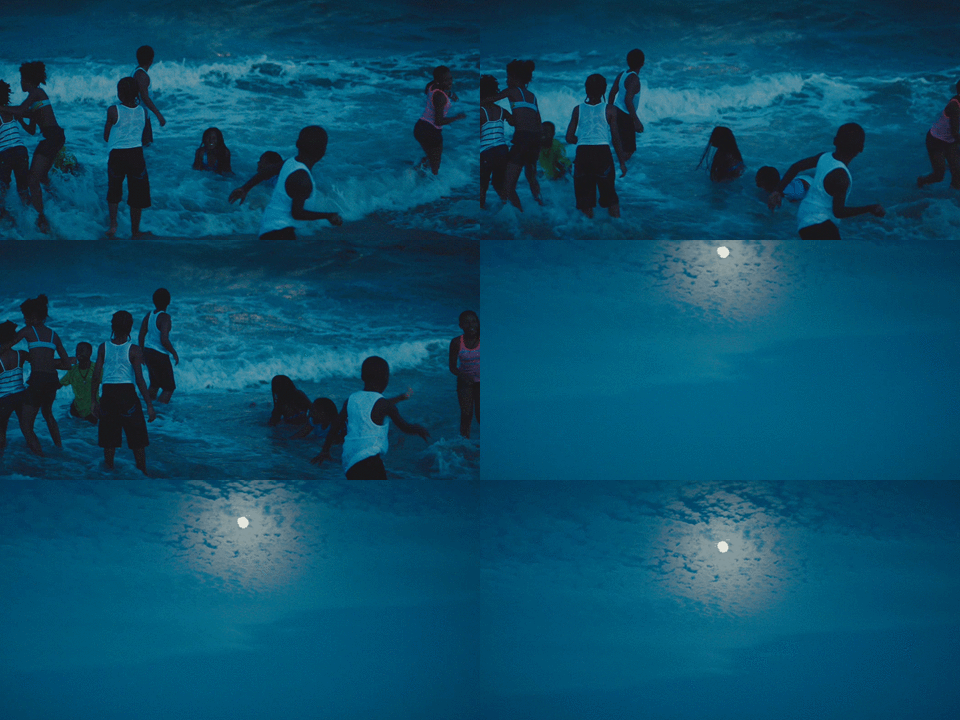
“waves and shadows,” image by Flickr User Albatrail
For Spillers, then, it is essential to trace this misnaming and undifferentiation of black women to the physical and psychic conditions of the Middle Passage. When Freud begins Civilization and Its Discontents, he notes an “oceanic feeling” engendered by religion. The oceanic is the longing for return to a pre-subjective state where one is united with all that is, before the cut that is birth and then language (indeed, the oceanic feeling is often attributed to song). Spillers’ move is to read the oceanic literally and structurally at once: there is the Atlantic Ocean and its Middle Passage. The oceanic, in this way, is de-subjectivating; it casts the subject out of itself in a terror of undifferentiation that does not cease with landfall.
But Spillers also implies that, in that (sexual) undifferentiation, a radical political potential can be retrieved. It is not that black feminism retrieves for her a sexual differentiation after becoming an ambiguous thing. It would not be “woman” in any traditional sense, for that New World category rests upon the violence Spillers seeks to describe. Above all, it would not be easy to name.
Du Bois certainly takes up the Father in his poetic epigraphs. But in ending with the Bantu woman’s song—as it seems to anatomize all of the other songs he describes—Du Bois upholds himself as being named by the maternal line. He is unable or perhaps unwilling to make a clarified place for a black female political agent. If we listen with ear’s pricked, we find that she is the submerged, oceanic condition for his speech.

By way of an open-ended conclusion, we can recall the sound of the ocean that punctuates Jenkin’s stunningly lyrical and psychologically complex coming-of-age film, Moonlight. The ocean provides the anchoring location for the psychological action, but also its aesthetic locus, the beginnings of its cinematic language. The sound of the ocean continually marks a desire for “return” to maternal undifferentiation and oneness, and yet, it provides the space for two embodied memories that cannot be compassed by traumatic separation. In the first, a father-like figure, Juan, embraces a young boy, Little, to allow him to float in a nearly baptismal scene of second birth, and in a second scene at the shore, Little experiences with his friend, Kevin, sexual gratification, a coming into his body as a site of pleasure.
The conclusion of the film posits these moments as being in the past. We had experienced them as contemporary, but only later realize they are a well of memory for a now-adult subject who does not know himself. I want to focus, then, on the film’s conclusion, after Kevin and Little (now named Black, his adult re-renaming), meet again after many years. Kevin calls Little/Black on the phone, a defining gesture of reaching out erotically and acousmatically with voices. We later learn that he calls because Kevin has heard an old song that reminded of him of his lost friend. By this voice or call, Black is brought somewhere back to his moment of break to become Little again, as if something in the past must be recuperated for the present. As he drives down the open road to find Kevin, the music of Caetano Veloso soars.
We can’t be sure if this is extra-diegetic or diegetic music. To be sure, Black would never listen to such a song on his stereo. And yet, the song seems to emanate directly from its affective space. In the language of literature, it is a “free-indirect style,” part character and part author; the film is hearing Black/Little feel. He’s in a space of haunting melody, drenched in personal memory, whose principle scene had been the Florida shore, the ocean lapping providing a (maternal) containing motif for the film, now transmuted into song.
The oceanic, Spillers might remind us, is violent, echoing the passages that made it possible for these two black boys to be there. But the sound is also amniotic, a space of maternal longing, particularly for a character who, in Bradley’s estimation, is positioned as pathological, injured by the missing mother who is, in turn, indicted by the film’s imaginary. To some extent, Moonlight participates in the mother’s misnaming: it cannot see the structures that ensure her lostness. But the film does also push towards some mode of melancholia that, as Michael B. Gillespie argues of Jenkins’ earlier work, would cease to be depressive. Jenkins’ aesthetic practice is transformative, Gillespie suggesting that we use Flatley’s term, “antidepressive melancholia,” as it’s with a stake in the personal past but turned towards the collective future (106).

When the two boys, now men, meet again, several sounds punctuate the scene. They are not words or even phonemes, yet “speak” to provide a sonic geography of feeling that includes or “holds” the viewer, as Ashon Crawley might suggest. Among them is the sound of the bell on the door, which marks hello and goodbye, entry and exit, coming and going (or “fort-da” in Freud’s lexicon). When Black enters the diner, he is still “Black.” It is only when remembering what happened at the shore, then to say that no man has touched him since, that he becomes Little. He discloses this truth on behalf of a potential in present and a still-nascent future. Kevin cooks for Black, and Jenkins’ is careful to amplify the sound of the spoon stirring. He provides for Black, the film locating Kevin, a male, within the coordinates of maternal care. The sonic crux of the scene—no longer primal, no longer traumatic—is when Kevin plays the song on the jukebox that had drawn him to call to Little/Black in the first place. “Hello, stranger,” Barbara Lewis croons, “it seems like a mighty long time. Shoo bop shoo bop, my baby, ooooo.”
In listening to a song that is from our past, Newtonian time collapses, a shock running from past to present. The film never discloses whether these two had once heard this song together before. It is more likely that its affective map impacts Kevin, that he hears in its melancholic sound a nascence, and with it, a longing to retrieve his own past and repair. Lewis herself, singing in the sixties, is a recalling an already eclipsed fifties doo-wop. The phonemes circle back to their beginnings in “Do ba- na co-ba.” Such sounds are to be opposed to the shot of Little’s mother yelling at him (presumably a slur). There, the sound had cut out of the scene, which recurs for Little in a traumatic nightmare.
In contrast to that violent naming, the boys’ intimacy was defined by, to use Kevin Quashie’s term, “quiet,” a sense of interiority Michael Gillespie explores in his analysis of Jenkins’ first feature film, Medicine for Melancholy. Shakira Holt and Chris Chien called this dynamic in Chiron and Juan’s relationship “silence as a form of intimate conversance” in their 2017 post about Moonlight. There is a queer intimacy revived apart from trauma, triangulated by a black woman’s voice, paired with male harmonies, that resonate acousmatically from the jukebox to hold and contain the scene. For psychoanalytic theories of voice, containment is the essential maternal gesture of song.
We begin to wonder what might be possible for the feminine were it to be separated from the maternal dimension, a potential that Jenkins does not explore in this particular film in his oeuvre (as he does in Medicine for Melancholy, for example); each of the women in Moonlight “mother” to some extent. Nonetheless, he disperses the maternal function across male and female subjects, particularly in moments when the film resists depression. In listening with ears pricked, as with Du Bois’ epigraphs, the voices cease to belong to an individual, to be male voices or female voices, but become plural and pluralistic. It becomes possible to ground a politics of listening to the past for remaking in the present in that sound.

—
I would like to thank Michael B. Gillespie, Amanda Holmes, and Jennifer Stoever for their incredible scholarly assistance and comments in writing this essay trilogy.
—
Julie Beth Napolin is Assistant Professor of Literary Studies at The New School, a musician, and radio producer. She received a PhD in Rhetoric from the University of California, Berkeley. Her work participates in the fields of sound studies, literary modernism and aesthetic philosophy, asking what practices and philosophies of listening can tell us about the novel as form. She served as Associate Editor of Digital Yoknapatawpha and is writing a book manuscript on listening, race, and memory in the works of Conrad, Du Bois, and Faulkner titled The Fact of Resonance. Her work has appeared in qui parle, Fifty Years After Faulkner (ed. Jay Watson and Ann Abadie), and Vibratory Modernism (ed. Shelley Trower and Anthony Enns).
—
 REWIND! . . .If you liked this post, you may also dig:
Moonlight’s Orchestral Manoeuvers: A duet by Shakira Holt and Christopher Chien
“A Sinister Resonance”: Joseph Conrad’s Malay Ear and Auditory Cultural Studies–Julie Beth Napolin
“Scenes of Subjection: Women’s Voices Narrating Black Death“–Julie Beth Napolin
Share this:

“Most pleasant to the ear”: W. E. B. Du Bois’s Itinerant Intellectual Soundscapes
Inspired by the recent Black Perspectives “W.E.B. Du Bois @ 150” Online Forum, SO!’s “W.E.B. Du Bois at 150” amplifies the commemoration of the occasion of the 150th anniversary of Du Bois’s birth in 2018 by examining his all-too-often and all-too-long unacknowledged role in developing, furthering, challenging, and shaping what we now know as “sound studies.”
It has been an abundant decade-plus (!!!) since Alexander Weheliye’s Phonographies “link[ed] the formal structure of W.E.B. Du Bois’s The Souls of Black Folk to the contemporary mixing practices of DJs” (13) and we want to know how folks have thought about and listened with Du Bois in their work in the intervening years. How does Du Bois as DJ remix both the historiography and the contemporary praxis of sound studies? How does attention to Du Bois’s theories of race and sound encourage us to challenge the ways in which white supremacy has historically shaped American institutions, sensory orientations, and fields of study? What new futures emerge when we listen to Du Bois as a thinker and agent of sound?
Over the next two months, we will be sharing work that reimagines sound studies with Du Bois at the center. Pieces by Phillip Luke Sinitiere, Kristin Moriah, Aaron Carter, Austin Richey, Julie Beth Napolin, and Vanessa Valdés, move us toward a decolonized understanding and history of sound studies, showing us how has Du Bois been urging us to attune ourselves to it.
Readers, today’s post by Phillip Luke Sinitere offers a wonderful introduction to W.E.B. Du Bois’s life’s work if he is new to you, and a finely-wrought analysis of what the sound of Du Bois’s voice–through first hand accounts and recordings–offers folks already well-acquainted.
–Jennifer Lynn Stoever and Liana Silva, Eds.
In her 1971 book His Day is Marching On: A Memoir of W. E. B. Du Bois, Shirley Graham Du Bois recalled about her late spouse’s public lectures that “everyone in that hall followed his words with close attention. Though he read from a manuscript replete with statistics and sociological measurements, he reached the hearts as well as the minds of his listeners.” Shirley’s memory about W. E. B.’s lectures invites reflection on the social and political significance of what I call his “itinerant intellectual soundscapes”—the spaces in which he spoke as an itinerant intellectual, a scholar who traveled annually on lecture tours to speak on the historical substance of contemporary events, including presentations annually during Negro History Week.
Yet Du Bois’s lectures took place within and across a soundscape he shared with an audience. In what follows, I center the sound of Du Bois’s voice literally and figuratively to 1) document his itinerant intellectual labor, 2) analyze how listeners responded to the soundscapes in which his speeches resided, and 3) explore what it means to listen to Du Bois in the present historical moment.
***
Upon completing a Ph.D. in history at Harvard in 1895, and thereafter working as a professor, author, and activist for the duration of his career until his death in 1963, Du Bois spent several months each year on lecture trips across the United States. As biographers and Du Bois scholars such as Nahum Chandler, David Levering Lewis, and Shawn Leigh Alexander document, international excursions to Japan in the 1930s included public speeches. Du Bois also lectured in China during a global tour he took in the late 1950s.
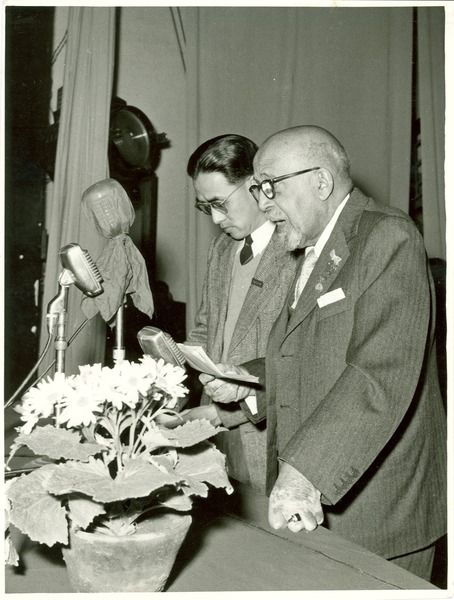
W. E. B. Du Bois delivering a speech in front of a microphone during trip to China, circa 1959, Courtesy of the Massachusetts Digital Commonwealth, physical image located in Special Collections and University Archives, University of Massachusetts Amherst Libraries
In his biographical writings, Lewis describes the “clipped tones” of Du Bois’s voice and the “clipped diction” in which he communicated, references to the accent acquired from his New England upbringing in Great Barrington, Massachusetts. Reporter Cedric Belfrage, editor of the National Guardian for which Du Bois wrote between the 1940s and 1960s, listened to the black scholar speak at numerous Guardian fundraisers. “On each occasion he said just what needed saying, without equivocation and with extraordinary eloquence,” Belfrage described. “The timbre of his public-address voice was as thrilling in its way as that of Robeson’s singing voice. He wrote and spoke like an Old Testament prophet.” George B. Murphy heard Du Bois speak when he was a high school student and later as a reporter in the 1950s; he recalled the “crisp, precise English of [Du Bois’s] finely modulated voice.”
One benefit of Du Bois’s long life was its intersection with technological advances in audio recording and amplification, the dynamics of which literary historian Jennifer Lynn Stoever insightfully narrates in The Sonic Color Line. This means that in 2018 we can literally listen to Du Bois’s voice; we can experience sonic dimensions of his intellect and sit with the verbal articulation of his ideas. For example, Smithsonian Folkways released two audio recordings of Du Bois: an April 1960 speech, “Socialism and the American Negro” he delivered in Wisconsin, and a 1961 oral history interview, including a full transcript. Furthermore, in his digitized UMass archive we can read the text of another 1960 speech, “Whither Now and Why” and listen to the audio of that March lecture.
The intersection of these historical artifacts texture understanding of the textual and aural facets of Du Bois’s work as an itinerant intellectual. They give voice to specific dimensions of his late career commitments to socialism and communism and unveil the language he used to communicate his ideas about economic democracy and political equality.
The act of hearing Du Bois took place within and across his itinerant intellectual soundscape was rarely a passive activity, an experience toward which Shirley’s comments above gesture. Those who attended Du Bois’s lectures often commented on listening to his presentations by connecting visual memories with auditory recollections and affective responses.
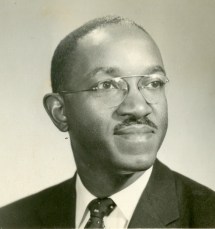
John Hope Franklin, 1950s, while Chair of Department of History at Brooklyn College, Courtesy of Duke University
For example, the late black historian John Hope Franklin penned an autobiographical reflection about his first encounter with Du Bois in Oklahoma in the 1920s at 11 years old. At an education convention with his mother, Franklin commented on Du Bois’s physical appearance: “I recall quite vividly . . . his coming to the stage, dressed in white tie and tails with a ribbon draped across his chest . . . the kind I later learned was presented by governments to persons who had made some outstanding contribution to the government or even humankind.” He then referenced a sonic memory. “I can also remember that voice, resonant and well modulated,” Franklin wrote, “speaking the lines he had written on note cards with a precision and cadence that was most pleasant to the ear . . . the impression he made on me was tremendous, and I would make every effort to hear him in the future wherever and whenever our paths crossed.” While Franklin did not remember the speech’s content, his auditory memories deliver a unique historical impression of the sound of Du Bois’s intellectual labor—a “resonant and well modulated” inspirational voice to which Franklin attributed his own career as an intellectual and historian.
A few years after the Oklahoma lecture, Du Bois gave a February 1927 presentation on interracial political solidarity in Denver during Negro History Week. Two audience members penned letters to him in response to his speech. A minister, A. A. Heist, told Du Bois that his encouragement for interracial work across the color line was bearing fruit through community race relation meetings. Attorney Thomas Campbell’s letter, like Heist’s, confirmed the speech’s positive reception; but it also revealed captivating details about the soundscape. Campbell described the lecture as a “great speech” and a “remarkable address.” “I have never heard you deliver such an eloquent, forceful and impressive speech,” he gushed, to an “appreciative and responsive audience.” Although the speech’s text does not survive, from correspondence we learn about its subject matter and receive details about the soundscape and positive listener responses to his spoken words.

NAACP Pres W.E.B. DuBois speaks Third Baptist Church 1958, San Francisco
The observations of Franklin, Heist, and Campbell collectively disclose pertinent historical, gendered, and racialized dimensions of listening to Du Bois. These historical documents convey what rhetoric scholar Justin Eckstein terms “sound ontology,” the multifaceted relationship between speakers, words, listeners, and the intellectual, cultural, and affective responses generated within such sonic settings. In other words, within the context of each speech’s delivery listeners heard Du Bois speak and felt his words which generated embodied responses. At the intersection of Franklin’s visual and aural memories is a well-dressed regal Du Bois, a male black leader whose presence in Tulsa a handful of years after a destructive race riot perhaps represented recovery and resurrection, whose words and voice commanded authority. Similarly, recollections of a leading lawyer in Denver’s early twentieth-century black community lauded Du Bois’s role in fostering interracial possibility. Campbell’s admission was important; it documents how a male race leader and key figure in one of the nation’s most important interracial organizations, the NAACP, inspired through an impactful, moving, and persuasive lecture collaborative conversations across the color line. Given Du Bois’s stature as a national and international scholar and intellectual leader, Franklin, Heist, and Campbell perhaps expected him to dispense wisdom from travel and study. Nevertheless, the historical record documents an interactive soundscape that emanated from Du Bois’s presence, his words, and the listening audience.
Ethel Ray Nance, a black educator and activist from Minnesota, first met Du Bois during the Harlem Renaissance. After she moved to Seattle in the 1940s, Nance helped to organize his west coast lecture tours and assisted with his United Nations work in 1945. Nance also assembled a memoir of her work with Du Bois, titled “A Man Most Himself.” Her reflections provide a unique personal perspective on Du Bois. She recalled meeting him at a reception held in his honor after a lecture in Minneapolis in the early 1920s. She described the larger soundscape of Du Bois’s lecture, especially how listeners responded to him. “The audience gave him complete attention,” she wrote, “they seemed to want him to go on and on. You could feel a certain strength being transmitted from speaker to listeners.”
Also in Minnesota, around the same time a young black college student named Anna Arnold Hedgeman heard Du Bois lecture at Hamline University. As she listened to a lecture on Pan-Africanism with “rapt attention,” Hedgeman wrote in her 1964 memoir The Trumpet Sounds, she noticed that Du Bois wore “a full dress suit as though he had been born in it” and commented that “his command of the English language was superb.” Hedgeman located her inspiration for a career in education and activism to hearing Du Bois speak. “This slim, elegant, thoughtful brown man had sent me scurrying to the library and I discovered his Souls of Black Folk,” she said.

W.E.B. Du Bois on a country road in his own car, 1925, Courtesy of the Massachusetts Digital Commonwealth, physical image located in Special Collections and University Archives, University of Massachusetts Amherst Libraries
Broadly speaking, the listener responses mentioned above capture dimensions of Du Bois’s public reception at arguably the mid-life pinnacle of his career. He was in his 50s during the 1920s, an established scholar, author, and black leader. Yet due to shifting national and international conditions related to capital, labor, and civil rights during the Great Depression and World War II, his politics moved further left. He settled more concretely on socialist solutions to capitalism’s failures. This position became increasingly unpopular as the Cold War dawned. People still listened to Du Bois, but with far more critical and dismissive dispositions.

Page from W.E.B. Du Bois’s voluminous FBI file
Peering further into the historical record, part of Du Bois’s verbal archive and audible history resides in his FBI file. Concerned about his leftist political leanings, the Bureau had surveilled Du Bois starting in the 1940s by reading his publications, and dispatching agents or informants to attend his lectures and speeches. As the Cold War commenced, scrutiny increased. Redacted reports communicated his movements throughout the world in 1960, including a speech at the Russian Embassy in Washington, D. C. when he received the Lenin Peace Prize, and an address he gave in Ghana at a dinner celebrating that nation’s recent independence in 1957. The FBI file states that he received “an ovation as he rose to make a statement” about world peace and a more equitable distribution of resources. Similarly, the report from Ghana relayed that in his address he outlined two divergent world systems, “the socialism of Karl Marx leading to communism, and private capitalism as developed by North America and Western Europe.”
The bureaucratic construction of FBI reports reveals less about the audibility of Du Bois’s voice. However, unlike the listener reports presented above, the technical nature of bureaucratic communications offer a great deal more about the content of his speeches and thus documents another sense in which people—presumably FBI agents or informants—heard or listened to Du Bois as part of their sonic surveillance.
Du Bois’s audible history invests new meaning into his work as a scholar and public intellectual. Through John Hope Franklin, Shirley Graham Du Bois, and Anna Arnold Hedgeman we “see” Du Bois lecturing and speaking, in effect the public presence of a scholar we tend to know more readily through the printed words of his publications. With Thomas Campbell and Ethel Ray Nance—and from a different vantage point his FBI files—we “feel” the power of Du Bois’s words and the affective experience of his verbal constructions. Whether found in historical documents or narrated through vivid descriptions of the “clipped” aspects of his voice’s literal sound, investigating Du Bois’s audible history innovatively humanizes a towering scholar mostly readily known through his published words.
Attending to the audible and archival records of his life and times, we not only encounter the sonic dimensions of his literal voice, we observe how ordinary people listened to him and responded to his ideas. Some embraced his perspectives while others, especially during the Cold War, denounced his socialist vision of the world. Yet this is where the redactions in the FBI files ironically speak loudest: Du Bois’s ideas persisted, and survived. Scholars and activists amplified his words and retooled his ideas in service of black liberation, social justice, and economic equality.
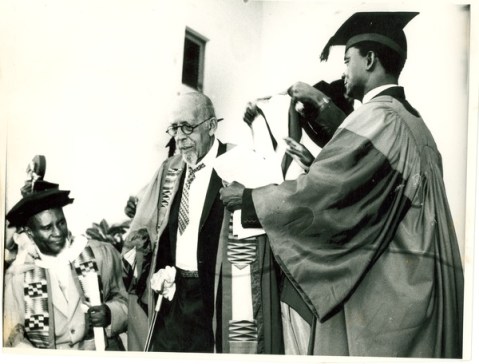
W.E.B. Du Bois receiving honorary degree on his 95th birthday, University of Ghana, Accra, 1963, February 23, 1963,Courtesy of the Massachusetts Digital Commonwealth, physical image located in Special Collections and University Archives, University of Massachusetts Amherst Libraries
By literally listening to and sitting with an audible Du Bois today there’s an opportunity to mobilize affect into action, a version of what Casey Boyle, James J. Brown, Jr. and Steph Ceraso call “transduction.” Du Bois’s voice digitized delivers rhetoric within yet beyond the computer screen. It (re)enters the world in a contemporary soundscape. Hearing his voice produces affect and thought; and thought provokes action or inspires creativity. Such a “mediation of meaning” shows that contemporary listeners inhabit a soundscape with Du Bois. Whether a scholar listens to Du Bois in an archive, students and teachers engage his voice in the classroom, or anyone privately at home leisurely tunes into his speeches, time, space, and place collectively determine how wide and expansive the Du Bois soundscape is. Advancements in communication, digital and sonic technologies mean that across whatever modality his voice moves there’s a sense in which Du Bois remains an itinerant intellectual.
—
Phillip Luke Sinitiere is a W. E. B. Du Bois Visiting Scholar at the University of Massachusetts Amherst in 2018-19. He is also Professor of History at the College of Biblical Studies, a predominately African American school located in Houston’s Mahatma Gandhi District. A scholar of American religious history and African American Studies, his books include Christians and the Color Line: Race and Religion after Divided by Faith (Oxford University Press, 2013); Protest and Propaganda: W. E. B. Du Bois, The Crisis, and American History (University of Missouri Press, 2014) and Salvation with a Smile: Joel Osteen, Lakewood Church, and American Christianity (New York University Press, 2015). Currently, he is at work on projects about W. E. B. Du Bois’s political and intellectual history, as well as a biography of twentieth-century writer James Baldwin. In 2019, Northwestern University Press will publish his next book, Citizen of the World: The Late Career and Legacy of W. E. B. Du Bois.
—
 REWIND! . . .If you liked this post, you may also dig:
Black Mourning, Black Movement(s): Savion Glover’s Dance for Amiri Baraka –Kristin Moriah
Saving Sound, Sounding Black, Voicing America: John Lomax and the Creation of the “American Voice”–Toniesha Taylor
The Sounds of Anti-Anti-Essentialism: Listening to Black Consciousness in the Classroom–Carter Mathes
“I Love to Praise His Name”: Shouting as Feminine Disruption, Public Ecstasy, and Audio-Visual Pleasure–Shakira Holt
Share this:


Current Top Posts





April 2021

January 2020

November 2019

October 2019

August 2019

April 2014

November 2017

March 2015

December 2017

October 2015
 Sounding Out!
Recent Comments