
Listening to the Border: “’2487’: Giving Voice in Diaspora” and the Sound Art of Luz María Sánchez

Statistics of death can startle a reader. As tidy yet powerful numeric representations statistics are often used as tools of persuasion, cited routinely by journalists and politicians alike to strengthen or belittle a political objective. According to professors from Wharton’s School of Business, statistics are also gaining in importance as our society attempts “to make sense of an increasingly large and complex barrage of information.” Many have argued, quite provocatively, of the gendered and racialized nature of statistics as objective, “hard,” facts. In “2487: Giving Voice in Diaspora,” the artist Luz María Sánchez uses sound-based art to trouble a statistic brought on by institutional violence on the U.S./Mexico border.
In 2006 Luz María Sánchez used a lone statistic from 2004 – 2487, the number of bodies found dead throughout the border region of the U.S. and Mexico – to create a sound-based art installation for the San Antonio Artpace (now available as an online exhibit). The museum invited audiences to sit in sparsely furnished rooms with strategically placed speakers in order to experience the exhibition. The online access, however; makes certain the exhibit travels beyond the geographical boundaries of Texas, bellowing from the private devices of laptops. Seemingly simple, the crux of the project involves the artist stating each of the 2487 names. Its complexity, as mentioned below, lies in the actual organization of the names. The voice of Luz María Sánchez within this artistic expression reminds us, as Brandon LaBelle states, that sound “leaves a body and enters others” and is never merely a “private affair.” The use of sound forces spectators to listen closely to a statistic and in doing so, directs attention towards the parts of the sum.
The topic of immigration has become a staple of news network channels. Its somewhat mundane presence has served to lump immigrants together into one sound bite: “them” sapping social services; “them” taking away our jobs; or “them” having those anchor babies. The reporting of immigrants as a block serves to dehumanize and delegitimize intentions of family reunification held by many immigrants. Indirectly, “2487” tackles the verbal “them” head on.
Buried within discussions of immigration policy and arguments for increased border enforcement on the U.S./Mexico border are the statistics of those who have died crossing the treacherous dry desert. A series of shifts in immigration policy and increasingly anti-immigrant public sentiment have produced record setting budgets that intensified efforts to beef up border control. The once urban points of crossing in Tijuana or Juarez are now heavily discouraged; the visual yellow and black warning of a family running an insignia of those times. Many immigrants take greater risks as they walk through the Sonoran desert in southern Arizona, now considered the busiest gateway for immigrants where temperatures easily mount well into the 100s.
Within 2487, it is not merely the statistic that serves to astound, it’s the ingenuous yet powerful act of listening to the full name of each body that can engulf the listener.
José Salomon López
Francisco Torres Santiago
Leticia Torres Solis
Adolfo Sánchez
Enrique Soto Pacheco
Guadalupe Valdez Sandoval
Antonio Sánchez Morales
Juan Antonio Sánchez Reyes
Patricia Trinidad
Narrated by the artist herself, each name is voiced individually with a dignified, strong tenor. The text itself – the names – mark this sound piece as solemn. It’s as if one is listening to an obituary read out loud, a roll call with no response, or – a tradition many Latinos identify with – a rosary in honor of the dead. Despite studies that explain a Latina’s public wail as a sign of pain and grief, this piece in its parallel focus of honoring the dead stands out as the artist’s female voice never quivers, trembles, or abandons its strength. In naming each person, listeners may not necessarily focus on their death – represented numerically in 2487 – but may also find themselves imagining their risk as they hear each name. Under the website’s database tab, lies a detailed chart of each name, the location of their body, presumable age, known origin, and the cause of death. Many of the columns are listed with a tag of “unknown” or left blank except for their names.
It’s a forced, almost-awkward, tension-laden, and heavy listening experience. Sánchez makes certain that any semblance of passive listening is disrupted, disturbed, and therefore nearly impossible since the names voiced do not follow a pattern or rhythm. The eight piece sound compilation offers no sense of monotony since it is played continuously and at random. Pauses are sometimes short, long, pensive, and altogether distressing. Names are voiced either in isolation or in an overlapping manner, said to model the “organic patterns of migration itself”; an audible gesture towards the word “diaspora” itself. Because of the deliberate variation of the names, the listener can make out the names of some yet not detect the names of others.

Even as Sánchez gives voice and dignity to a statistic based on dead bodies, the topic of death certainly is not easy to translate. Regina Marchi’s “Day of the Dead in the USA” argues that the public commemoration of death by Latino communities has slowly begun to transform American Culture’s views of death. According to Marchi, Americans tend to be “removed from death” or lack positive modes of relating to those deceased. A popular case in point is the plethora of euphemisms used to characterized death: moved on, no longer with us, watching over us now, passed away. Día de los Muertos or Day of the Dead (on November 1) has become a multicultural method of publically viewing and even embodying death as different communities construct altars, dress as the dead, and openly pay tribute to those who have died. The use of art galleries, the mass media, and community centers have become public venues for these celebrations since their inception by Chicano artists in 1972.
Despite, or (perhaps more precisely) because, honoring the dead is so frequently a visual custom these sonic remembrances are that much more significant. A politicized eulogy for immigrants who have died while crossing the border merits the weight of listening. The 2487 statistic encompasses two thousand and eighty seven bodies and each, according to Luz María Sánchez, had a name that deserves our listening attention.
by Dolores Inés Casillas, UCSB
Share this:

“Take ‘Em to Chuch”: OutKast and the Sounds of the Southern Black Church
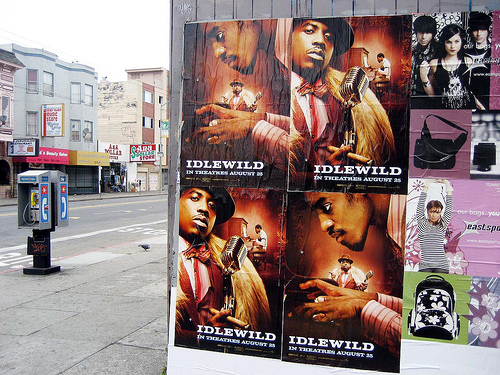
Advertising for Outkast
In 2006, I ventured into Hoosier Country. I found myself in the middle of…nowhere. And I was depressed. No, not because I decided to move to Indiana all by my lonesome on a huge leap of faith to pursue a graduate degree – I was too smooth for that – but because I found myself in a town where I couldn’t watch Outkast’s debut film Idlewild. Where they do that at? I am a Southern-bred, Southern-fed kinda girl. And Outkast was my muse. Hell, as a certified Down South Georgia Girl, all things Georgian were my muse. I planted my feet in red clay. My soundtrack was Organized Noise, the production team and heavy hitters that worked with OutKast, Goodie Mob, and a slew of other folks out of a rinky dink house basement that would later become known as the Dungeon (Family). I took pride in being from the Dungeon. And here I was, hundreds of miles away, frantically trying to find a theatre that would, if only for a brief 90 minutes, thrust me back into that familiarity of Southern life.
Of course, OutKast (comprised of members Andre Benjamin and Antwan “Big Boi” Patton) is hardly considered strictly Southern today. However, their 1994 release Southernplayalisticadillacmuzik shattered perceptions that Southern Rap was an oxymoron. In fact, OutKast’s initial sound updated tropes of southern black resistance and retaliation, fusing a lethal mastery of lyricism and flecks of a contemporary Southern culture too easily dismissed by non-Southerners. Calling upon and subverting the stereotypical traits of the Southern black voice – drawn out, slow, and heavy – OutKast sets up shop in hip hop by showcasing a rich history of Southern flair and homegrown sounds. The album made this intervention at the precise moment when hip hop became much more accessible to a mainstream white American market and the idea of being “post-Civil Rights” gained cultural traction. Combining narratives of being young, black, and frustrated with a sonic backdrop that includes an instrumental arsenal of horns, harmonicas, organs, drums, and bass, OutKast challenged and reconfigured how Southernness, Americanness, and contemporary black experience sounded at the turn of the millenium. Their initial releases seem to pick up the question of what it means to be displaced, Southern, and black after the South settled from its liberatory movements, pulling from the voices, images, and music of Southern protest like the Freedom Singers or Sweet Honey in the Rock and fusing these sounds with hip hop.

Andre Benjamin Onstage in 2003, Photo by Tulane University Public Relations
In order to discuss how they challenge and reconfigure notions of Southerness, Americanness, and contemporary black experiences, we should look at their musical nods to the black church. OutKast draws heavily on the Southern black church through sermon-esque flow, call and response, and snatches of “chuch” (lose the ‘r’) music. The black church is a staple in OutKast’s sound, reflecting what Guthrie Ramsey refers to in Race Music as community theatre, a site where “cultural, communal, and family memories associated with forms like music often become standards against which many explore and create alternative and highly personal identities for themselves” (33). The Southern black church provides such a site for communal and collective memory not only in Outkast’s music, but in African American history. Celebrated and upheld as a site of refuge from an abrasive and openly racist white supremacist environment, the black church provided a safe haven for freedom of cultural expression and social commentary unavailable in Southern white public space and discourse. OutKast challenges this older, static definition by updating its purpose to reflect the shifting social climate of the late-20th century American South. While they continue the resistance narrative tradition by bringing their marginalized experience to the forefront, they also sonically reorient mainstream views of contemporary Southern black life.
Instantly recognizable across OutKast’s recordings, their funky blend of sacred and secular musics–the blues, gospel, and hip hop–give sonic texture to something quiet-as-its-kept in black churches, how the so-called “bad” folks still come to church on Sunday, even if they were unholy on Saturday night. OutKast plays upon this unspoken understanding in songs like “Jazzybelle” from 1997’s ATLiens, “B.O.B. (Bombs Over Baghdad)” from their 2000 release Stankonia, and the straightforward “Church” from SpeakerboXXX/The Love Below (2003).
A particularly striking instance is heard on “B.O.B.,” a song which brazenly discusses issues that are often reserved for closet prayer and silent suffering. As Andre weaves a lyrical assault on the poor conditions of living in the black working class:
One-Nine-Nine-Nine, Ano Domini, anything goes, be whatchu wanna be
Long as you know consequences are given for livin – the fence is
too high to jump in jail
Too low to dig, I might just touch hell – HOT!
Get a life, now they gon’ sell
Then I might cast you a spell, look at what came in the mail
A scale and some Arm and Hammer, slow grow grid and a baby mama
Black Cadillac and a pack of pampers
Stack of question with no answers
Cure for cancer, cure for AIDS
Make a nigga wanna stay on tour for days
Get back home, things are wrong
Well not really, it was bad all along
Andre rhymes across an instrumental blend of bass and the church organ, inundating his listener’s ear with agency and anger. The church organ is as angry and explosive as his flow, with riffs and keys banged out loudly, quite different from the soft accompaniment often heard in a church setting. By heavily utilizing the organ and church choir at the end of the track, chanting “Bible music electric revival” OutKast subverts and updates the celebrated Black Church Revival, a gathering of church folk and the lost, swinging church music to give a voice to the marginalized black working class. The hybrid, urban sound of “B.O.B.” provides a space for the reclamation of a disenfranchised southern African American narrative that blends the suffering trope mandating much of African American religion with current trends in cultural expression reflected in Hip Hop. In Idlewild (which I FINALLY saw a year later, by the way), Andre and Big Boi visually annotate their secularized black church by creating an imagined community in rural Georgia that revolved around the jukejoint Church. OutKast’s audio-visual syncretism paved the way for later acts like Pastor Troy, who secularizes tropes of black masculinity and leadership in the black church, likening them to the struggles of being at war with those who don’t understand the struggles of a young black south.
The black church provides OutKast with a blueprint for reconciling displacement and authenticity by creating a sound that maneuvered a Post-Civil Rights landscape of shifting markers of social-economic identities and race. By connecting the historical context of the Southern black church with Hip Hop, OutKast’s sound reflects not only the historical residue of a pre-Civil Rights Movement South but also the constant search for a space of expression in an era where a stagnant or nonexistent “modern South” is a popularly comfortable disbelief. Perhaps this is why I was so desperate to find a theatre showing Idlewild; I found myself a geographically displaced Southern black youth searching to situate and sustain a new layer of my own post-Civil Rights narrative.


Share this:


Current Top Posts





April 2021

January 2020

November 2019

October 2019

August 2019

April 2014

November 2017

March 2015

December 2017

October 2015
 Sounding Out!
Recent Comments