
SO! Amplifies: An Interactive Map of Music as Ukrainian Resistance to the 2022 Russian Invasion
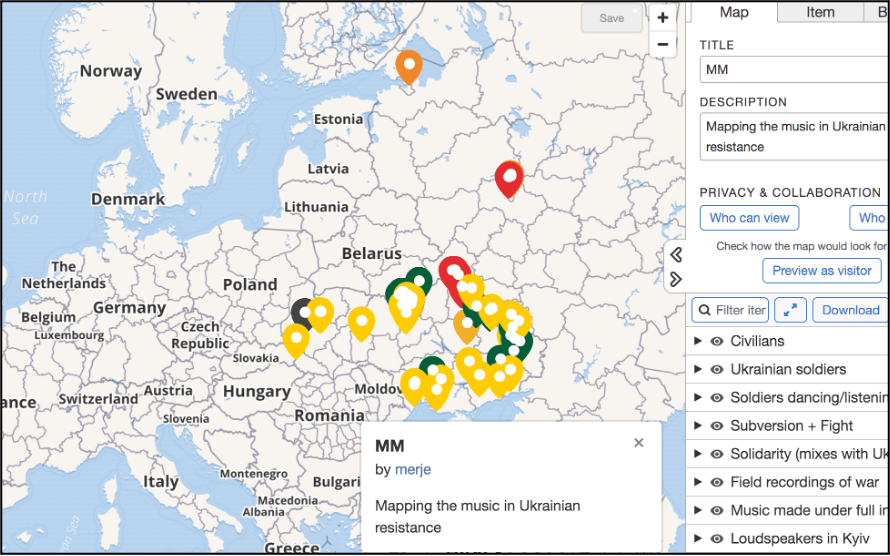
https://maphub.net/merje/mm

SO! Amplifies. . .a highly-curated, rolling mini-post series by which we editors hip you to cultural makers and organizations doing work we really really dig. You’re welcome!
—
BONUS POST: Directly following Merje’s introduction to her music mapping project, SO! has also published is her analysis of the observational research she conducted during the first 55 days of the 2022 Russian invasion of Ukraine, drawing from the collection of videographic material from online sources she embedded on this public interactive map. To go directly to that post, click here.
As an Estonian national, I have a regional interest in the relationship between music and cultural identity in Eastern Europe. Popular music has been foundational in building and sustaining Estonian national identity, through the Song Festival tradition which started in 1869, and the Singing Revolution at the end of the 1980s. In the Baltic states, Poland and Ukraine, there are similarities in how music has facilitated resistance to an oppressive regime or invasion.
While other cultural forms can articulate and show off shared values, only music can offer the immediate experience of collective identity (Frith 2007, 264). Looking into the sensitive representation of music in conflict, therefore, is about exercising hapticity with the precarity and suffering in the videos, and ultimately a work of not only academic, but affective labour.
The map format helps visualise the video evidence as it continues to appear in different parts of Ukraine. For accurate analysis, understanding the context, region, and the phase of war in which a musical event originates, is vital. In different parts of the country on the same date, one city can embody a collective feeling of resistance, while the other grief. The map is useful in analysing regional differences in the types of songs performed, and in ‘placing’ the international cases of solidarity. I decided to map the solidarity mixes that directly engage with the musical footage from Ukraine, and to exclude the high number of global fundraising concerts. All map entries depict in some way the role of music in Ukrainian resistance.
The map function is made redundant in posts where the location should not be disclosed for safety reasons, such as this video of soldier Yuriy Gorodetsky performing ‘How Can’t I Love You, My Kyiv’ in a military camp. Additionally, I decided not to embed posts that could inform the Russian military of civilian and humanitarian targets, for example a video from Lviv showing the Philharmonic concert space being used for humanitarian storage.
The focus has been on mapping songs and music, rather than the wider soundscape of war, although sounds such as air raid sirens do appear in some videos. The map includes sections on recorded music, such as this wartime ska track by Mandry, field recordings, and ways in which music has been used in online warfare. Most map entries fall under the civilian resistance category, exploring the following questions:
- What kind of music appears in this resistance? In terms of genre, is it folk, rock, hip hop, or national patriotic song? Is it Ukrainian or ‘Western’? How do the different examples embody national feeling and safeguarding of a culture?
- What is the power of these musical moments, for the artists, for Ukrainians, and for the world? What can music achieve in a conflict environment, and how does it evoke moments of solidarity?
- How does the music reflect the different phases and emotions of the war, from mobilisation, resistance, support, contemplation, to grief?
Similar research questions have been posed by Arve Hansen et al. in A War of Songs (2019) about the 2013-14 Euromaidan protests, in which music carried much of the revolutionary feeling. Adriana Helbig wrote about the Orange Revolution of 2004-05 in Hip Hop Ukraine: Music, Race, and African Migration when the Internet played a huge role in circulating political messages through music, especially as Ukraine’s media was controlled by president Yanukovich (2014). Maria Sonevytsky’s Wild Music (2019) looks at both revolutions and the vernacular Ukrainian discourses of ‘wildness’ as they manifested in popular music during this politically volatile decade.
When looking at Ukraine, we are studying a repeatedly colonised region, where, as part of the former Russian Empire, serfdom was abolished in 1861. Ethnographic research and promotion of a national culture in the decades that followed led to a brief window of independence for Ukraine in 1917, only to be occupied and incorporated into the Soviet Union as the Ukrainian Soviet Socialist Republic in the same year. Unlike Poland and the Baltic states, Ukraine was not independent between the two world wars, which adds depth to Soviet propaganda that permeated the region throughout the 20th century – important context to consider when analysing its struggle for autonomy.

Drawing from Parkes, the relationships of domination and subordination are particularly marked and articulated through music in colonised groups (Parkes 1994). Often, Ukraine is portrayed as a country of two opposing regions: the pro-European West and the pro-Russian East. While there have been two sides opposed to each other since the 2014 Crimean occupation, the linguistic, ethnic, historical and religious divisions in Ukraine cannot neatly fit into this East-West dichotomy. In addition to complicated ethnic boundaries that define and maintain the region’s cultural identities, Ukraine is dealing with a post-colonial struggle to protect its independence from imperialist Russia.
The ‘places’ constructed through Ukrainian music embody these complex issues, notions of difference and social boundaries – the very reason why music is socially meaningful: it provides means by which people recognise identities, places and the boundaries which separate them (Stokes 1994). In a war situation, beyond political and social alliances, we are also looking at music as survival (Stokes 2020).
—
Merje Laiapea is a curator, artistic programmer and writer working across sound, music and film. She is completing her Master’s in Global Creative and Cultural Industries in the Music Department at SOAS, University of London. Within the broad realm of music and cultural identity, her research interests include the expressive power of the sound-image relationship, forms of frequency, and multimodal approaches to research itself. She assists with event production and community engagement at SOAS Concert Series and works as Submissions Advisor for the 2022 Film Africa festival. Merje also broadcasts the occasional radio show and DJ mix. To find out more about Merje’s motivation behind the project, click here to read an interview by the University of London.
—

REWIND!…If you liked this post, you may also dig this:
Mapping the Music in Ukraine’s Resistance to the 2022 Russian Invasion–Merje Laiapea
SO! Amplifies: Wu Tsang’s Anthem (2021)—Freddie Cruz Nowell
SO! Amplifies: Marginalized Sound—Radio for All–J. Diaz
SO! Amplifies: Die Jim Crow Record Label
SO! Amplifies: Cities and Memory–Stuart Fowkes
Share this:

A Feast of Silence: Listening as Stoic Practice

In honor of International Podcast Day on 30 September, Sounding Out! brings you Pod-Tember (and Pod-Tober too, actually, now that we’re bi-weekly) a series of posts exploring different facets of the audio art of the podcast, which we have been putting into those earbuds since 2011. Enjoy! –JS
Zeno of Citium, the Hellenistic philosopher who founded the Stoic school at the turn of the third century BCE, once had this advice to give to a garrulous young man: “the reason why we have two ears and only one mouth is so that we might listen more and talk less.” The more we speak, Zeno was saying, the more self-absorbed and foolish we become; in learning to listen, we temper our own egos and attune ourselves to the truths of the world around us.
This piece of wisdom from a 2,300-year-old philosophy was a part of the marketer and best-selling author Ryan Holiday’s reflection on stillness and silence on the October 4 edition of his Daily Stoic podcast, a daily affirmational that brings listeners “a meditation inspired by the ancient Stoics illustrated with stories from history, current events, and literature to help you be better at what you do.” In citing Zeno, Holiday’s point was that while our highly mediated culture often rewards loudness, extroversion, and “hot takes,” we might do better to listen, and learn from others, rather than simply talk over them.
Over the past decade, Stoicism, which teaches that self-discipline, moderation, and emotional equanimity are key to overcoming hardship and living a good life, has had something of a revival as a self-help paradigm – and Holiday has been one of its most energetic evangelists. Articles in Vice, the New York Times, the Atlantic, the New Yorker, the Guardian, Forbes, Wired, and Sports Illustrated have all taken note of his influence among Silicon Valley tech workers, corporate executives, professional athletes, military personnel, and celebrities to whom he markets the philosophy as a “life-hack”; his six best-selling books on the subject, meanwhile, have positioned him as perhaps the most commercially successful author in a mushrooming genre of Stoic literature; and The Daily Stoic’s A-level guest list, which has included Malcom Gladwell, Camilla Cabello, Matthew McConaughey, and Charlamagne Tha God, has established Stoicism’s cultural cachet as a practical guide for living, and positioned Holiday as its authoritative interpreter.
Among the lessons Holiday draws from Stoicism, the practice of stillness (as his 2019 book puts it) is key: a way of quieting the mind, of “hear[ing] only what needs to be heard,” and really listening to the truth of the world in order to achieve the kind of tranquility (what the Greeks called apatheia) that will help us “think well, work well, and be well.”

With this emphasis on stillness, silence, and listening, it would seem quite appropriate that Holiday would turn to the aural medium of podcasting to proclaim the ancient wisdoms of Zeno, Cleanthes, Seneca, Epictetus, and Marcus Aurelius. Indeed, for the Stoics, listening was a foundational skill through which one cultivated the habits of discipline, self-control, and self-reflection that are the heart of the Stoic way of life (askesis); for it is in quieting ourselves and listening that we begin to open ourselves to the teachings of the masters and think about their application in our own lives.
And Holiday is hardly the only Stoic podcaster. As I write this, a simple search on Stitcher yields over 30 podcasts with “Stoicism” in their titles or descriptions, many of which have been updated in the past month (December, 2021), including the philosopher Massimo Pigliucci’s Stoic Meditations, Stoicism Discovery, Stoicism on Fire, The Sunday Stoic, The Stoic Handbook, The Walled Garden, Stoic Coffee Break, and Stoic Solutions.
Elsewhere, Stoicism has been promoted by self-improvement podcasters like the tech investor and lifestyle guru Tim Ferriss,and retired Navy SEAL and leadership coach Jocko Willink; and – perhaps unsurprisingly, given that the ancient Stoics were white men who emphasized values like rationality and self-mastery, which are typically coded as male – it has been advocated as a tactic for modern living by masculinity podcasters like Brett McKay and Ryan Michler.
Navigating this space can often feel like a small world (or, perhaps a promotional circuit): Holiday has been a guest on The Tim Ferriss Show, The Art of Manliness, and Order of Man, and has hosted Willink, McKay, and Ferriss on The Daily Stoic.
A full exploration of this network is outside my scope here. For now, I will consider the ways in which podcasting is particularly well-suited to Stoic askesis; and specifically, how the very act of listening – on our commutes, on long drives, at the gym, on hikes, and in moments of quiet meditation – constitutes what Michel Foucault (who himself drew upon Stoic texts in his later work on ethics) called a technology of the self: those techniques, “which permit individuals to effect by their own means or with the help of others a certain number of operations on their own bodies and souls, thoughts, conduct, and way of being, so as to transform themselves in order to attain a certain state of happiness, purity, wisdom, perfection, or immortality.”
Part of a larger project investigating the historical emergence of discourses of sex and sexuality in Western culture, Foucault in his later writings and lectures turned his attention away from the normative and disciplinary systems of subjectivation that had previously concerned him, and toward the study of ethical modalities by which individuals actively fashioned their own subjectivity. Focusing particularly on the ethical practices of the ancient world, he discovered a more autonomous framework for individual conduct, one that centered on self-imposed standards and daily habits rather than a prescribed moral code.
This precept of the “care of the self” (epimeleia heatou), Foucault maintained, could be traced from Alcibiades to the Imperial period, and had impelled individual Greeks and Romans (the free white men, at least) to embark upon their own stylized projects of self-transformation.
Among the practices that interested Foucault – and indeed, the one he understood to be essential to the “subjectivation of true discourse” – was the act of listening. In the first hour of his March 3, 1982 lecture at the Collège de France (published in English in The Hermeneutics of the Subject), for example, Foucault explained that listening is
the first move in as[k]esis … since listening, in a culture which you know was fundamentally oral, is what enables us to take in the logos, to take in what is said that is true. However, if conducted properly, listening also makes it possible for the individual to be convinced of the truth spoken to him, of the truth he encounters in the logos. And, finally, listening is the first moment of the process by which the truth which has been heard, listened to, and properly taken in, sinks into the subject so to speak, becomes embedded in him and begins to become suus (to become his own) and thus forms the matrix for ethos (p. 332).
This emphasis on listening, Foucault noted, is evident as far back as the Pythagoreans, who required initiates to spend five years in silence so as to be able to learn the community’s exercises, practices, and philosophical precepts. The themes of silence and listening were further developed in the culture dominated by Stoicism, Foucault noted, and emerged as a “new pedagogical game” that contrasted with the earlier dialogic model. Now, the master spoke, and the student listened.
But the nature of audition could be somewhat ambiguous for the ancients, Foucault explained, in that it was a passive (pathetikos) activity, yet it is the primary sense through which we receive the logos, the rational substance that the Stoics believed to govern the universe. In his treatise On Listening, for instance, Plutarch (46 CE – c. 116CE) wrote that it was imperative for young men cultivate the art of listening because they must learn to listen to the logos throughout adulthood, and so must learn to distinguish truth from the artifices of flattery or rhetoric. One must listen to the words of the master attentively, so that the logos might penetrate the soul. “The man who has the habit of listening with restraint and respect,” Plutarch wrote, “takes in and masters a useful discourse, and more readily sees through and detects a useless or false one, showing himself thus to be a lover of truth and not a lover of disputation” (On Listening, IV).

Perhaps the most striking of the texts Foucault discussed, however (see The Hermeneutics of the Subject, pp. 343-344), is Philo of Alexandria’s (20 BCE – c. 50 CE) description of the practices of the Therapeutae, a closed community of ascetics who renounced their earthly possessions in order to pursue “perfect happiness,” and the salvation of their soul (De Vita Contemplativa, §12). In his text, Philo takes specific note of the group’s elaborate banquet rituals, during which an elder comes to the fore and gives a discourse on philosophical doctrine or on sacred scripture (“teaching very slowly, lingering and emphasizing with repetitions, engraving the thoughts on the souls” [§76]). During these talks, the audience remained silent and motionless, adopting a precisely prescribed posture intended to fix their attention on the speaker, so that the discourse “does not stay on the tips of the ears, but comes through the hearing to the soul and there remains securely (§31).” In these feasts of silence, mastery of the body is the foundation of the care of the soul.
Though modern Stoic podcasting does not demand nearly this level of physical discipline of its listeners, we are nevertheless encouraged to incorporate podcasting into a daily ritual of silence and reflection – a new, digital feast of silence. As we listen through our headphones, in our cars, or in some other quiet personal space, we are joined in intimate connection with our hosts, who guide us in our contemplation of timeless Stoic wisdoms, engraving these thoughts in our minds so that we might have them ready at hand in order, as Holiday often says, to make them the principle of our actions.
It is this possibility of principled living that is perhaps at the heart of Stoicism’s twenty-first century appeal. As Elizabeth J. Peterson has written, in our age of seemingly perpetual crisis, Stoicism’s resurgence is undoubtedly due to its reputation as a practical guide for surviving difficult times. “Between President Trump, Brexit, the Middle East and the domestic issues in virtually every country,” she writes, “it’s not difficult to see why many people, across the world, need a source of clarity, calm, and fortitude.” (And that was before the pandemic, which occasioned a spate of articles explaining how Stoicism might help us endure a moment of profound uncertainty).
But the headlines aren’t the only source of our anxieties; we have plenty of it in our own lives. At a time of deepening economic precarity, in which we are routinely urged to become self-reliant, self-enterprising subjects in order to maximize our value in the marketplace, Stoicism offers a ready-made coping mechanism with a pedigree of centuries: at once a framework for cultivating emotional resilience, and a self-help paradigm for transforming ourselves into more disciplined, effective, and successful individuals.

When co-opted by late capitalist culture, when marketed as a “life-hack” and configured as an ethics of personal success, then, Stoic principles quite easily align with neoliberal imperatives that we endlessly labor on ourselves in order to better compete in an agonistic struggle for personal fulfillment and economic security. From this perspective, even the advice that we embrace stillness becomes a way of momentarily refreshing ourselves, only to return to work to “persevere” and “succeed.”
One of the most trenchant critiques of Stoicism is that by advising us not to concern ourselves with that which we cannot control (see Epictetus, The Discourses, 2.5.4-5), it is fundamentally a philosophy for living in the world as it exists, and not for challenging it (indeed, Stoicism’s popularity among the Roman elite indicates something of its congeniality with the established order). And while, as Sara Ahmed has written, “neoliberalism sweeps up too much when all forms of self-care become symptoms of neoliberalism,” it is nevertheless worth considering how an ostensibly self-directed ascetic practice is complicit in more hegemonic (neoliberal, patriarchal, and misogynistic) templates of subjectivity.
—
Featured Image: “Marcus Aurelius Headphone Stand!” by JM3is3D @Etsy. Image used for purposes of critique.
—
Andrew J. Salvati is an adjunct professor in the Media and Communications program at Drew University, where he teaches courses on podcasting and television studies. His research interests include media and cultural memory, television history, and mediated masculinity. He is the co-founder and occasional co-host of Inside the Box: The TV History Podcast, and Drew Archives in 10.
—

REWIND! . . .If you liked this post, you may also dig:
‘No Place Like Home’: Dissonance and Displacement in Gimlet Media’s Fiction Podcast “Homecoming”–-Miranda Wilson
SO! Podcast #78: Ethical Storytelling in Podcasting–Laura Garbes, Alex Hanesworth, Babette Thomas, Jennifer Lynn Stoever
SO! Podcast #79: Behind the Podcast: deconstructing scenes from AFRI0550, African American Health Activism – Nic John Ramos and Laura Garbes
Deep Listening as Philogynoir: Playlists, Black Girl Idiom, and Love–Shakira Holt
Share this:




Current Top Posts





April 2021

January 2020

November 2019

October 2019

August 2019

April 2014

November 2017

March 2015

December 2017

October 2015


Recent Comments