
The Braids, The Bars, and the Blackness: Ruminations on Hip Hop’s World War III – Drake versus Kendrick (Part Two)
A Conversation by Todd Craig and LeBrandon Smith

Happy Hip Hop History Month! Last week writer, educator and DJ Todd Craig and cultural curator and social impact leader LeBrandon Smith kicked off their three part series parsing out this past spring’s beef between Kendrick Lamar and Drake, Hip Hop history in the making. We left off in the wake of Drake’s rapid-fire releases from April 19th, 2024, the one-two punch of Drake’s “Push Ups” and “Taylor Made Freestyle.” Today, Craig and Smith pick up their conversation where Kendrick did, releasing “Euphoria” and “6:16 in LA” after eleven days of anticipation. Since the dust has settled a bit between K-Dot and OVO, it’s the perfect time for these intergenerational Hip Hop heads to tap in and sort out what this epic beef really meant for the artists, the sound, and most importantly, the culture. School is IN, yall! If you want to catch up with part one, click here.
What is it? The braids?–Kendrick Lamar, “Euphoria”
After a much-anticipated wait, Kendrick dropped “Euphoria.” It not only stopped Hip Hop culture in its tracks, but it allowed all spectators to realize this was gearing up to be an epic battle. The song starts with the backwards Richard Pryor sample from the iconic film The Wiz. For those unfamiliar, The Wiz is a film adaptation of The Wizard of Oz featuring an all-Black star-studded cast, including Diana Ross and Michael Jackson. Richard Pryor played the role of the Wizard. When the characters realize the Wizard is a fraud, he says, “Everything they say about me is true”; this is the sample Kendrick uses, grounding himself in 1970s Black culture and situating where he plans to go in his writing.
There are numerous layers that Kendrick builds into “Euphoria” – which gets back to Drake’s warning of “you better have a motherfuckin’ quintuple entendre on that shit.” The two specific lines that resonate for how K.Dot’s attack plan will unfold come at the beginning and the middle of the song. The choice of his introductory lines are a serious forewarning for Drake: “Know you a master manipulator and habitual liar too/ But don’t tell no lie about me and I won’t tell truths ’bout you.” Kendrick references the idea of a “friendly fade” but sounds firm in this warning.
The second line to resonate in our listening was “‘Back to Back’ I like that record/ I’ma git back to that for the record.” This bar was an intriguing foreshadowing of not only how Dot planned to approach the battle, but it also references the fact that Kendrick has studied Drake’s battles, thus he is prepared for this moment. It’s critical to note in Drake’s last battle with lyrical tactician Terrance Thorton aka Pusha T in 2018 (which Kendrick references in “Euphoria”), he mentioned Pusha T’s wife – this led to Pusha T introducing the world to Adonis, Drake’s then-infant child which he most definitely had NOT introduced to the world. As Kendrick runs through this 6:24 minute song, his indictments of Drake’s cultural voyeurism and appropriation are crystal clear, but Kendrick doubles down on this idea by saying: “It’s not just me, I’m what the culture’s feeling.” This is the start of Kendrick framing the argument of how Drake is exploiting Black American culture from the safety of the Embassy, his Canadian compound located in a different country.

LeBrandon highlighted a few additional quotes while also generating a series of questions. When he heard, “I even hate when you say the word ‘nigga’ but that’s just me, I guess/ some shit just cringeworthy it ain’t even gotta be deep, I guess,” it evoked the feeling of not having to justify why the usage of the word “nigga” is okay for Black people. While LeBrandon acknowledges his grandparents and parents may not agree with him, he feels its usage is not worthy of a fight unless used by a non-Black person; it’s widely accepted as part of the vernacular of Black people in Hip Hop culture. So to question Drake’s usage of the word and strip him of this privilege is a demoralizing and thought-provoking action. A second aspect of these bars considers hater-ation. Sometimes hate is irrational and without cause and sometimes that’s simply good enough! This moment also sparked questions for LeBrandon that we wanted to include:
Maybe it’s overstating the impact of the battle but will the remainder of Drake’s career be under a microscope?
Will Hip Hop heads and casuals now analyze and likely scrutinize Drake’s every move?
Another moment we both agreed on was an additional Kendrick quote LeBrandon highlighted: “What is it? The braids?” Hair, hair, hair: a fixture in these conversations as well as a clue into where this battle gets debated…the barbershop and even the hair salon. Drake’s masculinity, racial and cultural authenticity has always been sensitive; let us never forget Pusha T’s “Story of Adidon”: a song that questioned Drake’s character and even his hair, released with cover art displaying Drake in Blackface with Jazz hands. Drake’s perceived “entanglement” with Black American culture has always been warm, and felt like a younger cousin following their big cousin. Drake was younger then and Pusha T was written off by some as a bully: an old Hip Hop head yelling at the clouds.
But recently, Drake’s actions began to feel like a mockery, or even a caricature (like a “master manipulator”). How much of this behavior is Drake trying on costumes, using real hairstyles and real life experiences of Black folks to portray a life he hasn’t lived or interacted with? Fashion and swag regionalism has become lost in the internet age, which makes the concerns about Drake’s “costumes” jarring. And despite one of Hip Hop’s keys being the ability to flex individuality, Hip Hop has always been a conduit of style (think throwback jerseys and other fashion cues). So why does Drake’s recent fascination with braids and other things raise eyebrows? Are his braids too tight? Maybe the bobbles and barrettes are giving young Black girl vibes too much? Only time will tell…
LeBrandon also tapped into the Kendrick line, “notice I said we, it’s not just me, I’m what the culture’s feeling.” How many behind-closed-doors conversations were had about the current state of Drake? Naturally, we’ve all had them, as he’s the second biggest artist in the world. Drake is a brand, a corporate behemoth, and one of Universal Music Group’s greatest interests. But is he a cultural thief? Another corporate behemoth once said “dark knight feeling, die and be a hero/ or live long enough to see yourself become a villain” (Carter). Is Drake becoming a villain or are these valid concerns and questions Kendrick has raised?
Hip Hop has existed for 50+ years now – but cultural moments and movements can die off, so can we just dismiss some of the thoughts this battle has provoked? Is it the responsibility of those at the forefront of the artform to behave a certain way? Or does innovation and variety–even at its silliest– keep Hip Hop’s spirit alive? Kendrick’s ability to stay off the grid, then “pop out and show niggas” is unparalleled. The way his city and coast showed up for him also has to be acknowledged in a time when access to rappers’ lives is oversaturated online. The line “I’m what the culture’s feeling” is interesting because it informs us that Kendrick is paying attention and considering the artform, even when we can’t see it with his presence in public or on social media.
Kendrick quickly followed up with “6:16 in LA,” and the layering throughout each song only gets impressively more intricate. For example, the length of the song refers back to the date the TV show “Euphoria” was released (Drake is credited as executive producer on the show). The entire first section is incredible, especially as Kendrick spits “Like Raphael, I can heal and give you art,” which speaks to the duality Kendrick uses to approach this battle.
It was also one of Todd’s favorite moments of the “Pop Out” show. While multiple online analyses say Kendrick is personifying Drake, the way in which he’s rhyming is undeniable. Furthermore, the Kendrick line telling Drake “every dog gotta have his day/ now live in your purpose” is quite condemning, especially alongside the concept of Drake being a voyeur of Black American Hip Hop culture. Couple this sentiment with Sounwave and Taylor Swift music collaborator Jack Antonoff producing the beat for the song that uses a sample from Al Green’s “What a Wonderful Thing Love Is” – a song that features Drake’s uncle (Mabon “Teenie” Hodges) on guitar – shows just how cerebral Kendrick has gotten with his sonic offerings. This song also presents a different tempo: a more soulful, Boom-Bap-style that highlights Kendrick’s flow and cadence, diverging from “Euphoria.”
We both agreed Kendrick may not enjoy tearing down another artist. LeBrandon highlights the lines, “Who am I if I don’t go to war.” This line, its surrounding bars, the tone, and delivery speak to the conflict Kendrick feels about the ensuing lyrical violence. It’s incredible that such conflict is being considered by Kendrick during a heated battle–it requires us to cherish this level of consideration and introspection. This line also feels layered because of Kendrick’s roots, and the enduring Hip Hop element of battling: “if I’m called out,” Kendrick raps, “who am I if I don’t answer that call?”
—
Todd and LeBrandon’s Hip Hop History Month play-by-play concludes on November 25th!
—
Our Icon for this series is a mash up of “Kendrick Lamar (Sziget Festival 2018)” taken by Flickr User Peter Ohnacker (CC BY-NC-SA 2.0) and “Drake, Telenor Arena 2017” taken by Flickr User Kim Erlandsen, NRK P3 (CC BY-NC-SA 2.0)
—
Todd Craig (he/him) is a writer, educator and DJ whose career meshes his love of writing, teaching and music. His research inhabits the intersection of writing and rhetoric, sound studies and Hip Hop studies. He is the author of “K for the Way”: DJ Rhetoric and Literacy for 21st Century Writing Studies (Utah State University Press) which examines the Hip Hop DJ as twenty-first century new media reader, writer, and creator of the discursive elements of DJ rhetoric and literacy. Craig’s publications include the multimodal novel tor’cha (pronounced “torture”), and essays in various edited collections and scholarly journals including The Bloomsbury Handbook of Hip Hop Pedagogy, Amplifying Soundwriting, Methods and Methodologies for Research in Digital Writing and Rhetoric, Fiction International, Radical Teacher, Modern Language Studies, Changing English, Kairos, Composition Studies and Sounding Out! Dr. Craig teaches courses on writing, rhetoric, African American and Hip Hop Studies, and is the co-host of the podcast Stuck off the Realness with multi-platinum recording artist Havoc of Mobb Deep. Presently, Craig is an Associate Professor of African American Studies at New York City College of Technology and English at the CUNY Graduate Center.
LeBrandon Smith (he/him) is a cultural curator and social impact leader born and raised in Brooklyn and Queens, respectively. Coming from New York City, his efforts to bridge gaps, and build community have been central to his work, but most notably his passion for music has fueled his career. His programming has been seen throughout the Metropolitan area, including historical venues like Carnegie Hall, The Museum of the City of NY (MCNY) and Brooklyn Public Library.
—

REWIND!…If you liked this post, you may also dig:
“Heavy Airplay, All Day with No Chorus”: Classroom Sonic Consciousness in the Playlist Project—Todd Craig
SO! Reads: “K for the Way”: DJ Rhetoric and Literacy for 21st Century Writing Studies—DeVaughn (Dev) Harris
Deep Listening as Philogynoir: Playlists, Black Girl Idiom, and Love–Shakira Holt
“The (Magic) Upper Room: Sonic Pleasure Politics in Southern Hip Hop“–Regina Bradley
“‘I’m on my New York s**t’: Jean Grae’s Sonic Claims on the City”––Liana Silva
Share this:

SO! Reads: Todd Craig’s “K for the Way”: DJ Rhetoric and Literacy for 21st Century Writing Studies

or, Last Summer a DJ Saved My Life
“Hip Hop does work that a lot of other things don’t do” Young Guru (viii).
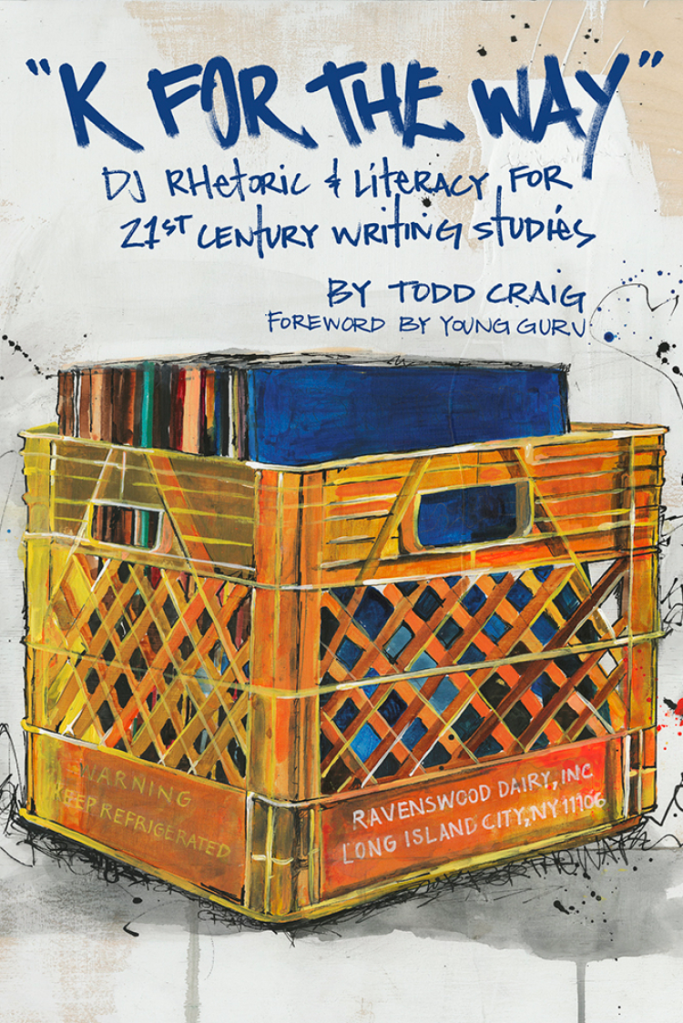
The way that we imagine English Studies, specifically Composition and Rhetoric (Comp/Rhet), today needs a radical shift. Specifically, we need new techniques for Writing Studies pedagogy to reach students in a more meaningful and contemporary fashion. Todd Craig’s “K for the Way:” DJ Rhetoric and Literacy for 21st Century Writing Studies (Utah State University Press, 2023) both documents the need for this shift and enacts it. Craig’s work enables us to recognize the pedagogical impact on writing that Hip Hop has had over the last 50 years—specifically how the DJ/deejay as twenty-first century new media reader and writer teaches students not just to think about sound, but to compose with it, too.
An Associate Professor of English at CUNY Graduate Center, Craig has little desire to shake the foundations of English Studies, but instead do what Hip Hop has always done—make a way where there is none. The point is to (re)imagine new ways of doing old things; in this case, of teaching and reaching students who arrive in First-Year Writing courses. “K for the Way” does more than demonstrate the ways in which the DJ is a twenty-first century pedagogical savant; it also teaches readers, using DJ Rhetoric and DJ Literacy, about the culture that makes them possible.
This summer, a DJ really did save my life: as someone who feels consistently overwhelmed by the vast nature of scholarly discourse, “K for the Way” gave me a chance to breathe, to identify with something that has been a part of me for the better part of my life, and to see myself in a conversation about a topic I am more than passionate about. For Craig, community, history, and culture are the core of his mission as a scholar, educator, and DJ.
Craig defines several new terms that bridge the worlds of Hip Hop and Composition and Rhetoric. First, we have DJ Rhetoric, which can be understood as the modes, methodologies, and discursive elements of the DJ. For Craig, it “encompasses the quality of oral, written, and sonic language that displays and expresses sociocultural, historical, and musical meanings, attitudes, and sentiments” (23). Next, there is DJ Literacy, which is the “sonic and auditory practices of reading, writing, critically thinking, speaking, and communicating through and with the rhetoric of Hip Hop DJ culture” (23). These two definitions, operating in conjunction, situate the DJ as a kind of griot, a figure that Adam Banks invokes as a carrier of tradition, stories, and histories in Digital Griots: African American Rhetoric in a Multimedia Age (Studies in Writing and Rhetoric) (2011). The mission of the griot is to carry stories and translate them to various audiences while adhering to the rhetorical conventions and modes of whichever audience they find themselves before; similarly, the DJ is responsible for “communicating the pulse and the evolution of a culture that once sat as ‘underground’ but now has dramatically evolved to ‘mainstream’” (25). These definitions serve as guides for the reader as they are tethered to all of the concepts and (re)imagining happening throughout the book.
Craig is intimately close to the work he is doing. He lives and breathes Hip Hop; and what should a book about the Hip Hop DJ be if not written by someone who embodies the role, culture, and practice of DJing? Craig uses a a research methodology known as hiphopography in which Hip Hop ways of being are central to studying it. Coined by James G. Spady, this term is defined as “a shared discourse with equanimity, not the usual hierarchical distancing techniques usually found in published and non-published (visual-TV) interviewers with rappers” (27). Craig states that hiphopography “allowed me to engage a variety of Hip Hop DJs while also maintaining my own shared values and sentiments around my love of Hip Hop culture and DJ practices” (28). Hiphopography constructs a conversational, intimate space—touched by history, culture, and music—wherein the interviewer and interviewee can engage and produce meaningful data. This methodology—and Craig’s many interviews with DJs about their craft—becomes part of the text’s core as we begin to see how Craig’s two-pronged argument connects DJ Rhetoric and DJ Literacy to bring both life throughout the book.
If one understands the DJ as a twenty-first century rhetorician and compositionist and considers the ways in which the DJ is a cultural meaning-maker, sponsor, and master sampler, then one can clearly see the connections between the DJ, DJ culture, and Writing Studies in the contemporary moment. In the first part of his argument supporting the significance of DJ Rhetoric and Literacy in writing pedagogy Craig asserts that, “it is essential that the academy at large works to strengthen students’ undergraduate experiences by reinforcing their racial, ethnic, and cultural ties” (14). This perspective provides the foundation for the second part of his argument that “the DJ (and thus, Hip Hop DJ culture) is the epicenter of Hip Hop culture’s creation” (23). Taken together, these dynamic arguments make the claim that the DJ offers a powerful model of a new media reader, writer, and critic. Today, our students come to writing classrooms with a “vast array of cultural capital. . .in their philosophical and cultural backpacks” (107). If we, as writing teachers, want to honor that cultural capital and build with it, we should follow Craig’s lead and look toward the DJ for some pointers on how to expand students’ access to a language that represents them.
Readers will also see a developing research agenda in “K for the Way” that thinks toward changing the culture beyond the present, while acknowledging the groundwork laid for the current moment and building genealogically upon that foundation, just as DJs do with sampling. Craig best exemplifies this when he writes, “in order to fully engage in a conversation—whether intellectual, pedestrian or otherwise—that discusses what DJ Rhetoric might look like, one has to think about the cultural and textual lineage of sponsors and mentors” (51). This notion of textual lineage is borrowed from Alfred W. Tatum who explains the term as “Similar to lineages in genealogical studies” and continues to note that textual lineage is “made up of texts (both literary and nonliterary) that are instrumental in one’s human development because of the meaning and significance one has garnered from them” (Tatum, qtd. in Craig, 51). Craig builds upon Tatum’s idea by introducing sonic lineage, which follows the same logic as Tatum’s term, but through sound (51). What becomes apparent, is that the DJ, as a cultural sponsor, can deploy sonic lineage as a way of communicating history and culture to members within and outside of the Hip Hop community and, more specifically, DJ culture.
Chapter three, especially, works at the interdisciplinary junction of Sound Studies, Writing Studies, and Hip Hop studies to convey a clear critique of the dominant discourse surrounding plagiarism. Craig is unsatisfied with the black-and-white conception of plagiarism as it presents itself in the academy. As a result, he moves to inquire “how we as practitioners [of teaching composition] approach citation methods and strategies within a twenty-first century landscape” (75). Craig promptly turns us toward the DJ’s conceptualization of sampling as a citation practice. Sampling in Hip Hop, as defined by Andrew Bartlett, “is not collaboration in any familiar sense of the term. It is a high-tech and highly selective archiving, bringing into dialogue by virtue of even the most slight representation” (77). The highly selective archiving, a.k.a crate diggin’, builds upon the idea of sonic lineage.
For the DJ, the process of diggin’ through crates to find that right sound, that one joint that going to get the party jumpin’, is a key element in the practice of “text constructing” (79). The Hip Hop sample functions alongside an understanding, offered by Alasdair Pennycook, of “transgressive-versus-nontransgressive intertextuality,” which, for an academic audience, complicates the idea of plagiarism.. The DJ becomes a figure through which we can understand intertextuality, sampling becomes the practice through which we can see parallels to citation through text construction, and the mix is where we begin, with the help of Pennycook, to complicate notions of plagiarism. In this chapter, readers are able to understand through sound.
Subsequently, Craig explores the concept of revision as it relates to the DJ’s ability to engage with an emcee on the point of “remix as revision” (107). Building from on Nancy Sommers’ article, “Revision Strategies of Student Writers and Experienced Adult Writers,” Craig lifts and examines four strategies of revision through the lens of the Hip Hop DJ: deletion, substitution, addition, and reordering (Sommers, qtd. in Craig, 107). These practices not only identify the Hip Hop DJ as a master of revision but also center the DJ, in the context of the writing classroom, as a key figure for understanding editorial practice. As teachers of writing—and especially for those of us who are deeply connected to Hip Hop culture—we have traditional scholars, such as Sommers, but we also have the DJ as cultural scholar, which offer new models with communicating and practicing the craft of writing in the twenty-first century.

Chapter Five, which is co-written by Craig and Carmen Kynard, centers on six women DJs: DJs Spinderella, Pam the Funkstress, Kuttin Kandi, Shorty Wop, Reborn, and Natasha Diggs to work toward developing a “Hip Hop Feminist Deejay Methodology” that positions women in Hip Hop culture as a key source of key knowledge production–as meaning-makers, theoreticians, storytellers–and as tastemakers in twenty-first century discourse about education, technologies, race, and gender. This chapter is also apt representation of hiphopography at work, as both Craig and Kynard ground their position in the interviews of these six women deejays, “deliberately situating their stories first… as opposed to the usual academic expectation that a tedious delineation of methods and an extant literature review come before a discussion of the actual subjects” (123).
In part, this chapter focuses on the affordances and limitations—political, social, and economic—present in DJ culture, and the effects it has on these women DJs to make it do what it does. For example, the introduction of the digital software Serato has simultaneously made access to music easier, and complicated access to the cultural archive that made the music possible in the first place. Natasha Diggs, states, “While she values the ability to access mp3 files so readily, she argues a deejay’s research and craft suffer, because many times the mp3 files do not include information about an artist’s name, history, or band” (129). Pam the Funkstress ties this sentiment up nicely when she argues, “There’s nothing like vinyl” (129).
The final chapter is fashioned like a Hip-Hop outro, with Craig leaving with a few parting ideas. Most important among them is his vision of “Comp 3.0,” a version of Comp/Rhet wherein “we have to push the scope of writing and rhetoric—with or without the field’s permission or acknowledgement” (171). For scholars of composition and rhetoric and writing teachers who ground part of their understanding of the field in Black Studies, Hip Hop, and the DJ, we gotta make it do what it do, regardless of who says what! Comp 3.0 does not seek approval or recognition from the powers that be; instead, it focuses on the new ways of thinking and writing, and of teaching, that we are able to conjure—with history, culture, and practice propelling us—when we invoke that which got us to the academy in the first place.
What is at stake, for those of us who engage Black Studies, Sonic Studies, Comp/Rhet, and Hip Hop Studies as critical points of departure for the teaching of writing, is that our presence—our being, methods, and our teaching—is crucial for developing a genealogy of scholars and world citizens who are aware of the myriad possibilities present in the twenty-first century.
—
Featured Image: Cover Art for “K for the Way”: DJ Rhetoric and Literacy for 21st Century Writing Studies by Cathey White
—
DeVaughn (Dev) Harris is a PhD student studying composition and rhetoric in NYC. His academic interests are mainly in writing studies and pedagogy, but those are often supported by other sub-interests in music, creative writing, African American studies, and philosophy. When not reading or writing, Dev enjoys making music wherever and however possible. He has published music before under the collective AbstraktFlowz.
—

REWIND! . . .If you liked this post, you may also dig:
“Heavy Airplay, All Day with No Chorus”: Classroom Sonic Consciousness in the Playlist Project—Todd Craig
Deep Listening as Philogynoir: Playlists, Black Girl Idiom, and Love–Shakira Holt
SO! Reads: Steph Ceraso’s Sounding Composition: Multimodal Pedagogies for Embodied Listening--Airek Beauchamp
The Sounds of Anti-Anti-Essentialism: Listening to Black Consciousness in the Classroom- Carter Mathes
Contra La Pared: Reggaetón and Dissonance in Naarm, Melbourne–Lucreccia Quintanilla
Ill Communication: Hip Hop and Sound Studies–Jennifer Stoever
SO! Amplifies: Regina Bradley’s Outkasted Conversations
A Listening Mind: Sound Learning in a Literature Classroom–Nicole Brittingham Furlonge
Share this:


Current Top Posts





April 2021

January 2020

November 2019

October 2019

August 2019

April 2014

November 2017

March 2015

December 2017

October 2015
 Sounding Out!
Recent Comments