
Quebec’s #casseroles: on participation, percussion and protest

en francais suivant
NOTE: Due to the ongoing nature of the protests and the official bilingualism of Quebec, Sounding Out! wanted to ensure Jonathan Sterne’s work could be read by as many participants of the manifs casseroles as possible. Therefore, we bring you his wonderful post in English and French, with the French below. This translation could not have happened without the lightning-fast English-to-French skills of the excellent Frédéric Milard, fredericmilard@yahoo.ca, and of course, Jonathan’s generous flexibility and patience. Merci beaucoup and bang on! –JSA, Editor-in-Chief
Every night around 8pm, in neighborhoods across Montreal and Quebec, you can hear the din of clanging pots and pans in manifs casseroles (manif is short for manifestation en cours, a street protest). About a block from our home in Montreal’s Villeray neighborhood, at the intersection of Jarry and St-Denis—one of the major epicenters—our local manif begins with people crossing in the crosswalks, banging loudly and rhythmically. We see neighbors and people from local businesses, families with small children, elderly and retired people, working adults, and many students.
.
Sometimes a manif casserole sounds like random banging, but most I’ve experienced leave sheer raucous pounding for moments when one march meets up with another, or when someone on a balcony does something particularly cool to cheer on the marchers. A rhythm usually arises from the chaos, encircling the disorder and enveloping everyone. Sometimes the rhythms connect with chants like “la loi spéciale, on s’en câlisse,” which roughly translates to “we don’t give a fuck about your special law.”
Eventually, the numbers grow, and then all of a sudden, as if by magic or intuition, we stand in the middle of the intersection, blocking traffic. The police have taken to simply routing traffic away from the protest. Eventually, we march south on St-Denis toward other neighborhoods (the exact route varies), often swelling into a giant parade of thousands, or as E.P. Thompson might suggest, a parody of a formal state procession, announcing the “total publicity of disgrace” for its subject. (“Rough Music Reconsidered,” 6,8).
The numbers are part of the politics. For the last 100-odd days most Quebec students have been on strike against tuition increases of over 70% in five years. Some protests have numbered in the hundreds of thousands. The Quebec government tried to suppress the student movement by passing Bill 78 on May 18, 2012. Among its many preposterous provisions, any spontaneous gathering of over 50 people is illegal without prior police approval—even a picnic. Protesters not only must disclose their planned route, but also their means of transportation, According to Law 78, people are criminals the minute they join a protest, which is why so many people have taken to the streets.
21st Century Charivari
In a piece I co-authored with Natalie Zemon Davis for the Globe and Mail, we connected the casseroles with a 700-year-old Francophone tradition of charivari. In English, the tradition is called “rough music”; there are also Italian, German and Spanish versions and the practice has spread from Europe throughout its former colonies. Groups of disguised young men would meet up at night and bang on pots and pans and make a grand din outside an offender’s home. Usually the offense was against some heterosexual norm, but they sometimes took on a political character, and older people would join in. As Allan Greer has shown in The Patriots and the People, they played an important role in Lower Canada’s failed rebellion of 1837-8, where charivaris greeted British officials who would not surrender their commissions (252-57).

Granville, “Eine Katzenmusik” lithograph published in La Caricature, 1 Sep. 1831
In the French tradition, charivaris were (usually) an alternative to violence on occasions where community reparation was possible. Charivaris were largely inclusive, as the subjects of harassment were usually allowed to return to good standing after paying some type of fine. This history may well have resounded in Jacques Attali’s ears when he described music is a simulacrum of violence in Noise: “the game of music resembles the game of power: monopolize the right to violence; provoke anxiety and then provide a feeling of security; provoke disorder and then propose order; create a problem in order to solve it” (28).
Of course, the broader multinational traditions of rough music have no guaranteed politics. Pots and pans were sometimes heard before lynchings in the American South, but also as improvised instruments for black musicians in New Orleans’ public squares. John Mowitt has even suggested that rough music is one of the cultural roots of the drummer’s trap kit, that backbone of rock and jazz music.

Image by Flickr User Scott Montreal
In the 20th century, varieties of rough music largely moved from domestic concerns to political protest, though again without guarantees. Rough music has greeted bank failures in Latin America and—most recently—Iceland; it was the sound of Spanish citizens opposed to their government’s involvement in the 2003 Iraq war. In Chile, protesters used pots and pans to protest Allende in the early 1970s, and later to protest Pinochet in the mid-1980s.
The casseroles thus have symbolic roots in charivari, but of course they are also creatures of social media and the particularities of Quebec culture and politics. A popular 2003 Loco Locass song “Libérez-nous des libéraux” (“Liberate Us From the Liberals”), written for the provincial election, mentions a charivari for Quebec’s liberal party.
.
And, as the student movement has already demonstrated, the protest cultures here are extremely vital. While New York’s May Day Parade was happy to attract tens of thousands in a metropolitan area of over ten million, participation here can be counted in the hundreds of thousands for a region with three million.
Rhythm and Participation
We need to listen to the casseroles protests to understand them. They are, after all, embodied acts in the old-fashioned sense, performed loudly and defiantly by people in the streets. They have a politics of volume and frequency, as well as rhythm.
In Percussion, Mowitt writes: “there is something extraordinary about the importance of beating, of creating a specifically percussive din … as though a distinctly sonoric response was called for when a breach in the community’s self-perception was at issue” (98). Rhythmic participation in the casseroles is a kind of political involvement, and participation of various kinds plays a role in most of the positive political visions associated with music.

Image courtesy of Flickr User Juan Madrigal
“Participation is the opposite of alienation,” wrote Charlie Keil in his essay “Participatory Discrepancies and the Power of Music”, and his account of music as a social process in “Motion and Feeling through Music” helps us better understand the casseroles’ particular combination of clangor and rhythm. Writing amidst massive changes in the 1960s, Keil challenged prevailing theories of musical affect, like Leonard Meyer’s, which assumed that musical meaning was lexical and syntactic, contained in melody and harmony. While Meyer attempted to draw universal conclusions about emotion from Western Art Music and its attendant values, Keil derived his theory of musical affect from African-American traditions like blues and jazz. Against the ideals of concert hall perfection and rational mastery, Keil—along with writers such as Christopher Small, Leroi Jones, and Steven Feld—argued that music should be understood as action. Thus, Small coined the term “musicking,” describing music not as a collection of rarefied texts performed by experts and professionals, but rather as a field of social action that includes all participants, from musicians to the people cleaning up after the event.
By the 1980s, Keil specified the affective power of music through its “participatory discrepancies,” the mixture of groove on one hand, and timbre and texture on the other (96): “music, to be personally and socially valuable, must be ‘out of time’ and ‘out of tune.’” Over the minutes and hours, the casseroles sway in and out of both, as people join and exit, and as the procession happens to each new block. Because of their unique musical character, the nightly manifs casseroles are profoundly inclusive. They are in many ways closer to the utopian ideals of collective musicking one finds in Keil and Small’s work, and that of Attali’s “composition,” than the so-called digital revolution in musical instruments. They are also good fun, as any child will tell you.

Contre la loi spéciale : les casseroles!, May 23, 2012 in Quartier Latin, Montreal, QC, CA, image by Flickr User . . .bung
Despite Anglophone press caricatures that recast the protests as the product of entitled, rabble-rousing students, the casseroles transcend differences that often structure local politics–like language, class, and race–as well as gender and age, which can present barriers in music-making (especially drumming) in addition to politics. Because the instruments are simple, cheap and improvised, almost anyone can join. Because the music is deliberately non-professional, the ideals of mastery and perfection and the weighty gendered and aged assumptions about who can be a “good musician” are inoperative. The beats are easy to pick up and play in time—and if you swing a little out there, all the better. I have heard skilled drummers syncopate catchy rhythms on single drums or cymbals, but most people are content to simply move in and out of time with everyone else. (My partner and I join with maracas and an otherwise-rarely-used buffalo drum—I am a bassist at heart—though we offer guests pots and pans).

Casseroles 26 mai 2012, Place Emilie Gamellin, Image by Flickr User scottmontreal
Taken together, volume and frequency work to immerse some in its proximal footprint, while hailing others at a distance. The sheer power and volume for someone inside a casseroles protest is hard to convey. My neighbor on a pot is a lot like my drummer hitting a cymbal. The transient (the sharp, initial part of the hit) can be piercing at close range due to frequencies at the very top of the audible range traveling at a high sound pressure level (this is why drummers often lose their hearing faster than guitarists). Inside the casseroles march, our ears are percussed with every hit; many people show up wearing earplugs.
The frequencies dull a bit farther away, and the more pitched sounds of the casseroles tickle the ear’s center of hearing in a gentler cacophony that is both declarative and invitational. Since the point of the protests is to audibly flout Law 78, the fact that they can be heard much further than they can be seen helps make this lawbreaking an expressly public and political act. Montreal mayor Gerard Tremblay acknowledged as much: “They can stay on their balconies to make noise. I’m in Outremont [a wealthy enclave next to Mile End and the Plateau, another epicenter of the protests] and I can hear it. No need to go onto the street, to walk around and paralyse Montreal.”
The volume’s territorial reach also works as an invitation to join in, either by banging along on one of Montreal’s ubiquitous porches, or by entering the procession itself. While at the other end of the frequency spectrum from Steve Goodman’s “bass materialism,” it affords some of the “collective construction of a vibrational ecology” he describes in Sonic Warfare (196), as the whole of the pots and pans becomes greater than the sum of its parts.
Participants’ overwhelming response to the casseroles has been a kind of weighty sentimentality, an outpouring of emotion and relief. One can hear it in the viral video that has been making rounds:
and one can see it in letters like this one to the editors of Le Devoir:
Now people greet and talk. Now neighborhood meetings, discussions, vigils start up casually among neighbours on the steps and balconies of Montreal. The neighborhood will be less and less alien. This is a true political victory!
We should repeat this friendly beating [the evocation of tapage doesn’t quite work as well in English] possibly in other forms, until the land is occupied by neighbors who recognize one another, encounter one another each day by chance, and have known one another over the years. That is how we live in a place, that is how we become citizens.
My heart swells with joy.
Because “the clashing of pots and pans […] is so blatantly percussive, it is hard not to hear in the retributive structure of rough music something like a beating back—a backbeat, in short, or a response on the part of the community to what it perceives as a provocation, a call to act,“ writes Mowitt (98). The connections to charivari matter: the casseroles protests are local, neighborhood, community movements asking for a simple redress—the repeal of a heinous law. Of course there are many other resonances: signs can be seen challenging various aspects of neoliberalism alongside symbols of Quebec nationalism (which, I must remind Anglophone Canadians, is not automatically separatist). In my neighborhood, people collect food donations.

“If you keep us from dreaming, we’ll keep you from sleeping,” Image from Flickr user ScottMontreal
When we recently spoke about the differences between student activists in the 1960s and now, my former teacher Lawrence Grossberg pointed to the central role of music in the 1960s. Those movements had songs that everyone knew, and through which shared affect grew. Like many other observers, he doesn’t see music playing the same role today (perhaps supplanted by a wider range of media practices, as the usual story goes).
Apart from viral videos and the revivified Loco Locass tune, I’m not sure the current Quebec movement has unifying songs.
But it certainly has a groove we can move to.
—
Many thanks to Natalie Zemon Davis, Manon Desrosiers, Nicholas Dew, Dylan Mulvin, Derek Nystrom and Carrie Rentschler for comments on and conversations leading up to this piece. Thanks also to Jennifer Stoever-Ackerman for the space to do it and the engaged editorial eye.
—
Jonathan Sterne teaches in the Department of Art History and Communication Studies and the History and Philosophy of Science Program at McGill University. He is author of The Audible Past: Cultural Origins of Sound Reproduction (Duke, 2003), MP3: The Meaning of a Format (Duke 2012); and numerous articles on media, technologies and the politics of culture. He is also editor of The Sound Studies Reader (Routledge, 2012). Visit his website at http://sterneworks.org.
—
Quebec’s #casseroles: on participation, percussion and protest
Tous les soirs vers 20 heures, plusieurs quartiers de Montréal et de Québec s’animent au tumulte des manifs de casseroles. J’habite tout près d’un des épicentres du mouvement, à l’intersection des rues Jarry et Saint-Denis, dans le quartier Villeray à Montréal. Ici, comme ailleurs, la manifestation démarre quand quelques personnes se mettent à traverser sans discontinuer des passages piétons en martelant poêles et chaudrons. Ce sont des voisins, des commerçants du coin, de jeunes familles, des personnes âgées, des retraités, des travailleurs et, surtout, des étudiants.
.
Si, parfois, les manifestations de casseroles peinent à s’élever au-dessus du simple tapage informe, la plupart de celles dans lesquelles j’ai été tiennent en réserve le vacarme pur et simple pour les moments où l’on croise une autre marche ou lorsqu’il est question de saluer ceux qui, sur leur balcon, se distinguent par leur ferveur pour la cause. Autrement, le chaos cède généralement la place à une structure rythmique qui vient encercler chacun et contenir le désordre. Parfois même, les rythmes s’accrochent aux slogans qu’on scande, du type : « la loi spéciale, on s’en câlisse! ».
Bientôt, les rangs grossissent et, sans qu’on sache trop comment, comme par magie ou par intuition, nous voilà en plein milieu d’un carrefour à bloquer la circulation. Les policiers, dépassés, se contentent de faire dévier le trafic dans les rues adjacentes. La marche finit par descendre le boulevard Saint-Laurent vers d’autres quartiers plus au sud (les itinéraires varient sans cesse). Elle se transforme alors en un gigantesque défilé de plusieurs milliers de personnes ou, comme le suggère E.P Thompson, en une parodie des processions politiques, annonçant pour ses sujets une « total publicity of disgrace » (“Rough Music Reconsidered,” p.6,8).
En politique, les chiffres ont leur importance. Depuis plus de 100 jours, une bonne partie des étudiants du Québec fait la grève pour s’opposer à une augmentation des frais de scolarité de plus de 70 % sur cinq ans. Certaines des manifestations se sont chiffrées à plusieurs centaines de milliers de personnes. Le 18 mai 2012, le gouvernement du Québec a voté la loi 78 pour tenter de mater le mouvement étudiant. Une de ses nombreuses dispositions aberrantes rend illégale toute manifestation spontanée de 50 personnes et plus si celle-ci n’a pas été approuvée au préalable par les autorités; un pique-nique rentre dans cette catégorie. Les manifestants doivent révéler non seulement leur itinéraire, mais aussi le moyen de transport qu’ils entendent utiliser. Selon la loi 78, une personne est coupable dès qu’elle se joint à une manifestation; c’est pour cela que tant de personnes sont descendues dans la rue.
Un charivari du vingt-et-unième siècle
Dans un article écrit en collaboration avec Natalie Zemon Davis pour le Globe and Mail, j’ai rapproché le phénomène des manifestations de casseroles à la tradition du charivari, qu’on retrouve dans les pays francophones depuis 700 ans. En anglais, on appelle rough music cette tradition, qui existe aussi dans des variantes italienne, allemande et espagnole et dont la pratique s’est propagée de l’Europe vers ses anciennes colonies. Des groupes de jeunes hommes déguisés, auxquels se joignaient parfois des personnes plus âgées, se retrouvaient le soir pour faire du tapage devant la maison d’un individu au comportement jugé déviant, généralement à l’aune de quelque norme hétérosexuelle. La faute, cependant, pouvait être de nature politique. Ainsi, comme l’a montré Allan Greer (The Patriots and the People, p.252-57), les charivaris jouèrent un rôle important au Bas-Canada lors de la rébellion manquée de 1837-38 et visèrent les fonctionnaires au service de la Couronne qui refusaient d’abandonner leurs fonctions.
Granville, “Eine Katzenmusik” lithograph published in La Caricature, 1 Sep. 1831
Dans la tradition française, les charivaris étaient (habituellement) une solution de rechange à la violence dans des cas où il était possible d’expier sa faute envers la communauté. Les charivaris avaient un caractère inclusif, les victimes rentrant généralement en grâce après avoir fait amende honorable. Il est probable que Jacques Attali, dans son livre Noise ait eu en tête de telles pratiques quand il décrit la musique comme un simulacre de la violence : « The game of music resembles the game of power: monopolize the right to violence; provoke anxiety and then provide a feeling of security; provoke disorder and then propose order; create a problem in order to solve it » (p.28).
Les diverses traditions internationales de la rough music n’ont évidemment pas toutes cette dimension politique. Le son des casseroles a parfois servi de prélude aux lynchages du sud des États-Unis, mais a aussi enrichi les improvisations des musiciens noirs dans les squares publiques de La Nouvelle-Orléans. John Mowitt suggère même que la rough music est une des origines culturelles de la batterie, pierre angulaire du rock et du jazz.
Image by Flickr User Scott Montreal
Au 20e siècle, les variantes de la rough music ont migré, en grande partie, des affaires domestiques vers les manifestations politiques, avec encore une fois quelques bémols. La rough music a ainsi servi de bande sonore à la faillite des banques en Amérique Latine et, plus récemment, en Islande; c’est au son des casseroles qu’en 2003 les Espagnols se sont insurgés contre leur gouvernement au sujet de l’engagement de leur pays en Irak. Au début des années 70, au Chili, les opposants d’Allende sortirent leurs casseroles, imités quinze ans plus tard par ceux de Pinochet.
Le phénomène des manifestations de casseroles puise donc ses racines symboliques dans le charivari. Mais pas seulement : il est aussi, bien entendu, une créature des médias sociaux et le fruit des particularismes politiques et culturels du Québec. Une célèbre chanson du groupe Loco Locass, Libérez-nous des libéraux, composée au lendemain des élections provinciales de 2003, appelle ainsi explicitement au charivari contre le Parti libéral du Québec.
.
Les traditions de militantisme, comme celle entre autres du mouvement étudiant, sont aussi très actives. Tandis que New York, forte de ses 10 millions d’habitants, s’enorgueillit d’attirer les manifestants par dizaines de milliers pour son défilé du premier mai, ils se comptent, à Montréal, une ville d’à peine trois millions d’habitants, par centaines de milliers.
Rythme et participation
Il faut écouter ces manifestations de casseroles pour en saisir le sens. En effet, elles sont avant tout des spectacles vivants (au sens classique du terme) donnés dans la rue, par bravade et à plein volume. Elles participent ainsi d’une politique du volume et des fréquences, une politique du rythme.
Dans son livre Percussion, Mowitt écrit : « There is something extraordinary about the importance of beating, of creating a specifically percussive din … as though a distinctly sonoric response was called for when a breach in the community’s self-perception was at issue » (p.98). La participation aux rythmes des casseroles est une forme d’engagement politique; de même, la participation sous toutes ses formes joue un rôle dans la plupart des visions politiques positives portées par la musique.
Image courtesy of Flickr User Juan Madrigal
Charlie Keil écrit dans son essai P“Participatory Discrepancies and the Power of Music”: « Participation is the opposite of alienation ». Sa description de la musique comme processus social permet de mieux saisir la combinaison particulière de bruit métallique et de rythme qu’on retrouve dans les manifestations de casseroles. Plongé au coeur des bouleversements des années 60, Keil entreprit de réfuter les théories alors dominantes de l’affect musical, comme celle de Leonard Meyer pour qui le sens de la musique était lexical et syntaxique, et résidait dans la mélodie et l’harmonie. Alors que Meyer cherchait à tirer des conclusions universelles sur l’émotion depuis l’art musical occidental et ses valeurs sous-jacentes, Keil, lui, élaborait une théorie de l’affect musical à partir des traditions afro-américaines, telles que le jazz et le blues. S’opposant aux idéaux de virtuosité formelle et de perfection des salles de concert, Keil — tout comme Christopher Small, Leroi Jones, et Steven Feld— soutenait que la musique doit avant tout être comprise comme action. C’est pourquoi Small a proposé le terme musicking : la musique doit être conçu non pas comme une collection de textes ésotériques joués par de rares experts et musiciens professionnels, mais plutôt comme un champ d’action sociale qui inclut tous les participants, des musiciens jusqu’à ceux qui s’occupent de nettoyer les rues après les manifestations.
Dans les années 80, Keil précisa la nature de ce pouvoir affectif de la musique grâce à sa description des participatory discrepancies (qu’on pourrait traduire par « hiatus dans la participation ») : un mélange de groove d’un côté, et de timbre et texture musicale de l’autre. Il écrit : « Music, to be personally and socially valuable, must be ‘out of time’ and ‘out of tune » (p.96). Au fil des minutes et des heures, les manifs de casseroles passent d’un ton à l’autre, suivent et perdent le rythme pour en créer d’autres à mesure que la procession grossit en nombre à chaque pâté de maisons. En raison de leur caractère musical unique, ces manifestations nocturnes demeurent profondément inclusives. Elles se rapprochent, à bien des égards, de l’utopie du collective musicking des travaux de Keil et de Small, et de celle de la composition décrite par Jacques Attali. En plus, et ça n’importe quel enfant vous le dira, ces manifestations sont franchement amusantes.
Contre la loi spéciale : les casseroles!, May 23, 2012 in Quartier Latin, Montreal, QC, CA, image by Flickr User . . .bung
N’en déplaise à la presse anglophone qui aime à caricaturer les manifestations comme la seule oeuvre d’étudiants gâtés et dissipés, les manifestations de casseroles viennent transcender les différences qui souvent structurent la politique locale — la langue, les classes sociales, les différences de race, de genre et d’âge —, tout ce qui peut faire obstacle à la production de musique (particulièrement celle faite à l’aide de percussions) ainsi qu’à l’implication citoyenne. Parce que les instruments sont improvisés, simples et pas chers, tout le monde peut participer. Délibérément non professionnelle, la musique se départit de ses idéaux de virtuosité et de perfection, et l’argument éculé selon lequel il y a un âge et un sexe pour être un « bon musicien » devient soudainement caduc. Les rythmes sont faciles à suivre et à reproduire; qui perd la cadence en créer de nouvelles, et ne s’en porte que mieux. J’ai entendu des batteurs chevronnés se lancer dans des rythmes syncopés sur des tambours ou des cymbales, mais la plupart des gens se contentent de suivre les cadences capricieuses du groupe. (Ma compagne et moi — un bassiste invétéré — avons déterré nos maracas et un vieux tambour en bison pour l’occasion, et laissons les chaudrons aux invités.)
Casseroles 26 mai 2012, Place Emilie Gamellin, Image by Flickr User scottmontreal
Pris ensemble, volume et fréquences pénètrent complètement les marcheurs qui tombent dans leur aire, en même temps qu’ils interpellent ceux qui se tiennent au loin. Il est difficile de rendre compte du volume et de la puissance purs ressentis à l’intérieur d’une manif de casseroles. Mon voisin qui se déchaîne sur son chaudron produit le même effet que mon batteur qui frappe sur une cymbale : à proximité, le son transitoire (la partie initiale, suraiguë du coup) peut être perçant parce qu’il mobilise des fréquences au faîte du champ auditif et qui voyagent à un niveau élevé de pression sonore (c’est pourquoi l’audition d’un batteur se détériore souvent plus vite que celle d’un guitariste). À l’intérieur d’une manif de casseroles, chaque coup atteint l’oreille; on voit ainsi beaucoup de manifestants porter des bouchons.
Bientôt, les fréquences ardues s’estompent quelque peu, les sons les plus aigus des casseroles finissent par amadouer l’oreille et se fondent en une douce cacophonie, à la fois déclarative et invitante. Puisque le but de ces manifestations est de bafouer la loi 78 de la manière la plus assourdissante possible, le fait qu’on puisse les entendre plus loin qu’on puisse les voir transforme ce délit en un acte public et politique exprès. C’est d’ailleurs ce que le maire de Montréal, Gérard Tremblay, reconnaît bien malgré lui : « Ils peuvent rester sur leur balcon pour faire du bruit. On va l’entendre le bruit. Moi, je suis à Outremont [une riche enclave entre le Mile-end et le Plateau, deux des épicentres du mouvement] et je l’entends le bruit. Pas besoin d’aller sur la rue, de se promener et de commencer à paralyser Montréal ».
La portée territoriale du volume fonctionne aussi comme une invitation à se joindre à la manifestation, soit en faisant du tapage sur les porches (emblématiques) de Montréal, soit en entrant dans la marche même. Si elle se situe à l’extrémité opposée du spectre sonore de ce bass materialism dont parle Steve Goodman dans son livre Sonic Warfare, cette portée territoriale du volume participe de cette « collective construction of a vibrational ecology » qu’il décrit (p.196). Là aussi, le tout formé par les casseroles finit par dépasser la somme de ses parties.
La réaction souvent unanime des participants aux manifs de casseroles est pleine d’effusion et teintée d’un sentiment de soulagement, comme on peut l’entendre dans cette vidéo virale qui a beaucoup circulé :
et comme on peut le constater dans bon nombre de lettres, comme celle-ci, envoyée au journal Le Devoir :
Désormais, les gens vont se saluer, se parler. Maintenant, mine de rien, s’amorcent entre voisins des rencontres, des discussions, des veillées sur les perrons et sur les balcons de Montréal. Le voisinage sera de moins en moins étranger. Ça, c’est une vraie de vraie victoire politique !
Il faut répéter ce tapage sympathique, éventuellement sous d’autres formes, jusqu’à ce que le territoire soit entièrement occupé par des voisins qui se reconnaissent, se parlent, se fréquentent au hasard des jours et se connaissent au fil des ans. C’est comme ça qu’on habite un lieu, c’est comme ça que nous devenons citoyens.
J’ai le coeur gonflé de joie.
Mowitt écrit : « [Because] the clashing of pots and pans […] is so blatantly percussive, it is hard not to hear in the retributive structure of rough music something like a beating back—a backbeat, in short, or a response on the part of the community to what it perceives as a provocation, a call to act » (p.98). Le rapprochement avec le charivari est ici capital : les manifs de casseroles sont en effet des mouvements locaux, communautaires qui, à l’échelle d’un quartier, demandent réparation : l’abrogation d’une loi liberticide. Évidemment, d’autres éléments entrent ici en résonance : on y voit autant de signes de défi contre certains aspects du néo-libéralisme que de symboles du nationalisme québécois (qui, il est bon de le rappeler aux Canadiens anglais, n’est pas forcément indépendantiste). Dans mon quartier, on organise même des collectes de denrées alimentaires.
“If you keep us from dreaming, we’ll keep you from sleeping,” Image from Flickr user ScottMontreal
Alors que je discutais récemment des différences existant entre l’agitation étudiante des années 60 et celle d’aujourd’hui avec mon ancien professeur Lawrence Grossberg, celui-ci soulignait le rôle de premier plan joué par la musique à l’époque : ces mouvements avaient des chansons que tout le monde connaissait et qui venaient renforcer des affects communs. Comme beaucoup d’autres, il considère que la musique n’assume plus aujourd’hui le même rôle (supplantée, peut-être, par un ensemble plus large de nouvelles pratiques médiatiques, comme le veut l’analyse habituelle).
Mis à part les vidéos virales et la reprise de la rengaine de Loco Locass, je ne suis pas certain que le mouvement québécois actuel possède de tels hymnes rassembleurs.
Une chose est incontestable cependant : elle a un groove sur lequel il fait bon marcher.
—
French Translation by Frédéric Milard, fredericmilard@yahoo.ca
—
Many thanks to Natalie Zemon Davis, Manon Desrosiers, Nicholas Dew, Dylan Mulvin, Derek Nystrom and Carrie Rentschler for comments on and conversations leading up to this piece. Thanks also to Jennifer Stoever-Ackerman for the space to do it and the engaged editorial eye.
—
Jonathan Sterne teaches in the Department of Art History and Communication Studies and the History and Philosophy of Science Program at McGill University. He is author of The Audible Past: Cultural Origins of Sound Reproduction (Duke, 2003), MP3: The Meaning of a Format (Duke 2012); and numerous articles on media, technologies and the politics of culture. He is also editor of The Sound Studies Reader (Routledge, 2012). Visit his website at http://sterneworks.org.
Share this:

The Sound of Hippiesomething, or Drum Circles at #OccupyWallStreet
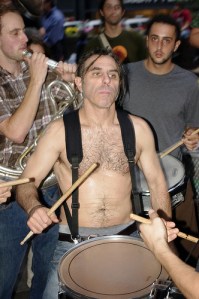
Photo from Zuccotti Park, September 28 2011 by Flickr user David Shankbone
Last week’s news was been full of alarming stories of real and threatened violence at various #Occupy sites around America. But also disturbing were the reports that complaints about the continuous drumming at the Occupy Wall Street site in Lower Manhattan were threatening to shut the entire operation down. According to stories in N + 1, slate.com, Mother Jones, and New York, the ten hour marathon drum circles at Zuccotti Park have been a focal point of mounting tensions, both between the occupiers and the drummers, and between the occupiers and the community at large. Last week, community members asked that the drummers limit their drumming to 2 hours a day, a request backed by actual OWS protesters. The drummers, loosely organized in a group called PULSE, initially resisted the restriction, claiming that such requests mimicked those of the government they were protesting against. Since then, a compromise has been worked out, but the situation gives rise to a host of questions about race, sound, drums, and protest.
Community organizers both inside and outside OWS said they were distressed by the continuous noise that these protesters are making, and certainly they had reason: as Jon Stewart put it in his episode of talking points, “it’s a public space, it’s for everyone, including people who don’t consider drum circles to be sleepy time music.”
Writer and singer Henry Rollins agrees, telling LA Weekly that he dreams of an #Occupy Music festival, because “So far [he has] heard people playing drums and other percussion instruments” but still wonders “if there will be a band or bands who will be a musical voice to this rapidly growing gathering of citizens.” Rage Against the Machine guitarist and frequent #Occupier Tom Morello also seems to concur, telling Rolling Stone, “Normally protests of this nature are furtive things, It’ll be 12 people with a small drum circle and a couple of red flags. But this has become something that people feel part of.” Stewart, Rollins, and Morello all have a point: not everyone likes drum circles, in fact some people feel quite strongly about them, which has the potential to be divisive for a movement famously representing “the 99%.”
But over and above the questions of musical taste, the very audible presence of snare drums, cymbals, and entire drum sets at OWS—more often found in marching bands or suburban garage band practice spaces than the usual drum circle staple, the conga—raises a different set of questions, both sonic and social, around the interrelated issues of “noise,” public space, and privilege.
That a drum circle populated by a large number of bad, mostly white drummers is being touted as “the sound” of occupation isn’t that surprising, at least not for alumni of UC Berkeley.
In my day, a more conga-oriented drum circle sprouted up on Sproul Plaza every Sunday; today, a similar one occupies a green space in Golden Gate Park right across from Hippie Hill, pretty much 24/7. (I walk by it every Thursday on my way to the gourmet food trucks: happily, the delicious smell of garlic noodles and duck taco obliviates all other senses.)
These kinds of regular, yet impromptu, circles abound in California and elsewhere: indeed, the sound of drum circles à la OWS has characterized certain types of social spaces for the last forty years. But what exactly does the sound of drum circles characterize? What meaning is being made by them, and why?

Drumming and Dancing the Bamboula in Place Congo, circa 1880
In the Americas, drum circles go back hundreds of years– many indigenous peoples have drumming traditions, for example, and, in Congo Square in New Orleans, slaves of African ancestry gathered weekly to dance to the rhythms they played on the bamboula, a bamboo drum with African origins, beginning in the early 1700s. The notion of the “circle” was a fundamental part of the dancing and music making at Congo Square—according to Gary Donaldson, the circles represented the memories of African nationalities and various reunited tribes people—and was echoed in various types of “ring shouts” across the West Indies and the Southern U.S. The contemporary drum circle stand-by, the conga, also came to the Americas via the forced migration of slaves; it is of Cuban origin but with antecedents in Africa, like the bamboula. The black power movements of the 1960s drew on this history—and sound—to good effect, reigniting semi-permanent drum circles in many U.S. neighborhoods– like the formal gathering that meets in Marcus Garvey Park in Harlem on Saturdays that is currently also under fire from a nearby condo association –audibly announcing their presence and enacting new community formations.
Given this history–and without erasing the presence of drummers of color at OWS--it can seem puzzling how the drum circle has come to occupy such a curiously whitened position in America’s cultural zeitgeist. Furthermore, one of the more problematic aspects of the OWS drum circle debate is the racialized implications of the instrumentation there—implications borne out by videos of OWS that show an overabundance of snares, some of the loudest drums available. According to percussionist Joe Taglieri, “no conga is louder than a fiberglass drum with a synthetic head.” If snares are louder than congas, then noise – actual decibel level — is probably not the sole issue when community groups attempt to control or oust drummers like those in Marcus Garvey Park. It does seem to be a key point of contention at OWS, however.
While there is also a history of African American marching bands, especially in the South, snare drums speak to a different set of American cultural traditions. Drum kits themselves evolved from Vaudeville, when theater space restrictions (and tight pay rolls) precluded inviting a large marching band inside. Mainstream associations with snares include but are not limited to army parades, high school marching bands, and of course hard rock music. Sometimes, like in the case of Tommy Lee, it is an unholy alliance of several of these contexts.

Tommy Lee, formerly with Motley Crue, drumming for the University of Nebraska
In other words, outside of OWS, snares are hardly the sound of social upheaval.
How the drum circle became associated with political protest in the first place is interesting. Although people sometimes associate drum circles with beatniks rather than hippies, a case could be made that they actually connect more strongly to an electrified Woodstock rather than an acoustic Bleecker Street, thanks in part to Michael Shrieve’s widely mediated turn during Santana’s performance of “Soul Sacrifice” at the 1969 festival.
It is important to note that Shrieve is playing the traps in this sequence, not the conga, which is one reason I’d like to suggest that something about that scene – the hands on the congas, the grins of the other guys, the ecstatic face of a 20-year-old as he slams his kit, and the fetishistic gaze of the camera on the sticks, the skins and the cymbals – caught the imagination of a particular segment of American society. Santana’s band – two Mexican Americans (Carlos Santana and Mike Carabello), a Nicaraguan (Chepito Areas), two whites (Shrieve and Gregg Rolie, who later plagued the world in Journey) and an African American (bassist David Brown)—was truly multi-racial, creating a “small world” visual that furthered Woodstock’s utopian rhetoric in ways that were surely not borne out by the demographics of its audience. More importantly perhaps, the Woodstock movie showed a white suburban hippie guy as an equal participant in a multi-ethnic rhythmic stew, a powerful image in the 1960s. Indeed, the Santana performance may be precisely the moment when the idea of the drum circle was lifted from the context of “black power” and moved into the hippie mainstream.
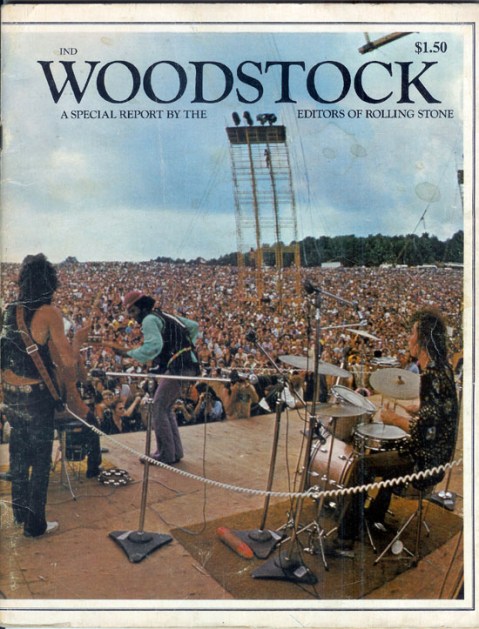
When's the last time you've seen a drummer on a magazine cover?: Santana on Rolling Stone's Woodstock special issue
Woodstock made congas hip to the mass of America—not just in Santana’s set but also in the performances of Richie Havens and Jimi Hendrix—and Woodstock helped define what the drum circle meant, in part by encapsulating certain discursive tropes that were very particular to those times. For example, drum circles epitomize the ’60s idea that political action is simultaneously self-expressive and collective. If a crowd of people sing “We Shall Overcome” or chant “Ho Ho Ho Chi Minh/The NLF is going to win,” it is a a collective act. It’s collective even if the crowd is singing “Yellow Submarine” and it’s not overtly political. By contrast, drum circles are about improvisation, so each drummer can “do his own thing” while participating in the groupthink. (The “his” is implied: video of drum circles show few women participants. Apparently Janet Weiss, Meg White, and Sheila E.’s “own thing” can actually be done on their own.)
In terms of sound, drum circles also project well beyond their immediate location, compared to singing and chanting (in fact, OWS has had problems with the drum circles drowning out its “human microphone”). Plus, since the drummers can take breaks and change out, the actual drumming never stops, unlike a performing musician. Thus, drum circles are celebrations of self expression that are actively imposed on an audience that is well beyond eyesight. This summarizes a modern view of personality rooted in the 1960s: that it’s not enough to participate, you’ve also got to “be yourself.” I think these two notions account for the enduring idea of the drum circle as a supposedly political sound, even when it’s not. Drumming in a drum circle allows for a public display of self-expression that simultaneously allows the participant to belong to a group. The appeal of that is obvious, especially in our contemporary iCulture. However, the politicization of the sound of drum circles only makes sense when you add in the lingering sonic traces of black protest, modulated through a hippie lens. You can see this clearly in New York magazine’s “Bangin’: A Drum Circle Primer” (10.30.11), whose visual imagery prominently features a West African djembe drum and describes only the “hippie-era use of traditional African instruments” rather than their actual, snare-heavy configuration at OWS. Despite the snares and in spite of the oft-commented on lack of black faces at OWS—see Greg Tate’s piece in the Village Voice—drum circles still carry enough connotations of militant blackness to annoy the bourgeoisie.
One key thing differentiates OWS’s drummers from the demonstrations of yore, however: in the 60s and early 70s, there was a notion that drum circles were for drummers. Santana’s band, though young, was made up of world class musicians from the San Francisco scene. But to a certain type of viewer – young, white and male—the drum circle must have seemed so doable. Compared to the singular virtuosity of Jimi Hendrix or sheer talent of Pete Townshend, Santana’s music was the sonic equivalent of socialism. No wonder the drum circle scene has had more of a half-life in the hearts and minds of would-be Woodstockians than just about any other: it is a visceral depiction of music as communal, ecstatic, and accessible. Today, thanks to the far-reaching waves of the movie Woodstock: 3 Days of Peace & Music (1970), the percussive noise such a circle makes creates a particular sonic backdrop that clearly—and nostalgically—says hippiesomething.
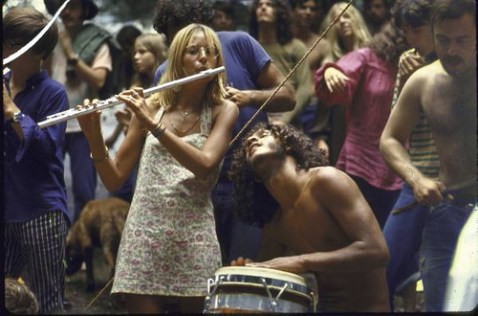
Photo by Flickr user Paul Townsend
And yet, politically speaking, nostalgia is, as theorists like Antonio Gramsci, Guy Debord, Jacques Attali and Theodor Adorno have frequently reminded us, invariably associated with Fascism. From Mussolini to Hitler to Reagan to Glenn Beck, it’s a tactic that has been explicitly invoked to thwart social progress. The nostalgia conundrum seems to have escaped both mainstream news media—which uses the drum circle to signify to viewers that OWS is a radical leftist plot—as well as the drummers themselves. For the drummers are hippies, and hippies young and old really believe in drum circles. Hippies take part in them, hippies enjoy them. It’s fair to say, however, that few others do, just as no one ever really enjoyed the 45- minute drum solos on live records by Cream, Led Zeppelin, and Iron Butterfly. (I’m thinking about Ginger Baker’s “Toad,” John Bonham’s “Moby Dick,” and “In-a-Gadda-Da-Vida,” respectively. Also about the time I went to the bathroom and bought popcorn at the LA Forum during a drum solo by some band I know forget, and still had to sit through ten more minutes.) .

Corporate Teambuilding in Boston, by Exclusive Events
However, that fact does not seem to bother those involved in drum circles, and herein lies the great problem with the whole equation drum + hippie = activism. To any members of the mainstream media who hears and records them, a drum circle instantly conjures up a chaotic, possibly even violent, scene: Chicago ‘68, Seattle 2000, Oakland 2011. But the truth is that, outside Fox News, the noun “hippie” no longer means “liberal,” or possibly even politically engaged. The curious thing about drum circles, then, is that while they sound progressive, they can actually mean conservative. A 2006 piece from NPR, for example, describes how drum circles have been adapted as teambuilding exercises for corporations like Apple, Microsoft, and McDonald’s.
The OWS situation illustrates such conservatism in different ways. In another recent article in New York Magazine, a 19 year old drummer from New Jersey is quoted as saying, “Drumming is the heartbeat of this movement. Look around: This is dead, you need a pulse to keep something alive.” This is said in the face of opposition from the movement’s own management, who fear a shutdown due to severe problems with neighborhood groups and restrictions on the General Assembly’s call-and-response “mic checks” that have been so galvanizing. His words are instructive as well as ominous, illustrating that young hippies like him believe that the sound of drums is a suitable replacement for protest or action itself.
The idea that sound alone can energize a movement is not just wrong, it also showcases a willful misunderstanding within the ranks of OWS. In Oakland last week, a small band of anarchists threw bottles at the police, whose wrath rained down in the form of tear gas canisters and a fusillade of dowels: one protester, an Iraq veteran, has been seriously injured.
The incident highlights a kind of cognitive dissonance that is hindering the ability of OWS to achieve political progress. The drumming problems at Zuccotti Park highlight the way that history can repeat itself as farce, as the distance between nostalgia and action — and between sound and meaning — disturbs the peace in more ways than one. Just as drummers in Sproul Plaza refuse to acknowledge that UC Berkeley is now mainly host to computer science and business majors, and drummers in Golden Gate Park refuse to deal with a Haight Ashbury that is gentrifying in front of their eyes, so too do the drummers at OWS refuse to acknowledge that their sound is no longer the sound of social activism. Indeed, the sound of a drum circle is reminiscent of the ring of a telephone, the scratch of a needle dropped on a record, or the clip clop of horse hoofs on hay-covered streets. No wonder it sounds out of place at OWS.
—
Gina Arnold recently received her Ph.D. in the program of Modern Thought & Literature at Stanford University, where she is currently a post doctoral scholar. Prior to beginning graduate work, she was a rock critic. Her dissertation, which draws on historical archives, literature, and films about counter cultural rock festivals of the 1960s and 1970 as well as on her own experience covering the less counter cultural rock festivals of the 1990s, is called Rock Crowds & Power. It is about rock crowds and power.
Share this:


Current Top Posts





April 2021

January 2020

November 2019

October 2019

August 2019

April 2014

November 2017

March 2015

December 2017

October 2015
 Sounding Out!

Recent Comments