
Toward a Practical Language for Live Electronic Performance

Amongst friends I’ve been known to say, “electronic music is the new jazz.” They are friends, so they smile, scoff at the notion and then indulge me in the Socratic exercise I am begging for. They usually win. The onus after all is on me to prove electronic music worthy of such an accolade. I definitely hold my own; often getting them to acknowledge that there is potential, but it usually takes a die hard electronic fan to accept my claim. Admittedly the weakest link in my argument has been live performance. I can talk about redefinitions of structure, freedom of forms and timbral infinity for days, but measuring a laptop performance up to a Miles Davis set (even one of the ones where his back remained to the crowd) is a seemingly impossible hurdle.
Mind you, I come from a jazzist perspective, which means that I consider jazz the pinnacle of western music. My classicist interlocutors will naturally cite the numerous accomplishments of classical composers as being unmatched within jazz. That will bring us to long debates about the merits of Charles Mingus and Duke Ellington as a composers, which leads, for a good many, to a concession on the part of Duke at least, but an inevitable assertion of the general inferiority U.S. composers compared to the European canon. And then I will say “why are we limiting things to composition when jazz goes so much further than the page?” To which I will get the reply: “orchestral performers were of the highest caliber.” Then I will rebut, “well why was Europe so impressed by Sidney Bechet?” But I digress.
Why talk about classical music in a piece on electronic music, you, my current interlocutor, may ask? Well, in placing electronic music in a historical context, its current stage of development keeps pace with the mental cleverness found in classical but applies it to different theoretical principles. The electronic musician’s DAW (Digital Audio Workstation) file amounts to the classical composer’s score; the electronic musician’s DSP (Digital Signal Processor) parallels the classical composer’s orchestra. I could call electronic music “the new classical” and I’d have a few supporters. But. . .taking it to the level of jazz? Electronic music would have to include not only the mental cleverness, but the physical cleverness as well.
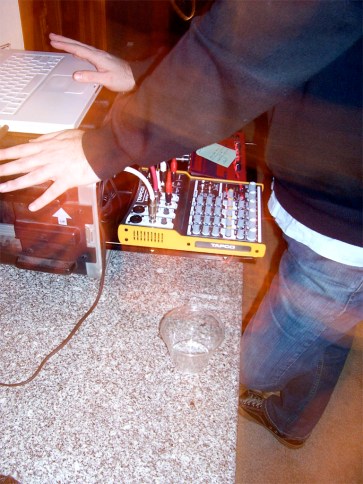
Electronic artist using Ableton 5 Live, Image by Flickr user Nofi
Let’s back up for a bit. A couple years back, I did a piece for Create Digital Music on Live Electronic performance. I talked to a diverse group of artists about their processes for live performance, and I wrote it up with some video examples. It ended up being one of the most discussed pieces on CDM that year, with commentary ranging from fascination at the presentation of techniques to dismissal of the videos as drug-addled email inbox management.
This was to be expected, because of the lack of a language for evaluating electronic music. It is impossible to defend an artist who has been called a hack without the language through which to express their proficiency. Using Miles Davis as an example–specifically a show where his back is to the audience–there are fans that could defend his actions by saying the music he produced was nonetheless some of the best live material of his career, citing the solos and band interactions as examples. To the lay person, however, it may just seem rude and unprofessional for Davis to have his back to the audience; as such, it cannot be qualitatively a good performance no matter what. Any discussion of tone and lyrical fluidity often means little to the lay person.
The extent of this disconnect can be even greater with electronic performances. With his back turned to the audience, they can no longer see Miles’ fingers at work, or how he was cycling breath. Even when facing the crowd, an electronic musician whose regimen is largely comprised of pad triggers, knob turns, and other such gestures which simply do not have the same expected sonic correspondence as, for example, blowing and fingering do to the sound of a trumpet. Also, it is well known that the sound the trumpet produces cannot be made without human action. With electronic music however, particularly with laptop performances, audiences know that the instrument (laptop) is capable of playing music without human aid other than telling it to play. The “checking their email” sentiment is a challenge to the notion that what one is seeing in a live electronic performance is indeed an “actual performance.”
In the time since writing the CDM piece, I’ve seen well over a hundred live sets, listened to days worth of live recordings, spoken in-depth with countless artists about their choices on stage, and gauged fan reactions many times over: from mind-blowing performances in barns to glorified electronic karaoke in sold-out venues, tempo locked beat matching to eight channel cassette tape loops, ten thousand dollar hardware to circuit bent baby toys. After all of that, I still don’t know that I can win the jazz vs. electronic music debate, but I will at least try.
*****
A while back, I was paging through the December 2011 edition of The Wire when I came upon a review of a Flying Lotus performance, the conclusion of which stood out:
On record, the music has the unruly liquidity of dream logic wandering from astral pathways down alphabet street, returning via back alleys on its own whims. Maybe the listening mind, presented with pretty straight analogues of those tracks, rebels, expecting something more mercurial, more improvised. The atmosphere in the venue reflected this upper-downer tension and constraint: the crowd noise was positive, but crowd movement was minimal – a strange sight in the midst of FlyLo’s headier jams. When the hall emptied there was a grumbling undercurrent as the tide of humanity was spilling slowly down the Roundhouse steps, whispers of it must have reached the upper levels. One casualty high above leaned over to berate them: “You don’t know, even understand, what you just FELT.” Sadly though, he didn’t stick around to enlighten anyone.
It should be noted that there are positive reviews of the show, and while not necessarily the best gauge, the videos from the event may seem to tell a different story.
What stood out for me from the review however, was that in trying to write about what the writer felt was a less than stellar performance, there was only one critique which could directly be attributed to the music, which was to say that Flying Lotus performed “straight analogues” of his tracks. Beyond that, the writer was left describing the feelings from the audience.
Feelings are tricky things. We all have them and they are the fundamental point of connection we seek when experiencing music. The message conveyed through the medium of music is meant to be an emotional one. But measuring those emotions is a task which cannot escape subjectivity. In a case like this when one writer is attempting to speak for the feelings of the whole audience, it becomes really tricky. Sure the writer may consider their analysis to have been objective, but it was still based on their perception of the audience, not the audience’s perception. Even more, this gauging of the audience dynamic does not tell us how the actual music performance was regardless of the varied perspectives from within the audience. I contend that this gap occurs because the language for discussing electronic performance has not yet been established.
Around the time I read The Wire review I was also reading Adam Harper’s Infinite Music, which offers variability as a primary factor of analysis in music. Instead of building on traditional music theory, Harper takes cues from those on the fringes of western music. He builds a concept of ‘music space’ by expanding John Cage’s “sound space,” the limits of which are ear determined. Furthermore, Harper’s non-musical variables and how they play into creating individually unique musical events, strengthens Christopher Small’s notion of musicking as a verb. In this way, Harper creates a fluid language for discussing music which might prove practical for these purposes.
It is helpful to use one of the central concepts of Harper’s music space, musical objects, as a means of distinguishing electronic performance.
Systems of variables constitute musical objects – Adam Harper
Going back to Miles Davis, his instrument is a monophonic musical object with a limited pitch and dynamic range in the upper register of the brass timbre. His musical talent is evaluated based on how he is able to work within those limitations to create variable experiences. His band represents another musical object comprised of the individual players as musical objects as well. The venue in which they are playing is a musical object, as is the audience and Davis’ decision to perform with his back to it. It is the coming together of all of these musical objects that creates the musical event (an alternate event includes the musical object which recorded the performance, and the complete setting of the listener as an individual musical objects upon playing the live recording). In a musical event comprised of these musical objects – Davis performing live in front of an audience with his back turned so he can face the band–it is possible to imagine a similar reaction to the above commentary about Flying Lotus, including a guy berating the audience for not making the connection.
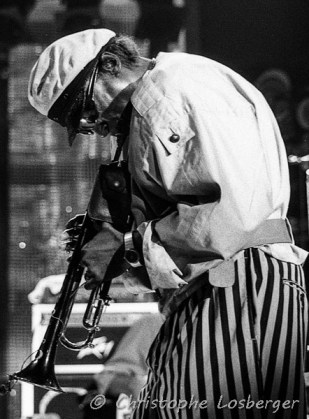
Miles Davis @ Montreux, 8.7.1984 Image by Flickr user Christophe Losberger
In this Davis example however, we could listen to the audio to determine whether or not it was a “good” performance by analyzing the musical objects which can be observed in the recording (note: this would be technical analysis of the performance, not the event or its reception). Does Davis’s tone falter? How strong are the solos? Is he staying in the pocket with the rest of the band? Evaluation of these variables would be a testament to his proficiency which could be compared to other performances to determine if it measures up.
Flying Lotus’s set however is a bit different. Yes, we could listen back to the audio (or watch the video) and determine if indeed it measures up to other sets he has performed, but unlike with Davis, we cannot translate what we hear directly to his agency. When we hear the trumpet on the Davis recording we know that the sound is caused by him physically blowing into his instrument. When we hear a bass in a Flying Lotus set, there isn’t necessarily a physical act associated with the creation of the sound. With all of the visual cues removed in the Davis example, we can still speak about the performance aspect of the music; the same is not necessarily so about an electronic set, even with visual cues. In many electronic sets, it is only when something goes wrong that actual agency in the music being performed can be attributed.
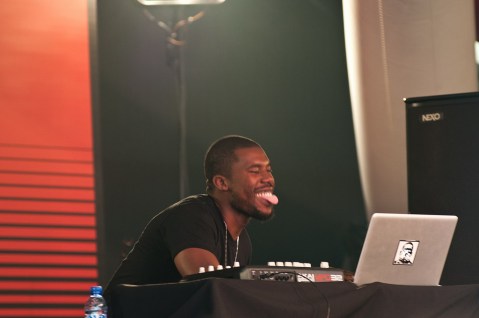
Flying Lotus,@ SonarDome, Sonar 2012, Image by Flickr user Boolker
Where the advent of the laptop and DSP advances for music have expanded creative possibilities, they only shroud what the performers using them are actually doing in more mystery. It’s an esoteric language, or perhaps languages, as ultimately each artist’s live rig configuration amounts to different musical objects, across which there may not be compatibilities.
However, in certain musical circles there are common musical objects. Perhaps the most common musical object for performance in electronic music right now is Ableton Live, which results in common component musical objects across performances by different artists. Further, an Ableton Live set can sound just like a Roland 404 set, which can sound just like a DJ set with a Kaoss pad, all of which can sound identical to a set not performed live but produced in the studio (or bedroom as the case may be) for a podcast. The reason for this is that much of the music is already fixed. What changes is the sequencing of these fixed pieces of music over time, their transitions and the variety of effects employed. The goal for these types of sets is a continuous flow of pre-arranged music, which parallels that of a DJ set.
In the past few years, the line between a live electronic set and a DJ set has been blurred extensively. Fans have become fairly critical of artists, to the point that it has become standard practice for promoters to list whether performances will be live or a DJ set. Even on the DJ end of the spectrum there’s a lot of questions, as artists have been called out for their DJ set being an iPod playlist. To qualify as a live set however, an artist must be doing more than just playing songs. How much more is debatable, but should it be?

Flying Lotus – Sónar 2012 – Jueves 14/05/2012, Image by Flickr user scannerfm
Nobody in their right mind would call Miles Davis a hack. Even if they didn’t like specific performances, few would question his proficiency with the instrument. The reason for this is that his talent rises above the standard performance, beneath which someone could be qualified as a hack. If a trumpet player spent a whole night performing only shrill notes of a C major chord around middle C, without properly qualifying that their performance would be so constrained as a stylistic choice, one might consider calling that artist out as a hack (I apologize in advance to the serious musician that fits in this description).
The rationale behind this assessment is based on knowing the potential variability of the instrument and realizing that the performer is not exploring any of that variability. Perhaps there could be other layers of variability (e.g. an effects chain) added to the trumpet to make it interesting musically, but it can be objectively said that they don’t measure up to a standard quality of a trumpet player. If we say that the trumpet has an extensive dynamic range, a tonality which can go from smooth to harsh and a pitch range of just over three octaves, we can see how the player in our example is exhibiting quite a low proficiency.
This goes across all styles of trumpet playing. Were a style to impose limitations on a player, it could be said that the style did not allow for the full expression of proficiency on the instrument. A player within that style could be considered proficient in that context, but would require a broader performance to be analyzed for general proficiency. So the player in our example could be a master of “Shrill C” trumpet, but in order to compare with a Miles Davis they would have to perform out of style. Conversely, Miles Davis may be one of the world’s greatest trumpet players, but possibly the worst “Shrill C” trumpet player ever.
From this we can see that the language of variability provides a unique way to objectively speak on the performance of musical objects, while fully taking into account the way styles can play into performance. Using this language we open the world of electronic performance up for analysis and comparison.
—
This is part one of a three part series. In my next installment, I will use some of the language here to analyze the instruments and techniques used in electronic performance today. Once we have a fluid language for describing what is being used, I believe we will be better equipped to speak about what happens on stage.
—
Featured Image by Flickr User Scanner FM, Flying Lotus – Sónar 2012 – Jueves 14/05/2012
—
Primus Luta is a husband and father of three. He is a writer and an artist exploring the intersection of technology and art, and their philosophical implications. He is a regular guest contributor to the Create Digital Music website, and maintains his own AvantUrb site. Luta is a regular presenter for the Rhythm Incursions Podcast series with his monthly showRIPL. As an artist, he is a founding member of the live electronic music collectiveConcrète Sound System, which spun off into a record label for the exploratory realms of sound in 2012.
—
 REWIND! . . .If you liked this post, you may also dig:
Experiments in Agent-based Sonic Composition–Andreas Pape
Evoking the Object: Physicality in the Digital Age of Music–-Primus Luta
Sound as Art as Anti-environment–Steven Hammer
Share this:

Freedom Back: Sounding Black Feminist History, Courtesy the Artists
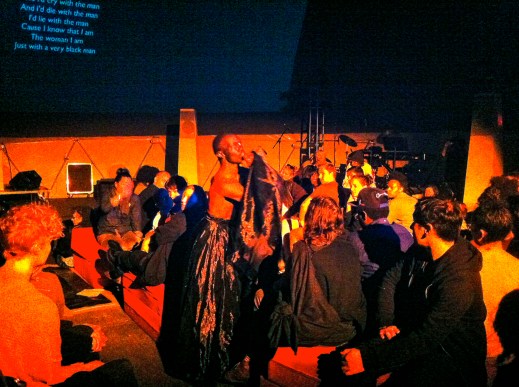
 Welcome to week four of our February Forum on “Sonic Borders,” a collaboration with the IASPM-US blog in connection with this year’s IASPM-US conference on Liminality and Borderlands, held in Austin, Texas from February 28 to March 3, 2013. The “Sonic Borders” forum is a Virtual Roundtable cross-blog entity that will feature six Sounding Out! writers posting on Mondays through February 25, and four writers from IASPM-US, posting on Wednesdays starting February 6th and ending February 27th. For an encore of weeks one through three of the forum, click here. And now, Tavia Nyong’o reviews Courtesy the Artist’s The Meeting, courtesy of Sounding Out! –JSA
—
Last October 2012, in tandem with the New York launch of the retrospective art show Now Dig This! Art and Black Los Angeles 1960-1980, curated by Kellie Jones and running through March 11, 2013, MoMA PS 1 invited the sounds and images of Black Power into their courtyard Performance Dome for a Sunday afternoon collaborative arts project called The Meeting curated by Courtesy the Artists. Courtesy the Artists is the collaboration of Malik Gaines and Alexandro Segade: two-thirds of the core members of the L.A.-based performance art collective My Barbarian (the third is Jade Gordon). For The Meeting, recently transplanted New Yorkers Gaines and Seagade opted to curate a gathering of local artists, dancers and musicians they wanted to get to know better, such as LaTasha Diggs, niv Acosta, and Samita Sinha.
Curation as collaboration was the ethos behind The Meeting in PS1; Gaines and Segade were much more than masters of ceremony, but performed alongside the artists and musicians they invited. At times The Meeting felt more like a jam session than anything else, following the improvisatory and ensemblic ethos of experimental jazz. Performance piece as musician’s jam was indeed a fitting form, given that the afternoon was built around Seize the Time, a 1969 album of agit-prop cabaret recorded by activist, musician, and erstwhile Black Panther leader, Elaine Brown.
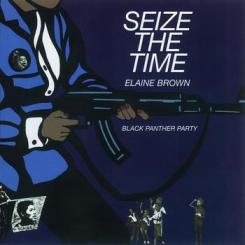
Each participant in The Meeting was invited to respond, in their chosen art form to a song from Brown’s album or another aspect of her legacy that moved them. And move them it did. If music held the event together — from Charles Gaines on the piano and drums to Matana Roberts on a haunting saxophone solo to Geo Wyeth closing down the evening with an astonishing version of “Seize the Time” intermixed with “Age of Aquarius” from the musical Hair — poetry, polemic, video, and dance sent it spinning off into a dozen scintillating tangents.
What those intersecting and diverging responses to Brown’s album shared was a concern with how the past resonates in the present, how a historical call might not always be muted over time, but sometimes amplified by its repetition across time. Given the predominance of the visual in contemporary culture — nowhere more glaring, perhaps, than in institutions devoted to visual art — what do we make of the role of the aural as a medium through which to register the reverberations of a past? The Meeting was held in a temporary structure, literally vestibular to the permanent edifice of the museum. Is the ear a similar vestibule to the institutions of culture, and, if it is, then wherein might the power of that vestibular flesh, as Hortense Spillers once named it, lie?
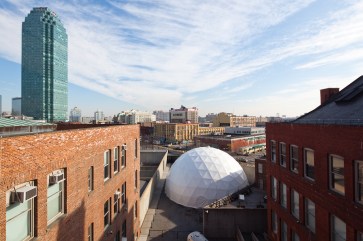
NYC MoMa Ps1’s Vestibular Performance Dome, image by http://momaps1.tumblr.com/
On Seize the Time, the mercurial Brown transposed the black revolutionary urgency of the 1960s into a musical idiom that sounded remarkable even in its day. It is slightly bemusing to settle into the jazzy opening of the title track “Seize the Time” with the knowledge that Marvin Gaye’s What’s Going On and Curtis Mayfield’s Super Fly were just around the corner. Certainly, despite their shared sonic defiance of American racism, Brown’s didactic sprechegesang would never be mistaken for Nina Simone’s soulful alto. Closer to the sonic mark would be singer-songwriters like Carole King, Janis Ian and Joni Mitchell, artists who broke the mold for women in pop in the late 1960s and early 1970s. Consider the rhetorical and musical twists and turns of the first verse of “The End of Silence,” a song that manages equal parts women’s liberation and black nationalism without ever teetering into blaxploitation supervixen territory:
Have you ever stood
In the darkness of night
Screaming silently you’re a man?
Have you ever hoped
That the time would come
When your voice could be heard
In the noonday sun?
Have you waited so long
Till your unheard song
Has stripped away your very soul?
Then believe it my friend
That the silence can end
We’ll just have to get guns and be men.
If The Meeting was a response to the call of that final line, it was one in which the shift from a single voice with backing band to a range of voices and positions was always audible. Some might call this postmodern fragmentation: dance choreographed to a repeating sample of Brown singing “freedom back,” a version of the album edited down to just the sequential instances of her singing the word “man,” played to projected images of every gun in the Panther arsenal she lists in her book. But these interventions arguably only expand our audition of the original album’s possibilities. More than 30 years on, The Meeting took advantage of Seize The Time’s musico-political incongruity to prise open new lines of affiliation between the past and our revanchist present. The question continuously hung in the air: How do we occupy our radical black and feminist legacies, especially given the fact that we cannot simply repeat those struggles in identical terms? How do we get freedom back?
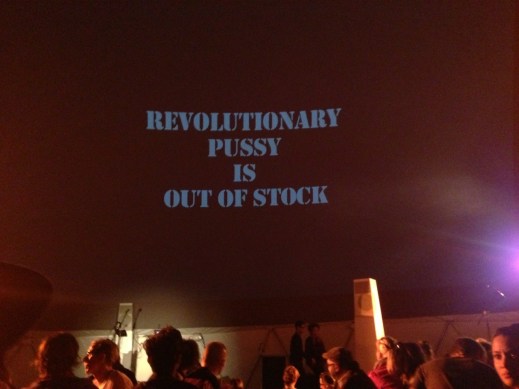
The Meeting courtesy of http://blackcontemporaryart.tumblr.com/
The declamatory cadences of black rhetoric were as central to the way The Meeting sounded as was its music. LaTasha Diggs’s barnburning performances stopped the show to inform us that revolutionary pussy was out of stock. With Charles Gaines on drums and Matana Roberts on sax, Malik Gaines scatted excerpts from President Obama’s “race speech” while excerpts from speeches Elaine Brown had given to the Panthers were read. Since the context of Obama’s speech had been his own attempt to surrogate the justified anger of the Black Power generation with a message of reconciliation, re-mixing it in this context meant it no longer had the privilege of temporal succession over Brown, but black feminist rhetoric and the improvisatory sax could invaginate his rhetoric with an eternal recurrence of radical insurgence.
It is important to note the predominantly queer and trans performance modalities through which the Meeting posed–if not fully answered–its questions regarding freedom in a contemporary context. Brown’s refrain “we’ll just have to get guns and be men” took on a new connotation when juxtaposed against the queer and trans bodies and voices in performance.
Here history revealed itself as palimpsest: images and icons were superimposed one upon the other to create dense, freighted symbols of masculinity and femininity. In a refrain originally meant to rally radical black women towards the community leadership roles tendentiously claimed by men, the gun was much more than a ‘phallic symbol.’ As Kara Keeling recounts in The Witch’s Flight (an important book containing a shrewd analysis of Seize the Time):
The appearance of the [Black Panther Party] allowed for the recognition of the black man in the Black. But this need not be understood as precluding black “females” from appearing in blacks with guns, nor does it necessarily indicate an inherent connection between “men” and “males.” What is perhaps most innovative about the BPP’s cinematic appearance is that it threw into doubt the validity of the common sense that linked “man” with “male” with “masculine” (85).
For Keeling, the innovative disruption of white supremacist racist sense — congealed in stereotypical images of black men and black women — set the stage, formed the backing track, for the historical emergence of queer and transmasculinities.
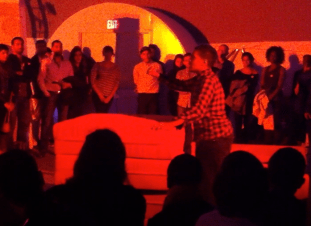
niv Acosta, image courtesy of the author
Transgender dancer and choreographer niv Acosta rhythmically ran his body against the cushioned seating of the performance dome, to the rhythmic sampling of “freedom back.” The phrase was curiously ambiguous: what actual historical freedom could Brown have possibly exhorted the panthers to claim? What imagined freedom do we think we can reclaim via our remixing of Black Power? The power of Acosta’s performance was to embody that question as a lived and livable improvisation.
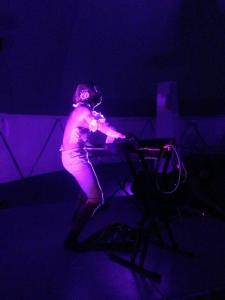
Geo Wyeth performs, image courtesy of @momaps1
The degree to which a musical legacy such as Brown’s can or should be appropriated beyond a black context was also pointedly staged that afternoon, perhaps most self-consciously by Alex Segade’s rendition of “The Meeting” — which Brown once called the Party’s anthem — in Spanish. Segade’s version captured the melodrama and romantic longing, staging the historical interconnections between black and brown power in California as a hall of mirrors and fleeting glances.
Geo Wyeth brought the house down with a funky final number that had the audience on the edge of their seats, perhaps awaiting the promised nudity a sign at the entrance warned the performance would contain. Wyeth’s onstage costume changes were anything but a striptease, however, as he instead fused the militancy of Seize the Time with the sexual revolution of Hair in an incompossible auditory portrait of the legacy of “the Sixties.” His performance left the audience with the emphatic reminder that it is less his generation’s challenge to prove adequate to the past than it is to retrieve from history’s shroud the pulsating star of their own desires.
—
[The Meeting included Simone Leigh, Samita Sinha, Matana Roberts, Charles Gaines, Malik Gaines, Adam Pendleton, niv Acosta, LaTasha Diggs, Xaviera Simmons, Jarrod Kentrell, Alex Segade, and Geo Wyeth].
—
Featured Image of Jarrod Kentrell performing to Elaine Brown’s “Very Black Man” at The Meeting, Courtesy of the author
—
Tavia Nyong’o is Associate Professor of Performance Studies at New York University, where he writes, researches and teaches critical black studies, queer studies, cultural theory, and cultural history. His first book, The Amalgamation Waltz: Race, Performance, and the Ruses of Memory (Minnesota, 2009), won the Errol Hill Award for best book in African American theatre and performance studies. Nyong’o has published articles on punk, disco, viral media, the African diaspora, film, and performance art in venues such as Radical History Review, Criticism, TDR: The Journal of Performance Studies, Women & Performance: A Journal of Feminist Theory, Women Studies Quarterly, The Nation, and n+1. He is co-editor of the journal Social Text.
Share this:


Current Top Posts





April 2021

January 2020

November 2019

October 2019

August 2019

April 2014

November 2017

March 2015

December 2017

October 2015
 Sounding Out!
Recent Comments