
“This AI will heat up any club”: Reggaetón and the Rise of the Cyborg Genre


This series listens to the political, gendered, queer(ed), racial engagements and class entanglements involved in proclaiming out loud: La-TIN-x. ChI-ca-NA. La-TI-ne. ChI-ca-n-@. Xi-can-x. Funded by an Andrew W. Mellon Foundation as part of the Crossing Latinidades Humanities Research Initiative, the Latinx Sound Cultures Studies Working Group critically considers the role of sound and listening in our formation as political subjects. Through both a comparative and cross-regional lens, we invite Latinx Sound Scholars to join us as we dialogue about our place within the larger fields of Chicanx/Latinx Studies and Sound Studies. We are delighted to publish our initial musings with Sounding Out!, a forum that has long prioritized sound from a queered, racial, working-class and “always-from-below” epistemological standpoint. —Ed. Dolores Inés Casillas
—
Busco la colaboración universal donde todos los Benitos puedan llegar a ser Bad Bunny. –FlowGPT, TikTok
In November of 2023, the reggaetón song “DEMO #5: NostalgIA” went viral on various digital platforms, particularly TikTok. The track, posted by user FlowGPT, makes use of artificial intelligence (Inteligencia Artificial) to imitate the voices of Justin Bieber, Bad Bunny, and Daddy Yankee. The song begins with a melody reminiscent of Justin Bieber’s 2015 pop hit “Sorry.” Soon, reggaetón’s characteristic boom-ch-boom-chick drumbeat drops, and the voices of the three artists come together to form a carefully crafted, unprecedented crossover.
Bad Bunny’s catchy verse “sal que te paso a buscar” quickly inundated TikTok feeds as users began to post videos of themselves dancing or lip-syncing to the song. The song was not only very good but it also successfully replicated these artists– their voices, their style, their vibe. Soon, the song exited the bounds of the digital and began to be played in clubs across Latin America, marking a thought-provoking novelty in the usual repertoire of reggaetón hits. In line with the current anxieties around generative AI, the song quickly generated public controversy. Only a few weeks after its release, ‘nostalgIA’ was taken down from most digital platforms.

The mind behind FlowGPT is Chilean producer Maury Senpai, who in a series of TikTok responses explained his mission of creative democratization in a genre that has been historically exclusive of certain creators. In one video, FlowGPT encourages listeners to contemplate the potential of this “algorithm” to allow songs by lesser-known artists and producers to reach the ears of many listeners, by replicating the voices of well-known singers. Maury Senpai’s production process involved lyric writing, extensive study of the singers’ vocals, and the Kits.ai tool.
Therefore, contrary to FlowGPT’s robotic brand, ‘nostalgIA’ was the product of careful collaboration between human and machine– or, what Ross Cole calls “cyborg creativity.” This hybridization enmeshes the artist and the listener, allowing diverse creators their creative desires. Cyborg creativity, of course, is not an inherent result of GenAI’s advent. Instead, I argue that reggaetón has long been embedded in a tradition of musical imitation and a deep reliance on technological tools, which in turn challenges popular concerns about machine-human artistic collaboration.
Many creators worry that GenAI will co-opt a practice that for a long time has been regarded as strictly human. GenAI’s reliance on pre-existing data threatens to hide the labor of artists who contributed to the model’s output. We may also add the inherent biases present in training data. Pasquinelli and Joler propose that the question “Can AI be creative?” be reformulated as “Is machine learning able to create works that are not imitations of the past?” Machine learning models detect patterns and styles in training data and then generate “random improvisation” within this data. Therefore, GenAI tools are not autonomous creative actors but often operate with generous human intervention that trains, monitors, and disseminates the products of these models.
The inability to define GenAI tools as inherently creative on their own does not mean they can’t be valuable for artists seeking to experiment in their work. Hearkening back to Donna Haraway’s concept of the cyborg, Ross Cole argues that
Such [AI] music is in fact a species of hybrid creativity predicated on the enmeshing of people and computers (…) We might, then, begin to see AI not as a threat to subjective expression, but another facet of music’s inherent sociality.
Many authors agree that unoriginal content—works that are essentially reshufflings of existing material—cannot be considered legitimate art. However, an examination of the history of the reggaetón genre invites us to question this idea. In “From Música Negra to Reggaetón Latino,” Wayne Marshall explains how the genre emerged from simultaneous and mutually-reinforcing processes in Panamá, Puerto Rico, and New York, where artists brought together elements of dancehall, reggae, and American hip hop. Towards the turn of the millennium, the genre’s incorporation of diverse musical elements and the availability of digital tools for production favored its commercialization across Latin America and the United States.
The imitation of previous artists has been embedded in the fabric of reggaetón from a very early stage. Some of the earliest examples of reggaetón were in fact Spanish lyrics placed over Jamaican dancehall riddims— instrumental tracks with characteristic melodies. When Spanish-speaking artists began to draw from dancehall, they used these same riddims in their songs, and continue to do so today. A notable example of this pattern is the Bam Bam riddim, which is famously used in the song “Murder She Wrote” by Chaka Demus & Pliers (1992).
This riddim made its way into several reggaetón hits, such as “El Taxi” by Osmani García, Pitbull, and Sensato (2015).
We may also observe reggaetón’s tradition of imitation in frequent references to “old school” artists by the “new school,” through beat sampling, remixes, and features. We see this in Karol G’s recent hit “GATÚBELA,” where she collaborates with Maldy, former member of the iconic Plan B duo.
Reggaetón’s deeply rooted tradition of “tribute-paying” also ties into its differentiation from other genres. As the genre grew in commercial value, perhaps to avoid copyright issues, producers cut down on their direct references to dancehall and instead favored synthesized backings. Marshall quotes DJ El Niño in saying that around the mid-90s, people began to use the term reggaetón to refer to “original beats” that did not solely rely on riddims but also employed synthesizer and sequencer software. In particular, the program Fruity Loops, initially launched in 1997, with “preset” sounds and effects provided producers with a wider set of possibilities for sonic innovation in the genre.
The influence of technology on music does not stop at its production but also seeps into its socialization. Today, listeners increasingly engage with music through AI-generated content. Ironically, following the release of Bad Bunny’s latest album, listeners expressed their discontent through AI-generated memes of his voice. One of the most viral ones consisted of Bad Bunny’s voice singing “en el McDonald’s no venden donas.”
The clip, originally sung by user Don Pollo, was modified using AI to sound like Bad Bunny, and then combined with reggaetón beats and the Bam Bam riddim. Many users referred to this sound as a representation of the light-heartedness they saw lacking in the artist’s new album. While Un Verano Sin Ti (2022) stood out as an upbeat summer album that addressed social issues such as U.S. imperialism and machismo, Nadie Sabe lo que va a Pasar Mañana (2023) consisted mostly of tiraderas or disses against other artists and left some listeners disappointed. In a 2018 post for SO!, Michael S. O’Brien speaks of this sonic meme phenomenon, where a sound and its repetition come to encapsulate collective discontent.
Another notorious case of AI-generated covers targets recent phenomenon Young Miko. As one of the first openly queer artists to break into the urban Latin mainstream, Young Miko filled a long-standing gap in the genre—the need for lyrics sung by a woman to another woman. Her distinctive voice has also been used in viral AI covers of songs such as “La Jeepeta,” and “LALA,” originally sung by male artists. To map Young Miko’s voice over reggaetón songs that advance hypermasculinity– through either a love for Jeeps or not-so-subtle oral sex– represents a creative reclamation of desire where the agent is no longer a man, but a woman. Jay Jolles writes of TikTok’s modifications to music production, namely the prioritization of viral success. The case of AI-generated reggaetón covers demonstrates how catchy reinterpretations of an artist’s work can offer listeners a chance to influence the music they enjoy, allowing them to shape it to their own tastes.
Examining the history of musical imitation and digital innovation in reggaetón expands the bounds of artistry as defined by GenAI theorists. In the conventions of the TikTok platform, listeners have found a way to participate in the artistry of imitation that has long defined the genre. The case of FlowGPT, along with the overwhelmingly positive reception of “nostalgIA,” point towards a future where the boundaries between the listener and the artist are blurred, and where technology and digital spaces are the platforms that allow for an enhanced cyborg creativity to take place.
—
Featured Image: Screenshot from ““en el McDonald’s no venden donas.” Taken by SO!
—
Laurisa Sastoque is a Colombian scholar of digital humanities, history, and storytelling. She works as a Digital Preservation Training Officer at the University of Southampton, where she collaborates with the Digital Humanities Team to promote best practices in digital preservation across Galleries/Gardens, Libraries, Archives, and Museums (GLAM), and other sectors. She completed an MPhil in Digital Humanities from the University of Cambridge as a Gates Cambridge scholar. She holds a B.A. in History, Creative Writing, and Data Science (Minor) from Northwestern University.
—

REWIND!…If you liked this post, you may also dig:
Boom! Boom! Boom!: Banda, Dissident Vibrations, and Sonic Gentrification in Mazatlán—Kristie Valdez-Guillen
Listening to MAGA Politics within US/Mexico’s Lucha Libre –Esther Díaz Martín and Rebeca Rivas
Ronca Realness: Voices that Sound the Sucia Body—Cloe Gentile Reyes
Echoes in Transit: Loudly Waiting at the Paso del Norte Border Region—José Manuel Flores & Dolores Inés Casillas
Experiments in Agent-based Sonic Composition—Andreas Pape
Share this:

Brasil Ao Vivo!: The Sonic Pleasures of Liveness in Brazilian Popular Culture

 After a rockin’ (and seriously informative) series of podcasts from Leonard J. Paul, a Drrty South banger dropped by SO! Regular Regina Bradley, a screamtastic meditation from Yvon Bonenfant, and a heaping plate of food sounds from Steph Ceraso, our summer Sound and Pleasure series gets even louder with Kaleb Goldschmidt‘s work on live events in Brazil. Brasil Ao Vivo! –-JS, Editor-in-Chief
—
Brazilians pray, cheer and celebrate in public and often in close physical proximity to each other. From the nearly 3 million people that flocked to Copacabana Beach to hear Pope Francis lead a mass in 2013 to the huge crowds that regularly turn out for concerts at Maracanã stadium, Brazilians earn their global reputation for large-scale public events. Of course there is Carnival in Rio de Janeiro and Salvador; the largest LGBT Pride Parade in the world held in São Paulo; and then there is football.
The relationship between large-scale public events and sound hit home as the country reacted to the national team’s humiliating loss to Germany in the semi-final round of the 2014 FIFA World Cup. The world witnessed a different kind of public outpouring as the Brazilian public mourned. Within hours of the initial shock at the lopsided score, images of Brazilian football fans weeping and screaming in the stadium and on the street became a humorous meme with music and sound playing a prominent role. By the next day, most Brazilian football observers were taking pleasure in the public spectacle of weeping fans. With the abundance of images featuring hysteria, videos mocking the intensity of the crying went viral with dramatic musical scores. One observer proclaimed : “essa capacidade de rir de nós mesmos é uma das melhores qualidades”; the capacity to laugh at ourselves is one of our best qualities. That Brazilians express all varieties of emotions and annual passages together in public for everyone to witness, even when they border on campy excess, allow for everyone to feel the pleasures of community and the power of public performance.

“Abschlussfeier Maracana Fifa WM 2014” by Flickr user Marco Verch, CC BY 2.0
All of this led me to believe that such a public culture has an effect on the aesthetics of what performance studies scholar Philip Auslander calls “liveness” in recorded music and related viral media. Auslander argues that the appeal of liveness for television broadcasts, concerts, and other stage performances allows audiences to feel the immediacy of the moment even if the presence of mediation, such as screens and on-air censorship, is obvious. The international spectacle of Brazilians emoting en masse, then, has a direct relationship with Brazilian sonic aesthetics. Nowhere, I argue, is this more prominent than in the (sometimes viral) popularity of live recordings.
That immediacy Auslander speaks of spreads to many aspects of Brazilian popular culture, including the popularity of concert DVDs and albums which are regularly listed among the most popular domestic recordings. In fact, concert records tend to be more popular than the studio albums that inspire the tour. These live albums often carry the designations Ao Vivo, live or MTV Acústico (the equivalent of the Unplugged albums popular in the United States), and they are often recorded in such a way so as to feature the interaction of the crowds. In place of the draw for authenticity (a value that permeates the MTV Unplugged recordings) is the love for community, and for experiencing big emotions together no matter how obviously they are mediated through cameras, microphones and other technology. Through the example of the continued popularity of live albums in Brazil, there is an opening for a different theorization for sounding liveness; in place of celebrating canonic performances and virtuosity, the valorization of liveness in Brazil reinforces the importance of crowds and the so-called “popular classes” at the root of the politicized singer-songwriter genre MPB or Música Popular Brasileira.
The pleasure and preference for live recordings also extends to social media. For meme chasers, a good example of this is Michel Teló’s 2011 hit “Ai Se Eu Te Pego.” The song and video were recorded ao vivo before a crowd dominated by young women. A close listen reveals that sounds of Teló’s female audience members are just as important as his voice even if his voice is only slightly louder in the mix. There is barely a moment in the recording when the audience stops making itself heard; the engineering revels in their presence. This is especially obvious during the opening seconds of the track when Teló and his audience sing “Nossa, nossa / assim você me mata / Ai, se eu te pego / Ai, ai, se eu te pego” [Wow, wow / you kill me like that / Ah, if I could get you / ah, ah, if I could get you] in unison at nearly the same volume in the mix. When the accordion and electric bass (crucial instruments for the song’s forró style) finally enter over the screaming audience, there is a noticeable break in the tension set up by the audience and Teló singing together. Their cries, like those in other live recordings, illustrate Teló’s appeal to the crowd in that moment while also allowing other listeners to imagine themselves there.
Teló’s song went viral (as of this writing, the official version currently has nearly 580 million views on YouTube and over 72 million plays on Spotify), with alternate video versions teaching the song’s dance steps and others highlighting global football stars dancing and singing along to the song. At one point Neymar, the national team’s biggest hope for World Cup victory, sang with Teló in front of a crowd. In general, Teló’s live songs easily outpace his studio recordings in terms of virality, and, I would argue, that a major part of the appeal of “Ai Se Eu Te Pego” is its provenance in a concert setting. It is just as important that the screaming throngs of women are audible as it is for those dance steps to be easy and recognizable. The liveness of the recording is so important, in fact, that the screaming audience appears as sampled snippets in the Pitbull remix. In its viral form, Teló’s song united the popularity of live spectacle with Brazil’s enthusiasm for other live events, merging concert goers with football fans.
The popularity of Teló’s live song is not an isolated incident. Look, for example, at record sales figures for all time. Two are live albums by artists who do not appear elsewhere on the list. Other albums that have sold more than 2 million copies in Brazil alone are by Roberto Carlos (Acústico MTV) and the teen pop/rock duo Sandy and Júnior (As Quatro Estações ao Vivo and Era Uma Vez… Ao Vivo). In 2011, five of the top ten albums in Brazil fit the ao vivo mode with little regard to genre: MPB stars Caetano Veloso and Maria Gadú are there alongside sertanejo artists Paula Fernandes and Luan Santana. In 2012, three of the top 20 best-sellers were live albums. Meanwhile, DVDs of concerts in Brazil continue to be strong sellers. Thus, the communal pleasure palpable on-screen translates to that experienced in the home.
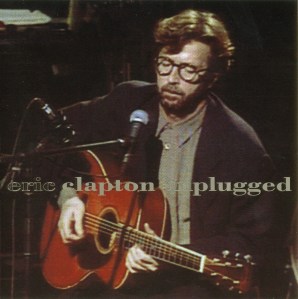
“Eric Clapton – Unplugged” by Flickr user Ian Alexander Martin, CC BY-NC-ND 2.0
Compare this with the status of live records in the United States in the last few years where they have rarely seen any chart success. If anything, liveness continues in YouTube clips and Spotify Sessions but not in physical sales and downloads. This is probably because live albums for U.S. based artists are embedded with different values having to do with the rock authenticity rather than communal pleasure. These performances demonstrate the chops of the musician and valorize the concerts (and tours) as events. The double live albums from the 1970s such as as Frampton Comes Alive, Lynyrd Skynyrd’s One More From The Road, and Kiss Alive! hold a prized place in the classic rock canon, often as much for extended guitar solos rather as the screaming throngs of fans. In the late ‘80s and early ’90s live albums, especially MTV Unplugged, re-inscribed a love of liveness through acoustic instruments and songs that reached back into the roots of American popular music. Eric Clapton’s Unplugged (1992) even topped the Billboard album charts and won 6 Grammy awards including Album of the Year while other records such as Nirvana’s MTV Unplugged in New York and U2’s Rattle and Hum were multi-platinum hits. While there is the occasional top-40 live single, these songs are the exception to a genre of that has has moved liveness to YouTube rather than streaming and MP3 markets.
SO! contributor Osvaldo Oyola has noted there is a tension between the efforts recording engineers often go through to make studio recordings sound as immediate as possible, and those that call attention to the recording process. Live records replace the need to sound polished with the need to sound spontaneous, often reveling in mistakes and banter. That immediacy is something I enjoy when listening to live recordings and it has a parallel for many people who participate in the reception of major events in real time through social media.
In Brazil, audiences enjoy the immense power of participation in live events. As part of a larger work in progress I’m particularly fascinated by how this power and pleasure is mediated through the sonic experience of recordings and viral social media. Whether they are sharing tears over an international football loss or singing along to “Ai Se Eu Te Pego” Brazilians extend Auslander’s liveness by prolonging and replaying the immediacy of the crowds to experience that shared sonic moment, again and again.
—
Kaleb Goldschmitt is a Visiting Lecturer in the Faculty of Music at University of Cambridge. Her scholarly work focuses on Brazilian music, modes of listening, and sonic branding in the global cultural industries. She has published in the Oxford Handbook of Mobile Music Studies, Popular Music and Society, American Music, Yearbook for Traditional Music, and Luso-Brazilian Review and contributes to the South American cultural magazine, Sounds and Colours.
—
Featured image: Adapted from “Gloria” by Flickr user Lourenço Fabrino, CC BY-NC-SA 2.0
—
 REWIND! . . .If you liked this post, you may also dig:
Sound-politics in São Paulo, Brazil— Leonardo Cardoso
Calling Out To (Anti)Liveness: Recording and the Question of Presence–Osvaldo Oyola
Hello, Americans: Orson Welles, Latin America, and the Sounds of the “Good Neighbor“– Tom McEnaney
Share this:


Current Top Posts





April 2021

January 2020

November 2019

October 2019

August 2019

April 2014

November 2017

March 2015

December 2017

October 2015
 Sounding Out!
Recent Comments