
The Absurdity and Authoritarianism of Now: My Chemical Romance’s The Black Parade Resonates Queerly, Anew
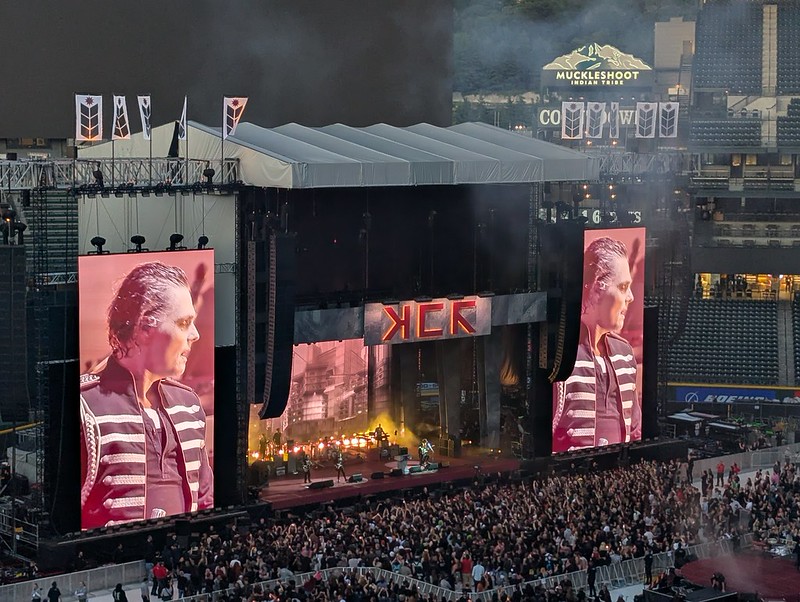
My Chemical Romance fans are speculating about new music after the band wiped their X account clean and wrapped up the Latin America leg of their tour this month. Whether another album is on the way or not, MCR’s magnum opus – The Black Parade – continues to endure two decades later. The sound now resonates through MCR’s commentary on fascism, critiquing the nation while holding the crowd accountable for our participation or passivity.
As the band tours The Black Parade for its 20th anniversary, the members have rejected nostalgia in favor of a new storyline, playing alter-ego characters who have been conditioned to perform for a dictator. The plot, slightly shifting night to night, encourages fans to follow along.
In the first run of the tour, each concert paused midway for an “election.” Four hooded figures walked out to the center stage. Nearby, an army official watched. Singer Gerard Way asked the audience to vote: Support these candidates or reject them? Each person in the crowd had a sign. One side: YEA. The other side: NAY.
“Now we need to hear you,” Way says. The audience roars, jeering and cheering.
No matter the spectators’ will, the result is the same: execution.
The warped election – and the sound of The Black Parade – reflects the absurdism of authoritarianism. Here is a democracy that ends in death, regardless of how you vote. Viewers log into livestreams to watch the fanfare repeat.
MCR’s commentary echoes the ramping authoritarianism and upheaval in the United States:
- The Supreme Court cleared the way for immigration agents to use race as a reason to stop and check someone’s citizenship documents. Daily ICE arrests reached a decade high last year. 2025 also marked the deadliest year for people in ICE custody in two decades.
- Protests have swept the nation, with outrage further increasing after federal agents killed two Minneapolis demonstrators this January.
- Cuts and changes to Medicaid and SNAP are on their way. The longest government shutdown also ended without extending subsidies for health care.
- The Epstein files were released, showing ties between powerful leaders and sex offender Jeffrey Epstein.
- The Department of Governmental Efficiency, named after an outdated Internet meme (DOGE), has resulted in the elimination of at least 290,000 jobs.
- The U.S. withdrew from the Paris Agreement and World Health Organization. The country also pulled out of 66 international organizations.
- Trump continues to enact steep tariffs after a Supreme Court ruling against his policy.
- Layoffs soared past 1.1 million job cuts in 2025, the highest since 2020’s COVID-19 shutdown.
This list represents a fraction of stories and executive orders in 2025; a “flood the zone” strategy overwhelmed the news cycle. Despite censorship efforts – such as the federal defunding of NPR and PBS – much of this information is available to us at the click of a button. State-sanctioned propaganda even encourages the spectacle. Just take a look at footage of ICE raids on the WhiteHouse’s TikTok account, set to songs and images of pop stars:
Yet fatigue and fearmongering keep many complacent; looming economic crises also draw our attention and time. I do not mean to diminish people’s efforts of resistance. But I am interested in the way technology has expanded our potential to witness violence, without ever requiring us to act – as well as the power of entertainment to distract.
So I turn back to MCR’s spectacle, which twists and mirrors this descent into fascism. Up against the tour’s faux-executions, the boos and the cheers of the crowd collapse into a cacophony. I locate the sound of our times within these screams, where dissent seems to go unheard and melds into the chorus of support.
The Black Parade is full of these bombastic wails, but the most intense of them are in “Mama,” a song that balloons into an extended eight-minute performance in the Long Live the Black Parade Tour. Within “Mama,” I try to make some sense of these screams, finding queer resonance with the present moment.
With my analysis, I ask: How might we hold fascist figures to account without squirming out of our own role in the daily exchange of authoritarianism? I argue My Chemical Romance’s 2025-2026 performance of “Mama” highlights structures of violence but also criticizes our participation within them.
In “Mama,” the indulgence of sin is contagious. It’s loud. It’s repeated: “Mama, we all go to hell.” This refrain, set to a polka beat, creates an abject intimacy around our shared fate. Queer listeners have interpreted this song as an angry anthem against the rejection we face from our families and dogmatic religion. For those of us who have heard, “You’re going to hell,” the response, “We all go to hell,” serves as a relief. Verses like “You should’ve raised a baby girl, I should’ve been a better son” have been reclaimed by transgender fans.
Other fans have taken issue with these interpretations, arguing queer attachments distract from the “true” meaning of the song. Indeed, “Mama” tells the story of a soldier writing from the trenches of war, while his mother judges him from afar. But I argue that by placing a queer reading in tandem with the canonical narrative, generative meanings emerge. Queer theory provides tools to understand the role of the mother here. Mama is the title of the song. Mama is pervasive. Mama is mean. Mama is on his mind. But she is also almost entirely absent, avoiding accountability for her son’s violence and instead blaming him: “She said, ‘You ain’t no son of mine.’”
The soldier finds that the trenches are not just his domain, but also his mama’s: “Mama, we’re all full of lies…And right now, they’re building a coffin your size.” His plea to his mother helps us wonder: What about the culture that birthed this violence? In this metaphor, critiquing the mother extends to critiquing the nation.
At the climax of the song, these sentiments come through screams: 30 seconds of an extended, “AHHHHHH” and a crying out of, “Mama, Mama, Mama.” In these wails, I find a soldier begging to share responsibility with his motherland, even as he contends with his own role in the violence. The cries puncture the polka, demonstrating “Mama” is not a celebration, after all.
Mama only sings one line back, through the voice of theater icon Liza Minnelli: “And if you would call me a sweetheart/I’d maybe then sing you a song.” Minnelli’s voice connects the song’s sound to her role in Cabaret, a musical which mixes together queer aesthetics and indulgent decadence with a foreboding rise of fascism. This allusion to Cabaret, as well as the tour performance, serve as a reminder: pleasure and entertainment does not always equal resistance.
In the extended version of “Mama” on tour, these lines are sung by an opera singer, whose voice, too, serves the dictator. Preceding her performance, the song briefly opens up a space for resistance. A new section of the song, debuted on the tour, includes the lyrics:
A dagger, a dagger
Please fetch me a dagger
A tool for our treasonous needs…
With tears in our eyes we collapse on the crosses
And said death be the son of us all
This war is the son of us all.
Even as Gerard Way’s character plots treason against the dictator, these new lyrics make clear: this “death” and “war” is “the son of us all.” Though we might want to pin fascism on one figure, many Americans have participated in the creation of this “death/war.” There are fatal consequences for our collective actions – or our passivity.
Ultimately, the dramatics of this song, delivered like a sinister weapon, critique violence, while ironically trapping us in its pleasures. If prayer is crying out to our father who art in heaven, “Mama” is yelling back at our mother to bring her to where she belongs: the hell in which we both exist. Given the stakes of our political moment, I argue we need to scream louder, with purpose and strategy, against our motherland.
—
Featured Image: “My Chemical Romance Live at T-Mobile Park 6/11/25,” Image by Flickr User Laura Smith CC BY-ND 4.0
—
Max Lubbers (he/she) is a first-year PhD student in the American Studies and Ethnicity department at the University of Southern California. His research centers on transgender affects and sounds. Max earned a bachelor’s degree in Journalism and Gender and Sexuality Studies from Northwestern University, with a senior thesis on butch affect. She previously worked as a journalist, with pieces in Chicago’s NPR station, Colorado Public Radio, and Windy City Times.
—

REWIND!…If you liked this post, check out:
The Sounds of Equality: Reciting Resilience, Singing Revolutions–Mukesh Kulriya
Vocal Anguish, Disinformation, and the Politics of Eurovision 2016–Maria Sonevytsky
“To Unprotect and Subserve:” King Britt Samples the Sonic Archive of Police Violence —Alex Werth
Share this:

Queer Timbres, Queered Elegy: Diamanda Galás’s The Plague Mass and the First Wave of the AIDS Crisis
 Welcome to the final week of our February Forum on “Sonic Borders,” a collaboration with the IASPM-US blog in connection with this year’s IASPM-US conference on Liminality and Borderlands, held in Austin, Texas from February 28 to March 3, 2013. The “Sonic Borders” forum is a Virtual Roundtable cross-blog entity that will feature six Sounding Out! writers posting on Mondays through February 25, and four writers from IASPM-US, posting on Wednesdays starting February 6th and ending February 27th. For an encore of weeks one through four of the forum, click here. And now, while we regret to inform you that Art Jones’s dispatch from Pakistan must be re-booked at a later date, the show must go on . . .and I am thrilled that writer and Ph.D. student Airek Beauchamp is stepping in as our closing act. Make no mistake, he brings the pain! Once again, Sounding Out! gives you something you can feel. –JSA, Editor-in-Chief
—
At dinner a few days later in the Village Jarrod tells me that he cries whenever anyone says that they really ‘get’ his work. Because his work is so horrifying. It hurts him to know that he has inflicted it upon someone, someone able to understand it.–A.W. Strouse, in reference to the recent performance of Jarrod Kentrell at Ps1‘s “The Meeting”
I first heard Diamanda Galás’s The Plague Mass (1991) around 1994, when I would have been about 20 years old. Equal parts mass and babble, The Plague Mass is an elegiac tribute to Galás’s brother and other victims of the HIV/AIDS epidemic, a sonic rage against the silence surrounding the disease that redefines “the elegy” in the process. I suppose that I should make a confession here and say that contracting HIV was one of my biggest fears at the time. I was fresh out of the closet and ready to experiment, yet the media coverage of the crisis had pretty much told me that, as a gay man, an active sex life was a death sentence, a message I had been receiving since I was in fourth grade. There was something in Galás’s record to which I automatically, deeply connected. Although this brand of desire was new to me, there was also something deeply familiar about it–ancient even–and this feeling was produced by the horror of her work, not in spite of it.
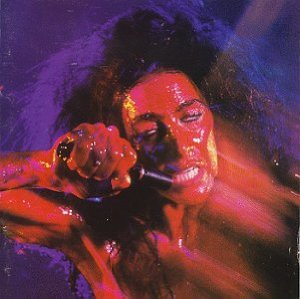
Cover of The Plague Mass (1991)
Recorded live in 1990 at Cathedral of St. John the Divine in New York City, The Plague Mass was conceived as a performance piece, enabling Galás to use sound to move in a messy, unstructured, and often terrifying way across multi-dimensional space. Her sonic trajectories seemed to take my global, abstract fears and make them intimate and concrete. In “Diamanda Galás: Defining the Space In-between,” Julia Meier describes Galás’s soundscape as composed of “chants, shrieks, gurgles, hisses often at extreme volumes, frequently distorted electronically and accompanied by a torrent of words” which defy description (2). In the space created by this cacophony, Galás mourns her brother, responding to the silence surrounding AIDS by making use of what composer and sound theorist Yvon Bonenfant refers to as “queer timbres” in “Queer Listening to Queer Vocal Timbres,” the unique, dynamic sounds of desire and self in the voice that also operate as a kind of touch, a reaching out to other desired and desiring bodies. In homage to Antonin Artaud’s theory of the theater of cruelty–in which audiences are exposed through multisensory domains to truths they often do not wish to see–Galás uses queer timbres to form an outsized means of aural communication in The Plague Mass that fills more affective space than standard musical productions or theater productions. The shrieks and howls suggest Galas as depicted on the album’s cover: flayed, raw, and radically open to the passage of every vibration. By erasing semantic and syntactical codes, these sounds deeply engage the entire body in the process of making sound.
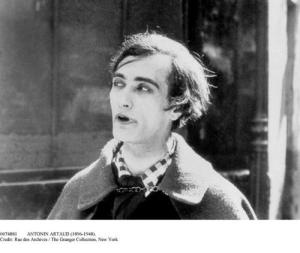
Artaud
Queering the traditional theater, Artaud argued for new intersensuality that would occupy space in a three-dimensional manner. In The Theater and Its Double, Artaud describes how the “intensities of colors, lights, or sounds, which utilize vibration, tremors, repetition, whether of a musical rhythm or a spoken phrase, special tones or a general diffusion of light, can obtain their full effect only by dissonances. But instead of limiting these dissonances to a single sense, we shall cause them to overlap from one sense to the other” (125). Texturing sound, or working with dissonance and disruption to create a more forceful product, offered Artaud a unique play between the senses, allowing it a more direct and apparent physical impact upon the bodies of both performers and the audience.
The plague and how it inhabits and destroys bodies is a central metaphor for sound and language in the work of both Artaud and Galás. Artaud focused much of his theory on the plague as an example not only of an affective space but also as a transformative event in human history and in individual lives. Artaud’s writing on the plague, however, also garnered him harsh criticism. By suggesting a theater in which language became subordinate to the shriek, the grunt or other non-semantic orality, he decried all of traditional French theater and its lofty legacy. Nonetheless, he was invited to speak about his essay “The Theater and the Plague” at the Sorbonne. Deciding to actually incorporate his ideas about ‘liquefying boundaries,” he began speaking in a standard oratorical mode but slowly devolved into a theatrical performance of the plague, eventually ending in shrieks of physical pain. In Watchfiends & Rack Screams, Clayton Eshleman describes how, by the end of his speech, the only people left in the lecture hall were a minor contingent of his close friends, including Anais Nin, who recounted the tale (12). The shrieks, the howls are all a further way to engage the whole body in the process of making sound, while also erasing semantic and syntactical code. In Gilles Deleuze’s estimation of Artaud’s work in The Logic of Sense, it reached the depths of language: “The word no longer expresses an attribute of the state of affairs; its fragments merge with unbearable sonorous qualities, invade the body where they form a mixture and a new state of affairs… In this passion, a pure language-affect is substituted for the effect of language” (89).
Jaap Blonk performs Artaud’s “To Have Done with the Judgement of God”
Reflecting and refracting Artaud, Galás uses the space of The Plague Mass to re-consider and re-theorize the ailing body. In her work the body represents not just Galás herself, but also the bodies of all the afflicted, the bodies issuing negation of suffering, and finally, the collective body of the spectacle of the AIDS crisis. Like Artaud, Galás sees the plague of AIDS as transformative, but without the safe buffer provided by the critical space of history. This plague is instead an immediate issue made all the more volatile due to the refusal to help the victims by the conservative Reagan administration as well as the rigidity of the Catholic Church’s encoded dogma that characterizes homosexuality as sinful depravity and refuses to acknowledge the need for AIDS education and condom distribution. Galás evidences this in the opening track “There Are No More Tickets to the Funeral” which incorporates traditional Christian hymns, liturgical representations of condemnation, and the voices of the afflicted.
These appropriated sounds circulate in constant tension, queering the ominous, authoritative patriarchal drones by contrasting them to the timbres of desire and pain embodied by the shrieks. In “Confessional (Give Me Sodomy or Give Me Death),” the narrator’s voice bleeds into the frantic voice of the defiant dying, blending in with the conjured voices of angels of death that hover over the bed. This commentary places the listener in a very immediate and uncomfortable multidimensional space encompassing several terrifying aspects of death. Here Galás exemplefies Bonenfant’s queer timbres through the tactile effect of layered sound that is felt with the skin, in the bones, as well as with the ears, communicating a palpable experience that lies beyond the barely-nuanced music it is seductively easy to grow accustomed to.
It is Galás’s use of sound’s affective properties that makes The Plague Mass most effective as queered communication. In “This is the Law of the Plague” she incorporates elements of glossolalia, colloquially known in religious communities as “speaking in tongues,” a speech act that embodies voice by implying a physical loss of control of the body as well as the casting off of concrete linguistic structure. Galás’s use of glossolalia deliberately blurs the border between spiritual possession and the madness inherent to AIDS as the virus passed through the blood/brain barrier of its human host.
Aided by electronics, Galás’s vocals begin as the chant of orator. Punctuated by a throbbing, sparse single drum-beat, her sickened, keening crawl of words enumerates in detail what it is that defines a person as unclean. The language is precisely enunciated, each word sharply edged and cornered—a practice that would no doubt double Artaud over in pain, given his struggle with schizophrenia that left him vulnerable to crisp sounds. Slowly, Galás’s voice rises to the shriek of a pious, avenging angel, a shrill, wail shimmering with vibrato communicating the sound of a raptured body, rent in chaotic ecstasy. Eventually her ululations are submerged in a bath of primordial babble, a place where language moves in every direction through a body somehow more permeable, a sonic space that Deleuze would describe as topographic, that is, possessing heights and depths. Enacting and inviting the babble of the mad and the afflicted maintains a red line on the tolerance of the listener’s psyche before returning, without ceremony, to the sparse and cold incantations of the church. Here queer(ed) timbres push the audience to limits well past the reaches of patriarchal or accepted sound; Galas plays along the edge of tolerance before dropping the audience abruptly back into the decidedly colder and less humane sonic tropes of an unforgiving religion.
Galás’s sonic practices encourage in me a listening that reaches out into space to connect with these sounds, whose physicality communicates fears and apprehensions that are old enough to feel genetically encoded in my psyche. Bonenfant describes this reaching as “queer listening,” an extrinsic process based on desire in which “we listen ‘out’ for (reaching towards) voices that we think will gratify us” (77). Bonenfant queers the body in the process of sound; it becomes abstracted, absorbed into a process and functioning on many layers that include—but also subsume—the subjective Cartesian body of agency we are comfortable with. The body becomes bodies, and it becomes present in spaces that go beyond the immediate space it occupies in space/time. Galas traverses time and space in The Plague Mass, from the ancient litanies of hymns and spirituals to the anguish of those afflicted with AIDS, and layers voice on voice until they are inextricable, a huge din telling more than just a story, or The Story but the stories of many.
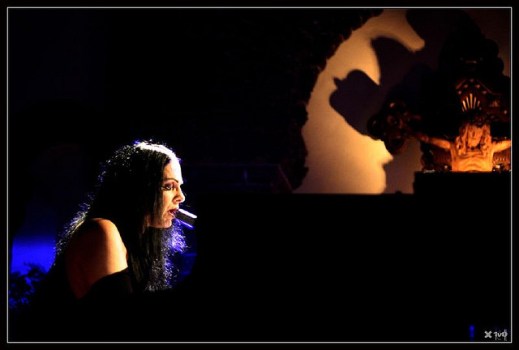
Image by Flickr User 1v0
In a personal e-mail exchange, Bonenfant clarified his relation to both Artaud and Galás. When asked if he was influenced by Artaud he explained:
Not directly, but certainly indirectly, and his ideas affect extended voice practice generally. I think the idea of the ‘theatre of cruelty’ is often deeply misunderstood and it was a product of its time. I understand Artaud to have been crying out for an anti-bourgeois theatre that actually stirred people up. But stirring people up is only part of the story. What stirs some, attracts others. Now, my argument is more that: these voices we might call ‘queer’ stir SOME people up but actually they ATTRACT others – others who might be seeking queered bodies to contact.
Bonenfant went on to explain that artists such as Galás can thus make contact with people who desire the kind of disruption or ‘stirring’ that they provide. He went on to relate a story that Galás shared in an interview, in which she described a performance in which she looked out at the audience and noticed a very young boy listening to her perform. For the rest of the concert, Galás said she felt guilty for the damage she was undoubtedly inflicting on the young boy’s ears and psyche. However, after the concert the boy approached her and thanked her profusely. It turns out that he had suffered from a terminal and painful illness and felt unable to express the physical and emotional distress that he lived with. Here, though, was an artist onstage articulating it, broadcasting it to him and others, for him and others. This is what Bonenfant refers to as “an affective, somatic bond” created through shared sonic experience, and this is what Galas constructs. By standard definitions The Plague Mass is almost unlistenable, but yet it has connected audiences remote in space and time (a nod here to Karen Tongson’s “remote intimacy”). A sonic reaching out attracting listeners similarly reaching, its indelicate music draws the suffering near, providing a form of collective comfort by exploring and embodying the suffering, grief, and rage located beyond the permeable membrane of conscious thought and feeling.
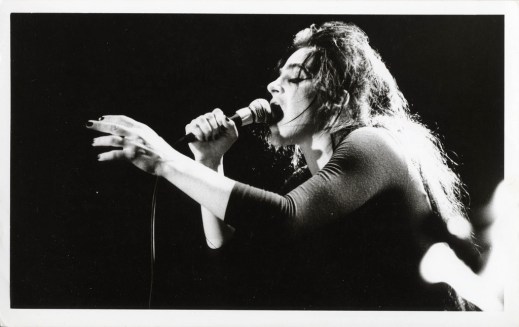
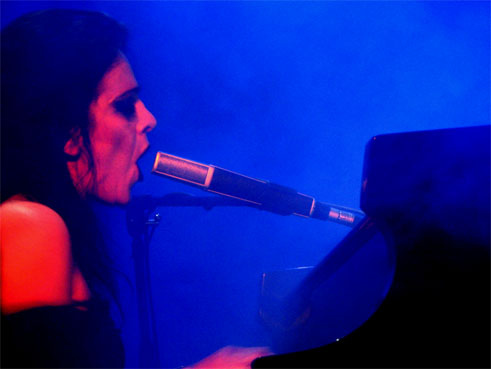
Diamanda Galas performing in the 1980s, Image Courtesy of Flickr User Carl Guderian
It is this kind of connection through a tonal richness that is uncoded but yet full of information that is radically important. Galás’s groans, growls, and chants create an intersubjective circuit of communication that moves active listening outside of the body and draws visceral connections in a three-dimensional psychic space. This is what Galás immediately stirred in me back in 1994, and what I have been determined to recover and communicate since that first listening cut me to the quick. Queer listening does not just entail an affirmation of the soundtracks of queer lives–a kind of perpetual disco, 12” remix project–but rather it also demands a critical–and visceral–vulnerability to the jarring, violent world arranged against queer agency. Galas’s work hijacks the elegy and queers it, extending it to us as an offering against the true horror: the official silence in the face of so much death.
—
Featured Image of Diamanda Galás courtesy of Flickr user digital_freak
—
A Taurus who enjoys the ocean, Airek Beauchamp is currently at SUNY Binghamton pursuing his PhD in Creative Writing. He also studies composition pedagogy and queer theory, although he is becoming more and more seduced by sound studies. He can rock a disco all night or just stay in and maybe catch up on some 30 Rock. Some call him fancy, some call him a bitch, but really he is both. He is a multiplicity of multiplicities, all in one mortal shell.
Share this:


Current Top Posts





April 2021

January 2020

November 2019

October 2019

August 2019

April 2014

November 2017

March 2015

December 2017

October 2015
 Sounding Out!
Recent Comments