
Living with Noise

Image by Flickr User Bill Selak
[O]ne of the chief values of living with music lies in its power to give us an orientation to time.– Ralph Ellison, “Living with Music” (1955)
Early this past fall, my wife and I moved back to Brooklyn after three years in central New York State. We spent two of those years on a back street in a mostly rural area of Cortland, NY, where are there are more dogs than people and more cows than dogs. Those dogs were probably the most intrusive neighborhood sound—a barker would get going and that’d set off a chain reaction from yard to yard, like a real life version of the “Twlight Barking” from 101 Dalmations. Still, I could get used to it, ignore it, zone out. The only other sounds that penetrated our home were the nearby freight trains, but their sounds are almost soothing—the rhythm of the clacking rails like Paul Simon singing “Everybody loves the sound of a train in the distance. . .” or a relaxation tape.
Now back in New York City, I am very aware of the different degree, frequency and quality of sounds I am subjected to while in my living space. Reconsidering living with noise put me in the mind of Ralph Ellison’s 1955 essay “Living With Music” from High Fidelity magazine. Like the living situation Ellison describes, our new place is a rear-facing apartment and we get the sound of echoing voices, car horns or yowling cats (fighting and/or making more cats) bouncing off the back wall of a garage on the next street. However, as most city-dwellers know, it is our neighbors that provide the most persistent and profound sonic disturbances. Ellison himself was disturbed at an upstairs neighbor’s overzealous singing, vocalizing “[f]rom morning until night.” In our case, another four-family apartment house abuts ours and through the two brick walls sandwiched by two layers of plaster, we can frequently hear the shrill cries of teenage anguish. The violent screaming between teenaged siblings or between one or more of them and their parents can shake the walls. It is difficult to ignore.
 The noise of children in New York City apartments was a topic of a New York Times feature a couple of years ago, but in that article the age of the children makes it easy to sympathize with the parents and to cast the complainers as insensitive villains. Little children cannot be expected to regulate their own crying or the seemingly ceaseless energy that is so easily transformed into cries of glee or the galloping of those baby shoes. In the case of my neighbors, it harder to sympathize when the sound is from near-adult children screaming about how life isn’t fair, or getting forced into frequent violent disagreements with a similarly aged sibling with which they must share a tiny part of an already tiny space—a New York City apartment.
It is easy to get angry when they get going. A teenager is not a chorus of barking dogs, a small crying child, or even some jerk honking his horn a block away who doesn’t realize how far the sound can travel, but ostensibly someone developing into a functional adult. The things they are screaming about can often seem beyond ridiculous to older people, and thus their need to scream about them is particularly offensive when I am simply trying to enjoy a evening of catching up on Mad Men or (more importantly) an afternoon writing my dissertation. As my wife often asks, “Why don’t their parents regulate?” But I try to remind her, it is the attempt to regulate their behavior that often starts the screaming matches. Like a 2-year old testing the range of her voice, these teens are exploring their own boundaries. Furthermore, unlike the class entitlement permeating the NYT Real Estate section feature, the economic reality of living in row houses in Bensonhurst changes expectations regarding the living experience.
The sonic disturbances often come when I am trying to get some writing done, so it is not hard to think about Ellison’s essay, since writing was also what he endeavored to do when bedeviled by his neighbor’s practice of “bel canto style.” The way noise can carry in these apartments creates a form of anonymous intimacy. Think of Duke Ellington’s “Harlem Airshaft,” a musical representation of just that urban intimacy.
As he said of the apartment airshaft that inspired that piece,
You hear fights, you smell dinner, you hear people making love. You hear intimate gossip floating down. You hear the radio. An air shaft is one great loudspeaker, you hear people praying, fighting and snoring.
While I don’t know my neighbors better than a polite nod of hello when I pass them sitting on the stoop, I am ear-witness to their dramas, and more than that I am sometimes drawn into them, finding myself banging the wall with a forearm and calling through the wall “enough already!” Or spending time discussing the family’s private affairs with my wife, speculating about the arguments. Similarly, Ellison’s trepidations about trying to silence his neighbor come from how her practice makes him intimately aware of her aspirations, even as that same intimacy drives him to build a stereo to blast at her in an attempt to conquer their shared sonic space.
Urban sonic intimacy is tightly tied to Ellison’s assertion regarding music and our orientation to time. However, Ellison’s observations can be expanded beyond music, because remember one person’s music is another person’s noise, as Scott Poulson-Bryant discussed in his Sounding Out! post on music and New York City apartment life in “The Noise You Make Should Be Your Own” (August 2010). A noise can likewise orient me in time: the sound of freight trains will bring me back to my time in Cortland, and more profoundly, that teenaged screaming brings me back to my own volatile adolescence, asking me to reconcile that version of me with the one I am now.
 In Ellison’s essay, he arrives at two conclusions regarding music. The first is the above-mentioned orientation to time and the second is deep sympathy that arises from that realization, as he associates his upstairs neighbor’s intrusive singing practice with his own childhood attempts to master the trumpet. The orientation to time he discusses is not only a matter of looking back and making associations with a younger self’s relationship to music, but also comes from an adult understanding that there were those “who were willing to pay in present pain for future pride. For who knows what skinny kid. . .might become the next [Louie] Armstrong?” The anonymous intimacy of city-living has made me reflective regarding these screaming matches and I have begun to develop a sympathy that lets me tolerate the disturbance, to understand it in a context of living and growing. For how do I know that those volatile teenaged emotions might not develop into the sensitive and thoughtful adult attitude I try to have in my own life? There is no need to imagine that these kids will grow into anyone special (though the world could certainly use a couple more Louis Armstrongs or Ralph Ellisons), but their noise is a signal for the need for empathy, to remember our own ability to make noise not only through simply living but in trying to grow, to become. . .
Ellison may have thought that “the enjoyment of music is always suffused with past experience,” but I think enjoyment is just the tip of an iceberg of sonic experience, because it also holds out the possibility for an affective relationship with sound that can shift from annoyance to understanding without actually having to enjoy. It is not just music, but noise that “gives significance to all those indefinable aspects of experience, which. . .help to make us what we are.” Noise transforms in the cramped urban setting from a residue of life into a connective tissue that signals a challenge to boundaries, requiring greater empathy and patience. The very noise that endangers our peace is also a reminder of how close and alike we really are. It is only time that separates me from the screaming of a teenager and it is only time that stands between me and a screaming teen of my own.
—
Osvaldo Oyola is a regular contributor to Sounding Out! and ABD in English at Binghamton University.
—
 REWIND! . . .If you liked this post, you may also dig:
Summer Soundscapes, East Coast Style–Jennifer Stoever-Ackerman
The Noise You Make Should Be Your Own–Scott Poulson-Bryant
Sound-politics in São Paulo, Brazil–Leonardo Cardoso
Share this:

Something’s Got a Hold on Me: ‘Lingering Whispers’ of the Atlantic Slave Trade in Ghana

Interior of Men’s Slave Cells – Cape Coast Castle – Ghana, Image by Flickr User Adam Jones, PhD
I am standing in the mouth of the female dungeon. I hesitate to breathe for fear the hole will swallow me. It is competing with a rising tide of anguish that also threatens to eat me alive. The hole is dark, dank and noisome yet oddly comforting. After all, this is why I, and others, come to this site of torture—to fill in the gaps of our history, to make better sense of our lives, to find some comfort. But how does one find home in throbbing loss? Why must one dig for answers—that, ultimately, produce new questions—within the locus of pain? I run my fingers across the length of the thick, cavernous rock. It is brown like my skin…I can’t tell where it ends or begins.
In a 2010 interview with FADER Magazine, poet Gil Scott-Heron declared, “The spirit should be material. It’s your blood. Inside your bloodstream is your parents and their parents and their parents and their parents and they want you to make it, because when you do what you do and you’re successful, then they’re happy you made it. You’re the link with immortality” (88). What Scott-Heron articulates here is an ontological claim to spirit as inherently material and always already an eternal force over life’s struggles. The answers to the puzzle are embedded underneath the skin in an internal dialogue between spirit, mind, blood, bone and mass. This same ideological force is what pulls so many African American tourists back to Elmina and Cape Coast Castles in Ghana, in search of what Anne Bailey calls “lingering whispers” in African Voices of the Atlantic Slave Trade (3). We spin back the wheel of time to re-trace its deep grooves and recover the loss/lost in dungeons, burial sites, Donkor Nsuo (The Slave River), and the Atlantic Ocean.

Marks made by slaves in the Cape Coast Castle slave dungeons, Image by Flickr user Floris van Halm
Perhaps one’s DNA is a recording that is not only biological and racial but cultural and cosmological. Carolyn Cooper, in Noises In the Blood: Orality, Gender, and the “Vulgar” Body of Jamaican Popular Culture discusses “noises in the blood and reverberating echoes in the bone” as genealogical discourses of race. Can one’s DNA be an embedded and embodied soundtrack that charts particular and interconnecting nodes of history? Are those memories, experiences, dreams and longings then “recorded on my body,” as Nancy Frey suggests in “Stories of the Return: Pilgrimage and Its Aftermaths” (101) ? If we broke down the strands into coherent codes, or notes, or rearranged them into other combinations, what would they sound like? Would it produce a series of mixtapes, like hip hop records that sample older Black music—blues, R&B, funk, soul and jazz—and re-articulate them with new and emerging sounds? Perhaps it’s like Nathaniel Mackey muses in Bedouin Hornbook, “The last thing I remember is coming to the realization that what I was playing already existed on a record” (5). The slave forts become the ontological point of racial and cultural identity because, according to Saidiya Hartman’s Lose Your Mother: A Journey Along the Atlantic Slave Route, “the dungeon was a womb in which the slave was born” and where, by the performance of walking through the “Door of Return” one’s social life can be recovered, revitalized or remade (111).
I strain to hear any forms of life. As Slavoj Žižek suggests in “‘I Hear You With My Eyes’; or, The Invisible Master,” “ultimately we hear things because we cannot see everything” (90 and 92). According to tour guides at Elmina and Cape Coast Castles, the brick slave pens reverberate with the loss/lost of life, particularly at night, where bodiless moans, sobbing, screams and litanies can be heard rocking through the forts. But I can only detect distant sounds of activity beyond the back of the castle doors and “The Door of No Return.” The predominant noise is the Atlantic Ocean, crashing against the seashore. I hear the fishermen speak in rapid, hushed tones as their bodies struggle against the tiny canoes, their oars pulse against the waves as nets are thrown in with great precision. At the entrance of the castle, teenaged boys patronize African American tourists with “Sister! Brother!,” “Akwaaba”(Welcome), or “Welcome Home” as they pass folded letters with requests for contact information, money, or school donations, colorfully braided bracelets or other trinkets for sale. Market women pierce the air with unique calls for customers to try their products of bagged ice water, oranges, sugarcane, pineapple, and groundnuts. Cab drivers compete for tourists’ attention with loud, intermittent honks, verbal petitions or hisses.

Outside Cape Coast Castle, Image by Flickr User Abby Flatcoat
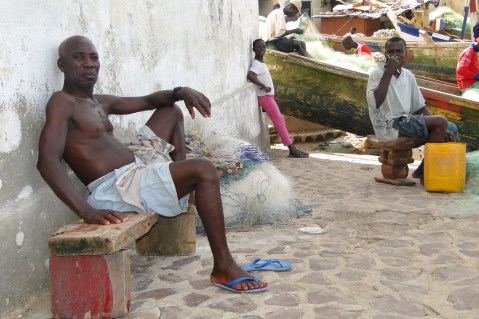
Outside the Door of No Return – Cape Coast Castle – Ghana, Image by Flickr User Adam Jones, PhD
The shops in the courtyard just beyond the reception area are now filled with traditional instruments—drums, guitars, piano boxes, and rattles—beads, cloth, masks, paintings, rugs and postcards. It is no longer a market in Black flesh but of “African” objects, or cultural artifacts that amplify the racial identity of diasporic visitors, and make them more “real” once they return home. Shop owners busy themselves making crafts, passing the day chatting with one another and potential customers.
This cell in which I stand is one of many at the Twin Castles, the gargantuan fortresses that after five hundred years continue to hold fast to the southern coast of Ghana. The intersecting trails of fine cracks rupture the once-pristine white paint on the walls. . .possibly one for every person stolen out of the dungeons. The hull is transfixing, the hold captivating. For some reason, I am suddenly reminded of Rev. James Cleveland’s gospel song, “Something’s Got A Hold On Me” where he proclaims, “Something hit me/Up over my head/And run right to my feet.”
.
Cleveland is talking about the power of the Holy Ghost to re-fashion his troubled life through spiritual re-birth. He sings of transformation from a life of misery to a brand new liberation that is manifested like a shock through his entire being and body. This new shock counters the crisis he regularly experiences “in the world.” This new bodily sensation permeates his entire being and acts as a shield against daily strife. Similarly, Etta James’ secular version, “Something’s Got A Hold On Me” attests, “My heart feels heavy/my feet feel light/I shake all over/ but I feel alright.”
.
James’ something is more possessive of her person; it is the overwhelming yoke of romantic love that seeps into her pores and won’t let up. This occupation of James’ senses is so startlingly pleasurable that she longs for and needs it. Similarly, The Miracles’, “You’ve Really Got A Hold On Me” pronounces, “Don’t want to leave you/don’t want to stay here/don’t want to spend another day here/oh, oh, oh, I wanna sit now/I just can quit now.”
.
Robinson expresses the ambivalence of love and longing—frustration, disappointment, ecstasy and desire—that crowds the senses with the sheer torture of being powerless over this structure of feeling. The protagonist is unable to shake hold of the beloved object, which makes him question his own capacity.
The “hold” becomes embodied and acts out in ways the mind cannot comprehend or prevent. It is the same hold the castles have on many African American visitors—an enigmatic narrative of love, loss and longing that the progeny of slaves refuse to relinquish and attempt to retell by inserting their bodies into slave histories. African Americans tour the castles as a way of tracing what Ralph Ellison calls “the grooves of history” in Invisible Man (443). Like a phonograph record, grooves are meant to be linear and progressive, but diasporic African history is awkward, uneven and full of odd ruptures, gaps and distortions. As James Clifford insists in “Diasporas,” “Diaspora discourse articulates, or bends together, both roots and routes” (251). These grooves consist of a series of complex and overlapping relationships that are multi-directional and non-linear. Like an album record, the records of history indicate particular events of static (crisis), interludes (junctures), and rhythms (discourse).

78 Record grooves by Flickr User Roger Smith
“The music is mysteriously ‘in’ these physical recesses, pressed into the vinyl,” Steven Feld argues in Music Grooves: Essays and Dialogues, “and listeners may imagine journeying there to merge right ‘into the groove’” (111). Grooves are doubly intentioned as: 1) the tracing of deep historical roots through specific routes of migration and 2) a physical and/or psychic space where utopic possibilities are imagined, alternative choices can be sought out, and past and future events are persistently contextualized within the present moment. To be “in a groove” is to be in tune with multiple realities simultaneously, to compress or stretch out time and space and one’s capacity in extraordinary ways.
Strangely, this cell is absent of all sound, even the static, white noise of silence. But it refuses to sound for me and tell me its history. I hear nothingness in the emptied hole. All that remains is a heavy vastness of what once was. As Mackey so profoundly articulates, “I wept for the notion of kin, as though the very idea were an occasion for tears, a pitiful claim to connection, a bleeding socket whose eye’d been plucked out” (21).
Over time, the cold stone has absorbed the blood, sweat, feces and bones of its inhabitants. It is the only material trace that proves the enslaved were once there.
—
Sionne R. Neely received her Ph.D. in August 2010 in American Studies & Ethnicity from the University of Southern California. Her dissertation examines how music artists in Ghana create transnational work alliances in response to shifting political regimes under independence, from Kwame Nkrumah’s administration to the present. Since 2005, Dr. Neely has recorded and archived more than 150 interviews with creative artists and industry professionals based in Ghana. In 2010, Dr. Neely co-founded ACCRA [dot] ALT, a cultural organization that promotes the alternative work of emerging Ghanaian artists through innovative programming and international exchange with artists worldwide. In 2011, she co-produced the Accra homecoming concert and documentary film for hip hop artist Blitz the Ambassador and Afro-Pean soul duo, Les Nubians. She is co-producer of Gbaa Mi Sané (Talk To Me), a short documentary film that explores the creative process of young visionary artists in Ghana (to be released in Summer 2013). Dr. Neely will also publish an article on hip hop practices in Ghana in the forthcoming Cambridge Companion Series (Fall 2013).
Share this:


Current Top Posts





April 2021

January 2020

November 2019

October 2019

August 2019

April 2014

November 2017

March 2015

December 2017

October 2015
 Sounding Out!
Recent Comments