
The (Magic) Upper Room: Sonic Pleasure Politics in Southern Hip Hop
 After a rockin’ (and seriously informative) series of podcasts from Leonard J. Paul–a three part “Inside the Game Sound Designer’s Studio”– our summer Sound and Pleasure series keeps giving you the good stuff, this week with SO! Regular Regina Bradley, making it rain. . . with some serious knowledge. What is the connection between sound and enjoyment, and how might black women’s sexual freedom be manifested via sound? –-JS, Editor-in-Chief
—
At fifteen, while in church service, I learned how to clutch pearls after hearing a woman moan during the altar call.
It was not a “Jesus done found and saved me” moan, either. A friend forgot to turn his cell phone off for church. As the church prayed, his phone started to ring. It was not the usual digital beeping or quick calypso ring tone. His phone calls were annotated by a woman’s moan during sex. She moaned from his cell phone to pick up the call. Each ring the woman moaned louder and adamant until she hollered like she was just saved. The kids in the back snickered as the ushers – including my grandmother – silently and angrily screened each pew to see who would pick up the phone. Quaking church ladies and my grandmother’s wide-eyed glare and heaving chest suggested they were about to pass out from embarrassment. Wringing their white gloved hands and grabbing at their pearl necklaces in angst, they looked everywhere but at each other: the back of a man’s head, the cross at the front of the church, the stain glass windows. A flush of warmth entered my cheeks and neck as I tried to contain my laughter and creeping embarrassment. I was embarrassed for my grandmother and the ladies of the church because I was aware of the unspoken rule that women – especially middle-class black women – don’t do sex. Being embarrassed of sex is proper and “ladylike.”
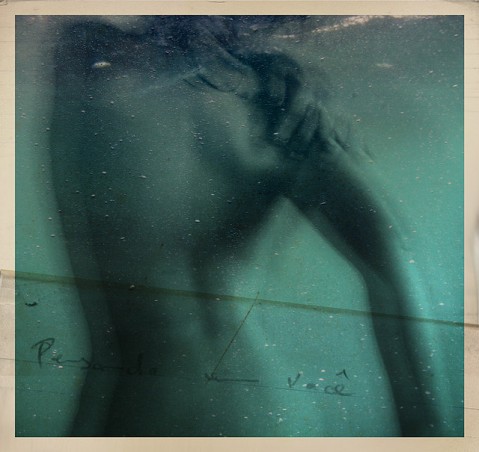
“Dancing underwater II” by Flickr user Miss Cartier, CC BY-NC-SA 2.0
Ashon Crawley’s contextualization of the praise and worship in Black Pentecostal church as a sonic public zone is useful for using sound to complicate the church as an erotic space. Crawley’s suggestion of sound as a “vessel. . .for the exchange of ecstasy and ecstatics” collapses the more tangible notions of gender and respectability via physical displays –i.e. the quaking church ladies and clutching pearls – to recognize the overlap of moaning as a marker of sexual joy, moaning as a form of praise and worship, and moaning as an indicator of shame. Crawley’s observations bring to mind Helga Crane’s run in with the storefront church in Nella Larsen’s Quicksand. It is not the physical aspect of the church and its embodiment of respectability that draws Helga into the space. Rather, it is the singing, weeping, and moaning – the sonic elements of praise and worship–that parallel her own suppressed sexual frustrations. Her weeping is not necessarily a “come to Jesus moment” but rather a sonic release acknowledging her sexual agency.
Looking back at when this dude’s phone went off in church, I realize the bulk of discomfort in acknowledging sexual pleasure exists in how it sounds. The woman’s moan highlighted an alarming reality for the women at my church: pleasure was being presented outside of its respectable physical and sonic boundaries. I wish to identify what I call sonic pleasure politics to address new developments in 21st century southern gender identity politics. Sonic manifestations of pleasure point to a younger generation’s rearticulation of sexuality as a site of agency and self-definition in an otherwise suppressed southern experience.
![Purity-Rings.jpg by Wikimedia user Bibleknowledge, CC-BY-SA-3.0 (http://creativecommons.org/licenses/by-sa/3.0)], via Wikimedia Commons](http://commons.wikimedia.org/wiki/File:Purity-Rings.jpg)
Purity-Rings.jpg by Wikimedia user Bibleknowledge, CC-BY-SA-3.0, via Wikimedia Commons
As a southern black woman, I’ve always been struck by the anxiety sex and pleasure invoked in the women in my life. Sex and pleasure were never articulated in the same breath, as sex was a wifely duty and responsibility for procreation. Pleasure was never synonymous with sexual joy, even when I snatched whispers of conversation about sex from my elders. Moreover, I was taught that sex (or even an interest in it) would plummet my stock as a good girl and put me in the ranks of “fast-tailed” girls who used sex as a desperate plea for attention. Nope, sex – pleasurable sex – was always for men’s gratification. Aside from the abstinence manifesto – “just don’t do it, chile” – for women, enjoying sex was the devil’s work. Respectable sex was quiet, for marriage, and never discussed outside of the house.
Sound as a signifier of sexual pleasure is considered by many to be counterintuitive because of the history of sexual trauma associated with black women’s bodies in the south. Reading sex as a genesis point of southern black women’s pleasure and empowerment is a difficult undertaking. The forced silence of slave women’s rapes and other physical violence that took place on southern soil parallels the silence that is deemed to be necessary for survival in a racist society. Further, the far-reaching residual effects of black women’s inferred lacking virtue lurk in how black folks navigate their southern experience and identities. Conservative attitudes towards sex in the southern black community are no doubt associated with the constructed attempts to humanize and validate blacks outside of hypersexual scripted blackness.
However, the sonic dimension of sex and pleasure in the south goes largely without analysis even though sound is a primary space in which recognition of sexual and nonsexual pleasure takes place. Consider blues women and, more recently, women in [southern] hip hop culture. The sounds of women’s giggles and moans as representative of sexual pleasure in bass music and the heavy use of moaning in the work of Trina, Jacki-O, Khia, Erykah Badu, Beyoncé, and Missy Elliott points to a need to recognize sound as a reservoir of pleasure, raunchiness, and sexual work—what I call “sonic pleasure politics.”
Studies of sonic pleasure including those of Robin James contextualize pleasure via the technical production of sound to induce a particular set of cultural and visceral responses. However, I ground my theorization of sonic pleasure politics in the growing body of scholarship offered by the “Pleasure Ninjas” collective consisting of Joan Morgan, Brittney Cooper, Treva Lindsey, Kaila Story, Yaba Blay, and Esther Armah. They utilize pleasure as a site of healing and reclamation of black women’s identities. Morgan’s interrogation of pleasure as a form of survival, for example, is especially useful in thinking about how southern women’s sexuality stems from the trauma of the transatlantic slave trade. She suggests pleasure’s palpability as an alternative space to reclaim slaves’ humanity. The Pleasure Ninjas’ construction of pleasure lends credence to my theorization sonic pleasure politics as a space for mediating the historical implications of abusive sexual power and the use of sexual pleasure as a form of resistance in the south.
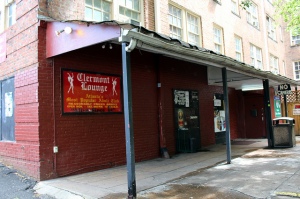
“Atlanta – Poncey-Highland: Clermont Lounge” by Flickr user Wally Gobetz, CC BY-NC-ND 2.0
Situating women’s pleasure in southern hip hop is messy as it reflects both men’s investment in women as objects of pleasure – i.e. bass music – and women’s subversion of this expectation of their sexuality a way to express themselves. For example, Lil Wayne’s lyrical affirmation of his sexual prowess via cunnilingus in songs like “Pussy Monster,” “She Will,” and “Lollipop” parallels singer Joi’s demonstration of pleasure as a form of sexual consent via the use of (presumably her) moans and sounds of cunnilingus on her popular song “Lick.” Sonic pleasure politics become a workspace for bridging the south’s historical construction of [black] women’s sexuality-as-respectability and the recent, more fluid form of younger women’s embrace of sex-as-empowerment heard in southern popular culture.
Sonic Pleasure Politics and Strip Club Culture
A primary space for teasing out the multi-layered significance of sounds and sexuality in southern hip hop is the strip club. The production of sonic and visual representations of strip clubs are inextricably linked: bass heavy musical tracks keep time with the “clapping cheeks” of exotic dancers. Further, the loudness of the strip club denotes patrons’ attempts to drown out the world while pivoting off of the fantasy of sexy women dancing, moaning, and sexually gesturing for their entertainment. The dominance of strip clubs in southern hip hop contribute to the erotic map(s) of a younger generation of southern black women. My contextualization of strip clubs as a cartographic point of interest pivots off of Kaila Story’s description of erotic maps as an entry point for recognizing black women’s sexual agency. Erotic maps are the touchstones through which people address sexual pleasure. Story uses black women’s social-historical narratives to map out black women’s use of sexuality as a measure of self-definition. These maps are complex as they are intertwined with historical-cultural biases and cultural preferences frequently outside of black women’s experiences.

“IMG_0478” by Flickr user Ferrum College, CC BY-NC-SA 2.0
Strip club anthems, like Memphis rapper Juicy J’s “Bandz a Make Her Dance,” riff on the sonic and physical components of strip club culture. The bass kicks complement what sounds like clapping hands, a signifier of strippers’ clapping butts. Juicy J talks at length about his love of the strip club, distinguishing between “real” and fake strip clubs by the amount of nakedness and strippers wrangling for high-paying patrons’ bands of money. The snapping sound of rubber bands holding wads of cash together authenticates the duality of the women’s sexual posturing as physically pleasurable for men and profitable – economically pleasurable – for women. “Bandz a Make Her Dance” is grounded in the appeal of strip clubs as spaces of empowerment for black men. From this perspective, the clapping heard across the track could also signify the snapping of rubber bands against money to sonically signify men’s power as a strip club patron. Yet the physical and sonic presence of black women’s bodies – i.e. grunting as they maneuver and climb the dancing pole – also makes strip club culture a useful space to pivot southernness and sonic pleasure.
An example of establishing black women’s sonic pleasure narratives in strip clubs is singer Rihanna’s panning of “Bandz a Make Her Dance” titled “Pour It Up.” Although Rihanna is a pop singer from the “Global” South, she sonically signifies if not subverts southern hip hop gender politics via sampling the instrumental from Juicy J’s record. The majority of “Pour It Up’s” instrumental accompaniment is a subdued if not washed out sample of “Bandz a Maker Dance” that helps highlight Rihanna’s voice. The clarity of Rihanna’s voice “garbles” the accompaniment in the sense it is background noise to her narrative of enjoying herself and taking pleasure in the bodies of other women present in the club. The accompaniment serves as a brief nod to Juicy J’s initial intentions of crafting the strip club as a sexual space but ultimately uses the track as a testament to her own pleasure narrative.
In particular, Rihanna’s sing-song holler before the chorus “All I see is signs…all I see is dollar signs,” points to a subversion of the hypermasculinity in strip club culture to establish her own pleasure in a similar space. Parallel to Juicy J’s indulging of exotic dancers via throwing bands of money, Rihanna enjoys herself at the strip club using other people’s money:
Strip clubs and dolla’ bills (Still got mo’ money)
Patron shots can I get a refill (Still got mo’ money)
Strippers going up and down that pole (Still got mo’ money)
4 o’clock and we ain’t going home (Still got mo’ money)
Bands make your girl go down (Still got mo’ money)
Lot more where that came from (Still got mo’ money)

“Rihanna – Oslo 2013” by Flickr user NRK P3, CC BY-NC-SA 2.0
In particular, Rihanna’s verse not only demonstrates an alternative viewpoint of black women’s bodies in the strip club but destabilizes the idea of the strip club – and intercedes on the understanding of southern hip hop – as a heternormative hypermasculine space. The line “bands make your girl go down” alludes to not only a possible sexual encounter by Rihanna or for the girl in question but doubly signifies upon the potential for pleasure via the strip club culture for women and the hypersexuality of Juicy J’s track. “Pour it Up” reflects the messiness of [southern] hip hop gender politics because it builds upon the reputation of the strip club as a site for men’s pleasure to excavate women’s dancing as pleasurable for their own purposes. In addition to Rihanna’s sonic signifying of strip club culture, the “Pour It Up” reveres pole dancing as an art form rather than an exploitative practice. Rihanna’s pleasure in watching the dancers perform parallels the exertion of joy – and consent – that the dancers exhibit in their movement.
Trekking back to the sexy moaning phone in church, the sonic cue of sexual pleasure and joy conflicted with the gender norms associated with southern black women’s identities. Consideration of sonic pleasure narratives stirs discussion of the unarticulated experiences of southern black womanhood that may be overlooked in favor or a larger, more conservative, and familiar narrative of sex as tool of victimization. Sonic pleasure politics makes room to remap the contemporary southern social-cultural landscape as a complex yet living space of cultural production and sexual freedom.
–
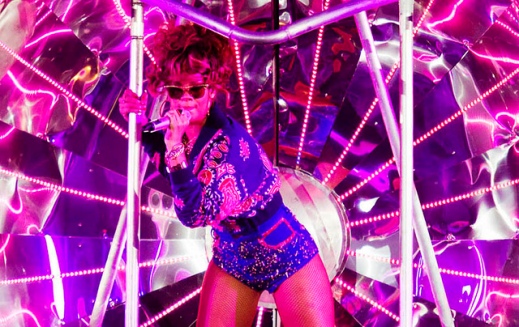
Featured Image: “RIHANNA EM BELO HORIZONTE” by Flickr user http://www.rihannafentyforum.com, CC BY-NC-SA 2.0
–
Regina Bradley recently completed her PhD at Florida State University in African American Literature. Her dissertation is titled “Race to Post: White Hegemonic Capitalism and Black Empowerment in 21st Century Black Popular Culture and Literature.” She is a regular writer for Sounding Out!
–
 REWIND!…If you liked this post, you may also dig:
Thrills, Chills, and Safe Sexuality: The Sounds of Michael Jackson’s “Thriller” – Osvaldo Oyola
“I Love to Praise His Name”: Shouting as Feminine Disruption, Public Ecstasy, and Audio-Visual Pleasure – Shakira Holt
I Like the Way You Rhyme, Boy: Hip Hop Sensibility and Racial Trauma in Django Unchained – Regina Bradley
Share this:

Sound at IASPM-US 2014

For the second weekend in March, the U.S. chapter of the International Association for the Study of Popular Music (IASPM-US) will be holding its annual meeting at the University of North Carolina, Chapel Hill. Like sound studies, popular music studies is fueled by an interdisciplinary spirit, and many of the questions that currently occupy the popular culture corner of sound studies have much in common with those of us who take the study of music seriously. This year’s conference offers a unique theme, “Music Flows,” that centers around questions of water, flows, and liquidity. The conference theme also offers more expansive ideas to flows, including mobility, embodiment, sonic materialities, and ecology. While the theme may strike some as unconventional, it ends up being an excellent metaphor for those of us who study musical flows in fields that prefer static works and communities over transient ones.

The James Taylor Bridge over Morgan Creek in his native city of Chapel Hill, North Carolina
Since this is a popular music conference, many of the papers at this meeting take musical texts as their focus (including mine); however, there are still many panels and individual papers that might interest scholars from a sound studies perspective. After all, sound travels better in water than in air, and following that logic, water and sound both feature waves. Indeed, there are papers that take the water waves and sound waves as their inspiration. Compare, for example, SO! guest writer Mack Hagood’s discussion of an early popular recording of water waves against Robin James’s philosophical theorizing about sound waves and Neo-Liberalism in the music of Ludacris. Similarly, many papers take their inspiration from the sounds that come from water or are performed in it: Peter Schultz specifically tackles the sound-design of watery environments in video games, while SO! guest writer Josh Ottum investigates the sounds from the floating garbage island in the middle of the ocean. These papers offer attendees the opportunity to consider the large theoretical consequences of changes to the water and waves in recordings.
Some papers approach water from a perspective focused on materiality and mediation. Craig Eley’s paper offers a historically grounded study of the hydrophone and underwater recording. Peter McMurray’s paper analyzes the problem of making music for watery environments and the challenges of water’s sonic conduciveness. For an athletic perspective on hearing music in the water, Niko Higgins talks about the music that swimmers use in their athletic training. These perspectives on liquid mediation offer a tremendous opportunity to expand sound studies beyond its general dependence on sounds that happen in the open air.
Beyond the more literal takes on the water in music flows, a large portion of the papers have taken their inspiration from the metaphor of social mobility, liquidity, and trade. There are panels and papers that emphasize transnational sonic flows, such as the panel “In and Out of Africa,” and Jason Robinson’s work on recording challenges in a transatlantic jazz collaboration. Two papers in particular deal with the role of African Americans in U.S. diplomatic relations: Darren Mueller’s paper on Dizzy Gillespie as a jazz ambassador, and Kendra Salois’s work on hip-hop diplomacy. Along a similar vein, Yvonne Liao specifically considers ports and their relationship to musical trade in Shanghai’s jazz scene. There is also a paper on the role of music as a social lubricant by Luis-Manuel Garcia that promises to be a real treat.
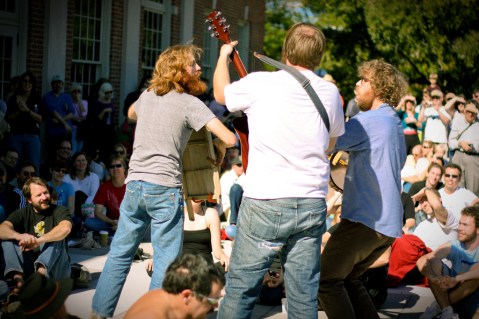
Megafaun serenades a Chapel Hill, North Carolina crowd, Image by Flickr user abbyladybug
Finally, it is worth mentioning how many papers address sound studies’ long-standing relationship with soundscapes, ecomusicology, and the environment. There is a panel called “Ecologies of Place” with papers on ecologically-minded music from places as far flung as India, Iceland, Appalachian Ohio, and Canadian parks. There is also a panel on “Urban Soundscapes,” including Robert Fry’s paper on sound, music, and branding at a hot spring resort and Mathew Robert Swiatlowski’s paper on the boom box and the Walkman in urban space.
Many in sound studies cite Jonathan Sterne’s critiques of ocularcentrism in cultural criticism. This conference encourages us to think beyond the air and stasis and shift our focus to the possibilities of liquid metaphors in cultural change.
—
Featured Image: One of Chapel Hill’s many ponds, at the Outdoor Education Center, Image by Flickr User Kat St Kat
—
Kariann Goldschmitt is an Adjunct Assistant Professor at New College of Florida and Ringling College of Art and Design. She holds a Ph.D. in Musicology from UCLA (2009) and was the 2009-2011 Mellon Fellow of Non-Western Music at Colby College in Maine. Her scholarly work focuses on Brazilian music, modes of listening, and sonic branding in the global cultural industries. She has published in The Journal of Popular Music Studies, American Music, Yearbook for Traditional Music, and Luso-Brazilian Review and contributes to the South American cultural magazine, Sounds and Colours.
—
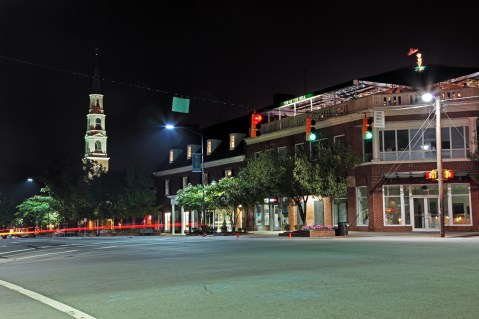
“Franklin Street, Chapel Hill” by Wikimedia user Caroline Culler, CC BY 3.0
Friday, March 14

So nice we put it twice, The James Taylor Bridge, Public Domain
.
Saturday, March 15

“Cheerleaders, UNC, 1989” by Flickr user North Carolina Digital Heritage Center, CC BY-NC-ND 2.0
.
Sunday, March 16
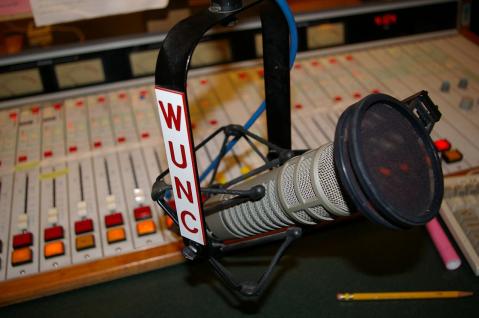
Chapel Hill’s finest, WUNC, image by Flickr user Keith Weston
Share this:


Current Top Posts





April 2021

January 2020

November 2019

October 2019

August 2019

April 2014

November 2017

March 2015

December 2017

October 2015
 Sounding Out!
Recent Comments