
What Feels Good to Me: Extra-Verbal Vocal Sounds and Sonic Pleasure in Black Femme Pop Music

The lyrics to Beyoncé’s 2008 song “Radio” treats listening pleasure as a thinly-veiled metaphor for sexual pleasure. For example, they describe how turning up a car stereo transforms it into a sex toy: “And the bassline be rattlin’ through my see-eat, ee-eats/Then that crazy feeling starts happeni-ing- i-ing OH!” Earlier in the song, the lyrics suggest that this is a way for the narrator to get off without arousing any attempts to police her sexuality: “You’re the only one that Papa allowed to hang out in my room/…And mama never freaked out when she heard it go boom.” Because her parents wouldn’t let her be alone in her bedroom with anyone or anything that they recognized as sexual, “Radio”’s narrator finds sexual pleasure in a practice that isn’t usually legible as sex. In her iconic essay “On A Lesbian Relationship With Music,” musicologist Suzanne Cusick argues that if we “suppose that sexuality isn’t necessarily linked to genital pleasure” and instead “a way of expressing and/or enacting relationships of intimacy through physical pleasure shared, accepted, or given” (70), we can understand the physical pleasures of listening to music, music making, and music performance as kinds of sexual pleasure.
Though Cusick’s piece overlooks the fact that sexual deviance has been, since the invention of the idea of sexuality in the late 19th century, thoroughly racialized, her argument can be a good jumping-off point for thinking about black women’s negotiations of post-feminist ideas of sexual respectability; it focuses our attention on musical sound as a technique for producing queer pleasures that bend the circuits connecting whiteness, cispatriarchal gender, and hetero/homonormative sexuality. In an earlier SO! Piece on post-feminism and post-feminist pop, I defined post-feminism as the view that “the problems liberal feminism identified are things in…our past.” Such problems include silencing, passivity, poor body image, and sexual objectification. I also argued that post-feminist pop used sonic markers of black sexuality as representations of the “past” that (mostly) white post-feminists and their allies have overcome. It does this, for example, by “tak[ing] a “ratchet” sound and translat[ing] it into very respectable, traditional R&B rhythmic terms.” In this two-part post, I want to approach this issue from another angle. I argue that black femme musicians use sounds to negotiate post-feminist norms about sexual respectability, norms that consistently present black sexuality as regressive and pre-feminist.
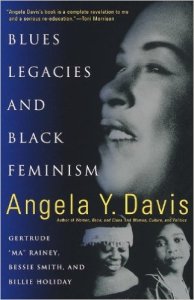 Black women musicians’ use of sound to negotiate gender norms and respectability politics is a centuries-old tradition. Angela Davis discusses the negotiations of Blues women in Blues Legacies & Black Feminism (1998), and Shana Redmond’s recent article “This Safer Space: Janelle Monae’s ‘Cold War’” reviews these traditions as they are relevant for black women pop musicians in the US. While there are many black femme musicians doing this work in queer subcultures and subgenres, I want to focus here on how this work appears within the Top 40, right alongside all these white post-feminist pop songs I talked about in my earlier post because such musical performances illustrate how black women negotiate hegemonic femininities in mainstream spaces.
As America’s post-identity white supremacist patriarchy conditionally and instrumentally includes people of color in privileged spaces, it demands “normal” gender and sexuality performances for the most legibly feminine women of color as the price of admission. As long as black women don’t express or evoke any ratchetness–any potential for blackness to destabilize cisbinary gender and hetero/homonormativity, to make gender and sexuality transitional–their expressions of sexuality and sexual agency fit with multi-racial white supremacist patriarchy.
It is in this complicated context that I situate Nicki Minaj’s (and in my next post Beyoncé’s and Missy Elliott’s) recent uses of sound and their bodies as instruments to generate sounds. If, as I argued in my previous post, the verbal and visual content of post-feminist pop songs and videos is thought to “politically” (i.e., formally, before the law) emancipate women while the sounds perform the ongoing work of white supremacist patriarchy, the songs I will discuss use sounds to perform alternative practices of emancipation. I’m arguing that white bourgeois post-feminism presents black women musicians with new variations on well-worn ideas and practices designed to oppress black women by placing them in racialized, gendered double-binds.
 For example, post-feminism transforms the well-worn virgin/whore dichotomy, which traditionally frames sexual respectability as a matter of chastity and purity (which, as Richard Dyer and others have argued, connotes racial whiteness), into a subject/object dichotomy. This dichotomy frames sexual respectability as a matter of agency and self-ownership (“good” women have agency over their sexuality; “bad” women are mere objects for others). As Cheryl Harris argues, ownership both discursively connotes and legally denotes racial whiteness. Combine the whiteness of self-ownership with well-established stereotypes about black women’s hypersexuality, and the post-feminist demand for sexual self-ownership puts black women in a catch-22: meeting the new post-feminist gender norm for femininity also means embodying old derogatory stereotypes.
I think of the three songs (“Anaconda,” “WTF,” and “Drunk in Love”) as adapting performance traditions to contemporary contexts. First, they are part of what both Ashton Crawley and Shakira Holt identify as the shouting tradition, which, as Holt explains, is a worship practice that “can include clapping, dancing, pacing, running, rocking, fainting, as well as using the voice in speaking, singing, laughing, weeping, yelling, and moaning.” She continues, arguing that “shouting…is also a binary-breaking performance which confounds—if only fleetingly—the divisions which have so often oppressed, menaced, and harmed them.” These vocal performances apply the shouting tradition’s combination of the choreographic and the sonic and binary-confounding tactics to queer listening and vocal performance strategies.
Francesca Royster identifies such strategies in both Michael Jackson’s work and her audition of it. According to Royster, Jackson’s use of non-verbal sounds produces an erotics that exceeds the cisheteronormative bounds of his songs’ lyrics. They were what allowed her, as a queer teenager, to identify with a love song that otherwise excluded her:
in the moments when he didn’t use words, ‘ch ch huhs,’ the ‘oohs,’ and the ‘hee hee hee hee hees’…I ignored the romantic stories of the lyrics and focused on the sounds, the timbre of his voice and the pauses in between. listening to those nonverbal moments–the murmured opening of “Don’t Stop Till You Get Enough,” or his sobbed breakdown at the end of “She’s Out of My Life,’ I discovered the erotic (117).
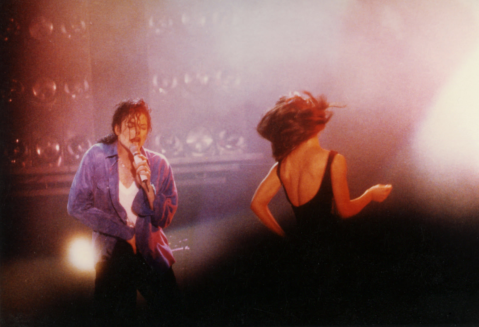
“Michael Jackson” by Flickr user Daniele Dalledonne, CC BY-SA 2.0
Royster references a black sexual politics in line with Audre Lorde’s notion of the erotic in “The Uses of the Erotic,” which is bodily pleasure informed by the implicit and explicit knowledges learned through lived experience on the margins of the “European-American male tradition” (54), and best expressed in the phrase “it feels right to me” (54). Lorde’s erotic is a script for knowing and feeling that doesn’t require us to adopt white supremacist gender and sexual identities to play along. Royster calls on this idea when she argues that Jackson’s non-verbal sounds–his use of timbre, rhythm, articulation, pitch–impart erotic experiences and gendered performances that can veer off the trite boy-meets-girl-boy-loses-girl stories in his lyrics. “Through his cries, whispers, groans, whines, and grunts, Jackson occupies a third space of gender, one that often undercuts his audience’s expectations of erotic identification” (119). Like shouting, “erotic” self-listening confounds several binaries designed specifically to oppress black women, including subject/object binaries and binary cisheterogender categories.
Nicki Minaj uses extra-verbal sounds as opportunities to feel her singing, rapping, vocalizing body as a source of what Holt calls “sonophilic” pleasure, pleasure that “provide[s] stimulation and identification in the listener” and invites the listener to sing (or shout) along. Minaj is praised for her self-possession when it comes to business or artistry, but such self-possession is condemned or erased entirely when discussing her performances of sexuality. As Treva B. Lindsey argues, “the frequency that Nicki works on is not the easiest frequency for us to wrestle with, because it’s about…whether we can actually tell the difference between self-objectification and self-gratification.’’ Though this frequency may be difficult to parse for ears tempered to rationalize post-feminist assumptions about subjectivity and gender, Minaj uses her signature wide sonic pallette to shift the conversation about subjectivity and gender to frequencies that rationalize alternative assumptions.
In her 2014 hit “Anaconda,” she makes a lot of noises: she laughs, snorts, trills her tongue, inhales with a low creaky sound in the back of her throat, percussively “chyeah”s from her diaphragm,among other sounds. The song’s coda finds her making most of the extraverbal sounds. This segment kicks off with her quasi-sarcastic cackle, which goes from her throat and chest up to resonate in her nasal and sinus cavities. She then ends her verse with a trademark “chyeah,” followed by another cackle. Then Minaj gives a gristly, creaky exhale and inhale, trilling her tongue and then finishing with a few more “chyeah”s. While these sounds do percussive and musical work within the song, we can’t discount the fact that they’re also, well…fun to make. They feel good, freeing even. And given the prominent role the enjoyment of one’s own and other women’s bodies plays in “Anaconda” and throughout Minaj’s ouevre, it makes sense that these sounds are, well, ways that she can go about feelin herself.
Listening to and feeling sonophilic pleasure in sounds she performs, Minaj both complicates post-feminism’s subject/object binaries and rescripts cishetero narratives about sexual pleasure. “Anaconda” flips the script on the misogyny of Sir Mix-a-Lot’s hit “Baby Got Back” by sampling the track and rearticulating cishertero male desire as Nicki’s own erotic. First, instead of accompanying a video about the male gaze, that bass hook now accompanies a video of Nicki’s pleasure in her femme body and the bodies of other black femmes, playing as she touches and admires other women working out with her. Second, Nicki re-scripts the bass line as a syllabification: “dun-da-da-dun-da-dun-da-dun-dun,” which keeps the pattern of accents on 1 and 4, while altering the melody’s pitch and rhythm.
Just as “Anaconda”’s lyrics re-script Mix-A-Lot’s male gaze, so do her sounds. If the original hook sonically orients listeners as cishetero “men” and “women,” Nicki’s vocal performance reorients listeners to create and experience bodily pleasure beyond the “legible” and the scripted. Though the lyrics are clearly about sexual pleasure, the sonic expression or representation of that pleasure–i.e., the performer’s pleasure in hearing/feeling herself make all these extraverbal sounds–makes it physically manifest in ways that aren’t conventionally understood as sexual or gendered. Because it veers off white ciseterogendered scripts about both gender and agency, Minaj’s performance of sonophilia is an instance of what L.H. Stallings calls hip hop’s “ratchet imagination.” This imagination is ignited by black women’s dance aesthetics, wherein “black women with various gender performances and sexual identities within the club, on stage and off, whose bodies and actions elicit new performances of black masculinity” renders both gender and subject/object binaries “transitional” (138).
Nicki isn’t the only black woman rapper to use extra-verbal vocal sounds to re-script gendered bodily pleasure. In my next post, I’ll look at Beyoncé and Missy Elliot’s use of extra-vocal sounds to stretch beyond post-feminism pop’s boundaries.
—
Featured image: screenshot from “Anaconda” music video
—
Robin James is Associate Professor of Philosophy at UNC Charlotte. She is author of two books: Resilience & Melancholy: pop music, feminism, and neoliberalism, published by Zer0 books last year, and The Conjectural Body: gender, race and the philosophy of music was published by Lexington Books in 2010. Her work on feminism, race, contemporary continental philosophy, pop music, and sound studies has appeared in The New Inquiry, Hypatia, differences, Contemporary Aesthetics, and the Journal of Popular Music Studies. She is also a digital sound artist and musician. She blogs at its-her-factory.com and is a regular contributor to Cyborgology.
—
 REWIND! . . .If you liked this post, you may also dig:
“I Love to Praise His Name”: Shouting as Feminine Disruption, Public Ecstasy, and Audio-Visual Pleasure–Shakira Holt
Music Meant to Make You Move: Considering the Aural Kinesthetic–Imani Kai Johnson
Something’s Got a Hold on Me: ‘Lingering Whispers’ of the Atlantic Slave Trade in Ghana–Sionne Neely
Share this:

Mediated Sexuality in ASMR Videos

“Why does it feel so good when someone else is touching you?” she asks, fluttering her fingers up her forearm in demonstration. The cheerful blond woman smiles brightly. “Is it because of the physical contact itself? Or is there something else going on?”
This YouTube celebrity is Olivia Kissper, and she is about to demonstrate 40 different sounds that act as “triggers” for ASMR, or Autonomous Sensory Meridian Response. ASMR is a term coined by the community of internet users who experience a particular tingling sensation in response to certain auditory, visual, or haptic stimuli. The sensation often originates in the scalp and travels down the spine and is reported to be immensely pleasurable, as well as relaxing. “ASMRtists” now flood YouTube with a steady stream of high definition videos designed to trigger this sensation for viewers, either by whispering or making other sounds with the mouth, by tapping, crinkling, or scratching various household objects, or through role-play scenarios (which often incorporate some or all of the above). In answer to Olivia’s question, I suggest that ASMR “feels so good” because the technology affords listener-viewers the opportunity to imagine alternative sexualities outside of the dominant Western paradigm of heterosexual, two-bodied, genital, orgasmic, reproductive intercourse.
However, the online ASMR community vehemently asserts that there is nothing sexual about ASMR. Of course, that is not to say that NSFW ASMR doesn’t have a strong following on Reddit, or that there haven’t been strident debates on the topic (such as the one sparked by comedian Russell Brand earlier this year). But it does mean that the vocal majority of ASMRtists and their listeners perceive this experience as intensely pleasurable, yet outside the regime of sexuality. It seems that positioning ASMR as distinct from sexual fetishes is an effort to destigmatize what may otherwise be viewed as deviant or unhealthy sexual behavior.
The problem at hand, then, is not that ASMR may in fact be sexual, but that pervasive definitions of sexuality pertain to very narrow set of actions and gestures among a very narrow set of bodies and pertaining to a very narrow set of moralistic qualities. I argue that ASMR videos broaden the scope of what we understand as “sexuality” and provide a means for bodies to gain access to certain other bodies in particular ways, and thus serve as an outlet for people to enjoy those (sexual) pleasures alongside of what is deemed appropriate in the mainstream. By analyzing this video phenomenon, specifically through the videos of ASMRtist Olivia Kissper, I consider what is “real” about this mediated intimacy, and how this mediated intimacy can help us to reimagine sexuality.
Pleasure
If ASMR is described by those who experience it as intensely pleasurable and relaxing, and if ASMRtists craft their videos with the deliberate intention of producing this automatic, visceral, pleasurable sensation, then it is indisputable that ASMR is, above all, concerned with the production of pleasure. In this way, it is not difficult to note the parallels between ASMR videos and pornography—another “body genre” (to borrow the term from Linda Williams) that employs genre-specific techniques with the intention of producing an automatic, visceral, pleasurable sensation in the viewer. Bearing this in mind, it should not be overlooked that most of the bodies interacting with the objects in these videos are young, conventionally attractive, white women. As art historian Joceline Andersen notes, ASMR often “relies on the heteronormative gender roles of care” (685). In other words, the popularity of an ASMRtist (with few exceptions) seems to be directly related to her sexual appeal and the degree to which she upholds Western standards of beauty.
Despite the fact that these videos may not be pornographic in the traditional sense, they are certainly sensual, if not sexual. This is exemplified by the way in which these ASMRtists attempt to evoke the sensation of contact with the viewer. ASMR is triggered not only by sound, but also by touch, and many ASMRtists strive to create perfect illusions of tactile sensation through the expert manipulation of visual and aural components. These are the kinds of videos that Olivia Kissper produces most often, such as “This FEELS SO REAL! Binaural ASMR SCALP MASSAGE with head massager, cicadas & WHISPERING.”
The tabloid-headline-esque style of the video’s title exemplifies the common practice of wordy titles for ASMR videos, so that viewers can tell at a glance if the video contains the specific triggers they are looking for, in this case tactile role-play and the auditory triggers of whispering and binaural recording. The quality of ASMR videos has steadily improved over the last couple of years, and most successful ASMRtists use high definition binaural microphones that record from two different “ear” locations, so that when the listener uses headphones, it produces the immersive effect of “3D” sound.
At the beginning of this video, Olivia asks, “are you ready for the most blissful experience?” then leans in close to whisper: “Are you ready to treat your senses a little bit today?” She speaks very softly and slowly, her voice intonated by her Czech accent. She punctuates her speech with graceful, twirling hand movements, and she shows off her long fingers and perfectly groomed fingernails as she displays the head massager and taps on the different materials it is made of in order to display its texture.
As a rule, ASMR videos deliberately engage with texture: if not of objects, then of the voice and the mouth, sibilance and saliva amplified sensuously through binaural recording. ASMR, then, is exemplary of Eve Kosofsky Sedgwick’s claim in Touching Feeling that, “what [texture and affect] have in common is that at whatever scale they are attended to, both are irreducibly phenomenological” (21). Here, the pleasurable affect manifests in the phenomenological tingles across the listener-viewer’s skin as Olivia taps her fingers along “your” hairline, runs her fingers through your hair, massages your scalp with her fingertips, and pushes the tines of the wire head massager down your head. If all goes well, you will feel like Kissper really is touching, stroking, and caressing you, and the experience will trigger “the tingles.” Performances such as Kissper’s produce the sensation of proximity, and are able to do so specifically through the digital technology that allows for the perfect storm of amplified aural, visual, and haptic stimulation. Here, the ASMRtist’s performance evinces the sensation of proximity and even direct contact with another body. As sound studies scholar Joshua Hudelson has described, in ASMR media, “sound is transduced into touch, and the taut membranes of the listener’s headphones become coterminous with his own skin.” The pleasure of these role-play videos derives not only from the physiological response to the mediated contact, but from the “personal attention” trigger (one of the top five most popular ASMR triggers according to a recent survey), as established through the use of second-person address. The demand for this element of intimacy is also growing in porn, according to Ela Darling, whose new website vrtube.xxx (NSFW) features virtual, one-on-one 3D cam sessions.
Intimacy
Mediated intimacy is at play in all ASMR videos, in the sense that they are produced for personal use. ASMR videos that use binaural recording techniques must be listened to with headphones, which means that each individual among the hundreds of thousands of viewers of these performances experiences an intimate encounter with the ASMRtist. But that intimacy is turned up even higher in role-play scenarios, as in one of Olivia’s earliest videos, “❀ Whispering, HAIR BRUSHING, Braiding & card reading ASMR ❀.”
This video takes place in a softly lit bedroom, with eye level low enough to suggest that the viewer-listener is sitting on the bed. Olivia is dressed casually in a plaid shirt, which is, not incidentally, unbuttoned rather low. She begins the video by addressing the viewer-listener directly as “friend,” and providing some expository dialogue indicating that the relationship is one of good friends who have not seen each other for a long time. She tells the viewer-listener she wants to braid her hair, but before she does that, she wants to:
start with acknowledging you because I’ve realized recently that I don’t tell you certain things and I just don’t want to put it off anymore. And I’m gonna whisper it to you, um, because it is really important for me that you really get that, yeah?
However, despite the platonic relationship established in the expository introduction, the boundary-crossing proximity of Olivia’s neck and hair in the viewer-listener’s field of vision erotically charges the banal acknowledgements she whispers.

Image by Bill Strain @Flickr CC BY.
It is clear that the intimacy that I experienced with Olivia is mediated—the hair she is braiding is not my own, for example, I cannot actually touch the objects she offers me, nor would she recognize me if I met her walking down the street—but does mediation necessarily imply inauthenticity? If intimacy is affective (pleasurable) and phenomenological (tingly), then doesn’t my experience with the mediated Olivia count as “real” intimacy? Dominic Pettman has suggested that love itself is a technology in “Love in the Time of Tamagotchi,” and points to the fact that intimacy is often done better through digital simulation:
[W]ith the current technology, simultaneous eye-contact is not possible. […] The video-chatter has the choice of staring at the image of their interlocutor, or straight into the camera, but not both at the same time. […] In 2012, simulated avatars already have an advantage over other humans on video-chat, since they can better simulate such a vital interactional presence, precisely by better simulating this eye-to-eye event (110).
Although Pettman provides the example of a digital avatar in a game, I think the same could be said of ASMR videos, and that Olivia’s eye contact is equally effective and affective. Olivia herself believes this to be true, asserting on her personal website that, “Because of our emphatic [sic] human connection and mirror neurons, our brain cannot tell the difference between a face-to-face interaction and online roleplay.”
Care
The authenticity of the encounter between the ASMRtist and her listener-viewer is paramount in Olivia’s work, especially when it comes to the concept of healing. It is no coincidence that spa treatments and medical exams are two of the most popular genres of ASMR role-play: both appeal to the pleasure of being cared for. Indeed, for Olivia, her videos are not just about producing pleasure for her viewers, but about healing them. This has become more evident in her recent videos, which belie her interest in science fiction, Eastern medicine and spirituality, New Age and metaphysical therapies, and what she calls “transpersonal healing.” One of her more unique videos, “FUTURISTIC TINGLES! Binaural ASMR exam and transpersonal healing role play with binaural beats,” exemplifies this philosophy. “FUTURISTIC TINGLES!” is quite different from the typical ASMR video in that it is less about stimulating particular senses or simulating particular experiences, and much closer to the abstraction of meditation exercises. It is not realistic, nor is it trying to be. But it is still acutely concerned with the phenomenological effect on the listener-viewer’s body.
This unique video, replete with computerized special effects, opens with a quote that draws connections between the placebo effect and the role of “caring attention” in healing. The viewer-listener is then led through a complex scenario in which Olivia, as a virtual cyborg healer, examines them through their computer screen, and then leads them through a healing meditation involving trippy visual sequences and binaural beats intended to trigger different, relaxing brain wave states. While the medical tests conducted in the first half of the video set the scene (and appeal to popular tropes within the ASMR genre at large), the second half is intended to produce actual healing effects within the body, not just simulate them. Olivia’s point is not that alternative therapies such as binaural beats and ASMR could be supported by Western research if only the scientists would study them; on the contrary, her performances embrace the healing potential of those phenomena that cannot be substantiated by Western research.
But although Olivia advocates for the alternative healing qualities of ASMR, her most popular videos are still about spas and medical offices, not reiki, palm reading, or ayahuasca, although she does have videos on all of those topics. The reason these two scenarios—doctor’s offices and salons—are so much more popular than, say, scenes in which the viewer is ill or tired and being cared for by a lover or a parent is because we are more likely to already have access to those forms of intimacy in our day-to-day lives. But although our doctors and aestheticians may know our bodies more intimately than most people in our lives, they are still considered strangers, and interactions with them must therefore follow strict protocol, particularly regarding sexual encounter. We may not articulate the pleasures we enjoy at the doctor or the salon because sexuality is understood as necessarily genital, and definitively relegated to specific relationships only. Similar to Anderson’s point that ASMR videos are productive of a “queer intimacy” (697), this essay shows how ASMR videos exemplify that there are alternative pleasures in these caring intimacies, and provide an outlet for enjoying those intimacies alongside of what is deemed appropriate in the mainstream.
Conclusion
Bearing these three components of Olivia’s videos in mind—pleasure, intimacy, and care—what interests me about ASMR is that they really do touch us: the mediation of the digital recording allows the vibrations produced by Olivia’s vocal cords and finger nails to literally penetrate my ear and resonate within my body. In this way, the technological mediation of ASMR videos facilitates, rather than hinders, contact between the performer and the viewer-listener, a point that speaks to the appeal of ASMR role-play videos in particular. ASMR refers not just to “the tingles” but to the affective conglomeration of physiological tingles and psychical pleasure and relaxation, as produced by the touch of the ASMRtist. And similarly, as Teresa Brennan suggests in The Transmission of Affect, even my internal chemistry may literally be affected by “body movements and gestures, particularly through the imitation of rhythms (effected by sight, touch, and hearing)” (70). While the sexuality of this resonance is implied by the (problematically) gendered performances of ASMRtists such as Olivia Kissper, I suggest, somewhat provocatively, that ASMR is not just like sex, but is sex.

Image by Ron Wiecki @Flickr CC BY-NC-ND.
As “sex” is increasingly acknowledged as referring to a wide range of activities outside of penetrative, heterosexual, genital intercourse, it seems inevitable that its bounds will continue to expand, blur, and reconstitute themselves. Sexuality, therefore, should not be defined by the concrete gestures that constitute “sex” in a given time and place. Rather, sex could be understood as any embodied technique of pleasure, intimacy, and care, while sexuality could refer to an infinite scope of techniques within that category. In this way, by asking what sex does to the body rather than what it means for the subject, we may be able to cast aside sexuality’s moralistic conundrums and better attend to its affective aspects. What the current, dominant, Western definitions of sexuality often restrict, are the socially sanctioned opportunities for certain bodies to touch other bodies and, it follows, the ability to see the benefit of a multiplicity of intimacies. ASMR performances may be one means of transgressing the interdictions on when and how bodies may access one another, sowing the seeds for cultivating alternative, pleasurable, intimate, and caring modes of life.
–
Image “In the Pink” by Koppenbadger @Flickr CC BY-NC-ND.
–
Emma Leigh Waldron is a Ph.D. student in the Performance Studies Graduate Group at the University of California, Davis and a graduate of the MA Performance Research program at the University of Bristol. She is also Co-Editor-in-Chief at the online journal, Analog Game Studies.
Emma’s research focuses on affective communities that coalesce around intimate performances of touch. She is currently researching the mediated intimacy of ASMR videos on YouTube, and how sex is represented in larp (live-action role-playing games). She is especially interested in how definitions and manifestations of sexuality are negotiated, reified, and transformed through these practices. Her work lies at the intersection of performance studies and media studies, and questions the role of embodiment in sexuality, intimacy, and touch. Her work is informed by feminist theory, queer theory, affect studies, and phenomenology. You can find Emma online at www.emmaleighwaldron.com.
—
 REWIND! . . .If you liked this post, you may also dig:
Listening to Whisperers: Performance, ASMR Community, and Fetish on Youtube — Joshua Hudelson
Enacting Queer Listening, or When Anzaldúa Laughs — Maria P. Chaves Daza
Live Through This: Sonic Affect, Queerness, and the Trembling Body — Airek Beauchamp
Share this:


Current Top Posts





April 2021

January 2020

November 2019

October 2019

August 2019

April 2014

November 2017

March 2015

December 2017

October 2015
 Sounding Out!
Recent Comments