
Deep Listening as Philogynoir: Playlists, Black Girl Idiom, and Love


Here at Sounding Out! we like to celebrate World Listening Day (July 18) with a blog series. This year, we bring your attention to the role of listening when it comes to the sounds of the K-12 classroom, and by extension, the school.
Any day in a K-12 school involves movement and sounds day in and day out: the shuffling of desks, the conversations among classmates, the fire drill alarm, the pencils on paper, the picking up of trays of food. However, in many conversations about schools, teaching, and learning, sound is absent.
This month’s series will have readers thinking about the sounds in classrooms in different ways. They will consider race, class, and gender, and how those aspects intersect how we listen to the classrooms of our past and our present. More importantly, the posts will all include assignments that educators at all stages can use in their classrooms.
Time’s up, pencils down, and let’s listen to Shakira Holt‘s playlists, compiled by three of her high school graduates. –Liana Silva, Managing Editor
—
This past school year, in my roles as a high school teacher who likes what music can do for the classroom environment and as a Link Crew Coordinator who oversees student leaders as they host a mixture of freshman-only and schoolwide events, I frequently found myself sternly censoring black female student contributions to musical playlists. Although I emphasized the criterion of “clean” with increasing exasperation, my students just did not seem to get it. Strangely overlooking “ni**a,” “f***,” and “s**t,” they brought me songs, which, if played, would have gotten me called into the principal’s office, literally. When they triumphantly approached me with “clean” versions, they typically cast not a moment’s thought towards the lyrical content of drugging, drinking, fighting, and sexing, topics no less hazardous for campus play. Clearly, my students and I were working from battling notions of “clean.”

Parental Advisory label, By RIAA (RIAA) [Public domain], via Wikimedia Commons
Feeling every bit the forty-year old school marm that I am, I remain abundantly clear on my objections to these songs for general classroom and campus use. However, I confess that my effectual silencing of these young women never sat quite right with me. It nagged me with worries over what I was really refusing to hear, to make space for by shutting off the voices of these young black women in this way.
However outré, daring, or trouble-making I may fancy myself as a scholar and thinker, when placed within the K-12 context, I am, it turns out, your average, workaday campus censor. I hypocritically feign alarm at cussing. I fake-clear my throat with loud ahems whenever that blue talk ventures into the X-rated. While I fully respect the creativity and naughtiness of student-to-student speech and spend a good bit of time pretending not to hear what is meant to be conversation among peers, there is a limit I feel compelled to enforce. Whenever the volume grows too loud for me to pretend not to have heard or when the word choice becomes spectacularly adventurous, the expectations of the classroom/campus setting demand my intervention. Dutifully, I step in as judge and censor.
“DSC02583_ep_gs” by Flickr user Erik Parker, CC BY-NC 2.0
Nor is this a singular feature of schools. Places and spaces of all kinds depend heavily upon the extent to which both occupants and itinerants adhere to place-based expected modes of behavior and speech. It is important to note that even when enforced and observed by people of color, these behavior and speech norms remain overwhelmingly middle-class and white in origin and character, which can lead to interesting, sometimes alarming, and even deadly implications for people of color who enter “allegedly public” spaces without observing these norms, as Jennifer Lynn Stoever points out. In the Introduction to The Sonic Color Line: Race & the Cultural Politics of Listening, Stoever argues that in failing to act or speak in ways that reflect the place-based expected modes of behavior and speech governing such spaces, people of color frequently run the risk of falling prey to what she calls “white Americans’…implicit, sometimes violent, control over…an ostensibly ‘free,’ ‘open,’ and ‘public’ space” (2). This risk, as Stoever illustrates, often exposes non-compliant people of color to condemnation, confrontation, and even bodily harm.
 The collision of place/space, race, and gender is a natural element of life in the U.S. and has become a regular and needful facet of contemporary national discourse. In a brilliant analysis of this collision as it took place in the 2013 George Zimmerman trial, Regina Bradley explores how the presence of Rachel Jeantel laid bare the way in which enforcement of place-based norms is often racialized and gendered. Rachel Jeantel is the young black woman whose body, comportment, and speech set off waves of derision and controversy as she testified in court regarding the last living moments of her close friend, Trayvon Martin. Bradley recalls how critics ignored Jeantel’s anguish, her grief, and her trauma in order to train excessive focus on her “refusal and inability to conform to expected cultural and aural scripts of black womanhood within the confines of the courtroom.” The courtroom’s “cultural and aural scripts of black womanhood” demand overt demonstrations of respect, if not outright intimidation, passivity, and general humility in tone and demeanor which would typically compensate for any deviations from Standard American English speech norms. Jeantel’s speech played only by the rules of what Brittney Cooper has called “her own particular, idiosyncratic black girl idiom” as created by her “Haitian and Dominican working-class background, her U.S. Southern upbringing, and the three languages—Haitian Kreyol…Spanish, and English—that she speaks,” and not by the rules of SAE. Thus lacking both the gentle mien expected of black women in court and an acceptable mainstream speech pattern, Jeantel suffered a broad range of brutal racist, classist, and sizeist critiques centering not only on her attitude and her speech, but also on her weight, her skin tone, her hair, and her general unfitness for public consumption.
Like the courtroom, the K-12 classroom and campus are place-based contexts that possess their own “expected cultural and aural scripts.” These scripts prescribe and police such speech elements as volume, tone, syntax, diction, and content. Like courtrooms and other spaces, the K-12 classroom and campus can easily become oppositional, and sometimes downright antagonistic, towards the young black female people who occupy these spaces while speaking their “own particular, idiosyncratic black girl idiom[s].” The idiosyncrasies of their idioms can so completely transgress the K-12 cultural and aural script that these young black female people often lose the right of being heard altogether, of achieving any attention at all beyond opprobrium for their transgressiveness. Bradley writes pointedly of Jeantel, “Her emotionally charged question ‘are you listening?’ jolted not only [George Zimmerman’s attorney, Don] West but those watching the trial. Were we listening? What were we listening for?” I find overwhelming resonance here because when I reframe my students’ playlists and song choices as alternative types of “idiosyncratic black girl idiom,” I must also reframe myself as an agent of what Bradley calls “hyper-respectability,” a source of censure and scorn. I must then answer Jeantel and Bradley’s questions honestly: For most of the year, I was not listening to my black female students. Too preoccupied with listening for speech that matched the cultural and aural scripts of the K-12 classroom and campus, I repeatedly silenced idiosyncratic black girl idiom, enacting an all too-frequent response to black female voices.

“son of roots” by Flickr user Brittany Randolph, CC BY-NC-ND 2.0
This sin against my students becomes even clearer when I consider it in the context of terms set forth by Robin James in “How not to listen to Lemonade: music criticism and epistemic violence.” James discusses at length how music criticism can inflict great violence upon “black women’s cultural and creative work” by “recentering [white] men as authorities and experts.” When white men are recentered as omniscient, innately generic, and consummately universal arbiters of culture and artistry, cultural and creative work emerging from outside of their personal and cultural frames of reference become subjected to filters, demands, and expectations often inapplicable or inappropriate to the work but especially to the black female experiences and vantage points from which that work arises. Hence the “epistemic violence” of which James’ title speaks. Without difficulty, I can replace James’ “black women’s cultural and creative work” with Cooper’s “idiosyncratic black girl idiom,” or even have my own go at it with “black female vision and voice.” I can then also substitute James’ “recenter[ed white] men with “recentered elder/teacher/agent of hyper-respectability.” Having done so, I arrive once again at the epistemic and ontological violence I enacted upon my students—for good reason, of course, but to the same unfortunate end.
My intention is not to intimate that I should have green lighted their every choice and let their music go blaring from the loud speaker at lunch while high school kids enjoyed our classic recess days, during which big kids actually had fun at lunch, dancing and tossing the football (girls, too!) and jumping double-dutch. In retrospect, I see now that there was a way to keep that aural space PG-13 AND to listen deeply to the songs that mattered most to these young women, to hear not only what the songs were saying to them but more importantly to hear what they were saying through the songs. I am saddened that I could have been generating ways throughout the year to center and amplify the very black female student voices I stifled and silenced far too often, for far too long.

“Afro Punk Fest 2013” by Flickr user J-No, CC BY-NC-ND 2.0
This post is an attempt at redemption for all my huffy exasperation and my quickness to relieve them of the aux cord this school year. Enlisting the help of the three seniors (now graduates) who bore the brunt of all my aux cord snatching, I have set about putting things right. I asked them to compile playlists of their top five songs, along with the lyrics. I then asked these young women either to come in and speak with me about their songs or to submit written commentary about the music they chose. I took off all restrictions and encouraged them to select whatever songs their hearts desired.
When I first imagined the critical value of engaging in this project, I figured that I might be able to mine their playlists and commentaries for some Patricia Hill Collins-esque crystallization of black female thought as it exists at this moment, late in the second decade of the new millennium, among high school seniors on the cusp of black womanhood in a country which remains steadfastly anti-woman, anti-black, and anti-black woman. That is indeed a worthy project and one which deserves completion. For this post, however, I simply want to listen to my students at long last. I want to listen closely, and I want to listen deeply. I want others to listen to them, too.
Attending fully to the thoughts and words and feelings of black female people, is but one means of expressing a form of love I call philogynoir. Clearly, this term plays with and off of Moya Bailey’s misogynoir, which she defined upon its 2010 inception as a “the particular brand of hatred directed at black women in American visual & popular culture.” Philogynoir is my attempt to rise to the challenge of naming, which Bailey identified as essential to addressing social ills. She told Mic.com last year, “I think we have to refine language in a lot of different ways so we can actually come up with solutions that help the communities we want to address,” she said. “When you use language that’s generic or unspecific you can get at some of the problem, but not all of it.”
If misogynoir calls out racist-sexist hatred aimed squarely at black women so that that hatred can be challenged and ultimately eliminated, then the concept of philogynoir provides a name for conscious gestures of love towards those same people—words, acts, and artifacts of acknowledgement, admiration, and adoration which have the potential to neutralize and ultimately undo the effects of the hatred. Deep listening, as I imagine it, in its potential to affirm, to humanize, to dignify, and to amplify, can be activated as a powerful form of philogynoir.
Other than the chance to redress my teacherly wrongs, the greatest honor I experienced in this philogynoir project was the opportunity to attend to the hurts of my students by listening to their distress, their agony. To be sure, their playlists and commentaries demonstrate that the idiosyncratic black girl idiom is highly equipped to express a full range of feelings, thoughts, experiences, and yearnings, so I hesitate to make any move which might define and confine the black female experience or its idiosyncratic idiom only in terms of pain and trauma, especially when there is such little space for black girl pain beyond its most fetishized pop culture iterations. The pain and the trauma are there, however, and deserve witness and respect.

“Listen to the music” by Flickr user Ludo Rouchy, CC BY 2.0
I call attention to the pain and the trauma in my students’ idiosyncratic black girl idiom because it is precious. These are sacred hurts, holy injuries—not because they were inflicted by a deity, but because where they touched the lives of these young women, they became creative forces, shaping the signs and symbols by which these young women will know and be known, by which they will call and be called. There is tragedy here, yes, and terrible misery—but there is also mystery and great, thrilling, healing power, as well. My fervent wish for these young women is that with time, they will come to embrace the mystery and to know healing in every hurting place. My prayer is that they will each, in time, wield that creative force of their own accord to make something beautiful and lasting in the genius of their own idiosyncratic black girl idiom.
What follows are the playlists, with commentary, of these three young black women (whose names I have changed), both bespeaking and spoken in the “idiosyncratic black girl idiom” of each individual young woman, articulating each unique voice and vision and innately honoring the experiences that have shaped them. I have included no critiques of the songs or even of their commentaries. For the time being, these playlists represent a sacred line in the sand across which I will not venture with critique.
I am simply listening now. I’m listening to them, and I’m listening for them…in solidarity and in love.

“Afro Punk Fest 2013” by Flickr user J-No, CC BY-NC-ND 2.0
Amani’s List
- Long Song Away by Kevin Ross
This whole song is jazzy, especially the intro. It’s about a girl in the rush of it all. I connected to it because I had so many responsibilities at home. I never had time for fun. My life was joyless. I was like a robot. I finally had to have a conversation with my mom and let her know that she would have to let me live a little and be young. There had to be some kind of fun in my life. This song is about slowing down and just letting the record play.
- Confidently Lost by Sabrina Claudio
This song speaks to me. I’ve been lost before and I got to a place where I was comfortable with my lostness. I love the part about “I don’t need you to find me cuz I’m not hiding anything.” This is a good soul/R&B song about how hard it is to figure out what will bring you fulfillment but that’s not a bad place to be. Being lost is not necessarily anything negative. It means you’re going somewhere.
- Redbone by Childish Gambino
This song makes me want to put on some skates and roll-bounce to it. A lot of people like the groove on this song, but they miss the deeper meaning. It’s telling people to wake up and be known for who you are. It has a lot of references to the Black Lives Matter Movement and the dangers involved in being black. When he says “scandalous” and “creep up on you,” he’s talking about police brutality and racism, especially with the president we have now, and when he says “greenlight,” that’s a code for “wake up” as in “be woke.”
- Location by Khalid
This one is about early teenage love and it’s talking about how we are all too attached to our electronics, so when he says “send me your location,” he’s talking about using the electronics as a way to get to face-to-face communication.
- Put It On Me by Jah Rule feat. Lil Mo & Vita
I like this song maybe because I was born in them days. It’s about a thug and his ride-or-die chick. I like the part when he says, “Every thug needs a lady.” But this song actually means more to me than just the song. In my family, I have many family members who have ties to gangs. I’m looking out for my little brother and doing everything I can to keep him from that life. One of the things we do is perform in the house. We always do this song, like we act it out and everything. So I always think of my brother when I hear this song, especially the part where he says, “Where would I be without you?” I’m that person for my brother. If I wasn’t there for him, he’d be in a gang. I also have a close friend who used to be affiliated, but she’s not anymore. I think about her on the part where it says, “A tear for a tear,” because when she cries, I cry.
Rikki’s List
- Coming Out Strong by Future & The Weekend
I chose this song because it reminds me that no matter what, I can never give up on myself even if I’m in a bad position in life.
- Do For Love by TuPac
I like this song because it tells a story and the way TuPac loves the girl and never gave up on her….I wish someone could do the same for me.
- Confidently Lost & Much Too Late by Sabrina Claudio
I chose these two songs by this particular singer because she talks about love in a different aspect compared to everyone else these days. Her take on love is different, like it’s more thoughtful and more mature. It’s not just sex and drama.
- Candy by Cameo
I chose this song because I just have to have some funk in my life. LOL
- Ride of Your Life by Tinashe
I like the beat of this song and it’s kind of catchy in a way.
- Habits (Stay High) by Tove Lo
I chose this song because after my first love broke my heart, I developed bad habits because my heart was traumatized.
- Kiss It Better by Rihanna
I wish someone could kiss my heart better, but it seems like everyone is the same.
- Party Monster by The Weekend
After my bad habits formed like having sex with no love interest hoping it would make me feel better some type of way….This song talks about sex, drugs, and waking up next to someone and not really knowing them.
Zora’s List
- The Letter by Kehlani
“‘The Letter’ by Kehlani is featured on her album You Should Be Here. It was released in April of 2015. The song speaks on a loved one who abandoned Kehlani at a young age. She references her mother, and it goes through the motions of abandonment and feeling unwanted. In the song, she says,
And if you weren’t gonna guide me
Why bring me into the light?
Must have done something
To make you want to run and hide
Why oh why didn’t you just live your life?
And every girl needs a mother, and dammit, I needed you.
I chose this song because it was the first time I felt like I could personally and truly relate to art. My mother left my life when I was 15. Similar to Kehlani in the song, I had so many things going on in my head for years. But then I heard the song…and it said everything I didn’t know how to say at the time. I blamed myself like she did for a while, and I questioned her motives every day. My mother left during a crucial stage of my childhood, and it’s something I still don’t know how to recover from. The experience in this song plays a role in my story because it showed me that I’m not the only one, and that I had a choice to let the loss make me or break me. I chose for it to make me stronger.”
- Keep Ya Head Up by Tupac
“Keep Ya Head Up” by Tupac was featured on his album Strictly for My N.I.G.G.A.Z. which debuted in February of 1993. This song talks about a lot of issues in today’s society but particularly women’s roles. He speaks on rape culture and women’s rights.
I wonder why we take from our women
Why we rape our women — do we hate our women?
I think it’s time to kill for our women
Time to heal our women, be real to our womenAnd since a man can’t make one
He has no right to tell a woman when and where to create one
So will the real men get up?
I know you’re fed up, ladies, but keep ya head up
I chose this song because it relates to my womanhood. Tupac speaks on our lesser value in today’s society and our mistreatment. Women are allowed to be raped without any repercussions and we are constantly STILL fighting for our own rights, even today.
- 1st of Tha Month by Bone Thugs-n-Harmony
“1st of Tha Month” by Bone Thugs-N-Harmony is featured on their 1999 Eternal album. The song centers around receiving welfare checks in lower income areas and how the community rejoices.
Wake up, wake up, wake up
It’s the 1st of the month
So get up, get up, get up
So cash your checks and come up
I chose this song because I know that feeling, of not having much to eat all month. Sometimes you could feel that emptiness and you resort to doing things you wouldn’t normally do if you weren’t put in that situation. Getting those checks brought solace to my household. That economic struggle made me who I am, and made me appreciate so much. But the 1st of the month… The whole hood would feel that deposit.
- Weary Blues by Louis Armstrong
“Weary Blues” by Louis Armstrong was released in the year of 1925 and is featured on his Jazz Collected album, collaborating with Hot Five and Hot Seven. The song feels like soul. With the rhythm, all the way to the emotion, you can feel celebration. I chose this song because it reminds me of Louisiana itself. It reminds me of Mardi Gras, the crawfish, the Southern lingo. It reminds me of my Southern culture which plays a huge role in my life.
- Wishing by Edo G feat. Masta Ace
“Wishing” by Edo G and Masta Ace is featured on Edo G’s album, My Own Worst Enemy, which released in 2004. The song speaks about problems reflected in the system, that need to be addressed. Being lied to by presidents, lack of healthcare, blacks being murdered, drugs, and many other issues. In the first verse Masta Ace says,
I wish the president would stop lying
Black babies would stop crying
And young brothers would stop dying
I wish the police would stop killing
Politicians stop stealing and acting like they not dealing
When they know they got bricks in the street
I’ve chosen this song, because it speaks about problems that often are ignored that go on within my community. It also speaks about political corruption, which is something I care about. These issues affect me as an American because they are American issues. Being black and low income, you are subjected to a lot of different deprivations. This song highlights them and throws up a red flag. For change.
—
Featured image: “Afro Punk Fest 2013” by Flickr user J-No, CC BY-NC-ND 2.0
—
Shakira Holt is a lifelong Los Angeles resident and teaches literature on the secondary level. She earned a doctorate degree in English from the University of Southern California and works primarily in the area of black women’s literature and culture. o
—
 REWIND! . . .If you liked this post, you may also dig:
What Feels Good to Me: Extra-Verbal Vocal Sounds and Sonic Pleasure in Black Femme Pop Music-Robin James
This is What It Sounds Like . . . . . . . . On Prince (1958-2016) and Interpretive Freedom-Ben Tausig
A Listening Mind: Sound Learning in a Literature Classroom–Nicole Furlonge
Share this:

Scenes of Subjection: Women’s Voices Narrating Black Death

This past summer 2016, U.S. President Barack Obama arrived in Warsaw and delivered an unplanned statement on the brutal police shooting deaths of two black men that had just occurred within one day of each other, Philando Castile in Minnesota and Alton Sterling in Louisiana. Obama was speaking from afar on the structural relationship between two events that should trouble “all of us Americans.” Obama spoke pointedly to the fact of “racial disparity” in police shootings and in the justice system more broadly.
Since November 2016, it has felt as though a space of sanctioned public discourse—still in the making since Reconstruction—has once again become smaller and, in a manner of speaking, unhearing. Quite simply, Obama’s statement meant that identification could not compass the ground of an imagined community. A white listener could not say, as with gun violence in general, “he speaks of someone who could have been me, therefore I am troubled.” Again, identification with white experience asserts itself as the ground of “we.”
The death of Sterling had been captured on cellphone video that showed the police holding him down before shooting him. The video was taken by a store owner who was friendly with Sterling. The ground of a white viewer’s identification is here easily acceded. That viewer might say to him or herself, “I too could know someone who I don’t believe is violent or dangerous; I too might wish to protest or prevent his or her unjust murder.”

still from cell phone video of the police shooting of Alton Sterling, cropping/blurring by JS, SO!
The shooting of Castile by police officer Jeronimo Yanez was not captured on video; there is no visual evidence of the event made by a bystander. Instead, Castile’s dying moments were captured on live video stream by his girlfriend, a black woman, Diamond Reynolds, who orally narrated the immediate aftermath of the event while it was happening. There was no rescue that could have been attempted by Reynolds. Even though Castile was alive and Reynolds’s daughter sat in the back seat, the effort immediately—and of necessity—turned to testimony. The camera—but also narration, putting into words the event that was still unfolding—afforded Reynolds and her daughter some measure of protection against the officer’s gun still aimed in the car. Reynolds no doubt imagined the recording would be used as evidence in a court of law. If she herself did not survive the event, the recording would have already been seen by a public and archived by live stream; her voice would still testify within it.
What does it mean, on an ethical level, for a black woman to narrate the spectacle of a black death? What does it mean for me, a white woman, to listen to that narrative or read a transcription, knowing that I will never be called upon to narrate the death of my loved one while it is happening, and then to write of it, to narrate it to you?
To feel emotionally impacted by an image of another person, Kaja Silverman argues, is to imaginatively project oneself into the visual field. This identification for Silverman can be fractured, multiplied and redirected in ways that richly expand the parameters of ethical life; but at base, one must be able to project oneself into the image.

still image from Diamond Reynold’s live video feed of Jeronimo Yanez’s shooting of her boyfriend, Philando Castile, Cropping/blurring by JS, SO!
In contrast, testimony is to assert that some juridical order has been perverted for an individual and to seek adjudication. But it is also to critique the boundaries of public life: it is to insist that to listen to or receive a narrative is to recognize an another who is not—and could never be—you. To recognize another is to affirm the singularity of the other’s life, a life that has been or can be lost or brutalized. Identification cannot be the sole ground of political action around unjust death: one must be able to say to oneself, “that was not me; that could not have been me; someone singular has been lost; I am troubled nonetheless.”
In Scenes of Subjection, Saidiya Hartman shows how 19th century white abolitionist sentiment was first organized by the spectacle of the black body in pain. White abolitionists often recounted the feeling of “what if that were me?” or “what if that were my family?” Hartman shows how the black body in American life takes on what she calls “fungible” form. If as a commodity, that body must be exchanged, then as spectacle, that body must also be a projective screen for identification where the white viewer emplaces him or herself in order to feel sympathy or outrage. Such sentiment, Hartman insists, is merely feeling for oneself.
Much of the recent discourse surrounding viral videos of black death has concerned looking or “not looking,” or what Alexandra Juhasz calls in a recent essay on her decision not to watch Reynolds’s video, “surfeit images.” But these are not simply images—they are narratives and testimonies. Later in this post, I return to what it means to speak of a “voices” in this context—some of them written and some of them mediated by retelling.
***

Diamond Reynolds narrating after her camera falls, Instagram screen capture by author
A long history of black women’s acts of testimony is occluded in the emphasis on the newness of the new media event and the “convergence” it affords. As Juhasz notes, new media scholar Henry Jenkins describes convergence as the spreading of media events across mediums and formats. Juhasz felt “compelled to join the fray of discourse that surrounds, reproduces and amplifies the video I have not yet seen.” She describes the sense of “knowing” the video without watching because of its convergence across platforms as well as its historical repetition. But convergence is, in the term long afforded by literary discourse, a narrative. Reynolds told the story in real time; one person may have watched the video, in full or in fragments, and told the story of the event in a status update, in conversation, or in a text message. The convergence relates Reynolds’s live stream to a long history of testimony, testifyin’(g), and unofficial or counter-history that has long been held by both oral and print culture across the black diaspora. It is how one “knows” in advance that Castile’s death is “like” so many others before him.
But this advance sense of “knowing” overleaps the singular voice that mediated the video of a singular death. To feel oneself to know in advance is to have internalized, but then occluded, the other. I say this because convergence is premised upon fungibility. Reynolds’s narrating voice is “like” many voices before hers; she occupies a place in a long historical field. At the same time, the singular always interrupts fungibility as an untenable ground of ethical life. Quite simply, the choice is as follows: you can avert your gaze and still participate in public outrage, but you’re missing something important if you don’t listen or attend to narrative, if you don’t amplify its particular domain.
When Reynolds narrated what was happening in the car at that moment—when that narrative is again repeated by people who watched or read of it, as I am now—an alternate and urgent relation is demanded by the narrating voice: neither projection nor identification, but recognition. In this post, I want to explore how this is the case. I will bring to the discussion my understanding of what has long been a concern in American literary studies, one that corresponds to the entry of black women into American literature and public discourse: testimony. Under what conditions have black women been called upon to testify and how does this kind of testimony get mediated?
Image by Flickr User Johnny Silvercloud, Taken 15 November 2015, (CC BY-SA 2.0)
***
On September 24, 2016, the New York Times released a cellphone video of the death of Keith Lamont Scott in Charlotte, North Carolina. Police shot Lamont outside of his car. The police claimed–and continue to claim–that he was holding a gun. Several videos from different vantage points have emerged since Lamont’s death. The presentation of videos mainly confirms a contemporary epistemic and ethical relationship to the visual, a new twist on an old sensory formation that continues to organize American social and political life. Repeatedly, people express a hope, or the belief, that some angle or some vantage correctly adjoined to another angle alone will answer the questions of “what happened?”
President Obama has called for more body cams for police, the underlying logic being that, if recorded, police brutality will become more preventable as it becomes more officially visible. However, the issue remains that the relationship to visual evidence always-already concerns the racist optic that organizes the black male body for a white gaze in advance as “threat.” Judith Butler, writing in 1993 of the Rodney King trial in the essay “Endangered/Endangering: Schematic Racism and White Paranoia” in the Reading Rodney King/Reading Urban Uprising anthology, reminds us that “The visual field is not neutral to the question of race; it is itself a racial formation, an episteme” (17).
This post does not focus on the urgent question of how white supremacy has historically marshaled the black male body within the racialized regime of the visible. Ta-Nehisi Coates and Jackie Wang are among those who have provided recent and pivotal accounts that orient me as I write.
Instead, I want to shift our contemporary conversation about white supremacy, racist policing, and black life and death by addressing the ethical place of black women’s voices as they narrate the spectacle of black death. The question is not, can black death be seen within a white optic? I think the answer is no, it cannot. Time and again, the amassment of images insists that no amount of video footage can or will change the optic. Race is no doubt a visible artifact.
Can hearing differently augment and change its regime?
Jennifer Stoever has recently asked after “the sonic color line” as a rejoinder to W.E.B. Du Bois’s 1903 insistence in The Souls of Black Folk that the “problem of the 20th century is the problem of the color line” (3). The problem of a line or threshold suggests the possibility of crossing and, with it, amalgamation. For Du Bois, the need and demand for crossing moves in one direction: the white consciousness should experience, not what it is to live as a black consciousness, but that her own consciousness, indeed very life, is inextricably bound to the other it repudiates. For Du Bois, this transformation–even in the act of writing—was intimately linked to song and narrative. Stoever reminds us that, though writing, he implored his reader to “hear” him.
As I sifted through the news in the weeks following Scott’s death, I kept returning to this question: what does it mean for the voices of black women to become politically audible and intelligible as narrators in a society that still insists on identification as the only ground for ethical life? At the same time, what does it mean for a black woman to become a voice for another, to survive a death and tell the story where another cannot?

NYC action in solidarity with Ferguson. Mo, encouraging a boycott of Black Friday Consumerism. Image by Flickr User The All Nite Images, (CC BY-SA 2.0)
The majority of the police brutality that has received widespread public scrutiny is the visible violence against black males. As the #sayhername hashtag was meant to illustrate, black women are more invisible as subjects of racist violence. When Castile was bleeding out in silence, Reynolds took the camera and became his voice for him. The ground was suddenly shifted away from the visibility, toward audibility. I include within its matrix the significance of Sandra Bland who, using her phone’s video camera, orally narrated her own arrest in her own voice.
In the U.S., white supremacy has attempted to make black voices historically inaudible as historical agents: slaves (not being citizens) were not originally allowed to testify in court, and even after Emancipation, black litigants could not testify against whites in some states. The demand for extra-juridical testimony has remained constant since slavery and Emancipation and it was the first point of entry for black writers into American literature. But the task of testimony—and making it “heard” in a manner of speaking—has long fallen disproportionally on black women, but this task brings to black women, as I will describe, an important power and ethical charge.

Ida B. Wells, 1893, Courtesy of the US National Portrait Gallery
In 1895, Ida B. Wells wrote A Red Record: Tabulated Statistics and Alleged Causes of Lynching in the United States. The pamphlet provides statistics (the number of lynchings listed under year and purported crimes), but also narratives of specific events. In the Preface by Frederick Douglass, he writes, “I have spoken, but my word is feeble in comparison. You give us what you know and testify from actual knowledge.” She tells one story of a lynch mob coming to a house where a black man accused of a crime was being held while still with his family. As you read, I want to ask “where” Wells is as a speaker is and by what authority:
…that night, about 8 o’clock, a party of perhaps twelve or fifteen men, a number of whom were known to the guards, came to the house and told the Negro guards they would take care of the prisoners now, and for them to leave; as they did not obey at once they were persuaded to leave with words that did not admit of delay.
The woman began to cry and said, “You intend to kill us to get our money.” They told her to hush (she was heavy with child and had a child at her breast) as they intended to give her a nice present. The guards heard no more, but hastened to a Negro church near by and urged the preacher to go up and stop the mob. A few minutes after, the shooting began, perhaps about forty shots being fired. The white men then left rapidly and the Negroes went to the house. Hamp Biscoe and his wife were killed, the baby had a slight wound across the upper lip; the boy was still alive and lived until after midnight, talking rationally and telling who did the shooting.
He said when they came in and shot his father, he attempted to run out of doors and a young man shot him in the bowels and that he fell. He saw another man shoot his mother and a taller young man, whom he did not know, shoot his father. After they had killed them, the young man who had shot his mother pulled off her stockings and took $220 in currency that she had hid there. The men then came to the door where the boy was lying and one of them turned him over and put his pistol to his breast and shot him again. This is the story the dying boy told as near as I can get it.
Here, testimony is not to tell what happened to Wells herself, but to tell the story where the young boy cannot.
Is this narrative’s ethical stance premised upon identification and fungibility? No, I think not. But it is premised upon self-absencing. Using the strategies of direct discourse and shifts in narrative voice (or the subject of the verb’s mode of action), she absents herself as an “I” or first-person to mediate the story—until the very end: “This is the story the dying boy told as near as I can get to it.” Her written tactics are vivid, and a reader perhaps imagines a scene. But the culmination of the image insistently returns to a voice: the dying boy’s. It is only at the end of the synthetic narrative that she attributes the narrative to him as its witness. She writes in the third-person of an event she did not witness: she has allowed her voice to move around in space – from the site where the warrant was made, to the threshold of the family’s cabin door, on the other side of the door, to the anonymous spaces of rumor, then away from the scene to the church, and back.
I’m reminded of a recently audio performance, The Numbers Station [Red Record], where sound artists Mendi + Keith Obadike sonifed Wells’s statistics, using them as numbers to generate audio frequencies (some of the numbers being below 20 hz, the lowest threshold of human hearing).
In a measured and restrained, yet breathy and resonant tone of voice, Mendi Obadike reads the statistics as Keith Obadike generates and oscillates corresponding tones. It is a study in repetition, as is Wells’s pamphlet (racist crime, Douglass writes, “has power to reproduce itself”). And yet, both the pamphlet and the Obadikes’ performance are a study in the singular: one female voice carries each of the numbers in their signification.
Numbers Station is depleted or exhausted narrative space that asks that no images be conjured. The vocal style is impersonal, to be sure—the performer does not passionately react to the numbers. And yet, it is style that moves the voice into that region of the throat where Roland Barthes found the “grain,” where timbre most resonates. It burrows in the human capacity for timbre as the singularity of every voice that says, “here I am.”
When Roland Barthes asked the famous question, “who speaks?” in “The Death of the Author,” he delighted in the impersonal domain of the literary, wherein writing becomes “an oblique space” no longer tied to the physical voice of the body writing. We can say that a physical guarantee of white life, its freedom of continuation underwrites the death of the author. In other words, one can die into text, relinquish the tie that binds the first-person to the body writing, and survive those deaths. It was not important for Barthes to ask, “who may die?,” as in who might have the freedom of impersonality, and “who hears?”, as in who has the right to determine the meaning of the utterances. I want to address these questions.
***
Video technology means that one can record sound and image simultaneously–video having built in mics–yet cell technology makes video, as sound and image, even more accessible and disseminable. Often, the voices of those holding the cell phone at a distance are also captured, remarking upon what they are witnessing or trying to cognize, or they are simply breathing; these voices become a part of the narrative scene. Cell phone technology enables a new mode of witnessing, one connected to older antecedent technologies: the written word as a form of “voice” for black writers. Yet, there is something even more importantly material that gets lost when one focuses on the image of brutality rather than the narrative agency that can be harnessed by the act of recording. In the case of Reynolds’s video, this narrating is explicit. She puts into words what she is seeing. But this narrating can also be more implicit.

Facebook picture of Rakeyia Scott and Keith Lamont Scott
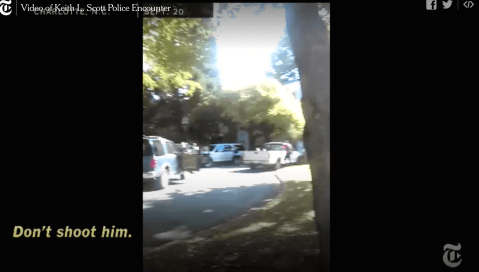
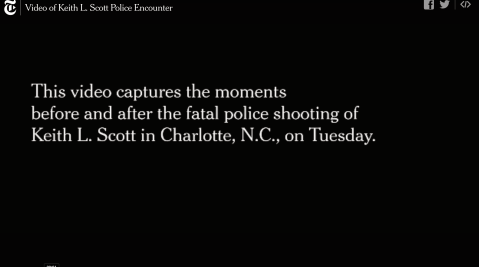
The video released by the New York Times of the police shooting of Keith Lamont Scott included the subtitle, as an introductory slide, that “It was recorded by his wife, Rakeyia Scott.” I pressed pause and, like Juhasz, felt myself unable to watch, stopped in my tracks by this matter-of-fact annotation. Scott had had to videotape the murder of her husband. It took some time before I could return to the video itself, but immediately my thoughts return to Reynolds—again, a black woman had been thrust into the position of narrating black death at the hands of a white police officer, while it was unfolding. But I want to insist that the fungible quality is ethically augmented by narrating itself.
In what follows, New York Times reporters Richard Fausset and Yamiche Alcindor transcribe Scott’s audio and summarize the visuals of the video rather than calling upon readers to view or re-view the video itself. I am choosing to provide the summary report—a narrative—in order to underscore the types of social and sensory positions that get taken up when one tells a story (in this case, it is a narrative of a narrative, since Rakeyia Scott is already positioned in the video as its participant-narrator). This account is not “what happened”—it is a narrative that tries to synthesize audio-visual information into a narrative form. If I also choose to repeat the narrative, rather than the video, it is in alignment with Hartman’s ethical insistence that to repeat the spectacle of death is to reify it, as when she choose not to quote Douglass’ narrative of witnessing the beating of his Aunt Hester in the introduction to Scenes of Subjection. Fred Moten, in In the Break, rightly suggests in response that to turn away from an image is still to be caught up in its imaginary reproduction.
I want the reader to focus on how the Times’s narrative conjures the scene while also involving certain decisions about what sensory data to include as internal to the logical order of events, harnessing adjectives, adverbs, and certain sensorial details. It is one platform of convergence:
Immediately, Ms. Scott said, “Don’t shoot him,” and began walking closer to the officers and Mr. Scott’s vehicle. “Don’t shoot him. He has no weapon. He has no weapon. Don’t shoot him.”
An officer can then be heard yelling: “Gun. Gun. Drop the gun.” A police S.U.V. with lights flashing arrived, partly obscuring Ms. Scott’s view, and a uniformed officer got out. From that point, there are five officers, most of whom appeared to be wearing body armor over plain clothes, around Mr. Scott.
“Don’t shoot him, don’t shoot him,” Ms. Scott pleaded, her voice becoming louder and more anxious. “He didn’t do anything.”
Officers continued to yell “drop the gun” or some variation of it — at least 12 times in 38 seconds.
“He doesn’t have a gun,” Ms. Scott said. “He has a T.B.I.” — an abbreviation for a traumatic brain injury the lawyers said Mr. Scott sustained in a motorcycle accident in November. “He’s not going to do anything to you guys. He just took his medicine.”
“Drop the gun,” an officer screamed again as Ms. Scott tried to explain her husband’s condition. The officer then said he needed to get a baton.
“Keith don’t let them break the windows. Come on out the car,” Ms. Scott said, as the video showed an officer approaching Mr. Scott’s vehicle.
“Drop the gun,” an officer shouted again.
Ms. Scott yelled several times for her husband to “get out the car,” but on the video, he cannot be seen through the window of the S.U.V.

still image from Rakeyia Scott’s video of the police shooting of her husband, Keith Lamont Scott. Cropping/blurring by JS, SO!
The above summary reproduces on the page how Scott’s speaking voice suddenly thrust her into a position of addressing several auditors. In listening to the video, I can hear that she modifies her tone of voice to communicate to each addressee, speaking alternately in an imitate imploring tone to her husband and with sharper emphasis to the police. The tone of voice is also linguistic—the diction changes as the addressee changes (“Come on out the car” is so intimate and familiar to my ear somehow, a private grammar and tone suddenly thrown into the public space). She calls the police, “you guys,” which strikes me as an attempt to tone them down, as it were, to bring them back into a human sphere from which they’d removed themselves. “Ms. Scott tried to explain her husband’s condition”—I add this emphasis, because I think the journalist is channeling here the ways in which Rakeyia Scott is not being heard.
In narrating the scene of her husband’s death, Rakeyia Scott becomes the absolute tie between that past of the image and the present of watching; I use the present tense, because it happens again, with each telling. Scott speaks, more silently and spectrally, to the audiences that will later watch and listen to the video she is recording, or read the transcript as synthesized by journalists or other viewers. In holding the camera, she imputes to herself a third voice as narrator, as did Wells in narrating the scene in A Red Record. This third voice, I am suggesting, is inaudible. It hovers next to her words with new force because, in the act of recording itself, she is testifying, offering a synthetic view as to reality. She creates a hearing space even though it is being foreclosed around her.
She is the only party in the scene who speaks to all addressees at once: her husband, the police, and “us.” The police do not respond to her directly, as if she not there. Indeed, she is standing somewhere outside of the scene as would a narrator. Because Rakeyia Scott holds a camera–outside of the frame–while also speaking, something of testimony gets activated. She has one foot outside of the event in the future after the video. She courageously separates herself from what is unfolding in order to constitute a narrative of the event; she mediates the scene. She not only puts into words facts that are not visible to the police, she issues pleas, commands, and words that carry the explanatory force of narrative, but also testimonial force because she holds the recording device.
still from the NYT‘s publication of Rakeyia Scott’s video of the police murder of her husband, Keith Lamont Scott
By holding a camera, Scott directs her words not only to police, but toward a yet-to-be constituted audience. The recording device also activates the presence of a juridical gaze. She anticipates having to bring this event, not yet fully unfolded, before a court of law. But at the same time, her use of the recording device reveals the juridical sensorium as white. The device’s presence indicates that, were Scott to remember and tell the story later in a court of law, her words on their own would not be enough to guarantee their explanatory power. The spectacle of black death cannot, on its own, announce its own truth within a racist optic. She says what the police (and a spectral jurist) refuse to see. She is forced to narrate because her voice is negated by the police, but also for those unknown viewers who will see this later.
still from the NYT’s publication of Rakeyia Scott’s video of the police murder of her husband, Keith Lamont Scott
There is hope, no doubt, that sometime after this scene has come to end, the video will find a place in the civic as a force of enacting law and justice, and above all, change.
At the turn of the last century, Du Bois wrote of “double consciousness” in The Souls of Black Folk, or the split incumbent upon black American consciousness to see oneself and then, to see oneself as the other sees you, “measuring one’s soul by the tape of a world that looks on in amused contempt and pity.” However, in narrating her husband’s death at the hands of American police in 2016, Rakeyia Scott was split in ways that are not fully compassed by double consciousness. This split into three (or more) not only marks the mediating place of black women in the spectacle of black death, but marks another ethical horizon where at issue is not only seeing differently, but hearing differently. As I’ve tried to describe, these ways of hearing are not an identification with (like me), but a recognition of (you are singular).
This is not yet to speak to the collapse of Scott’s voice after her husband’s murder. Continually occupying this position of testifying, Scott bravely maintains her hold on the camera, even when it means capturing her own screams when Charlotte police begin to shoot. She is both forms. Even then, in screaming, her voice retains its narrative power. Horrifyingly, she cannot change the sequence of events. But her voice continues to exist in belated relation to the scene and to the political afterlife of the murder as image.
With the digital, it becomes possible to reduce the space and time of testimony. With Reynolds, many watched on Facebook Live an event they were powerless to change in its unfolding. With Scott, the police gun shots had not yet taken place. I think the question is, were Rakeyia Scott white, would her words have been pro-active testimony of a not-yet determined event? Her words would have been lent a different power, a power to change events in their unfolding. In America, white testimony and black testimony bear fundamentally different ontological weight.
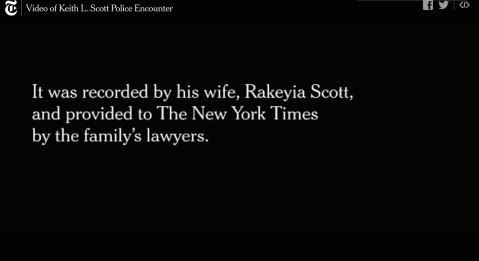
still from the NYT‘s publication of Rakeyia Scott’s video of the police murder of her husband, Keith Lamont Scott
In repeatedly trying to answer the question whose recurrence haunts me–What does it mean for Scott to have narrated the murder and death of her loved one as it was taking place?–I am thrust up against the sense that we are in a new ethical moment and relation to history when it becomes possible—and necessary—for black women to narrate death to an unknown public as it is unfolding. This includes the moments before their own deaths, such as Korryn Gaines, who was killed by the Baltimore County Police Department in August 2016, in her own apartment while holding her five year old son, who watched and himself suffered a gunshot wound. Like Reynolds, she broadcast her recordings via Facebook live.
Testimony is usually reserved for some time after the scene, and its hallmark is that it is belated. It must reconstitute a scene we can no longer see. The burden is on the narrating voice to conjure, with persuasion and conviction, the truth of the missing image, so that the story can in fact stand in place of the scene, merging with it on an ontological level. The live streamed video fundamentally reduces that distance in time, where the narrative now overlays the image, not from outside of it, but within it. They refuse the false juridical narratives that will, in the future, attempt to reframe the image in the name of “fact.”
In the differentiation of the senses, there is the order of the visible and the order of narrating voice that accompanies the image to give it sense, to retell its meaning somehow after. Scott insists on being there to narrate. That is not to suggest that somehow, because Scott speaks, she is more “present.” While the video is meant as future evidence, it also lends a voice of recognition in this ethical sense I have been trying to describe. Scott’s voice is split by the camera. Even if she herself were not to have survived the event, in narrating and taping, she becomes the medium for history (the persistent and unchanging fact of unjust black death). And yet, she is the vehicle for this death that matters in its singularity. She speaks as both, as history and particularity.
In watching and listening, I finally understand something of Hannah Arendt’s argument in The Human Condition that speech and action form a fundamental unit. For Arendt, great deeds cannot happen in silence: they must be narrated and accompanied by speech. And yet the scenes Arendt describes couldn’t be more different. This raises the issue of the conditions of narration: it is one thing to be speaking to your fellow citizens in a sanctioned forum. It is another to hold a camera as an officer holds a gun that might very well shoot you too.

Alicia Garza, one of the three co-founders of the national #blacklivesmatter movement in 2013, along with Opal Tometi and Patrisse Cullors.
What I’d like to preserve about Arendt’s analytic is the union of speech and action. It is related to the role of the right to speak in the ancient polis, where one had to take responsibility for the possibility that one’s speech might lead to the deeds of the community. But speech, for Arendt, is the function of action that makes it for others, that commits that action to the memories of others who can narrate it. In Arendt’s view, the story does not end there. The fact is, one might not survive one’s greatest deed. If one does survive, it would be in highly transformed terms. It is for others to tell the story.
In part, the ethical bond means our lives are in each other’s hands, that the other is responsible for narrating where you cannot. We are always-already ethically bound as “witnesses and participants,” as Frederick Douglass once described himself in his 1851 Narrative. He remembers himself as a six year old child not only watching, but listening to the scene of brutality against his Aunt Hester that he later recalls and transmutes into a narrative.
My hope is that this power of narrative is in the midst of opening another political horizon. It refutes identification as the untenable ground of ethics and action. We must act—or hold on to a sense of acting, even if its meaning and parameters remain unclear. As I reach the end of this essay, I can’t shake the sense that that it is not enough to have provided an analytic for understanding these videos and their voices in their long resonance with history. Nor does it feel right to say that these videos “do” something for us– they, and their narrators, demand that we do something for them. This mode of action begins in the attitude of hearing. Hearing testimony, Jill Stauffer describes in Ethical Loneliness: The Injustice of Not Being Heard, means allowing the unchangeable past to resound in the present. Only then can one “author conditions where repair is possible” (4).
It might be, then, that hearing itself is a mode of action, even if that action be much delayed. Hearing becomes action when formal power structures have denied its event as a source of repair. As listeners to the present and the past, we are neither projecting ourselves in the images nor imagining ourselves uninvolved in their scenes of subjection. We were all already there. And yet, to be “there” means to allow oneself to be exposed to another’s singular experience, rather than favor a collectively conditioned idea of what is known in advance. Who and where will we be afterward, is what remains. These videos and their not-yet determined afterlives become louder than the optic, if not in the word than in the sounds.
—
I’d like to thank Jennifer Stoever, Erica Levin, Jay Bernstein, and Ben Williams for their thoughtful voices and contributions that resound throughout this essay.
—
Julie Beth Napolin is Assistant Professor of Literary Studies at The New School, a musician, and radio producer. She received a PhD in Rhetoric from the University of California, Berkeley. Her work participates in the fields of sound studies, literary modernism and aesthetic philosophy, asking what practices and philosophies of listening can tell us about the novel as form. She served as Associate Editor of Digital Yoknapatawpha and is writing a book manuscript on listening, race, and memory in the works of Conrad, Du Bois, and Faulkner titled The Fact of Resonance. Her work has appeared in qui parle, Fifty Years After Faulkner (ed. Jay Watson and Ann Abadie), and Vibratory Modernism (ed. Shelley Trower and Anthony Enns).
—
 REWIND! . . .If you liked this post, you may also dig:
“A Sinister Resonance”: Joseph Conrad’s Malay Ear and Auditory Cultural Studies–Julie Beth Napolin
SANDRA BLAND: #SayHerName Loud or Not at All–Regina Bradley
On Whiteness and Sound Studies–Gus Stadler
Spaces of Sounds: The Peoples of the African Diaspora and Protest in the United States–Vanessa K. Valdés
Share this:


Current Top Posts





April 2021

January 2020

November 2019

October 2019

August 2019

April 2014

November 2017

March 2015

December 2017

October 2015
 Sounding Out!
Recent Comments