
The Specialty Record Shop

Harold Kelley holds "Blue Danube," a 78 record. Single 78s are visible on the rack below. Behind him is the store's soundproof listening booth. Circa 1949.
In 1947, my grandparents converted a room connected to their small home in downtown Richmond, Indiana, into a record shop. According to my grandmother, my grandfather—perhaps enamored with the family’s new “Airline” table model automatic phonograph (purchased from Montgomery Ward the year before)—somehow managed to persuade her, my great aunt Ina, and my great uncle Henry to embark on the venture. On May 12, 1947, the Monday after Mother’s Day, the Specialty Record Shop opened its doors. It would become the first black owned and operated retail establishment in the area to serve both black and white customers. (The store closed in 1980.)
Many years later, so many things strike me about this ambitious undertaking. Mostly, I realize that their actions were, particularly at that time, a very bold step across a profoundly demarcated color line in American life and music, even in Richmond, which was, with its Quaker history, somewhat more tolerant of African Americans. While Richmond’s public schools had been integrated by 1947, official segregation in the City of Richmond didn’t end until 1965. Long after my mother graduated from high school (1957), blacks and whites lived mostly separate lives—and listened to different music.

The shop's second location on Main Street in Richmond, Indiana, circa 1955.
This seems especially true in the early days of the shop, although among the nearly 100 78 rpm, ten-inch breakable shellac records that comprised the store’s first inventory were records by Nat King Cole, who by 1947 had himself made it across the color line into popular music. For the week ending January 3, 1947, King Cole’s “I Love You (For Sentimental Reasons)” was among Billboard’s top ten “Honor Roll of Hits,” a tabulation of the most popular tunes in the nation. Other popular songs carried by the shop on opening day were Alvino Rey’s “Near You” and Tex Williams’s “Smoke! Smoke! Smoke! (That Cigarette).”
.
Specialty would come to distinguish itself from its five Richmond competitors by carrying all kinds of music and special ordering any sound a customer wanted: classical, country and western, bluegrass, jazz, R&B, spiritual, folk. Music that other stores didn’t stock, Specialty carried, and its inventory eventually included more than 400 different labels. White customers who listened to sounds outside of mainstream popular music of the day found a home at Specialty, but on occasion would still feel the need to discreetly whisper their requests for the latest country and western or bluegrass hit, as if embarrassed by their own musical tastes. Such was the climate in those early days.
.In the 1950s, the Specialty Record Shop, which had from its inception boasted the “Greatest Variety in Recordings,” was in its advertisements not only marketing all genres of music but also both white and black musicians. A November 24, 1954, advertisement, for example, promotes Specialty’s wide variety of “albums and single records of popular, children’s, classical, religious, western, rhythm and blues, and jazz.” And an earlier advertisement from May 19, 1954, for example, promotes Tommy Dorsey (“Little White Lies”), Artie Shaw (“Special Delivery Stomp”), Fats Waller (“Honeysuckle Rose”), Duke Ellington (“Solitude”), Jimmie Lunceford (“Jazznocracy”), and Coleman Hawkins (“Body and Soul”).

A "Tips on Tops" Specialty advertisement promoting music by Perez Prado, Sarah Vaughn and Dinah Shore, Johnny Desmond, Les Baxter and Roy Hamilton, and Sauter-Finegan. This ad also features Specialty's outlet store in Connersville, Indiana. Richmond Palladium-Item, May 11, 1955.
Still, what’s painfully clear from the majority of advertising during that time is that mainstream music of the day reflected “popular” (that is, white) tastes. While black teenagers like my mother listened to “Ain’t That a Shame” by Fats Domino, her white counterparts listened to “Ain’t That a Shame” by Pat Boone. On and on, two versions of records—black and white—and two audiences: Among black songs covered by white artists that my mother remembers from her youth (most certainly carried in my grandparents’ store in both incarnations) are “Fever” by Little Willie John and “Fever” by Peggy Lee, “Long Tall Sally” by Little Richard and “Long Tall Sally” by Pat Boone, “Good Night, Irene” by Leadbelly and “Good Night, Irene” by the Weavers, and “Hound Dog” by Big Mama Thornton and “Hound Dog” by Elvis Presley.
.
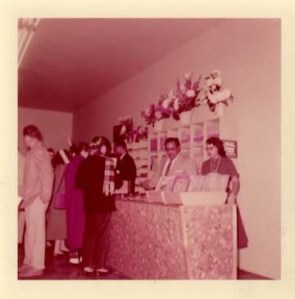
Marilyn Kelley, fifteen, helping customers with Henry Bass and Harold Kelley at the Main Street shop, 1955.
The R & B sounds that my mother, Marilyn Kelley, favored in musical artists in the 1950s were the familiar sounds of (or “sepia” as it was called early on), gutbucket, and melisma—black musical sounds and pronunciation not acceptable to the parents of white teenagers (although white youth were of course becoming familiar with these sounds). Covers changed that sound and made popular rhythm and dance music acceptable to white parents while satisfying white teens and keeping them “inside the fold.” White people (and black people) regularly heard and saw Dinah Shore, Peggy Lee, Pat Boone, Elvis Presley, and other white performers on radio and television, as the record companies heavily promoted these artists and their versions of popular songs. Black performers, on the other hand, were much harder for black people (or everybody else, for that matter) to discover. In the Midwest you had to catch Randy, a white disc jockey out of Nashville, who played black performers’ records and sold them through mail order (see WLAC—Radio). My mother listened to Randy’s show from her bedroom nearly every Saturday night.
.
I had never heard of Little Willie John or his version of “Fever” until my mother mentioned it, but when I listened to his voice for the first time I immediately understood what compelled my parents as teenagers to desire this song, even without lots of radio play or the benefit of television. When I sent my mother a link to Gayle Wald‘s review of a book about the musician (Fever: Little Willie John: A Fast Life, Mysterious Death and the Birth of Soul), she remarked that as a young girl in the rural Midwest she knew not a single thing about him except for the sound of his voice on that one song, which has stuck in her memory all these years. Few people in rural America knew what budding black artists looked like in those days. For listeners like my mother it was all about sound because there was practically nothing else. Pure sound drove her to enjoy these artists and made her want to hear their music again and again.
Into this world jumped two ordinary black couples, moved by their own phonograph player and records to turn a space they had leased to a succession of black beauty parlor operators into a small storefront: Harold Kelley, my grandfather, a carpenter by training who tended as carefully to the foundations of the store as to its customers; my grandmother, Elizabeth, who handled the register and advertising; my great aunt Ina, who mostly worked behind the scenes as the bookkeeper; and my great uncle, Henry Bass, known among the family as “the promoter,” likely as much for his knowledge of music, particularly jazz, as for a habit of walking up and down the street talking to people (a young African-American man named John would join the four after first lingering in the shop as a customer, then helping as a volunteer, until finally becoming an invaluable employee in 1955.)

Kelleys and Basses: Left to right: Henry Bass, Mary Ina Bass, Elizabeth Kelley, and Harold Kelley, co-owners of the Specialty Record Shop, circa 1963.
Benefiting first from their proximity to downtown at 611 South A Street, beneath a rose-colored neon sign, and later in the more spacious Main Street shop—with its “high fidelity” room in the basement—that I remember, the Kelleys and Basses managed to put several other record stores out of business, but more significantly they forged a small community—white and black—around music at the heyday of a vast industry and at one of the peaks of cultural segregation, which even now, so many decades later, seems like no small accomplishment.
Last year, my mother and I traveled to Richmond to visit both Specialty locations, maybe thinking that in all their metaphorical glory they would inspire us to write down what we remember. We went first to the storefront on Main Street, the place that I knew, and then to the small frame house on South A Street, the early shop and my mother’s childhood home. The drabness of the place knocked any hint of nostalgia out of both of us: The bushes and flowerbeds were gone, and the building looked cold and empty, slightly seedy, and a little miserable—these days no doubt valued more for the land it sits on than for the property itself. Thinking now of how my mother must have felt to see her childhood home diminished so mercilessly by time and progress still pains me.
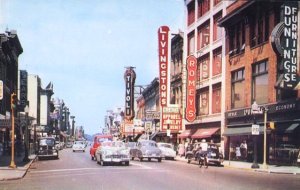
Main Street, Richmond, Indiana in the 1950s
She said then and I write with certainty now that it was more than it looked, which brings me back to what Specialty was, which must be something larger than what stands in our memories or I would not be writing this. It is difficult to attach particular significance to the place in a simple essay about music except to say that as with sound with Specialty meaning was everywhere, and as with music, Specialty reached everyone, at least in Richmond. Its soundproof booth, five-by-five feet square, drew high-fidelity enthusiasts to listen longer than perhaps should have been allowed. A single door connecting the store to my grandparents’ home, sometimes left open by chance, invited curiosity and even boldness from some customers who, stumbling upon the family’s dining room table with its treasure trove of uncataloged records may well have lingered too long in a private space but were never scolded or turned away. The record company representatives who, swept up in the excitement of Specialty’s open house in 1955, began helping customers buy any record, regardless of its label. Taken together, these shared experiences become a narrative of human experience as intricate and complicated as music itself, not so unlike the tapestry of sound that compelled my mother to listen to the magnetic voice of Little Willie John.
In the musical amalgam of today, it is at times difficult to imagine an America so rural, isolated, and segregated, at least in these particular ways. These days “black” music—that is, music by African-American performers—is likely more accepted by and certainly more fully integrated into mainstream America than is the black population itself. Virtual musical communities like turntable, Spotify, Grooveshark, and Pandora are as much growing purveyors of music as are iTunes and Amazon, the new corner record stores, and as such hold much promise for unprecedented global musical cross-pollination and exchange.
 As we may rightly celebrate the cultural integration of more sounds into a larger and perhaps more democratic musical landscape, it is also appropriate to mourn the passing of brick and mortar record stores (and bookstores and libraries, too, I might add) like Specialty, as much for their fidelity as for the ephemeral things these spaces once contained: qualities that bring kinship and serendipity to human experience—sound, yes, but also light, smell, touch, and color, with all its complications.
—
Jacqueline Dowdell received a B.A. from the University of Michigan and an M.F.A. from Cornell University. She is a communications coordinator at Cornell Law School. Thanks to her mother’s memories, her grandmother’s meticulous archive of Specialty history, and a newfound enthusiasm for sound, she is working on a memoir about the Specialty Record Shop.
.
Share this:

The Sound of Hippiesomething, or Drum Circles at #OccupyWallStreet
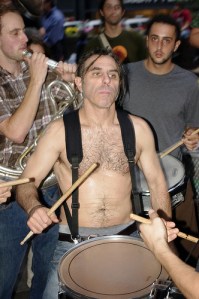
Photo from Zuccotti Park, September 28 2011 by Flickr user David Shankbone
Last week’s news was been full of alarming stories of real and threatened violence at various #Occupy sites around America. But also disturbing were the reports that complaints about the continuous drumming at the Occupy Wall Street site in Lower Manhattan were threatening to shut the entire operation down. According to stories in N + 1, slate.com, Mother Jones, and New York, the ten hour marathon drum circles at Zuccotti Park have been a focal point of mounting tensions, both between the occupiers and the drummers, and between the occupiers and the community at large. Last week, community members asked that the drummers limit their drumming to 2 hours a day, a request backed by actual OWS protesters. The drummers, loosely organized in a group called PULSE, initially resisted the restriction, claiming that such requests mimicked those of the government they were protesting against. Since then, a compromise has been worked out, but the situation gives rise to a host of questions about race, sound, drums, and protest.
Community organizers both inside and outside OWS said they were distressed by the continuous noise that these protesters are making, and certainly they had reason: as Jon Stewart put it in his episode of talking points, “it’s a public space, it’s for everyone, including people who don’t consider drum circles to be sleepy time music.”
Writer and singer Henry Rollins agrees, telling LA Weekly that he dreams of an #Occupy Music festival, because “So far [he has] heard people playing drums and other percussion instruments” but still wonders “if there will be a band or bands who will be a musical voice to this rapidly growing gathering of citizens.” Rage Against the Machine guitarist and frequent #Occupier Tom Morello also seems to concur, telling Rolling Stone, “Normally protests of this nature are furtive things, It’ll be 12 people with a small drum circle and a couple of red flags. But this has become something that people feel part of.” Stewart, Rollins, and Morello all have a point: not everyone likes drum circles, in fact some people feel quite strongly about them, which has the potential to be divisive for a movement famously representing “the 99%.”
But over and above the questions of musical taste, the very audible presence of snare drums, cymbals, and entire drum sets at OWS—more often found in marching bands or suburban garage band practice spaces than the usual drum circle staple, the conga—raises a different set of questions, both sonic and social, around the interrelated issues of “noise,” public space, and privilege.
That a drum circle populated by a large number of bad, mostly white drummers is being touted as “the sound” of occupation isn’t that surprising, at least not for alumni of UC Berkeley.
In my day, a more conga-oriented drum circle sprouted up on Sproul Plaza every Sunday; today, a similar one occupies a green space in Golden Gate Park right across from Hippie Hill, pretty much 24/7. (I walk by it every Thursday on my way to the gourmet food trucks: happily, the delicious smell of garlic noodles and duck taco obliviates all other senses.)
These kinds of regular, yet impromptu, circles abound in California and elsewhere: indeed, the sound of drum circles à la OWS has characterized certain types of social spaces for the last forty years. But what exactly does the sound of drum circles characterize? What meaning is being made by them, and why?

Drumming and Dancing the Bamboula in Place Congo, circa 1880
In the Americas, drum circles go back hundreds of years– many indigenous peoples have drumming traditions, for example, and, in Congo Square in New Orleans, slaves of African ancestry gathered weekly to dance to the rhythms they played on the bamboula, a bamboo drum with African origins, beginning in the early 1700s. The notion of the “circle” was a fundamental part of the dancing and music making at Congo Square—according to Gary Donaldson, the circles represented the memories of African nationalities and various reunited tribes people—and was echoed in various types of “ring shouts” across the West Indies and the Southern U.S. The contemporary drum circle stand-by, the conga, also came to the Americas via the forced migration of slaves; it is of Cuban origin but with antecedents in Africa, like the bamboula. The black power movements of the 1960s drew on this history—and sound—to good effect, reigniting semi-permanent drum circles in many U.S. neighborhoods– like the formal gathering that meets in Marcus Garvey Park in Harlem on Saturdays that is currently also under fire from a nearby condo association –audibly announcing their presence and enacting new community formations.
Given this history–and without erasing the presence of drummers of color at OWS--it can seem puzzling how the drum circle has come to occupy such a curiously whitened position in America’s cultural zeitgeist. Furthermore, one of the more problematic aspects of the OWS drum circle debate is the racialized implications of the instrumentation there—implications borne out by videos of OWS that show an overabundance of snares, some of the loudest drums available. According to percussionist Joe Taglieri, “no conga is louder than a fiberglass drum with a synthetic head.” If snares are louder than congas, then noise – actual decibel level — is probably not the sole issue when community groups attempt to control or oust drummers like those in Marcus Garvey Park. It does seem to be a key point of contention at OWS, however.
While there is also a history of African American marching bands, especially in the South, snare drums speak to a different set of American cultural traditions. Drum kits themselves evolved from Vaudeville, when theater space restrictions (and tight pay rolls) precluded inviting a large marching band inside. Mainstream associations with snares include but are not limited to army parades, high school marching bands, and of course hard rock music. Sometimes, like in the case of Tommy Lee, it is an unholy alliance of several of these contexts.

Tommy Lee, formerly with Motley Crue, drumming for the University of Nebraska
In other words, outside of OWS, snares are hardly the sound of social upheaval.
How the drum circle became associated with political protest in the first place is interesting. Although people sometimes associate drum circles with beatniks rather than hippies, a case could be made that they actually connect more strongly to an electrified Woodstock rather than an acoustic Bleecker Street, thanks in part to Michael Shrieve’s widely mediated turn during Santana’s performance of “Soul Sacrifice” at the 1969 festival.
It is important to note that Shrieve is playing the traps in this sequence, not the conga, which is one reason I’d like to suggest that something about that scene – the hands on the congas, the grins of the other guys, the ecstatic face of a 20-year-old as he slams his kit, and the fetishistic gaze of the camera on the sticks, the skins and the cymbals – caught the imagination of a particular segment of American society. Santana’s band – two Mexican Americans (Carlos Santana and Mike Carabello), a Nicaraguan (Chepito Areas), two whites (Shrieve and Gregg Rolie, who later plagued the world in Journey) and an African American (bassist David Brown)—was truly multi-racial, creating a “small world” visual that furthered Woodstock’s utopian rhetoric in ways that were surely not borne out by the demographics of its audience. More importantly perhaps, the Woodstock movie showed a white suburban hippie guy as an equal participant in a multi-ethnic rhythmic stew, a powerful image in the 1960s. Indeed, the Santana performance may be precisely the moment when the idea of the drum circle was lifted from the context of “black power” and moved into the hippie mainstream.
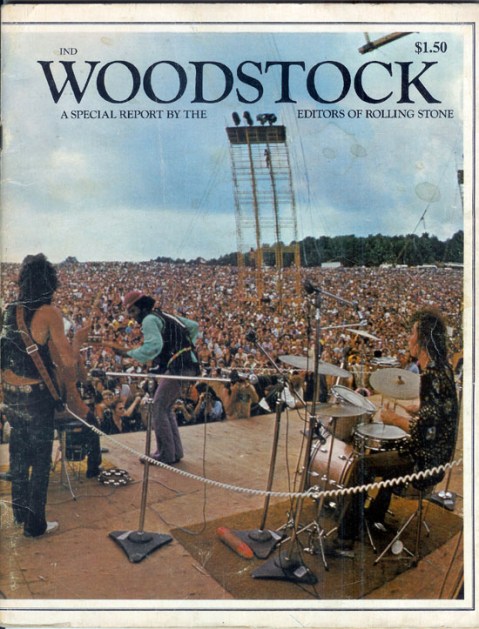
When's the last time you've seen a drummer on a magazine cover?: Santana on Rolling Stone's Woodstock special issue
Woodstock made congas hip to the mass of America—not just in Santana’s set but also in the performances of Richie Havens and Jimi Hendrix—and Woodstock helped define what the drum circle meant, in part by encapsulating certain discursive tropes that were very particular to those times. For example, drum circles epitomize the ’60s idea that political action is simultaneously self-expressive and collective. If a crowd of people sing “We Shall Overcome” or chant “Ho Ho Ho Chi Minh/The NLF is going to win,” it is a a collective act. It’s collective even if the crowd is singing “Yellow Submarine” and it’s not overtly political. By contrast, drum circles are about improvisation, so each drummer can “do his own thing” while participating in the groupthink. (The “his” is implied: video of drum circles show few women participants. Apparently Janet Weiss, Meg White, and Sheila E.’s “own thing” can actually be done on their own.)
In terms of sound, drum circles also project well beyond their immediate location, compared to singing and chanting (in fact, OWS has had problems with the drum circles drowning out its “human microphone”). Plus, since the drummers can take breaks and change out, the actual drumming never stops, unlike a performing musician. Thus, drum circles are celebrations of self expression that are actively imposed on an audience that is well beyond eyesight. This summarizes a modern view of personality rooted in the 1960s: that it’s not enough to participate, you’ve also got to “be yourself.” I think these two notions account for the enduring idea of the drum circle as a supposedly political sound, even when it’s not. Drumming in a drum circle allows for a public display of self-expression that simultaneously allows the participant to belong to a group. The appeal of that is obvious, especially in our contemporary iCulture. However, the politicization of the sound of drum circles only makes sense when you add in the lingering sonic traces of black protest, modulated through a hippie lens. You can see this clearly in New York magazine’s “Bangin’: A Drum Circle Primer” (10.30.11), whose visual imagery prominently features a West African djembe drum and describes only the “hippie-era use of traditional African instruments” rather than their actual, snare-heavy configuration at OWS. Despite the snares and in spite of the oft-commented on lack of black faces at OWS—see Greg Tate’s piece in the Village Voice—drum circles still carry enough connotations of militant blackness to annoy the bourgeoisie.
One key thing differentiates OWS’s drummers from the demonstrations of yore, however: in the 60s and early 70s, there was a notion that drum circles were for drummers. Santana’s band, though young, was made up of world class musicians from the San Francisco scene. But to a certain type of viewer – young, white and male—the drum circle must have seemed so doable. Compared to the singular virtuosity of Jimi Hendrix or sheer talent of Pete Townshend, Santana’s music was the sonic equivalent of socialism. No wonder the drum circle scene has had more of a half-life in the hearts and minds of would-be Woodstockians than just about any other: it is a visceral depiction of music as communal, ecstatic, and accessible. Today, thanks to the far-reaching waves of the movie Woodstock: 3 Days of Peace & Music (1970), the percussive noise such a circle makes creates a particular sonic backdrop that clearly—and nostalgically—says hippiesomething.
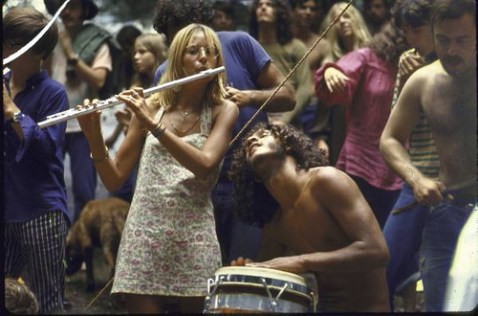
Photo by Flickr user Paul Townsend
And yet, politically speaking, nostalgia is, as theorists like Antonio Gramsci, Guy Debord, Jacques Attali and Theodor Adorno have frequently reminded us, invariably associated with Fascism. From Mussolini to Hitler to Reagan to Glenn Beck, it’s a tactic that has been explicitly invoked to thwart social progress. The nostalgia conundrum seems to have escaped both mainstream news media—which uses the drum circle to signify to viewers that OWS is a radical leftist plot—as well as the drummers themselves. For the drummers are hippies, and hippies young and old really believe in drum circles. Hippies take part in them, hippies enjoy them. It’s fair to say, however, that few others do, just as no one ever really enjoyed the 45- minute drum solos on live records by Cream, Led Zeppelin, and Iron Butterfly. (I’m thinking about Ginger Baker’s “Toad,” John Bonham’s “Moby Dick,” and “In-a-Gadda-Da-Vida,” respectively. Also about the time I went to the bathroom and bought popcorn at the LA Forum during a drum solo by some band I know forget, and still had to sit through ten more minutes.) .

Corporate Teambuilding in Boston, by Exclusive Events
However, that fact does not seem to bother those involved in drum circles, and herein lies the great problem with the whole equation drum + hippie = activism. To any members of the mainstream media who hears and records them, a drum circle instantly conjures up a chaotic, possibly even violent, scene: Chicago ‘68, Seattle 2000, Oakland 2011. But the truth is that, outside Fox News, the noun “hippie” no longer means “liberal,” or possibly even politically engaged. The curious thing about drum circles, then, is that while they sound progressive, they can actually mean conservative. A 2006 piece from NPR, for example, describes how drum circles have been adapted as teambuilding exercises for corporations like Apple, Microsoft, and McDonald’s.
The OWS situation illustrates such conservatism in different ways. In another recent article in New York Magazine, a 19 year old drummer from New Jersey is quoted as saying, “Drumming is the heartbeat of this movement. Look around: This is dead, you need a pulse to keep something alive.” This is said in the face of opposition from the movement’s own management, who fear a shutdown due to severe problems with neighborhood groups and restrictions on the General Assembly’s call-and-response “mic checks” that have been so galvanizing. His words are instructive as well as ominous, illustrating that young hippies like him believe that the sound of drums is a suitable replacement for protest or action itself.
The idea that sound alone can energize a movement is not just wrong, it also showcases a willful misunderstanding within the ranks of OWS. In Oakland last week, a small band of anarchists threw bottles at the police, whose wrath rained down in the form of tear gas canisters and a fusillade of dowels: one protester, an Iraq veteran, has been seriously injured.
The incident highlights a kind of cognitive dissonance that is hindering the ability of OWS to achieve political progress. The drumming problems at Zuccotti Park highlight the way that history can repeat itself as farce, as the distance between nostalgia and action — and between sound and meaning — disturbs the peace in more ways than one. Just as drummers in Sproul Plaza refuse to acknowledge that UC Berkeley is now mainly host to computer science and business majors, and drummers in Golden Gate Park refuse to deal with a Haight Ashbury that is gentrifying in front of their eyes, so too do the drummers at OWS refuse to acknowledge that their sound is no longer the sound of social activism. Indeed, the sound of a drum circle is reminiscent of the ring of a telephone, the scratch of a needle dropped on a record, or the clip clop of horse hoofs on hay-covered streets. No wonder it sounds out of place at OWS.
—
Gina Arnold recently received her Ph.D. in the program of Modern Thought & Literature at Stanford University, where she is currently a post doctoral scholar. Prior to beginning graduate work, she was a rock critic. Her dissertation, which draws on historical archives, literature, and films about counter cultural rock festivals of the 1960s and 1970 as well as on her own experience covering the less counter cultural rock festivals of the 1990s, is called Rock Crowds & Power. It is about rock crowds and power.
Share this:


Current Top Posts





April 2021

January 2020

November 2019

October 2019

August 2019

April 2014

November 2017

March 2015

December 2017

October 2015
 Sounding Out!

Recent Comments