
Reproducing Traces of War: Listening to Gas Shell Bombardment, 1918

Welcome to World Listening Month 2014, our annual forum on listening in observation of World Listening Day on July 18th, 2014. World Listening Day is a time to think about the impacts we have on our auditory environments and, in turn, its affects on us [for the full deets, peep our recent SO! Amplifies post by Eric Leonardson, Executive Director of the World Listening Project]. We kick off our month of thinking critically about listening with a post by media historian Brian Hanrahan, who listens deeply to sonic traces of the past to prompt us to question our desires for contemporary media representations of “reality.” It also marks the global 100 year anniversary of World War I this August 2014: a moment of silence. —J. Stoever, Editor-in-Chief
—
For some reason that I don’t fully understand, I am very emotionally moved by the space around a sound. I almost think that sometimes I am recording space with a sound in it, rather than sound in a space. –Walter Murch
If you want to listen to the past, there’s never been a time like the present. Every year, it seems, new old recordings are identified, new techniques developed to recover sounds thought irrecoverable. Here is Bismarck’s voice, preserved on a cylinder in 1889. Here, older still, is Edison’s. There is the astonishing recuperation of phonautograms – reverberation traced onto soot-blackened paper in the mid-nineteenth century, digitally processed and played back in our own. But as that processing underlines, no sound recording straightforwardly reproduces the real. An acoustic artifact is a compound of materiality, form and meaning, but also a place where technology meets desire. Old recordings meet the listener’s longing halfway; they invoke a reality always out of reach. And not simply a longing to hear, but also to touch, and be moved by, the fact of an absent existence.
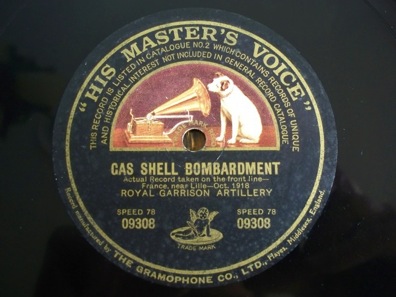
Take, for instance, HMV 09308. In October 1918, just before the end of the Great War, William Gaisberg, a sound recordist of the pre-electric era, took recording equipment to the Western Front in order to capture the sound of British artillery shelling German lines with poison gas. Gaisberg died not long after, probably from Spanish flu, although some say he was weakened by gas exposure during the recording. Nonetheless the “Gas Shell Bombardment” record – a 12-inch HMV shellac disc, just over 2 minutes at 78 rpm – was released a few weeks later, just as the war came to an end. Initially intended to promote War Bonds, ultimately the record was used to raise money for disabled veterans.

For decades, the HMV recording had a reputation as one of the very earliest “actuality” recordings – one documenting a real location and event beyond the performative space of the studio, imprinted with the audible material trace of an actual moment in space and time. Documents like this – no matter what the technology – usually come with additional symbolic authentication. Here, the record’s label does some of that work. This “historic recording,” says the subtitle, is an “actual record taken on the front line.” Publicity pieces drove home the message. In the popular HMV magazine The Voice, Gaisberg – or probably his posthumous ghost-writer – described the expedition in detail, claiming the track to be a “true representation of the bombardment.”
.
In the same issue, a Major C.J.C. Street compared the recording to his own experience on the Front. “Its realism,” he wrote, ”took my breath away… I played the record many times… finding at each attempt some well-remembered detail.” He didn’t say so in his article, but Street – an artillery officer, a novelist and a propaganda man for the intelligence agency MI7 – was in fact the impresario of the record. This was not the first time he had found astute uses for sound media. The previous year he had put together a record that set artillery drill commands to popular tunes – the recording was both a propaganda release and an army training tool for new recruits. With the Gas Shell record, Street knew he wasn’t just selling recorded sound, but also an auratic sense of closeness to an overwhelming reality, the palpable proximity of war and death. Authenticating detail helped to underpin this sense of an absent real made present. Street cued the listener for those “well-remembered details.” In particular, he singled out one indistinct rattly flap-whizz noise, hearing in it, he claimed, the sound of a round with a “loose driving-band.”
The record stayed in the HMV catalog until 1945, but only in the early 1990s were its production history and authenticity claims seriously examined. In specialist journals, archivists, collectors and amateur historians undertook a collective forensic and critical analysis. A promising auditory witness was located: 95-year-old Lt.-Col. Montagu Cleeve another former artillery officer, in his time a developer of “Boche Buster” railway gun, later a music professor – was invited to critically assess the recording. Cleeve vouched unreservedly for its authenticity. He heard in it, he said, an unmistakable succession of sounds – the clang of the breech, the gigantic report of the firing explosion, the distinctive whiny whistle of a gas shell on its way across no-man’s-land. Others looked to data rather than the memories of old soldiers. One expert on pre-electric recording noted the angles commanded in firing instructions, correlated them with known muzzle velocities for 4.5 and 6-inch howitzers, then used this and other information to “definitively” explain the counter-intuitive anti-Doppler sound of the shells’ whistling. He also identified the audible echo effect – the curious “double report” of the guns heard here – as the sound of a brass recording horn violently resonating at a distance of exactly 26.5 meters from the guns.
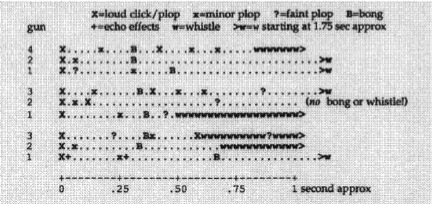
Peter Adamson, “The Gas Shell Bombardment record,” The Historic Record Quarterly, April 1991.
Eventually, skepticism won out. Close listening at slow speeds – just careful attention and notation, nothing more elaborate – revealed inconsistencies and oddities in the firing noises. The bongs, plops and whistles seemed internally inconsistent. Some of the artillery sounds – ostensibly a battery of four, firing in quick succession – varied implausibly with each successive firing. Physical evidence from the record’s groove, as well as extraneous noises – surface crackle and fizz, and, audible within the recording, the swish of a turntable – seemed to indicate at least two rudimentary overdubs, in which the output of one acoustic horn was relayed into a second, possibly using an auxetophone, an early compressed-air amplifier. All this resulted in a double- or triple-layered sonic artifact. Finally – the crucial evidence, although oddly it was hardly noticed at the time – an alternative take was located. In this take, according to its discoverer, the entire theatrics of gunnery command is simply absent, and there is no sound at all of whistling shells in motion. What was left was a skeleton sequence of clicks, thuds and cracks, supplemented with only a single closing insert, the portentous injunction “Feed the Guns with War Bonds!”
In short, it seems highly likely that any original field recording was, at the very least, post-dramatized with performed voices and percussive and whistling sound effects. So, it is tempting to say, that clears that up. The recording’s inauthenticity is proven. File under Fake. But in fact, if we don’t stop there, if we set aside narrow and absolutist ideas of authenticity, and instead explore the recording’s ambiguity and hybridity, then Gas Shell Bombardment becomes all the more interesting as an historical artifact.
Let’s assume, for the sake of argument, that some form of basic recording was done in France, very possibly a staged barrage specifically performed for Gaisberg’s visit, and that this recording then had effects added back at HMV in London. The record might then be seen less as a straightforward documentary, and instead as an unusual version of the “descriptive speciality,” a genre of miniature phonographic vignette dating back to the 1890s, far predating longer-form radio drama. Very little is known about these early media artworks, but it is a fair generalization to say that in America the genre was more slanted towards vaudeville comedy, whereas in Europe, imperial and military scenes predominated. As early as 1890, for example, there had been German phonographic representations of battles from the Franco-Prussian war. The Great War saw a flourishing of the genre. Scholars are just beginning to take an interest these old phonographs; here’s one recent essay on the “Angel of Mons,” for example, a British acoustic vignette of a famous incident on the Western Front.
Listen to a 1915 German descriptive speciality, depicting the attack on the fortress of Liège the previous year:
.
As a descriptive speciality, Gas Shell Bombardment is unusual because it incorporates an actual indexical trace. But such traces – as emphasized by Charles Sanders Pierce and many later media-theoreticians– do not resemble their referent, they are caused by it. The bullet hole does not look much like a bullet; thunder is lightning’s trace, not its likeness. But for Street and Gaisberg, the trace’s lack of resemblance caused problems: the original recording’s lack of detail, cues and clues, but above all its lack of internal dimensionality, created a perceptual shortfall and a lack of credibility. Maybe they hoped that the guns, by sheer force of amplitude, would overcome the spatially impoverished, reverbless reproduction of pre-electric recording. If so, it didn’t work. Without added effects, the guns’ trace was as flat and “body-less” as a sequence of Morse. It was a sound without a scene. The producers’ interventions aimed to thicken the primary artifact with referential-sounding detail, but also to heighten the sense of materiality and spatiality, and to strengthen the sense of diegetic presence, of worlded thereness. The soldiers’ voices – louder and quieter, close-up and farther-out – and the fake-Doppler of the “shell whistling” lent the recording narrative direction (literally, some trajectory) and “authenticating” points of detail. But above all they gave a sense of internal space to the recording, a space into which the listener could direct her attention.
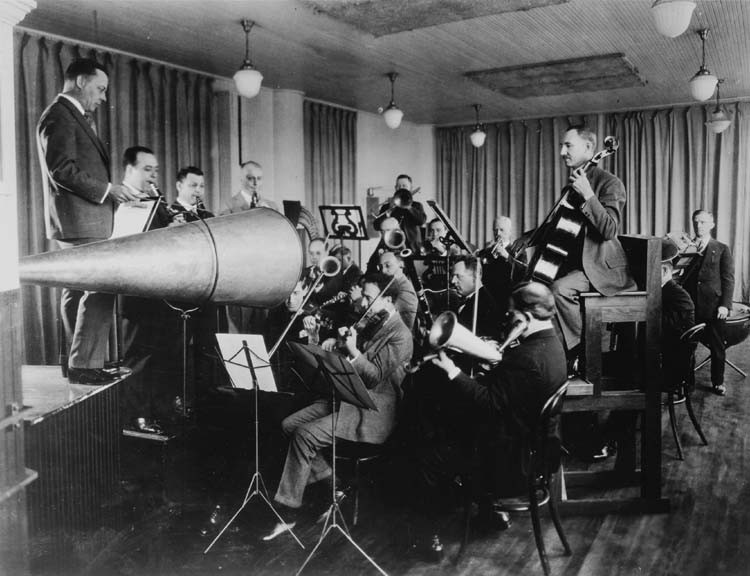
In this context, we can only admire the creativity and performative élan of the unknown production crew. We know little about effects production in early phonography. It is a safe bet that some techniques were adopted from theatre, and that there was overlap with silent film accompaniment. But whatever the method used, it would have called for the awkward orchestration of a limited number of iconic sounds to create an impression of a spatially coherent and materially detailed sonic environment. The recordist and his team would first have had to imagine how relative loudness – of voices, of material objects struck and sounded – might create a sense of spatial depth when transduced through the horn’s crude interface. Then they would have had to perform this as a live overdub, keeping time with the base track of the gun recording played through another horn. And all this done with participants and equipment crowded tightly around the mouth of the huge horn, crammed into the tiny pick-up arc, a scene looking something like this image of Leopold Stokowski’s pre-electric recording sessions or this photograph of the recording of a cello concerto.
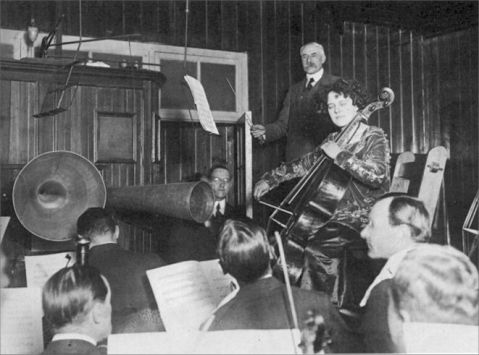
Acoustic recording session with Elgar and Beatrice Harrison, 1920
As well as this hybrid of trace and live performance, there is another performance here – Gaisberg’s journey itself. With twenty years of recording experience, Gaisberg was probably very well aware that the expedition would not yield a “realistic” recording of the guns. But the expedition had to be made, so that it could be said to have taken place. Expectations had to be primed and colored, so that, to use André Bazin’s famous phrase about photographs, the recording could partake in an “irrational power to… bear the belief” of the listener. The journey, and the accounts of Gaisberg and Street are not a supplement to the “true representation” of the gas bombardment. They are part of that representation. Moreover, in subsequent writing it is noticeable that the manner of Gaisberg’s death becomes a rhetorical amplification for the authenticity of the recording’s trace, as if his fatal inhalation (of gas molecules or flu bacilli) were itself a deadly indexation, paralleling the recording’s claim to capture the breath of the War, and even of History itself.
In media-historical terms, the Gas Shell Bombardment recording can be understood as a late, transitional artifact from phonography’s pre-microphonic era. The desire for the sonic trace, for an ever more immersive proximity to events was there, but electro-acoustic technology was not yet in place. Two years later, in 1920, Horace Merriman and Lionel Guest made the first experimental electrical recording, arguably also the first true field recording. The event, appropriately enough, was an official war memorial service in London, where Merriman and Guest – working for Columbia Records – put microphones in Westminster Abbey, running cables to a remote recording van parked in the street outside, where they sat amidst heating ovens and cutting lathes. By the end of the 1920s, remote recording and broadcasting, while never straightforward, were well on the way to ubiquity.
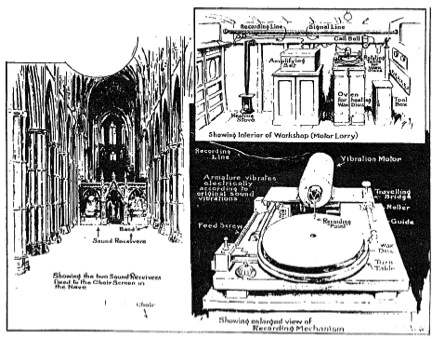
Illustrated London News, 1920.
Claims made on behalf of technologies of reproduction may seem simplistic, but there’s a grain of truth to their simplicity. If there were nothing special – even magical – in the referentiality of the camera that captures the moment, the recording that’s like being there, the liveness of the live broadcast, these things would not play the role they do in everyday life and in the ideological fabric of society. But there is falsehood too, in over-simplifying the nature and affective charge of old photographs, old footage, old recordings. These are made things, composed of different materials, media, signs and conventions; they are inseparable from the desires and expectations they induce and direct. They function in part by mimesis and verisimilitude, but also through the gaps, blank spots and false illusions of their trace. They can – rightly – intensify our feeling towards the past, but should also prompt us to think about our own desires and investments.
—
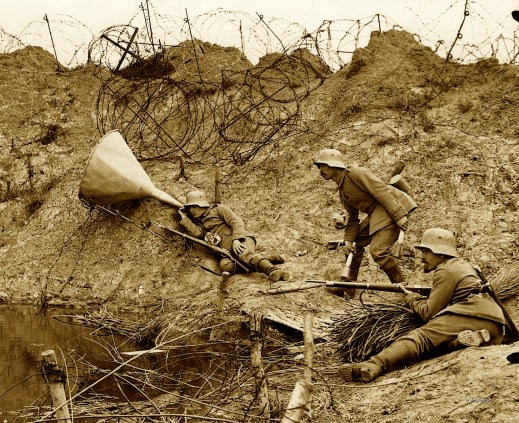
Image by Flickr User DrakeGoodman, “Horchposten im Spengtrichter vor Neuve-Chapelle 6km nördlich von La Bassée Nordfrankreich 1916,” A trio of lightly equipped soldiers from an unidentified formation oblige the photographer by looking serious and pretending they’re just metres from the enemy, listening for activity in his lines. The improvised “listening device” is actually a large funnel, probably liberated from a nearby farm.
—
Brían Hanrahan is a film, media and cultural historian, whose work focuses on the history of acoustic media, German and European cinema and the culture of the Weimar Republic.
—
Edited post-publication at 8:00 pm EST on July 7, 2014
–
 REWIND!…If you liked this post, you may also dig:
SO! Reads: Susan Schmidt Horning’s Chasing Sound: Technology, Culture and the Art of Studio Recording from Edison to the LP–Enongo Lumumba-Kasongo
A Brief History of Auto-Tune–Owen Marshall
DIY Histories: Podcasting the Past–Andrew Salvati
Share this:

On Sound and Pleasure: Meditations on the Human Voice

 After a rockin’ (and seriously informative) series of podcasts from Leonard J. Paul–a three part “Inside the Game Sound Designer’s Studio”– and a post on sound and black women’s sexual freedom from SO! Regular Regina Bradley, our summer Sound and Pleasure series keeps doin’ it and doin’ it and doin’ it well, this week with a beautiful set of meditations from scholar, artist, performer, and voice activist, Yvon Bonenfant. EVERYBODY SCREAM!!!–-JS, Editor-in-Chief
—
1
What I have to say about sound and pleasure can mostly be summed up this way: everyone deserves to take profound pleasure in their body’s sound.
Not only this, everyone deserves to both engage passionately with social sound and negotiate the exchange of social sound on pleasurable terms.
Like other expressive systems, however, these inalienable sonic human rights are mostly ignored, curtailed, or otherwise ‘disciplined and punished’ in the Foucauldian sense by our social systems. So, we are mostly neurotic, or otherwise hung up on, what kinds of sounds we make, where and when. We fetishise sound, particularly virtuosically framed sound, because it is part of a series of sublimated impulses, or we repress it because we think we aren’t supposed to emit it, or we ignore it.
2

“DSC_0296” by Flickr user Anastasia CW, CC BY-NC-SA 2.0
In any given human relationship within which all parties can vocalize, the voice is an evident, key relational tool. It is full of gesture and meaning and text and sends rapid-fire, complex, layered, even self-contradictory or oxymoronic messages. It is a truly tangled web, and of course, for those who can use speech, transmits language.
However, I’d like to disentangle our sound from our language for a moment. Indeed, sound is not necessary in order to develop and transmit linguistically carried ideas, information and impulses. It has long been accepted that sign languages are fully developed languages, with intricate grammatical systems, vocabularies, and all of the other features of spoken languages. It is thus not necessary to use sound as a carrier of language. Yet if we have a voice, we almost always use sound to carry our language. And we force deaf people to try to fake having a voice and to fake listening to voices through lip reading and gesturing.
The last twenty years has seen a real boom in speculation and even scientific experiments that theorise why human bodily sound – the most evident aspect of which is our vocal sound – is so important to us. Musicology, biomusicology, evolutionary psychology, neuropsychology, and cultural studies of many kinds have tried to account for this. I have my own favorite reason, one I’ve tried to describe in a number of scholarly articles. This is that sound is much like touch. Like, yet unalike. It reaches and vibrates bodies, but at distance. It voyages through space in other ways, but it evokes haptic responses.
3
Sound isn’t solid, but it takes up space. This is expressed by Stephen Connor within his concept of the vocalic body. When we sound, there is a resonant field of vibration that moves through matter, which behaves according to the laws of physics – it vibrates molecules. This vibratory field leaves us, but is of us, and it voyages through space. Other people hear it. Other people feel it.

“GAELLE” by Flickr user Pauline Thomas, CC BY-NC 2.0
I’ve said that sound is like touch. However, one key way that it is not like touch is that it can do this thing. It can leave our bodies and travel away from us. We don’t need to grip it. We don’t need to hold on. And once emanated, it is out of our control.
More than one emanation can co-exist within matter. Their vibrations interact with one another, waves colliding and travelling in similar or different directions, and the vocalic bodies that they represent are morphed, hybridized: they intersect and invent composite bodies.
We hear the resulting harmonies. Historically policed into ‘consonances’ and ‘dissonances’, we have the power to let the negativizing connotations of either of these words go and simply hear the results of the collisions. Voices sounding simultaneously create choreographies of gesture that can be jubilant, depressing, assertive, aggressive, delightful, morose… or many of these simultaneously and in rapid alternation.
The fields of human sound in which we bathe are a continually self-knitting web of sensation. They are full of gestures pregnant with intention, filled with improvisatory spontaneity, success, failure and experimentation. They are filled with a desire to act upon matter, and to reach and engage one another.
4
My Ukrainian-origin mother was ‘loud’, I guess, at least by Anglo-Saxon standards, and her voice was timbrally very rich. And my father was a radio announcer (he disliked being called a DJ immensely, even though he worked in commercial radio and worked on shows that spun discs – he preferred being associated with talking). His voice was also very rich, as well as extremely crafted. It could be pointed and severe: a weapon. He had professional command of its qualities. We were not a quiet family; none of us were vocal wallflowers. But were our soundings pleasure-filled? Certainly, we were allowed to make lots of sound in some circumstances. However, just being allowed to be loud – though it might sometimes be a pleasure – does not necessarily lead to a pleasure-filled dynamic. Weightlifting makes us stronger, but it doesn’t necessarily feel good.
The amount of sound and whether ‘lots’ of it, or heightenings of its qualities – lots of amplitude, or lots of other kinds of distinctness, let’s say things like pitch or emotional timbre – are key variable features of family life in our cultures. Sound takes us directly into the meatiest of interpersonal dynamics – the dynamics of space and gesture, the dynamics of who takes up space with their sound and when. Families are, of course, microcosms of this sonic dynamic, but any group within which we generate relationships and encounters is subject to this dynamic, too. Our very own bodies end up developing what Thomas Csordas might call a ‘somatic mode’ that embodies our experience of these dynamics.

“Scream” by Flickr user madamepsychosis, CC BY-NC-ND 2.0
Whether we start from psychodynamic, neuropsychiatric, or even habitus-based models, it’s clear that repressing the expression of bodily sound regulates breathing impulses and other metabolic processes in ways that might become, well, habits.
Let’s put this in other ways.
The classic, Freudian, psychodynamic model of neurosis – as disputed as it is, and with all of its colonial, sexist, homophobic, racist and even abuse-denying overtones – did at least one thing for our understanding of what repressed emotion does. Repressed emotion affects the body.
Today, a popular understanding of this kind of emotional repression from a biophysical perspective might be: the use of the conscious mind to hold back emotional flow, and along with it, the emotional qualities of certain associations, memories, or even the content of the memories themselves.
Repressing this thing we might call emotional flow represses the voice. The literal, physical voice. Now, this kind of repression of the voice can become what Freudians would call unconscious. To allow it out isn’t any longer a choice that can be made, because we’re so used to holding back, that we don’t realize we’re doing it any more.
Somatics have taught us, through the contended practices of the body psychotherapies descended from Wilhelm Reich’s work, or Bonnie Bainbridge Cohen’s Body-Mind Centering, or any numerous other somatic practices – from certain styles of yoga through to Zen meditation and beyond – that emotional flow is at least partly dependent on how we breathe. And neuropsychology and physiology bear this out.

“Screaming Out My Hell” by Flickr user L’Orso Sul Monociclo, CC BY 2.0
Whatever might ‘cause’ an emotion – and the roots of the causes of emotion are a source of debate – once it gets going, it isn’t just a thought process. Emotion is meaty and full of pumping hormones and breath pattern alterations and gestures and rushes of fluid. Chemicals get released. Chemicals get washed away. Heart rates speed up and slow down. Our breath rises and falls and its patterns change. Digestion patterns speed up or slow down or get interrupted. What happens in the body affects the body. What happens in the body affects the voice. Ever heard that kind of voice that seems hardened against the world? Or that media voice – the voice that is carefully shaped to invoke reason? Maybe these vocalisers can never let go of that sound: maybe it’s the only sound they can do, now. It’s just too habitual to let it change.
So, these habits can become so habitual that we don’t notice them anymore. We might change our breathing in some way to modify our expressive states. Because the exact nature of the sound our voices make is exquisitely dependent on how we breathe, and on everything else we do with our bodies, it then changes as well. Our choices to not let impulses flow – and the breath is only one bodily impulse among many – get caught up in this web. What were once choices can become embedded, difficult, and stubborn. To go far beyond the psychoanalytic and neurophysiological models, we can end up embodying a culture of these choices, and invent together a cultural body that regulates vocal sound based on groups of people making similar choices or playing by similar rules of sonic exchange.
This can end up perpetuating itself within our very tissues, and it can be an incredibly subtle dynamic to identify and shift. The way we embody the complexities of how we structure our physical and psychological engagement with the world – the ways we breathe, look, move, gesture… the ensemble of these is how Bourdieu defined the habitus. Where these complexities start and end is perhaps an infinite loop, a continual cycle of turning and exchange and influence flowing from ourselves to our culture and back again. Our bodies are cultural, counter-cultural, infra-cultural, extra-cultural bodies: we react to culture; we interact with it: we take positions.
Sound – who gets to do it, and when and how – is negotiated, with others, but also, within our own bodies. The traces that others leave there, the things we might call sonic and vocal inhibitions, tensions, these held-back-nesses, eventually become ours to carry, live with, and/or dissolve. They are gifted to us by our culture…. by our environment… by our experience … and by our bodies themselves.
We negotiate sounding.
Pleasure is negotiated, too.
5

“Quiet” by Flickr user Leo Reynolds, CC BY-NC-SA 2.0
We do this to our children: we shut them up. Oh, of course, we also facilitate their sound, and some do this more than others. But even if we give them sonic liberty at home, someone will shut them up, somewhere. We all know and we all remember being silenced as children by somebody, or at least, made to raise our hands in a classroom to ensure one speaker at a time, chosen by the authority in question. Later, teenagers, more often girls than boys, are called mouthy. The mouth: implicitly loud, and if too active, implicitly offensive. The term has been used against feminists, every identity we might include within LGBTI+, African-Americans, and the list goes on.
The wet, open, loud, loud mouth, just ready to mouth off, just ready to make trouble with its irritating, nasty, and above all, bothersome noise – bothersome because it makes us have to react – to have to consider the existence, the needs, the demands of those we might otherwise ignore – that moist orifice can be a source of great pleasure.
6
And on the score of that poor mouthy mouth, let’s consider some other colloquial terms, like ‘sucker’. Sucking is bad, apparently. It expresses need. Thumb out of the mouth! Stop wanting intimacy, reassurance, warmth, contact, and above all stop wanting to satisfy your hard-wired, biological need to suck for comfort and food (my little child). And you there, you sexually active adult! You fucking cocksucker. You ass-licker. That gaping mouth should shut itself up: its gooey pleasures are disgusting. These pleasures involve direct skin-to-skin contact.
Perhaps there is a revolution to be had, in the simple facilitation of gape-mouthed drool.
The vocal tract – that long tunnel surrounded by tongue and palates and teeth and various bits of throat, with at its bottom, the resonant buzz of elastic membranes, through which air is squeezed – also grips the world with direct contact. It’s not just a resonating and sound-shaping cave.
7

“Whistling Boy by Frank Duveneck” by Flickr user Mary Harrsch, CC BY-NC-SA 2.0
I’m making some artworks for children and families right now, and I group them together under the project moniker “Your Vivacious Voice” [See SO! Amplifies post from 6/19/14 to learn more about the free Voice Bubbles App aspect of YB’s project—ed]. I’m collaborating with some scientists and clinician-scientists on this project. They all work with the voice – in psycholinguistics, in understanding infant language acquisition, in voice medicine, and even in laryngeal surgery. We interview these scientists, and use inspiration from our conversations as sources of metaphors for art-making.
One of these is the head Speech and Language Therapist at the Royal National Ear, Nose and Throat Hospital in London, Dr Ruth Epstein. She sees and/or oversees some of the most difficult cases of vocal problems in the whole of the UK. When we asked her what concerns she’d most like us to address in artworks for children and families, she responded along the lines of: please, find a way to get through to them that voice is contact, human contact. She has begun using communication skills, such as eye contact and turn-taking exercises, in addition to vocal skills, in families with children who have injured voices – because she realized at some point that in many of these families, the near exclusive modality of contact was yelling: yelling without contact – without relationship.
The contactless yell is the thrashing arm that somehow remains alone in a void. It’s a yell that might strike if it lands on other flesh, but somehow doesn’t grip, and can’t convert to a caress. It can’t hold… it only punches.
This reminds me of a rockish tune by Carole Pope and Rough Trade from the Canadiana of my childhood – the refrain went:
It hit me like, it hit me like, it hit me like a slap, oh-oh-oh, all touch…
All touch and all touch and no contact…..
8
Back to our children, and to us.
Bodily sound can be a pointed weapon. It can be violent, in that it can frighten, dominate, attack, evoke deep fear, and engage other mechanisms of terror and control and subjugation, and that it can attempt to annihilate our ability to recognize the existence of others. We can drown out others’ sounds. We can drown out their gesture. We can drown their vocalic bodies in our own through amplitude and clashes of timbral spectra. We can shut them up.
Let us consider, here, the desire for amplification and how amplified sound represents an exaggeration of this power, a cybernetic enhancement of the ability to dominate with our emanating waves. We can drown out the social ability for whole groups to hear anyone but ourselves.
However, if, in our cultural environments, everyone is allowed to sound – if, indeed, we facilitate social environments in which everyone’s sound is welcome, then those who are subjected to vocal and sonic violence have an incredible counter-power to this power: they have the power to make sound too.
Although making sound back to violent sound, back to annihilating sound, is not always easy, possible or permitted, it is a power that can’t be easily erased. And we can almost always feel, if not cognitively hear, our own sound vibrate within our own skulls and through our own bones, no matter what is coming from the outside, no matter what waves of vocalic body are streaming toward us. Our sound waves continue to exist, even if transformed.
“Mouthing Off” by Flickr user Demi-Brooke, CC BY 2.0
We can give voice to ourselves. We can change our habits. We can expand away from them.
It isn’t even necessary to fight back. It’s only necessary to vibrate.
And we can take it further.
We can actively encourage each other’s sound. We can actively encourage our children’s sound. We can actively encourage social sound. We can actively encourage a dance with others’ voices. We can facilitate, make space for, enjoy being touched by, the uniqueness of other voices. We can play with how our voices collide and create children with the vocalic bodies of others. After all, our composite vocal bodies are the products of our intensive exchange. We can jublilate in the massages we receive by making our own sound, by vibrating our own skulls, flesh, blood, lymph, interstitial fluid, and the air near us, and we can make it so that we can engage in passionate exchange with the vibrations of others.
This might be something like music. Or other kinds of art. Or it might be simple conversation. Or it might be cooing with a baby. Or it might be making comforting sounds while a toddler cries. Or it might be screaming with rage together.
What it always is, though, is focusing on, opening up to, enjoying the dynamics of the dance of individual, idiosyncratic, messy, fleshly, bodily, sonic emanations reacting with one another.
In the end, the policing of our sound is under our control. We can find ways to unpolice, and enjoy the unbridledness of our sound.
Our bodily sound is a means of engaging passionately with relationship and of glorying in its results.
—
Featured image: “Faces 529” by Flickr user Greg Peverill-Conti, CC BY-NC-ND 2.0
—
Yvon Bonenfant is Reader in Performing Arts at the University of Winchester. He likes voices that do what voices don’t usually do, and he likes bodies that don’t do what bodies usually do. He makes art starting from these sounds and movements. These unusual, intermedia works have been produced in 10 countries in the last 10 years, and his writing published in journals such as Performance Research, Choreographic Practices, and Studies in Theatre and Performance. He currently holds a Large Arts Award from the Wellcome Trust and funding from Arts Council England to collaborate with speech scientists on the development of a series of participatory, extra-normal voice artworks for children and families; see www.yourvivaciousvoice.com. Despite his air of Lenin, he does frighteningly accurate vocal imitations of both Axl Rose and Jon Bon Jovi. www.yvonbonenfant.com.
—
 REWIND! . . .If you liked this post, you may also dig:
Experiments in Aural Resistance: Nordic Role-Playing, Community, and Sound— Aaron Trammell
This Is Your Body on the Velvet Underground— Jacob Smith
Sound Designing Motherhood: Irene Lusztig & Maile Colbert Open The Motherhood Archives— Maile Colbert
Share this:


Current Top Posts





April 2021

January 2020

November 2019

October 2019

August 2019

April 2014

November 2017

March 2015

December 2017

October 2015
 Sounding Out!

Recent Comments