
Wayback Sound Machine: Sound Through Time, Space, and Place
 This is the second post in Sounding Out!’s July forum on listening in observation of World Listening Day on July 18th, 2013. World Listening Day is a time to think about the impacts we have on our auditory environments and, in turn, its affects on us. To read last week’s post by Regina Bradley (and to read more about World Listening Day) click here.
—
When I travel to somewhere I’m unfamiliar with to create a work, I’ve become in the habit of bringing my VLF receiver, hydrophones, and underwater camera in order to explore. Whether what comes out ultimately becomes part of the work or not, my interest in these particular tools stems from a fascination with obscure events around me, real and happening, that I cannot perceive. But it also marks my wonder at events and elements in our world that have been, while changing, continuous in a time line extending much further than my own. Similar to the sense one may get when experiencing a desert, or an ocean, with time and patience, what might at first seem bleak, barren, or monotonous, begins to give hint to a rich world hidden from our day to day.
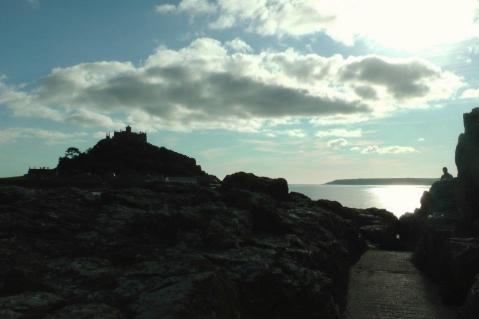
Photo by the author, Saint Michael’s Mound, Marazion, Cornwall
Two autumns ago, finding myself with a day off from a project I was working on near Penzance in Cornwall, I decided to take the day to hike the lesser known British arm of the Santiago Pilgrim Route: the St. Michael’s Way. Dating back tens of thousands of years, St. Michael’s Way enabled pilgrims and missionaries traveling from Ireland or Wales to choose to abandon their ships and walk across the peninsula, rather than navigating the treacherous waters around Land’s End. In the days of such pilgrimmages, the way was fraught with all sorts of dangers, and the path itself splits a few times, veering off towards a church near the harbor where they would get the boat to cross them. There they would meet a guide who would offer safe passage from the many thieves and pirates along the way. Still marked with the iconic scallop shell symbol of the pilgrim route, the path was nevertheless neglected, and overrun with all sorts of modern obstacles such as busy roads and farm irrigation systems.
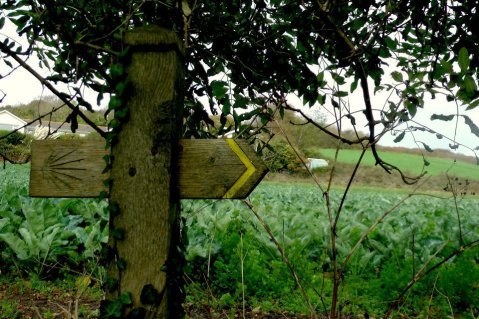
Photo by the author, Gulval, Cornwall
As I got lost time and time again making my way towards Saint Ives, I found myself marveling at all sorts of new and heretofore unknown sensations. My ears tuned from the project I was there working on, I was especially taken by the sound. Toward the middle of the path–located at the top of the hills inland of the peninsula –the wind from both sides carried over pieces of the day to day from the villages; a tractor, grazing animals, bits of conversation in Cornish, and church bells wisping by as quickly as they came, like ghosts. It is fitting that St Michael, after whom the route was named, is the patron saint of high places.
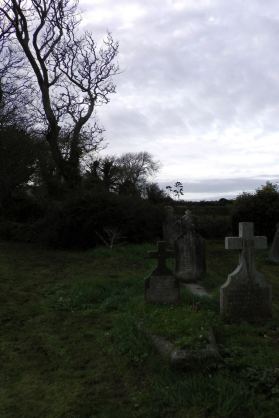
Photo by the author, Ludgvan, Cornwall
I began to wonder what this path may have sounded like back in the time of thieves and pirates, back when the occasion to use it was a shared occasion celebrated with the voices of people, priests, prayers, and the markets and fairs along the way to fuel all this activity. As I continued walking, I began to wonder how it may have sounded even before then, before the hills were blanketed with crops and cattle, before the many battles that must have been waged, and villages built and grazed. . .were there more birds then? Were there more trees? Were there more boar and foxes? What about even before these hills were hills, could there be a way to sonify these hills forming? I started to dream of a “wayback machine” for sound. What if as you walked this path, you could listen to time spinning back, listen to how it might have sounded, listen to its history? And what could you take from that experience? Could something be taken from this? In the two years since that happenstance, this idea has since stuck with me. Beginning tentative research and practice to apply these thoughts, I continue to unearth more questions than answers, so I began to seek others experimenting in a similar vein. While acoustic ecology is a growing field, I still have not found many researchers working with sound in/as time.
One person who has come close to this idea is acoustic ecologist, musician, and sound recordist Bernie Krause, whom last year I interviewed in an article on the sound of disaster about disappearing sounds as a signal of impending crises. The prelude of Krause’s book The Great Animal Orchestra: Finding the Origins of Music in the World’s Wild Places, is the beautifully written, “Echoes of the Past,” which takes a meandering listen to how the world might have sounded sixteen thousand years ago. With that trip in mind, perhaps something could come from working with people in various fields of statistical analysis to see what sounds are projected to go extinct from a soundscape with time, and what this could mean in terms of how the sound line will be extended into the future. In the section “First Notes,” Krause describes working with a graduate student, Kristin Junette, who reasoned that based on fossil records and the known sounds of insect species today, we might be able to re-create the insect ambience of about sixty-five million years ago. Then, based on acoustic physiology of the skull of a Hadrosaur, a dinosaur of the time, Krause and Junette were able to re-create a representative vocalization of its call to place in this early soundscape (for the Discovery Channel’s vision of how the hadrosaur might have sounded click here).

Hadrosaur skull, Image by Flickr user e_monk
I was also excited to learn of the research of Miriam Kolar, who has been working with various techniques and with people in various disciplines on a team studying and “recreating” the acoustic architecture of the Chavín de Huántar, a 3,000 year old ceremonial center, predating the Inca in the Peruvian Andes. Chavín de Huántar is a complex underground maze of rooms and twisting corridors connected by air-ducts. When they were being excavated, archeologists noticed the rooms played strange acoustic tricks on them. “This environment is not only a physical maze, but it’s a sound maze,” says Kolar. For one example, some rooms have interconnected spaces that multiply echoes and bounce them back to the ear so rapidly that the sounds appear to emanate from all directions at once, while other areas seem designed for absorption. The team has been using 3-D computer modeling and specialized recording equipment to try and recreate the auditory effect. “If you have archaeology and no acoustics, you’re deaf,” says archaeoacoustician David Lubman. “And if you have acoustics and not the other, you’re blind. You need both” to understand ancient places like Chavín.

Chavín De Huántar
Inspired in part by the research of Krause and Kolar, “Passageira em Casa/The Traveller at Home,” one of my projects from the two years since my walk in Cornwall, begins to explore the notion of the wayback machine with sound in geography. Passageira em Casa is an intermedia and interdisciplinary performance inspired by the journey to define the concept of home. The narrative is a partially fictionalized and personalized account of the Maritime history of Portugal, enacted by a dancer, vocal performer, live video, and live electronic sound composition that creates a geography through the narrative and space of the project. From a dawn chorus in Lisbon to underwater earthquakes in the Pacific, field recordings along a maritime navigation route flow throughout the performance, giving a soundscape to the narrative’s location.
.
The recent Australian version “Passageira australis” begings to explore sound in time. Recently developed at the iAir residency at RMIT, holds a focus on the debate behind whether the Portuguese were the first Europeans to arrive in Australia, based on the 16th century Dieppe maps of Jave la Grande and the myth/history of the Mahogany Ship. The soundtrack reveals a soundline based on the impact on flora, fauna, and overall soundscape on both countries.
.
A two channel composition, different then stereo, one speaker represents Europe, the other Australia. As the dancer, our sailor, moves from one end of the space to the other, the sound in each channel is changed based on her approximate location to each “country”. With this experience, my hope is the audience comes away thinking about interconnectivity of the world, and how we impact the places we touch. Although I will continue to research when I return to Australia, already the project had me working with a map historian at the Victoria State Library, as well as consulting the thesis of geologist Andrew Pickering on using GIS technology to search for the location and story behind the presumed mythological Mahogany Ship.
Based on hearing, listening (from an anthropological point of view) is the very sense of space and of time. . .By her noises, Nature shudders with meaning: at least this is how, according to Hegel, the ancient Greeks listened to her. The oaks of Dodona, by the murmur of their boughs, uttered prophecies, and in other civilizations as well. . .noises have been the immediate raw materials of a divination, cledonomancy: to listen is, in an institutional manner, to try to find out what is happening. –Roland Bathes, “Listening”
Sound has a special importance to emotion, instinct, and memory, both individual and historical.. Hitting the oldest part of our brain, sound provides immediate information telling us where we are, whether it is safe, and how we should feel about it. The wayback machine would function as a sonic database that would not only help us to remember and learn about the past, but also to create new experiences within the complexity of changing soundscapes over a period that usually defies our human comprehension. I see this tool being helpful to researchers in many disciplines as a new kind of living archive, but also having a place in libraries, museums, centers, and perhaps “in the field” along paths such as the Santiago’s Way, where one could download an audio file from the map online, then listen with wonder and unique sensation as they walk back through history.
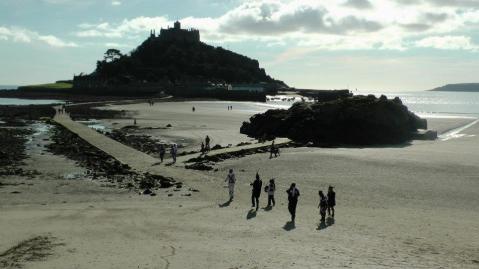
Photo by the author, Saint Michael’s Mound, Marazion, Cornwall
—
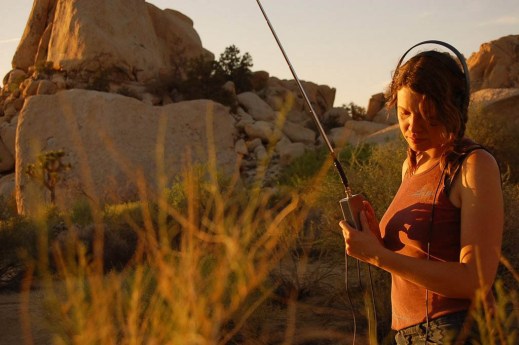
Featured Image photo credit: Vahid Sadjadi, Joshua Tree State Park, California
—
Author’s Note: A version of this post was presented at Musique et Écologies du Son/ Music and Ecologies of Sound: Theoretical and Practical Projects for the Listening of the World, Universitê Paris 8, May 2013. I slightly changed the original title of the paper to: “Sound through time, space, AND place.” Frank Vanclay said quite nicely in “Place Matters.” “‘Place” is generally conceived as being ‘space’ imbued with meaning. Thus, it refers more to the meanings that are invested in a location than to the physicality of the locality.” He goes on to state sometimes it’s the biophysical characteristics that make the foundation for those personal meanings.
—
Maile Colbert is a multi-media artist with a concentration on sound and video who relocated from Los Angeles, US to Lisbon, Portugal. She is a regular writer for Sounding Out!
—

REWIND! . . .If you liked this post, you may also dig:
“Listening to Disaster: Our Relationship to Sound in Danger”–Maile Colbert
“Within a Grain of Sand: Our Sonic Environment and Some of Its Shapers” –Maile Colbert
“Animal Renderings: The Library of Natural Sounds”--Jonathan Skinner
Share this:

To Sir, With Ratchety Love: Listening to the (Dis)Respectability Politics of Rachel Jeantel

Editor’s Note: July 18th, 2013 has been designated as World Listening Day by the World Listening Project, a nonprofit organization founded in 2008 “devoted to understanding the world and its natural environment, societies and cultures through the practices of listening and field recording.” World Listening Day is a time to think about the impacts we have on our auditory environments and, in turn, its affects on us. Once again, Sounding Out! has decided to observe World Listening Day by planning a month-long special forum of posts exploring several different facets of listening such today’s offering by SO! regular Regina Bradley, questioning how American racial ideologies impact listening as a cultural, embodied act. Listen carefully, because we will be following Regina’s post with a special Sounding Out! Comment Klatsch on Wednesday, July 3rd that considers the consequences of racialized refusals to listen. What are the consequences of a listening that is interrupted? distorted? denied? perpetually deferred?—Editor-in-Chief, Jennifer Stoever-Ackerman
—
Rachel Jeantel gave me life with a curt “that’s real retarded, sir.” Responding to George Zimmerman’s attorney Don West’s suggestion that Trayvon Martin pursued and wanted to hurt Zimmerman, Jeantel undoubtedly lifted many eyebrows and possibly a few “hell naws” under the breaths of those watching her testify. Her response to West regarding his lack of understanding can be extended to assess the firestorm of controversy surrounding her testimony: questions of her literacy as oppositional to the prosecution’s hopes of conviction, surprise at her brashness and demonstrative gestures of irritation, and, worst of all, judgments about the literal and figurative fullness of her girlhood/womanhood and chocolate skin as signs to ring the alarm as grounds for dismissing justice for Trayvon Martin. Because her testimony operated outside of normal constructs of witness etiquette and respectability, it was greeted with a hailstorm of controversy paralleling the rawness of responses to scripted reality shows. The shallowness of “critique” of Jeantel—whom, it must be continually repeated, is not on trial—was disgusting.
But you don’t need me to tell you that, because if you were really listening to Rachel Jeantel, SHE told you. Jeantel’s delivery was particularly striking, offering her audience low timbred and often emphatic quips of “what?!” and “you ain’t get that from me” to indicate her irritation and frustration with West. Jeantel’s refusal and inability to conform to expected cultural and aural scripts of black womanhood within the confines of the courtroom – the epitome of a hyper-respectable space – destabilizes not only racial paradigms of black (southern) respectability but Americanized expectations of black women’s scripts of respectability. As Brittney Cooper points out, “Rachel Jeantel has her own particular, idiosyncratic black girl idiom, a mashup of her Haitian and Dominican working-class background, her U.S. Southern upbringing, and the three languages – Haitian Kreyol (or Creole), Spanish and English – that she speaks.” Her people ain’t from hea and because of her upbringing can’t be categorized like other black girls from hea. In this sense, Rachel Jeantel is ratchet.
As I previously define in an analysis of Beyonce’s “Bow Down,” [sonic] ratchetness is a means of navigating sliding representations of respectability within American popular culture. Jeantel’s testimony, however, thinly treads between ratchetness as performative discourse and lived experience. Her reference to the television show The First 48, during a line of questioning regarding how she knew the police would contact her, for example, signified to some that Jeantel was oblivious to the judicial process.
Upon closer examination, however, The First 48 is a touchstone in understanding her negotiation of the criminal justice system as a series of steps/performances surrounding the policing of black bodies from her native Miami (which, it seems, is always on the show). It provides a widely acknowledged– and commodified – representation of black trauma in relation to the U.S. justice system. Jeantel’s ratchetness, then, is a tragicomedic site of cultural and gendered trauma accessible to the national public. Her personal loss of a close friend is overshadowed by her performance of that grief in a space of hyper-respectability. Her emotionally charged question “are you listening?” jolted not only West but those watching the trial. Were we listening? What were we listening for?

Jeantel’s performance of ratchetness both pointed out and disrupted America’s racialized and gendered listening practices. I’d like to suggest her two-fold performance of ratchetness – sonic and cultural, imposed and embodied –presented ratchetness outside of a strictly pop culture lens. Instead, Jeantel’s performance and lived experiences present ratchetness as an antithetical response to (hetero)normative politics of respectability currently in place in the black (diasporic) community.
The lightning-speed meme-ification of Jeantel invoked flatter, more familiarized representations of ratchet. Because of our inability to translate Jeantel’s grief as “respectable,” she bore the brunt of public scorn and attempts of humiliation. The idea that Jeantel signifies a real life Precious, for example—the main character of Lee Daniel’s Oscar-nominated 2009 film adaptation of Sapphire’s novel Push, played by Gabourey Sidibe—demonstrates increasingly blurred lines between black women’s performative and lived experiences. It should be noted that Sidibe herself was frequently attacked in the press and on the Internet, to the point where she told her co-star Mo’nique in Interview Magazine, “I try to stay off the Internet. Just because people hurt my feelings sometimes. . .a lot of people commented that I’m an incredible actress. But other opinions weren’t so nice, physically or whatever.” Jeantel-as-Precious inadvertently suggests Jeantel’s ratchetness is grounded in the sense that she is plus-sized, dark, “illiterate,” and from a working class background. Precious-as-Sidibe becomes the medium through which Jeantel’s (il)legible womanhood is comprehensive.
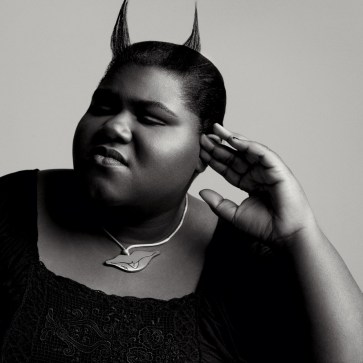
Gabourey Sidibe, from Interview Magazine, Photography by Vinoodh Matadin and Inez Van Lamsweerde
Further, meme-ing Jeantel as Precious solidifies her working class background and ultimately her testimony as a threat to Trayvon Martin’s (re)deemed middle class respectability as a portal of victimization. Returning to Cooper’s observations of Jeantel’s use of hybrid-linguistics, it is Jeantel’s sonic delivery that most threatens Martin’s perceived and scripted middle class respectability. Jeantel’s use of so-called “broken” English has overwhelmingly been heard by what Jennifer Stoever-Ackerman calls America’s dominant “listening ear” in “Reproducing U.S. Citizenship in Blackboard Jungle” as a marker of her working class background – not her trilingual background – and thus, it sonically aligns Martin with the black working class and voids prospects of him being considered a victim of violence rather than its perpetrator. Don West’s treatment of Jeantel on the witness stand attempted to impose a parallel between Jeantel’s alleged “illiteracy” and Martin’s criminality. The “crime” of illiteracy within the courtroom and supposed “crime” of Martin beating Zimmerman into shooting him co-exist within a policed space of (white) respectability that black bodies are frequently forced to adhere.

Jeantel retaliated against West’s attempts to back her into this tight space, however, with her emphatic use of “sir.” Jeantel’s brilliantly subversive tactic demonstrates ratchety resistance because it provides a subtle inversion of the white supremacist discourse directed towards her. Her use of “sir” reminded me of the unnamed protagonist’s grandfather at the beginning of Ralph Ellison’s Invisible Man, who on his deathbed commanded his family to “live with your head in the lion’s mouth:” “I want you to overcome ‘em with yeses, undermine ‘em with grins, agree ‘em to death and destruction, let ‘em swoller you till they vomit or bust wide open” (16). Indeed, Jeantel busted “the lion’s mouth” wide open vis-à-vis a hybridized slang and an emphatic “yes sir” or “no sir.” Most importantly, Jeantel sustained her dignity and self-respect in the process. Jeantel’s mastery of a low, monotone “sir” signifies her existence outside of the politics of respectability that frame not only black women’s experiences but blacks’ submission to white supremacy.
Where West and others focused on her facial features or even her delivery of “sir” as a sign of (dis)respect, what was lost upon many was how her aurally subversive delivery of arguably the most hyper-respectable word in (American) English kept her in command of her testimony.
 Rachel Jeantel is ratchety brilliance. She witnessed, performed, and sounded her truths in ways that complicated if not contradicted the normative discourse policing black women’s bodies. Although much of her cunning was shortsightedly heard as uncouth and aural evidence of a lack of (middle class) home training, Jeantel signifies the usefulness of ratchet as a form of resistance to the white privilege that dictates respectable spaces like the U.S. courtroom. Sir.
—
R.N. Bradley recently graduated with a PhD in African American Literature at Florida State University and is a regular writer for Sounding Out!
—
REWIND! . . .If you liked this post, you may also dig:
Death Wish Mixtape: Sounding Trayvon Martin’s Death–Regina Bradley
Hearing the Tenor of the Vendler/Dove Conversation: Race, Listening, and the “Noise” of Texts–Christina Sharpe
The Noise of SB 1070: or Do I Sound Illegal to You?–Jennifer Stoever-Ackerman
Share this:


Current Top Posts





April 2021

January 2020

November 2019

October 2019

August 2019

April 2014

November 2017

March 2015

December 2017

October 2015
 Sounding Out!
Recent Comments