
Kawa: Rediscovering Indigeneity in China via Reggae
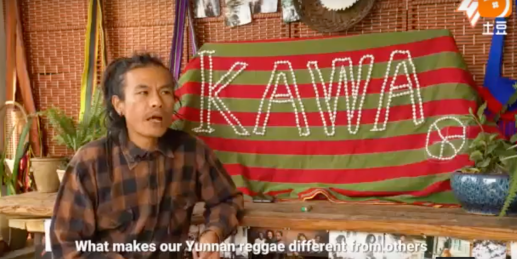
Kawa is a reggae group from Yunnan’s Ximeng, an autonomous county for the Wa people in the southwest of China, bordering Myanmar. When I learned about Kawa’s story in 2016, I was first intrigued by the geographical similarities between Yunnan and Jamaica: both regions are characterized by tropical climates, lush vegetations, and perhaps most prominently, proximities to marijuana plantations. Outsiders often associate the musical style of reggae with a stereotypical “laidback” lifestyle projected onto these locales. Known as “Yunnan Reggae,” Kawa’s music indeed exhibits some of the most characteristic elements of reggae music—slower tempos, remixed vocals, and repetitive chords falling on the offbeat.
“Yunnan Reggae”–Kawa
Recently I realized this climate connection was simplistic and reductive, and what I failed to grasp in Kawa’s music was far more important—a notion of indigeneity manifested through reggae’s generic elements. In Steven Feld’s “From Schizophonia to Schismogenesis: The Discourses and Practices of World Music and World Beat” in 1995, he noted the affinity of many indigenous cultures for reggae music. “Its [reggae] perception by indigenous peoples outside the Caribbean as an oppositional roots ethnopop form has led to its local adoption by migrants and indigenes in places as diverse as Europe, Hawaii, Native North America, Aboriginal Australia, Papua New Guinea, South Africa, and Southeast Asia” (110). In the 1970s, “roots” reggae translated the everyday lives of Jamaicans as well as their Rastafarian spirituality into a stark resistance to racial oppression, economic inequality, and colonial capitalism that they had experienced in history. The music was deeply embedded in the Jamaican culture. Around the same time, however, engineers and producers in Jamaica–many of them Chinese and Chinese-Jamaican–began to experiment with remixing reggae songs, contributing to an adaptive style of pop music as well as its international popularity. Therefore, against the global market force for “a world music,” reggae was quickly adopted to preserve indigenous cultures, remixing a wide range of ethnomusical elements.
But note that Feld’s list did not include East Asia. In fact, indigeneity as a discourse has been largely absent in this region. Taiwan is perhaps the only exception, where the Austronesian peoples have claimed their indigenous status and political rights. Japan and the Koreas are often considered as the most ethnically homogeneous countries in the world. And China, while officially acknowledging its ethnic diversity, never thought its internal migration of the Han majority as a potential threat to its ethnic minorities and indigenous cultures. I grew up in the southwest of China in the 1990s, when the internal migration of ethnic groups was already a norm. I could not remember if “indigeneity” meant anything even remotely political. I could not remember if the cultural traditions of ethnic minorities were meant to be tied up to the land on which they are/were practiced. What I do remember is that there are regions where the ethnic minorities concentrate and in which they integrate.
This post examines how the Chinese reggae group Kawa introduces an indigenous discourse through the sonic elements of reggae. In their performances, Lao Han often opens with a statement about being an indigenous ethnic minority. Most members of the group have non-Han Chinese backgrounds—Wa, Hani, Aini, and Hui. And even the name Kawa refers to the Wa people in their own language.
Kawa always find the most innovative ways to incorporate ethnic elements into their interpretations of the genre. In “Yunnan Reggae,” for example, sampled vocals from Wa people, lyrics written in Wa language, and traditional Wa instrumentation all work together to portray living cultural traditions closely associated with the Wa ethnic identity. However, it is the intimacy with the land Kawa expresses in their music that foregrounds their indigenous sentiments.
Although the entirety of the lyrics consists of two lines, the song “Red Hair Tree” reveals an indigenous life dwelling on the land—in its neighborhood, locality, and proximity.
Such a huge red hair tree
Hitting the wooden drum sounding dong dong
“Red Hair Tree” resembles a labor song narrating the mundane activities of logging and drum crafting. The first line describes the tree’s size, invoking a reverence for its sublimity. The glistening red color contributes to the plant’s vibrant animacies. As Ai Yong explains, “If you have chatted with the elders on the A Wa Mountains about this land, you will see an extraordinary beam of light glistening in their eyes, carrying endless assurance and reverence” (translated by Meng Ren). The second line translates that reverence into a more intimate whispering. Due to the Wa people’s animist beliefs, the red hair tree’s spirit is reincarnated in the wooden drum. The “dong dong” sound then embodies an invocation of the natural spirits. “The Wa ancestors believe, where there is the red hair tree, there is god’s blessing. In the past, the tall and robust red hair trees surrounded all Wa villages.” As Ai Yong continues to explain, the natural spirits are called for protection in exchange for the people’s worship.
“Red Hair Tree” is not the first time when reggae prompted the Han Chinese to confront questions about migration and indigeneity, however. It is often forgotten that the Chinese diaspora in Jamaica contributed to the development of reggae. Stephen Cheng’s “Always Together (A Chinese Love Song)” in 1967 is a rare yet symptomatic example of how the Chinese imagined indigeneity through remixing reggae.
Despite its obvious rocksteady overtone, the song combines a wide range of Chinese elements. It opens with a pronounced bass line coupled by the guitar and then the accented drum beat. Although this rhythmic beat is reminiscent of typical reggae songs, the music flow is somehow disrupted by the sudden appearance of the male vocal. Stephen Cheng sings in Mandarin. His chest voice meanders across a wide range, registering a sonority that is more often heard in Chinese opera than in reggae songs (or pop music in general). His delivery accentuates on the extended vowels, exaggerating the dramatic ups and downs of the tonal language—Mandarin Chinese. In fact, the music is adapted from a well-known Taiwanese folk song “Green is the Mountain (Gao Shan Qing).” On the surface, it is a romantic love story. It depicts the scenic landscape of the mountains and waters of Alishan, which the Taiwanese indigenous Tsou people traditionally inhabit. Through a metaphorical parallel, the romantic love between a young Tsou couple is embodied in the companionship between the mountain and the water, which resonates with its English title “Always Together.”
Indeed, “Green is the Mountain” was written by the Han Chinese who fled to Taiwan during the Chinese Civil War, and it is often criticized for romanticizing the experience of the indigenous peoples who were forced to move into the mountain. When the song is rendered into reggae by Cheng, however, it re-contextualizes this imagined indigeneity as a diasporic yearning to restore the lost connections between land and culture. “Always Together” was produced by Byron Lee, a Chinese-Jamaican who founded the renowned ska band Byron Lee and the Dragonaires. As record producers, sound system owners, or band managers, numerous Chinese-Jamaicans like Lee contributed “Chinese elements” to reggae during its formative years. In return, reggae carries on the tradition of cultural remix, always opening itself up to local adaptions.
Reggae has always been an eclectic music form. As we have seen, both examples combine a wide range of musical elements from different cultures—from ethnic minorities in China to Chinese and African diaspora in Jamaica. Despite almost a half century apart, the two reggae songs foreground a discourse on indigeneity that is shaped by the migration of people and the mixing of culture. Despite the most generic “pop” elements, the local adoption of reggae reveals an attempt to comprehend the relationship between ethnic identity, cultural practice, and the land. Understood in this way, Kawa’s reggae music becomes an important voice in understanding ethnic differences and indigeneity in today’s China.
—
Featured Image: Screen Shot from “Kawa: Chinese Yunnan Reggae Band”
—
Junting Huang is a Ph.D. Candidate in the Department of Comparative Literature at Cornell University. His research areas include literary studies, film/media studies, and sound studies. His dissertation project “The Noise Decade: Intermedial Impulse in Chinese Sound Recording” examines the figure of noise in contemporary Chinese literature and new media art. It analyzes how noise is conceptualized through the recorded sound as a materializing force that indexes the shifting social relations in the 1990s.
—
 REWIND! . . .If you liked this post, you may also dig:
Decolonizing the Radio: Africa Abroad in the Age of Independence– Samantha Pinto
“Everyone I listen to, fake patois…”– Osvaldo Oyola
Radio de Acción: Violent Circuits, Contentious Voices: Caribbean Radio Histories–Alejandra Bronfman
Share this:

Hearing Change in the Chocolate City: Soundwalking as Black Feminist Method
 Since its inception at the World Soundscape Project in the 1970s, soundwalking has emerged as a critical method for sound studies research and artistic practice. Although “soundwalking” now describes a diversity of activities and purposes, critical discussions and reading lists still rarely represent or consider the experiences of people of color (POC). As Locatora Radio hosts Diosa and Mala have argued in their 2018 podcast about womxn of color and the sound of sexual harassment in their everyday lives and neighborhoods, sound in public space is weaponized to create “sonic landscapes of unwelcome” for POC.
While we often think of soundwalks as engines of knowledge production, we must also consider that they may simultaneously silence divergent worldviews and perspectives of space and place. In “Black Joy: African Diasporic Religious Expression in Popular Culture,” Vanessa Valdés explored alternate conceptions of space held by practicioners of Regla de Ocha, epistemologies rarely, if ever, addressed via soundwalks. “Within African diasporic religions . . . including Palo Monte, Vodou, Obeah, Macumba, Candomblé – there is respect for the seemingly inexplicable,” Valdés remarks, “there is room for the miraculous, for that which can be found outside the realms of what has been deemed reasonable by systems of European thought. There is room for faith.” Does current soundwalk praxis—either as research method, public intervention, artistic medium, field recording subject, or pop culture phenomenon—impose dominant ideas about space and knowledge production as much as—if not more–they offer access to alternatives? Are there alternate historiographies for soundwalking that predate the 1970s? Can soundwalks provide such openings, disruptions, and opportunities without a radical rethinking? What would a decolonial/decolonizing soundwalk praxis look and sound like?
Soundwalking While POC explores these questions through the work of Allie Martin, Amanda Gutierrez, and Paola Cossermelli Messina. Today, Allie Martin kicks off the series with a powerful reframing of the soundwalk as a black feminist methodology. —JS
In July 2018 I visited Oxford, Mississippi for the first time, to attend a workshop on conducting oral histories. Upon walking with a friend back to our accommodations on the University of Mississippi campus, we heard a voice calling to us from far away, up a hill somewhere. It was a catcalling voice—that much I definitely recognized—but I also felt sure that I heard the word “nigger.” My friend, who is also a black woman, heard the taunting sounds of the voice but not that word specifically. Herein lies one of the difficulties of black womanhood: I was unable to distinguish which of my two most prominent identity markers (blackness and womanhood) the speaker was using to harm me in that moment. I found it ironic that I came to Mississippi to learn best practices for listening to people’s stories, but could not hear my own story, could not say for sure what had happened to me.
In the time since that visit, I have come to embrace the speculative sonic ephemerality of black womanhood and utilize it on my soundwalks. Soundwalks are a popular method for understanding the everyday sonic life of a place. Reminiscent of Michel de Certeau’s “Walking in the City,” soundwalks offer the kind of embodied experience missing from other more static soundscape recordings. I argue here that soundwalks can operate as black feminist method, precisely because they allow me to center the complex, incomplete sonorities of black womanhood, and they are enough in their incompleteness. One of our foremost thinkers on black feminism, Patricia Hill Collins, has argued that black women’s knowledge is subjugated (1990). I understand this to mean that my knowledge is tainted somehow, too specialized or not specialized enough, and not considered fit for application by a broader audience. Soundwalks as method, though, rely on my own subjugated knowledge. What did I hear? Black feminism centers and humanizes black women, and I utilize soundwalks to humanize myself in a soundscape that would otherwise disregard my sonic perceptions in favor of white hearing as the default standard of sound.
I began soundwalking in Washington, DC as a part of my dissertation project, which explores the musical and sonic dimensions of gentrification in the city. Gentrification is often considered in visual terms, meaning that a neighborhood is considered gentrified because new coffeeshops, bike lanes, and dog parks make it “look” different from what was once there. I recognize these new additions as important markers of gentrification, but what do they sound like? And what do these sonic markers reveal about the sonorities of race?

Rowhouses in the Shaw neighborhood, image by author
I have taken up the sonic exploration of gentrification, drawing inspiration from Jennifer Stoever’s Sonic Color Line and Regina Bradley’s exploration of the criminalization of black sound. As SO! writer and ethnic studies scholar Marlén Rios Hernandez has noted in her work on racial and spatial shifts in early punk in 1970s Los Angeles, it is crucial to work on “delinking gentrification as exclusively spatial and analyzing it as also a sonic force of expulsion.” Having spent time researching the auralities of gentrification in DC, I understand it to be a process that silences poor and marginalized populations while amplifying the concerns of those privileged enough to have the ear of the DC Council and developers. Gentrification displaces musicians and music genres, while increasing tensions around music and noise in “public” space. More than these changes, though, gentrification changes the soundscape of the city.
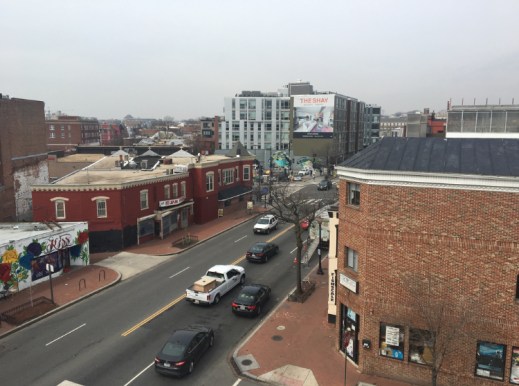
My soundwalks focus on the Shaw neighborhood in the Northwest quadrant of DC, part of the fastest gentrifying zip code in the country. Before the explosion of development, Shaw was a cultural hub of black DC, only blocks away from the U Street Corridor, formerly known as Black Broadway. From Pearl Bailey to James Brown, prominent black entertainers frequented the neighborhood because they were unable to perform in or have accommodations in other areas of the city. As the neighborhood shifts and transforms, the soundscapes grow louder with new nightclubs and quieter due to increased reporting of noise violations. The neighborhood diversifies in terms of languages, increases in siren whoops, and new sounds appear, such as the beep of a dockless scooter. Shaw has seen a concomitant increase in property values, community gardens, and bars; a Whole Foods is set to open in the neighborhood by 2020.
[The recording here is of a soundscape at 7th street and Florida Avenue NW, a busy intersection at the north edge of Shaw. Recorded on a mid-September afternoon, you can hear go-go music (DC’s indigenous subgenre of funk), engines idling, and the whoop of a siren. In the past two months, this intersection has become a battleground for cultural erasure, as artists, activists, and councilmembers attempt to legitimize the go-go music that has been playing in the area since 1995.]
During the day, Shaw oscillates between a quiet neighborhood and a busy city space. Traffic, horns, and sirens are frequent, yet so are the sounds of children at recess and old men chatting outside on their stoops or outside of corner stores.
Conducting soundwalks as a black woman in this gentrifying neighborhood is a curious space to tarry in. I am in some ways an outsider as a non-resident, mindful of who and what I record at any given moment because part of what makes gentrification such a tense and terrifying process is the lack of control that residents (particularly renters) have regarding their futures, and often their presence too. I am also an insider, a black woman in this space where being a black woman is not (yet) anything out of the ordinary. In fact, as the months went on, more of my recordings feature me speaking to people on the street, some I had come to know and some still strangers to me.
One of my favorite interactions on a soundwalk came early on, in late February of 2018. I was running late for an interview, listening intently to what was going around me, when I walked past a black man, seemingly in his 30s, on a narrow sidewalk. The exchange went something like this:
Man: Whoa, whoa, why you running up on people?
Me: My bad, my bad!
Man: It’s okay. Hey sis, you know how to make grits?
Me: [laughing], Nah, I don’t know how to make grits.
Man: What about pancakes?
Me: Yeah, I can make some pancakes.
Man: Ayyyee, I’m tryna get some breakfast!!
Me: I don’t know about all that!
The exchange, not quite a catcall but not quite comfortable either, consistently faded in volume, because during the entire time we spoke, I continued to walk away from him. I was in a position of wanting to speak, because I know the politics of being an outsider in a gentrifying neighborhood and not greeting folks as you walk by. However, I also know the dangers of being a black woman walking alone, and so I negotiated a lighthearted exchange while making my way to my destination. My soundwalks, then, act as a sonic record of gentrifying space as well as my attempts to keep myself safe.
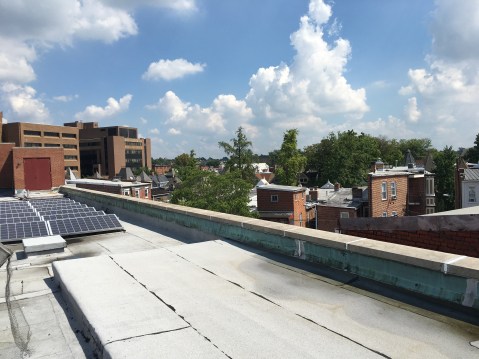
Shaw from a rooftop perspective, Image by author
These moments also inform the contours of my dissertation project on hearing gentrification in DC. The larger project involves passive acoustic recording in the same neighborhood, a methodology that entails creating a large amount of short soundscape recordings over a long period of time. Understanding both my soundwalks and passive acoustic recording as black feminist method allows for the consideration of multiple sonic perspectives of the neighborhood, rather than one record. When once describing passive acoustic recording to a colleague at a digital humanities workshop, they celebrated the idea that I would be able to “objectively” hear what was occurring in the neighborhood, instead of relying only on pieced together accounts from community members.
However, just as black feminist thought amplifies my “tainted” knowledge, it also mutes the authoritative “objective” knowledge of a rooftop recorder. The sounds of the stationary recorder placed on a rooftop at 7th and Florida are as partial and positioned as the recordings of my footsteps as I move around the neighborhood. As I continue to walk, be it through the unfamiliarity of Mississippi or my hometown DC, I do so with the reassurance that what I hear is enough.
—
Featured Image: Shaw From Above, by author.
—
Allie Martin is a PhD Candidate at Indiana University in the Department of Folklore and Ethnomusicology. Her dissertation project explores the musical and sonic dimensions of gentrification in Washington, DC, using a combination of ethnographic fieldwork, archival research, and soundscape recordings. Originally from the Washington, DC, metropolitan area, she received her BAs in music performance and audio production from American University.
—
 REWIND! . . .If you liked this post, you may also dig:
SO! Amplifies: Listening to the City Handbook
Sounding Out! Podcast #2: Springtime in KC: Soundwalking Kansas City—Liana Silva
Unlearning Black Sound in Black Artistry: Examining the Quiet in Solange’s A Seat At the Table–Kimberly Williams
Share this:


Current Top Posts





April 2021

January 2020

November 2019

October 2019

August 2019

April 2014

November 2017

March 2015

December 2017

October 2015
 Sounding Out!
Recent Comments