
“This Liquid Dream”: An Interview with Aquaphoneia Composer Navid Navab

Multidisciplinary composer and media alchemist Navid Navab and his team at the Topological Media Lab based at Concordia University (Montreal) presented Aquaphoneia, a sound installation which transmutes voice into water and water into air at Biennale Nemo in Paris in December 2017 (and will run until March 2018). I conducted this interview in the context of the first presentation of Aquaphoneia originally conceptualized for Ars Electronica 2016: RADICAL ATOMS and the alchemists of our time. This version of the piece looked at technology through the lens of the living materiality. As Prof. Hiroshi Ishii, of the MIT Media Lab’s Tangible Media Group, stated, artists “suggest completely new ways of looking at the role of science in our society and the interplay of technology and nature.”
***
EB [Esther Bourdages]: The theme of the 2016 Ars Electronica Festival, RADICAL ATOMS – and the alchemists of our time, is very close to the Topological Media Lab’s mission: transmutation and alchemy on the philosophical and phenomenological level. For Aquaphoneia, can you expand on alchemy and specifically on how this art piece stands out from your past work? How did alchemical thought process and production techniques come up in the process of the piece?
NN [Navid Navad]: When the 2016 theme for Ars Electronica Festival was announced I was happily surprised and thought: finally, things are coming to light at a much larger scale. Yes, please can we reverse the still prominent European Modernism’s separations—between the conceptual and the material, the precise and the messy, the sciences and the arts—and go back to the holistic richness of alchemical matter? This transition that we are currently experiencing calls for a shift away from representational technologies: from interfaces to stuff, from objects to fields of matter-in-process, from fixed concepts to processes that enact concepts. For over a decade, we as alchemists have been engaging with “bodies and materials that are always suffused with ethical, vital and material power.”
The Topological Media Lab [TML] is occupied by people who are living to fuse and confuse, ready to unlearn the apparent practicality of isolated disciplines, while playfully improvising new pathways to understanding potential futures. The TML hosts an array of projects for thinking-feeling through poetry-infused-matter and breathing life into static forms—which to me is an effortlessly artistic process, and all the while inseparable from a rigorously philosophical or scientific one. Even though it might take decades for the kinds of computational-materials that we are envisioning today to be engineered from ground up at an atomic level, with what is possible today, we explore how the messy stuff of the world could become computationally charged with the potential for play: sounding, dancing, and co-performing new ways of living with or without us.
Aquaphoneia comes out of this rich ecology of experiments. In Aquaphoneia, voice and water become irreversibly fused. The installation listens to the visitors, and transmutes their utterances into aqueous voice, which then is further enriched and purified through alchemical processes.
.
To fully realize this liquid dream, we went to great lengths in order to fuse the messy behaviour of matter flowing throughout the installation with meticulously correlated and localized sonic behaviour. For example, the temporal texture of boiling liquid in one chamber is perceptually inseparable from the spectral entropy of simmering voices which then evaporate into a cloud of spectral mist. All of this dynamic activity is finely localized: the sounds acoustically emit exactly from where the action occurs, rather than spatially schizophying loudspeakers elsewhere.
On another hand, our material-computational-centric approach lead to a tough yet rewarding meditation on control and process. As a composer, I had to let go of all desires for immediate control over sounds and surrender important rhythmical and compositional decisions to messy material processes. In Alchemical Mercury (2009), Karen Pinkus quotes Marcel Duchamp: “alchemy is a kind of philosophy: a kind of thinking that leads to a way of understanding” (159). For us, in the process of creating Aquaphoneia, essentially what had to be understood and then given up was our attachment to our far-too-human notions of time and tempo. Instead we embraced and worked within the infinitely rich and pluri-textural tempi of matter. Technically and compositionally this meant that most of our focus had to be placed on merging the continuous richness of material processes with our computational processes through an array of techniques: temporal pattern following, audio-mosaicing, continuous tracking of fields of activity using computer vision and acoustic sensing techniques in order to synthesize highly correlated sonic morphologies, careful integration of structure-born-sound, etc. We were able to co-articulate compositions by constraining material processes sculpturally, and then letting the liquid voice and the laws of thermodynamics do their thing.
[EB]: One of the first elements that we notice in the installation is the brass horn connected to an old Edison sound recording machine, that now turns into liquid instead of wax cylinders. In fact, it came from an Edison talking machine. You repurpose an authentic artifact, but you do not fall into the trap of nostalgia, and neither into the role of collector, but you embrace innovation with a dynamic approach which excavates past media technologies in order to understand or surpass contemporary audio technologies. Where does the use of the Edison horn come from and how does it speak to your relationship with the superposition of history?
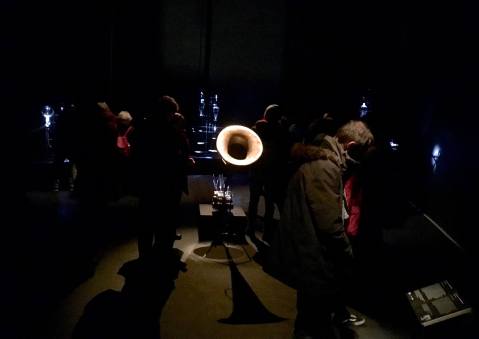
Paris, Biennale Némo, 17 October 2017 – 18 March 2018 Credit: Navid Navad, 2017
[NN]: The history of sound reproduction involves transforming audible pressure patterns or sound energy into solid matter and vice versa. The historic Edison recording machines gathered sound energy to etch pressure patterns onto tinfoil wrapped around a cylindrical drum. Sound waves, focussed at the narrow end of the horn, caused a small diaphragm to vibrate, which in turn caused a miniature steel-blade stylus to move and emboss grooves in the cylinder. The tin foil would later on be replaced by wax cylinders, vinyl disks and eventually digital encoding.
Aquaphoneia engages the intimately recursive relationship between sounding technologies and material transmutations. Our digital audio workstations are an in fact an inclusive part of this history, this endless chain of analog transmutation between energy and matter. Under the fiction of the digital there is always the murmur of electrons and of matter-energy fields in physical transmutation. As J. Fargier writes on an early book on Nam June Paik (1989) “The digital is the analog correspondence of the alchemists’ formula for gold” (translation by NN). Well, yes. The digital revolution has allowed us to shape, compute, purify, and sculpt sounds like never before… but then often at the hefty cost of a disembodying process, with interfaces that are linked to sounds only through layers upon layers of representation, far detached from resonating bodies and the sexy flux of sounding matter.
Aquaphoneia playfully juxtaposes material-computational histories of talking machines within an imaginary assemblage: sounds are fully materialized and messed with tangibly within an immediate medium very much like clay or water or perhaps more like a yet to be realized alchemico-sonic-matter. This odd assemblage orchestrates liquid sounds leveraging intuitive worldly notions—such as freezing, melting, dripping, swishing, boiling, splashing, whirling, vaporizing—and in the process borrows alchemical tactics expanding across material sciences, applied phenomenology, metaphysics, expanded materiology, and the arts. Aquaphoneia’s alchemical chambers set these materials, metaphors, and forces into play against one another. After the initial ritual of offering one’s voice to the assemblage, the aqueous voice starts performing for and with itself, and human visitors have the opportunity to watch and participate as they would when encountering the unpredictable order of an enchanted forest river.
It is also noteworthy that the horn resembles a black hole. The edge of the horn acts like an event horizon, separating sounds from their source-context. Sounds, once having passed the acousmatic event horizon, cannot return to the world that they once knew. Voices leaving the body of their human or non-human speaker, fall into the narrow depths of the horn, and are squeezed into spatio-temporal infinity. Disembodied voices, are immediately reborn again with a new liquid body that flows though alchemical chambers for sonic and metaphysical purification.
Much of my work deals with the poetics of schizophonia (separation of sound from their sources). Sound reproduction (technologies), from Edison’s talking machines to our current systems, transcode back and forth between the concrete and acousmatic, situated and abstract, materialized and dematerialized, analogue and digital. Often sounds are encoded into a stiff medium which then may be processed with an interface, eventually decoded, and re-manifested again as sound. Aquaphoneia ends this nervous cycle of separation anxiety and re-attachment by synthesizing a sounding medium capable of contemporary computational powers such as memory, and adaptive spectro-temporal modulation and morphing. To adapt Marshall McLuhan, instead of encoding and decoding a presumed message with representational technologies, it enchants the medium.
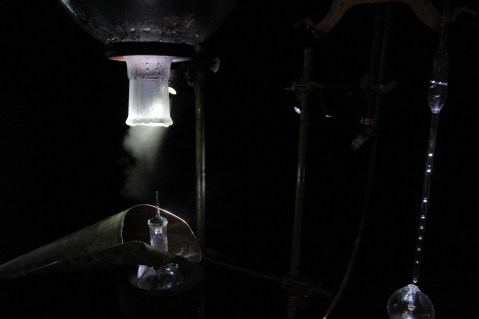
Image Credit: Topological Media Lab, 2016
[EB]: There is the tendency to think that artwork from Media Labs are stable and high tech. Aquaphoneia uses analog and digital technologies with a Do-It-Yourself (DIY) touch in the aesthetic. Since your lab is multidisciplinary oriented and influenced by diverse fields of knowledge, can you develop on the DIY dimension in Aquaphoneia under the gaze of Clint Enns—cinematographer in the experimental field of cinema—: “Adopting a DIY methodology means choosing freedom over convenience”?
[NN]: Aquaphoneia is a truly eclectic assemblage lost in time. Aquaphoneia’s mixed form reflects its extremely fluid, collaborative and playful creative process. Instead of coming up with a definitive design and executing it industrially, Aquaphoneia’s realization involved a much more playful process, where every little aspect of the installation—materials, sounds, software, electronics, etc.—was playfully investigated and messed with. Every little detail matters and every process, undulating back and forth between conception to execution, is an artistic process. The research-creation process leading to the works that come out of our lab are as critical to us as the final and fully produced art works. This was also true for the alchemists who, through their process, were seeking to develop new approaches for understanding the world, relating to matter, and surpassing nature.
Our research-creation activities concern experimenting with ethico-aesthetics of collective thinking-making: humans, non-humans, machines, and materials enacting and co-articulating the ever-changing material-social networks of relations which shape them. This DIY art-all-the-way approach, while providing a healthy dose of aesthetic freedom, is also an ethical one: we live with and within our designs and grow with them. That being said, we are not attached to a DIY process in the same way that some maker cultures might be. Sometimes we blindly find and repurpose something that does something cool, complicated, and mysterious and that is fantastic, sort of like philosophy of media meets cyber dumpster diving meets DIY hacker space meets cutting edge tech research meets miniMax (minimum engineering with maximum impact) meets speculative whatever…
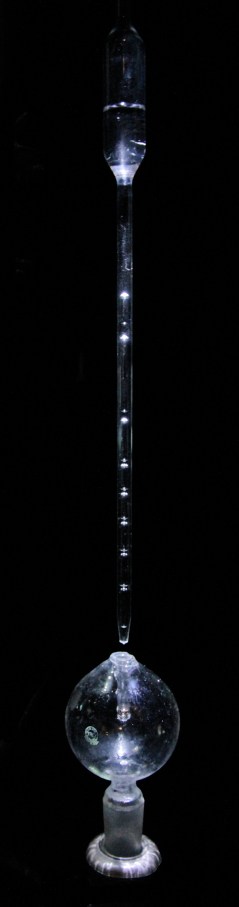
Image Credit: Topological Media Lab, 2016
For example, at some point we decided to gather sonic vapour in a glass dome and condense it back into drops, which were then guided to fall into the bottom of the installation. The purified drop of voice—sonic “lapis philosophorum”—was to fall into the depths of the earth beneath and shine upward like sonic gold, connecting heaven and earth. We had to execute this opus magnum inside a very small hole in the base of the installation. The water drop needed to be immediately sensed and sonified, leading to sounds coming out of the same hole, along with synchronized light. You can imagine that if we were relying on “black-boxed” technologies and ready-made techniques then this task would have seemed like a nightmare to design and fabricate. The water drop was to fall all the way to the bottom of the hole where it would be acoustically sensed by a small apparatus that had to be acoustically isolated from everything else. Then the result of the sonification had to be pushed through the very same hole with a high degree of intelligibility and in a way that it would be seamlessly localized. Meanwhile, light had to shine through this hole in sync with the sounds but the source of light had to remain hidden.
The solution to this technical puzzle came to us effortlessly when playing around with random stuff. We found a hipster product—a little plastic horn—that was made for turning your iPod into a gramophone. Then a speaker was mounted inside of this plastic horn in order to focus sounds towards the end tip of the horn. The back of the speaker was fully covered with foam and duct tape to stop any sound from escaping anywhere except for where we wanted it to appear. A small hole was drilled into the brass pipe in the base of the installation. Our advanced hipster horn-tip-sound-laser-thing was then inserted, allowing crisp sounds to enter the brass hole and emit from it without any visible clues for the perceiver as to where the speaker was hidden. Meanwhile, a similar lighting solution was created so that in a very small footprint we can focus, direct, and bounce enough directional light in the brass pipe without ever getting in the way of the water drops.
We had to engage with this sort of detailed fabrication/composition process throughout the whole installation in order to come up with solutions to sense the behaviour of the materials and liquids locally and to manifest them sonically and visually so that there would be no separation from local material behaviours and their computational enchantment. In trying to do so we discovered that more often than not, there was no ready-made solution or technique to rely on, and at the same time we didn’t have months ahead of us to engage in an abstract design and fabrication process. We had limited hours of collective play time to leverage and to come up with innovative techniques that we didn’t even know could exist and that was really fun.
**
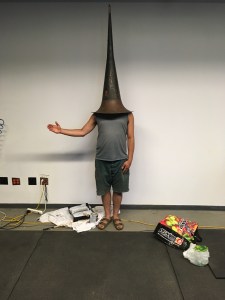
Image Credit: Topological Media Lab, 2016**
Aquaphoneia is a rich sound art piece – a manifesto by itself about innovation and inventiveness. The sound installation demonstrates that the main crafters Navid Navad and his partner Michael Montanaro, in collaboration with other members of the Topological Media Lab, swim easily into the multidisciplinary art. They are are not afraid to experiment and engage with the material, which results in an interlacing of forms, a mixture of historic references, and an interesting fusion of “low” and “high” technology. I was able to catch some of the build up of the art piece, and it was fantastic to witness the lab as a playful messy artistic field with a little team of scholars fusing their different backgrounds in convergence on the marriage of art and science.
Aquaphoneia, a sound installation which transmutes voice into water and water into air at Biennale Nemo in Paris runs until March 2018.
—
-
- NAVID NAVAB art direction, sound/installation concept and design, audiovisual composition, programming, behaviour design
- MICHAEL MONTANARO art direction, visual/installation concept, design and fabrication
- PETER VAN HAAFTEN electronics, sound, programming
- consulting assistants: Nima Navab (embedded lighting design) Joseph Thibodeau (electronics)
- research collaboration: Topological Media Lab
Featured Image: Aquaphoneia, Paris, Biennale Némo, 17 October 2017 – 18 March 2018, Credit: Navid Navad, 2017
—
Esther Bourdages works in the visual arts and technology art field as a writer, independent curator and scholar. Her curatorial research explores art forms such as site-specific art, installation and sculpture, often in conjunction with sound. She has authored many articles and critical commentaries on contemporary art. As a musician, she performs under the name of Esther B – she plays turntables, handles vinyl records, and records soundscapes. She works and lives in Montreal.
Navid Navab is a Montreal based media alchemist, multidisciplinary composer, audiovisual sculptor, phono-menologist, and gestureBender. Interested in the poetics of gesture, materiality, and embodiment, his work investigates the transmutation of matter and the enrichment of its inherent performative quali- ties. Navid uses gestures, rhythms and vibration from everyday life as basis for realtime compositions, resulting in augmented acoustical poetry and painterly light that enchants improvisational and pedestrian movements.
Navad currently co-directs the Topological Media Lab, where he leverages phenomenological studies to inform the the creation of computationally-augmented performance environments. His works, which which take on the form of gestural sound compositions, responsive architecture, site specific interven- tions, theatrical interactive installations, kinetic sound sculptures and multimodal comprovisational per- formances, have been presented internationally at diverse venues such as Canadian Center for Architec- ture, Festival du Nouveau Cinema, Ars Electronica Festival Linz, HKW Berlin, WesternFront Vancouver, McCord Museum, Musée d’art Contemporain de Montréal, Contemporary Arts Museum Houston, Inter- national Digital Arts Biennial, Musiikin Aika Finland, and Festival International Montréal/Nouvelles Mu- siques, among others. www.navidnavab.net
—
 REWIND! . . .If you liked this post, you may also dig:
Playing with Bits, Pieces, and Lightning Bolts: An Interview with Sound Artist Andrea Parkins — Maile Colbert
Sounding Our Utopia: An Interview With Mileece— Maile Colbert
Optophones and Musical Print–Mara Mills
Share this:

Voices at Work: Listening to and for Elsewhere at Public Gatherings in Toronto, Canada (at So-called 150)

“Decolonization,” Eve Tuck and K. Wayne Yang propose in “Decolonization is Not a Metaphor,” “is not an ‘and.’ It is an elsewhere.”
Elsewhere, not here, not now. Not here. Not now. Enough!
In the context of decolonization, elsewhere is a refusal to accept the conditions of life as is in the here and now.
Elsewhere is that place that already is, that place that used to be, that place that might just be.
Elsewhere, an endeavor to enact otherwise.
Elsewhere, a commitment to perform the work to create, memorialize, and sustain some place else because the here and now are not enough.
This essay listens to and for elsewhere in the voices performing decolonial efforts at some public gatherings—rallies, protests, marches, and memorials—in Toronto between March 2016 and June 2017. These gatherings took place in the lead-up to Canada (at so-called) 150, the federally funded, almost countrywide commemoration of Canadian Confederacy. At these public gatherings, the dissenting sounds of elsewhere reverberate to break the silence tantamount to Canada as a white settler colonial nation-state. It is by disrupting this silence that elsewhere takes form; “a break of something,” writes Sara Ahmed in her latest book, Living a Feminist Life, is also “the start of something” (200). This essay is about listening to the voice as a social prism of sound that disperses and reflects power. Thus by listening to and for elsewhere at public gatherings, we hear voices at work—in formation—producing an elsewhere by refusing to comply with the sonic demands of a Canadianness based on white settler colonialism, dependent on state-sanctioned multiculturalism, and rendered as silence.
Canadian Multiculturalism as Silent Visibility,
or the Visible Silence of White Settler Colonialism as Canada
Silence is often a condition of belonging that nation-states attach to citizenship. Indeed in Canada, visibility begets silence. Canadian Prime Minister Pierre Elliott Trudeau (1968–1979; 1980–1984) adopted Multiculturalism within a Bilingual Framework as official policy in 1971. This would subsequently catalyze the appearance of the figure of the visible minority, a demographic designation for anyone who is non-white and non-Indigenous but used as an umbrella term to denote “person of color.” The visible minority has been central to the discourse of diversity as multiculturalism; and diversity continues to be an enduring tenet of Canadian nationalism.
However, according to Eva Mackey’s The House of Difference: Cultural Politics and National Identity in Canada, the policy of multiculturalism is “primarily concerned with mobilising diversity for the project of nation-building, as well as limiting that diversity to symbolic rather than political forms” (80). To be understood as Canadian, one must ascribe to its multicultural terms, namely accepting white settler colonialism—and the sonic politics of whiteness—as norm; and typically, whiteness is thought to be unmarked and inaudible, silent.
It is in this way that in Canada silence is understood as harmony. Another way to put this: social harmony is believed to derive from silence. Any person or group or form of sound that breaks this social contract, what Audra Simpson refers to in “The State is a Man: Theresa Spence, Loretta Saunders and the Gender of Settler Sovereignty” as “Canadian silence,” is categorized as noise or noisy. Thus in the context of the US, and yet very much applicable to Canada, Jennifer Lynn Stoever writes in her book The Sonic Color Line, “As dominant listening practices discipline us to process white male ways of sounding as default, natural, normal, and desirable…they deem alternate ways of listening and sounding aberrant” (12).
Social censorship in Canada of what can and cannot be said in public is a distinguishing feature of everyday life. Silence is a sonic means by which white settler colonialism thrives. Stay quiet. Be quiet. Or, else; where the threat becomes a dare to live a life unrestrained by what Lesley Belleau describes as “the false safety of silence” in The Winter We Danced (181).
This else though. What are the possibilities of this else? Where might it lead?
Elsewhere.
Black Lives Matter Toronto Rally /// #BLMTOblackOUT
#BLMTOtentcity /// Toronto Police Service Headquarters
Saturday, March 26, 2016
It was a blustery, cold, spring day. Black Lives Matter Toronto (BLMTO) had organized a rally, #BLMTOblackOUT, to commemorate the then one-week anniversary of #BLMTOtentcity—their occupation of Toronto Police Service Headquarters’ outdoor plaza. On Sunday, March 20, 2016 outside Toronto City Hall in Nathan Phillips Square, BLMTO held a rally against anti-black racism—police brutality (in particular the killing of Andrew Loku and Jermaine Carby by the police), carding, and the defunding of black cultural programs, Afrofest namely. By evening’s end, the rally had moved to Toronto Police Service Headquarters where it became an occupation that lasted two weeks.
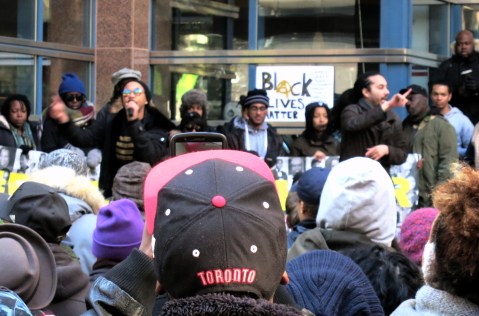
#BLMTOblackOUT, Toronto Police Service Headquarters, Toronto, Saturday, March 26, 2016, image by author
BLACK LIVES THEY MATTER HERE,” a BLMTO member shouted into a microphone; a call and declaration of a black elsewhere affirmed by the audience’s response: “BLACK LIVES THEY MATTER HERE.”
#BLMTOblackOUT, Toronto Police Service Headquarters, Toronto, Saturday, March 26, 2016, recording by author
She reiterated, “BLACK LIVES THEY MATTER HERE,” as Rhythms of Resistance Toronto, a band that performs at social justice events across the city, began to accompany her with a samba groove; this was elsewhere as a black diasporic space. “BLACK LIVES THEY MATTER HERE,” confirmed the audience in response who were now clapping along to the beat. A back-and-forth ensued where repetition and the obstinacy of the leader’s voice marked what Daphne Brooks has identified in “All That You Can’t Leave behind”: Black Female Soul Singing and the Politics of Surrogation in the Age of Catastrophe” as “urgency and excess.” This urgency and excess were further compounded by the start of another chant, which interlocked with the one she was leading. Another member of BLMTO then exclaimed into a microphone, “NO JUSTICE, NO PEACE. NO RACIST POLICE.” Some of the audience members began to heed her call. “BLACK LIVES THEY MATTER HERE / NO JUSTICE, NO PEACE. NO RACIST POLICE.” Together, the two chants, loud and overpowering, created a tension that paralleled the social pressures wrought by a Canadian silence that takes the form of anti-black racism.
After a few rounds of the layered chant were exhausted, the second leader stopped to catch her breath. By bringing the chant to a halt, she demonstrated not only the toll that shouting takes on a person but also the labor, power, and duress needed, according to Kelley Tatro, “to express personal and collective rage.” “I can’t breathe,” said Eric Garner eleven times while the police officers holding him down against the pavement disavowed him of his personhood. In the US and Canada, breathing and shouting are presumed antithetical to life within the realms of white settler colonialism.
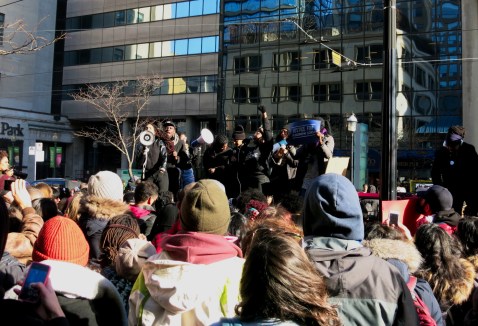
#BLMTOblackOUT, Toronto Police Service Headquarters, Toronto, Saturday, March 26, 2016, image by author
Shouting, performing anger and defiance via sound in public, is considered noise under the logics of whiteness. Thus, as Jack Halberstam writes in the introduction to Stefano Harney and Fred Moten’s The Undercommons, “In order to bring colonialism to an end then, one does not speak truth to power, one has to inhabit the crazy nonsensical, ranting language of the other, the other who has been rendered a nonentity by colonialism” (8). What both BLMTO members leading chants indicated at #BLMTOblackOUT is that shouting, in this case in the form of chanting, is another way of breathing elsewhere into existence.
#NoDAPL Solidarity March with Standing Rock
Queens Park to Nathan Phillips Square
Saturday, November 5, 2016
It began where many politically motivated public gatherings in Toronto do: outside Queen’s Park, which houses the Government of Ontario offices. Participants made speeches, chanted, cheered, jeered, and sang songs. The crowd then headed south on University Avenue sounding their discontent in front of the US Consulate building, which coincidentally is on the way to Nathan Phillips Square.
The march had been organized by and alongside Indigenous groups to show support for protesters at Standing Rock. In solidarity with the Water Protectors holding camp at Sacred Stone Camp, marchers in Toronto were expressing their disapproval of the US government’s efforts to construct an oil pipeline through Indigenous territory, a project that endangers clean water resources and violates treaties.
Once at Nathan Phillips Square, Indigenous people led participants in a pan-tribal round dance. Most strongly since Idle No More, or #IdleNoMore, in the winter of 2012/2013, round dances became emblems of Indigenous self-determination across what is typically referred to as Canada. Taking place in public venues, notably malls, as part of Idle No More actions, round dances served as communal claims not to Canada and Canadianness but rather to Turtle Island and Indigeneity.
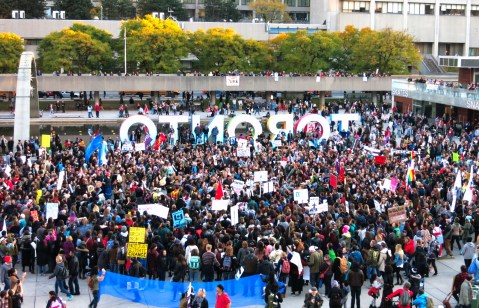
Round Dance, Nathan Phillips Square, Toronto, Saturday, November 5, 2016, image by author
Along with drumming, singing makes up the sonic elements of a round dance all the while those participants not playing a drum in the middle of the circle hold hands and move in a clockwise direction to the music. The high-pitched singing voice invites and welcomes those who have passed to join. In this way, the singing voice is an understanding that life and kinship do not cease at death. As such, the high-pitched singing voice is also a reach towards something else, a nameless elsewhere describable, graspable, through vocables. These vocables, these sonic registers of possibility, cannot be contained by the limitations of any official language. As part of round dances, then, vocables announce that while this elsewhere has yet to be legitimized through language, it exists in sound. And elsewhere’s existence is celebrated by what Anna Hoefnagels writes in “Northern Style Powwow Music: Musical Features and Meanings” are the improvised “whoops, shouts, yelps or ululations by singers” (14).
Through round dances, Indigenous people recognize that according to treaties signed by Indigenous groups and European settlers the land and its resources are to be shared. Round dances are a means to assert that Turtle Island is not another name for North America but rather a place that exists alongside North America.
Women’s March on Washington: Toronto
Queen’s Park to Nathan Phillips Square
Saturday, January 21, 2017
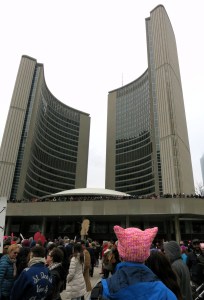
The labor, the creativity, of women of color is largely to thank for the organizing and mobilizing efforts that led to the Women’s March on Washington. Toronto’s “sister march” made evident the ways in which the work that women of color, particularly black women, perform in producing elsewhere has and continues to go unrecognized. The use of songs with black female vocals to lead Toronto’s Women’s March is an example of how audibility accompanies invisibility in Canada.
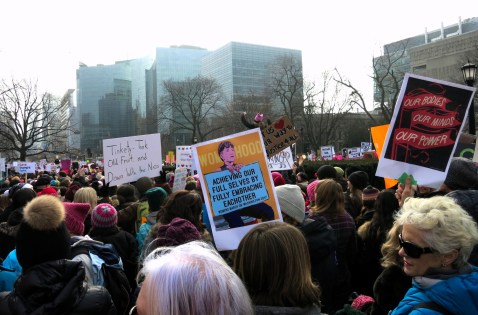
Women’s March on Washington: Toronto, Queen’s Park, Toronto, Saturday, January 21, 2017, image by author
he joyous tenor of the march was introduced partially through disco and disco-inflected songs like Sister Sledge’s “We Are Family” (1979) and the Eurythmics’ and Aretha Franklin’s duet “Sisters Are Doin’ It for Themselves” (1985). March organizers wanted participants to feel that this march was a celebration of sisterhood, of women, like Aretha Franklin and Annie Lennox, coming together harmoniously as kin. Intersectionality need not apply—maybe as a catchword but definitely not in practice.
Women’s March on Washington: Toronto, Queen’s Park, Toronto, Saturday, January 21, 2017, recording by author
.
Women’s March on Washington: Toronto, Nathan Phillips Square, Toronto, Saturday, January 21, 2017, image by author
The emotional labor that Debbie, Joni, Kim, and Kathy Sledge of Sister Sledge and Aretha Franklin perform in these songs was not meant to be heard as women belaboring a black feminist, or womanist or queer, elsewhere; instead, marchers—like much of white feminism historically—enjoyed the benefits, without the risks, of an elsewhere made possible by the emotional labor that black female singers perform in dance music. In the voices of Sister Sledge and Aretha Franklin, some marchers did not recognize the invisible labor required to flourish in white settler heteropatriarchal nation-states; at the march, the power of black female voices was misappropriated to signal thriving because of white settler colonialism, paternalism, and blanket sisterhood.
Women’s March on Washington: Toronto, Queen’s Park, Toronto, Saturday, January 21, 2017, recording by author
.
Pulse Memorial
Barbara Hall Park
Monday, June 12, 2017
Pulse Memorial Event, Barbara Hall Park, Toronto, Monday, June 12, 2017, image by author
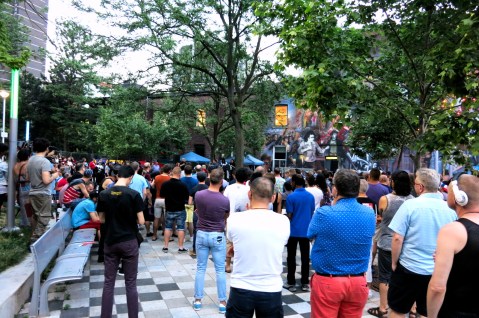
Adjacent to Toronto’s AIDS Memorial in Barbara Hall Park, attendees gathered to remember the forty-nine victims of the shooting at Pulse Nightclub in Orlando, Florida. The event commemorated the one-year anniversary of the shooting with a short film screening, a DJ set, musical performances, poems, short speeches, and food. Surrounded and sustained by the light of candles, the names of the forty-nine primarily Latinx victims were read by the event’s three MCs against the flickering screen of the lit wicks.
Pulse Memorial Event, Barbara Hall Park, Toronto, Monday, June 12, 2017, image by author
| Stanley Almodovar III, age 23
Amanda Alvear, 25 Oscar A. Aracena-Montero, 26 Rodolfo Ayala-Ayala, 33 Alejandro Barrios Martinez, 21 Martin Benitez Torres, 33 Antonio D. Brown, 30 Darryl R. Burt II, 29 Jonathan A. Camuy Vega, 24 Angel L. Candelario-Padro, 28 Simon A. Carrillo Fernandez, 31 Juan Chevez-Martinez, 25 Luis D. Conde, 39 Cory J. Connell, 21 Tevin E. Crosby, 25 Franky J. Dejesus Velazquez, 50 |
Deonka D. Drayton, 32
Mercedez M. Flores, 26 Peter O. Gonzalez-Cruz, 22 Juan R. Guerrero, 22 Paul T. Henry, 41 Frank Hernandez, 27 Miguel A. Honorato, 30 Javier Jorge-Reyes, 40 Jason B. Josaphat, 19 Eddie J. Justice, 30 Anthony L. Laureano Disla, 25 Christopher A. Leinonen, 32 Brenda L. Marquez McCool, 49 Jean C. Mendez Perez, 35 Akyra Monet Murray, 18 Kimberly Morris, 37 Jean C. Nieves Rodriguez, 27 |
Luis O. Ocasio-Capo, 20
Geraldo A. Ortiz-Jimenez, 25 Eric I. Ortiz-Rivera, 36 Joel Rayon Paniagua, 32 Enrique L. Rios Jr., 25 Juan P. Rivera Velazquez, 37 Yilmary Rodriguez Solivan, 24 Christopher J. Sanfeliz, 24 Xavier E. Serrano Rosado, 35 Gilberto R. Silva Menendez, 25 Edward Sotomayor Jr., 34 Shane E. Tomlinson, 33 Leroy Valentin Fernandez, 25 Luis S. Vielma, 22 Luis D. Wilson-Leon, 37 Jerald A. Wright, 31 |
The reading of their names was an incantation of forty-nine lives lost and an invocation of an elsewhere maintained through remembrance. The vocalization of their names was thus a commitment to an understanding of intimacy that refuses the state’s limited definitions of what and whom constitutes a (grievable) life; and concurrently, their names were sonic acknowledgments of the violence that is basic to life for many under white settler colonialism, what Christina Sharpe calls “being in the wake.” Their names, too, were evocations of the queer of color dancefloor. It us under and around the disco ball, after all, that many queers of color enact an elsewhere, love light in flight. Therefore, the reading of the forty-nine names was an assertion that life and intimacy are sonic demands and collective endeavors.
Night March
George Hislop Park to Old City Hall
Wednesday, June 21, 2017
Annually, some queer Canadians take it upon themselves to organize a Night March, an unofficial (by choice) Pride event that insists that Pride has been and will continue to remain political. Night March is a refusal to abide by the respectability politics attached to the visibility and corporatism that Pride garners across Toronto. “LET’S GET CRITICAL, OUR PRIDE IS POLITICAL,” one of the chants goes. Participants meet at a predetermined location, announced through posters and social media, somewhere near or in the Church and Wellesley Neighborhood—Toronto’s “gayborhood.” Before setting out to march, participants listen to a small set of speakers who share information on some of the issues that are not being discussed at Toronto’s official Pride events: the defunding of organizations working on HIV/AIDS and the housing discrimination faced by trans women and sex workers, for example.
The gathering at George Hislop Park this year also made evident a particular rift among LGBTQ+ people, groups, and institutions surrounding this year’s Pride festivities: whether to support BLMTO’s actions and demands at last year’s Pride Parade, namely the removal of uniform police from partaking in future parades. On Sunday, June 26, 2016 and in their role as honored guests of the parade, members of BLMTO halted Toronto’s Pride Parade at the intersection of Yonge and College Streets for thirty minutes—to the dismay of some and the approval of others. It was then that BLMTO served Pride Toronto, the organization that runs Pride in the city, with a list of demands. Pride Toronto’s Executive Director at time Mathieu Chantelois hastily signed BLMTO’s list of demands only to retract his approval shortly thereafter. Following months of heated debate and backlash against BLMTO, the Pride Toronto membership formally agreed to adopt all of BLMTO’s demands at its Annual General Meeting (AGM) on January 27, 2017—uniformed police would not march at this year’s Pride parade.
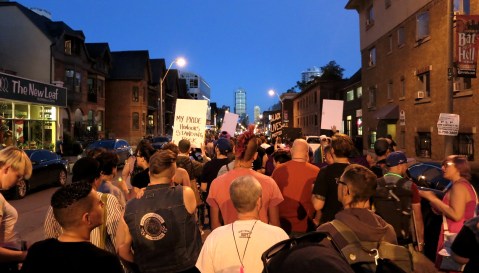
At George Hislop Park, Night March participants were unequivocal in their support of BLMTO. The mostly millennial and predominantly white gathering’s chants, which they shouted as they made their way down Church Street, included “BLACK LIVES MATTER” and “NO JUSTICE, NO PEACE. NO RACIST POLICE.”
Night March, Church Street, Toronto, Wednesday, June 21, 2017, image by author
Night March participants even halted traffic on College Street as they briefly occupied the traffic lanes in front of Toronto Police Service Headquarters. Accompanied by Rhythms of Resistance Toronto, a few participants called out “BLACK LIVES THEY MATTER HERE.” The rest of the gathering responded, “BLACK LIVES THEY MATTER HERE.”
Night March, Toronto Police Service Headquarters, Toronto, June 21, 2017, image by author
.

Night March, Toronto Police Service Headquarters, Toronto, June 21, 2017, image by author
Police officers who were following the marchers on bicycles sounded out a short siren, a sound of disapproval and a warning to disperse. The marchers continued chanting. They then switched chants and began shouting in unison, “NO JUSTICE, NO PEACE. NO RACIST POLICE.” After a few rounds of this chant, one participant led the gathering into another chant:
WHEN BLACK LIVES ARE UNDER ATTACK, WE REVOLT, UNITE, FIGHT BACK. x9
WHEN TRANS LIVES ARE UNDER ATTACK, WE REVOLT, UNITE, FIGHT BACK. x3
WHEN INDIGENOUS LIVES ARE UNDER ATTACK, WE REVOLT, UNITE, FIGHT BACK. x3
WHEN WOMEN’S LIVES ARE UNDER ATTACK, WE REVOLT, UNITE, FIGHT BACK. x3
WHEN QUEER LIVES ARE UNDER ATTACK, WE REVOLT, UNITE, FIGHT BACK. x3
The chants at Night March were sonic testaments of an elsewhere impossible to imagine and enact without the collective labor of BLMTO’s membership since its formation in 2014, which has included but has not been limited to #BLMTOtentcity and their protests at Toronto’s 2016 Pride Parade. The chants were also a compilation and validation of noisy political activity—a loud elsewhere—in a city and in a nation-state that prefers, promotes, and is predicated on the silence, the violence, that is white settler colonialism.
Conclusion
“Only together,” argues Gloria Anzaldúa in Borderlands/La Frontera, “can we be a force” (209).
Together, these voices at public gatherings say NO to Toronto, Canada at so-called 150; NO is a refusal to be complicit, to stay silent, to death. These are voices that do not consent to white settler colonialism. A NO to police brutality, the disappearance and murders of Indigenous women and girls, the conditions that drive Indigenous youth to suicide, lack of clean drinking water, carding, anti-semitic and Islamophobic hate crimes, the different forms of violence LGBTQ+ people, particularly trans women, face, the municipal, provincial, and federal governments defunding and unfunding of public housing and healthcare programs. It is by amplifying and listening to these NOs that we actually hear the workings of a YES, to an affirmation of elsewhere in the here and now that is always already attuned to the past and future, to lives—black, trans, Indigenous, feminine, queer—that matter, to life otherwise.
—
Featured Image: Round Dance, Nathan Phillips Square, Toronto, Saturday, November 5, 2016, photo by author
—
Gabriela Jimenez defended her PhD dissertation in ethnomusicology at the University of Toronto this spring. Her dissertation is on the ways in which nonnormatively gendered and sexually oriented persons in Mexico City use musical performances to alter their surroundings. Her writing has been featured in Black Music Research Journal and The Fader.
—
 REWIND!…If you liked this post, you may also dig:
“Quebec’s #casseroles: on participation, percussion and protest”-Jonathan Sterne
“Deejaying her Listening: Learning through Life Stories of Human Rights Violations”-Emmanuelle Sonntag and Bronwen Low
“Listening to the Border: ‘”2487″: Giving Voice in Diaspora’ and the Sound Art of Luz María Sánchez”-D. Ines Casillas
Share this:


Current Top Posts





April 2021

January 2020

November 2019

October 2019

August 2019

April 2014

November 2017

March 2015

December 2017

October 2015
 Sounding Out!
Recent Comments