
Black Joy: African Diasporic Religious Expression in Popular Culture

 Inspired by the recent Black Perspectives “W.E.B. Du Bois @ 150” Online Forum, SO!’s “W.E.B. Du Bois at 150” amplifies the commemoration of the occasion of the 150th anniversary of Du Bois’s birth in 2018 by examining his all-too-often and all-too-long unacknowledged role in developing, furthering, challenging, and shaping what we now know as “sound studies.”
It has been an abundant decade-plus (!!!) since Alexander Weheliye’s Phonographies “link[ed] the formal structure of W.E.B. Du Bois’s The Souls of Black Folk to the contemporary mixing practices of DJs” (13) and we want to know how folks have thought about and listened with Du Bois in their work in the intervening years. How does Du Bois as DJ remix both the historiography and the contemporary praxis of sound studies? How does attention to Du Bois’s theories of race and sound encourage us to challenge the ways in which white supremacy has historically shaped American institutions, sensory orientations, and fields of study? What new futures emerge when we listen to Du Bois as a thinker and agent of sound?
Over the last two months, we have shared work that reimagines sound studies with Du Bois at the center. Pieces by Phillip Luke Sinitiere, Kristin Moriah, Aaron Carter-Ényì, Austin Richey and Julie Beth Napolin move us toward a decolonized understanding and history of sound studies, showing us how has Du Bois been urging us to attune ourselves to it. To start the series from the beginning, click here.
Readers, today’s post by Vanessa Valdés closes our series: she explores the limits of Du Bois’ echo chamber metaphor within the context of a Black diaspora that looks past the white gaze and within its spiritual practices for recognition.
–Jennifer Lynn Stoever and Liana Silva, Eds.
In “The Concept of Race,” the fifth chapter of his autobiography Dawn of Dusk (1940), W. E. B. Du Bois theorizes the psychological damage of caste segregation using the metaphor of the echo chamber. He writes of being imprisoned within a mountain, looking out, speaking “courteously” and yet remaining unnoticed: “the passing throng does not even turn its head, or if it does, glances curiously and walks on” (66). As per Du Bois’s imagery, white supremacist segregation renders Black subjects ultimately unintelligible, even to themselves, as they “may scream and hurl themselves against the barriers, hardly realizing in their bewilderment that they are screaming in a vacuum unheard and that their antics may actually seem funny to those outside looking in” (66). Du Bois railed against the irreparable harm that results from legal and cultural separation of people on the basis of race; he focuses on the interactions between Black communities and a dominant white supremacist society, highlighting the damage inflicted by Black peoples upon Black peoples themselves when they continually attempt to prove their humanity to a white supremacist capitalist heteropatriarchal imperialist population in control of socioeconomic political systems within the United States and in fact throughout the Americas.
What then? Du Bois presents a vision in which there is no room, literal or figurative, for resistance to this seemingly pervasive surveillance that, in the words of Jennifer Stoever in The Sonic Color Line: Race and the Cultural Politics of Listening (2016), renders peoples of African descent “soundproofed yet hypervisible, constantly on display for the curiosity of the white gaze” (260). If there continues to be a search for acceptance, for recognition and acknowledgement of one’s humanity on behalf of “the white gaze,” what happens when it does not come? This essay presents a select history of musicians who, irrespective of a white audience, and in the face of a seemingly flattened definition of Blackness that is limited to an adherence to the Black (Christian) Church here in the United States, instead channel their multiple identities by invoking the orishas of the religion of Regla de Ocha. In it are aspects of Black culture that remain, in the words of E. Patrick Johnson in “Black Performance Studies: Genealogies, Politics, Futures,” “illegible and unintelligible to the undiscerning eyes and ears, and perhaps minds, of some scholars.” These artists resist the urge to explain, defying an unspoken dictate that their art must be completely comprehensible to all who interact with it. They draw from source material that for millions internationally is a viable source of inspiration on its own terms, without elucidation.

“Diasporic Genius Apprenticeship Program (D-GAP)” by Flickr user Diasporic Genius, CC BY-NC-ND 2.0
Known alternately as Santería, Yoruba, Lucumí, and Ifa, this religion, like others of the African diaspora in the Americas, call for their practitioners—formal initiates or simply those who show respect and affinity—to achieve balance on the paths to their destiny. According to Regla de Ocha, human beings, like the nature that surrounds us, are sparks of the divine made manifest; practitioners interact with the environment in order to reach said equilibrium through intoned supplications. While associated primarily with Black populations of the Hispanic Caribbean, those who are faithful are found throughout the hemisphere and in fact, throughout the world.
In the anglophone world of Black music here in the United States, critics have written about the multiple influences of gospel on the development of rhythm and blues and other musical genres, as made patently evident in Aretha Franklin’s homegoing services as well as Peter Guralnick’s Sweet Soul Music: Rhythm and Blues and the Southern Dream of Freedom (1986). Within the luso-hispanophone audiences in this hemisphere, there has been a similar inclusion of African diasporic religious music within popular genres. Prayers and chants within popular music and literature reflect systems of knowledge that have undergirded communities of African descent for centuries on both sides of the Atlantic and throughout this hemisphere. Those who know, who can see and hear those resonances, for them, there is no regard for the understanding of a dominant white audience; it is simply not for them. And it is here, in the knowledge that these works invoke systems of being that are inaudible and unappetizing to mass consumption, where one can wrestle out of the echo chamber.

“Gospel singers” by Flickr user Elin B, CC BY 2.0
In this series for Sounding Out!, Aaron Carter-Ényì has written about Du Bois’s theories on sound; on his musical transcriptions in The Souls of Black Folk (1903); the African retentions of the Gullah-Geechee population (1903); and the resonance of the drum within African music itself The World and Africa (1947). However, Du Bois did not look to a growing Spanish-speaking population that had migrated from the Hispanic Caribbean, particularly Cuba and Puerto Rico, that would also provide him evidence of the continued African heritage. As historian Nancy Raquel Mirabal writes in Suspect Freedoms: The Racial and Sexual Politics of Cubanidad in New York, 1823-1957 (2017), these men and women were working-class economic migrants, the majority of whom were of African descent: Black Cubans and Puerto Ricans arrived in the 1920s, 1930s, and 1940s, immediately impacted the musical scene. This would give way to the explosion of musical forms popularized here, including conga, mambo, rumba, cha-cha-cha, and later, salsa. (See César Miguel Rondón, The Book of Salsa: A Chronicle of Urban Music from the Caribbean to New York City, 2008.) All of these musical forms grow out of religious African music; the rhythms of religious ceremonies provide the literal foundation out of which these genres flourish. Practitioners can parse out these inflections; those without this knowledge simply engage. Those who know, know; those who make the music do so without consideration for exposition.
A 1950s U.S. audience witnessed Lucy Ricardo visit her husband Ricky at the club and sing “Babalu”; backed by his orchestra, it was originally a hit for Desi Arnaz in 1947 on RCA Victor records. In a later episode, Ricky would be backed by his young son, in an effort to demonstrate the continued influence of his Cuban heritage. Hector Lavoe’s “Aguanile” (1978) remains a classic both within his catalog as well as the larger genre of Salsa’s golden era of the 1970s; his labelmate Celia Cruz’s “A Santa Barbara” is a remake of Celina González and Reutilio Jr.’s 1949 hit of the same name. In this century, Carlinhos Brown released “Aganjú” in 2003, a year after his compatriot, Bebel Gilberto found success with her version in Brazil. In the United States, a remix of Gilberto’s adaptation was featured on the soundtrack of the HBO show Six Feet Under. In the last minute of their first hit, “River” (2015), the Ibeyi break their allegorical ode to the Oshun by making plain the entity to which they sing. On the same release, they sing to the entity associated with transformation in a song of her name, “Oya.” Daymé Arocena begins her 2017 release, Cubafonía, with “Eleggua,” he of the crossroads. Beginning with their 2015 debut “3 Mujeres” Ìlé have consistently brought together religious music with current soul and hip hop to larger audiences.
As these examples attest, there is at play an ethics of representation that is often misunderstood by non-practitioners of these religions; it is one that privileges confidentiality over explication. In a post-Enlightenment world that places emphasis on logic and reason, there exists a demand that everything be explained, be made legible. And yet, not everything is for everybody. Matters of spirit do not easily co-exist within Cartesian epistemological systems that demand bifurcation between the head and the heart. Within African diasporic religions – not only the ones mentioned here but also others including Palo Monte, Vodou, Obeah, Macumba, Candomblé – there is respect for the seemingly inexplicable. There is room for the miraculous, for that which can be found outside the realms of what has been deemed reasonable by systems of European thought. There is room for faith. And it is this kind of faith that practitioners of these Black religions – artists and scholars alike – respect when they refuse to explain the source of their joy, a joy I like to call “Black joy.”
Beyoncé’s Lemonade (2016) fits into this oeuvre; here, the world’s biggest pop star produced a work of art grounded in Black experiences of the Caribbean basin, including her family’s U.S. Southern Black heritage in Texas and Louisiana. While notable for a great many features, for some the most invigorating part was the incorporation of visual allusions to sacred entities well-known to and easily recognized by practitioners of West African and African diasporic religions throughout the Americas. (For a sample of the analyses that emerged, see here, here, and here.) The inclusion of these markers situated Beyoncé firmly within this long tradition of the ability of Black artists in this hemisphere to employ imagery, particularly that related to religious traditions outside of orthodox Christianity, as a means by which to invoke more full, three-dimensional expressions of racial, gendered, and sexual identities. In Oshun’s Daughters: The Search for Womanhood in the Americas (2014), I wrote about how women writers from United States, Cuba, and Brazil, writers such as Audre Lorde, Ntozake Shange, Cristina García, Nancy Morejón, and Conceição Evaristo, among others, all reference entities from these religions as a means by which to include complex portraits of womanhood in their work.

“Gospel” by Flickr user Geoffrey Froment, CC BY-NC-ND 2.0
To return to Du Bois’s echo chamber, the invocation of these entities allows practitioners to leave the mountain; there is no gazing to a mainstream culture for whom these prayers may be unintelligible. There is little consideration of explaining every element; again, those who know, know. They recognize a greater significance of the images, and are able to acknowledge allusions to whole systems of thought that are foundational to Black expressive cultures. These artists move forward accordingly. In 1926, The Nation published Langston Hughes’s “The Negro Artist and the Racial Mountain,” and his words continue to resonate: “We younger Negro artists who create now intend to express our individual dark-skinned selves without fear to shame. If white people are pleased we are glad. If they are not, it doesn’t matter. [..] We build our temples for tomorrow, strong as we know how, and we stand on top of the mountain, free within ourselves.” The white gaze of which Du Bois writes has no power in this formulation; instead, there is a turn away from the dominant white supremacist culture toward the richness that Black cultures offer. There is no flinging up against the metaphorical glass, no exhaustion in continued attempts to get them to acknowledge our humanity. They simply do not matter.
In her first novel, Sassafrass, Cypress & Indigo (1982), Ntozake Shange writes: “Drums and chanting ran thru the lush backwoods of Louisiana. Sassafras liked to think the slaves would have been singing like that, if the white folks hadn’t stolen our gods. Made our gods foreign to us […]” (214). The work of these artists suggests that These gods open up so many other possibilities for Black lives in the United States. These entities remain with those who choose to see, hear, and feel their presence, and even with those who don’t. They tried to make our gods foreign to us: they failed.
—
Featured image: “Woman dancing African dance in the street, São Paulo downtown” By The Photographer [CC BY-SA 4.0], from Wikimedia Commons
—
Vanessa K. Valdés is associate professor of Spanish and Portuguese at The City College of New York; she is the editor of Let Spirit Speak! Cultural Journeys through the African Diaspora (2012) and The Future Is Now: A New Look at African Diaspora Studies (2012) and the book review editor of sx salon. She is the author of Oshun’s Daughters: The Search for Womanhood in the Americas (2014).
—
 REWIND! . . .If you liked this post, you may also dig:
Spaces of Sounds: The Peoples of the African Diaspora and Protest in the United States–Vanessa Valdes
“I Love to Praise His Name”: Shouting as Feminine Disruption, Public Ecstasy, and Audio-Visual Pleasure–Shakira Holt
Share this:

Shoo bop shoo bop, my baby, ooooo: W.E.B. Du Bois, Sigmund Freud & Barry Jenkins’ Moonlight
 Inspired by the recent Black Perspectives “W.E.B. Du Bois @ 150” Online Forum, SO!’s “W.E.B. Du Bois at 150” amplifies the commemoration of the occasion of the 150th anniversary of Du Bois’s birth in 2018 by examining his all-too-often and all-too-long unacknowledged role in developing, furthering, challenging, and shaping what we now know as “sound studies.”
It has been an abundant decade-plus (!!!) since Alexander Weheliye’s Phonographies “link[ed] the formal structure of W.E.B. Du Bois’s The Souls of Black Folk to the contemporary mixing practices of DJs” (13) and we want to know how folks have thought about and listened with Du Bois in their work in the intervening years. How does Du Bois as DJ remix both the historiography and the contemporary praxis of sound studies? How does attention to Du Bois’s theories of race and sound encourage us to challenge the ways in which white supremacy has historically shaped American institutions, sensory orientations, and fields of study? What new futures emerge when we listen to Du Bois as a thinker and agent of sound?
Over the next two months, we will be sharing work that reimagines sound studies with Du Bois at the center. Pieces by Phillip Luke Sinitiere, Kristin Moriah, Aaron Carter-Ényì, Austin Richey, Julie Beth Napolin, and Vanessa Valdés, move us toward a decolonized understanding and history of sound studies, showing us how has Du Bois been urging us to attune ourselves to it. To start the series from the beginning, click here.
Readers, today’s post by Julie Beth Napolin brings her trilogy to a close, exploring the echoes of black maternal sounding and listening she has amplified in Du Bois in Barry Jenkins’s Oscar-winning film Moonlight (2016).
Essay One: Listening to and as Contemporaries: W.E.B. Du Bois & Sigmund Freud
Essay Two: (T)racing Mother Listening: W.E.B. Du Bois & Sigmund Freud
–Jennifer Lynn Stoever and Liana Silva, Eds.
The theory of the acousmatic—the idea of a sound whose source is unseen, as it comes to us from Barthes, Chion, and Dolar—rests upon the mother tongue and the Oedipal scene, the dyad of mother and father. There is in “Do ba – na co – ba”–his great- great- grandmother’s song Du Bois remembers hearing passed down through his family–a transmission from the mother, but what kind of transmission? “There is no one extant autobiographical narrative of a female captive who survived the Middle Passage,” Hartman writes in “Venus in Two Acts” (3). History becomes, she continues, a project of “listening for the unsaid, translating misconstrued words” (3-4). The word-sounds “Do ba-na co-ba” are not the translation of a misconstrued word and they bolster a song of survival, of living on. But there is a silence there. “Do ba-na co-ba,” in a manner of speaking, survives the Middle Passage, and re-opens it as a primary channel of listening and receiving.
The Bantu woman was Du Bois’ grandfather’s grandmother, so many generations removed.
Returning to the vestiges of black motherhood in recent black cinema (including Jordan Peele’s Get Out and Barry Jenkin’s Moonlight), Rizvana Bradley argues that the loss of the mother “in black life more generally, as it repeats through cycles of material loss, … encapsulates racial slavery’s gendered social afterlife” (51). Bradley’s essay is crucial in retrieving the figure of the lost mother even in moments when the mother is absolutely elided as a character, not to appear visually. Horror more generally owes its immersive quality to the womb (enclosed spaces), but Bradley turns to black film form in particular to find in its mise-en-scène (such as in the gravitational field of the “sunken place”) maternal flesh and form.
In the compositional and formal strategies of The Souls of Black Folk, in the punctuated silences that open each chapter, there is a trace of the elided black maternal. The Bantu woman is lost not because Du Bois did not know her (he could not have), but because something of her song transmits a loss and theft that were not symbolic, but literal—a stolen and kidnapped maternal, rather than simply destroyed, as in the Oedipal mandate. It is crucial that the song that is at the core of Du Bois’ memory is transmitted along the maternal line. This maternal voicing is the unspoken wound of Du Bois’ text.

Spillers begins “Mama’s Baby, Papa’s Maybe” from the premise of non-Oedipal psycho-biographies, and these include not only the single mother, but the kidnapped mother. The quotation marks that surround the figure of the “black woman” for Spillers are “so loaded with mythical prepossession” that the agents it conceals cannot be clarified. Spillers takes particular aim at the infamous conclusions of the Moynihan report of 1965 that trace the roots of African American poverty to the figure of the single mother, the underachievement of lower class black males being linked in the report to black women.
In this way, black culture is thought to operate in a matriarchal pattern essentially out of step with a majority culture where a child’s identity and name, by definition, cannot be determined by the maternal line (66). As Lacan insists, it is the Father who gives a child both the Name and the symbolic Law (language). According to this configuration, Spillers argues, the child of the black mother can only be left in a haunting dis-identity. The implications for psychoanalysis are radical: Spillers begins the essay with a “stunning reversal of the castration thematic,” one that displaces its structure “to the territory of the Mother and Daughter, [and] becomes an aspect of the African-American female’s misnaming” (66). Among these misnamings is that black women are often not seen as “women,” omitted from the category and its political inflections. She is left castrated, politically impotent. For in this displacement, the subject positions of “male” and “female” lose—or fail to adhere to—their traditionally conceived symbolic integrity, and this loss begins with the historical experience aboard ship.

“waves and shadows,” image by Flickr User Albatrail
For Spillers, then, it is essential to trace this misnaming and undifferentiation of black women to the physical and psychic conditions of the Middle Passage. When Freud begins Civilization and Its Discontents, he notes an “oceanic feeling” engendered by religion. The oceanic is the longing for return to a pre-subjective state where one is united with all that is, before the cut that is birth and then language (indeed, the oceanic feeling is often attributed to song). Spillers’ move is to read the oceanic literally and structurally at once: there is the Atlantic Ocean and its Middle Passage. The oceanic, in this way, is de-subjectivating; it casts the subject out of itself in a terror of undifferentiation that does not cease with landfall.
But Spillers also implies that, in that (sexual) undifferentiation, a radical political potential can be retrieved. It is not that black feminism retrieves for her a sexual differentiation after becoming an ambiguous thing. It would not be “woman” in any traditional sense, for that New World category rests upon the violence Spillers seeks to describe. Above all, it would not be easy to name.
Du Bois certainly takes up the Father in his poetic epigraphs. But in ending with the Bantu woman’s song—as it seems to anatomize all of the other songs he describes—Du Bois upholds himself as being named by the maternal line. He is unable or perhaps unwilling to make a clarified place for a black female political agent. If we listen with ear’s pricked, we find that she is the submerged, oceanic condition for his speech.

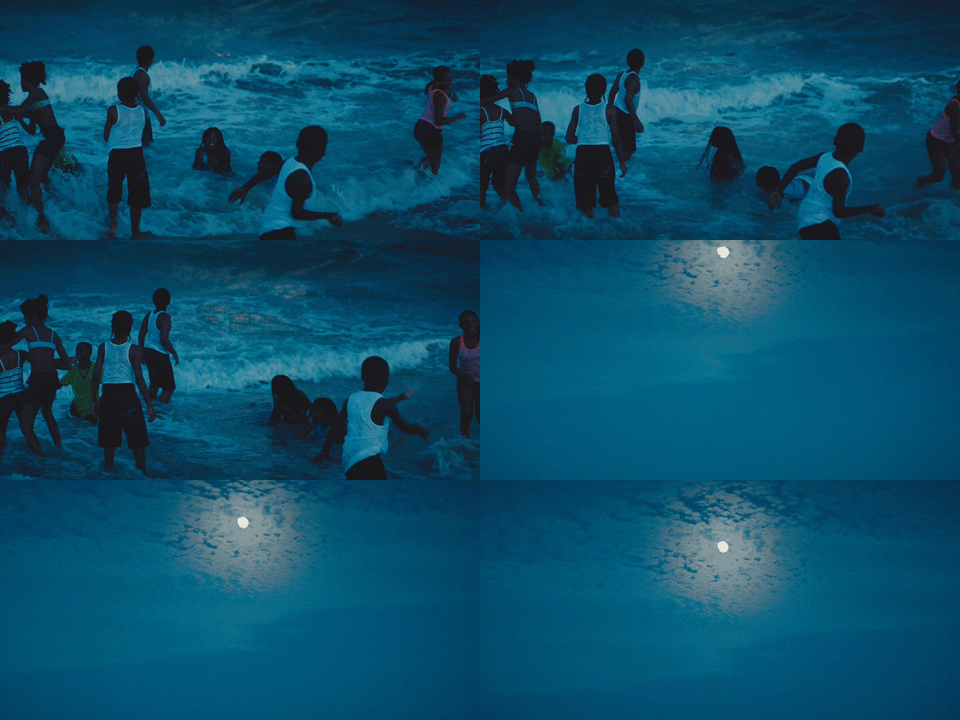
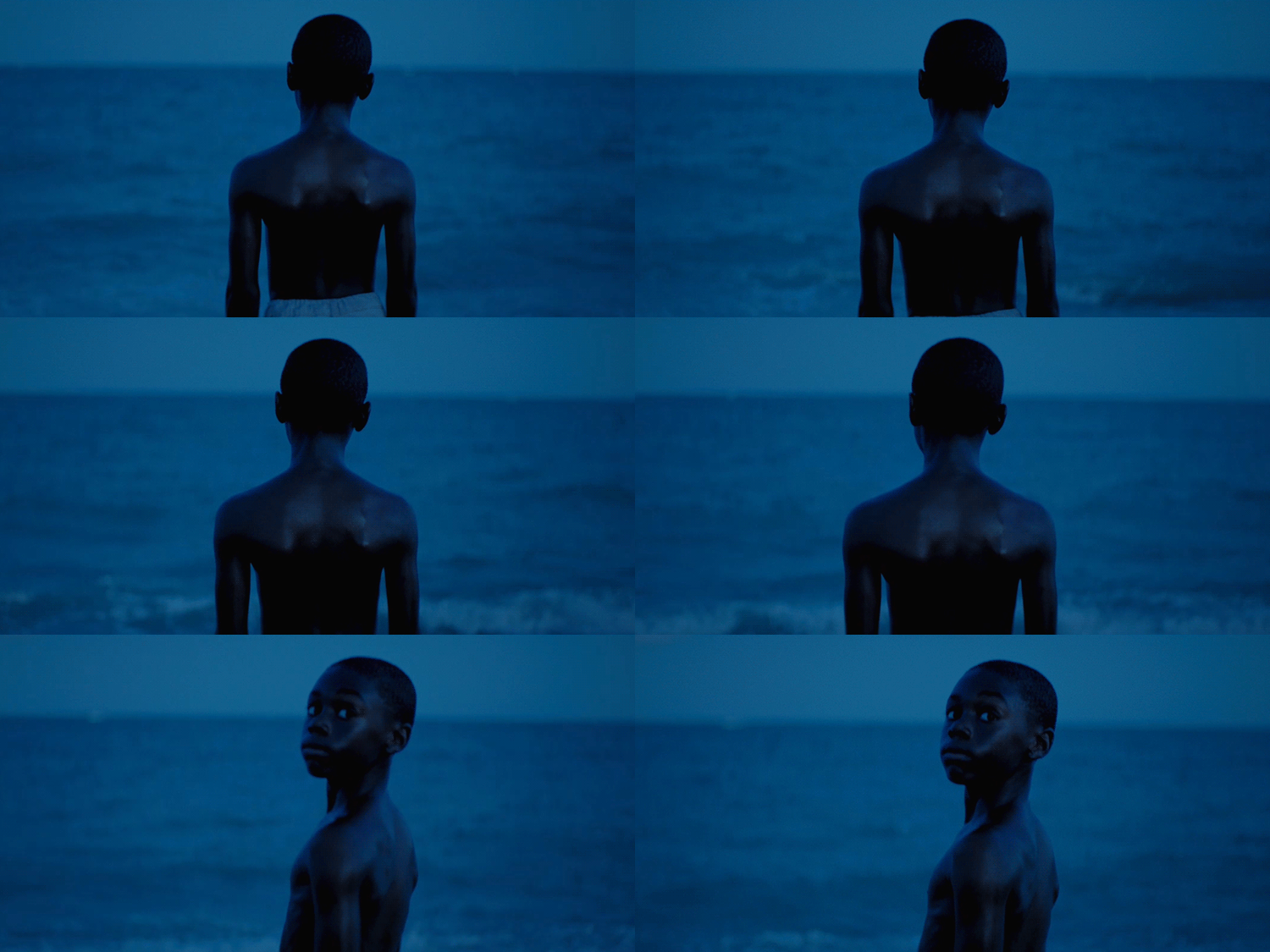
By way of an open-ended conclusion, we can recall the sound of the ocean that punctuates Jenkin’s stunningly lyrical and psychologically complex coming-of-age film, Moonlight. The ocean provides the anchoring location for the psychological action, but also its aesthetic locus, the beginnings of its cinematic language. The sound of the ocean continually marks a desire for “return” to maternal undifferentiation and oneness, and yet, it provides the space for two embodied memories that cannot be compassed by traumatic separation. In the first, a father-like figure, Juan, embraces a young boy, Little, to allow him to float in a nearly baptismal scene of second birth, and in a second scene at the shore, Little experiences with his friend, Kevin, sexual gratification, a coming into his body as a site of pleasure.
The conclusion of the film posits these moments as being in the past. We had experienced them as contemporary, but only later realize they are a well of memory for a now-adult subject who does not know himself. I want to focus, then, on the film’s conclusion, after Kevin and Little (now named Black, his adult re-renaming), meet again after many years. Kevin calls Little/Black on the phone, a defining gesture of reaching out erotically and acousmatically with voices. We later learn that he calls because Kevin has heard an old song that reminded of him of his lost friend. By this voice or call, Black is brought somewhere back to his moment of break to become Little again, as if something in the past must be recuperated for the present. As he drives down the open road to find Kevin, the music of Caetano Veloso soars.
We can’t be sure if this is extra-diegetic or diegetic music. To be sure, Black would never listen to such a song on his stereo. And yet, the song seems to emanate directly from its affective space. In the language of literature, it is a “free-indirect style,” part character and part author; the film is hearing Black/Little feel. He’s in a space of haunting melody, drenched in personal memory, whose principle scene had been the Florida shore, the ocean lapping providing a (maternal) containing motif for the film, now transmuted into song.
The oceanic, Spillers might remind us, is violent, echoing the passages that made it possible for these two black boys to be there. But the sound is also amniotic, a space of maternal longing, particularly for a character who, in Bradley’s estimation, is positioned as pathological, injured by the missing mother who is, in turn, indicted by the film’s imaginary. To some extent, Moonlight participates in the mother’s misnaming: it cannot see the structures that ensure her lostness. But the film does also push towards some mode of melancholia that, as Michael B. Gillespie argues of Jenkins’ earlier work, would cease to be depressive. Jenkins’ aesthetic practice is transformative, Gillespie suggesting that we use Flatley’s term, “antidepressive melancholia,” as it’s with a stake in the personal past but turned towards the collective future (106).

When the two boys, now men, meet again, several sounds punctuate the scene. They are not words or even phonemes, yet “speak” to provide a sonic geography of feeling that includes or “holds” the viewer, as Ashon Crawley might suggest. Among them is the sound of the bell on the door, which marks hello and goodbye, entry and exit, coming and going (or “fort-da” in Freud’s lexicon). When Black enters the diner, he is still “Black.” It is only when remembering what happened at the shore, then to say that no man has touched him since, that he becomes Little. He discloses this truth on behalf of a potential in present and a still-nascent future. Kevin cooks for Black, and Jenkins’ is careful to amplify the sound of the spoon stirring. He provides for Black, the film locating Kevin, a male, within the coordinates of maternal care. The sonic crux of the scene—no longer primal, no longer traumatic—is when Kevin plays the song on the jukebox that had drawn him to call to Little/Black in the first place. “Hello, stranger,” Barbara Lewis croons, “it seems like a mighty long time. Shoo bop shoo bop, my baby, ooooo.”
In listening to a song that is from our past, Newtonian time collapses, a shock running from past to present. The film never discloses whether these two had once heard this song together before. It is more likely that its affective map impacts Kevin, that he hears in its melancholic sound a nascence, and with it, a longing to retrieve his own past and repair. Lewis herself, singing in the sixties, is a recalling an already eclipsed fifties doo-wop. The phonemes circle back to their beginnings in “Do ba- na co-ba.” Such sounds are to be opposed to the shot of Little’s mother yelling at him (presumably a slur). There, the sound had cut out of the scene, which recurs for Little in a traumatic nightmare.
In contrast to that violent naming, the boys’ intimacy was defined by, to use Kevin Quashie’s term, “quiet,” a sense of interiority Michael Gillespie explores in his analysis of Jenkins’ first feature film, Medicine for Melancholy. Shakira Holt and Chris Chien called this dynamic in Chiron and Juan’s relationship “silence as a form of intimate conversance” in their 2017 post about Moonlight. There is a queer intimacy revived apart from trauma, triangulated by a black woman’s voice, paired with male harmonies, that resonate acousmatically from the jukebox to hold and contain the scene. For psychoanalytic theories of voice, containment is the essential maternal gesture of song.
We begin to wonder what might be possible for the feminine were it to be separated from the maternal dimension, a potential that Jenkins does not explore in this particular film in his oeuvre (as he does in Medicine for Melancholy, for example); each of the women in Moonlight “mother” to some extent. Nonetheless, he disperses the maternal function across male and female subjects, particularly in moments when the film resists depression. In listening with ears pricked, as with Du Bois’ epigraphs, the voices cease to belong to an individual, to be male voices or female voices, but become plural and pluralistic. It becomes possible to ground a politics of listening to the past for remaking in the present in that sound.
—
I would like to thank Michael B. Gillespie, Amanda Holmes, and Jennifer Stoever for their incredible scholarly assistance and comments in writing this essay trilogy.
—
Julie Beth Napolin is Assistant Professor of Literary Studies at The New School, a musician, and radio producer. She received a PhD in Rhetoric from the University of California, Berkeley. Her work participates in the fields of sound studies, literary modernism and aesthetic philosophy, asking what practices and philosophies of listening can tell us about the novel as form. She served as Associate Editor of Digital Yoknapatawpha and is writing a book manuscript on listening, race, and memory in the works of Conrad, Du Bois, and Faulkner titled The Fact of Resonance. Her work has appeared in qui parle, Fifty Years After Faulkner (ed. Jay Watson and Ann Abadie), and Vibratory Modernism (ed. Shelley Trower and Anthony Enns).
—
 REWIND! . . .If you liked this post, you may also dig:
Moonlight’s Orchestral Manoeuvers: A duet by Shakira Holt and Christopher Chien
“A Sinister Resonance”: Joseph Conrad’s Malay Ear and Auditory Cultural Studies–Julie Beth Napolin
“Scenes of Subjection: Women’s Voices Narrating Black Death“–Julie Beth Napolin
Share this:


Current Top Posts





April 2021

January 2020

November 2019

October 2019

August 2019

April 2014

November 2017

March 2015

December 2017

October 2015
 Sounding Out!

Recent Comments