
Blank Space and “Asymmetries of Childhood Innocence”

In 2015 a video of a child in an Internet café in the Philippines began to trend on social media sites. Titled, Kanta ng isang Anak para sa kanyang inang OFW “Blank Space“ (“Song of a child for her overseas foreign worker mother”), the video shows a girl singing via Skype to her mother who is working in an unnamed location, presumably outside of the Philippines. “Ma kakantahan ulit kita ha?” (I’ll sing for you again mom), she says, and starts singing Taylor Swift’s “Blank Space”. Her mother attentively watches and listens to her song, soon beginning to cry in longing for a daughter she has not seen in a long time. The girl’s attention is divided between the screen that shows the lyrics, the camera that films her singing, and her mother who quietly observes. This video has over 110,000 views and is one of many archived messages from a child singing or speaking to their mother who labours transnationally. Despite the videos’ jittery framing and low quality, the intended message of shared longing across cyber and transnational borders is clear.
The Spanish-American war (1899-1902) resulted in the relinquishment of the colony of the Philippines from Spain to the United States. This transfer of power instituted the imperial specter that continues to grip the archipelago. The many performances of American pop music on Youtube and on stages throughout the Philippines are what Christine Bacareza Balance calls the “musical aftermath of US imperial cultures” (2016). Having amassed over 97 million YouTube views in the Philippines, Taylor Swift’s overwhelming popularity is evidence of this continued imperial presence. In the video, the young Filipinx girl sings lyrics written by Swift: “I’m dying to see how this one ends. Grab your passport and my hand.” When sung by this child these lyrics take on different meaning than Swift likely intended. Perhaps she is anticipating an end to the necessity of separation between mother and daughter.
Using song, the video provides evidence of what Hannah Dyer calls the ‘asymmetries of childhood innocence’ (2019), reminding its audience of the ways transnational labour and global capital impact children’s experiences of kinship and development. Dyer suggests that some children are withheld the protective hold of childhood innocence. She writes:
“Childhood innocence is a seemingly natural condition but its rhetorical maneuvers are permeated by its elisions and attempted disavowals along the lines of race, class, gender and sexuality. That is, despite the familiar rhetorical insistence that children are the future, some children are withheld the benefits of being assumed inculpable (2)”
Ascriptions of childhood innocence thus require a child to replicate social norms including the production of the nuclear family. In the Philippines, where the liberalization of international trade and high levels of unemployment have disproportionately impacted the labour migration of women, structures of the nuclear family are being re-organized (Parreñas 2005; Tungohan 2013). Women who work outside of the Philippines and away from their families are paradoxically celebrated for their “sacrifice” while also subject to disapproval over their absence (Tungohan 2013). When mothers leave the Philippines, the care-arrangements for children are shifted. There is a growing recognition of the changing nature of motherhood within transnational contexts and the concomitant emotional consequences of negotiating “long distance intimacy” (Parreñas 2005). The demands for transnational labour reconfigure Filipinx family formations and necessitate fraught intimacies between parent and child across borders. Cyber technologies like cell phones and the Internet initiate creative opportunities for children to be “virtually present” in the lives of their mothers and vice versa.

“Parenthood” by Flickr user Saúl Alejandro Preciado Farías, CC BY 2.0
Drawing from Dyer, we might think of children who live without the physical presence of their mothers as “queer” to normative theories of childhood development that affirm overwrought expectations of maternal presence. She suggests that discourses of childhood innocence intend to subjugate the queerness of childhood and that these elisions hold bio-political significance. Faced with social inequities, Dyer emphasizes the importance of a child’s symbolic expression. She argues that children express their psychic and social conflicts aesthetically. A child’s imagination elaborates resistances to the enclosure of childhood innocence as a barometer of value. In this way, this article suggests a child’s singing and dancing are aesthetic expressions that take notice of the entangled traces of colonialism and nation, while resisting hierarchal structures that deem some childhoods more valuable than others.
The child’s sonic performance in the YouTube video is a queer offering that creatively procures transnational connection. Her singing registers a queer frequency that destabilizes normative theories of child development that assume a mother’s physical presence as necessary to developmental success. The girl’s performance suggests that psychic and political reparations can occur in the sounds the child makes. The tactile, spatial and physical qualities of her voice forge a new relation to her mother. Her voice is affecting, seemingly moving her mother to tears and rousing the onlookers at the Internet café to reorganize their bodies and sing along. In this video, we are invited to witness a child whose world has been altered by globalization and the continued geo-political violence’s enacted by the American empire. Given these circumstances, her “creative re-interpretation[s] of kinship” serves as a reminder that the affective fortitude of her voice tests physical and emotional borders (Dyer 2019). The restraint of normative conceptions of family is ruptured when the child remakes her relation to her mother in ways that stir joy, collectivity, and pleasure.

Screenshot from “
By observing and listening to the child’s song more closely, we can listen for its potential to re-sound and re-imagine the parent-child relationship across borders. The sounds of “OFW Blank Space” linger after the clip has ended. By listening for what is in excess of the video’s content, we can consider the affective registers that enunciate alternative understandings of migration, family and belonging. There is a humming that is ubiquitous in the video. Perhaps, it is the sound of the electric fans that run to combat the tropical heat of the Philippines. Maybe it is the collective buzzing from the computers that have been set up to provide the Internet to its cybercafé patrons. The acoustics of the space are at once mundane and haphazard, and at the same time, cogent indicators of the geopolitical truths echoing throughout the scene. With limited access to Internet in the home, the cybercafé has been a site that children frequent to communicate with family working in another country. The convergence of sound, technology and diasporic subjectivity becomes audible when the practice of listening is attuned to these methods of transnational connection.
While listening to the pedagogical potential of the cybercafé more broadly, a focus on the vocal performance of the child reveals my investment in what the sound of her voice tells us. The video starts with greetings spoken in Tagalog, the primary language of the Philippines. When the backing track begins, the child makes a seamless transition into singing in English. In her vocal performance of the lyrics, her Filipino accent is almost undetectable. She sings with a dulcet tone that is clear and appealing. Her voice sounds well-trained and confident. If not for the video, one might believe the child to be a professional American performer. In this scene, it is her voice that is marked and constituted by a narrative of American imperial conquest and Filipino assimilation. But in a creative adaptation of American cultural production, the child re-writes this racialized script and uses American pop songs as a mechanism of care for both herself and her mother.
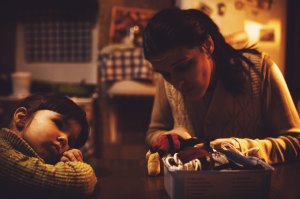
“Mother and daughter at home” by Flickr user Dejan Krsmanovic, CC-BY-2.0
The economic instability in the Philippines has created a state instituted transnational workforce. Women have been disproportionately affected by the demand for work in care industries such as nursing, childcare and care for the elderly (Francisco-Menchavez 2018). These gendered and racialized structures of employment privilege the presence of Filipinx women in families other than their own. The child is withheld a future that assures her the presence of her mother and their physical proximity is denied as a result of the demand for labour and capital exchange between nation-states. However, despite these circumstances, the child uses her voice to summon a beautiful intimacy, one that does not disavow the imperial history that marks its possibility, but instead uses loss as a resource to creatively mourn their separation. For the child, the act of singing is a replacement for her lost object, her mother. In the video we witness a child who is full of joy and whose strength of voice quells, if not, temporarily, whatever longing for her mother she might have. Relatedly, the child is also perceptive of her mother’s needs and uses music as a method of offering her care. Her performance creatively re-routes the presumed directionalities of care (from mother to child) which globalization has fundamentally altered.
—
Featured image: “Children” by Flickr user Clive Varley, CC-BY-2.0
—
Casey Mecija is an accomplished multi-disciplinary artist, primarily working in the fields of music and film. She played in Ohbijou, the Canadian orchestral pop band, and released her first solo album, entitled Psychic Materials, in 2016. Casey is also an award winning filmmaker whose work has screened internationally. She is completing a PhD at The University of Toronto, where she researches sound, performance studies and Filipinx Studies as they relate to queer diaspora.
—
 REWIND! . . .If you liked this post, you may also dig:
Relocating Soundscapes of Schooling: Learning to Listen to Children’s Lifeworlds-Cassie Brownell
Top 40 Democracy: Taylor Swift’s Election Day Victory-Eric Weisbard
Hearing “Media-Capitalism” in Egypt–Ziad Fahmy
Share this:

SO! Podcast #79: Behind the Podcast: deconstructing scenes from AFRI0550, African American Health Activism

 Welcome to Next Gen sound studies! In the month of November, you will be treated to the future. . . today! In this series, we will share excellent work from undergraduates, along with the pedagogy that inspired them. You’ll read voice biographies (Kaitlyn Liu’s “My Voice, or On Not Staying Quiet,”) check out blog assignments (David Lee’s “Mukbang Cooks, Chews, and Heals”), listen to podcasts, and read detailed histories that will inspire and invigorate. Bet. –JS
We are thrilled to bring you today’s utter gift from Dr. Nic John Ramos (Drexel University) and Laura Garbes (Brown University) who team taught this tremendous course in the Department of Africana Studies at Brown University called African American Health Activism from Colonialism to AIDS that used podcasting as a critical venue of knowledge production and a pedagogical tool. The introductory paragraph of their syllabus explains the class as follows:
Welcome to Next Gen sound studies! In the month of November, you will be treated to the future. . . today! In this series, we will share excellent work from undergraduates, along with the pedagogy that inspired them. You’ll read voice biographies (Kaitlyn Liu’s “My Voice, or On Not Staying Quiet,”) check out blog assignments (David Lee’s “Mukbang Cooks, Chews, and Heals”), listen to podcasts, and read detailed histories that will inspire and invigorate. Bet. –JS
We are thrilled to bring you today’s utter gift from Dr. Nic John Ramos (Drexel University) and Laura Garbes (Brown University) who team taught this tremendous course in the Department of Africana Studies at Brown University called African American Health Activism from Colonialism to AIDS that used podcasting as a critical venue of knowledge production and a pedagogical tool. The introductory paragraph of their syllabus explains the class as follows:
In other words– theirs wasn’t a radio or a podcasting themed course, but instead, Professors Ramos and Garbes introduced podcasting to students as a mode of critical thought and expression. As they reflect:This historical survey course examines African American activism and social movements from Colonialism and Emancipation to the contemporary period through the lens of African American access to health resources. The course also explores how marginalized peoples and communities are using new digital technologies, such as podcasting, to represent and intervene on historical inequalities. Thus, the course aims to produce public historians who are well versed in the history of medicine from the perspective of African descended peoples AND can produce social justice-oriented digital content based on their knowledge of history and marginalized communities.
Like many educators, we see podcasting as an opportunity to enter students on the ground floor of an increasingly popular social medium that many conceive of as a potentially more democratic sound space. We firmly believe spaces of sound, such as podcasting, however, cannot truly be democratic unless more people have the knowledge and know-how to enter their voices and the voices of their communities into the fray. In these troubling times, we especially see podcasting as an opportunity to share and tell stories often misheard, untold, and unheard in history and on the radio. It was important to us that our students recognize that the voices of the communities they come from and/or the histories rarely hear elsewhere have a legitimate place in the academy and on the airwaves.Today, via the form of a podcast, Ramos and Garbes go fantastically meta- on us, introducing one of the final projects from their course–an audio story entitled “Shadows in Harriet’s Dawn” by Brown Undergraduates Mali Dandridge, Sterling Stiger, and Amber Parson— giving us rare insight and commentary on the process. The student work understands Harriet Jacobs (activist and author of Incidents in the Life of a Slave Girl) in the context of enslavement and childhood trauma. The full transcript of their “Behind the Podcast” podcast follows this introduction. Here’s the students’ podcast description:
Through the re-telling of American author and former slave Harriet Jacobs’s girlhood from her autobiography Incidents in the Life of a Slave Girl there is an opportunity to learn about the adverse childhood experiences (ACEs) of children of American slavery. Harriet’s 19th-century trials of navigating complicated family dynamics, emotional abuse, and sexual harassment at a young age are analyzed in the lens of the modern science supporting the clinical ACEs questionnaire tool. This podcast will hopefully mark the beginning of creating more discussions that uncover the social determinants of well-being and trauma in a way that could be helpful even for the struggles of modern day youth.You may also download the syllabus for their course (African American Health Activism Syllabus 1.25.2018 ), along with their Podcast Pitching Assignment (AFRI 0550 Pitching Assignment for Webpage), a process assignment they named the “fieldwork summary prompt” (AFRI0550 Fieldwork Summary Prompt), and the grading rubric for this assignment (AFRI0550 Podcast Grading Rubric). In addition, Ramos and Garbes have also generously documented this experience via their collaborative website: Case Study: Afri 0550, A PEDAGOGICAL APPROACH TO STORYTELLING AND TECHNOLOGY that you absolutely MUST check out. We all have so much to learn! CLICK HERE TO DOWNLOAD: SO! Podcast 79: Behind the Podcast: deconstructing scenes from AFRI0550, African American Health Activism SUBSCRIBE TO THE SERIES VIA APPLE PODCASTS FOR TRANSCRIPT: SCROLL BELOW or ACCESS EPISODE THROUGH APPLE PODCASTS , locate the episode and click on the three dots to the far right. Click on “view transcript.”
Behind the Podcast: deconstructing scenes from AFRI0550, African American Health Activism In this podcast, Dr. Nic John Ramos and Laura Garbes introduce Shadows in Harriet’s Dawn, a final audio project by Mali Dandridge, Sterling Stiger, and Amber Parson. They analyze the project in the context of the course, African American Health Activism, taught at Brown University in spring 2019. The two reflect on how beginner technical and ethical training come together within in the audio story. Resources mentioned within this podcast provided at the end of this transcript. Listeners are highly encouraged to listen to this as a piece of the larger course blog, written by Laura and Nic, and developed as a webpage by Leo Selvaggio, Instructional Media Specialist at the Brown MML. Nic Ramos: Hi, this is Nic John Ramos. Laura Garbes: Hi, this is Laura Garbes, NR: and this is, Behind the Podcast… LG: …deconstructing scenes from African American Health Activism. NR: Laura, what are we doing in this podcast? LG: Right, So first of all, we’re trying to display a really awesome audio story that our students made. That’s first and foremost. But we’re also using it as a teaching tool, right? NR: Yeah, that’s right. For our class called African American Health Activism from Colonialism to AIDS, which is taught in the Department of Africana Studies here at Brown University. This historical survey course examines African American activism and social movements from colonialism and emancipation to the contemporary period, through the lens of African American access to health resources. The course also explores how marginalized people and communities are using new digital technologies such as podcasting to represent and intervene on historical inequalities. The course aims to produce public historians who are well versed in the history of medicine from the perspective of African-descended peoples and can produce social justice oriented digital content based on their knowledge of history and marginalized communities. LG: Yeah. So part of this is really giving space to show the great work on this audio story on Harriet Jacobs and childhood trauma. Through doing so, we want to touch on a few things behind the process that will be good for educators looking to implement similar projects in their own classrooms. NR: If you’re interested in learning more about podcasting as a pedagogical tool, check out our webpage. LG: Well, check out our webpage, which will put it in the show notes later. Always with the show notes.. [laughs] Right, because there were going to put in a bunch of sound clips of this and sort of a step by step guide of how to replicate the process assigning a podcast. And, you know, there are other sources out there and we linked them at the end of that guide. But what we really wanted to emphasize was like… Okay, cool there is a lot of stuff on the technical recording and the technical interviewing pieces. And then there’s some scholarship, notably Dr. Jenny Lynn Stoever on the sonic color line, and the cultural politics of listening and how our listening ear has been conditioned. We weren’t really finding something that kind of weaves those two together, and we really think it’s important that when we’re teaching the technique, it not be divorced from that theory. NR: The podcast we’re showcasing today is called Shadows in Harriet’s Dawn, on the childhood trauma of American slavery, through the retelling of American author and former slave Harriet Jacobs’ girlhood from her autobiography, Incidents in the Life of a Slave Girl. There’s this opportunity that our students saw to learn about the adverse childhood experiences of children of American slavery. This podcast will hopefully mark the beginning of creating more discussions that uncover the social determinants of well-being and trauma in a way that could be helpful even for the struggles of modern-day youth. LG: Yes, okay, so this podcast was created by three students in your class. Amber, Sterling and Molly. So, let’s take a listen. Upbeat, childlike music Incidents in the Life of a Slave Girl Archive #1: I was born a slave; but I never knew it till six years of happy childhood had passed away. (Chapter I) Children’s music box mixed in with the sound of children laughing Archive #1: My father was a carpenter, and considered so intelligent and skilful in his trade, that, when buildings out of the common line were to be erected, he was sent for from long distances, to be head workman. On condition of paying his mistress two hundred dollars a year, and supporting himself, he was allowed to work at his trade, and manage his own affairs. His strongest wish was to purchase his children; but, though he several times offered his hard earnings for that purpose, he never succeeded. In complexion my parents were a light shade of brownish yellow, and were termed mulattoes. They lived together in a comfortable home; and, though we were all slaves, I was so fondly shielded that I never dreamed I was a piece of merchandise, trusted to them for safe keeping, and liable to be demanded of them at any moment. (Chapter I) Loud thump Silence Mali: But, almost inevitably, the fond shielding around Harriet would cease to exist, profoundly changing her life for the worse. Sterling: For Harriet, the context in which that happy childhood took place would be revealed to be one filled with abuse and trauma. Amber: Trauma works to stay hidden and unexposed. It knows how and when to enter into the crawl space, and it is always on the run to move from generation to generation. Amber: My name is Amber and I am here alongside my other fellow classmates Pauses Sterling: Hello, I’m Sterling. Pauses Mali: Hi, I’m Mali. Amber: And we’re here today to explore Harriet Jacobs’ story in relation to childhood trauma. LG: Ok Nic. I’m going to stop this right here, just to say two and a half minutes have passed. That’s it. And there’s already a collection here of kind of really rich sound clips. You hear from the archive an approximation of Harriet Jacobs’s voice straight from the very beginning. You hear different types of music. You hear their own voices that have to be cut out of different sound clips. It’s already getting pretty complex. And as we’ll kind of see as we go into it, they’ll go on to cut in all of the interviewees’ voices and introductions so that you’ve got a sort of sense of where we’re going. NR: Yeah, what I really love about this is that they’ve really set the tone and mood, but also have given us a clue about where they want to take this podcast, what direction they want to take this podcast. What I really love about this is that we get already a very historical context, that they’re drawing out how they want to connect it to really present-day issues. LG: And I think two things really made those possible. So first is the fact that we have trainings at the MML at Brown, which in that digital resource guide we mentioned there’s the stuff that is going to be available on arranging tracks. When you specifically focus on arranging tracks, it makes it possible for first-time podcasters to think a little bit more creatively instead of saying: we’re going to put the entire chunk of what we recorded from person A, the entire chunk from person B, and we’ll do our analysis in the end. You can see that they’re being creative. They’re interspersing these things like quotes in an academic essay or a historical essay. NR: Yeah. What I love is that we’re going to hear in the next couple minutes all the people that they’re going to interview as experts to craft an argument and perspective on Harriet Jacobs. LG: Let’s listen. Sterling: Through the re-telling of this American author and former slave’s girlhood from her autobiography Incidents in the Life of a Slave Girl, there is an opportunity to learn about the adverse childhood experiences, or ACEs, of children in American slavery. Mali: Harriet’s 19th-century trials of navigating slavery, complicated family dynamics, emotional abuse, and sexual harassment at a young age have a lot to reveal about trauma and the different ways it is able to manifest itself. We hope to offer both a lens of social and scientific understanding of these complexities using knowledge from the following expert sources, starting with our guest Anna Thomas. Cheeky, academic music Enter: Montage of guest speakers Anna: I am a PhD candidate in the English Department at Brown. I am graduating this year, and I work on African American literature alongside Caribbean literature. I study the relationship between ethics and form in nineteenth and twentieth century African and Caribbean literature. Ramos: I’m Nic John Ramos I’m the Mellon postdoctoral fellow in Race and Science and Medicine at Brown University. Dima: My name is Dima Amso, and I am a professor in the Cognitive Linguistic and Psychological Sciences Department. I study brain and cognitive development. Kevin: My name is Kevin Bath. I am a professor in Cognitive Linguistic and Psychological Sciences. My research focuses on using animal models to understand how real life adversity, especially during early post-neonatal, impact the development of the brain and may drive risk for negative outcomes. Amber: Through the collective perspectives of us, our guests, and several archival sources, we now present to you the story of Harriet…that is a story that beautifully and remarkably demonstrates resilience towards the mobility of trauma. 19th century music Archive #1: When I was six years old, my mother died; and then, for the first time, I learned, by the talk around me, that I was a slave. My mother’s mistress was the daughter of my grandmother’s mistress. She was the foster sister of my mother; they were both nourished at my grandmother’s breast. In fact, my mother had been weaned at three months old, that the babe of the mistress might obtain sufficient food. They played together as children; and, when they became women, my mother was a most faithful servant to her whiter foster sister. On her death-bed her mistress promised that her children should never suffer for anything; and during her lifetime she kept her word. They all spoke kindly of my dead mother, who had been a slave merely in name, but in nature was noble and womanly. I grieved for her, and my young mind was troubled with the thought who would now take care of me and my little brother. I was told that my home was now to be with her mistress; and I found it a happy one. No toilsome or disagreeable duties were imposed upon me. My mistress was so kind to me that I was always glad to do her bidding, and proud to labor for her as much as my young years would permit. (Chapter I) I would sit by her side for hours, sewing diligently, with a heart as free from care as that of any free-born white child. When she thought I was tired, she would send me out to run and jump; and away I bounded, to gather berries or flowers to decorate her room. Those were happy days—too happy to last. (Chapter I) The slave child had no thought for the morrow; but there came that blight, which too surely waits on every human being born to be a chattel. (Chapter I) Science music Dima: So, in general, some basic principles of brain development are that there’s tremendous amounts of change that happens very early on in postnatal life. So after like about three or four, the brain is sort of fine-tuning rather than showing huge amounts of organization. Even still, the way that the brain develops is that continually tries to adapt to its environment so both positive experiences are highly shaping and negative experiences are highly shaping, um and stress in particular has received a lot of attention in the developmental science community, both with respect to human stressors and animal models that try to recapitulate those and try to understand what’s under the hood so to speak and the idea is that what’s happening with stress and trauma especially early on in postnatal life is that it’s um shaping the system and ways that then get sort of set that sort of set up their brains to have long-term consequences of that stressor. NR: So that was Dima Amso, one of the interviewees of this podcast. And what I like what the students are doing here is that they’re setting up an expert voice to provide context to what we just heard and we’re going to hear in the future. But as you can tell, they’re going to set up these experts in a way in which they’re able to speak for themselves, and the listener is going to be able to hopefully differentiate the different positions that some experts say without them having to directly say the differences between these experts… if that makes sense. LG: Yeah, this was a conversation we had in that Q&A discussion. We went in and we talked through techniques with the students. But then we moved on to OK, actually, you’ll have to do a little field work log and then we’ll talk again, because there’s only so much you can do before you actually go out there and interview. So I think what was great was building in time to actually discuss the interviews, because there were a few instances and a few groups were saying, OK, there some discrepancies here between either different interviewees’ perspectives. Or there were discrepancies between the interviewees’ perspectives and perhaps the main argument trying to be made. Allowing for those differences to kind of breathe, while weaving a cohesive narrative that’s fit for a podcast, is an art, and they sort of have to walk this tightrope. And that was definitely one of the skills of argumentation that could definitely be transferred over for them when they’re writing essays in the future. NR: You know, the students had to edit, and they had to figure out what story they wanted to tell You can tell that some of these experts are giving a story that conflate animal studies with human behavior in a way that’s really popular in making comparisons today within science. But the students also had to make a decision about whether or not they wanted to go down the road of talking about the history of scientific racism and the conflation of some humans as animals. And while there’s room here is that I know that they had a lot of work to do around just talking about Harriet’s story alone. You’ll find later that they’ve just left some of these opportunities to delve deeper, where it’s on the listener to think about, make their own conclusions about that. Let me say a note on ethical interviewing is that when we say ethical interviewing, we’re allowing the experts to speak on their terms. And allowing them, allowing their positions and their thoughts to manifest through the other voices that you’re going to hear right? In the contrast of the comparisons that listeners are going to be able to hear in the different voices and positions they take. LG: Right and coming up next, as we’ll see, they definitely contextualize all of the different interviewees’ comments, like Sterling here. Sterling: According to Harriet from her narrative, she had an early childhood with “unusually fortunate circumstances” in comparison to other children of American slavery. Mali: This understanding of her background is important to truly capture understanding of how events that would impact her later in life would vastly change herself perception regarding her quality of life. In particular, these events would occur after the death of her described “kind mistress” when the mistress’s sister and new husband Dr. Flint claimed ownership of Harriet. Dima: You know, childhood development isn’t happening in a vacuum, it’s happening in a broader context and a good part of early child development is about the caregiving, no matter how. It’s really interesting to think about the animal models. I do these examples, so we study socioeconomic status in a lab and what they try to do is recapitulate what happens when a great parent gets their resources taken away, so for animals and the mouse studies, you can take away the bedding and make it really hard for them to keep their babies warm and they are just like working so hard to replace that to take care of that and that then stresses them out, which turns out to have consequences on the growing pup later, and then if you add an additional stressor you kind of see how this sort of balloons into multiple now stressors and formative times. Loud thump Archive #1: During the first years of my service in Dr. Flint’s family, I was accustomed to share some indulgences with the children of my mistress. Though this seemed to me no more than right, I was grateful for it, and tried to merit the kindness by the faithful discharge of my duties. (Chapter V) Sound: opening of door…. assertive, domineering footsteps… heartbeat But I now entered on my fifteenth year—a sad epoch in the life of a slave girl. My master began to whisper foul words in my ear. (Chapter V) Enter old, southern man whispering LG: So something I’m hearing here that is fantastic are the sound effects: something to keep our interest, that loud thump you hear before you hear Harriet Jacobs’s voice again. NR: Just this science music they used… LG: It’s so on point, right? NR: Yeah, the science music, the loud thump, opening the door, footsteps, heartbeat, they’re really layering a lot of stuff to keep the listener interested, and many people wouldn’t think about doing that. You could imagine that if they didn’t have these elements in here, you would just be hearing one long monologue, that quite frankly you’d be just bored.

Figure 1: Final Audition Software File for “Shadows in Harriet’s Dawn”
- “P-Pops And Other Plosives.” Transom, April 27, 2016. https://transom.org/2016/p-pops-plosives/.
- Workshop I: Intro to Audio Editing Multimedia Lab at Brown. https://docs.google.com/presentation/d/1xNoz4xO50AYJyEahLLuAOXx_TfPWdP_iBke7j7jTXcI/edit?usp=sharing
- AFRI0550: Hearing a Story Structure https://drive.google.com/file/d/10F0EcgIApO1Nw0W3ZB4edFliWroR31bA/view?usp=sharing
Nic John Ramos is an Assistant Professor in the Department of History at Drexel University and held a Mellon Postdoctoral Fellowship of Race in Medicine and Science at Brown University from 2017-2019. His article “Poor Influences and Criminal Locations: Los Angeles’s Skid Row, Multicultural Identities, and Normal Homosexuality” was recently published in American Quarterly.
Laura Garbes is a PhD student in sociology at Brown University, where she studies racism, whiteness, and cultural organizations. Her research explores the racialization of sound in public broadcasting. She is also a fellow at Brown University’s Swearer Center for Public Service, and a member of the Du Boisian Scholar Network. —REWIND! . . .If you liked this post, you may also dig:
SO! Podcast #78: Ethical Storytelling in Podcasting
A Manifesto, or Sounding Out!’s 51st Podcast!!! – Aaron Trammell
Deep Listening as Philogynoir: Playlists, Black Girl Idiom, and Love–Shakira HoltShare this:


Current Top Posts





April 2021

January 2020

November 2019

October 2019

August 2019

April 2014

November 2017

March 2015

December 2017

October 2015
 Sounding Out!
Recent Comments