
Brasil Ao Vivo!: The Sonic Pleasures of Liveness in Brazilian Popular Culture

DOI: https://doi.org/10.59350/q75tk-qn733
After a rockin’ (and seriously informative) series of podcasts from Leonard J. Paul, a Drrty South banger dropped by SO! Regular Regina Bradley, a screamtastic meditation from Yvon Bonenfant, and a heaping plate of food sounds from Steph Ceraso, our summer Sound and Pleasure series gets even louder with Kaleb Goldschmidt‘s work on live events in Brazil. Brasil Ao Vivo! –-JS, Editor-in-Chief
—
Brazilians pray, cheer and celebrate in public and often in close physical proximity to each other. From the nearly 3 million people that flocked to Copacabana Beach to hear Pope Francis lead a mass in 2013 to the huge crowds that regularly turn out for concerts at Maracanã stadium, Brazilians earn their global reputation for large-scale public events. Of course there is Carnival in Rio de Janeiro and Salvador; the largest LGBT Pride Parade in the world held in São Paulo; and then there is football.
The relationship between large-scale public events and sound hit home as the country reacted to the national team’s humiliating loss to Germany in the semi-final round of the 2014 FIFA World Cup. The world witnessed a different kind of public outpouring as the Brazilian public mourned. Within hours of the initial shock at the lopsided score, images of Brazilian football fans weeping and screaming in the stadium and on the street became a humorous meme with music and sound playing a prominent role. By the next day, most Brazilian football observers were taking pleasure in the public spectacle of weeping fans. With the abundance of images featuring hysteria, videos mocking the intensity of the crying went viral with dramatic musical scores. One observer proclaimed : “essa capacidade de rir de nós mesmos é uma das melhores qualidades”; the capacity to laugh at ourselves is one of our best qualities. That Brazilians express all varieties of emotions and annual passages together in public for everyone to witness, even when they border on campy excess, allow for everyone to feel the pleasures of community and the power of public performance.
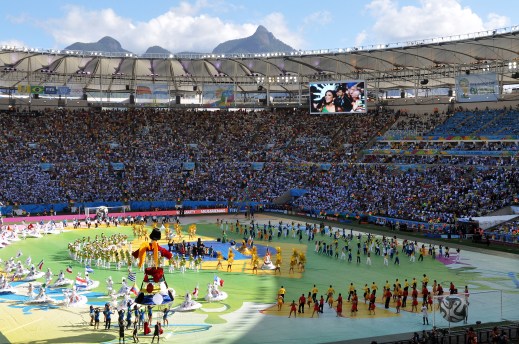
All of this led me to believe that such a public culture has an effect on the aesthetics of what performance studies scholar Philip Auslander calls “liveness” in recorded music and related viral media. Auslander argues that the appeal of liveness for television broadcasts, concerts, and other stage performances allows audiences to feel the immediacy of the moment even if the presence of mediation, such as screens and on-air censorship, is obvious. The international spectacle of Brazilians emoting en masse, then, has a direct relationship with Brazilian sonic aesthetics. Nowhere, I argue, is this more prominent than in the (sometimes viral) popularity of live recordings.
That immediacy Auslander speaks of spreads to many aspects of Brazilian popular culture, including the popularity of concert DVDs and albums which are regularly listed among the most popular domestic recordings. In fact, concert records tend to be more popular than the studio albums that inspire the tour. These live albums often carry the designations Ao Vivo, live or MTV Acústico (the equivalent of the Unplugged albums popular in the United States), and they are often recorded in such a way so as to feature the interaction of the crowds. In place of the draw for authenticity (a value that permeates the MTV Unplugged recordings) is the love for community, and for experiencing big emotions together no matter how obviously they are mediated through cameras, microphones and other technology. Through the example of the continued popularity of live albums in Brazil, there is an opening for a different theorization for sounding liveness; in place of celebrating canonic performances and virtuosity, the valorization of liveness in Brazil reinforces the importance of crowds and the so-called “popular classes” at the root of the politicized singer-songwriter genre MPB or Música Popular Brasileira.
The pleasure and preference for live recordings also extends to social media. For meme chasers, a good example of this is Michel Teló’s 2011 hit “Ai Se Eu Te Pego.” The song and video were recorded ao vivo before a crowd dominated by young women. A close listen reveals that sounds of Teló’s female audience members are just as important as his voice even if his voice is only slightly louder in the mix. There is barely a moment in the recording when the audience stops making itself heard; the engineering revels in their presence. This is especially obvious during the opening seconds of the track when Teló and his audience sing “Nossa, nossa / assim você me mata / Ai, se eu te pego / Ai, ai, se eu te pego” [Wow, wow / you kill me like that / Ah, if I could get you / ah, ah, if I could get you] in unison at nearly the same volume in the mix. When the accordion and electric bass (crucial instruments for the song’s forró style) finally enter over the screaming audience, there is a noticeable break in the tension set up by the audience and Teló singing together. Their cries, like those in other live recordings, illustrate Teló’s appeal to the crowd in that moment while also allowing other listeners to imagine themselves there.
Teló’s song went viral (as of this writing, the official version currently has nearly 580 million views on YouTube and over 72 million plays on Spotify), with alternate video versions teaching the song’s dance steps and others highlighting global football stars dancing and singing along to the song. At one point Neymar, the national team’s biggest hope for World Cup victory, sang with Teló in front of a crowd. In general, Teló’s live songs easily outpace his studio recordings in terms of virality, and, I would argue, that a major part of the appeal of “Ai Se Eu Te Pego” is its provenance in a concert setting. It is just as important that the screaming throngs of women are audible as it is for those dance steps to be easy and recognizable. The liveness of the recording is so important, in fact, that the screaming audience appears as sampled snippets in the Pitbull remix. In its viral form, Teló’s song united the popularity of live spectacle with Brazil’s enthusiasm for other live events, merging concert goers with football fans.
The popularity of Teló’s live song is not an isolated incident. Look, for example, at record sales figures for all time. Two are live albums by artists who do not appear elsewhere on the list. Other albums that have sold more than 2 million copies in Brazil alone are by Roberto Carlos (Acústico MTV) and the teen pop/rock duo Sandy and Júnior (As Quatro Estações ao Vivo and Era Uma Vez… Ao Vivo). In 2011, five of the top ten albums in Brazil fit the ao vivo mode with little regard to genre: MPB stars Caetano Veloso and Maria Gadú are there alongside sertanejo artists Paula Fernandes and Luan Santana. In 2012, three of the top 20 best-sellers were live albums. Meanwhile, DVDs of concerts in Brazil continue to be strong sellers. Thus, the communal pleasure palpable on-screen translates to that experienced in the home.
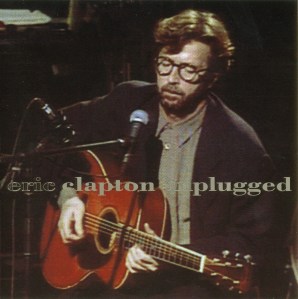
Compare this with the status of live records in the United States in the last few years where they have rarely seen any chart success. If anything, liveness continues in YouTube clips and Spotify Sessions but not in physical sales and downloads. This is probably because live albums for U.S. based artists are embedded with different values having to do with the rock authenticity rather than communal pleasure. These performances demonstrate the chops of the musician and valorize the concerts (and tours) as events. The double live albums from the 1970s such as as Frampton Comes Alive, Lynyrd Skynyrd’s One More From The Road, and Kiss Alive! hold a prized place in the classic rock canon, often as much for extended guitar solos rather as the screaming throngs of fans. In the late ‘80s and early ’90s live albums, especially MTV Unplugged, re-inscribed a love of liveness through acoustic instruments and songs that reached back into the roots of American popular music. Eric Clapton’s Unplugged (1992) even topped the Billboard album charts and won 6 Grammy awards including Album of the Year while other records such as Nirvana’s MTV Unplugged in New York and U2’s Rattle and Hum were multi-platinum hits. While there is the occasional top-40 live single, these songs are the exception to a genre of that has has moved liveness to YouTube rather than streaming and MP3 markets.
SO! contributor Osvaldo Oyola has noted there is a tension between the efforts recording engineers often go through to make studio recordings sound as immediate as possible, and those that call attention to the recording process. Live records replace the need to sound polished with the need to sound spontaneous, often reveling in mistakes and banter. That immediacy is something I enjoy when listening to live recordings and it has a parallel for many people who participate in the reception of major events in real time through social media.
In Brazil, audiences enjoy the immense power of participation in live events. As part of a larger work in progress I’m particularly fascinated by how this power and pleasure is mediated through the sonic experience of recordings and viral social media. Whether they are sharing tears over an international football loss or singing along to “Ai Se Eu Te Pego” Brazilians extend Auslander’s liveness by prolonging and replaying the immediacy of the crowds to experience that shared sonic moment, again and again.
—
—
Featured image: Adapted from “Gloria” by Flickr user Lourenço Fabrino, CC BY-NC-SA 2.0
—

REWIND! . . .If you liked this post, you may also dig:
Sound-politics in São Paulo, Brazil— Leonardo Cardoso
Calling Out To (Anti)Liveness: Recording and the Question of Presence–Osvaldo Oyola
Hello, Americans: Orson Welles, Latin America, and the Sounds of the “Good Neighbor“– Tom McEnaney
—
Share this:

The Sound of Hippiesomething, or Drum Circles at #OccupyWallStreet
DOI: https://doi.org/10.59350/mkjxk-ckf41
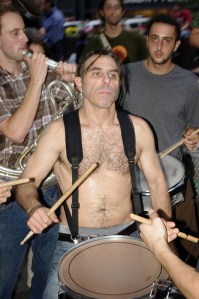
Last week’s news was been full of alarming stories of real and threatened violence at various #Occupy sites around America. But also disturbing were the reports that complaints about the continuous drumming at the Occupy Wall Street site in Lower Manhattan were threatening to shut the entire operation down. According to stories in N + 1, slate.com, Mother Jones, and New York, the ten hour marathon drum circles at Zuccotti Park have been a focal point of mounting tensions, both between the occupiers and the drummers, and between the occupiers and the community at large. Last week, community members asked that the drummers limit their drumming to 2 hours a day, a request backed by actual OWS protesters. The drummers, loosely organized in a group called PULSE, initially resisted the restriction, claiming that such requests mimicked those of the government they were protesting against. Since then, a compromise has been worked out, but the situation gives rise to a host of questions about race, sound, drums, and protest.
Community organizers both inside and outside OWS said they were distressed by the continuous noise that these protesters are making, and certainly they had reason: as Jon Stewart put it in his episode of talking points, “it’s a public space, it’s for everyone, including people who don’t consider drum circles to be sleepy time music.”
Writer and singer Henry Rollins agrees, telling LA Weekly that he dreams of an #Occupy Music festival, because “So far [he has] heard people playing drums and other percussion instruments” but still wonders “if there will be a band or bands who will be a musical voice to this rapidly growing gathering of citizens.” Rage Against the Machine guitarist and frequent #Occupier Tom Morello also seems to concur, telling Rolling Stone, “Normally protests of this nature are furtive things, It’ll be 12 people with a small drum circle and a couple of red flags. But this has become something that people feel part of.” Stewart, Rollins, and Morello all have a point: not everyone likes drum circles, in fact some people feel quite strongly about them, which has the potential to be divisive for a movement famously representing “the 99%.”
But over and above the questions of musical taste, the very audible presence of snare drums, cymbals, and entire drum sets at OWS—more often found in marching bands or suburban garage band practice spaces than the usual drum circle staple, the conga—raises a different set of questions, both sonic and social, around the interrelated issues of “noise,” public space, and privilege.
That a drum circle populated by a large number of bad, mostly white drummers is being touted as “the sound” of occupation isn’t that surprising, at least not for alumni of UC Berkeley.
In my day, a more conga-oriented drum circle sprouted up on Sproul Plaza every Sunday; today, a similar one occupies a green space in Golden Gate Park right across from Hippie Hill, pretty much 24/7. (I walk by it every Thursday on my way to the gourmet food trucks: happily, the delicious smell of garlic noodles and duck taco obliviates all other senses.)
These kinds of regular, yet impromptu, circles abound in California and elsewhere: indeed, the sound of drum circles à la OWS has characterized certain types of social spaces for the last forty years. But what exactly does the sound of drum circles characterize? What meaning is being made by them, and why?
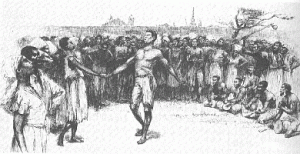
In the Americas, drum circles go back hundreds of years– many indigenous peoples have drumming traditions, for example, and, in Congo Square in New Orleans, slaves of African ancestry gathered weekly to dance to the rhythms they played on the bamboula, a bamboo drum with African origins, beginning in the early 1700s. The notion of the “circle” was a fundamental part of the dancing and music making at Congo Square—according to Gary Donaldson, the circles represented the memories of African nationalities and various reunited tribes people—and was echoed in various types of “ring shouts” across the West Indies and the Southern U.S. The contemporary drum circle stand-by, the conga, also came to the Americas via the forced migration of slaves; it is of Cuban origin but with antecedents in Africa, like the bamboula. The black power movements of the 1960s drew on this history—and sound—to good effect, reigniting semi-permanent drum circles in many U.S. neighborhoods– like the formal gathering that meets in Marcus Garvey Park in Harlem on Saturdays that is currently also under fire from a nearby condo association –audibly announcing their presence and enacting new community formations.
Given this history–and without erasing the presence of drummers of color at OWS--it can seem puzzling how the drum circle has come to occupy such a curiously whitened position in America’s cultural zeitgeist. Furthermore, one of the more problematic aspects of the OWS drum circle debate is the racialized implications of the instrumentation there—implications borne out by videos of OWS that show an overabundance of snares, some of the loudest drums available. According to percussionist Joe Taglieri, “no conga is louder than a fiberglass drum with a synthetic head.” If snares are louder than congas, then noise – actual decibel level — is probably not the sole issue when community groups attempt to control or oust drummers like those in Marcus Garvey Park. It does seem to be a key point of contention at OWS, however.
While there is also a history of African American marching bands, especially in the South, snare drums speak to a different set of American cultural traditions. Drum kits themselves evolved from Vaudeville, when theater space restrictions (and tight pay rolls) precluded inviting a large marching band inside. Mainstream associations with snares include but are not limited to army parades, high school marching bands, and of course hard rock music. Sometimes, like in the case of Tommy Lee, it is an unholy alliance of several of these contexts.
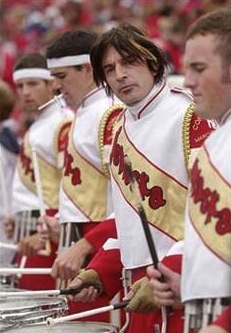
In other words, outside of OWS, snares are hardly the sound of social upheaval.
How the drum circle became associated with political protest in the first place is interesting. Although people sometimes associate drum circles with beatniks rather than hippies, a case could be made that they actually connect more strongly to an electrified Woodstock rather than an acoustic Bleecker Street, thanks in part to Michael Shrieve’s widely mediated turn during Santana’s performance of “Soul Sacrifice” at the 1969 festival.
It is important to note that Shrieve is playing the traps in this sequence, not the conga, which is one reason I’d like to suggest that something about that scene – the hands on the congas, the grins of the other guys, the ecstatic face of a 20-year-old as he slams his kit, and the fetishistic gaze of the camera on the sticks, the skins and the cymbals – caught the imagination of a particular segment of American society. Santana’s band – two Mexican Americans (Carlos Santana and Mike Carabello), a Nicaraguan (Chepito Areas), two whites (Shrieve and Gregg Rolie, who later plagued the world in Journey) and an African American (bassist David Brown)—was truly multi-racial, creating a “small world” visual that furthered Woodstock’s utopian rhetoric in ways that were surely not borne out by the demographics of its audience. More importantly perhaps, the Woodstock movie showed a white suburban hippie guy as an equal participant in a multi-ethnic rhythmic stew, a powerful image in the 1960s. Indeed, the Santana performance may be precisely the moment when the idea of the drum circle was lifted from the context of “black power” and moved into the hippie mainstream.

Woodstock made congas hip to the mass of America—not just in Santana’s set but also in the performances of Richie Havens and Jimi Hendrix—and Woodstock helped define what the drum circle meant, in part by encapsulating certain discursive tropes that were very particular to those times. For example, drum circles epitomize the ’60s idea that political action is simultaneously self-expressive and collective. If a crowd of people sing “We Shall Overcome” or chant “Ho Ho Ho Chi Minh/The NLF is going to win,” it is a a collective act. It’s collective even if the crowd is singing “Yellow Submarine” and it’s not overtly political. By contrast, drum circles are about improvisation, so each drummer can “do his own thing” while participating in the groupthink. (The “his” is implied: video of drum circles show few women participants. Apparently Janet Weiss, Meg White, and Sheila E.’s “own thing” can actually be done on their own.)
In terms of sound, drum circles also project well beyond their immediate location, compared to singing and chanting (in fact, OWS has had problems with the drum circles drowning out its “human microphone”). Plus, since the drummers can take breaks and change out, the actual drumming never stops, unlike a performing musician. Thus, drum circles are celebrations of self expression that are actively imposed on an audience that is well beyond eyesight. This summarizes a modern view of personality rooted in the 1960s: that it’s not enough to participate, you’ve also got to “be yourself.” I think these two notions account for the enduring idea of the drum circle as a supposedly political sound, even when it’s not. Drumming in a drum circle allows for a public display of self-expression that simultaneously allows the participant to belong to a group. The appeal of that is obvious, especially in our contemporary iCulture. However, the politicization of the sound of drum circles only makes sense when you add in the lingering sonic traces of black protest, modulated through a hippie lens. You can see this clearly in New York magazine’s “Bangin’: A Drum Circle Primer” (10.30.11), whose visual imagery prominently features a West African djembe drum and describes only the “hippie-era use of traditional African instruments” rather than their actual, snare-heavy configuration at OWS. Despite the snares and in spite of the oft-commented on lack of black faces at OWS—see Greg Tate’s piece in the Village Voice—drum circles still carry enough connotations of militant blackness to annoy the bourgeoisie.
One key thing differentiates OWS’s drummers from the demonstrations of yore, however: in the 60s and early 70s, there was a notion that drum circles were for drummers. Santana’s band, though young, was made up of world class musicians from the San Francisco scene. But to a certain type of viewer – young, white and male—the drum circle must have seemed so doable. Compared to the singular virtuosity of Jimi Hendrix or sheer talent of Pete Townshend, Santana’s music was the sonic equivalent of socialism. No wonder the drum circle scene has had more of a half-life in the hearts and minds of would-be Woodstockians than just about any other: it is a visceral depiction of music as communal, ecstatic, and accessible. Today, thanks to the far-reaching waves of the movie Woodstock: 3 Days of Peace & Music (1970), the percussive noise such a circle makes creates a particular sonic backdrop that clearly—and nostalgically—says hippiesomething.

And yet, politically speaking, nostalgia is, as theorists like Antonio Gramsci, Guy Debord, Jacques Attali and Theodor Adorno have frequently reminded us, invariably associated with Fascism. From Mussolini to Hitler to Reagan to Glenn Beck, it’s a tactic that has been explicitly invoked to thwart social progress. The nostalgia conundrum seems to have escaped both mainstream news media—which uses the drum circle to signify to viewers that OWS is a radical leftist plot—as well as the drummers themselves. For the drummers are hippies, and hippies young and old really believe in drum circles. Hippies take part in them, hippies enjoy them. It’s fair to say, however, that few others do, just as no one ever really enjoyed the 45- minute drum solos on live records by Cream, Led Zeppelin, and Iron Butterfly. (I’m thinking about Ginger Baker’s “Toad,” John Bonham’s “Moby Dick,” and “In-a-Gadda-Da-Vida,” respectively. Also about the time I went to the bathroom and bought popcorn at the LA Forum during a drum solo by some band I know forget, and still had to sit through ten more minutes.) .
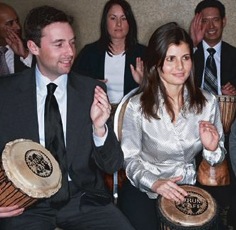
However, that fact does not seem to bother those involved in drum circles, and herein lies the great problem with the whole equation drum + hippie = activism. To any members of the mainstream media who hears and records them, a drum circle instantly conjures up a chaotic, possibly even violent, scene: Chicago ‘68, Seattle 2000, Oakland 2011. But the truth is that, outside Fox News, the noun “hippie” no longer means “liberal,” or possibly even politically engaged. The curious thing about drum circles, then, is that while they sound progressive, they can actually mean conservative. A 2006 piece from NPR, for example, describes how drum circles have been adapted as teambuilding exercises for corporations like Apple, Microsoft, and McDonald’s.
The OWS situation illustrates such conservatism in different ways. In another recent article in New York Magazine, a 19 year old drummer from New Jersey is quoted as saying, “Drumming is the heartbeat of this movement. Look around: This is dead, you need a pulse to keep something alive.” This is said in the face of opposition from the movement’s own management, who fear a shutdown due to severe problems with neighborhood groups and restrictions on the General Assembly’s call-and-response “mic checks” that have been so galvanizing. His words are instructive as well as ominous, illustrating that young hippies like him believe that the sound of drums is a suitable replacement for protest or action itself.
The idea that sound alone can energize a movement is not just wrong, it also showcases a willful misunderstanding within the ranks of OWS. In Oakland last week, a small band of anarchists threw bottles at the police, whose wrath rained down in the form of tear gas canisters and a fusillade of dowels: one protester, an Iraq veteran, has been seriously injured.
The incident highlights a kind of cognitive dissonance that is hindering the ability of OWS to achieve political progress. The drumming problems at Zuccotti Park highlight the way that history can repeat itself as farce, as the distance between nostalgia and action — and between sound and meaning — disturbs the peace in more ways than one. Just as drummers in Sproul Plaza refuse to acknowledge that UC Berkeley is now mainly host to computer science and business majors, and drummers in Golden Gate Park refuse to deal with a Haight Ashbury that is gentrifying in front of their eyes, so too do the drummers at OWS refuse to acknowledge that their sound is no longer the sound of social activism. Indeed, the sound of a drum circle is reminiscent of the ring of a telephone, the scratch of a needle dropped on a record, or the clip clop of horse hoofs on hay-covered streets. No wonder it sounds out of place at OWS.
—
Gina Arnold recently received her Ph.D. in the program of Modern Thought & Literature at Stanford University, where she is currently a post doctoral scholar. Prior to beginning graduate work, she was a rock critic. Her dissertation, which draws on historical archives, literature, and films about counter cultural rock festivals of the 1960s and 1970 as well as on her own experience covering the less counter cultural rock festivals of the 1990s, is called Rock Crowds & Power. It is about rock crowds and power.
—
Share this:




Current Top Posts





April 2021

January 2020

November 2019

October 2019

August 2019

April 2014

November 2017

March 2015

December 2017

October 2015


Recent Comments