
Sonic Connections: Listening for Indigenous Landscapes in Kent Mackenzie’s The Exiles

In April 2015, ten American Indian extras walked off the set of Adam Sandler’s new film The Ridiculous Six, a spoof on the classic Magnificent Seven (1960), in protest over the gross misrepresentation of Native cultures in general, and in particular over its insults to women and elders. Allison Young, a Navajo actress who participated in walking off, stated, “Nothing has changed. We are still just Hollywood Indians.” Young is referencing a long history of the film industries’ construction of stereotypical American Indians by non-natives created to entertain non-natives.

Still from the movie. From http://www.arthousecowboy.com
Within this long history exists a rare film, Kent Mackenzie’s 1961 The Exiles, re-restored and re-released in 2008 by Milestone Films. The Exiles is one of the few 20th century films that feature urban American Indians; it follows three main Native narrators from dusk to dawn as they experience the joys and struggles of urban life. Without an official score, this black and white docudrama places sound against haunting 35 millimeter black-and-white images of a downtown Los Angeles landscape. This mis-en-scène creates what Mackenzie (the white screenwriter, director and producer) asserts is “the authentic account of 12 hours.” The voiceovers of Homer Nish, a Hualipai from Valentine, Arizona who recently moved to Los Angeles after fighting in the Korean War; Yvonne Walker, originally from the White River Apache reservation in San Carlos, Arizona who first moved to the city to work as a domestic; and Tommy Reynolds, who is identified only as Mexican-Indian and is portrayed as a comedic playboy and the life of the party; narrate the intimate, day-to-day lives of urban American Indians.
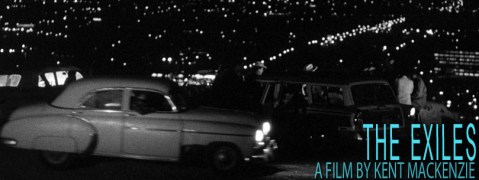
From the website http://www.exilesfilm.com/
In this post, I consider what we can hear if we pay close attention to how the director incorporates the narrators in a kind of Indigenous soundscape. Mackenzie’s soundscape bring together voices as well as music. The collage of sounds traces the journeys of American Indians to and from Los Angeles in the mid-twentieth century. The sonic connections in The Exiles provide a cacophony of histories of forced movement, transit, and re-making spaces as Indigenous at the same time that it perpetuates important historical silences. I borrow Chickasaw scholar Jodi A. Byrd’s term from The Transit of Empire: Indigenous Critiques of Colonialism (2011), cacophony—or “discordant and competing representations” and experiences— and apply it to the sounds that inform the indigenous space represented through the film.

“Bunker Hill 1968” by Flickr user Laurie Avocado (CC BY 2.0)
The narrators are part of a large population of American Indians who moved from rural reservations to urban centers after WWII. Due to the federal government’s mismanagement of Native tribes’ land and resources, and the genocidal abandonment of treaties made with tribes, the late 1950s and 1960s were times of dire economic and social conditions on reservations. The influx of Native Americans to cities also came because of assimilation campaigns in boarding schools, military service and the Bureau of Indian Affairs’ “Termination Era” policies (1940s –1960s) that intended to terminate the state’s bureaucratic relationships with Native tribes. Relocating Native populations from reservations into cities where work was available year-round was a key aspect of the Termination Era policies. According to Norman Klein (The History of Forgetting: Los Angeles and the Erasure of Memory), areas near downtown Los Angeles, including Bunker Hill where the film is primarily shot, were multi-racial neighborhoods in economic decline and therefore became relocation sites for American Indians. Importantly, both Klein and Mackenzie are silent about the prior forced removal of Tongva on that very same location that began in the 1840s.
The audio track of The Exiles contradicts the stereotypical American Indian sounds featured in Hollywood movies. The film’s contemporary mainstream Hollywood releases included sounds such as the whooping sounds of “hostile Indians” in John Ford’s The Searchers (1956), the broken English spoken by the “Apache” in Delmer Daves’ Broken Arrow (1950), and stereotypes played out in John Sturges’ Magnificent Seven (1960). In the soft Southwestern Native lilt of Yvonne’s voice, the way that Homer and others add “you know?” to the end of almost every sentence they utter, alongside the rhythm of the casual banter and tenor of the men’s laughter, I hear a potential sonic archive of American Indians that talks back. For example, in a short clip when Tommy and his friends enter Café Ritz, an Indian bar, Thomas calls out over the loud rock and roll music as he passes people at the bar. Tommy shifts easily between English (“What’s happening there, man?”), Spanish (“Gracias amigo, ¿cómo estas?”), and Dine (“Yá’át’ééh. E la na tte?”). Careful attention to the cinematic soundscape provides access to voices of discontent and resiliency, practices of building and maintaining multilingual multi-tribal Indian spaces, and the flow of American Indians between reservations and multiple cities.
Understanding the sounds and the silences of The Exiles as a cacophony offers a way to appreciate how the film both perpetuates stereotypes but also provides insights into the urban American Indian experience. Mackenzie’s construction of Homer Nish and American Indian men continues a myth that it is individualized behavior that keeps Indians from the American Dream. (In his 1964 masters thesis, “A Description and Examination of the Production of The Exiles: A Film of the Actual Lives of a Group of Young American Indians” Mackenzie states outright that he believes they are responsible for the mess they created). The Exiles portrays American Indian men reading comic books, listening to rock and roll, hanging out at bars instead of working, and taking rent money away from their suffering women and children to gamble. These formulaic images of Native Americans are informed by a long history of visual, literary and legal representations of American Indians that compose Indian men as either savage, infantile and emasculated. But if we listen to the banter and laughter in the bar scenes and at home, we also hear the caring intimacy of camaradrie. The cacophony of sound provides a counterbalance to the visual representations.
The Voiceover and Realism
Mackenzie uses dialogue to direct the visual and sonic narrative of the docudrama’s soundscape. Ironically, this collaborative low budget project that stretched on for three and a half years has minimal original dialogue. They could not afford sound techs on site, so the most obvious sonic evocation of realism Mackenzie explores is asynchronous sound performed in a studio months later. In Mackenzie’s master’s thesis he writes that, to construct dialogues (they often voiced their lines with a group of people around), “people would joke around a lot” while “everybody was drinking beer” (76). The filmmaker did not find that dialogue on larger budget feature films at the time were “lifelike” and believable. He writes that people
seldom spoke of important matters directly; they seldom spoke clearly or coherently when they did speak and their everyday language was full of overlaps interruption and communications through looks, gestures and shrugs. Many sentences made the end understood. …What a person said seemed less important than how he said it. (73)
Here, it becomes clear that the “realism” Mackenzie pursues is more about a style of filmmaking rather than about an authentic rendering of Native American everyday life. If he found the actors performing lines too dramatically Mackenzie states he “would blow the scene apart by asking for more casual and apparently pointless lines” (73). He created a specially mediated recording of the people, downtown Los Angeles and the time period. In other words, he pursued realism: he did not seek to fully capture real experiences.

Tommy Reynolds and Homer Nish in Kent Mackenzie’s THE EXILES (1961).
Through interviews he guides the actors to talk about their everyday lives, their problems and their thoughts about life. Mackenzie used “improvised tracks” out of individual interviews in an attempt “to help preserve their point of view in the film.” He interviewed Homer, Tommy and Yvonne for several hours apiece, questioning and re-questioning them – not necessarily to document the subjects’ truths but “for emotional quality and general attitudes and feelings” (78). Despite his intentions, the voiceovers provide some context of the trials of everyday life and how the leads negotiated their belonging in a space far from home. Mackenzie’s realism builds a collage of soundscapes—voiceovers, background noise, music—to orchestrate a scene rather than simply document part of a 12-hour period of life.
Rock and Roll and Urban Indian Sounds
Mainstream “Hollywood Indians” are associated with a limited soundscape of drums and whoops, but Mackenzie’s use of contemporary rock and roll illustrates the complexity of the indigenous soundscape. Even though the film opens with the slow repetitive beating of the buckskin drums and a contextual opening monologue, after the drums stop it is the early surf music of Anthony Hilder and his five-piece band, The Revels, that drive many of the scenes. The music renders audible the many ways people tried to belong in new locations and within new cultures, juxtaposing the fast blast of the trumpet and guitar riffs of the Revels with the steady beat of the drum and shake of a turtle rattle.
Mackenzie continues this juxtaposition later in the film. Homer, alone on the street in front of a liquor store, opens a letter a bartender handed to him earlier in the evening. At the top of the letter is written “Peach Springs, Arizona” and tucked within the letter is a picture of an older man and woman. The camera focuses on the picture that dissolves and reemerges as a rural desert scene. The man from the picture sits beneath a tree with a girl and the woman, and rhythmically chants and shakes a rattle. There is no voice-over or dialogue; ceremonial singer Jacinto Valenzuela’s repeats a song multiple times without an English translation. The steady rattle of the dry seeds in the gourd are a sharp contrast to the pace of the Revels’ songs that saturates Homer’s earlier scenes.
Without guidance from a narrator, the scene is left to audience interpretation. The scene and its sounds could represent Homer’s sense of being displaced between times, or a homesick romanticized remembrance of family life: the moment quickly dissipates and Homer once again stands alone on a corner bathed in the streetlight. However, the music here could be a sonic connection that provides an alternative geography of indigenous space and place. Mackenzie’s collage of sound echoes the circuitous path of indigenous bodies and ideas of indigenous life in diasporas described in Winnebago Tribe of Nebraska scholar Renya Ramirez’s work in Native Hubs: Culture, Community, and Belonging in Silicon Valley and Beyond. The rattle and drum can instead signal a belonging to a community and people in a present that Homer carries within him. Through sound, Mackenzie connects Homer with his communities, traditions, and a sense of belonging regardless of spatial distance.
Mackenzie deepens this connection when he imbeds Homer in a place and community through the dancing and drumming on Hill X in the penultimate scene of the film sounds. When Homer talks about Hill X (formerly Chavez Ravine, then a site of the forced displacement of Mexican residents in Los Angeles in 1950-1952, now the site of Dodger Stadium) we hear his strategy for his own and his tribe’s collective survival. The shaking of the gourd in the desert and the dancing, singing and drumming of the 49 —lead by Mescalero singers Eddie Sunrise Gallerito and his twin cousins Frankie Red Elk and Chris Surefoot—shows a reclaiming of Los Angeles as indigenous land. Thus practices of sound and movement function as what Tonawanda Seneca scholar Mishuanna Goeman identifies as “remapping” of Indian space. Taken together with the beat of the drum, the bells and rock and roll compose the content of a Los Angeles indigenous soundscape.
 The Exiles registers contemporary American Indians in motion. Homer and his comrades reclaim Hill X as Indian land with song and dance over a century after the City of Los Angeles displaced the Tongva out of that same location. At the time of the filming, American Indians were also forced to move within Los Angeles- their homes on Bunker Hill soon demolished and replaced by high rises. Paying attention and critically re-listening to the sounds of The Exiles offers an alternative soundscape of Indigenous life.
−
Featured image: “chavez ravine” by Flickr user Paul Narvaez, CC BY-NC 2.0
−
Laura Sachiko Fugikawa holds a doctoral degree in American Studies and Ethnicity with a certificate in Gender Studies from the University of Southern California. Currently she is working on her book, Displacements: The Cultural Politics of Relocation, and teaches Asian American Studies at Northwestern University.
−
 REWIND! . . .If you liked this post, you may also dig:
Sounding Out! Podcast #40: Linguicide, Indigenous Community and the Search for Lost Sounds–Marcella Ernst
The “Tribal Drum” of Radio: Gathering Together the Archive of American Indian Radio–Josh Garrett Davis
Vocal Gender and the Gendered Soundscape: At the Intersection of Gender Studies and Sound Studies–Christine Ehrick
Share this:

Machinic Ballads: Alan Lomax’s Global Jukebox and the Categorization of Sound Culture


Today, SO! continues its series reconsidering the life and work of Alan Lomax in his centenary year, edited by Tanya Clement of The University of Texas at Austin. We started out with Mark Davidson‘s reflections on what it means to raise questions about the politics behind Lomax’s efforts to record and collect folk music, and continued a few weeks later with Parker Fishel‘s consideration of Lomax’s famous “Southern Journey” and how it has been appropriated by musicians more recently.
With Clement’s own article below, the series begins to rethink Lomax as a touchstone in current and continuing drives to collect, measure and compute sonic cultures, something that seems hot all of a sudden (see, for instance, coverage of recent digital analysis of trends in pop music at Queen Mary University of London). In her thoughtful, illuminating and inspiring article below, Clement challenges us to consider the politics behind these efforts to search, retrieve and analyze audio, something that the case of Lomax throws into stark relief.
— Special Editor Neil Verma
—
When the Association for Cultural Equity, an organization that Alan Lomax founded in 1983, announced the release of 17,000 music tracks from Lomax’s fieldwork collections, the New York Times heralded the release as a manifestation of Lomax’s Global Jukebox project, a computational experiment for accessing and studying his vast multimedia collection of the world’s culture. The Times piece likens Lomax’s project to Pandora, which allows the listener to search for music “like” music she has already found. Lomax’s biographer, John Szwed, also makes this comparison but modifies his description by proclaiming that unlike Pandora’s recommendations which are “based on personal taste” and “tend to lead sideways . . . to production style,” Lomax’s Global Jukebox idea held the potential to point a listener to “deeper principles of cultural and musical organization” (The Man Who Recorded the World 391).
Gobsmacked by whizbang possibilities, neither the Times nor Szwed discuss the deeper principles behind Lomax’s attempt to represent culture as a global search engine. In the context of the powerful work being accomplished in the Music Information Retrieval (MIR) community and my own project (HiPSTAS) to develop software for making sound collections searchable and accessible, In this article I will argue that how we build systems for searching and retrieving and browsing cultural artifacts as data is a profoundly political act. Recognizing such politics suggests that Lomax’s Global Jukebox project serves as a cautionary tale for how social and cultural contexts — or what Donna Haraway calls our “ways of being” — are reflected in the systems we develop.

John A. Lomax Collection in UT Folklore Center Archives, Small Multiples. Instrumental sections are in red, spoken sections are in green, and sung sections are in blue. Click to see a full-size version.
The Singer with the Song
The year that Alan Lomax was born (1915), his father John Alan Lomax published a landmark piece heralding seven new types of American ballads for study. American ballads, he argues “reveal the mode of thinking, the character of life, and the point of view, of the vigorous, red-blooded, restless Americans, who could no more live life contented shut in by four walls than could Beowulf and his clan, who sailed the seas around the coasts of Norway and Sweden” (“Some Types of American Folk-Song”, 3). Unlike any other collection of ballads, John’s “American ballad” included the ballads of the miner, the lumbermen, the inland sailor, the soldier, the railroader, “the ballads of the negro; and the ballads of the cowboy . . . [and] the songs of the down-and-out classes, — the outcast girl, the dope fiend, the convict, the jail-bird, and the tramp” (3). Governed by a laudable goal to record the songs of folk cultures at the fringes of mainstream society, the senior Lomax’s view of the communities where he would collect his songs (including jails and state farms), was complex, and can fairly be called both progressive as well as racist (Porterfield 170).
John and Alan went on seven collecting trips together between 1934 and 1936 and co-authored five books on their return. On these trips, they collected songs from people on the street in cities like New Orleans and people in the country, from both church-goers and prisoners. While John held romanticized views of the “noble” southern black man, Alan, on the other hand, indicated a more nuanced understanding of the complexities inherent to his father’s attempt to generalize patterns of “folk” for study. Alan linked “the singer with the song” and was interested in the politics behind prisoners made to sing with guns at their backs and in the cultural lives of people that were so poor in means but so rich in “beautiful harmony, with enormous volume, with total affection” (Szwed 49). While Alan maintained that he was interested in the individual’s story, John believed that “a genuine ballad has no one author. It is therefore the expression of no one mind: it is the product of the folk . . . It might have been written by any one” (“Some Types of American Folk-Song”, 1).

John A. Lomax Collection in UT Folklore Center Archives, Small Multiples. Instrumental sections are in red, spoken sections are in green, and sung sections are in blue. Click to see a full-size version.
Taxonomies
The Global Jukebox project demonstrates an almost complete reversal in Alan’s concerns. The studies behind the Global Jukebox include Alan’s Cantometrics and Choreometrics, in which he produces taxonomies for studying song and dance and his Parlametrics project, an “experiment in metalinguistics,” which Alan and his collaborators describe as a taxonomy of “patterns of style” in speech based on dynamic changes in pitch, loudness, speed, spacing, rhythm, and timbre (“A stylistic analysis of speaking”). These taxonomies show that Alan’s early consideration for the individual performer gave way to a desire to make folk study more scientific as a cultural mapping like what his father espoused rather than what Szwed and others have seen as Alan’s concerns with the situated politics of individuals.
Alan’s Parlametric study serves as good example. Approaching delegates from the United Nations and soliciting mail-in samples from regions not covered by the U.N. volunteers, Alan and his team collected representative recordings of 114 languages. Then, in order to study the “generally neglected meta-communicational level” in these recordings, the team designed a rating system including 50 codes that (1) “described the distinctive features of each recording,” and (2) “tended to cluster the recordings into sets of similars” that Alan maintains anyone could “readily use” to record “salient differences in conversation style” (19). These clusters pointed to 14 factors that Alan and his team would use to categorize the cultures from which they received samples:
- Repetitiveness
- Timing
- Speech length
- Upglides
- Descending cadence
- Syllabification
- Drawl
- Empathy
- Space
- Dominance/Sharing
- Relaxed/Tense
- Noise
- Breathy
- Forceful
Using these factors, Alan makes some broad assertions. The association of clear syllabification” (the degree to which syllables run together) “is most strongly predicted among gardeners with domesticated animals” and “[t]he association of clear syllabification to feminine autonomy is suggested by the discovery that this mode of speaking predicts and is predicted by permissive rather than restrictive premarital sexual mores” (27). Further, “Dominance vs. Sharing of conversation space” is strongly correlated with settlement size and severity of sexual sanctions,” a statement that Alan immediately rationalizes by noting that “this relation between a more crowded social space, high sexual tension and increased rate of interaction seems to make good sense, even if it does not account for every possibility” (31).
These spurious and broad generalizations were what Lomax hoped to facilitate for all with his Global Jukebox as the access point for “the first numerical models of the full range of global cultural variation in holistic form” for “the scientist, the layman, and the student to explore, experience, and manipulate the broad universe of culture and creativity in a systematic fashion, with audio-visual illustrations at every turn of the road” (“The Global Jukebox,” 318). By leveraging his taxonomies of song, dance, and speech in the computer age, Alan could suddenly associate and differentiate cultures holistically and en masse.

A visualization of a song in ARLO. Click to see a full-size version.
Machinic Methods / Humanistic Questions
As someone who works in the liminal spaces between the humanities and technology, between cultural studies and critique and the machines that increasingly function both as access points and barriers to our cultural artifacts, I see Alan’s switch to generalizable taxonomies as par for the course in the digital age. My own >HiPSTAS project’s primary objective is to develop a virtual research environment in which users can better access and analyze spoken word collections of interest to humanists. We understand that in order for us to search digital sound artifacts, we have to create taxonomies, metadata, keywords and other generalizable frameworks that facilitate discovery.
At the same time that we are using machinic methods, however, we can still ask humanistic questions that open up rather than close down debates and dialogues. In a recent test for the HiPSTAS project, for example, we used machine learning to analyze the recordings in the UT Folklore Center Archives, which comprises 219 hours of field recordings collected by John and Alan Lomax, Américo Paredes, and Owen Wilson, among others (UT Folklore Center Archives, ca. 1928-1981, Dolph Briscoe Center for American History, University of Texas at Austin, Box 2.325/R). In our attempt to predict the presence of different sonic patterns including instrumental music, singing, and speech, the results of our analysis are noteworthy as the visualization shown in this brief movie demonstrates.
from Tanya Clement on Vimeo
Within the results, we see a visualization of how many seconds comprise each file (in blue) and how many of those seconds for each file our software has predicted the presence of instruments (green), speech (red), and song (purple). A subtle yet striking difference emerges in the comparison between the Lomax recordings (created 1926-1941), which are the oldest in the collection, and the others, which were created up until 1968. The Lomax recordings (primarily created by John Lomax) consistently contain the least amount of speech in comparison to what the other files contain.
Of course, there are a number of ways you can read these results. Given the conversation above, one could hypothesize that perhaps the Lomaxes were primarily interested in their participants’ songs rather than their stories. One could also think about it in terms of recording capabilities across time. When the Lomaxes were first recording, John Lomax writes, “The amplifier weighed more than one hundred pounds; the turntable case weighed another one hundred; two Edison batteries weighed seventy-five pounds each. The microphone, cable, the tools, etc., accounted for sufficient weight to make the total five hundred pounds. . . . In order to carry them in the car I tore out the back seat . . .” Even in 1967, forty years later, good recorders still weighed 70 pounds and required a car battery, but tapes were longer and costs were less. More tape and more time at less cost both financially and physically had a big impact on what researchers recorded. At the same time, the data shows that the later recordings are not much longer, but do seem to have more seconds of speech.
There is a danger in these kinds of machine-generated generalities. We employed taxonomies (instrumental, sung, speech) to teach the machine to categorize these patterns, but why these patterns? Are there others? Or did I choose these based on what I already wanted to say about the Lomaxes’ practices? And, I haven’t even mentioned here the subjective practices inherent to choosing algorithms for such work.
These kinds of questions require more research, and more contextualization than this aggregated data set can show. Just as the ballads that John and Alan Lomax once collected were written and sung by someone, so were the communities that Alan interpreted through his Parlametrics made up of individuals, not types. Perhaps Alan’s desire “to record the world” was just and Google, the collector, categorizer, and interface for all things on the Internet, isn’t evil. But the Global Jukebox Project serves as a cautionary tale about the politics behind the speed and efficiency that machinic methods seem to promise, a politics that needs to be far less opaque about its deeper principles and problems.
—
Tanya Clement is an Assistant Professor in the School of Information at the University of Texas at Austin. She has a PhD in English Literature and Language and an MFA in fiction. Her primary area of research is scholarly information infrastructure. She has published widely on digital humanities and digital literacies as well as scholarly editing, modernist literature, and sound studies. Her current research projects include High Performance Sound Technologies in Access and Scholarship (HiPSTAS).
—
Featured image: “Day 21 – Waveform” by Flickr user evil_mel, CC BY-NC 2.0
—
REWIND! . . .If you liked this post, you may also dig:
Revising the Future of Music Technology — Aaron Trammell
SO! Amplifies: Carleton Gholz and the Detroit Sound Conservancy — Carleton Gholz
Sounds of Science: The Mystique of Sonification — Margaret Anne Schedel
Share this:


Current Top Posts





April 2021

January 2020

November 2019

October 2019

August 2019

April 2014

November 2017

March 2015

December 2017

October 2015
 Sounding Out!
Recent Comments