
Audio Culture Studies: Scaffolding a Sequence of Assignments

 Developed to explore the relationship between sound and learning, our fall forum on “Sound and Pedagogy” blends the thinking of our editors (Liana Silva), recruited guests (D. Travers Scott), and one of the winners of our recent Call For Posts (Jentery Sayers) to explore how listening impacts the writing process, the teachable moment, and the syllabus (and vice versa). If you need a make-up assignment for the first post by D. Travers Scott, click here, or for last week’s post by Liana Silva, click here. Otherwise, get ready to take some furious notes, because today’s post from Jentery Sayers offers a generously revealing—and unprecedented—glimpse inside the development of his audio culture course over several years. Chock full of suggestions, prompts, unique assignments, and troubleshooting tips, Sayers’s offering is refreshingly frank about the unique challenges facing sound studies scholars in the classroom. As in most classes, information this deep may need some time to settle in and effect some change, so we’ll check back with you in spring with a Sound and Pedagogy “refresher course.” It’s already on our syllabus.–JSA, Editor in Chief
—

This semester, I am teaching my fourth course in audio culture studies. Since students and faculty in the humanities rarely have the opportunity to intensively examine sound in the context of higher education, thus far I have learned that—even for teachers who are well-versed in sound studies—planning and structuring work in an audio culture course is more difficult than it may at first appear. For instance, to what degree should an audio culture course intersect with visual culture studies? What cultural assumptions about sound inform how students learn about it, not to mention how instructors teach it? When engaging histories of sound reproduction, how might students combine knowing and doing, or composing about and with sound? And how should work in an audio culture course be assessed? Through what sorts of learning outcomes? With what forms of student preparation and self-reflexivity in mind?
In the following paragraphs, I engage these questions by unpacking a portfolio-based assignment sequence from an undergraduate course I taught at the University of Washington-Bothell in 2010: “Technologies of Expression: Sound Reproduction Studies.”
As I prepare for my “Audio Culture Studies” undergraduate course at the University of Victoria this semester, the above questions are guiding my lesson plans as well as my revisions of previous teaching materials. Yet more importantly, I imagine they—or variants of them—resonate with other instructors invested in sound studies, and I hope this post will spark a conversation about how to continue developing sound studies curricula in higher education. In one sense, such curricula should be and are distinct from work anchored in visual culture, print, film, and e-text studies. Nevertheless, there are a variety of suggestive intersections across these fields, and my approach to audio culture courses often builds upon them, especially since my training is in literary and cultural studies.
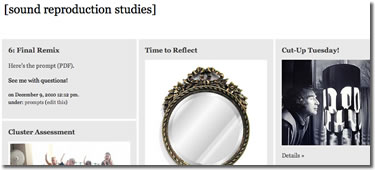
To begin “Sound Reproduction Studies” (heretoafter “205”) at the University of Washington-Bothell, I told students to let me know (in writing) how they were going to record sound during the course. After all, I did not know what technologies they could access, and I wanted to make sure that—with help from the University’s library and digital media services—recording equipment was available to them. I also informed them that, throughout the course, we would be focusing on basic recording and editing but not high fidelity techniques or post-production. In other words, I was not expecting them to gain competencies common in sound art and audio engineering, and my humanities-oriented assessment of their audio work would privilege content and composition over the aesthetics of recording and playback. For a course anchored primarily in cultural studies, they were welcome to use everyday audio equipment intended for consumers and amateurs, and fortunately that equipment was available on loan through the University.
After that request, I asked them to “crowdsource” a brief history of sound reproduction using SIMILE’s Exhibit 2 framework. While I have my reservations about crowdsourcing, for the purposes of the class—especially at the beginning of the quarter—it was appropriate. As the prompt suggests, I wanted to survey what students already knew about audio, together with where their interests in sound tended to constellate.

From the start of the course, I also wanted to situate visual and audio cultures in the same space, encouraging students to think about the tensions and intersections between them as well as the epistemologies and affects they enable. Here’s a screen grab of what students produced in a week (between two class meetings):
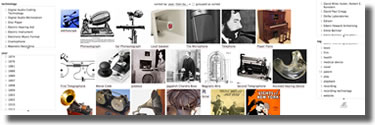
I used this crowdsourced exhibit as the basis for an introductory lecture on the vexed legacies of sound reproduction. It helped me identify gaps in student knowledge while also underscoring what was familiar to them (e.g., Edison’s phonograph, the turntable, and auto-tune). The exhibit became a handy vehicle for posing questions to explore for the balance of the course: How is noise defined differently over time, by whom, and for whom? How is sound naturalized, and to what effects on critical inquiry? How is sound embodied, and why is it so often associated with emotion, affect, and immersion? When studying the history of sound reproduction, what roles do old technologies and media play in our research? How has the composition and playback of audio changed from decade to decade?
In other words, the exhibit was a low-stakes launching pad into the course material. I found it instilled a bit of confidence in students by giving them some sense of authority over the material. And it gave them a concrete sense of what I meant by “audio culture” (as opposed to, say, “music history”). Early in the course, I also appreciated the opportunity to highlight the deep and rich history of sound reproduction, a history which no doubt informs contemporary obsessions with all things digital. Where I failed as an instructor was by not returning to the exhibit later in the quarter. In future courses, I’ll give them an opportunity to add, revise, and even remove content where appropriate. Such a gesture would add a layer of self-reflexivity and iterative knowledge-making to the learning process, premised on questions like: “Now that you’ve studied audio for seven weeks, how would you revise your contributions to the crowdsourced exhibit you helped compose earlier in the course? How has your perception of audio’s history changed and why?”
After the crowdsourced exhibit of sound reproduction, the students in 205 shifted toward composing with audio, exploring ways to combine knowing and doing sound studies. For this shift, I relied on another low-stakes assignment: the “audiography.”
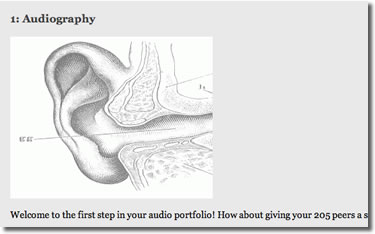
Here, students had the opportunity to share “playlists” of sounds typical to their everyday lives. However, the ultimate motivation of the exercise was twofold: (1) for them to closely attend to those common soundscapes, organize them (around a theme of some sort), and record them; and (2) for them to develop some basic competencies in the free audio editor and recorder, Audacity (based on a workshop conducted during class). Although the very notion of a “soundscape” was likely new to them, and even though most of them had never recorded audio, the concept of a playlist was personal and familiar enough to make the assignment approachable. It also stressed the fact that, like images and texts, people design and structure arguments through sound. A playlist of everyday sounds involves rhetorical strategies not entirely distinct from, say, an academic essay or television broadcast.
For the audiography (as well as every other audio composition in 205), the students were given constraints (e.g., “no narration,” “no effects,” and “eight to fifteen recordings only”) similar to guidelines for academic essays. And once the audio files were composed, the students uploaded them to our class audio blog (using a WordPress theme that unfortunately is no longer supported or maintained). The benefit of the blog was that everyone in the course could hear everyone else’s audio work. Additionally, I could play student audio during class meetings, treating it as an object of inquiry for discussion. In so doing, I made sure that—during the quarter—we discussed every student’s audio work at least once.
Audiographies are great for getting at cultural assumptions about sound, especially when students are able to respond to them through repurposing, voice-over, or a similar strategy. For the “re: audiography” prompt, I asked students to do just this.

They downloaded a peer’s audiography (from the class audio blog), edited it, produced a story through it (including voice-over tracks), and circulated the final product. While, quite obviously, this exercise became a gateway into studying montage, cut-up, turntable, DJ, and laptop practices, it also gave students an opportunity to assess how an audience member might interpret their audio work, the soundscapes with which they are familiar, and the rhetorical strategies motivating their compositions. “Re: audiography” relies on re-situating audio in a new context, as it demands thinking about how setting, history, and ideologies all affect interpretation. In so doing, it also requires significant consideration of the risks, play, warrants, and claims involved in an audio composition relying heavily on existing work. As an instructor, I was sure to remind students that such play is not innocent; it is quite serious, and—in the context of 205—it was not intended to offend or mock another student’s work, interests, or background. Consequently, adding this line to the prompt was key: “Don’t be rude to them and recognize that they worked hard to make their audiographies. What’s more, the sounds involved mean something to them.”
As I plan for my audio culture studies course at the University of Victoria, I am revising the “re: audiography” prompt to make it more concrete, with clear parameters. In particular, Step 5 in the instructions is too vague; it lacks sufficient focus, without being anchored in a particular genre or example to which students can refer. As such, during 205 I ultimately worried that the flexibility in the prompt induced student anxiety. Without a genre in mind, they had too many avenues to explore, even if all of those avenues afforded ways of engaging cultural assumptions about sound.
After the audiography prompts in 205, I assigned students two “found sound” exercises, which furthered the combination of knowing and doing through a line of research. Both exercises were scaffolded toward the production of an audio documentary that was academic in character.
The first “found sound” prompt asked them to gather a series of historical audio clips related to a particular medium and begin formulating a research question about them.
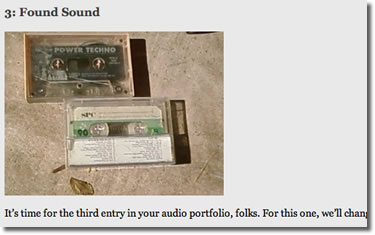
The audio piece that resulted included not only the audio clips but also the student’s initial thoughts, questions, and concerns about the research. One significant benefit of this exercise was that it acted in conversation with other strategies for academic argumentation, namely how arguments involving actual audio differ from and intersect with arguments devoid of audio. In other words, it introduced students to the very notion of multimodal argumentation, including the ways in which audio functions in scholarly communications. Students also had to consider what it means for an argument to be heard, not read.
As an instructor, I find that I still tend to map norms for text- and image-based argumentation onto audio work. For instance, the language of the “found sound” prompt resonates with a prompt I would write for a text-based “thought piece.” It is a translation of modes, without much consideration for how audio-based arguments might actually serve distinct and perhaps divergent aims—aims premised on, say, affect or non-sequential arrangement. For future iterations of this prompt, I plan to highlight such possibilities, brushing against my own proclivities for validating audio-based arguments through text- and image-based conventions.
Comparable to the “re: audiography” prompt, the students in 205 responded to each other’s “found sound” exercises, this time through “re: found sound.”

Rather than repurposing or sampling a student’s work, in this case students recorded verbal feedback, which essentially acted as a form of peer review. Perhaps above all else, this exercise allowed students to articulate an understanding of how to structure and evaluate audio compositions, preparing them for the audio documentary. Yet one of the most effective components of the prompt is this request: “Identify at least one thing (but preferably more) that you think your peer is overlooking or not considering. This thing can be a concept (e.g., ‘speaking with’), an example work (e.g., film, audio recording, or text), or a perspective (e.g., conflicting opinions on the topic). When you make this gesture, explain why it’s relevant to not only his or her audio documentary, but also the history of sound reproduction.” From my perspective as an instructor, this intervention in a peer’s work is difficult yet rewarding. It is a response that demands its own research, as it asks the reviewer to more or less deconstruct what is being heard.
“Re: found sound” also requires students to meticulously consider how they are saying what they are saying when critiquing someone else’s work. For instance, tone, inflection, and dialogic gestures are foregrounded. To be sure, students make similar decisions when responding through text. Nonetheless, the shift in modality affords a learning experience arguably rare in higher education humanities.
For future iterations of “re: found sound,” I will ask students to submit written feedback in tandem with the audio, not only for accessibility purposes but also to stress correspondences between the media. Again, one of my ongoing concerns in audio culture courses is that I will—in a reactionary fashion—privilege speaking and listening over seeing, reading, and watching. Such reactionary approaches risk dividing critical approaches when they can instead be suggestively blended through interdisciplinary research.
The two “found sound” prompts guided students in 205 toward an audio documentary, which was steeped in a specific historical issue and informed largely by cultural studies approaches to audio technologies and media.

To prepare students for this genre, I provided example documentaries, and we also conducted several workshops on how to make and critique those documentaries. In the end, these documentaries were a real pleasure to hear, and one of the biggest difficulties is listening and re-listening to them closely. After all, the evaluation of audio operates through a different temporality than text, and often times it lends itself to focusing too much on production and post-production (rather than, in this case, the actual content of the audio documentary). Requesting transcripts, and even the original AUP files (or a similar format), can facilitate fair and thorough evaluation. I also try to listen to each documentary at least twice, with and without headphones. Finally, as an instructor I have learned that audio documentaries will always take students twice as long as I assume they will. Despite popular assumptions about the speediness and ease of digital production, the genre is labor-intensive and layered with samples, effects, voice-over, and transitions. It is also often new to students in higher education.
Even though the documentary was the most involved piece of the students’ audio portfolios in 205, it was not the final submission. In a self-reflexive fashion, the students were asked to submit a final remix of their work (PDF).

At its core, the final remix intersected audio theory, practice, and history. Intended for educated, non-expert audiences beyond the course, it asked students to provide specific examples of how they fulfilled particular outcomes in the course. Among other things, the samples in the remix were intended to demonstrate an awareness of: (1) audience, (2) the technocultural history of sound, (3) a theory of listening, (4) audio composition and post-production, (5) constructive, audio-based peer review, and (6) persuasive media strategies for audio-based argumentation.
Perhaps quite obviously, this reflective remix borrows from a long history in writing studies. And I have found it quite effective for identifying what and how students learned from the course. That said, what I enjoy most about it is how it requires thinking about sound as matter: its arrangement and manipulation, its existence in various iterations and formats, its function as tangible, audible evidence. For, when returning briefly to those questions in the first paragraph of this piece, I tend to think the greatest challenge facing sound studies curricula and pedagogy is the challenge of sound’s materiality. As sound studies scholars, how do we foster spaces and opportunities where people can learn about the history of sound as an object with its own fluctuations, politics, aesthetics, and material particulars? How do we teach audio culture as that which can be simultaneously inhabited and examined from a distance? As a thing, a mode of composition, and a way of thinking, feeling, and acting?
—
Featured Image “Burn Station @ inSIRACJE festival” by Flickr User Paula Rey
—
Jentery Sayers is an Assistant Professor of English at the University of Victoria, where he teaches cultural studies, digital humanities, and 20th-century U.S. fiction. His writing has appeared in Kairos: Rhetoric, Technology, and Pedagogy; The New Work of Composing; Computational Culture; The New Everyday; Writing and the Digital Generation; Off Paper; Collaborative Approaches to the Digital in English Studies; and ProfHacker. Among his other work involving audio, his current book project is a cultural history of magnetic recording. He’s grateful to Jennifer Stoever-Ackerman at Sounding Out! for feedback on drafts of this piece.
Share this:

Listening to #Occupy in the Classroom

Yes, it’s that time again, readers. You are going to have to stop pretending the “Back to School” aisles haven’t been appearing in stores for the past few weeks. We at SO! are here to ease your transition from summer work schedules to the business of teaching and student-ing with our fall forum on “Sound and Pedagogy.” Developed to explore the relationship between sound and learning, this forum blends the thinking of our editors (Liana Silva), recruited guests (D. Travers Scott), and one of the winners of our recent Call For Posts (Jentery Sayers) to explore how listening impacts the writing process, the teachable moment, and the syllabus (and vice versa). We hope to inspire your fall planning–whether or not you teach a course on “sound studies”–and encourage teachers and students of any subjects to reconsider the classroom as a sensory space. We also encourage you to share your feedback, tips, and experiences in comments to these posts and on our Twitter, Facebook, and Reddit sites. As I said in the Call for Posts for this Forum: “because teaching is so crucial—yet so frequently ignored at conferences and on campus—Sounding Out! wants to wants to provide a virtual space for this vital discussion.” This conversation will be ongoing: we will also bring you a “Spring Break Brush-Up” edition in 2013 featuring several more excellent posts by writers selected from our open call. Right now, the bell’s about to ring–so take a seat, open those ears, and enjoy this shiny auditory apple of an offering from D. Travers Scott in which he discusses how the sounds of #Occupy invigorated his classroom. And, yes, it will be on the test. —JSA, Editor-in-Chief
—

In the late fall of 2011, I was teaching a class on cultural studies of advertising. I presented the Occupy Student Debt campaign, a subcategory or spinoff of the larger Occupy movement, while we were examining ways people challenged consumer culture. We discussed education as a commodity and students as consumers. Unsurprisingly, my seniors were dissatisfied consumers. They expressed that what had been advertised to them was a product that guaranteed or at least would strongly increase their chances for quality employment (of course, it was also a product they had worked for years in creating, and one they couldn’t return.) If higher education really did land you the lucrative job it had been advertised as guaranteeing, in theory, then, you would be able to more easily pay off student loan debt. To address this dissatisfaction, I showed them two artifacts: a video from the launch in New York City on November 12, 2011, and the OSD debtors’ pledge*.
In the video, OSD founder Pamela Brown reads the pledge one line at a time, with each line chanted back by others. I played the video in a dark classroom. I also projected it on the room’s main screen, but I didn’t use the room’s amplification system because it sounds too much like an authoritarian public address and disperses the audio in a dominating way. External speakers connected to my laptop made the sound feel, to me, more localized and objectified, something we could focus on rather than an institutional part of the room. The students’ first reaction was, not to the words, but the sound: the verbal relay used at the public demonstration. Brows furrowed and heads cocked quizzically, they asked, “Why are they all repeating the speaker like that?” I explained how this provides additional amplification, but the students’ listening experience was instructive to me. Their unfamiliarity with a sonic practice of vocalization indicated their unfamiliarity with larger practices of collective, public social action.
Listening to OSD, and paying attention to how my students listened to it, informed me of larger contexts they needed to understand and discuss it, in ways that the object of the text did not suggest to me. It made me think about the experience and process of my students’ encountering OSD. I immediately noticed its ambient sounds of city life, which I no longer hear. These sounds of traffic, the acoustics of being surrounded by buildings, etc. gave several urban dimensions to the movement the pledge text did not. From the perspective of Upstate South Carolina, “urban” is not a simple thing, an identity or geography category, but intersectional: our largest city, Greenville, has a population under 60,000. City noises feel not merely urban, but un-Southern, and thereby alien. (I say un-Southern rather than Northern or Yankee because another thing I’ve learned here is the inadequacy of that binary: Los Angeles, for example, is not a Northern city but most certainly is as un-Southern as New York. Cities also carry a class dimension.) Even though my school is one of the elite institutions in this area, this region is still worse off economically than the rest of the country and has a generally lower cost of living. Cities require money to live in. In spatial, class, and urban dimensions, OSD felt alien.
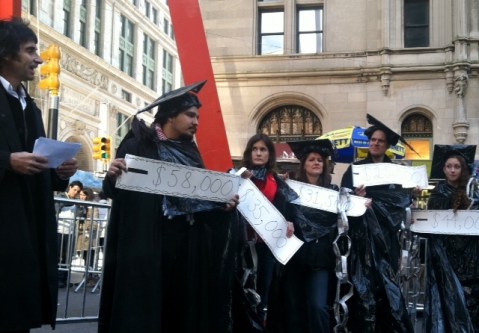
Opening of the Occupy Student Debt Campaign, Image by Flickr User JohannaClear
The experience of listening to the ODS rally illustrates how a sound studies perspective foregrounds experiential processes over exclusive categories of things and ideas. For example, when I read the OSD Debtors’ Pledge aloud to my students—vocalizing the text and sounds and listening to them— it brought the text into my body, making it an action. It also made students uncomfortable. Even just a round-robin reading of theory seems to make then anxious and fidgety. While I try to understand and accommodate anxieties around public speaking, I think the way sound makes a text enter the body can be a powerful affective experience. And no one ever said the classroom always had to be comfortable. For me, reading the text aloud personalized the OSD pledge. It evoked sensory memories: “Pledge of” evoked saying the pledge of allegiance in public school; saying “We believe” took me to attending Lutheran church services with my husband at the time where they collectively recite the Apostles’ Creed. These associations evoked emotional disidentifications from organized religion and mandatory collective professions of patriotism. It also temporalized and spatialized OSD for me, positioning it in relations to Dallas, Texas in the 1970s and Greenville, SC today.
Overall, the reading aloud of the pledge staged a tension or dialectic of identification and disidentifications. Although I agreed and identified with the sentiments of the movement, several alienating and unsettling aspects of the pledge came through as I read aloud: the blithe collapsings of “we” and “as members of the most indebted generations” made me wary (collectives always do, but so do easy historical assertions. Really? Are we more indebted than indentured servants who came to America, or people born into slavery?), and the sudden shift to first person singular at the very end seemed jarring: (After saying “we” six times, suddenly it’s ‘I’ now – what happened?). Lastly, the numerous alliterations also had an alienating effect, making the text seem sophistic and manipulative, artificial, composed.
The auditory experience of OSD can also provide insight into how we create texts. A video of Andrew Ross shows him presenting the first, “very rough draft” weeks earlier at an OWS event. Listening to him read this different, earlier version underscores the text as process. The pledge is something that developed. While his flat tone and straight male voice do not appeal to me, they do complexify and dimensionalize Brown’s reading, giving it depth. They also show that some things that bothered me in the final version – the collectivity and alliterations – were not there. This intertextual, diachronic listening does not erase troublesome aspects of the ‘final’ text, but it mediates them. I am moved closer to it by listening to its different origin.
Arguably, any of these points could have been arrived at by good ole’ textual analysis. My point is not that listening always should supplant visual modes; sound studies tries to break that false dichotomy by not denigrating or replacing the visual but by elevating the sonic to complementary – not superseding – status. I argue that reading aloud should be a fundamental, basic component of sound studies methodology, as it allows anyone to hear, voice, embody, and experience a text. I not only noticed these aspects sooner through listening – my first time speaking it aloud, despite having read it at least a dozen times before. Moreover, I didn’t just notice them: I felt them on a personal, emotional, level, which spurs thinking and analysis that is, if not completely new and unique, definitely qualitatively different in its potency and urgency.
Listening to OWS, and the OSD in particular, brings insights affective and personal. Yes, I can read a statistic from a survey stating that a certain percentage of participants in OWS feel angry or betrayed. That doesn’t mean anything to me in a specific, personal, and empathetic way – and empathy is crucial for a social movement to garner support. Listening to both Ross and Brown, I am reflective and conflicted over my professional role – no longer a grad student, but certainly not an established scholar like Ross. I feel connected to OSD in ways beyond the literal facts of my debt. Listening draws me into a contemplative, reflexive space beyond a sticky note on my office desk saying “OWS: teachable moment.” I can see a map with big, red OWS circles over Washington D.C. and New York, but I don’t feel the distance from myself and my students in the same way—and this is crucial for my teaching and engaging them in dialogue about what could be the most significant social movements of their lifetimes.
Share this:


Current Top Posts





April 2021

January 2020

November 2019

October 2019

August 2019

April 2014

November 2017

March 2015

December 2017

October 2015
 Sounding Out!
Recent Comments