
SO! Amplifies: Sounding Board Curated by Leonardo Cardoso
DOI: https://doi.org/10.59350/0thrb-wyd33
—

SO! Amplifies. . .a highly-curated, rolling mini-post series by which we editors hip you to cultural makers and organizations doing work we really really dig. You’re welcome!
—
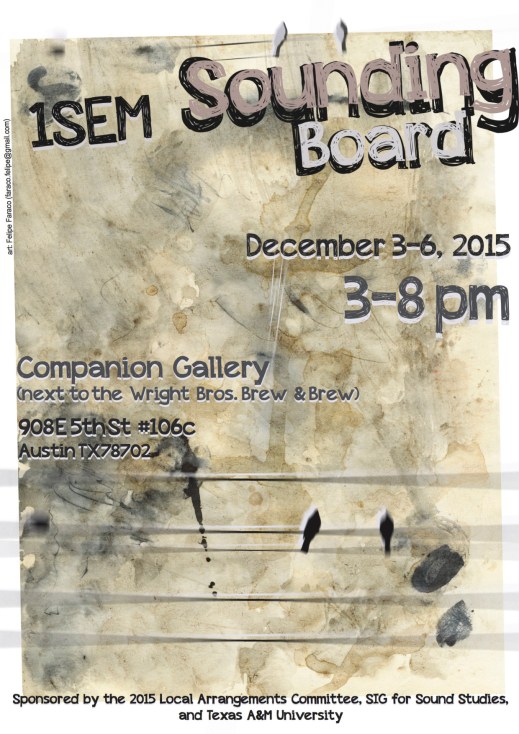
The first annual Sounding Board sound exhibit was held at The Companion Gallery in Austin, Texas on December 3 – 6, 2015, as part of the 60th anniversary meeting of the Society of Ethnomusicology (SEM). In the promotional literature for the show, the curator, Leonardo Cardoso (Texas A&M), described its objective: to give students, ethnographers, ethnomusicologists, and any “sound-minded” people an opportunity to share research and contemplate fieldwork from different perspectives. Cardoso hoped that SEM Sounding Board would “stimulate dialogue between ethnomusicology and other fields, especially sound studies, sound art, ecomusicology, anthropology, and media studies.” He also sought to facilitate interaction between the local community in Austin and SEM scholars who traveled to attend the conference.
I spoke with Cardoso about this exhibit on several occasions. When I asked him why name the exhibit “Sounding Board”?, he told me that Veit Erlmann (University of Texas Austin), described once described his role as a mentor as someone to bounce ideas off of, like a sounding board. In a similar way, Cardoso’s vision for the first annual SEM sound art exhibit was to create opportunities for scholars and local people to meet and discuss sound, ethnography, art, and fieldwork in an open context, and learn from each other while interacting in that space. He designed Sounding Board as a place where “ideas are amplified” and scholars and community members can make fruitful connections because they have an opportunity to reflect and discuss research with people from different backgrounds.
In his invitation to SEM attendees, Cardoso described Sounding Board as
[eight] sound works that probe into sonic in-placements (water and wind), sonic displacements (the telephone, the radio, and the microphone), sonic emplacements (the acoustic territories of urban Taiwan, the Brazilian hinterlands, and West Texas), and sonic mix-placements (in Mexico City).
This collective sound exhibit showcases the creative work of scholars attentive to the spatial, acoustemological, and ethnographic potential of sound. SEM SOUNDING BOARD challenges distinctions between sound-as-episteme and sound-as-performance, sound-as-ethnography and sound-as-art.
Interactive, Immersive, Ethnographic Sound Art
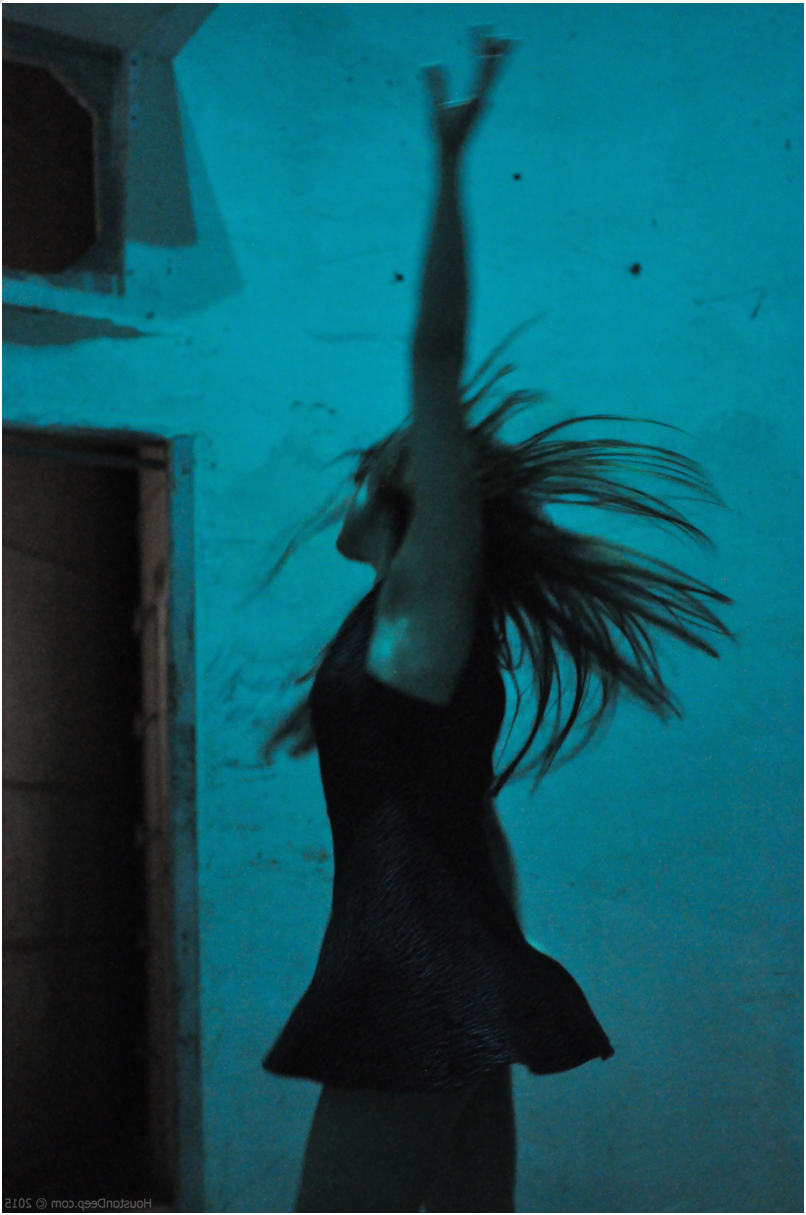
The playfully engaging work, Pool of Sound, welcomed me to the interactive SEM Sounding Board exhibit. As soon as I walked into The Companion Gallery, I noticed the eye catching 1st Annual SEM Sounding Board poster near a studio monitor on a stand, facing another monitor, placed directly across from it, about 20 feet away. A large illuminated circular area gleamed in between the silent speakers. When I moved into the light, I suddenly heard the clear sounds of gently rushing water, but only for an instant, then there was silence again, as soon as I stood still. As I turned and stepped towards one of the speakers I heard the rushing water return. The gurgling sound mirrored my movement and when I stopped, the sound of the water stopped.
Lina Dib (Rice University) created the piece, with an
enchanted zone [that] literally becomes a pool of sound where sound becomes substance, something to be physically and playfully encountered. In other words, sound with this installation becomes palpable, sound is made (in)to matter. The larger the visitors’ gestures, the louder and stronger the sound of water becomes.
Dib cites Jean-Luc Nancy in her work’s description, understanding her piece as an embodiment of Nancy’s observation in Listening that sound envelops the listener: “Sound has no hidden face; it is all in front, in back, and outside inside, inside-out.”
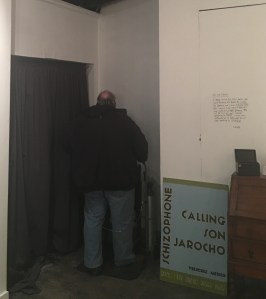
While experimenting with the intersections of sound and gesture in Dib’s Pool of Sound, I noticed someone sit down at an antique-looking wooden desk across the gallery, pick up an old school, land line telephone, dial a number, and start writing on a notecard. The person at the desk was experiencing Schizophone, Calling Son Jarocho, a installation by Craig Campbell (University of Texas Austin) and collaborators, Julian Etienne, Juan-Pablo Gonzalez, and Cameron Quevedo. When the person hung up and left, I sat down, braced the phone between my ear and shoulder and listened to a dial tone.

I dialed a few numbers and started to hear a conversation through the receiver: musicians were speaking in Spanish, discussing certain subtleties of a Son Jarocho performance. I felt like I was eavesdropping. I dialed another number and the sounds of Son Jarocho music flooded my ear. This installation provides numerous sound bytes of field recordings related to Son Jarocho music of Mexico. Each recording is described on a notecard that gives ethnographic descriptions of the situation. Campbell also asks the listener to participate in the piece by filling out a card to leave a record of their experience. The artist says that his “work builds on R. Murray Schafer’s ‘schizophonia’ to signal the profound but also banal experience of listening to recorded sound. The schizophone recruits the telephone–a mundane, though now largely residual technology–to frame and structure an encounter with archival recordings.”
A few feet away from the Schizophone desk, a poster stand held a flyer for the piece Wind Noise by Marina Peterson (Ohio University). A pair of headphones clung to the stand.
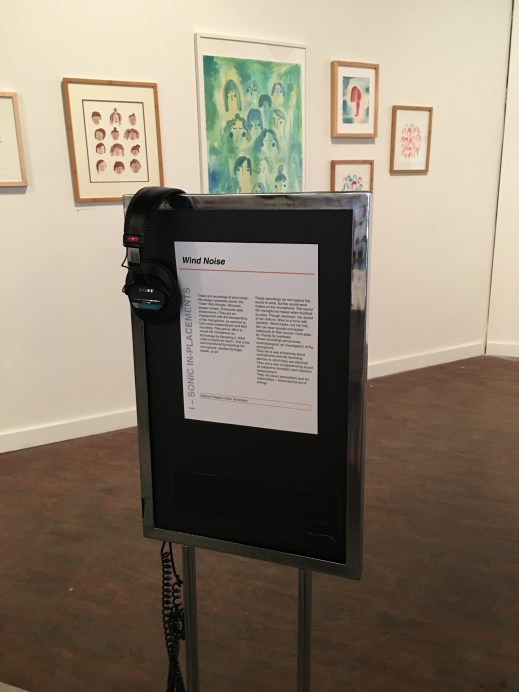
When I put the headphones on I expected to hear some cinematic blowing, or the soft sound of a summer breeze. Instead, I heard a familiar, dreaded, thumping noise. Peterson’s work indulges in a recording taboo: the clipping, dull thud of wind hitting an unprotected microphone.
As I listened, I thought about noise and how to define it. Usually, this thudding sound would bother me and I would cut out chunks of recordings to get rid of it. But in the context of a sound art exhibit, I found myself examining this noise, and listening to it as art. This reinterpretation of sound in relation to space reminded me of David Novak’s discussion of “Noise” as a genre in the context of Japanese music coffeehouses in his article, “2.5 meters of space: Japanese music coffeehouses and experimental practices of listening.” Peterson discusses her work as an exploration of technology, mediation, and the microphone. She describes these recordings as
an effort to reveal the microphone as technology by disrupting it. Wind noise is sound as touch – this is the sound produced by touching the microphone, whether by finger, breath, or air. These recordings do not capture the sound of wind, but the sound wind makes on the microphone. The sound the microphone makes when touched by wind.
In a recessed corner of the gallery I saw a music stand with a piece of paper on it. I didn’t know if it was part of the Sounding Board installation, or just a piece of equipment, set aside. As I stepped up to the stand to read the paper, I unexpectedly stepped into a chamber of sound. A Holosonics AudioSpotlight AS-24i directional speaker, mounted on the ceiling, beamed a column of music into that area, which a listener can hear only when directly below the speaker.
The piece is called Resting Place, by Michael Austin (Howard University). In the description of this work Austin states:
Resting Place is based on the old cowboy song ‘Bury Me Not on the Lone Prairie.’ Not only does this work confront listeners with thoughts of mortality and final resting places, it embodies the wide open spaces of my childhood home and serves as a place of peace and relief for the here and now.
Austin grew up in the countryside of the Texas Panhandle, and his work intends to bring a piece of that Texan soundscape to a corner of the gallery. I could hear the sounds of birds, wind, and water combined with chant and meditative, drone music; they were all sounds that would usually communicate rest and peace. Unfortunately, I had a difficult time entering that relaxed frame of mind because the recording of the Texan soundscape often clipped, which disrupted my concentration on the calming aspects of the field recording. Composers such as Annea Lockwood and Janet Cardiff use binaural microphones to capture nature sounds up close and create an intimate surround sound experience for the listener; although I am fascinated by the concept of creating a “soundscape chamber” by using a hyper directional speaker, I would love to hear the details of Austin’s field recordings through a nice pair of headphones.
Resting Place and Wind Noise invite contemplation as the listener receives sound. In contrast, the broadcasting sound piece by Tom Miller (Berkeley College) is intensely interactive. In Radio Texas International, a Micro Radio Station in the Austin Wavescape, Miller creates an experience where it is possible to broadcast sound and listen to recordings.
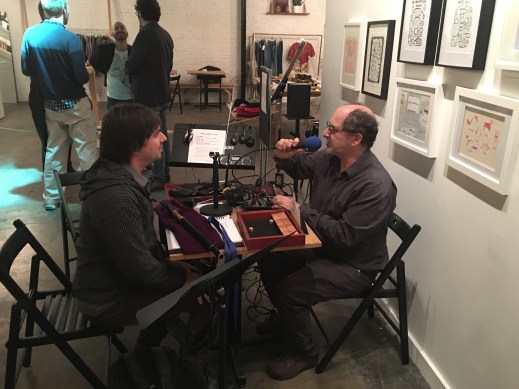
Resting Place and Wind Noise invite contemplation as the listener passively receives sound. In contrast, the broadcasting sound piece by Tom Miller (Berkeley College) is intensely interactive. In Radio Texas International, a Micro Radio Station in the Austin Wavescape, Miller creates an experience where it is possible to broadcast sound and listen to recordings. Miller explains that for this piece he
operate[s] a low power Mini FM Micro Radio station in the gallery… Tuning to open frequencies, a legal micro power transmitter broadcast[s] to receivers distributed within a 200-foot radius as a hyperlocal, pop-up intervention into the FM band. Using headsets, listeners will tune the radio dials seeking to locate the signal interspersed with the music, religious broadcasts, news, foreign language programming and static of the local radio wavescape.
In the video of his work you can hear several different ethnographic recordings that are broadcasted by Miller in the gallery, and at the same time intertwine with the sounds of local radio stations in Austin. Besides broadcasting field recordings, Miller also aired live interviews and music throughout the three-day exhibit. I was delighted to have the chance to play some traditional Irish music on the air for Radio Texas International.
雜 (dza) is a piece by Yun Emily Wang (University of Toronto) and Wendy Hsu (Dept. of Cultural Affairs, City of Los Angeles), who created a work that inhabits a cardboard box. The artist Zimoun often uses percussive elements to explore acoustics and cardboard, but in 雜 (dza), Wang and Hsu employ the box as a resonator to amplify and combine sounds emitted from headphones playing loops. The listener is asked to put their head in the box to hear a cacophony of intermingled field recordings that create a decontextualized soundscape of Taiwan.
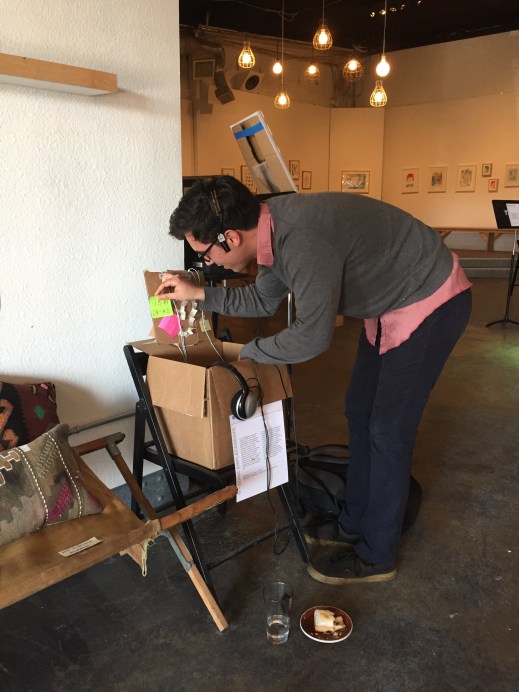
The artists explain that “These composed loops recontextualize the sonic materiality of the informal economy and quotidian life exemplified at a Taiwanese night market, and interact with the spatial and sonic elements of the venue and its role within the emerging art-as-enterprise share economy.
There were two pieces of interactive, ethnographic sound art that integrated both audio and visual elements of fieldwork in Mexico City, and Brazil. Dry Signals by Michael Silvers (University of Illinois Urbana – Champaign) invites the auditor to “touch the screen” and listen to field recordings. The touchscreen of the laptop displays an image of a painting of a small town surrounded by mountains, near water.

I put the headphones on and touched a part of the image of the town that caught my attention: a traditional forró trio standing on the porch of small pink house (no.8). In the headphones I immediately heard the rhythmic music produced by the musicians playing the drum, the accordion, and a triangle.
Silvers describes the inspiration for Dry Signals as an exploration of
the sounds of drought in northeastern Brazil. From trickling reservoir spillways… to the music and shuffling feet of dance parties in dusty fields, these sounds tell stories of labor, birds, politics, agriculture, plants, mass media, corruption, water, and the quotidian experience of life in the semi-arid Brazilian hinterlands.
The artists take advantage of touchscreen technology to give the viewer a chance to curate their own soundtrack of their experience of the painting. There is no lag in the experience of touching, listening and viewing the village and surrounding landscape. Even though the field recordings are not uniform in sound quality, I enjoyed the experience of hearing an ethnographic audio record of a small town in northeastern Brazil, by touching an image of it.
Anthony Rasmussen (UC Riverside) provides an opportunity to peek in on urban street scenes filmed throughout Mexico City in his work, El Caracol: A Stroll through Space and Time in Mexico City.
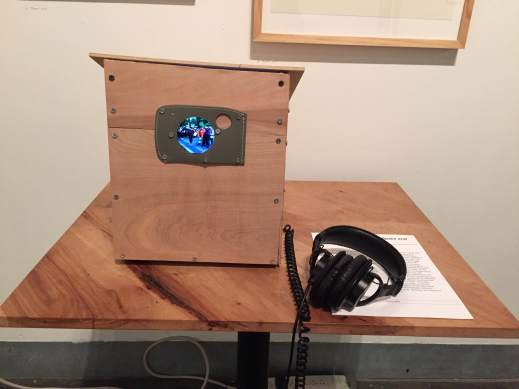
Some of the most compelling scenes in the 20 minute loop of video and audio depict street protests in Mexico City which are accompanied by ambient sounds from the field recording, combined with subtle music, and seemingly unconnected background conversation.
The artist explains that
the video element consists of footage captured while walking through various sites in Mexico City and represents the phenomenological ‘present’. The audio element provides a counterpoint to the visual; as the loop begins the audio corresponds to the action on screen, but with increasing frequency (based on the ‘Fibonacci Spiral’) the contemporary sounds will be ‘ruptured’ by historical recordings of Mexico City that drift further back in time.
I particularly enjoyed the sections where the connection between the audio and the video was unclear. Toby Butler’s article “A walk of art: the potential of the sound walk,” traces the efforts of different artists and their uses of the sound walk in their work, but he does not describe any endeavors like Rasmussen’s, where ethnographic footage is the prime source of the walk. I wondered about the position of peering through the hole to watch Rasmussen’s field recording of Mexico City, and I realized that at times, gazing through the hole gave me the sense that I was the ethnographer gathering footage.
“always more sound to experience”
I visited the Sounding Board exhibit several times while attending the SEM conference. Every time I left I felt like there was always more sound to experience. I wanted to hear all of the numerous field recording of Son Jarocho material presented by Campbell’s Schizophone; Miller’s Radio Texas International changed every time I listened and I wondered what ethnographic material I might encounter the next time I tuned in. I never tired of Lina Dib’s Pool of Sound because it gave me the chance to perform the gurgling of water, using gesture. Apart from the evocative expressions of ethnology as art, Sounding Board converted The Companion Gallery into an interactive playground of sound.

The live performances in the gallery on Friday night brought the ethnographic sound art to life. When I listened to at least twenty members of the Comunidad Fandango of Austin perform and dance Son Jarocho music in the gallery on Friday evening, I began to make connections to the field recordings that I heard in Schizophone. When Bruno Vinezof and Forró de Quintal took the stage to play forró music from northeastern Brazil, I could feel the groove of the drum that was merely suggested in the field recording that I had listened to in Dry Signals. It was a unique pleasure to observe and participate in these musical traditions with my body, after having encountered them earlier through headphones as sound art.
When I spoke with Cardoso he was especially grateful to the Son Jarocho community of Austin, who volunteered to participate in the show by gathering in The Companion Gallery for a Fandango. He emphasized the grassroots aspect of this community music making event which came about because Cardoso knows the group and their passion for Son Jarocho music.
Cardoso plans to expand the variety of works and disciplines involved in next year’s Sounding Board to include media studies, literature, film, and the visual arts. As SEM 2016 will be meeting in Washington DC and co-hosted by Smithsonian Folkways Recordings (and George Washington University), this should not only be possible, but especially exciting.
—
Featured image: Lina Dib’s “Pool of Sound” by Matt Morris
—
Jay Loomis is a composer, a performer, and a graduate student in ethnomusicology at Stony Brook University with a particular interest in transnationalism, soundscapes, improvisation, wind instruments, and electronic music. He hosts a radio show called “Face the Music,” and recently curated a sound installation called “SOUNDREAMS” at Stony Brook University, which used geo-located sounds and music strategically placed around the university campus which people heard by using a smart phone app called Recho. Jay hand crafts Native American and other kinds of flutes, and leads flute making workshops in local libraries and schools. He plays a variety of wind instruments from around the world. He recently led workshops in a contemporary music festival in Cuenca, Ecuador (FIMAC: Festival Internacional de Musica Academica Contemporanea). Participants in Jay’s workshops arranged music and created flutes as a practical way to examine how indigenous music making practices and pre colonial instruments can contribute to the world of contemporary academic music.
—

REWIND!…If you liked this post, you may also dig:
Sound and Curation; or, Cruisin’ through the galleries, posing as an audiophiliac–reina alejandra prado
SO! Amplifies: Shizu Saldamando’s OUROBOROS–J.L. Stoever
SO! Amplifies: Mendi+Keith Obadike and Sounding Race in America–Mendi + Keith Obadike
—
Share this:

Heads: Reblurring The Lines

DOI: https://doi.org/10.59350/9337j-fxb80
I don’t intend to discuss the “Blurred Lines” case in this post. There are plenty of folk already committing thoughts on the ruling. While the circumstances of the recent Thicke/Williams/Gaye case are not explicitly about sampling, they are indicative of the direction sample/copyright litigation can go in the future. When samples from a composition infringe upon the copyrights for the song, it is dangerous territory. Rather than focus on those dangers however, I’d like to exemplify possibilities of a more open (and arguably the intended) interpretation of copyright laws, by doing something I should have done seven years ago – put out my project Heads (dropping on April 1st, 2015).
My position has not changed from previous writings on sample laws – transformative sampling produces original work. My intent here is to present an artist’s statement on Heads that illustrates how transformative sampling and derivatives of it require broader interpretation; they should be legally covered as original compositions.

I’ve kept Heads in the vaults since 2007 while continuing from its artistic direction, all the while doing little tinkerings to convince myself it wasn’t done yet (it was). I had been pursuing analog technologies I swore would be the finishing touches it needed, to convince myself it wasn’t ready yet (it was). Then I lost 4TB of files in a quadruple hard drive killer power surge. The last Heads masters were among the 500GB that survived.
The project was born in response to comments made by Wynton Marsalis, dismissing hip-hop and denying its connection to the legacy of black music.
It’s mostly sung in triplets. So what? And as for sampling, it just shows you that the drummer has been replaced by a loop. The drum – the central instrument in African-American music, the sound of freedom – has been replaced by a repetitive loop. What does that tell you about hip-hop’s respect for African-American tradition? – Wynton Marsalis
I was offended as both a hip-hop and jazz head, so I set out to produce a body of work that showed the artistic originality of sampling and tied the practice to black musical traditions.
Prior to the analog experiments, I was modeling a series of digital Open Sound Control (OSC) instruments based on the monome, starting with a sampler but expanding into drum machines synthesizers and other noise makers. Together I called them the Heads Instruments. 95% of the composition work on Heads began with these instruments, all of which were built around the concept of sampling.
The title Heads, comes from the musical head, which is a fundamental part of the jazz tradition. The head is the thematic phrase or group of phrasings that signify a song; heads can be comprised of melody, harmony and/or rhythm. Jazz musicians use the head as a foundation for improvisation, a traditional form including the alternating of head and solo improvisations . Often times in jazz, the head comes from popular songs re-envisioned through improvisation in a jazz context, such as John Coltrane’s famous refiguring of “My Favorite Things” from The Sound of Music. In addition to being covers, these versions are transformations of the original into a different musical context. The Heads Instruments were designed specifically as instruments that could perform a head in a transformative manner.
Hip-hop attacks itself. It has no merit, rhythmically, musically, lyrically. What is there to discuss? – Wynton Marsalis
Tony Wynn
I was a bit annoyed at Marsalis, just how much is illustrated by the opening track of Heads, “Tony Wynn,” eponymously named after the contemporary jazz saxophonist, who, like Marsalis, feels that hip hop is not music. In it a character berates his friend for bringing up Wynn’s position. On the surface the song talks trash, but musically it makes layers of references.
First, the song’s format (down to the title) is a nod to the Prince tune “Bob George.” In his song, Prince parodies a character berating a girlfriend for being with Bob George. The voice of the character in “Tony Wynn” and some of his comments come straight from Prince’s song, but the work as a whole is not a direct cover of “Bob George.”

“Tony Wynn” is undeniably influenced by the Minneapolis sound, that eclectic late 1970s and early 80s scene that blend of funk, rock, and synthpop, but how the track arrives there is complicated. It does contain a Prince sample, but not from “Bob George.” The sample is played in a transformative manner, chopping a new riff different from the source material. It also includes a hit from another song, a sample of only one note, yet one identifiable as signature. The drums are ‘played’ in what could be described as the Minneapolis vibe. You can also hear a refrain that mimics yet another song. All of these sampled parts create a new head, to which I added instrumental embellishments with co-conspirator Dolphin on bass, synth, and the killer Prince-esque guitar solo.
The track represents a hodgepodge of Prince influences, but because those influences are so varied, none can be individually identified as the heart of “Tony Wynn.” Furthermore, at the bridge all of the samples get flipped on each other, some re-sampled and performed anew. Nothing can be pinned down as an infringement on technicalities, without taking into account the full context of the transformation. While “Tony Wynn” is heavily influenced by Prince, it is not a Prince song.
Rap Rap Rap
The second track on Heads,”Rap Rap Rap,” features Murda Miles and Killa Trane. I chose its title and head to reference the 1936 Louis Palma song “Sing Sing Sing,” made popular by the Benny Goodman Band. Coming out of the big band era, the song is closer to a traditionally composed Western standard, the heavy percussions however distinguish it. While you will find no samples of sound recordings from any version of “Sing Sing Sing” in “Rap Rap Rap,” it still represents the primary sample head used.
The opening percussive phrases are influenced by rhythmic hand games—an important but often overlooked precursor to hip hop discussed in Kyra Gaunt’s The Games Black Girls Play: Learning the Ropes from Double-Dutch to Hip-Hop. Here the rhythm sets the pace before charging into the head with a swing type of groove as the two featured artists, Murda Miles on trumpet and Killa Trane on sax, call out the head. What distinguishes these horns however, is that they are both sample based.
The song’s head is still based on “Sing Sing Sing,” but for the dueling horn parts the samples come from the recordings of Miles Davis and John. While Davis and Coltrane played together at a fair number of sessions, these samples come from two divergent sources from their individual catalogs. I chopped, tuned and arranged them for performance so that they could play in tune with the head.
The opening half of “Rap Rap Rap” sees both sticking to the head with little flourishes, but at the half way mark, the accompaniment changes to a distinct hip-hop beat still firmly rooted in the head. The two horns shift here as well, trading bars in a way that nods to both jazz and rap. The phrasing of the sample performance itself mimics a rapping cadence here, bridging the gap between the two traditions.
La Botella
The head for next track “La Botella” (The Bottle), uses a popular salsa motif as the head, accentuated by a son influenced percussive wall of sound. The percussions vary from live tracked percussions to percussion samples to percussive synthesis. I performed many of the percussive sounds utilizing the Heads Instruments sequencer, which lends itself to the slightly off—while still in the pocket—swing.
The format of this particular head allowed for an expanded arrangement, through which I nod to the Afro-Cuban influence in the African American tradition, from jazz to hard soul/funk to rock and roll. Son evolved from drumming traditions that have their own forms of the head. There is a duality in these two traditions that pairs a desire for tightness with a looseness in spirit, and this tension continues into musics influenced by them. The percussions on “La Botella” carry that duality. The collective drums sound as an instrument, while each individual drum can be aurally isolated.
The actual samples in the song come from vocal bits of The Fania All-Stars, but the true Fania mark I emulate on “La Botella” is the horn section. They sound nowhere near as good—let’s just get that out of the way—but the role they play comes directly from the feel of a classic Fania release. Could the horns actually be attributable to a single source? I doubt it, but more importantly, they operate only as a component of the song itself, placing this inspiration in a different musical context.
Sound Power
“Sound Power” fully embraces ‘sound’ as a fundamental musical object. Sounds in and of themselves can be understood as heads. The primary instrument I used on “Sound Power” is the sound generator of the 4|5 Ccls Heads Instrument. 4|5 Ccls is an arpeggiator modeled after John Coltrane’s sketches on the cycle of fifths. I tend to think of such sounds in relationship to the latter Coltrane years when he was using his instrument as a sound generator, clustering notes together and condensing melody.
Similarly, arpeggiators group notes into singular phrases which can be interpreted as heads. The head on “Sound Power” does not push the possibilities to the extreme, as Coltrane did; it remains constrained within a rhythmic framework. However, it shows the power of sound as fundamental. All of the drums, percussive elements, bass and harmonies flow from the head, accentuated by heavyweight vocal chops from the Heads Instrument scratch emulator.
Come Clean
The intro to “Come Clean” marks a turning point in the album. The first four tracks present are technical feats to illustrate the point. “Come Clean” doesn’t slack off. Musically this track is the closest to the “Blurred Lines” case; notably, other than the intro, it contains no sample. It’s head, however, comes from the Jeru the Damaja song “Come Clean” produced by DJ Premier. I did an extensive breakdown on the technical details of “Come Clean” on Avanturb a few years ago; my online installation shows how (and for how long) I have been contemplating this track. But to paraphrase the sample here, the true power of music is helping the listener realize the breadth of their own existence in this universe. My use of the song is very intentional, and I deliberately change its themes for the album.
For “Come Clean,” I worked with percussionists Zach and Claudia who studied in the Olatunji line of drumming. They noted the physical timing challenges getting used to the song’s unique head, but, once they locked in, the head held its own. That exemplifies the power of this means of composing – new original ideas which can push music’s possibilities.
As an artist, I advocate for the interpretation of copyright laws so that someone cannot sue because three notes of a song appear in one they own, or because a sound from the recording the record company convinced the artist to sign over to them for pennies was repitched and played into a melody. I know that arriving to music via these methods can push the traditions further, everything copyright laws were written to encourage. If we don’t change the way we think about copyright, the ability to create in this manner will be lost in litigation.
Heads comes out on April 1, 2015
—
Primus Luta is a husband and father of three. He is a writer and an artist exploring the intersection of technology and art, and their philosophical implications. He maintains his own AvantUrb site. Luta was a regular presenter for Rhythm Incursions. As an artist, he is a founding member of the collective Concrète Sound System. Recently Concréte released the second part of their Ultimate Break Beats series for Shocklee.
—
REWIND!…If you liked this post, you may also dig:
“SO! Reads: Jonathan Sterne’s MP3: The Meaning of a Format”-Aaron Trammell
“Remixing Girl Talk: The Poetics and Aesthetics of Mashups”-Aram Sinnreich
The Blue Notes of Sampling– Primus Luta
—
Share this:




Current Top Posts





April 2021

January 2020

November 2019

October 2019

August 2019

April 2014

November 2017

March 2015

December 2017

October 2015


Recent Comments