
“Don’t Be Afraid to Pogo!”: Chicana Hollywood Punks Negotiate ‘h/Home’ After Hardcore Takes L.A.


DOI: https://doi.org/10.59350/hjy88-vp716
For the full intro to the forum by Michelle Habell-Pallan, click here. For the first installment by Yessica Garcia Hernandez click here. For the second post by Susana Sepulveda click here. For the third post by by Wanda Alarcón click here. For last week’s post by Iris C. Viveros Avendaño click here.
The forum’s inspiring research by scholars/practioners Wanda Alarcón, Yessica Garcia Hernandez, Marlen Ríos-Hernández, Susana Sepulveda, and Iris C. Viveros Avendaño, understands music in its local, translocal and transnational context; and insists upon open new scholarly imaginaries. . .
Current times require us to bridge intersectional, decolonial, and gender analysis. Music, and our relationship to it, has much to reveal about how power operates within a context of inequality. And it will teach us how to get through this moment. –MHP
—
When did punk become white? Sound white? Sound male, even? The story of moshing–a dance where predominantly young men gather in a half circle aggressively pushing into each other –which is integral to how the history of punk is shaped, understood, and passed on, offers a window into investigating the outright erasure of Chicana punk from broader punk history which has generally centered cis-heterosexual men from either the U.K. or New York scenes.
Yet, the story of slam dancing, later known as moshing, was also not always a part of punk. In the early 80s slam dancing was introduced by Orange County punks to the Hollywood/ LA scene and through the advent of technologies such as the VHS and Betamax, punk then consequently becomes satirized, recorded, and archived as angry, white, and “Hardcore.”
I argue that the erasure of the Los Angeles punk scene and queer Chicanx youth from punk history can be mapped through the story of when and how the pogo was replaced by slamming. I position the Los Angeles punk scene of the late 1970s and early 1980s as a prime example of how the experiences of punk youth were deeply shaped by the conditions of possibility the pogo offered, creating a completely different scene than the ones more popularly archived as white, male, and devoid of queer people of color and women. Here, gentrification takes the noisy and rapid shape of upper- to middle-class OC Hardcore beach punks introducing slamming and eventually pushing out the pogo –– mirroring the co-optation of L.A. punk and finally cementing the story of US Punk as white. Therefore, the genealogies of these punk dances demonstrate the ways that dance and sound together can produce the gentrification and expulsion of an entire scene.
Pogoing, the predecessor to moshing, as a physical dance consisted of jumping up and down with varying degrees of contact danced usually by participants across venue space. The pogo’s movements embodied a kind of fun that was quite equitable across gender expressions and sexualities. I put this thesis into practice every time I ask my students to pogo with me in class, mainly because literature on the pogo is very scarce and recreating the pogo through movement serves as a pedagogical tool. The pogo was a common form of punk dancing in the earlier days of punk and can be seen more prominently in The Punk Rock Movie (1980), The Great Rock and Roll Swindle (1980), and Decline of Western Civilization (1981).
Though pogoing goes as far back at the U.K scene, it reached the L.A. scene last, just before it became slamming. Broader than a dance, the pogo signified a particular relationship between sound, community and a sense of belonging––a home for the outsider and their band of misfit friends, a home that created space for queer Chicanx/POC youth later forced to reckon with a new wave of punks wearing Swastika patches as eviction notices on their sleeves. The band X said it best on an interview with NPR’s Fresh Air.
X NPR Interview with Terry Gross, 2 May 2016, “A Personal History Of L.A. Punk: ‘It Was A Free-For-All For Outcasts'”
Singer Exene Cervenka explained how the pit formed following a trajectory of spontaneous punk dancing, which includes the pogo, that blurred the lines between audience and performer, particularly during a time where punk was not yet under the scrutiny or rubric of what it meant to be “punk.”
While the pogo was still relatively aggressive by many accounts, according to the late MTV program UltraSound, pogoing began as a response to mainstream Disco’s “the bump” or “the hustle.” These dances signified order and more broadly a celebration of U.S. mass consumer culture that punks from the U.K. and U.S. desired to resist. Though positioning the pogo as a direct response to disco can be deeply racialized–as disco initially was a queer, brown musical movement before mass marketing brought it beyond underground urban dance clubs to the white suburbs– I would rather look to to the pogo’s embodiment of an era of punk in the U.S., with a focused gesture to L.A. punk, that existed before hardcore. Susana Sepulveda defines hardcore as an intensified version of 1970s punk coming out of the local beach cities and commemorated by white cis men despite hardcore’s queer and POC ties from earlier scenes, especially via L.A. I would also add a class analysis, in which hardcore was welcome to upper to middle class punks unlike the scenes before that catered to poor whites and people of color. Yet, the question of how punk became white through the arrival of hardcore and the push back from Chicanx youth, I argue, meet in the pit.
Slam dancing, the predecessor to the mosh pit, is described by Joe Ambrose, as the accompaniment to hardcore shaped by its fast pace and as an expression of male youth aggression that includes a mix of the pogo, circle pitting, and stage diving. Slamming, unlike the pogo, is gendered as predominantly male and performed at the front and center of the stage. Ambrose maps the history of mosh pit by placing slamming as the main dance of the 1970s scenes, with very little attention to the pogo. Yet, I posit slamming as a variant of the pogo that was more violent and reflective of the anxieties and frustrations of upper to middle class white punks. And as a reactionary dance rooted in a bourgeois definition of boredom which punks before them could not afford, since boredom was for them rooted in poverty.
Yet, Ambrose’ erroneous conflation of slamming and the pogo is challenged by various L.A. punks, who have specifically pinpointed the moment they witnessed slamming taking over. Decline of Western Civilization, the aforementioned documentary featuring many queer/POC artists, allows the viewer to bear witness to the act of sound and dance used as a form of gentrification. The Bag’s performance of “Gluttony” and “Prowlers in the Night” alongside FEAR’s “I Don’t Care About You” demonstrates an evolving kind of bodily relationship with the sound of punk, one that began to incite and accommodate the sounds of hardcore through more violent touching and a gendered/racial divide on the dancefloor informed by the slam dance. I expand on Michelle Habell-Pallan’s analysis of Alice Bag’s performance in Decline by adding on how her hot pink mod dress is not just a marker of her unapologetic femininity but also as an unwavering reminder of the long time Chicana residency within L.A. punk unbothered by the misogyny and racism of hardcore, even as its encroachment intensified.
In the chapter “Hard To The Core” from her memoir Violence Girl, Bag recounts how the new wave of younger punks from the Southern California beach cities took over the scene and disinvested in punk as a creative and generally inclusive musical space. Just like Bag, Jello Biafra of the Dead Kennedys also recognized that slamming helped sever the connection between audience and performer, writing the song “Nazi Punks Fuck Off” to call out the dance’s connection between whiteness, heteromasculinity, and violence that was rapidly and radically changing the scene. As he told the LA Times in 2012:
I wrote that song in 1981, and at the time, it was aimed at people who were really violent on the dance floor; they didn’t call it mosh pits yet. It began to attract people showing up just to see if they could get in fights in the pit or jump off stage and punch people in the back of the head and run away.
Drawing from Bag and Biafra, I argue the pogo then also ceased to serve as a conduit for community and home for its LA initiators. OC/Beach punks finally drove out the Hollywood scene by relying on slamming as a classed expression of boredom, antipathy, and anti-patriotism fueled by the Reagan administration, which were all aspects later exploited within mainstream popular culture and through the advent of talk shows. As early as 1982, this wave of coverage created moral panics within conservative American white families about punk rock––finally cementing punk as white and violent.
The process of gentrification is most often perceived as a relatively quiet process where changes to an entire landscape are made against the demands of the community being affected. Yet, the threat and aftermath of gentrification also affects music, such as punk, that is particular to working class artistic spaces. Delinking gentrification as exclusively spatial and analyzing it as also a sonic force of expulsion can help us understand how public access to the arts and music making can be quickly demolished and replaced with new forms of expressive art symbolizing the modern day eviction notice. If the music, and its music makers, and its scene participants no longer have a home within the city, how then can any artistic expression survive in the face of displacement? How does the process of gentrification facilitate the pushing out of already existing music practices, the pogo, while simultaneously allowing windows for gentrification’s beneficiaries to replace and redefine an entire soundscape? Yet, the ways that dance in particular is also affected by gentrification are central to understanding how the eviction of the pogo, and its replacement replaced by slamming, reveals yet another gentrifying force that is not just physical demolition but a palpable vibrational form of sound and dance.
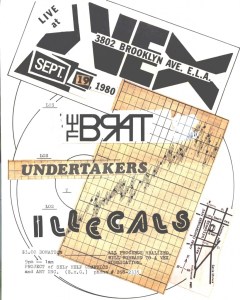
Although the legacy of care from the pogo has transcended into what we now know as “pit etiquette,” the mosh pit has made its home within punk and much like the process of gentrification, is secured at the expense of the communities that came before it. Thus, I look to the the current struggles of Mariachis in Boyle Heights to analyze gentrification as not just the displacement of a community or neighborhood, but also as a contemporary reminder that the attack on Latinx artistic practices is both ongoing and deeply rooted in Los Angeles history. The resilience of Chicana/Latina soundscapes today attests to our D.I.Y/Do It Yourself tools of recovery, testimonio, sonic and physical nepantlerisma or sonic in-betweenness that made it possible for me to share my interpretation of what happened to the pogo, a side of Chicanx L.A. history that neither physical demolition, hipsters, or even the current political climate can take away.
—
Featured Image: Alice Bag in mid-pogo, at Cinco de Mayo show, 2007. Lysa Flores on guitar.
—
Marlen Ríos-Hernández is a Ph.D. Candidate in the Ethnic Studies Department at the University of California, Riverside. Her current research revolves around queer Chicana/Mexicana punks in Mexico and Los Angeles from 1977-early 2000s. Her dissertation aims to theorize and argue how Alice Bag, an innovator of the 1970s Los Angeles punk scene alongside other Mexicana punks, utilized noise to correlate the systemic disenfranchisement of womxn of color with the desire for transformational change integral to the survival of Mexicanas and first generation Chicana womxn, especially during the Reagan and Bush Administrations. Via Ethnic Studies as her area of study along with her humanities and arts training as a Musicologist, Marlen investigates the relationship between unruly Chicana/Mexicana performing bodies and bisexuality, swapmeets, police brutality, photography, and film as instruments of noise-making necessary to invert normative gender and sexual politics in punk.
—

REWIND! . . .If you liked this post, you may also dig:
If La Llorona Was a Punk Rocker: Detonguing The Off-Key Caos and Screams of Alice Bag – Marlen Ríos-Hernández
Riot-Grrrl, Punk and the Tyranny of Technique – Tamra Lucid
An Evening with Three Legendary Rebel Women at Le Poisson Rouge, January 27, 2017: Margot Olavarria, Bibbe Hansen, and Alice Bag –Elizabeth K. Keenan
—
Share this:

Unapologetic Paisa Chingona-ness: Listening to Fans’ Sonic Identities

DOI: https://doi.org/10.59350/61nc7-e3063
For the full intro to the series by Michelle Habell-Pallan, click here.
The forum’s inspiring research by scholars/practioners Wanda Alarcón, Yessica Garcia Hernandez, Marlen Rios-Hernandez, Susana Sepulveda, and Iris C. Viveros Avendaño, understands music in its local, translocal and transnational context, and insists upon open new scholarly imaginaries. . .
Current times require us to bridge intersectional, decolonial, and gender analysis. Music, and our relationship to it, has much to reveal about how power operates within a context of inequality. And it will teach us how to get through this moment. –MHP
—

I am a self-identified Paisa, a Paisa Girl from Playa Larga – my home – in the Eastside of Long Beach, California. The term paisa/s is slang for paisanos (homies) and it references someone who takes pride in listening, dancing, and attending nightclubs where Banda music, corridos, and norteños are performed. I am part of a generation that has been referenced as the Chalinillos; youth with an urban gangsta aesthetic that was influenced by Chalino Sanchez, The Riveras, Saul Viera, Adan Sanchez, Los Dos Grandes, Tigrillo Palma, Los Amos; later came the Alterado, Progressivo (DEL) and now people like El Fantasma, Lenin Ramirez, Alta Consigna, Grupo Codiciado, Jesus Mendoza, and Los Perdidos de Sinaloa.
As they say, “Fierro Parriente!” “Andamos al Millon,” “Pa que vayan y digan” and “Puro Pa Delante!”
In the mid 2000s, besides partying hard in the paisa nightclub music scene, I also partied with several paisa party crews in Long Beach. The songs, “Las Malandrinas,” “Parrandera,” “Rebelde, y Atrevida,” and “Mi Vida Loca” by Jenni Rivera were my anthems. These songs described the music scene we were a part of, and how we situated ourselves within a male-dominated subculture. “La Malandrinas” for instance says that we make a lot of noise, we drink, ask for corridos at clubs (a masculine tradition) and do not care about what people say about us.
Thus, Jenni’s participation in this music genre was important because she created paisa sonic identities for the women in this subculture. “Sonic identities”, is a term that I use to describe the process fans engage in when they use a song to create a nickname and identity for themselves. This is a common practice among party crews and fan clubs. For instance, the nickname that I gave myself was “La Yaquesita” which is a title of a song. My participation in this nightlife shapes my analysis of this subculture. The gender dynamics and negotiations I had to engage with in this space made me an unapologetic feminist (although I did not call myself that at the time) who was fierce and defended herself but who—despite the slut shaming—approached this nightlife through a sex-positive attitude. Our attitude was “Fuck Haters!” and having this mentality was liberating. So, it makes sense that now I write about haters –or what Jonathan Gray calls anti-fans. I am interested in analyzing sonic haterism and how it tries to police Latina women-centered and sex-positive spaces like fan clubs and paisa party crews.

In my dissertation entitled, “Boobs and Booze: Jenni Rivera, the Erotics of Transnational Fandom and Sonic Pedagogies,” the intertwined themes of sound and home emerges via a loud shout-out of my hometown that sounds like “Playa Larga, Baby” or a louder shout out that says “Son Ovarios de Playa Larga, Chaooowww, Baby.” Similar to “Fuck Haters!,” the latter shout-out implies a particular attitude and feminisms rooted in unapologetic paisa chingona-ness. Paisa Chingona-ness is the sonic condition, the rebellious and intoxicating state of being a chingona “rancherota.” Chicana feminists such as Sandra Cisneros and Josefina Lopez have defined and theorized being a chingona in multiple ways. In her poem titled “Chingona,” Lopez for instance defines a chingona as a sex-positive Chicana who refuses to be slut-shamed for owning her fat body, sexuality (literally she loves to be on top), and agency. There are overlaps with how Lopez, Jenni and her fans practice being chingonas; however, the added layer with Paisa Chingona-ness is that Jenni’s music and fandom shapes the way they embody it.
Activist and Writer, Raul Alcaraz Ochoa, has written a piece titled “Jenni Rivera y los 9 Puntos del Feminismo Chingona” here he acknowledges that Chingona Feminism is rooted in the barrio, the hood and is born from within and in response to a machista context, where the priority is always given to men. According to Ochoa, Chingona Feminism is also born from race oppression and class-struggle. Ochoa states that Jenni “dice lo que piensa sin pelos en la lengua, te agrede si eres injusto porque su lengua es una bala que te deja con los huevos estrellados.” My work shows how chingona feminism is also practiced and embraced among fans. I expand on Ochoa’s analysis to think through Paisa Chingona-ness which asks us to listen to the “details” that Chingonas make when they are surrounded by each other.
Heard through my experiences, identifications, and stance toward the world, it makes sense why home manifests itself in the approach that I use to study popular music: that of fandom, that prioritizes fans and their approach to what I call sonic pedagogies. Which is a concept that was inspired by scholars such as Deborah Vargas, Alicia Schmidt Camacho, Jillian Hernandez, Anya Wallace, Gloria Anzaldúa, and Martha Gonzalez. These scholars write about the power of music as “sung theory,” the power of music to create “sonic imaginaries,” or inspire teachings between the artists and the listener, that oftentimes creates “an erotic of feminist solidarity.”
For me, sonic pedagogies is a concept that centers the fan and what John Fiske has called their “textual, enunciative, and semiotic productivity.” Sonic pedagogies allows me to think about the affective and corporeal fan-to-fan teachings that are inspired even when the artist is dead and yet their legacy and conocimientos are being used to teach fans to understand each other. Sonic Pedagogies centers the practice that Lawrence Grossberg explains when he states, that fans give “authority to that which he or she invests in, letting the object of such investments speak for and as him or herself” (59).

Listening to sonic pedagogies asks us to write about music from a different perspective, from the perspective of its fans. Oftentimes we listen and write about music from the perspective, the voice, the body, and lyrics of the artist. But what if we start from their re-interpretation of a song in a YouTube video for instance? What if we start from a fan shout-out during a concert? What if we start from the conversations that emerge when fans talk about their favorite songs to non-fans? What if we make anti-fans our starting point to understand an artist or a music genre? Analyzing music in this way allows us to hear the multiple sonic layers that a song and music in general inspires.
I am also a filmmaker, so the way I understand sound and the reception of music is inspired by how I edit sound for a film. When we edit film, we layer the sound, we usually have at least three layers of sound: the interview (main story and Track 1), music (Track 2), and background noise (Track 3). However, sometimes you can have up to 20 sonic tracks layered at once and, actually, is how I have experienced fandom. There’s a song that we usually are listening to because we identify with it (Track 2), then we add our own conocimiento to the song (Track 1), that conocimiento or what many times turns into “archisme” provokes background noise of solidarity (Track 3), either to show the other fan that you understand, acknowledge, and relate to what they are sharing. Fans ask us to listen to the study of music from a perspective of “love” (Duffet), “magic” (Guy) and “erotics.”
Scholars in the field of fan studies such as Daniel Cavicchi have defined fandom as “not some particular thing one has or does. Fandom is a process of being; it is the way one is” (59 ). Alexandra Vasquez, in particular, reminds us of the importance of “listening to details” when thinking about fandom, music and performance. Sonic Pedagogies requires that I listen to the “details” of audience members, fans, and anti-fans that tell me about how Chicana/ Mexicana/Latina women resist structures of governmentality by questioning gender norms, and traditional ideas about sexuality. In Listening on Detail, Vasquez explains that details are “interruptions that catch your ear, musical tic that stubbornly refuse to go away. They are things you might first dismiss as idiosyncrasies. They are…saludos, refusals, lyrics, arrangements, sounds, grants, gestures, bends in voice” (19). In my work, Jenni chants, removal of clothing, mobile recordings, posters, fliers, fan shirts, and sing alongs, are the details that allows me to examine Jenni Rivera.
For instance, I analyze the deschichadera “removal of bra” ritual that both Jenni and her fans engaged in during concerts. I am fascinated by the deschichadera ritual and Jenni’s concerts in general because these fans are constantly redefining home, embodying Cherrie Moraga’s feminist praxis of “making familia from scratch” (58).
Thus for fans, home is found in the affective, erotic, collective, and intimate aspects of music reception and its sociality. Home is found in fan clubs, fan gatherings, tribute events, living room, and the travels of bumping music in the car. Listening to the details of fans allows me to view audience responses to Jenni’s performance part of Jenni’s own presentation and music, not separate from them. Engaging music through fans allows me to see that songs, concerts, and albums do not end when the music stops.

In “Boobs & Booze,” home also appears in murals, particularly their visual representations of Mexican music. In the vein of Deborah Paredes’s study of Selenidad, I write about the visual politics of Jenni’s remembering, particularly Jenni Rivera Memorial Park, dedicated by the city of Long Beach in 2015. Home appears in the fashion that we decide to dress our bodies in, especially the femme challinillo aesthetic, and homegirl/Pachuca/partygirl look that Jenni performed on stage. We also find home in the memories we make when we listen to a particular song. So for me, listening to” Mi Vida Loca” for instance always bring me back to Long Beach, the barrio that has shaped me as a chingona feminist, scholar, and artivist.
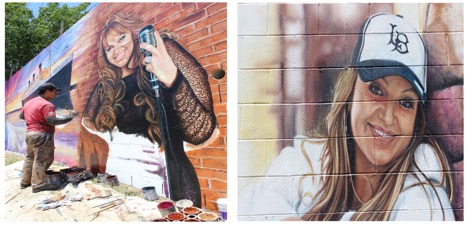
Home is the music that we take with us, the music and sounds that we carry in our backs when we enter white or middle-class dominated spaces where our paisa music is not acknowledged or it is even looked down upon and critiqued for being “too Mexican,” “too chunti,” “too low.” Home and sound makes me think of how people of color co-exist with each other sonically. In the EastSide of Long Beach, for instance, home and sound is black and brown relations, tensions, and solidarity. Home and sound is acknowledging that both corridos, hip-hop, and G-Funk relationally, has formed paisas. I mean, I also get an adrenaline rush when I hear Snoop Dog, Warren G, Nate Dogg, O.T Genasis, and Ladies of Beach City referencing their roots to Long Beach, as Snoop says, “it’s an Eastside thang.”
The recent example of Playa Larga’s black and brown sonic solidarity is Snoop Dog’s recent Instagram video listening to Jenni’s music. Watching two Playa Larga finest artists being fans of each other, despite the differences in music genre, language, and spatial politics (East vs. West) is powerful, it tells us that we listen to each other even when they try to put us against each other. In this video, Snoop Dogg embodies the “We have each other” solidarity with which Gaye Theresa Johnson ends Spaces of Conflict, Sounds of Solidarity: Music, Race, and Spatial Entitlement in Los Angeles (189).
Rip jenni rivera- sweet lady n a beautiful voice she will b missed we were supposed to do a song together Im so sad!
— Snoop Dogg (@SnoopDogg) December 10, 2012
Listening to Chingona-ness pushes me to theorize a new framework for anti-fandom, one that centers race, class, sexuality, and is not only about an artist’s music– or what Gray calls the “text” – but also about their bodies and the bodies of the fans, their ontologies, and existence. Focusing particularly on Jenni and her fans allows me to think about gender, sexuality, class, pleasure, music reception in relation to anti-immigrant sentiments, war on drugs, war on poverty, and the war on Latina reproduction and fatness. Jenni as a case study allows me to explore how unapologetic paisa chingona-ness triggers anti-fans, exposes what I am calling agitations and their “agitated responses.” Agitated responses refers to the hater comments that anti-fans (or non-fans) make towards Jenni, (and there are many), while agitation is the carnal disgust that anti-fans display when they police the behavior of Jenni and her fans. In this anti-fandom framework, agitation is the disaffection – the visceral aggression or enmity – that people who hate Jenni and her fans express when they write, say, or gesture agitated responses towards them, a form of sonic haterism.
I entered academia to theorize my home and write the paisa girl epistemology since there is little literature written on our sonic identities, and to show how sonic haterism, in conversation with fandom, allows me to understand the historical, social, and cultural realities working-class Latinas face. Here is how Jenni Rivera once expressed this same intersection in the song “Mi Vida Loca,” which asks listeners to hear what Paisa Chingona-ness sounds like in Playa Larga, her sonic home, and mine too.
—
Featured Image: Paisa Party Crews in Long Beach, The Myspace Days , courtesy of author
—
Yessica Garcia Hernandez is a doctoral candidate and filmmaker in the Department of Ethnic Studies at the University of California San Diego. Her scholarship bridges fan studies, sound studies, women of color feminisms, fat studies, girl studies, and sexuality/porn studies to think about intergenerational fans of Mexican regional music. Yessica earned her B.A. in Chicanx Studies from University of California, Riverside and an M.A. in Chicanx and Latinx Studies at California State University Los Angeles. She has published in the Journal of Popular Music, New American Notes Online, Imagining America, Journal of Ethnomusicology, and the Chicana/Latina Studies Journal. Her dissertation entitled, “Boobs and Booze: Jenni Rivera, the Erotics of Transnational Fandom, and Sonic Pedagogies” examines the ways in which Jenni Rivera fans reimagine age, gender, sexuality, motherhood, and class by listening to her music, engaging in fandom, and participating in web communities. She explores the social element of their gatherings, both inside and outside the concert space, and probe how these moments foreground transmissions of Latina power. Yessica’s broader research interests includes paisa party crews, Banda Sinaloense, Contestaciones, and Gordibuena/BBW erotics. She is a co-founder and member of the Rebel Quinceañera Collective, a project that utilizes art, music, photography, creative writing, filmmaking, and charlas to activate spaces for self-expression and radical education by and for youth of color in San Diego.

—
REWIND! . . .If you liked this post, you may also dig:
Deep Listening as Philogynoir: Playlists, Black Girl Idiom, and Love –Shakira Holt
Listening (Loudly) to Spanish-language Radio—Dolores Inés Casillas
Feeling Through the Keen and Grind: Team Dresch’s Personal Best –Gretchen Jude
New Wave Saved My Life—Wanda Alarcón
—
Share this:




Current Top Posts





April 2021

January 2020

November 2019

October 2019

August 2019

April 2014

November 2017

March 2015

December 2017

October 2015


Recent Comments