
The Sweet Sounds of Havana: Space, Listening, and the Making of Sonic Citizenship


DOI: https://doi.org/10.59350/xg4mz-b3k40
Welcome to the third and final installment of Unsettling the World Soundscape Project, a series in which we critically investigate the output of early acoustic ecology and assess its continuing value for today’s sound studies. In our first post, Mitchell Akiyama addressed the WSP’s ten-hour Soundscapes of Canada radio series from 1974 to situate the broadcast’s innovative work historically and explore how it attempted to represent a diverse nation by way of sound. In my follow-up post, I focused on the WSP’s Vancouver research, their only output since returning from Europe in 1975, assessing shifts in the ideologies and practices over its two official releases and arguing for the best path that future iterations of the project might follow.
In this final entry, Vincent Andrisani puts the “world” back into the World Soundscape Project by carrying his experience as the recordist for the WSP’s last archiving mission in Vancouver out into his solo doctoral research in Havana, Cuba. Andrisani lends an unsettled ear to one of the city’s most beloved sounds, the tune of the ice cream vendor, unpacking its social and historical significance to make an argument about the role that sound plays in local self-definitions of citizenship. Inspired by the WSP’s continuing quest to discover how people’s relationship to places can be defined through sound, Andrisani’s work offers an example of what contemporary soundscape research can be while demonstrating how to deal with many of the concerns raised about the WSP’s output over the course of this series.
It has been a great pleasure acting as editor for this series over the past few weeks and it is our hope that these posts will provide further fuel for celebrating, expanding, critiquing and rethinking the work of acoustic ecology in the broader context of contemporary sonic research.
— Guest Editor Randolph Jordan
—
To conceive of Havana in sound is to think not of the material spaces of the city, but rather, across them. From inside the home, residents participate in conversations taking place in the streets, while those in the streets often call for the attention of their friends or family indoors. Through windows, open doors, and porticoes, residents engage in interpersonal exchanges that bring neighbourhood communities to life. To listen across these spaces is to listen trans-liminally from the threshold through which sounds must pass as they animate the vibrant social life of the city. Such an act is made most apparent by the voices of vendedores ambulantes, or, mobile street vendors. “¡El buen paquete de galleta!” (“The good packs of cookies!”), “¡Se compran y se vendan libros!” (“I’m buying and selling books!”), and most famously, “¡Mani! ¡Mani!” (“Peanuts! Peanuts!”) are some of the pregones—the musical cries—heard through the streets and into the home.
But not all vendors are pregoneros. El heladero, the ice cream vendor, uses the jangly melodies of the electronic music box to make ears perk up, mouths water, and children’s shoes hit the ground running. The sound signals a respite from the sweltering Caribbean heat and is symbolic of a novelty food item for which Cubans have a strong cultural affinity. But most of all, the ice cream vendor’s melodic tunes bring people out of their homes and into the street, giving life to a moment that is as social, participatory, and convivial as it is savory.

For over a century, ice cream vendors have been heard on the streets of Havana. Throughout this time, the city’s spaces have been contested by external regimes of power that include the Spanish Crown, U.S. business interests, Cuba’s own socialist government, the Soviet Union, and since the 1990s, Cuba’s resurgent tourist economy. Yet, in spite of the exclusionary logic imposed by each of these systems of power, the sound of the ice cream vendor still remains. To listen to it is to listen to Havana according not to the agenda of outside interests, but rather, according to the collective interests of residents themselves.
Borrowing from the work of Saskia Sassen (2006) who maintains that “citizenship practices have to do with the production of ‘presence’ of those without power and a politics that claims rights to the city” (315), I regard the tacit, communicative, trans-liminal act of listening as a means through which residents assert their embodied presence amidst both the spatial and political landscapes of the city. Listening to the sound of the ice cream vendor, I argue, constitutes an act of citizenship—an act of sonic citizenship—that momentarily claims Havana’s spaces according to the aims, aspirations, and desires of those who live there.
Citizenship, in this sense, is conceived of not as an institution bound to the political-juridical architecture of the nation-state, but rather, as a place-based “practice and project” (Sassen, p281) that, over time, has the potential to condition changes in the formalized institution itself. It emerges in the everyday, rather ordinary moments during which the city’s spaces are produced and given meaning by those with unequal access to political power. Just as Jennifer Stoever (2011) and Michael Francis O’Toole (2014) have discussed elsewhere, I too contend that citizenship is articulated in sound, but in order to hear it, we must listen historically to—and through—the spaces of Havana’s built environment.
The above clip, which I captured while conducting fieldwork in Havana, represents a moment of everyday life in the municipality of Centro Habana. While speaking about it with friends, colleagues, and acquaintances, I came to realize that only recently had the ice cream vendor’s heralding music become part of the local soundscapes. “Where was it before that?”, I asked. “Before that,” they all said, “it was gone.” In 1990, the Soviet Union collapsed and brought Cuba’s economy along with it. Shortages of food, petrol, and material resources were so severe that satisfying basic needs took precedence over the delivery of frozen novelties. The result was the loss of the ice cream vendor—and its corresponding sound—which, for decades, was part of the ongoing, everyday life of the city.
Fittingly, the collective sentiment surrounding that loss is captured in song. “Helado Sobre Ruedas,” or “Ice Cream on Wheels” by Gema y Pavel was released in 1994, during the height of Cuba’s economic crisis. In it, the duo lament the disappearance of the ice cream vendor from the streets of Havana and reflect on what it meant not only to them, but to all residents of the city. They speak about the presence of the ice cream vendor as a ‘refreshing’ event on hot days; as a source of joy, pleasure, and happiness that offered much more than a simple respite from the heat, but as one that “made family problems disappear.” The “sweet melody” of the vendor was the cause for celebration in neighbourhoods across the city, and is a sound that the duo recalls with both warmth and affection.
Throughout most of the twentieth century, ice cream sales in Havana looked and sounded much like it did in the United States. Minnesota-based Nichols Electronics developed the technology of the electronic music box in the mid-1950s, and within a few years, its chime-y sounds were heard on the streets of Havana. The frozen novelty itself can be traced back to 1920 in Youngstown, Ohio. Harry Burt, the eventual founder of the Good Humor brand paired, first, the lollipop’s wooden stick with chocolate covered vanilla ice cream, and subsequently, ice cream sales and automobility. In Havana, brands such as Hatuey, Guarina, and El Gallito borrowed Burt’s developments, and by the time the city underwent its westward suburbanization in the 1940s and ’50s, mobile ice cream sales were booming.
But if we listen further still into Havana’s past, we can discern the ways in which the ice cream vendor’s music echoes the complex history of the city. During Cuba’s struggle for independence in the late 1800s, American traditions and customs such as baseball, Protestantism, and new habits of hygiene began emerging in Havana. At once a rejection of the perceived backwardness of Spanish culture and an appeal to modernizing the island, this cultural appropriation was, as both Louis A. Pérez Jr. (1999) and Marial Iglesias-Utset (2011) have carefully observed, a way for residents to perform acts of citizenship with the intent of defining the customs of the impending nation.
It is perhaps no coincidence, then, that the practice of street side ice cream vending arrived in Havana at this very moment following its proliferation in cities such as Barcelona, London, and notably New York. These vendors performed a series of decisive functions amidst the city’s political geography, the most discernible of which was that they offered an opportunity for the working class to indulge in what historically was a bourgeois delight. Of equal importance however, was that ice cream vendors were also participants in Havana’s project of cultural modernization, and their street side presence enabled locals to inhabit the acoustic spaces of the city on their own terms and not those of the Spanish Crown.

This photograph, taken in Havana some time between 1890 and 1910, can be read not only as a silent image, but as an audiovisual text. Without any visible technology with which to herald his presence, it’s likely that this vendor relied on his own voice in the form of a pregón. We might imagine the slow rumble of the cart’s wooden wheels as they rolled over the unpaved road, glass cups jangling as the cart bounced along, and enthusiastic voices congregating in the street to buy what was known as a “penny lick.” Each of these sounds moved across the liminal spaces of the built environment, each marking a moment of savory indulgence and neighborly dialogue in the life of the city—as they do again today.
Listening to, documenting, and as historian Bruce R. Smith (2004) terms it, “un-airing” the history of Havana’s ice cream vendors offers a means through which to cultivate unexplored encounters with the city. It animates a narrative grounded not in political rupture, but in historical continuity; it locates a geography characterized not by unequivocal exclusion, but one that, quite simply, belongs to those who live there; and in so doing, it develops an account of the city not from the top-down, but rather, from the bottom-up. Such an approach renders audible the enactment of citizenship by listening for the sounds that firmly ground citizens in the very spaces that, time and again, have been destabilized by forces imposed from above.
To hear the ways in which citizens inhabit the city of Havana, we must simultaneously listen trans-liminally, across the open spaces of the built environment, and into the city’s history, which resonates through the sounds of neighbourhood communities, interpersonal dialogue, and social interaction. The heralding music of the ice cream vendor is one sound that does precisely that: for some, it offers a sense of childhood nostalgia, for others, it conjures the taste of a delicious frozen snack. But in every case, to listen to it is to enact a form of civic memory that orients residents according to both the spaces they inhabit, and the social and cultural history to which they belong. It comprises a moment, liminal as it may be, during which the city is lived, experienced, and imagined according to the interests of no one other than citizens themselves.
Acknowledgements: A sincere thanks to my extended family in Havana, to the academic community at Fundación Fernando Ortiz, and in particular, to Dr. Aurelio Francos Lauredo for his time, guidance, and for his attentive and compassionate ear.
—
Vincent Andrisani is a PhD Candidate and an instructor in the School of Communication at Simon Fraser University. He has written and lectured on the topics of popular music, broadcast media, and the politics of audio documentation in the context of Soundscape Studies, and has presented his research in a number of artistic and academic venues; the most recent of which was at the Pan-American Mobilities Conference in Santiago, Chile in 2014. Intersecting the areas of Sound Studies, Urban Geography, and Cuban Studies, Vincent’s doctoral research explores the relationship between sound, space, and citizenship in the city of Havana. In addition to the ice cream vendor, the sounds of water pipes, international travelers, and street musicians performing “Guantanamera” and other likely tunes form the basis of the study. http://www.vincentandrisani.com.
—
Featured image:Ice cream vendor in Havana, courtesy of University of Miami Libraries, Cuban Heritage Collection.
—

REWIND! . . .If you liked this post, you may also dig:
Radio de Acción: Violent Circuits, Contentious Voices: Caribbean Radio Histories — Alejandra Bronfman
Snap, Crackle, Pop: The Sonic Pleasures of Food — Steph Ceraso
Listening (Loudly) to Spanish-Language Radio — Doloris Inés Casillas
—
Share this:

Straight Outta Compton . . .Via New York

DOI: https://doi.org/10.59350/440bb-mrr46
Sounding Race in Rap Songs explores the production of musical identity in hip hop’s first two decades as a commercial genre. Although I don’t ignore lyrics or visual imagery, my main purpose is to analyze rap music as music, to understand how specific artistic decisions contribute to racial meaning in particular songs. My methods revolve around the study of how producers manipulate breakbeats, also commonly known as “breaks.” Initially understood as short, percussion-heavy passages that appear in many songs recorded in the 1960s and 1970s, breaks have been central to hip hop from the music’s earliest days in the South Bronx when DJs began isolating and looping them on their turntables to the delight of dancers. Since then, producers have tried out new approaches to working with breakbeats: hiring studio musicians to re-record them; programming drum machines to imitate them; and using sampling-sequencing technology to capture and rearrange them.
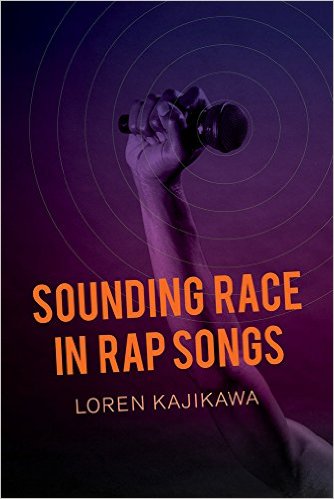
Throughout the book, I describe how producers use breaks and give rise to musical-racial codes that can be manipulated to project a variety of identities and attitudes. The following excerpt from the third chapter of Sounding Race, explains how the style of beat making popularized by the New York-based Bomb Squad (Public Enemy’s production team) provided a blueprint for pioneering west coast gangsta rap group N.W.A’s depiction of Compton, California. By layering multiple loops into a dense, cacophonous mix, N.W.A transposed Public Enemy’s “too black, too strong” sound onto the world of Los Angeles’s postindustrial streets.
N.W.A and its former members have been in the news recently thanks to the biopic Straight Outta Compton. Yet one aspect of the group’s development downplayed in the film is the way that its members formulated their identities in relation to east coast rap. In the mid-1980s, New York was the undisputed center of the industry, and its influence on L.A.-based acts is easy to see and hear. Ice Cube’s first group C.I.A. ( Cru’ In Action) used a nasal, hocket style approach to rapping cribbed directly from the Beastie Boys 1986 album License to Ill. And the cover of N.W.A’s first album N.W.A and the Posse, features numerous group members posing with the giant clock necklaces made famous by Public Enemy’s Flavor Flav. In similar fashion, the beat Dr. Dre produced for “Straight Outta Compton” (the title track to their breakout 1988 album) followed the Bomb Squad’s potent formula for signifying militant blackness. —Loren Kajikawa
—
The following is an excerpt from Chapter Three “‘Let Me Ride’: Gangsta Rap’s Drive Into The Popular Mainstream,” of Loren’s Kajikawa’s Sounding Race in Rap Songs, with thanks to The University of California Press. Any notes have been included in the text to conform to Sounding Out!‘s style sheet.
We [Public Enemy] were in Vegas and they [N.W.A.] were on tour with us, and I had just got the vinyl in. That’s what this is all about. Because Run-DMC and LL Cool J gave me energy. And if our energy happened to be transferred to N.W.A., then that’s what this whole thing is for.” Chuck D as quoted in Brian Coleman, Check The Technique: Liner Notes For Hip-Hop Junkies (New York: Villard Books, 2007), 354.
According to Chuck D, Public Enemy’s musical style directly influenced Dre, and he recalls giving the first two copies of It Takes a Nation of Millions To Hold Us Back to Dr. Dre and Eazy-E prior to the album’s official release. The recorded evidence supports Chuck D’s recollection. For many of the tracks on Straight Outta Compton, Dr. Dre seems to have borrowed from the “loops on top of loops” style of Public Enemy’s Bomb Squad.
In fact, when Ice Cube left N.W.A. in 1989, he hoped that Dre would continue to make beats for his solo project. When this proved impossible due to Dre’s contractual obligations to N.W.A., Ice Cube began collaborating with the Public Enemy’s Bomb Squad, which served as the production unit for his album Amerikkka’s Most Wanted (1990). N.W.A.’s breakthrough was finding a way to put a distinctive spin on these influences, and the artistic strategy that they arrived at for their first Ruthless Records release was designed to put themselves on the map—both literally and figuratively.
Rather than shout out the multiplicity of neighborhoods where their members were actually from (as they had done in “Panic Zone”), N.W.A. chose to center their identity around Dr. Dre and Eazy-E’s hometown of Compton, California. The sound of Compton as Dr. Dre imagined it, however, drew on musical practices and artistic decisions similar to those found in Public Enemy’s “Rebel Without a Pause.” To construct the rhythmic foundation of “Straight Outta Compton,” Dre looped the breakbeat from The Winstons’ “Amen Brother” (1969), one of the most sampled beats in hip hop, that also served as the foundation for dozens of songs in the UK’s “jungle” (aka “drum and bass”) genre.

Like other heavily sampled breaks from this era, the one-measure loop features a syncopated interlocking of snare and bass hits that is reminiscent of James Brown’s “Funky Drummer (featuring Clyde Stubblefield’s famous beat). As if he were following the Bomb Squad’s exact formula, Dr. Dre layered a drum machine (Roland TR-808) over this break.

The 808 was programmed to add its characteristic bass boom to the first two drum kicks of the “Amen” loop, and to tick off a 16-count hi-hat pulse with a closing hi-hat clasp on the downbeat of every other measure. The “Amen” break and the two hi-hat parts, provide the rhythmic foundation around which Dr. Dre places numerous other repeating sounds. Two other ingredients stand out in this beat: a guitar ostinato and a low drone on what sounds like a baritone sax or trombone (or perhaps a downwardly pitched sample of another instrument). The guitar ostinato, which plays straight eighth-notes on E-flat except for a one step descent to D-flat on the “and” of every fourth beat, churns out tight 1-measure units of sound.

The horn drone (also on E-flat) has a raw, muddled quality, and casts an ominous cloud over the track.
By combining these layers with the dense percussion track, Dre created a tightly packed funk groove with many sonic similarities to Public Enemy’s Bomb Squad. Like “Rebel Without a Pause,” the track to “Straight Outta Compton” features tight 1-measure loops stacked on top of one another to create a thick and intense groove.

Except for the drone, most of the elements in the track have a punchy feel, full of rhythmic stabs and staccato attacks, including the automatic gunfire that Dre samples to follow Ice Cube’s reference to an AK-47 assault rifle. Due to the “noisiness” of the beat, the way sonic space seems filled to maximum capacity, the members of N.W.A.—similar to Public Enemy’s Chuck D and Flavor Flav—practically yell their verses, as if they must raise their voices in order to be heard over the cacophony. Even before the actual words to “Straight Outta Compton” are digested, the sound of the track and the group’s vocals evoke the palpable tension of imminent conflict, which reinforces the theme of violent confrontation in the song’s lyrics. For the chorus of “Straight Outta Compton,” Dr. Dre strings together a series of samples with rapid-fire precision. The sound of screeching car tires from Davy DMX’s “One for the Treble” is followed by turntable scratching; the scratching leads directly to a choppy sample of the words “City of Compton” from Ronnie Hudson’s “Westcoast Poplock,” which is then followed by more scratching. The whole chain of musical events is deployed over the breakbeat from Funkadelic’s “You’ll Like It Too,” which Dr. Dre splices into the beat just for the chorus. The rapid cutting from one sample to the next exemplifies the “rupture” Tricia Rose identifies as fundamental to hip hop’s post-industrial aesthetic in Black Noise: Rap Music and Black Culture in Contemporary America (39).
Thus, the music and lyrics for “Straight Outta Compton” depict the city as a place of extremes, where things happen fast and change is sudden and complete. It is a place where one is either equipped to deal or left behind. In this way, Dr. Dre exploited the spatial characteristics encoded in Public Enemy’s music to depict Compton as place. The sonic characteristics that animated Public Enemy’s militant blackness were rerouted and effectively transposed onto N.W.A.’s depiction of Los Angeles gangstas.
—
Loren Kajikawa has served on the faculty at the University of Oregon’s School of Music and Dance since 2009. His main area of research and teaching is American music of the twentieth and twenty-first centuries, and he offers a variety of courses in music history, ethnomusicology, and musicology. Kajikawa’s writings have appeared in American Music, Black Music Research Journal, ECHO: a music-centered journal, Journal of the Society for American Music,and Popular Music and Society, among others. His recent book Sounding Race in Rap Songs (University of California, 2015) explores the relationship between rap music’s backing tracks and racial representation.
—

REWIND! . . .If you liked this post, you may also dig:
“‘I’m on my New York s**t’: Jean Grae’s Sonic Claims on the City”––Liana Silva
Love and Hip Hop: (Re)Gendering The Debate Over Hip Hop Studies–Travis Gosa
Caterpillars and Concrete Roses in a Mad City: Kendrick Lamar’s “Mortal Man” Interview with Tupac Shakur–Regina Bradley
—
Share this:




Current Top Posts





April 2021

January 2020

November 2019

October 2019

August 2019

April 2014

November 2017

March 2015

December 2017

October 2015


Recent Comments