
Listening to #Occupy in the Classroom

Yes, it’s that time again, readers. You are going to have to stop pretending the “Back to School” aisles haven’t been appearing in stores for the past few weeks. We at SO! are here to ease your transition from summer work schedules to the business of teaching and student-ing with our fall forum on “Sound and Pedagogy.” Developed to explore the relationship between sound and learning, this forum blends the thinking of our editors (Liana Silva), recruited guests (D. Travers Scott), and one of the winners of our recent Call For Posts (Jentery Sayers) to explore how listening impacts the writing process, the teachable moment, and the syllabus (and vice versa). We hope to inspire your fall planning–whether or not you teach a course on “sound studies”–and encourage teachers and students of any subjects to reconsider the classroom as a sensory space. We also encourage you to share your feedback, tips, and experiences in comments to these posts and on our Twitter, Facebook, and Reddit sites. As I said in the Call for Posts for this Forum: “because teaching is so crucial—yet so frequently ignored at conferences and on campus—Sounding Out! wants to wants to provide a virtual space for this vital discussion.” This conversation will be ongoing: we will also bring you a “Spring Break Brush-Up” edition in 2013 featuring several more excellent posts by writers selected from our open call. Right now, the bell’s about to ring–so take a seat, open those ears, and enjoy this shiny auditory apple of an offering from D. Travers Scott in which he discusses how the sounds of #Occupy invigorated his classroom. And, yes, it will be on the test. —JS, Editor-in-Chief
—

DOI: https://doi.org/10.59350/g5wbz-4bz75
In the late fall of 2011, I was teaching a class on cultural studies of advertising. I presented the Occupy Student Debt campaign, a subcategory or spinoff of the larger Occupy movement, while we were examining ways people challenged consumer culture. We discussed education as a commodity and students as consumers. Unsurprisingly, my seniors were dissatisfied consumers. They expressed that what had been advertised to them was a product that guaranteed or at least would strongly increase their chances for quality employment (of course, it was also a product they had worked for years in creating, and one they couldn’t return.) If higher education really did land you the lucrative job it had been advertised as guaranteeing, in theory, then, you would be able to more easily pay off student loan debt. To address this dissatisfaction, I showed them two artifacts: a video from the launch in New York City on November 12, 2011, and the OSD debtors’ pledge*.
In the video, OSD founder Pamela Brown reads the pledge one line at a time, with each line chanted back by others. I played the video in a dark classroom. I also projected it on the room’s main screen, but I didn’t use the room’s amplification system because it sounds too much like an authoritarian public address and disperses the audio in a dominating way. External speakers connected to my laptop made the sound feel, to me, more localized and objectified, something we could focus on rather than an institutional part of the room. The students’ first reaction was, not to the words, but the sound: the verbal relay used at the public demonstration. Brows furrowed and heads cocked quizzically, they asked, “Why are they all repeating the speaker like that?” I explained how this provides additional amplification, but the students’ listening experience was instructive to me. Their unfamiliarity with a sonic practice of vocalization indicated their unfamiliarity with larger practices of collective, public social action.
Listening to OSD, and paying attention to how my students listened to it, informed me of larger contexts they needed to understand and discuss it, in ways that the object of the text did not suggest to me. It made me think about the experience and process of my students’ encountering OSD. I immediately noticed its ambient sounds of city life, which I no longer hear. These sounds of traffic, the acoustics of being surrounded by buildings, etc. gave several urban dimensions to the movement the pledge text did not. From the perspective of Upstate South Carolina, “urban” is not a simple thing, an identity or geography category, but intersectional: our largest city, Greenville, has a population under 60,000. City noises feel not merely urban, but un-Southern, and thereby alien. (I say un-Southern rather than Northern or Yankee because another thing I’ve learned here is the inadequacy of that binary: Los Angeles, for example, is not a Northern city but most certainly is as un-Southern as New York. Cities also carry a class dimension.) Even though my school is one of the elite institutions in this area, this region is still worse off economically than the rest of the country and has a generally lower cost of living. Cities require money to live in. In spatial, class, and urban dimensions, OSD felt alien.
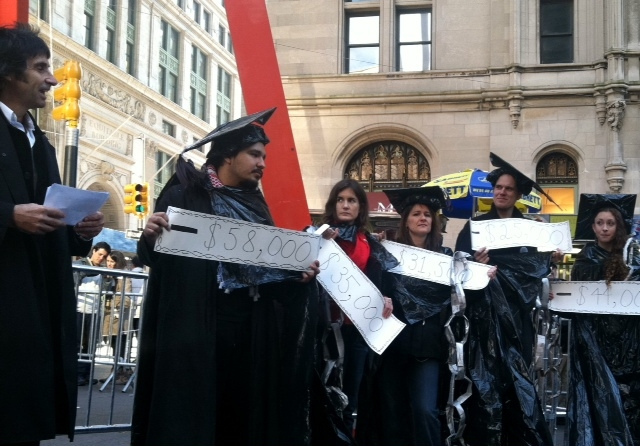
The experience of listening to the ODS rally illustrates how a sound studies perspective foregrounds experiential processes over exclusive categories of things and ideas. For example, when I read the OSD Debtors’ Pledge aloud to my students—vocalizing the text and sounds and listening to them— it brought the text into my body, making it an action. It also made students uncomfortable. Even just a round-robin reading of theory seems to make then anxious and fidgety. While I try to understand and accommodate anxieties around public speaking, I think the way sound makes a text enter the body can be a powerful affective experience. And no one ever said the classroom always had to be comfortable. For me, reading the text aloud personalized the OSD pledge. It evoked sensory memories: “Pledge of” evoked saying the pledge of allegiance in public school; saying “We believe” took me to attending Lutheran church services with my husband at the time where they collectively recite the Apostles’ Creed. These associations evoked emotional disidentifications from organized religion and mandatory collective professions of patriotism. It also temporalized and spatialized OSD for me, positioning it in relations to Dallas, Texas in the 1970s and Greenville, SC today.
Overall, the reading aloud of the pledge staged a tension or dialectic of identification and disidentifications. Although I agreed and identified with the sentiments of the movement, several alienating and unsettling aspects of the pledge came through as I read aloud: the blithe collapsings of “we” and “as members of the most indebted generations” made me wary (collectives always do, but so do easy historical assertions. Really? Are we more indebted than indentured servants who came to America, or people born into slavery?), and the sudden shift to first person singular at the very end seemed jarring: (After saying “we” six times, suddenly it’s ‘I’ now – what happened?). Lastly, the numerous alliterations also had an alienating effect, making the text seem sophistic and manipulative, artificial, composed.
The auditory experience of OSD can also provide insight into how we create texts. A video of Andrew Ross shows him presenting the first, “very rough draft” weeks earlier at an OWS event. Listening to him read this different, earlier version underscores the text as process. The pledge is something that developed. While his flat tone and straight male voice do not appeal to me, they do complexify and dimensionalize Brown’s reading, giving it depth. They also show that some things that bothered me in the final version – the collectivity and alliterations – were not there. This intertextual, diachronic listening does not erase troublesome aspects of the ‘final’ text, but it mediates them. I am moved closer to it by listening to its different origin.
Arguably, any of these points could have been arrived at by good ole’ textual analysis. My point is not that listening always should supplant visual modes; sound studies tries to break that false dichotomy by not denigrating or replacing the visual but by elevating the sonic to complementary – not superseding – status. I argue that reading aloud should be a fundamental, basic component of sound studies methodology, as it allows anyone to hear, voice, embody, and experience a text. I not only noticed these aspects sooner through listening – my first time speaking it aloud, despite having read it at least a dozen times before. Moreover, I didn’t just notice them: I felt them on a personal, emotional, level, which spurs thinking and analysis that is, if not completely new and unique, definitely qualitatively different in its potency and urgency.
Listening to OWS, and the OSD in particular, brings insights affective and personal. Yes, I can read a statistic from a survey stating that a certain percentage of participants in OWS feel angry or betrayed. That doesn’t mean anything to me in a specific, personal, and empathetic way – and empathy is crucial for a social movement to garner support. Listening to both Ross and Brown, I am reflective and conflicted over my professional role – no longer a grad student, but certainly not an established scholar like Ross. I feel connected to OSD in ways beyond the literal facts of my debt. Listening draws me into a contemplative, reflexive space beyond a sticky note on my office desk saying “OWS: teachable moment.” I can see a map with big, red OWS circles over Washington D.C. and New York, but I don’t feel the distance from myself and my students in the same way—and this is crucial for my teaching and engaging them in dialogue about what could be the most significant social movements of their lifetimes.
—
Share this:

Could I Be Chicana Without Carlos Santana?

DOI: https://doi.org/10.59350/8h53d-7nr15
This may be a given but I have to ask: Why is the music of Carlos Santana considered “Chicano music?”
It’s true; I am a fan. And as a fan I never question why I love the music, but I often ask myself what it is specifically about the music that resonates so strongly with me. I could say that I love Santana because I love a soulful electric guitar voice, because I admire the musicianship of the band, because I feel the “sabor” they sing about, because I’ve always loved Santana. But these parts surely do not make up a satisfying the “whole.” There is something else, something about listening to the music that amplifies my sense of identification as a Chicana with other Chicanos and Mexicanos. This happens whether I’m among raza, in the various communities I call home, or whether I find myself feeling very far from Aztlán. I’ve witnessed the effect of the music – maybe you have too – when it comes on the car radio, at backyard family BBQs, and friend’s living room dance floors, the music gets your body up and connects you to your Chicano roots.
In this sense, Santana is forever part of the Chicano sounded imaginary. For Chicanos, identifying with the music of Carlos Santana may have a special meaning that has something to do with a particular Chicano/Mexicano subjectivity. Yet, for non-Chicanos, Santana still retains their quintessential American rock band status. Most of their airplay is on mainstream radio, rarely if ever on Spanish-language stations. So Santana can be thought of at once as “puro” Chicano or “classic rock,” except that Santana is a straight up fusion band. This is why I have to ask, is the music of Santana “Chicano” music? And I further wonder, could I be Chicana without Carlos Santana?
…Oye Como Va…
Before the Rob Thomas & Carlos Santana collaboration on the Grammy award-winning album Supernatural (1999), before the phenomenon of “Smooth,” there was classic Santana. The Santana that produced the self-titled debut album Santana (1969) and Abraxas (1970). The songs “Evil Ways,” “Black Magic Woman,” and “Oye Como Va” from these two albums are on constant rotation on “classic rock” stations well after forty years since they first hit the airwaves. Even if you’re not a fan or a music connoisseur, when listening to “Oye Como Va” or “Smooth” it’s easy to recognize a distinct “Latin-ness” about them. In part, this is because of the fusion of Spanish and English lyrics with rock, blues, jazz, and Afro-Latin musical styles. For Chicanos, this particular fusion of language and sound might also resonate as something familiar and close to home – if sound can be a home. A quick search on YouTube will lead you to the classic 2000 Grammy Awards Performance of “Smooth” and a wealth of competing claims by fans (and foes) in the comments section.
Fan 1: “SANTANA ERES LO MAXIMO, VIVA MEXICO!!!!!!!!”
Fan 2: “Salsa baby, Oye Como Va is universal, Carlos is the man!!!!”
This was a special and high-profile performance so these comments are exceptionally spirited. But, YouTube is full of spontaneous, impassioned, (albeit anonymous) examples like this on any given day. I highlight these two as sort of placeholders for the idea of how sound and music mighty carry significant meaning toward subject formation in an everyday sense. These fans claim Santana both for Mexico and for the world, respectively, because they reflect a strong sense of Mexican or Chicano pride. In the first comment, the very enthusiastic fan could easily be a Mexico City native, maybe a Chicano wanting to sound like a Chilango –“ERES LO MAXIMO” is not a Chicano Spanish expression. The second fan’s comment is all in English and could be Chicano simply based on that—but those are slightly secondary points. As I suggested earlier, for Chicanos, Santana’s music has the potential to reflect a sense of ethnic history and culture. Sound can be a home. After all, the first comment claims Santana’s music for a whole country with “VIVA MEXICO!” helping to affirm the feeling that this fan and Carlos are Mexicanos together, across time and place.
When I was studying music in college, Mexican, Chicano, or Latino music was not part of the curriculum. Instead, in my private piano lessons, I would gravitate toward pieces by Spanish or Latin American composers as a sort of “good enough” way to stay in touch with my latinidad. This helped, but the fact is that Latin American art songs have much more in common with the Western musical canon than they do with my experiences and Chicana consciousness. In other words, it was a reach to identify with these composers solely because we shared a language. What would I miss in a too quick move to identify with the Latin-ness of Santana’s music this way? Would I hear only the Spanish spoken in the song? If so, then gaining a sense of my Chicana/o subjectivity by claiming “Oye Como Va” (for Aztlán?) relies on partially subsuming the specific Caribbean contexts and poetics of the song. Is this song originally Cuban, Puerto Rican? It’s really just a party song. “Oye como va, mi ritmo, bueno pa’ gozar, mulatta” Eso! Does it really matter now if Santana’s version has re-defined it for all time?
In a way, the second fan expresses a more complex desire: “Oye Como Va is universal.” Everyone knows that Carlos Santana is Mexican, some know that he is also an immigrant, and still others may have read that he grew up in Tijuana. As part of American rock music history, Santana’s roots are firmly planted in San Francisco and the Bay Area and it is well known that Santana played at the historic Woodstock Festival of 1969. Clearly, amongst other identities, Santana is a classic American rock band with long and wide appeal. But from the beginning, along with creative fusions of rock, jazz, blues, and salsa, it has been the distinctly Afro-Latino percussion core that defines their emblematic sound. And this is exactly how and why dwelling on these details in the sound of Santana matters. If Santana comes to mean or signify something like “pur0 Mexicano” or “pur0 Chicano” (in a brown pride or brown power sense) then that purity is already so productively and interestingly troubled because there is nothing remotely “pure” about Santana’s music.
Therefore, to identify with the music means confronting those complex fusions of language, race, and music that make up the Santana “sound.” To partly answer my earlier question, “Oye Como Va” is a composition by the renowned Puerto Rican timbalero and band leader Tito Puente, but the musical form, a basic cha-cha-cha, is Cuban. The song has other authors as well, that both Santana and Puente name. But ultimately, this song and indeed much of Santana’s music, comes in wake of much older histories of African diaspora, migration, colonization, artistry and spirituality.
…Sounding Home…
In a way, I’ve always felt that Santana’s music was making a black/brown connection, that racial boundaries were necessarily crossed or brought together because of the many histories that flow through the music. As a child of Mexican immigrant parents, I grew up listening to a wide repertoire of Afro-Latino music – elegant danzónes, romantic boleros, joyous cumbias, mad mambos, as well as more traditional Mexican music. Maybe that is also part of why listening to Santana reminds me of home. But this is perhaps too simple a response.
Santana’s music and popular image has been engaged in positive but also problematic ways in Chicana/o cultural production. Most recently, I noted this in a performance of the play New Fire, by Cherrie Moraga, in San Francisco. At a critical point in the drama, the evocative love song “Samba Pa’ Ti” is used to introduce a male character and a difficult, sexually violent scene. Moraga’s larger critique is of violent Chicano patriarchy and masculinity. The play is offered as a healing ceremony. But the association of this song, which features a famous guitar solo, with that specific scene is profoundly jarring. My sense was that Moraga selected Santana for the play’s soundscape it served as a shorthand for “Chicano.” Here, it was made to bear the history of violence of brown men against brown women and girls. This made it difficult for me to identify as a Chicana–queer and feminist–with Carlos Santana at that moment, and some time after. Surely this is also part of what “home” means.
Santana’s music interests me for these reasons, which go beyond the sounded Chicano imaginary in my headphones. What I find worthwhile in thinking further about Santana’s “sound” is how in the many acts of claiming Santana for oneself, one’s country, or one’s community, I can trace the way in which Chicano and Caribbean histories, both racialized and gendered, touch and cross in the music. That is, I see this as an invitation for the listener to reimagine notions of race, nation, gender, and sexuality even while dancing and singing along. In these ways, I see meaningful possibilities for imagining Chicana/o as a sounded subjectivity. I am certain that my sense of who I am, how I think, and how I walk in the world has been shaped by a life-long relationship with music and sound. And although being “Chicana” to me is not the same for anyone else, Santana’s music helps me to imagine a connection, a musical lineage I can trace and take part in. Santana is not my parent’s music. It’s not even my generation’s music. And, it’s not my only musical identity. But, even so, I couldn’t imagine being Chicana without Carlos Santana. Because when I listen, I do hear it, I hear how it all goes, together, and that is so, so good. “Give me your heart, make it real, or else forget about it!”
—
Wanda Alarcón is a PhD student in Ethnic Studies at UC Berkeley where her research involves reading Chicana and Caribbean “stories” together in a decolonial feminist vein. When she’s not living the glamorous grad student life she likes to make zines about po’try, learning new songs on her childhood piano, cooking for her loved ones, and exploring NorCal with her main squeeze. A native Los Angelena, she is beginning to appreciate thinking and writing about her beloved hometown from afar. Music helps bridge that distance. So do the trees and ocean breezes. She lives and loves kibbutz-style in Santa Cruz with her partner por vida, Cindy, their two sassy cats Lucy & Mona, and dear housemate, Ella.
—
Share this:




Current Top Posts





April 2021

January 2020

November 2019

October 2019

August 2019

April 2014

November 2017

March 2015

December 2017

October 2015


Recent Comments