
Freedom Back: Sounding Black Feminist History, Courtesy the Artists

Welcome to week four of our February Forum on “Sonic Borders,” a collaboration with the IASPM-US blog in connection with this year’s IASPM-US conference on Liminality and Borderlands, held in Austin, Texas from February 28 to March 3, 2013. The “Sonic Borders” forum is a Virtual Roundtable cross-blog entity that will feature six Sounding Out! writers posting on Mondays through February 25, and four writers from IASPM-US, posting on Wednesdays starting February 6th and ending February 27th. For an encore of weeks one through three of the forum, click here. And now, Tavia Nyong’o reviews Courtesy the Artist’s The Meeting, courtesy of Sounding Out! –JS
—
DOI: https://doi.org/10.59350/w8ynz-63m95
Last October 2012, in tandem with the New York launch of the retrospective art show Now Dig This! Art and Black Los Angeles 1960-1980, curated by Kellie Jones and running through March 11, 2013, MoMA PS 1 invited the sounds and images of Black Power into their courtyard Performance Dome for a Sunday afternoon collaborative arts project called The Meeting curated by Courtesy the Artists. Courtesy the Artists is the collaboration of Malik Gaines and Alexandro Segade: two-thirds of the core members of the L.A.-based performance art collective My Barbarian (the third is Jade Gordon). For The Meeting, recently transplanted New Yorkers Gaines and Seagade opted to curate a gathering of local artists, dancers and musicians they wanted to get to know better, such as LaTasha Diggs, niv Acosta, and Samita Sinha.

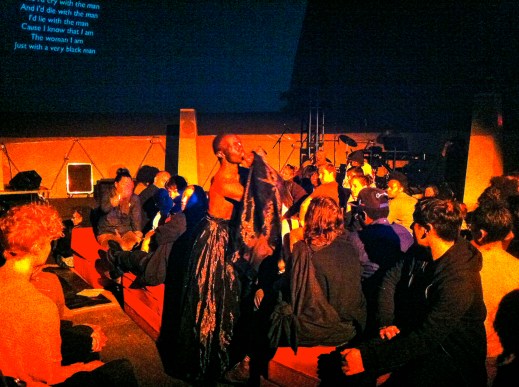
Curation as collaboration was the ethos behind The Meeting in PS1; Gaines and Segade were much more than masters of ceremony, but performed alongside the artists and musicians they invited. At times The Meeting felt more like a jam session than anything else, following the improvisatory and ensemblic ethos of experimental jazz. Performance piece as musician’s jam was indeed a fitting form, given that the afternoon was built around Seize the Time, a 1969 album of agit-prop cabaret recorded by activist, musician, and erstwhile Black Panther leader, Elaine Brown.
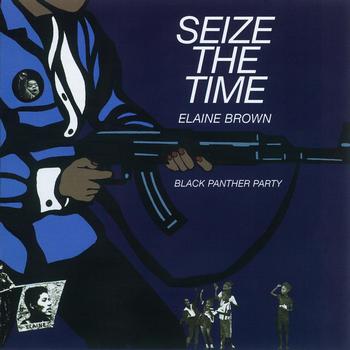
Each participant in The Meeting was invited to respond, in their chosen art form to a song from Brown’s album or another aspect of her legacy that moved them. And move them it did. If music held the event together — from Charles Gaines on the piano and drums to Matana Roberts on a haunting saxophone solo to Geo Wyeth closing down the evening with an astonishing version of “Seize the Time” intermixed with “Age of Aquarius” from the musical Hair — poetry, polemic, video, and dance sent it spinning off into a dozen scintillating tangents.
What those intersecting and diverging responses to Brown’s album shared was a concern with how the past resonates in the present, how a historical call might not always be muted over time, but sometimes amplified by its repetition across time. Given the predominance of the visual in contemporary culture — nowhere more glaring, perhaps, than in institutions devoted to visual art — what do we make of the role of the aural as a medium through which to register the reverberations of a past? The Meeting was held in a temporary structure, literally vestibular to the permanent edifice of the museum. Is the ear a similar vestibule to the institutions of culture, and, if it is, then wherein might the power of that vestibular flesh, as Hortense Spillers once named it, lie?

On Seize the Time, the mercurial Brown transposed the black revolutionary urgency of the 1960s into a musical idiom that sounded remarkable even in its day. It is slightly bemusing to settle into the jazzy opening of the title track “Seize the Time” with the knowledge that Marvin Gaye’s What’s Going On and Curtis Mayfield’s Super Fly were just around the corner. Certainly, despite their shared sonic defiance of American racism, Brown’s didactic sprechegesang would never be mistaken for Nina Simone’s soulful alto. Closer to the sonic mark would be singer-songwriters like Carole King, Janis Ian and Joni Mitchell, artists who broke the mold for women in pop in the late 1960s and early 1970s. Consider the rhetorical and musical twists and turns of the first verse of “The End of Silence,” a song that manages equal parts women’s liberation and black nationalism without ever teetering into blaxploitation supervixen territory:
Have you ever stood
In the darkness of night
Screaming silently you’re a man?
Have you ever hoped
That the time would come
When your voice could be heard
In the noonday sun?
Have you waited so long
Till your unheard song
Has stripped away your very soul?
Then believe it my friend
That the silence can end
We’ll just have to get guns and be men.
If The Meeting was a response to the call of that final line, it was one in which the shift from a single voice with backing band to a range of voices and positions was always audible. Some might call this postmodern fragmentation: dance choreographed to a repeating sample of Brown singing “freedom back,” a version of the album edited down to just the sequential instances of her singing the word “man,” played to projected images of every gun in the Panther arsenal she lists in her book. But these interventions arguably only expand our audition of the original album’s possibilities. More than 30 years on, The Meeting took advantage of Seize The Time’s musico-political incongruity to prise open new lines of affiliation between the past and our revanchist present. The question continuously hung in the air: How do we occupy our radical black and feminist legacies, especially given the fact that we cannot simply repeat those struggles in identical terms? How do we get freedom back?

The declamatory cadences of black rhetoric were as central to the way The Meeting sounded as was its music. LaTasha Diggs’s barnburning performances stopped the show to inform us that revolutionary pussy was out of stock. With Charles Gaines on drums and Matana Roberts on sax, Malik Gaines scatted excerpts from President Obama’s “race speech” while excerpts from speeches Elaine Brown had given to the Panthers were read. Since the context of Obama’s speech had been his own attempt to surrogate the justified anger of the Black Power generation with a message of reconciliation, re-mixing it in this context meant it no longer had the privilege of temporal succession over Brown, but black feminist rhetoric and the improvisatory sax could invaginate his rhetoric with an eternal recurrence of radical insurgence.
It is important to note the predominantly queer and trans performance modalities through which the Meeting posed–if not fully answered–its questions regarding freedom in a contemporary context. Brown’s refrain “we’ll just have to get guns and be men” took on a new connotation when juxtaposed against the queer and trans bodies and voices in performance.
Here history revealed itself as palimpsest: images and icons were superimposed one upon the other to create dense, freighted symbols of masculinity and femininity. In a refrain originally meant to rally radical black women towards the community leadership roles tendentiously claimed by men, the gun was much more than a ‘phallic symbol.’ As Kara Keeling recounts in The Witch’s Flight (an important book containing a shrewd analysis of Seize the Time):
The appearance of the [Black Panther Party] allowed for the recognition of the black man in the Black. But this need not be understood as precluding black “females” from appearing in blacks with guns, nor does it necessarily indicate an inherent connection between “men” and “males.” What is perhaps most innovative about the BPP’s cinematic appearance is that it threw into doubt the validity of the common sense that linked “man” with “male” with “masculine” (85).
For Keeling, the innovative disruption of white supremacist racist sense — congealed in stereotypical images of black men and black women — set the stage, formed the backing track, for the historical emergence of queer and transmasculinities.

Transgender dancer and choreographer niv Acosta rhythmically ran his body against the cushioned seating of the performance dome, to the rhythmic sampling of “freedom back.” The phrase was curiously ambiguous: what actual historical freedom could Brown have possibly exhorted the panthers to claim? What imagined freedom do we think we can reclaim via our remixing of Black Power? The power of Acosta’s performance was to embody that question as a lived and livable improvisation.

The degree to which a musical legacy such as Brown’s can or should be appropriated beyond a black context was also pointedly staged that afternoon, perhaps most self-consciously by Alex Segade’s rendition of “The Meeting” — which Brown once called the Party’s anthem — in Spanish. Segade’s version captured the melodrama and romantic longing, staging the historical interconnections between black and brown power in California as a hall of mirrors and fleeting glances.
Geo Wyeth brought the house down with a funky final number that had the audience on the edge of their seats, perhaps awaiting the promised nudity a sign at the entrance warned the performance would contain. Wyeth’s onstage costume changes were anything but a striptease, however, as he instead fused the militancy of Seize the Time with the sexual revolution of Hair in an incompossible auditory portrait of the legacy of “the Sixties.” His performance left the audience with the emphatic reminder that it is less his generation’s challenge to prove adequate to the past than it is to retrieve from history’s shroud the pulsating star of their own desires.
—
[The Meeting included Simone Leigh, Samita Sinha, Matana Roberts, Charles Gaines, Malik Gaines, Adam Pendleton, niv Acosta, LaTasha Diggs, Xaviera Simmons, Jarrod Kentrell, Alex Segade, and Geo Wyeth].
—
Featured Image of Jarrod Kentrell performing to Elaine Brown’s “Very Black Man” at The Meeting, Courtesy of the author
—
Tavia Nyong’o is Associate Professor of Performance Studies at New York University, where he writes, researches and teaches critical black studies, queer studies, cultural theory, and cultural history. His first book, The Amalgamation Waltz: Race, Performance, and the Ruses of Memory (Minnesota, 2009), won the Errol Hill Award for best book in African American theatre and performance studies. Nyong’o has published articles on punk, disco, viral media, the African diaspora, film, and performance art in venues such as Radical History Review, Criticism, TDR: The Journal of Performance Studies, Women & Performance: A Journal of Feminist Theory, Women Studies Quarterly, The Nation, and n+1. He is co-editor of the journal Social Text.
—
Share this:

Rallying Cries as Suffering Sounds: “Allah-O-Akbar” and the Aurality of Feminized Iranian Suffering
DOI: https://doi.org/10.59350/b7ptt-4mt33
By July of 2009 dozens of pitch-black videos began to appear on YouTube. Documenting ambient noise, in some cases narration and, most prominent of all, impromptu collective outcries of “Allah-o-Akbar,” these videos resonate with an urgent gusto, punctuated with an eerie sense of desperation through faint echoic reverberations. By the level of desperation audible in every voice, at once dulcet and melancholic in tone, there is a distinct sense that Allah very well may be called forth. While most of these videos received scant attention, one entitled “Inja Kojast”](translated as “Where is this Place”) received over 174,000 hits (as of writing).
It was dubbed with English, Spanish, and Japanese subtitles, was sampled by a music producer (“Tehran’s Roof Tops _Remix”) and also played a prominent role in the 2010 French film Fleur du Mal. What is enabled, invoked, and signified by the layering of these multiple and disparate incantations? What is affectively evoked in the widespread circulation of these chants by YouTube and in Fleur du Mal? Why was this video circulated so widely and deemed so affectively resonant by disparate audiences?
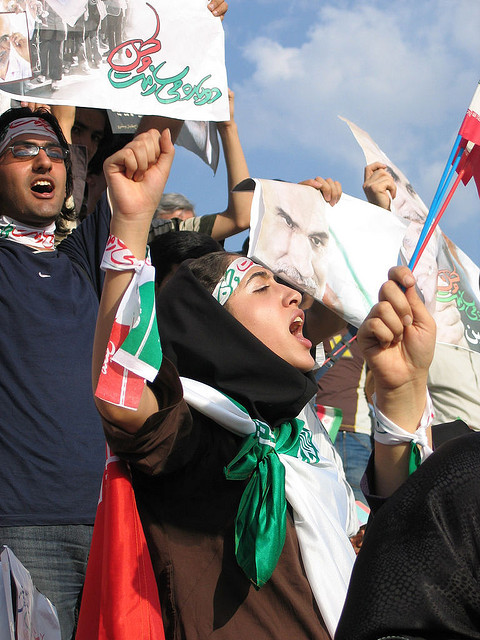
Due to the fact that the Iranian government had barred entry to representatives of foreign media and systematically jailed Iranian journalists accused of being hostile to the regime, the disputed 2009 Iranian elections and ensuing protests were largely reported on by a new breed of “citizen journalists”. Filling in the information vacuum, citizen journalists tweeted and uploaded to the Internet raw video footage of protest marches and confrontations with Basiji militiamen by day – and the voices of dissent performed on Iran’s many rooftops by night. Donning the cloak of darkness, residents of Iran’s major cities climbed to the rooftops of their buildings to chant “Allah-o-Akbar” in numbers – a brief reprieve from the violent suppression of their street protests by Basiji militiamen.
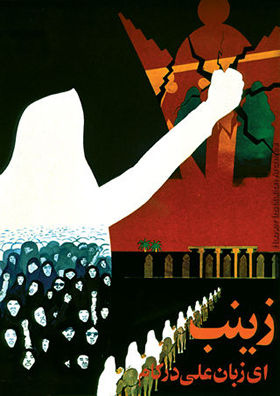
As Negar Mottahedeh has written in her online essay “Allah-o-Akhbar”: “The cry of “Allah-o-Akbar” was the defining sound of the 1978 protests against the Shah of Iran, during a revolution that toppled the Pahlavi monarchy and established the Islamic Republic of Iran.” This earlier revolutionary context is represented in the video for “Allah o Akbar, Khomeini Rahbar”, which hailed a politically diverse citizenry to stand behind this “rahbar” or new “leader.” The chanting of “Allah-o-Akbar” was further exploited as a nationalistic call-to-arms during the Iran-Iraq war in the music video for the anthemic “Allahu Akbar Iran, Iran.” The chant’s versatility and instrumentality in this immediate post-revolutionary period is due not only to its capacity to appeal to the pious and patriotic backers of the newly formed Islamic Republic but also because of its power as a performative political rallying cry. Mottahedeh’s essay title employs a pun: the addition of ‘h’ to the word “Akbar” in transliteration changes the word to “Akhbar” or news. Although she does not elaborate on this, her title suggests that this chant is itself a form of citizen journalism, a broadcast calling forth the revolutionary spirit that Iranians pride themselves for always having at the ready. But what kind of journal is “Allah-o-Akbar”? Is it a call to arms, a rallying cry, a collective sound of suffering or all of the above?
Despite its pious provenance and deployment as the paradigmatic cry of the revolutionary uprising against the Shah, the Islamic Republic currently led by Ali Khamenei and Mahmood Ahmadinejad–which was inaugurated by these earlier revolutionary calls–has interpreted the post-2009 chanting of “Allah-o-Akbar” as blasphemous and an affront to their authority. Journalist Jalal Hosseini argues that this is due in part to the fact that opposition candidate Mir Hossein Mousavi called upon his supporters to remember the revolutionary history of this performative chant in an open letter, stating “Let’s not abandon the green colour which is a symbol of spirituality, freedom and religious mentality and moderateness and the Allah O Akbar slogan that tells us of revolutionary roots.”
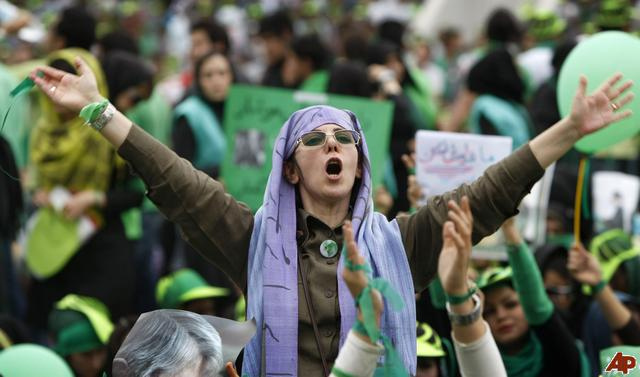
As Hosseini has written, “In a religious state, where religion is present in every aspect of life, Iran’s protestors have managed to turn religion against their government…Allah-o Akbar is perhaps the single most symbolic phrase in the Muslim world, yet Iran’s current rulers, who themselves employed this slogan in their struggle against the Pahlavi regime in the 1979 Revolution, did not tolerate the protesters’ cries of Allah-o-Akbar after the 2009 presidential election. Allah-o Akbar has essentially become a forbidden phrase.” Hosseini goes on to quote numerous Tehranis who testify to their disparate intentions behind the chanting, highlighting the ambivalence inherent to the slogan, which makes it available to Iranians of many stripes, and, as he argues, allows the calls to resonate even beyond the nation by appealing to other Muslims globally. But the widespread circulation of these videos and their popular impact on global YouTube audiences also suggests that the chanting has had an impact on non-Muslims as well.
Susan Moeller, who penned a Huffington Post piece right around the time of “Inja Kojast’s” semi-viral circulation, argues that this most recent phase of the chant’s resignification has helped to win Americans over to the protesting Iranian’s cause, writing, “watching Americans are learning to reframe the meaning of ‘Allah O Akbar’ and re-imagine the people of Iran. The pictures from Tehran are showing that Iranians are not monolithic in their beliefs.” Moeller suggests that this collective chanting has somehow cut through the status quo Islamophobic representations of a fundamentalist Iran to create an affective and empathetic pathway through which Americans can “re-imagine the people.” Moeller’s argument echoes the sentiment of the comments written on the YouTube page for “Inja Kojast,” comments like “This breaks my heart!” left by Annabanana23663 or “I have listened to this so many times already that you would think I would have moved on BUT I continue to listen and will continue to listen for there is truth in that voice of pain. And only by embracing pain can we love truth. And truth not only will set us free but without truth we cannot be free. Go you beautiful Persians. The people of the USA love you for your defiance” (by YouTube viewer HulkSmashPunyHumans).
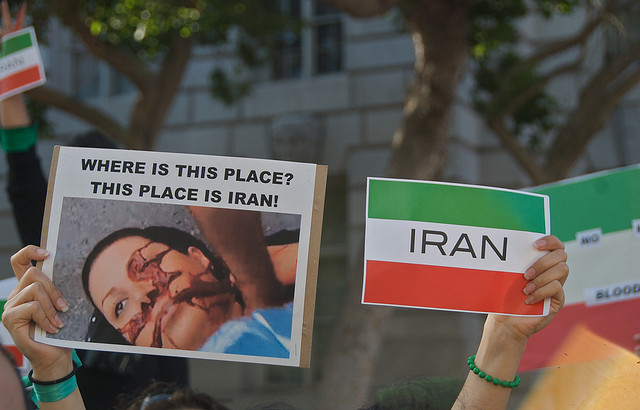
Not only were YouTube users impacted by “Inja Kojast” but the video’s representation of Iran’s rooftop chants inspired the narrative arc of French filmmaker David Dusa’s Fleur du Mal (Flowers of Evil, 2010), a film that explores the precarity and instability of Iran after the 2009 elections. Through a chanting scene in which the two main characters, Gecko (Rachid Youcef) and Anahita (Alice Belaïdi), vociferously call out “Allah-o-Akbar” on the edge of a rooftop in the avowedly anti-Islamic nation of France, they thumb their noses at both nation-states at once while also sealing their romantic bond. Perhaps in an ironic play on Khomeini’s exile in the same city, the beautiful, educated and upwardly mobile Anahita is incubated in Paris for a time while the political instability following the 2009 elections settles down. Completely obsessed with the post-election struggles that she and her friends were actively engaging in on the streets of Tehran, she daily follows every new tweet and YouTube video. She bides her time in Paris by convincing Gecko, the bellhop at her swanky hotel, to give her a tour of the city and the two soon become lovers.
Despite the somber context of the film’s main narrative preoccupations with Iran’s botched 2009 elections, this plot point, I argue, enables the cathexis of an Orientalist drive that is shared by Western audiences: a drive to consummate the desire for the feminized Muslim woman seen to have suffered under the despotic rule of Muslim masculinity. It is this same desire that gets sublimated in a consumption of feminized Muslim suffering which has led to a reductive popular reading of “Inja Kojast” that eclipses the ambivalence of and disparate intentions behind the chanting it documents. In particular, it is through the cries of the narrator’s own female sounding voice that “watching Americans are learning to…re-imagine the people of Iran” as finally available to and eligible for their empathy, attention and yearning.
Fleur du Mal weaves narrative scenes with YouTube footage of Iranian post-election street protests and, in one scene, an image of Neda Agha Soltan’s assassination. Viewed over 1,200,000 times (as of this writing), there has been a wide-scale promotion through documentary films, video diaries, songs and various other imagery of what has been called Neda’s martyrdom for Iran’s “green revolution”. This representation of a feminized Iranian suffering at the hands of an Islamic fundamentalist Iranian masculinity has become a privileged symbol for Iran’s Green Movement outside of Iran. This has enabled an affective attachment to be made which has, quoting Moeller yet again, enabled Americans to “re-imagine the people of Iran.” This time, somewhat counter to Moeller’s claim, it is not only “pictures” that are functioning to transform perceptions of Iranians; sound operates as a critical conduit to an interiority characterized by pain and suffering that has particular appeal.

I argue that the suffering sounds of “Inja Kojast” resonate within what I have elsewhere termed an “aural imaginary” through which Americans and the West “re-imagine[s] the people of Iran.” Through the suffering sounds of an anonymous feminine-sounding voice–reflecting upon and poetically translating the suffering sounds of a nation’s nightly chanting of “Allah-O-Akbar”– a direct link has been made to the feminized victim of Islam.
As US-backed Israeli war-drums are beaten, and as conspiracy theories regarding Iran’s hand in the recent spike in oil prices resuscitate decades-long antagonisms, we must be mindful of the multi-sensorial cooptations of empathetic and affective attachment that have constructed feminized suffering as justification for military intervention and the instrumentalization of sound in support of this. The old Orientalist desire for a feminized opening through which to re-imagine and know the radical other that is Iran has been found through a new gateway: aurality.
—
Featured Image: “Iran 06” courtesy of Flickr User Chong Head
—
Roshanak Kheshti is Assistant Professor of Ethnic Studies and affiliate faculty in the Critical Gender Studies Program at the University of California, San Diego. She is currently completing a manuscript entitled “Modernity’s Ear: The Aural Imaginary and the World Music Culture Industry,” which theorizeshow an other to the listening self is racialized and gendered within the world music listening event. She has published in American Quarterly, Feminist Studies, Hypatia and Parallax.
—
Share this:




Current Top Posts





April 2021

January 2020

November 2019

October 2019

August 2019

April 2014

November 2017

March 2015

December 2017

October 2015


Recent Comments