
A Brief History of Auto-Tune

This is the final article in Sounding Out!‘s April Forum on “Sound and Technology.” Every Monday this month, you’ve heard new insights on this age-old pairing from the likes of Sounding Out! veteranos Aaron Trammell and Primus Luta along with new voices Andrew Salvati and Owen Marshall. These fast-forward folks have shared their thinking about everything from Auto-tune to techie manifestos. Today, Marshall helps us understand just why we want to shift pitch-time so darn bad. Wait, let me clean that up a little bit. . .so darn badly. . .no wait, run that back one more time. . .jjuuuuust a little bit more. . .so damn badly. Whew! There! Perfect!–JS, Editor-in-Chief
—
DOI: https://doi.org/10.59350/fd1ga-js456
A recording engineer once told me a story about a time when he was tasked with “tuning” the lead vocals from a recording session (identifying details have been changed to protect the innocent). Polishing-up vocals is an increasingly common job in the recording business, with some dedicated vocal producers even making it their specialty. Being able to comp, tune, and repair the timing of a vocal take is now a standard skill set among engineers, but in this case things were not going smoothly. Whereas singers usually tend towards being either consistently sharp or flat (“men go flat, women go sharp” as another engineer explained), in this case the vocalist was all over the map, making it difficult to always know exactly what note they were even trying to hit. Complicating matters further was the fact that this band had a decidedly lo-fi, garage-y reputation, making your standard-issue, Glee-grade tuning job decidedly inappropriate.
Undaunted, our engineer pulled up the Auto-Tune plugin inside Pro-Tools and set to work tuning the vocal, to use his words, “artistically” – that is, not perfectly, but enough to keep it from being annoyingly off-key. When the band heard the result, however, they were incensed – “this sounds way too good! Do it again!” The engineer went back to work, this time tuning “even more artistically,” going so far as to pull the singer’s original performance out of tune here and there to compensate for necessary macro-level tuning changes elsewhere.
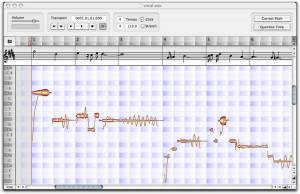
The product of the tortuous process of tuning and re-tuning apparently satisfied the band, but the story left me puzzled… Why tune the track at all? If the band was so committed to not sounding overproduced, why go to such great lengths to make it sound like you didn’t mess with it? This, I was told, simply wasn’t an option. The engineer couldn’t in good conscience let the performance go un-tuned. Digital pitch correction, it seems, has become the rule, not the exception, so much so that the accepted solution for too much pitch correction is more pitch correction.
Since 1997, recording engineers have used Auto-Tune (or, more accurately, the growing pantheon of digital pitch correction plugins for which Auto-Tune, Kleenex-like, has become the household name) to fix pitchy vocal takes, lend T-Pain his signature vocal sound, and reveal the hidden vocal talents of political pundits. It’s the technology that can make the tone-deaf sing in key, make skilled singers perform more consistently, and make MLK sound like Akon. And at 17 years of age, “The Gerbil,” as some like to call Auto-Tune, is getting a little long in the tooth (certainly by meme standards.) The next U.S. presidential election will include a contingent of voters who have never drawn air that wasn’t once rippled by Cher’s electronically warbling voice in the pre-chorus of “Believe.” A couple of years after that, the Auto-Tune patent will expire and its proprietary status will dissolve into to the collective ownership of the public domain.
.
Growing pains aside, digital vocal tuning doesn’t seem to be leaving any time soon. Exact numbers are hard to come by, but it’s safe to say that the vast majority of commercial music produced in the last decade or so has most likely been digitally tuned. Future Music editor Daniel Griffiths has ballpark-estimated that, as early as 2010, pitch correction was used in about 99% of recorded music. Reports of its death are thus premature at best. If pitch correction is seems banal it doesn’t mean it’s on the decline; rather, it’s a sign that we are increasingly accepting its underlying assumptions and internalizing the habits of thought and listening that go along with them.
Headlines in tech journalism are typically reserved for the newest, most groundbreaking gadgets. Often, though, the really interesting stuff only happens once a technology begins to lose its novelty, recede into the background, and quietly incorporate itself into fundamental ways we think about, perceive, and act in the world. Think, for example, about all the ways your embodied perceptual being has been shaped by and tuned-in to, say, the very computer or mobile device you’re reading this on. Setting value judgments aside for a moment, then, it’s worth thinking about where pitch correction technology came from, what assumptions underlie the way it works and how we work with it, and what it means that it feels like “old news.”

As is often the case with new musical technologies, digital pitch correction has been the target for no small amount of controversy and even hate. The list of indictments typically includes the homogenization of music, the devaluation of “actual talent,” and the destruction of emotional authenticity. Suffice to say, the technological possibility of ostensibly producing technically “pitch-perfect” performances has wreaked a fair amount of havoc on conventional ways of performing and evaluating music. As Primus Luta reminded us in his SO! piece on the powerful-yet-untranscribable “blue notes” that emerged from the idiosyncrasies of early hardware samplers, musical creativity is at least as much about digging-into and interrogating the apparent limits of a technology as it is about the successful removal of all obstacles to total control of the end result.
Paradoxically, it’s exactly in this spirit that others have come to the technology’s defense: Brian Eno, ever open to the unexpected creative agency of perplexing objects, credits the quantized sound of an overtaxed pitch corrector with renewing his interest in vocal performances. SO!’s own Osvaldo Oyola, channeling Walter Benjamin, has similarly offered a defense of Auto-Tune as a democratizing technology, one that both destabilizes conventional ideas about musical ability and allows everyone to sing in-tune, free from the “tyranny of talent and its proscriptive aesthetics.”

Jonathan Sterne, in his book MP3, offers an alternative to normative accounts of media technology (in this case, narratives either of the decline or rise of expressive technological potential) in the form of “compression histories” – accounts of how media technologies and practices directed towards increasing their efficiency, economy, and mobility can take on unintended cultural lives that reshape the very realities they were supposed to capture in the first place. The algorithms behind the MP3 format, for example, were based in part on psychoacoustic research into the nature of human hearing, framed primarily around the question of how many human voices the telephone company could fit into a limited bandwidth electrical cable while preserving signal intelligibility. The way compressed music files sound to us today, along with the way in which we typically acquire (illegally) and listen to them (distractedly), is deeply conditioned by the practical problems of early telephony. The model listener extracted from psychoacoustic research was created in an effort to learn about the way people listen. Over time, however, through our use of media technologies that have a simulated psychoacoustic subject built-in, we’ve actually learned collectively to listen like a psychoacoustic subject.
Pitch-time manipulation runs largely in parallel to Sterne’s bandwidth compression story. The ability to change a recorded sound’s pitch independently of its playback rate had its origins not in the realm of music technology, but in efforts to time-compress signals for faster communication. Instead of reducing a signal’s bandwidth, pitch manipulation technologies were pioneered to reduce the time required to push the message through the listener’s ears and into their brain. As early as the 1920s, the mechanism of the rotating playback head was being used to manipulate pitch and time interchangeably. By spinning a continuous playback head relative to the motion of the magnetic tape, researchers in electrical engineering, educational psychology, and pedagogy of the blind found that they could increase playback rate of recorded voices without turning the speakers into chipmunks. Alternatively, they could rotate the head against a static piece of tape and allow a single moment of recorded sound to unfold continuously in time – a phenomenon that influenced the development of a quantum theory of information.
In the early days of recorded sound some people had found a metaphor for human thought in the path of a phonograph’s needle. When the needle became a head and that head began to spin, ideas about how we think, listen, and communicate followed suit: In 1954 Grant Fairbanks, the director of the University of Illinois’ Speech Research Laboratory, put forth an influential model of the speech-hearing mechanism as a system where the speaker’s conscious intention of what to say next is analogized to a tape recorder full of instructions, its drive “alternately started and stopped, and when the tape is stationary a given unit of instruction is reproduced by a moving scanning head”(136). Pitch time changing was more a model for thinking than it was for singing, and its imagined applications were thus primarily non-musical.
Take for example the Eltro Information Rate Changer. The first commercially available dedicated pitch-time changer, the Eltro advertised its uses as including “pitch correction of helium speech as found in deep sea; Dictation speed testing for typing and steno; Transcribing of material directly to typewriter by adjusting speed of speech to typing ability; medical teaching of heart sounds, breathing sounds etc.by slow playback of these rapid occurrences.” (It was also, incidentally, used by Kubrick to produce the eerily deliberate vocal pacing of HAL 9000). In short, for the earliest “pitch-time correction” technologies, the pitch itself was largely a secondary concern, of interest primarily because it was desirable for the sake of intelligibility to pitch-change time-altered sounds into a more normal-sounding frequency range.
.
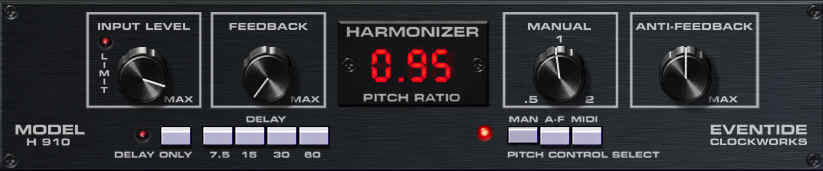
This coupling of time compression with pitch changing continued well into the era of digital processing. The Eventide Harmonizer, one of the first digital hardware pitch shifters, was initially used to pitch-correct episodes of “I Love Lucy” which had been time-compressed to free-up broadcast time for advertising. Similar broadcast time compression techniques have proliferated and become common in radio and television (see, for example, Davis Foster Wallace’s account of the “cashbox” compressor in his essay on an LA talk radio station.) Speed listening technology initially developed for the visually impaired has similarly become a way of producing the audio “fine print” at the end of radio advertisements.
Though the popular conversation about Auto-Tune often leaves this part out, it’s hardly a secret that pitch-time correction is as much about saving time as it is about hitting the right note. As Auto-Tune inventor Andy Hildebrand put it,
[Auto-Tune’s] largest effect in the community is it’s changed the economics of sound studios…Before Auto-Tune, sound studios would spend a lot of time with singers, getting them on pitch and getting a good emotional performance. Now they just do the emotional performance, they don’t worry about the pitch, the singer goes home, and they fix it in the mix.
Whereas early pitch-shifters aimed to speed-up our consumption of recorded voices, the ones now used in recording are meant to reduce the actual time spent tracking musicians in studio. One of the implications of this framing is that emotion, pitch, and the performer take on a very particular relationship, one we can find sketched out in the Auto-Tune patent language:
Voices or instruments are out of tune when their pitch is not sufficiently close to standard pitches expected by the listener, given the harmonic fabric and genre of the ensemble. When voices or instruments are out of tune, the emotional qualities of the performance are lost. Correcting intonation, that is, measuring the actual pitch of a note and changing the measured pitch to a standard, solves this problem and restores the performance. (Emphasis mine. Similar passages can be found in Auto-Tune’s technical documentation.)
In the world according to Auto-Tune, the engineer is in the business of getting emotional signals from place to place. Emotion is the message, and pitch is the medium. Incorrect (i.e. unexpected) pitch therefore causes the emotion to be “lost.” While this formulation may strike some people as strange (for example, does it mean that we are unable to register the emotional qualities of a performance from singers who can’t hit notes reliably? Is there no emotionally expressive role for pitched performances that defy their genre’s expectations?), it makes perfect sense within the current affective economy and division of labor and affective economy of the recording studio. It’s a framing that makes it possible, intelligible, and at least somewhat compulsory to have singers “express emotion” as a quality distinct from the notes they hit and have vocal producers fix up the actual pitches after the fact. Both this emotional model of the voice and the model of the psychoacoustic subject are useful frameworks for the particular purposes they serve. The trick is to pay attention to the ways we might find ourselves bending to fit them.
.
—
Owen Marshall is a PhD candidate in Science and Technology Studies at Cornell University. His dissertation research focuses on the articulation of embodied perceptual skills, technological systems, and economies of affect in the recording studio. He is particularly interested in the history and politics of pitch-time correction, cybernetics, and ideas and practices about sensory-technological attunement in general.
—
Featured image: “Epic iPhone Auto-Tune App” by Flickr user Photo Giddy, CC BY-NC 2.0
—

REWIND!…If you liked this post, you may also dig:
“From the Archive #1: It is art?”-Jennifer Stoever
“Garageland! Authenticity and Musical Taste”-Aaron Trammell
“Evoking the Object: Physicality in the Digital Age of Music”-Primus Luta
—
Share this:

(Sound)Walking Through Smithfield Square in Dublin

DOI: https://doi.org/10.59350/pywqa-vdt14
Editor’s Note: This month Sounding Out! is thrilled to bring you a collection of posts that will change the way you hear cities. The Sounds of the City series will prompt readers to think through ideas about urban space and sound. Are cities as noisy as we think they are? Why are cities described as “loud”? Who makes these decisions about nomenclature and why?
We kicked things off last week with my critical reading of sound in Lorraine Hansberry’s A Raisin in the Sun, a play about African Americans in Chicago that still rings/stings true today. Regular writer Regina Bradley will discuss the dichotomy of urban and suburban in the context of sound (noisy versus quiet, respectively), and CFP winner Lilian Radovac will share with us a photoessay on the sound installation Megaphóne in Montreal. Today, guest writer Linda O’ Keeffe takes readers on a soundwalk of Smithfield Square in Dublin, Ireland and specifically of the Smithfield Horse Fair, in order to illustrate how urban renewal disrupts city soundscapes and how sound reclaims those spaces.–Managing Editor Liana M. Silva
—
Since 2010, as part of my PhD research, I have conducted over two dozen sound walks through the Smithfield Square and its environs, in Dublin’s North Inner city; with teenagers, by myself and through organising deep listening group walks as part of World Listening Day. These walks were designed to encourage the participating walkers to listen intently to this space and compare it to other spaces on the north side of Dublin city. The walks were also designed to examine the changing use and design of the Smithfield space over the past four years. This essay is drawn from the findings of this research, which explored the co-production of space and soundscapes with 84 teenagers (43 girls and 41 boys) from Dublin, Ireland. I include some of their observations of Smithfield Square here.
The Smithfield Square’s redesign began in 1996 as part of an urban regeneration project, and was completed in May of 2013. Smithfield is a traditional working class area, historically connected to wholesale markets, and in recent years it has gone through many iterations. In a push towards gentrification, the Smithfield Square space was ripped up, rebuilt, re-imagined and ripped up again because each iteration of its design proved unattractive to potential visitors/users of this space. According to the Royal Institute of the Architects of Ireland (1991), Dublin City Council considered these users were tourists and new middle class urbanites, not the locals.
Large-scale apartment complexes with business premises on the ground floor, tourist facilities, and an art house cinema were situated alongside smaller, older social housing, flat complexes and wholesale markets within the area. This reshaping of architecture impacts the diffusion of sound in space. It changes what Brandon LaBelle (2010) calls the acoustic territories that demarcate space where sound is no longer attributable to specific spaces or communities. Additionally, since the early 1990s, sounds within Smithfield began to change with the removal or downsizing of certain productive practices, such as the fish and fruit markets. This reduced the kind of traffic, both pedestrian and commercial, which would have moved and sounded through the area. The Smithfield Horse Fair disrupts the area’s soundscape and opens up the possibilities of the space of Smithfield Square for the broader community.
The design of the square, its restaurants, boutique shops and cafes, suggest that the soundscape designed for this space was meant to be a quiet and calm, recreating in the square what Karin Bijsterveld has defined in Mechanical Sound (2008) as the quiet of the middle classes. The sounds produced by the fair are then seen as counter to the types of sensory experiences that, Monica Montserrat Degen argues in her book Sensing Cities: Regenerating Public Life in Barcelona and Manchester (2008), are acceptable to the middle classes, who purchase a type of sensory/sonic experience. However, the soundwalks I describe contest what “quiet” means in the context of the square.
Listening to the Square
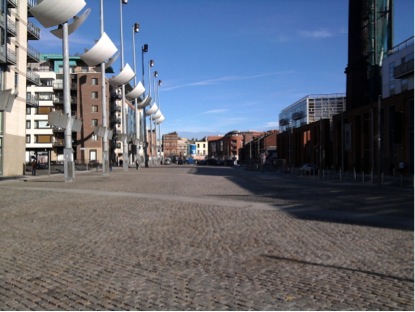

In 2009 the Smithfield Square, which is laid with thousands of cobblestones, had placed around one side twelve 26.5 metre gas lighting masts, at one end of the square two lines of trees were planted with seating placed among them, and at the other end some large concrete plant pots. The seating located within the trees, attracted groups of homeless people and addicts. As a result, the dominant soundscape during the day was the sounds of men and women shouting obscenities at each other, with the susurration of trees rarely heard over this dominant sound. One of my teenage participants noted, “you always hear people screaming in the background” (Participant 2).

Aside from the shouting voices and loud reflections from singular sound sources within the Square such as the clatter of suitcase wheels across the cobblestones, seagulls screeching overhead, the beeping of trucks reversing and even the sounds of people talking at a distance, the teenagers who participated in the soundwalks defined the space as silent. Their use of the word silent did not mean the absence of sound, but rather an absence of activities, life, general sounds of community, consumption and production.
One sound that dominates the soundscape of Smithfield and its surroundings is the sound of the Luas tramline. The Luas line sits at one end of the Square and the sounds produced are distinctive: there is the whoosh as it passes, the ding a ling of its bells and the sounds of the doors opening and closing. The sound of the Luas echoes around the area from 6 in the morning till midnight. The sounds have become synonymous with that part of the city. The teenage participants defined these sounds as rhythmic, musical, “like a ballet.” For the teenager participants, the sounds of the Luas has been the only constant sound within Smithfield.

The sounds of children and teenagers were absent, even with the vast housing areas that surround Smithfield Square—some dating back to the 1940s. Within five minutes of the square are two primary schools and one all-boy’s secondary school. During the day, I would hear the children playing in the school grounds, and in flat complexes close to the Smithfield Square. Each of these spaces were gated and enclosed. Most of the teenage participants lived within such housing areas, and would often refer to the level of noise made by the children within their immediate housing areas. Yet, none of the teenagers, and no young children, used the Smithfield Square for “hanging out” or playing.

The teenagers argued that the Smithfield Square had no point; it was too wide open and too quiet.
Group 11b: Although, there probably was sound for somebody who listened to it but because we were all coming down from the city, the space seemed to be nothing… it just seemed real quiet, empty.
Because of that, the teenagers felt they could not group together to chat. For them, it would be like situating themselves in the middle of a stage. Their sounds were amplified or reverberated, ironically creating a feeling of being surveilled. They felt more comfortable and safer in confined areas, such as street corners, laneways, and the archways of large buildings. Within these smaller spaces, the sounds produced have closer reflections. Teenagers often surround themselves with sounds by shouting, playing music, etc., creating what Barry Blesser and Linda-Ruth Salter in Spaces Speak, Are You Listening? (2009) call a sonic bubble. These “territorial bubbles appear as if by magic around a group of individuals if they begin to interact, and the group quickly acquires rights to the arena” (2009:34) thus creating a temporal space. They did not feel they could do so in such an open area.
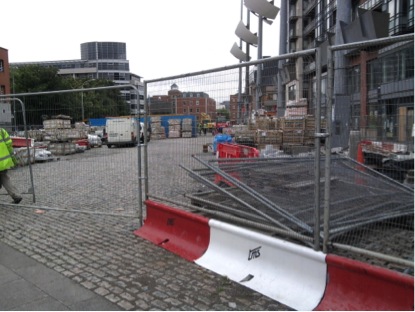

Because of the poor planning and design of the Smithfield area, there are vast empty spaces surrounded by fencing or construction hoarding, numerous derelict buildings, and closed-down shops and restaurants. The Smithfield Square is no different, with numerous buildings left empty as a result of foreclosures or bankruptcy. The silence in this space is indicative of the loss of the social and economic processes. The vast square then takes on another level of silence, the loss of productive meaning, the presence of poverty, homelessness and unemployment.
On one walk with the teenagers I noted that they would group together in the square, even when they were told to walk around and record sounds within the space independently. Later, they said there were no sounds to record, so they just walked towards the closest sound source, a small shopping market in the square. I had noted numerous individual sounds, but they would have required standing in the middle of the square to record them. During focus group sessions after the soundwalks, the teenagers defined positive soundscapes as places with numerous loud sounds, the voices of hundreds within busy shopping streets, music coming from stores and traffic in the distance. These sounds defined a city, and made the teenagers feel safe and enclosed. Smithfield contained none of these kinds of sounds.
Soundwalking the Smithfield Horse Fair

There are a few events held regularly within the square since it re-opened in 2013. Some of these events are part of the Dublin City Council’s efforts to invigorate the space, such as food and art markets, as well as fairs for various seasons and holidays. One of the few public events that take place in Smithfield Square is the Smithfield Horse Fair, which happens on the first Sunday of every month. Having walked through this space repeatedly over a period of 3 years, it was only when I attended the horse fair that the space came alive, it had a purpose.
The horse fair has been a contentious event for both locals and city managers for the past two decades, with the horse dealers arguing that there is either a historical precedence for the horse fair or with the Dublin city councillors arguing that the land was historically used for the selling of cattle for market. The appearance within the Smithfield Square once a month of the horse fair brings with it a vast and lively, and sometimes, as defined by the media and Dublin City Council, a threatening soundscape/environment.
Some sounds defined as threatening are the loud whinnying of horses as they are jostled around the fair. The media has also reported, on several occasions, large-scale fights, which have broken out during the fair, leading to the presence of riot police. This eventually led to the gating of the fair and an extreme police presence as if these measures might reduce such sounds through the threat of arrest. For those living in the new apartment complexes, the sounds produced at the fair are amplified because of the design of the space, and possibly sound more threatening as a result.
During one walk of the Smithfield horse fair that I did in April 2013, some of the audible sounds were horses neighing and whinnying in panic, horse shoes on the cobblestones, traders shouting out their wares of horse paraphernalia, seats, stirrups etc., the voices of old men, which was the dominant background sound, and the sounds of traditional Irish music.
Outside of the gated fair were the sounds of large groups of teenagers, shouting and calling to each other. The space was alive with sound; the voices of teenagers merged with, or were lost within, the chaos of other sounds, becoming part of a larger soundscape. Because the space was busy with people, activities, music and even security there was a reason to use the square, even if you were not actively taking part in the event. The fair created a space for teenagers to engage with, and perhaps feel safe within the boundaries of its soundscape. Suddenly the square was as busy and as loud as the city centre.

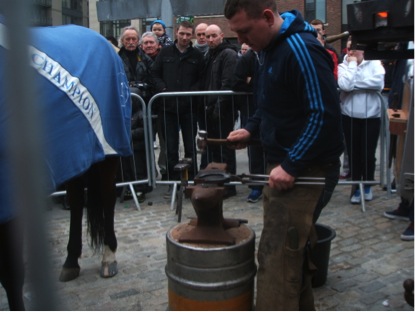
While walking through this soundscape, I encountered different kinds of soundmarks. For example, the banging of horseshoes was quite distinctive because it is, as Schafer would define, an archetypal sound, one that no longer belongs in the city. It felt like hearing a sound from the past. Yet this kind of sound creates a kind of historic continuity with the past (Barry Truax, Acoustic Communication, 2000). When discussing the cobblestones within Smithfield Square, most of the young female participants stated that it was not so much the look of the cobblestones that gave the space a sense of history but rather the sounds made when something moved over them. The lack of people and activities within the square meant that these sounds were rarely activated. The soundscape of the fair on those days transformed Smithfield, lifting it out of its everyday silences, which seemed to invite young people to participate. It was reactivated with life.
What was noticeable about the two fairs I visited was that by the second event in 2013, there were far fewer horses than at previous fairs. There were about 8 or 10 horses being paraded around the space by what looked like homeless people or addicts. There seemed to be no real horse-trading; the soundscape lacked the sounds of horses. Instead, the space had become a gathering space, with groups of tourists wandering around taking pictures of anything and everything.


Conclusion
This fair does not fit within the cultural ethos of regenerated urban spaces like Smithfield, where culture is defined as a consumerist process or part of the arts. However, the space takes on new potentialities as a result of the presence of people, sounds and activities, allowing the teenagers to view the possibilities of spatial use. Sounds can distinguish a space, as identified during the Smithfield horse fair. These sounds also remove focus from teenagers’ voices audible within the space, and transfer it to other sounds. The space was no longer a large fishbowl viewable from any angle; instead it had become a busy vibrant immersive soundscape.
—
Featured Image: “Smithfield Horse Fair, Dublin” by Flickr user Admanchester, CC BY-NC-ND 2.0
—
Linda O Keeffe is secretary to the Irish Sound Science and Technology Association and editor of the Interference Journal. Her practice is concerned with an exploration, both academic and creative, of the ways in which sound alters our experience of different spaces. Her art training was within the sculpture department of IADT under the tutelage of Finola Jones. She completed a Masters in Virtual Reality in NCAD with Kevin Atherton, and just finished a PhD in sociology in NUIM. Her research examined the urban of Dublin city soundscape as socially and technologically co-constructed. She has composed for dance, theatre, quartets, and new instrument performers, installed sound installations for commissions in Ireland, China and Holland, and has had radio works performed both nationally and internationally. In 2008 she mentored under Eric Leonardson in Chicago, a sound artist and performer. More recently, she was commissioned by Resonance FM to create a work for radio for the 2013 Derry city of culture event. Current projects include a solo exhibition in November 2014 for the Limerick Sculpture Centre, which will be a creative realization of her PhD research. You can find her at www.lindaokeeffe.com.
—

REWIND!…If you liked this post, you may also dig:
“Heard Any Good Games Lately?: Listening to the Sportscape”-Kaj Ahlsved
“Park Sounds: A Kansas City Soundwalk for Fall”-Liana Silva
“Sounding Out! Podcast Episode #7: Celebrate World Listening Day with the World Listening Project”
—
Share this:




Current Top Posts





April 2021

January 2020

November 2019

October 2019

August 2019

April 2014

November 2017

March 2015

December 2017

October 2015


Recent Comments