
SO! Reads: Shana Redmond’s Anthem: Social Movements and the Sound of Solidarity in the African Diaspora
 To follow a song, to trace its roots and genealogy, to consider the context of its emergence as well as its lineage. To consider how sound and song propels political movement. To trace histories and concepts through the enunciative force of sound, of song. This is the work of Shana L. Redmond’s Anthem: Social Movements and the Sound of Solidarity in the African Diaspora (NYU Press, 2014). Redmond is Associate Professor of American Studies and Ethnicity at University of Southern California and the 2014-2015 Ella Baker Visiting Associate Professo of Black Studies at UC Santa Barbara, with research interests in music and popular culture, history and social movements, labor and working-class studies and critical ethnic studies. And this is to say nothing of her interests inAfrican Diaspora and Black political and social life. All these interests are made explicit within Anthem, a book that compels readers and listeners not only to ask questions about bygone eras, but to consider the soundscapes and beat drops of their own milieus. Redmond’s work, in other words, causes readers to consider the efficacy of sound and song making as the vibratory force that inheres in any social mood and movement. Anthem‘s power lies in the attention Redmond gives the circulation of sound and song: how each emerges from specific contexts as well as how songs end up being contested sonic sites wherein an intellectual practice of justice organizing can be articulated and Black sociality and personhood asserted and contended.
 In particular, Redmond utilizes the concept of the Black anthem as a theoretical tool in order to consider the efficacy of organizing and fighting against practices of racism, sexism and imperialism. Redmond documents Black anthems as “sonic productions” that “were not ancillary, background noise” but “were absolutely central to the unfolding politics because they held within them the doctrines and beliefs of the people who participated in their performance” (8). That sounds, that songs, have so much potential to enunciate otherwise modes of living; that sounds, that songs, have within them the capacity to announce otherwise worlds, is something well known to those violently excluded from modernity and its epistemologies of the human, the citizen, the subject. We know this otherwise mode of living, this otherwise modality of world, affectively. And this affectivity is born out in aesthetic practice. Thus, to attend to the organizing of sound – as song – and how such musics made their way from, for example, Harlem to Cuba in the case of the Universal Negro Improvement Association’s “Ethiopia” or from women’s singing in Charleston to international stages, is all within the analysis and the archives offered by Redmond. What pleases is how her historical archival work is inflected by sonic analyses of songs; Redmond discusses the musicality of songs, how chord changes, harmonies, and melodies offer fresh insight into ways to think sonically about the movement of sound and song.
Anthem appeals to those interested in Black social movements of the twentieth-century, to be sure. But the book also makes musicological argumentation central to its thesis. So, for example, readers not only learn about lyrical content and history of brothers James Weldon and John Rosamond Johnsons’ “Lift Ev’ry Voice and Sing,” but they are also compelled to think about the song in its sonic registers, with its musicological features. For example,
The first measure of the vocal line is a half measure and offers a running start to the A-flat major key signature, with the text ‘lift ev’-ry’ notated by three eight notes in the 6/8 time signature. While the song was written in 6/8, its performance follows a 12/8 phrasing, placing it alongside the Black gospel tradition, which…was growing in dynamic ways at this very moment. The quick introduction leads the vocalist to a strong tonic chord on the downbeat of measure 2. The melodic emphasis lands on the word ‘voice’ with ‘and sing’ (measures 10 and 11) following as long notes (72-3).
This so say that Redmond takes seriously the ways songs are constructed as part of the argument she wants to put forward about the efficacy of the Black anthem. Her work models how to attend to the musicological as a fundamental feature of sound and song-making in Black sociality.

In considering the context of emergence for sounds and songs, Redmond produces a text that fits squarely within Black performance theory, since she is less concerned with the rightness or wrongness and much more with the efficacy of performance. The concern and the question of efficacy displaces the necessity for results-driven analyses in Black performance theory, placing emphases on how the production of sound and song proliferates, how it finds life, how it creates – while also being created by – worlds. Impressively, Redmond’s thorough sonic-historical approach to her archive gives her method resonance beyond even its richness. Anthem can be radicalized through generalizing its treatment of to songs as objects that are both part of and propel movements, enabling us to consider the context of emergence for any song and performance. Generalizing Anthem means that readers would take seriously the attempt to move from the specific sonic moment to the general, from various, plural moments of emergence to considering how sounds and songs move, how they create otherwise temporalities and spatial zones. Anthem produces a new theory of thinking relation between specific performances and their history and social movements, both in local and in global diasporic contexts.
In addition, Redmond analyzes how songs–and sounds within such songs–can at times be utilized to further racialist, sexist, imperialist impulses and practices. For example, Redmond analyzes “Ol’ Man River” in multiple forms and contexts, including the performance changes produced by Paul Robeson. Here Redmond begins the tension in the dialect as written by Oscar Hammerstein II and Robeson’s deployment of the song in performance.
The dialect demonstrates a particular version of blackness out of sync with the ‘fine intelligence’ of Robeson, a Phi Beta Kappa scholar at Rutgers University and Columbia Law School graduate. Hammerstein’s dialect not only distinguishes Black from white in the musical but also serves to contain the Black characters in their natural state as uneducated and simple laborers and confidants (105).
Thus, sound and song can also be deployed otherwise, can be used in order to critique, to produce an intervention into such normative conceptions of blackness. And from Redmond’s text, readers learn something of Robeson’s radicalizing, of his deep engagement with thinking global blackness, through the way he changed the lyrical content, and thus the dialect and mood, of “Ol’ Man River.”

Paul Robeson Leading Moore Shipyard Workers in the “Star Spangled Banner,”
Oakland, CA, September 1942, Image courtesy of the National Archives and Records Administration
Still Picture Branch, Record Group 208, National Archives Identifier: 535874
Ultimately, Anthem produced for me the occasion to wonder if we can think the very concept of diaspora otherwise, as a following of vibrational moods and movements, as antiphonal participation in an ongoing call. And as an ongoing call that is resistive in its enunciation, that is ongoing and open-ended. If we did so, perhaps we would also come to understand Black sociality otherwise. In other words, perhaps we can think of it as making a claim on us, a ceaseless and performative ceaseless pulse that beckons and convokes. We are then forced to consider what our response will be to this ongoing call, what reply and resolve we give. In such a response, reply and resolve will have been irreducible, will have had no grounds, will have been constant. Sound and song are resistant to any desire for capture because of the internal disruptive capacities of vibration. Whatever the sound, whatever the song, it has within it vibration, vibration as the materiality that makes anything audible, that gives anything over to its possibly being heard. And if vibration is the grounds from which sound and song emerge, if thoughts of diaspora and blackness and sociality were inflected through such vibration, what we are called to consider is the ongoing sound, the ongoing echo, the ongoing verve and materiality of otherwise modes of living into the world.
As vibrational, Anthem forces readers to think of possibilities for sociality not grounded in categorical distinction as pure or as possibly maintained. “Through anthems,” Redmond argues, “the delineation between art and politics as well as listener and actor is blurred” (2). This blurring can be radicalized as a generalized feature of Black performance as theory and critical intervention into the normative world that depends upon invented–and distinct–categories in order to produce ongoing violence. In their accounting, the sounds, songs, and sonicity of blackness, Black sociality and Black antiphonal force demand a radical rethinking of categorical distinctions of racial classifications, gender binaries, and nation-states. And their vibrations resonate outward. On and on and on and on.
—
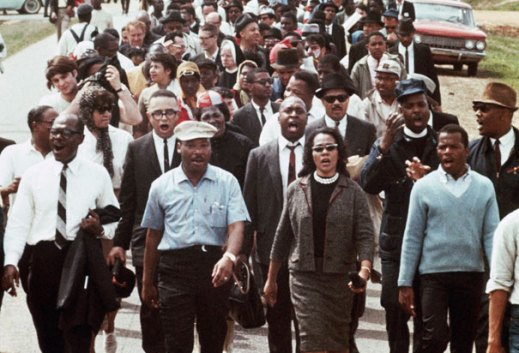
Featured Image: American Civil Rights Movement leaders singing on the 1965 March from Selma to Montgomery, Alabama, Photo Credit: Bettman/Corbis
—
Ashon Crawley is Assistant Professor of African American Studies in the Ethnic Studies Department of University of California, Riverside. He earned his doctoral degree from Duke University in the English Department with a certificate in African and African American Studies. Before Duke, he attended the Candler School of Theology at Emory University, earning a Master of Theological Studies degree with a concentration in feminist thought and queer theology. His research and teaching experiences are in the areas of Black Studies, Performance Theory and Sound Studies, Philosophy and Theology, Black Feminist and Queer theories. He has published work in Current Musicology; Souls: A Critical Journal of Black Politics, Culture and Society; The Journal of Theology and Sexuality; Black Theology: An International Journal and in Pneuma: The Journal of the Society for Pentecostal Studies. He is completing my first manuscript, titled Blackpentecostal Breath: The Aesthetics of Possibility, which investigates the relationship of aesthetic productions to modes of collective intellectual practice. this work contributes to interdisciplinary scholarship by engaging queer theory, sound studies, literary theory, theological studies, continental philosophy and visual studies.
—
 REWIND! . . .If you liked this post, you may also dig:
SO! Reads: Deborah R. Vargas’s Dissonant Divas in Chicana Music: The Limits of La Onda– Wanda Alarcon
Pentecostal Song, Sound, and Authentic Voices– Ashon Crawley
Quebec’s #casseroles: on participation, percussion and protest– Jonathan Sterne
Share this:

A Brief Review of Australian Radio Art

Welcome to the second part of Radio Art Reflections, a series on radio art that brings together the thoughts of three practitioners who have been researching the field from Canada, Australia and the UK.
In the first part Canadian sound and radio artist Anna Friz discussed how transmission art has shaped her practice and how it has become an important current within the expanded territory of radio art. Following this, musician and sound artist Colin Black reflects on the particularities of Australia’s radio art history, analyzing the effects of ongoing cutbacks at the Australian Broadcasting Corporation. Black fears a distinctive Australian soundscape-based radio art is in danger of being lost, while identifying a current renaissance in narrative based radio features which currently shape ABC radio output, and considers the potential of ABC’s new Creative Audio Unit.
– Guest Editor Magz Hall
—
As an artist growing up in rural Australia, I was hugely influenced by how state-owned radio engaged with sound-based practitioners. For decades, radio not only gave voice to some of the more exploratory artists and their works, it allowed artists and audiences from all over this vast continent to find a space in which experimental works could, with financial support, gestate, be realized and propelled onto a world stage, often receiving international acclaim for their distinctive perspective.
In recent years I have come back to those works as a PhD researcher, interviewing thirty five international practitioners, theorists and producers on Australian radio art thereby gaining a new appreciation of its particular aesthetic practices and approaches. This article draws on some of these interviews to highlight national and international perceptions about where Australian radio art has been, while also demonstrating its potential to influence a new generation of artists to explore beyond mainstream media formats.

Murray Higgins, ABC Adelaide Drama supervising engineer recording various armaments on the deck of a Royal Australian Navy ship. This actuality was used for a live broadcast of a radio play scheduled for broadcast on the same day of recording. (Photo taken April 8, 1945 by an unknown photographer)
THE LISTENING ROOM
While there are a few early examples of Australian radio art, consistant programming and commissioning of radio art effectively commenced in the 1980s with the formation of the ABC Arts Unit during 1984-85 and the acoustic arts programme The Listening Room, which aired from 1988 to 2003. Although long-decommissioned, The Listening Room was still one of a very few signposts that my interviewees cited when trying to understand the properties of Australian radio art. The Listening Room’s founding executive producer Andrew McLennan, who expanded the boundaries of ABC radio from 1976 onwards, had a clear take on the aesthetic framework of the show, stating in one internal ABC report (c1990) that the programme was a:
… venue for the exploration, the cross-pollination of radio forms. … you can hear new radio plays, audio essays, acoustic features, sound documentaries, new music, sound-scapes and sculptures, audio installations, acoustic art forms …
This approach was broader than that of other international radio art programs. Here is a quote from the formative executive producer of Deutschlandradio Kultur, Götz Naleppa, who took a much more “aesthetic” approach for his well-known Klangkunst programmes in Germany:
The difference to other radio-art-forms like radio-play is simple: sound-composition [a term Naleppa prefers to radio art] shares with them the same elements: sound, text (voice) and music. But in radio-play text (dialogue) is in the foreground and the other elements SERVE it (often in an illustrative way). And in (radio)sound-composition we have the same elements – but they are EQUAL, they are simply MATERIAL in the hands of the composer [Götz Naleppa, e-mail message to author July 28, 2005].
Of the two, The Listening Room clearly had a wider scope. Thus a number of ABC works, like On the Raft, All at Sea (by Robyn Ravlich and Russell Stapleton), placed the text in the foreground as the narrative is primarily driven by the use of spoken dialogue and the other elements are used to serve the text in a chiefly illustrative fashion. By definition Naleppa would call this a “radio-play” and not necessarily neues hörspiel or radio art, and definitely not a radio “sound-composition.”
.
Extract from On the Raft, All at Sea (2002) by Robyn Ravlich and Russell Stapleton (courtesy Robyn Ravlich and ABC Radio)

Figure Two: The Listening Room, program logo postcard designed by Antart (c 1990).
“AUSTRALIAN” RADIO ART
Alongside this inclusiveness of a wide scope of work, my research uncovered a range of other ideas about the identifiable properties of Australian radio art. Austrian Elisabeth Zimmerman claims that with Australian work there is “a certain tradition” that favours the “use of environmental sounds … but in a very composed way.” Andrew McLennan supports Zimmerman’s viewpoint and states: “it’s always hard to say and it is probably a bit of a cliché … [however he] often think[s] of it as quite environmentally driven.” Douglas Kahn, an American, is more skeptical, observing that “The Australian stuff was much broader range … I don’t think you can say that there was an Australian aesthetic because there were so many different artists that were brought in to do things.” Although later Kahn does state that a common thread heard in Australian work was its “really high quality production values … really nice complex mixes … people playing the mixing board like it was a piano in a really sophisticated way.” Kaye Mortley from her Australian French background describes Australian work as “radiophonic art, of various sorts, more experimental in nature, some produced by composers.” While not a composer, Australian Virginia Madsen supports Mortley’s viewpoint when she describes her own work as “experimental … it combines music, theatre performance, and documentary really.” The common theme that emerges from my research is the openness and commitment to experimentation that exists alongside a highly professional approach to the art form within Australian radio art culture.
My interviews also indicated that radio art plays a role in the perceived amorphous and multi-faceted notion of national identity, while confirming Kahn and Nicholas Zurbrugg’s earlier observations that radio art has critically contributed to the overall arts ecology in Australia. As a practitioner, I would also describe my own work as having an experimental approach that is influenced by the high quality production levels of programs like The Listening Room. While much of my work is environmentally driven, my artistic focus is to create multi-faceted, intimate aural geographies in which human imprint is present.
.
Extract from Alien In The Landscape (2007) by Colin Black (courtesy DeutschlandRadio Kultur). This extract features synchronous field recordings made by a Rodes NT4, X-Y configured stereo microphone and Fender Stratocaster with additional strings attached as pictured below.

Figure Three: The author conducting field recordings at the edge of the Great Sandy Desert in Australia, 2006.
THE CREATIVE AUDIO UNIT AND AUSTRALIAN RADIO TODAY
When The Listening Room was decommissioned in 2003, explorative radio was forced in two directions: ABC Radio National programmed some word-based works, while ABC Classic FM aired another set of works that Kate Dundas (Director of ABC Radio) has called “Shorter-form pieces, maybe perhaps down the sound-based acoustic end or radiophonic end of the spectrum.”Budgets were dramatically reduced and diverted, resulting in the effective abandonment of regular commissions and airtime for long-form sound-based works. In 2012 ABC management decommissioned book readings and Creative Instinct (a “feature program that reflects and explores the creative world”) and The Night Air (described as “aural equivalents of the avant-garde cut-up: a montage of interviews, location sound, music and found audio”). Moreover management oversaw the dismantling of the Airplay programme, which included “hour-long dramatic fictions [sic] experiment with form” effectively ending an 80-year tradition of Australian radio drama. In replacing these programmes, the Creative Audio Unit (CAU) was planned and American-style low budget radio production techniques for dramatic short stories (as championed at the 2012 ABC run Radio Beyond Radio conference) were put on the table as the future of radio.
In 2013 the ABC recruited a whole new team (who collectively had very little direct engagement with prior radio drama and The Listening Room production budgets and procedures), to setup, oversee and run the CAU. This transition was so atypical of past ABC changes that it raises questions as to whether this was an orchestrated act of cultural amnesia. It is perhaps not surprising that one of the major challenges this new team faces is the lack of resources, which impedes the magnitude of new works commissioned. This also raises questions as to how the previous budgets from Airplay, The Night Air and Creative Instinct have been reassigned. Another challenge is this unit’s extremely wide area of responsibility (that was previously spread across a number of ABC Units) ranging from radio drama and essays on the Radiotonic programme (effectively replacing the entire radio drama department) to what it claims to be a “portal into radio art, performance, soundscapes and composed audio features” on its Soundproof programme.
While Soundproof makes gestures to re-stimulate radio art activities in Australia, in sampling its first twenty episodes it becomes apparent that a very large percentage of airtime is heavily driven by the spoken dialogue narrative, more in line with radio drama or documentary. Furthermore, the episodes that contain the more interesting sound works seem to be frequently interrupted by extended contextual dialogue and therefore, for the most part, present only extracts or shorter form radio art works. Therefore, as a practitioner who runs the risk of being excluded from future CAU activities, I would nevertheless argue that for the most part, the CAU is doubling up on its focus on radio drama and documentary style productions and has not to date reached its goal of fully exploring and presenting sound rich radio art features, as it claims (please see Soundproof episode mp3 downloads dated between 11 May to 21 September 2014). Moreover, Soundproof is much more constrained, even backward-looking, when compared to its predecessors and is therefore aiming to attract a much less adventurous radio audience. More glaringly, the first twenty episodes lack a strong presence for new Australian works when compared to The Listening Room that broadcast sixty-four Australian works with a total duration of fifty hours in its first year of operation. As an inquisitive listener it seems that, to date, Soundproof has forgotten its own lineage without offering anything new or innovative and in doing so, has also forgotten audience members like myself in Australia and throughout the world.
I sometimes wonder what the conclusions from my research study would be if it were only focused on current practice. Would today’s Australian radio art still play a role in the perceived multi-faceted notion of Australian national identity? Would it still be perceived to have an experimental approach with high quality production levels that favour the use of environmental sounds? Is it still a critical contributor to the overall arts ecology in Australia? Audience members who have little prior knowledge of Australian radio art, may think so or may not conceive of its potential to do so. However, given sustained support, the space for experimentation and a clear inventive vision for the future, building on the legacy of past achievements, Australian radio art clearly has the potential to regain its status on a world stage.
—
Featured Image: Beastman mural on Brisbane Radio by Flickr User JAM Project
—
Dr Colin Black is an internationally acclaimed composer/sound artist having won the 2003 Prix Italia Award and achieving the final round selection in the 2010 and 2011 Prix Phonurgia Nova for his creative feature length works. As a result of this acclaim, Black has received multiple national and international commissions to create innovative long-form works for broadcast across major Australian and European networks. Black’s curator credits include, international festival/showcases of award winning Australian acoustic art and radio art at London’s Resonance104.4fm, Kunstradio (ÖRF, Austria) and Toronto’s New Adventures In Sound Art. In 2013 he also curated the Australian Broadcasting Corporation’s Sound Fix: Your Weekly Dose of Transmitted Audible Art series. He is a PhD graduate of the Sydney Conservatorium of Music where he was a recipient of the University of Sydney Postgraduate Awards Scholarship. More recently Black has been engaged as an academic lecturing at the University Technology, Sydney; moreover he has authored a number of conference papers and peer reviewed journal articles including “An Overview of Spatialised Broadcasting Experiments With a Focus on Radio Art Practices” in Organised Sound. Black is also the founding member of The International Radio Art (and Creative Audio for Trans-media) Research Group. For more information see: www.colinblack.com.au
—

REWIND! . . .If you liked this post, you may also dig:
Unsettled Listening — Randolph Jordan
Radio Ambulante: A Radio that Listens — Carolina Guerrero
Everything Sounds Podcast — Craig Shank
Share this:


Current Top Posts





April 2021

January 2020

November 2019

October 2019

August 2019

April 2014

November 2017

March 2015

December 2017

October 2015
 Sounding Out!
Recent Comments