
Sound as Art as Anti-environment

When I performed at the 2012 Computers and Writing Conference in Raleigh, North Carolina, I looked around during my fairly abstract 10-minute long improvisation featuring feedback loops, glitches, silences, and circuit-bent instruments, and I noticed the audience’s sometimes visible restlessness, discomfort, and even anxiety. This is a fairly common occurrence when I perform experimental sound art, particularly in contexts in which audiences expect “music” (you can hear my work at 38:30 in the video below). However, for an experimental sound artist to take offense to such reactions is, in my estimation, missing the point of the exercise. That sound art disrupts, agitates, and even offends is a powerfully reaffirming reminder that sound art transcends music and sound; it is a method of revelation, an act that surpasses logical communication, instead challenging the very nature of sound and perception.
.
As an artist, scholar, and fan, I am drawn toward sound and music that lures me into a new world, an unfamiliar way of being and knowing. Like Lewis Carroll’s Alice, I learn that the rules of my world no longer apply. This happened when I heard J Dilla’s Donuts album, and when I heard Madlib’s Medicine Show #3: Beat Konducta in Africa, when I heard Miles Davis’ Bitches Brew. An artist that continually draws me down the rabbit hole is Walter Gross, an experimental sound/beat artist out of Los Angeles. His work changes the way I usually interact with sonic art, both in terms of his sound and in his approach to physical collage and handcrafted cassette packaging, Gross departs from the comfortable and familiar listening imparted by polished hi-fi 3-minute tracks with definitive beginnings and ends and discernible melodies. Gross instead propels listeners into very unusual (and pleasantly discomforting) soundscapes that demand attention. Almost counter-intuitively, Gross’s visual representations of his work intensify that experience. Consider his 2010 work, Dopamine:
Dopamine is likely a challenging piece for audiences, at least in terms of violating the dominant structures of music. The piece opens with disorienting use of panning, deliberately obscuring degraded audio, largely indiscernible movements and patterns, and so on. His video work likewise presents a fitting yet relatively unusual juxtaposition of youth and destruction, celebration and danger. In terms of both sound and sight, Gross’ work disrupts dominant musical sensibilities, challenging the very patterns and structures within which we can express ideas. He violates tradition, shakes off the canonical baggage carried by prevailing paradigms of Art and Music, and plunges audiences into unfamiliar sensory experiences that require metacognition, reflection, and examination of what sonic art is, and more importantly, what sonic art can be. Gross, in other words, seems to transcend the musician moniker and reach something else entirely. In what follows, I’d like to explore a (very brief) history of such artists, and begin to think about how to frame sonic art as immersion in what Marshall McLuhan called anti-environments: the unconscious environment as raised to conscious attention.
Sound as Art
There exists a strong tradition of experimental noise and sound art, particularly in 20th-century Western avant-garde movements. Futurists were arguably the first to consider noise as music in the European tradition, and were certainly influential in asking artists and audiences to become more aware of the changing social and sonic surroundings . In his 1913 manifesto-of-sorts titled “The Art of Noises,” Italian Futurist Luigi Russolo proposed an orchestral configuration that more aptly represented the range of sounds available to contemporary listeners, namely those sounds that accompanied industrialization and urbanization. The sounds of the Futurist orchestra would include “rumbles, roars, explosions, and crashes.” Russolo built devices called intonarumori to mechanically achieve and manipulate these sounds. His brother, Antonio Russolo, also enacted this new philosophy of modern found sound and composed Corale and Serenata.

Luigi Russolo and Ugo Piatti with the Intonarumori, 1913
Any inquiry of art as anti-environment would be incomplete without a discussion of the great anti-art movement, Dada. Like the Futurists before them, Dadaists used found sound and technology-as-art to violently disrupt conventions of art, beauty, and authorship within the white avant-garde community. Marcel Duchamp’s famous work, “Fountain,” is likely the most familiar Dadaist artifact to contemporary readers, yet the sound poetry of Kurt Schwitters and other Dadaist and Dada-inspired sound pieces such as Erwin Schulhoff’s 1922 work In Futurum (the middle movement of which contains only a rest and the notation “with feeling,” an undoubtable precursor to John Cage’s 4’33”, written 30 years later) created sonic spaces of innovation and strangeness that changed the way audiences listened to both voices and silences. The Russian Cubo-Futurists, especially zaumniks such as Alexei Kruchenykh, made similar ventures into anti-environments. Kruchenykh developed the sound art zaum, which he understood as a transrational language that undercut existing language systems in which the “word [had] been shackled…by its subordination to rational thought” (70). Zaum was a sort of linguistic anti-environment, one rooted in the notion that meaning resided first and foremost in the sound of a word rather than the denotative symbol system that emerged alongside the proliferation of print/visual culture. One could also not underemphasize the work of John Cage, from his prepared piano to his work with organic instruments.

John Cage and His “Prepared Piano,” Image courtesy of Flickr User William Cromar
The list of artists, genres, and movements engaged to some extent in the enterprise of anti-environment architecture could go on and be debated indefinitely: Free Jazz, Turntablism/Nu Jazz, Experimental Hip-Hop,Fluxus, Circuit Bending, Prepared Guitar, ProtoPunk, Punk, Post-Punk, New Wave, No Wave. . . in all of these diverse movements, the sonic artists share the tendency to create strange new worlds via sound; worlds that reveal social and technological environments that most people seem unaware of in the moment. This is why media theorist Marshall McLuhan called the artist “indispensible,” because the artist can tell us something about ourselves that we cannot know via ordinary means of perception. Sonic artists expose audiences to auditory phenomena, structures, juxtapositions, etc. that are to various extents hidden, obscured, or ignored as “noise.” The sonic artist is more than just a clever selector and (re)arranger of sound; s/he is a revelatory agent, exposing what is inaudible.
Art as Anti-environment
Anti-environments, however we might define and classify them, are vital not only to artistic communities themselves, but they are also vital to a society of fish in water. In his 1968 text, War and Peace in the Global Village, McLuhan asserts (among other things) that humans remain largely unaware of their new environments, likening them to fish in water: “one thing about which fish know exactly nothing is water, since they have no anti-environment which would enable them to perceive the element they live in” (175). In other words, humans seldom possess or practice a sense of awareness regarding their surroundings because there’s nothing against which surroundings may be contrasted. The “water” to McLuhan represented the various environments (physical, psychological, cultural) shaped by technological innovation, but we can—and should—extend the water metaphor to a range of hegemonic frameworks: constructions of gender, race, ability, and so on.
This essay is certainly not an attempt to generate some sort of evaluative rubric by which to judge artistic or sonic expression objectively. Rather, we might use the concept of anti-environments as a way to frame our subjective experiences and encounters with all sound, and begin listening to unfamiliar sounds as psychedelic (from Greek psyche- “mind” + deloun “reveal”) keys to illuminate the patterns and structures in which listeners exist. We must work to understand our environments and our place in them; if we are to engage critically with our culture, we must first understand existing (yet invisible) patterns and structures that surround us. And we are aided in this effort, in great part, by humanity’s great seekers of pattern recognition, the sonic-psychonautical messengers: the sonic artists.

Sound Artist Performing at Circuit Bending Workshop in Dayton, Ohio in 2009, Image Courtesy of Flickr User Vistavision
To return to the sound that inspired this meditation, Walter Gross (among others) is in many ways participating in and propelling the discourse of Leary and McLuhan, Schwitters and Schulhoff, Kruchenykh and Cage,Davis and Sun Ra, Madlib and J Dilla. Gross performs the sonic anti-environment, enacts the revelation of obscured sonic paradigms. For me, Gross can act as a sort of lens through which ordinary sonic patterns and structures become visible. I hear Flying Lotus, Bob Dylan, and The Minutemen differently after Gross. I hear my office, my home, my family’s voices differently after Gross. I hear patterns that weren’t audible before. After Gross, I become aware of how I am continuously trained to expect certain things from the sonic world: compartmentalized units of meaning, clearly stated origins of utterances, linear narratives, repeated/repeatable melodies, and so on.
Likewise, my own sonic art/scholarship approaches the use of sound to reveal the inaudible assumptions present in Western frameworks surrounding sonic production. I will conclude with an illustration of my own work and why sonic anti-environments are so central to my philosophy and method. One of my sonic works, “Toward an Object-Oriented Sonic Phenomenology,” was recently part of an exhibition titled Not For Human Consumption, curated by Julian Weaver of CRISAP in London. I recorded the sounds of a high mast lighting pole using contact microphones. Contact microphones do not “hear” like humans typically hear. Typical (dominant) notions of human hearing (and therefore of sound itself) involve the reception and interpretation of vibrations present in air. Contact microphones instead only interpret the vibrations in solid objects.
By listening through an object–through alien “ears,” so to speak– we can begin to critique the ways that we privilege listening via air, a listening that places humans at the center of the universe. We can consider the ways that sound has very real effects on humans with atypical hearing abilities and nonhuman objects. It is difficult to have such conversations if we never explore sonic anti-environments, if we never break through dominant epistemological models, if we never expose the limits of our own environments.
—
Featured Image: Beatrix*JAR in Dayton, Ohio, September 9, 2009, by Flickr User Vista Vision
—
Steven Hammer is a Ph.D. candidate in Rhetoric, Writing, and Culture at North Dakota State University in Fargo, ND, USA. His research deals with various aspects of sonic art, from exploring glitch and proto-glitch practices and theories (e.g., circuit bending), to understanding and producing sound from an object-oriented ontology (e.g., contact microphones). He also researches and facilitates trans-Atlantic translation collaborations between American, European, and African universities. He has multimedia publications with Enculturation, Sensory Studies, as well as forthcoming book chapters with Wiley/IEEE press, and IGI Global Publishing, and has performed creative and academic work at several conferences across North America, including the national Computers and Writing Conference and the Council for Programs in Technical and Scientific Communication. He performs experimental circuit-bent and sampler-based music under the moniker “patchbaydoor,” and has constructed and documented a number of hardware modification projects for his own artistic projects and for other artists in the upper Midwest United States. You can read/hear more atstevenrhammer.com
Share this:

SO! L.A.: Sounding the California Story
 Editor’s Note: Welcome to the second installment in our month-long exploration of listening in observation of World Listening Day on July 18, 2012. For the full introduction to the series click here. To peep the previous post, click here. Otherwise, whip out your most oversized sunglasses, kick back, and listen to Bridget Hoida’s California. –JSA
—-
STOP.
Do not read along with me “in your book.”
Resist the temptation to follow along with your eyes.
Click play. Listen.

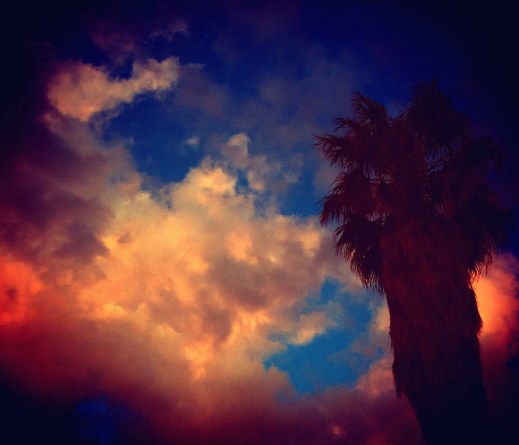
Sunset in the San Joaquin Valley
If I had things my way, I would whisper these stories to you as we sat in mesh folding chairs on the poured concrete porch of my Central Valley childhood home. If I had things my way, I would refill your glass with lemons and gin, and we would breathe in the sweet, summer smell of rotting blackberry brambles. If I had things my way, we would wait until the sun set against a Tokay harvest, taking with it the harsh triple digit temperature and leaving us nothing but the quiet of a delta breeze and moonlight. If I had it my way, I would ask you to lean in close as I whisper with canonical voices:
“This is a story about love and death in the golden land, …”
“I remember that moment exactly, those exact words registering in my mind like the notes of a solo…”
“Bobby Gene was a tattletale he told everything he heard…”
“You must not tell anyone what I am about to tell you…”
“My history is murky, and I wanted it [ …] that way so I could be free to tell whatever I wanted. ”
“I’ll tell you what I suppose from your silences and few words and you can tell me if I’m mistaken. You’ll have to speak up with the real stories if I’ve got you wrong…”
“And so they talked and told tales of their region, and I listened. Long into the night I listened until I dropped off to sleep and my father would pick me up onto his lap as he continued to talk about the Revolution…. And every camp was different, none existing for more than six or seven weeks, then off we would go to the next harvest, where new people would gather and there would be new tales to be told and heard. I knew when I was six years old that the one thing I most wanted from life was to be a storyteller.
The storied sound of California
-All Voices
Shush…. Listen.
Linger with me on the drawn-out drawl of the stories I was raised on. Of the stories I was raised upon. For this is the sound of the California story: A myriad of voices sounding out narratives onto the page. Conflicting, concurring, spoken-over and rewrote…no one lasts longer than the next harvest, the next filmic “Action!” This is the sound of the storied terrain of interwoven melodies spoken upon the California soil that I call home.
1.
In or around 1995, I fell madly in love with Joan Didion. It’s not so much Didion the woman but rather the sound of Didion’s words that have me so hung up. My obsession began in the stacks of the Bancroft Library at UC Berkeley. I was assistant to the assistant librarian there and during my lunch hour I would take the dumb waiter up to the roof, eat a Kaiser roll with apricot jam, and read dime store copies of classic novels. I chose the roof because I like to read aloud, and in libraries at the time, reading aloud, especially to yourself, was expressly forbidden.

So there I was on the roof of Bancroft, with my roll, my jam, and my dime store copy of Play It As It Lays. I opened the page and read something about snakes and Iago. A mother died, the town of Silver Wells was won, and then lost, in much the same way a marriage slips into divorce. And then it happened. I stumbled across a line that changed the way I thought about words. Page 7, the first full sentence of the top paragraph, on the right: I might as well lay it on the line, I have trouble with as it was.
And after that line a whole lot of white space.
Beautiful, brilliant, blank white space.
As though in the silence of the rooftop, of the view, Didion was screaming to the reader, to me, something louder than words. In that white space there was sound and it was deafening.

2.
Later, when I decided to get a Ph.D. in creative writing, and although I couldn’t say as much on paper, examine, among other things, the commonality of language in California writers and the sonic devices of oral storytelling, I came across a quote from Didion, in interview, that said:
I had the technical intention to write a novel so elliptical and fast […] it would scarcely exist on the page at all…white space. Empty space. […] A white book to which the reader would have to bring his or her own bad dreams…
And although I adore everything about her I almost wished she hadn’t said it. Or that I hadn’t read it, because the thing about Didion is that statement… the part about the blank space… and the nightmare… it was already there. On the roof of the Bancroft library with my Kaiser roll and apricot jam, when the air tasted like September, I brought my own bad dreams because in that brilliant bit of white space I heard the scream.
3.
I like the white page. I prefer stories to plots. Plot for me is how the narrative moves from one space in time (from one line on the page) to the next. Story is how the narrative sounds. Story is voice. Plots are where girls meet boys and girls lose boys and girls get boys back. Stories are the shuffle and stop of scuffed shoes walking railroad levees, old men clearing phlegm, the surprise of an elastic bikini band as it snaps against the freshly burnt back of a burgeoning starlet. And the sounds of words as they smack unbridled against the page.

a traditional page by John Steinbeck

a white page by Joan Didion
4.
When I read Didion we are on my porch and I hear her voice. When we think of writing, when we imagine reading, we think of quiet moments that exist alone with fixed type on a printed page. But as a reader, and more importantly as a writer, I have never felt this way.
5.
Voice, to paraphrase Emily Dickinson, is the “slant” you bring to your version of “the truth.” Plots are recyclable. Hell, you can buy one on eBay, to be sure. But a writer’s voice is different. I don’t read a book to figure out what happens next. I read to hear the whisper of the author’s voice. If they whisper well, I turn the page.
6.
From John Steinbeck to Gertrude Stein, John Fante to Susan Straight, Larry Levis and Mary Hunter Austin to William Saroyan and Shawna Yang Ryan, there is commonality of sound and language that I’m willing to claim composes an aural palimpsest of sorts. A voicing over, both literally and figuratively of native daughters and native sons held up on the tongue of the golden state.
The cadence, the rhythm, the obsession with things past. The aching nostalgic longing. The reflection. The fear. The reclamation. The imagination. The witness of an agrarian undoing. Sleepy Hollow moments reborn—again and again on western soil. The feeling of home. The feeling of home slipping away. The feeling of self, self-made in the image of home, slipping away alongside it. There’s a certain Californianess to it.
7.
What if we found a way to consider the sound these “fixed texts” emote? What if we broke with conventional narrative structure and embraced a written technique that more adeptly mirrored the sound and cadence of spoken story telling? Then might it be possible that the very aurality that is “written over” on the read palimpsest is in fact the sound that also remains?
As a writer, a writer who believes in voice, who rejoices in sounds as the strike-like syllables against a now forgotten Olivetti key, my pursuit in writing not only a novel, but in writing a novel about California was how I could possibly enter into this conversation. How I might be able to raise my voice loud enough to embrace the crowd of such a respectable page. How I could construct my text in such a way that it would not only read, but also sound Californian.

a “docu-page” by Raymond Barrio
8.
In my struggle to voice not only my novel, So L.A., but also my protagonist Magdalena de la Cruz, I relied heavily on the patterns, soundscapes and literary devices of the collective California canon comprised of authors such as the ones I spoke of above. In So L.A. I was looking for a way to tell the story out loud while still operating within the conventional structure of a “type and text” book.
 9.
9.
My novel opens with Magdalena falling off a boat and then moves both forward and backward in time. This is how most people tell stories orally. They begin in the middle and then jump around, forgetting, amending, and calling attention to the most important parts, while the listener rarely ever exclusively listens but instead interjects and provides his or her own connections, observations and experiences. Eliminating quotations allowed me to access some of this interplay. It allowed me to question the reliability of spoken language. Spoken utterance does NOT always translate to precise hearing of the said words uttered. There is always interference—be it emotional (memory-sound triggers), psychological (felt meaning as opposed to said meaning), physical (honking cars, loud birds, eye rolls and sneezing) or linguistic (signifiers and unspoken gestures). Just because words are utter does not mean they are the same words that are heard. And not only did I want this, but I needed it on my page. Although I considered the docunovel (in the vein of Raymond Barrio), autho-interview collage (like Anna Deavere Smith) and autofictive exploration (ala Salvador Plascencia) I ultimately decided to abandon quotation marks.


a “sounded” page from The People of Paper
10.
This (“) says open. It says start.
This (”) says closed. It says stop.
But (“) and (”) also sound.
For me they sound like a particularly rough clearing of the throat. They sound like standing on a library rooftop, trying to confess your love with the passion of a librarian “with hiccups.”
“They” interrupt the eye. “They” provide visual cues for accessing character and I didn’t want Magdalena “to be seen.” I wanted her to sound.
Her voice required a fluidity and unreliability not attainable “in quotes.” Without conventional quotes I was free to wander inside the head and voice of my protagonist as I pushed the blur between what she was saying, what the listener perceived she was saying, and what other characters were voicing without visual interruption.
11.
Also important in my authorial access to sound (and the absence of sound) on the fixed and written page was the use of filmic microchapters (some only as long as a single sentence). A sentence that reads as a chapter, surrounded by all that stark and lovely white space, not only looks different from a classical bookish chapter, but it also sounds different. Read out loud, or quietly inside the reader’s head, it sounds out a particular meaning and resonated differently within the mind’s eye and ear.
12.
With so much of the present world turning virtual, author and storyteller Barry Sanders concludes, “We demand less from the historical accuracy of our stories. We even demand less of a truth. We are content with images and feelings. If it feels closer to the truth then it might as well be.” However I’d like to extend Sander’s assessment beyond image and feeling to include sound. In this newly constructed world of virtual storytelling we are again experiencing a shift (not unlike the shift from oral to written storytelling) that is also sound dependent and sonically informed. From the staccato sounds of Twitter as compared to the unconstricted and leisurely expanse of Tumblr, it is important to acknowledge that the twenty-second sound bite can be (and historically has been) used (and utilized) in fiction to make noise and call attention to lasting moments of profound revelation. Although Didion’s Maria may “have trouble with how it was” I find a certain sense of comfort in how it is provided we are all able to lean in close and listen. Listen past the interference of type, text and YouTube to the sound of words both on and upon the page as,
“These are tales told in darkness in the quiet at the end of the day’s heat…”
—
Opening Image Credit: “L.A. Sky at Sunset” by Flickr User David Vienna
Audio note: Voices used, with the exception of Bridget Hoida, are not the actual voices of the authors listed, nor are they meant to be representative of said authors.
—
Bridget Hoida is the author of So L.A. (2012). In a past life she was a librarian, a DJ, a high school teacher, and a barista. In this life she experiments with words and has taught writing at UC Irvine, the University of Southern California and is currently a professor at Saddleback College. Hoida is the recipient of an Anna Bing Arnold Fellowship and the Edward Moses prize for fiction. She was a finalist in the Joseph Henry Jackson/San Francisco Intersection for the Arts Award for a first novel and the William Faulkner Pirate’s Alley first novel contest. Her short stories have appeared in the Berkeley Fiction Review, Mary, and Faultline Journal, among others, and she was a finalist in the Iowa Review Fiction Prize and the Glimmer Train New Writer’s Short Story Contest. Her poetry has been recognized as an Academy of American Poets Prize finalist and she was a Future Professoriate Scholar at USC.
She has a BA from UC Berkeley, a MA in fiction from San Francisco State University, and a Ph.D. in Literature and Creative Writing from the University of Southern California. So L.A. is her first novel.
Share this:


Current Top Posts





April 2021

January 2020

November 2019

October 2019

August 2019

April 2014

November 2017

March 2015

December 2017

October 2015
 Sounding Out!

Recent Comments