
The Sound of What Becomes Possible: Language Politics and Jesse Chun’s 술래 SULLAE (2020)

“To this day I think about all the strange words I missed out on, all the losses I’m still carrying from faraway…I still think of the time when I spoke one language, and that language was whole.”
Chun 2020
Language can be a site of loss, a wholeness with which one, due to migration, has never really known. In the above passage, artist, Jesse Chun, reflects on how her grandmother spoke words in a language she did not understand, but yearned to hear and feel those sounds after her passing. There is a sonic residue that sticks to diasporic experiences. There are sounds that can stir up a blend of affect and ideation that is comforting when whiteness is unsettling. It is this disjuncture between words, meaning, and their sounds, that drew me to Chun’s work, 술래 SULLAE (2020). This piece reminded me of how sound, in its most ambiguous and queer forms, can hold the contingencies of history, language, memory, family, and the genealogies of loss that mark these sites of colonial dispossession.
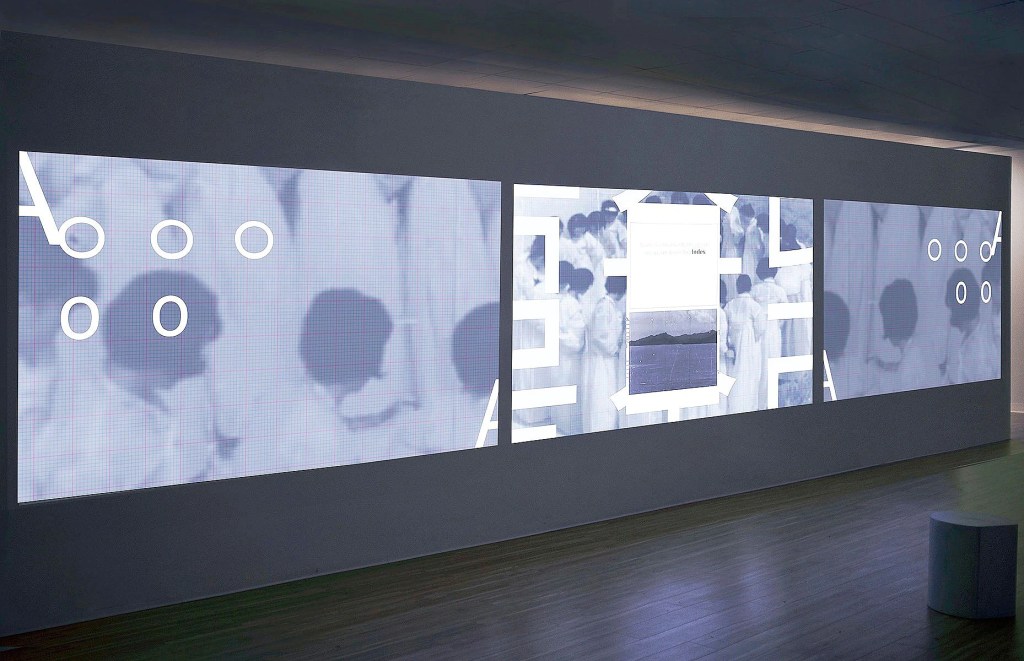
술래 SULLAE (2020) is a single channeled video that draws from ganggang sullae, a Korean seasonal harvest and fertility ritual that integrates song and dance and is typically performed by women under the glow of moonlight. The participants hold hands forming a circle that through their movement, expands, disassembles, and changes its form. The songs can be both impromptu or pre-determined and encourages the participants to express their feelings in chorus with one another.
Diana Seo Hyung Lee (2020) suggests that historically ganggang sullae was meant to provide a forum for its participants to express emotions connected to living within patriarchal systems of power and oppression. She writes: “the women participating would not have been able to, in their everyday lives, sing, speak loudly, nor leave the house at night, in the patriarchal society of ancient Korea. This dance was a license for their one release.” In 술래 SULLAE, the dance proves to be a defiant presence. The women flash on screen as an unbreakable chain reinscribing a gendered history with new sounds and images that gesture to emancipatory possibilities.
술래 SULLAE combines archival clips of ganggang sullae, index pages from intonation books, images of Hangul and English consonants and audio splices from YouTube tutorials on how to pronounce English correctly. In the video, language becomes unhinged from expectation but at the same time, given form through history. The sound of the English language is disembodied and spliced into phonemic pulses. In 술래 SULLAE, Chun has created an encounter with the grammars of polyphony; a simultaneity of sounds that are both restrained by and resistant to the imposition of English on the Korean diaspora. Through what Chun has described as a form of “unlanguaging” following Rey Chow, her audience is witness to new meanings produced through the abstraction, manipulation, and redaction of sounds and symbols from the English language.

Chun’s editing and manipulation of English sounds is intentional. In an interview with Art Forum, Chun shares: “Taking the sound apart but still keeping it within the conceptual framework of English made me think about what else is embedded in making a language. English is tied up with legacies of imperialism; there’s so much unseen violence that is part of how this language is institutionalized.” What remains after the edits is an inventory of sounds that disrupts the primacy of the vowel as central to English word construction and thus, central to colonial imagination.
Like Chun, I realize that my conceptualizing of language is within an English framework, but my hope is that when we turn to the affective and when we begin to pull language a part, something different, something resistant, is produced. I am neither an expert in English nor Korean linguistics, it was the sounds in this work that pulled me into it. In thinking with 술래 SULLAE, I’m interested in what becomes possible in the absence of the vowel. I turn to the interruptive potential of consonant sounds to affect and incite methods of communication outside of those steeped in colonial dominance. What does it mean to de-emphasize the function of vowel sounds in language and reorient our listening to the consonant? What do consonant sounds teach us about the sonics of race that underwrite hierarchies of language? What methods of communication become possible when we do away with words and are left with only their sonic substance?
Through her assemblage of consonant sounds in 술래 SULLAE, Chun is making a deliberate choice to describe and animate a politics of language through refusing its colonial enclosures and turning to the aesthetic in order hold the excesses of description. She refuses the vowel in this piece, not by denying its presence, but instead relegating it to the soundless and the unfamiliar, a space of, in her words, “untranslatability.” In this undoing, consonants become the emotive force where new meanings and orientations to the sounds that mark our words are forged.
술래 SULLAE opens with the sound ssshhh; a pairing of consonant sounds that is often associated with insisting on silence, a sound meant to reprimand. Chun extracts and emplaces this sound in a new aesthetic landscape that is independent and unregulated by colonial schemas of enunciation and translation. The prominent soundscapes of the video are consonant sounds and when removed from their phonetic relations to vowels these sounds undo the presumptive structuring or potential reprimand of English. In 술래 SULLAE, we are meant to experience the fullness of the consonants’ timbre…ssshhh, ppp, ddd, tttt, kkkk…these edited clips of sound originally meant to instruct and assimilate speech into English pronunciations now serve a different function. For me, they secure Chun’s political orientation: one that is about the crafting of a world that involves the careful consideration of the logistics, function, and embedded emotions of the sounds that inhabit it.

graphite, watermarks, paper, aluminum frame, 13 x 16 inches
All languages contain their own unique set of vowels and consonants, but, Anne Carson reminds us that: “The importance of vowels to human speech has remained. There are words in English without consonants, but so central are vowels to word construction that there isn’t a word in English that doesn’t include a vowel.” In speech, consonants sounds are meant to break up the intended agenda of vowels. The ssshhh, ppp, ddd, tttt, kkkk, are antithetical to the circle or the rounded mouth needed to voice a vowel sound. Unlike the openness of a vowel, producing consonant sounds involves a narrowing of the vocal tract. This narrowing is referred to as constriction or the obstruction of breath whereby sound is produced by a form of corporeal tension. Consonant sounds also demand all the mechanics of the mouth: the lips, the teeth, the tongue, and the palette. Shhhh, requires the corners of the lips to lower and rather than rounding, the lips become pursed, and teeth become exposed. Parts of the mouth are drawn in. The soft palate is raised, and the tongue reaches upwards towards the roof of the mouth without touching it and then the tip of the tongue lowers behind the teeth.
Consonants emerge out of collectivity. Where a vowel is sounded without vocal constraint, consonants require more effort. Their sounds are produced through intricate bodily choreographies in the mouth that involve both constriction and collaboration. Ganggangsullae likewise relies on effort and interdependence. Participants collectively determine the speed and/or shape of their dance. They may even become serpentine or separate into smaller circles depending on what the group decides. The dance also provides an aesthetic space for its participants to voice frustration, anger, and tension through song with the hopes of producing reprieve from gendered hardships. Chun has decided to withhold these songs from her audience; we never hear the women singing. Through this erasure, Chun embeds the consonant sound with affective force whereby a politics of language and gendered presence is enunciated through and beyond a form of silencing. The dance redirects trajectories of dominance whereby the shushing takes on a new voice imbued with agency and hope. Because of how Chun isolates and amplifies its sound, ssshhhh is free to take on different meanings and associations. For me, I was reminded of rushing water or gusts of wind, or the sound used to lull my child to sleep. I was brought into another index of knowing and relating.
The sounds of language hold erasures and layered histories often obfuscated by our mundane encounters with them. Largely understood as the most sonorous part of the syllable, vowels produce the loudest speech sounds and their capacity for holding larger amplitudes or louder volumes have been linked to the sonic expression of emotion. Consonant sounds are more pragmatic than vowels. They are known for their functionality, for the ways in which they assemble the semantic structure of words and for their capacities to hold vowels in place or as Anne Carson describes as “delineating meaning amid the flow of open vowel sounds.” Consonant and vowel sounds map out different functional trajectories by virtue of the shape of mouth and orientation of breath that these sounds demand. Like Chun, I’m interested in what political orientations become possible when we source emotion elsewhere, beyond the confines of spoken words imposed upon us.
The word consonant is a noun, a word used to identify or classify, a semantic enclosure that establishes a subject or object. But unlike the word vowel, consonant is also an adjective. A consonant possesses the capacity to describe, to name, to tell us more. Adjectives parcel out description on states of being, in this way, they are inherently phenomenological. In 술래 SULLAE, Chun empties vowels of their sonic substance leaving behind traces of fragmented characters and differently shaped circles in their wake. They are stripped of breath and their symbolic value forming a new method of communication that reroutes expectations of what language, as we know it, can do and sound like. Like, ganggang sullae, the vowel is premised on the shape of a circle, but in 술래 SULLAE, Chun provokes us to think about what becomes possible beyond the circular structuring device, what becomes possible beyond the purview of the violent embeddedness of English and its colonial exigencies.

untitled (ㄷ), 2020, a functional concrete stool, courtesy of artist
Chun has noted that the moon that hovers above the ganggangsullae is yet another site of imperial conquest. In Art Forum, Chun states: “when I look up at it to feel comforted or to find solace, I’m reminded of colonial violence and an agenda that’s projected onto it. In that way, the moon also reflected how I see language.” Chun’s turn to consonants signals a reshaping of the colonial frame that does not disavow or idealize the legacies of imperialism on systems of communication, but instead highlights the tensions and obstructions produced in its shadows.
—
Featured image: 술래 SULLAE, 2020, single-channel version, courtesy of artist
—
Casey Mecija is an Assistant Professor in the Department of Communication & Media Studies at York University. Her current research examines sound as a mode of affective, psychic and social representation, specifically in relation to diasporic experience. Drawing on sound studies, queer diaspora studies and Filipinx Studies, her research considers how sensorial encounters are enmeshed and disciplined by social and psychic conditions. She is also a musician and filmmaker, whose work has received a number of accolades and has been presented internationally.
—

REWIND! . . .If you liked this post, you may also dig:
Blank Space and “Asymmetries of Childhood Innocence” –Casey Mecija
Re-orienting Sound Studies’ Aural Fixation: Christine Sun Kim’s “Subjective Loudness”–Sarah Mayberry Scott
Tape Hiss, Compression, and the Stubborn Materiality of Sonic Diaspora–Chris Chien
Share this:

A Day on the Dial in Cap Haïtien, Haiti

Radyo Ayisyen
Learning from other scholars’ work on Haitian radio was, and still is, one of the greatest pleasures in the process of writing Isles of Noise: Sonic Media in the Caribbean (UNC 2016). People living in or from Haiti widely acknowledged and almost took for granted radio’s outsized role in public and political life. Edwidge Danticat and Jonathan Demme also understood this and paid tribute in Claire of the Sea Light and The Agronomist respectively, but historians remained largely fixated, understandably, on pivotal moments in Haiti’s rich history. Radio is different. Not pivotal, but witnessing the pivotal. Less dramatic and more long lasting and adhering to the same format for days, years, decades. It speaks to people who wouldn’t read newspapers or books. It floods private and public space with the sounds of music, talking, ruling, dissenting, explaining, satirizing, creating, crying, testifying, lying. But it leaves few archival traces. This is why the work of the five scholars in this series is so important. They allow us to hear a little and honor the listeners who make the medium what it is.
Liveness, and company: Ian Coss’s finely tuned account of a “day in the life” of a radio station follows the programming rhythm of days and nights, from rollicking to quiet and back again. Radio is a predictable presence, an intimate friend who anticipates your needs even before you do. Coss draws from his years of listening to the listeners as he marks radio time and space in Cap Haïtien. Guest Editor– Alejandra Bronfman
——-
Fabrice Joseph is a mender, set up on a street corner in Cap Haïtien, Haiti’s second largest city. He shows me a red plastic toolbox filled with supplies — thread, wires, scraps of fabric—which he can use to fix a jammed zipper or stitch up a torn backpack strap. I stop because he’s cradling a radio set in his hands, tuned to the city’s most popular station: Radio Venus.
We meet on a quiet day; Fabrice has been sitting on the stoop for five hours already with no work. Another day he’s engrossed in assembling a large umbrella—the kind food vendors use for shade—but the radio is still on, now propped on a ledge just behind his head. He replaces the batteries almost weekly, because the radio is always on. In the morning Radio Venus plays news, Fabrice tells me, followed by music as the day heats up. Then in the afternoon he’ll hear sports or perhaps a religious program, before the station returns to music in the evening.
This arc Fabrice describes is designed to follow the arc of his day. In this post, I trace that link: between the rhythms of radio programming and the rhythms of daily life, to show how formatting choices create a heightened sense of ‘liveness’ on Haiti’s airwaves, with all content located in a specific moment: the present moment.
In a technical sense, terrestrial radio broadcasting has always been defined by real time or ‘live’ transmission (an dirèk in Creole), a characteristic that is often invoked in discussions of the medium’s capacity to create shared experiences or even ‘imagined communities.’ And yet where I live in the United States, the passage of time is barely discernible on most commercial stations. Where radio schedules once varied from hour to hour (often reflecting gendered and classed norms of listening), today market research has driven the rise of so-called “format stations” that target specific interest groups and demographics with an equally targeted form of programming: non-stop sports, news, top 40, easy listening, etc.
When I first visited Haiti in 2015, I was surprised to find a radio format unlike any I had grown up with, and not unlike those broadcast schedules of the 1920s and 1930s. While doing research in Cap Haïtien, I conducted a series of bandscans—systematic reviews of the entire radio dial—in order to identify the different types of programming heard on stations throughout the day there. I found the full range of talk and music-oriented shows you might expect, and yet of the 31 stations I picked up, only a handful carried the same type of programming all day. The vast majority carried every kind of program, including Fabrice’s favorite station, Radio Venus.
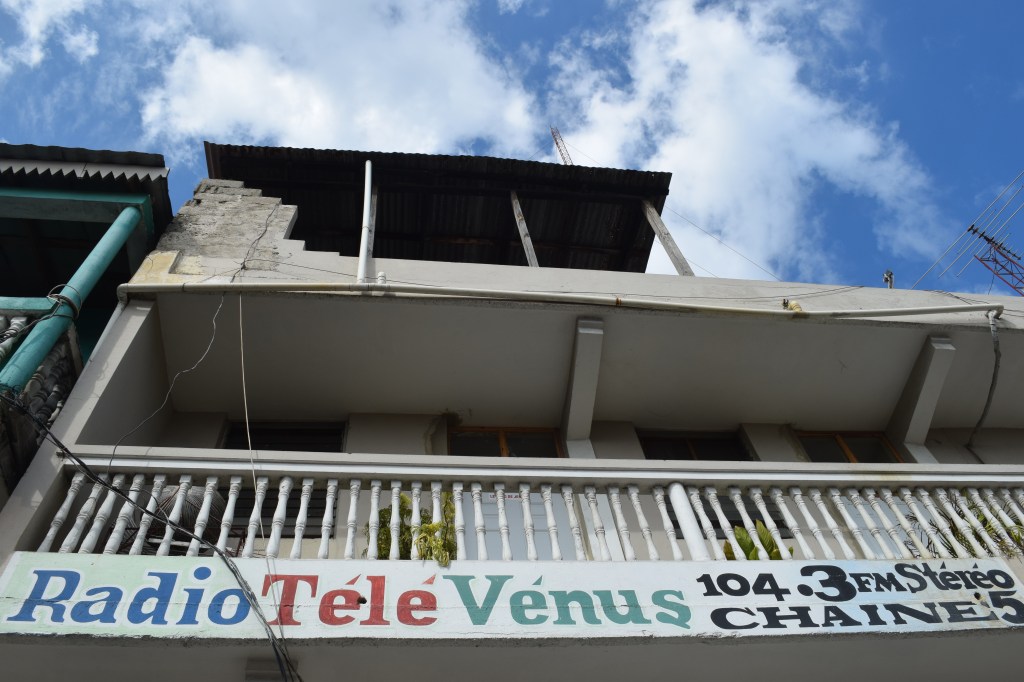
The Radio Venus studio sits on top of a three-story building, with a door leading straight out onto an open roof deck where the transmitter tower rises several more stories up in the air. That tower operates at 10 watts, just enough to relay the signal to a nearby mountain, where it’s then rebroadcast at roughly 450 watts, blanketing the country’s whole Northern Department. The person in charge of this whole system, as well as the overall flow of the day’s programs, is known as the opérateur. The station employs four operators—Molliere, Louis, Wilkonson and Simon—who work in shifts to cover the 24-hour schedule. This rotation provides stability as the hosts (or animateur) of different programs come and go—often showing up late, and sometimes not showing up at all. For long stretches of the day there is no host, so the operator just cues up a folder of songs in Windows Media Player, occasionally leaning over to trigger a station ID: a chesty voice that declares, “W’ap koute Radio Tele-Venus”—‘You are listening to Radio Tele-Venus.’
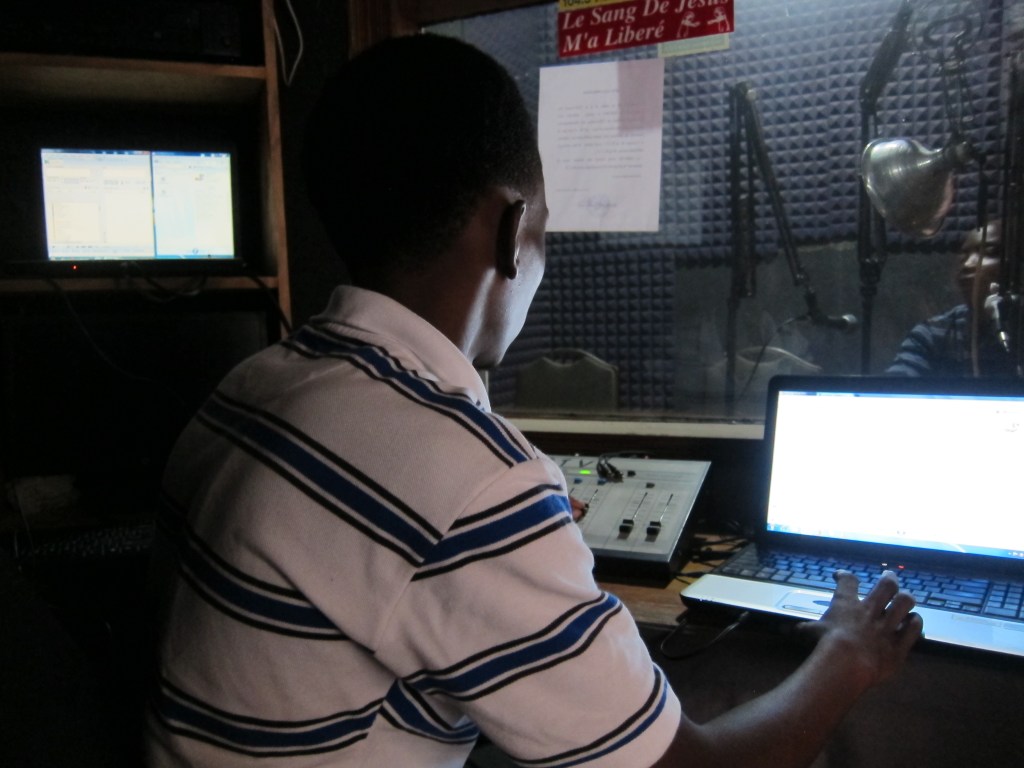
One day, while sitting behind the board of the cramped control room, Simon explains that the goal of the station’s format is to satisfy all of the listeners’ interests and to provide “stability” in their often unstable lives. That last descriptor, “estabilite,” strikes me as somewhat ironic, given that the station’s programming is constantly changing. But for Haitians like Fabrice, who listen all day while they work, the description fits: he never needs to touch the dial, and at the same time he knows exactly what he will hear. Indeed, most of the radio listeners I meet in Cap Haïtien praise the medium’s consistently variable nature; if they wanted to hear the same thing all day they could get a stereo that takes a kat memwa—a memory card—and load it up with their favorite mp3s. Radio should change with the hours of the day; that’s part of what makes it radio.
Many of the staff at Radio Venus describe the art of matching programming to the mood of the moment, in terms of ‘hotness’ (cho). For example, it’s important to have a lively host on the air between about 10am to noon, usually playing konpa music, so that the radio ‘heats up’ to give listeners more energy for their day. This shift takes place simultaneously across virtually every station on the dial, such that it’s literally audible on the street, from countless battery-powered radio sets. The timeliness of this ‘heating up’ is further emphasized by the host—at Venus, a local favorite named Don Lolo—who constantly reads the exact hour and minute off of a large analog clock on the studio wall. Lolo’s job is to make the music live in the moment; to make it ‘hot.’ By the same token, when I interview the overnight operator, Louis, he tells me that since many listeners keep the radio on all night, it’s important that he doesn’t play any music that’s ‘too hot,’ so as not to disturb their sleep. Everything in its right time.
The most dramatic shift in programming, however, begins on Friday evening. For the entire weekend, the station drops most of its talk-oriented shows and plays constant music—almost all of which is bootlegged recordings of live concerts. The idea is to convey the freewheeling mood of a night out on the town, even for those who won’t be at a bar or concert. To keep up this atmosphere, the station operators can choose from whole folders of “konpa live” tracks dating back decades—most of which run twelve to fifteen minutes long. Again, this programming convention of playing live recordings on weekends is ubiquitous across the dial, and indeed across Haiti. Turn on the radio on a Saturday night and you will be hard pressed to find any music that was recorded in a studio.

My first weekend at Radio Venus, I step out of the studio at dusk, and find the station’s signal is suddenly all around me—far more present than just a few hours earlier. Around the corner from the station, an electronics store has set up a row of folding chairs in the street, and is blasting Radio Venus for a small audience. At the end of the same block is a barbershop; there too the stereo is tuned to Venus, with one cabinet speaker set in its arched entryway.
At this hour, both the street and the shop are definitively male spaces—save for some market women packing goods and a mother overseeing her son’s haircut, those listening in public are men. A cell card vendor is perched on top of the stereo speaker itself; a man with two live chickens—their heads poking out of the bottom of plastic shopping bags—stops by and quickly exchanges some money with one of the barbers, who plays some air guitar as the next customer takes his seat. One of the other remaining barbers is perched sideways in his stool, feet in the air and a bottle of Barbancourt rum in one hand. The energy is loose, encouraged by the radio announcer.
Back at the station, the small studio is lit only by a single fluorescent bulb, whose harsh light spills through the glass pane into the neighboring control room. Don Lolo is on the air once again, but his style is different. No more telling the time or giving long monologues. Instead he sings along in a full-throated voice, occasionally adding personal shout-outs. We learn that Gerald is celebrating a birthday today, just as Claire and Alex are marking their anniversary. When his phone then rings, instead of picking it up Lolo silences the call and responds by radio: “Sorry, I can’t talk now!”
It’s late when Don Lolo wraps up his show and we head out of the studio, leaving Louis alone to cool the music back down for the overnight shift. The evening operator, Simon, offers to walk me home. At this hour, we can stroll down the middle of the street side by side, the city’s elaborate facades cast in silhouette by the occasional streetlight. As we head up the hill towards my place, Simon cocks his head and gestures across the street. I turn just in time to catch the station ID—“W’ap koute Radio Tele Venus”—coming out of a barbershop. The radio is still on.
Tune into a livestream of Radio Tele-Venus via Tune In: https://tunein.com/radio/Radio-Tele-Venus-1043-s181945/
—
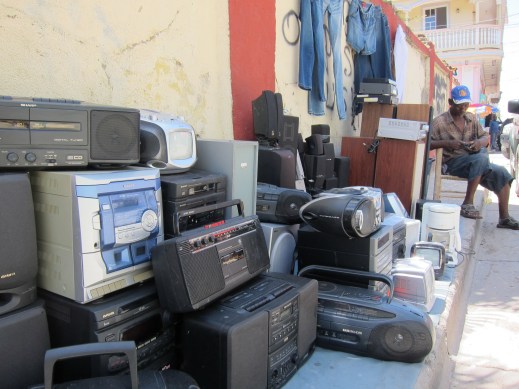
Featured Image: “An electronics vendor in Cap Haïtien, Haiti” by Ian Coss
—
Ian Coss is an audio producer, composer and sound designer whose work spans the worlds of podcasting and performance. He has produced several critically acclaimed series with the Radiotopia network, including Ways of Hearing, The Great God of Depression, and Over the Road. His audio work has been reviewed by the New Yorker and the Guardian; featured on NPR, Al Jazeera and the BBC; and recognized with an Edward R. Murrow Award for ‘excellence in sound.’ Additionally, Ian has premiered live sound works at the Boston Museum of Science and Harvard University, and collaborated on immersive audio tours for the Isabella Stewart Gardner Museum, Richmond ICA, and other major art institutions. Ian holds a PhD in ethnomusicology from Boston University, where he conducted research on Haitian radio broadcasting and Indonesian shadow-puppetry. He continues this work as musical director for The Brothers Čampur, an international puppetry collaborative that has performed at major festivals in Indonesia, and at universities throughout the eastern United States. More on all these projects at iancoss.com.
—

REWIND! . . .If you liked this post, you may also dig:
Radio de Acción: Violent Circuits, Contentious Voices: Caribbean Radio Histories–Alejandra Bronfman
Radio Ambulante: A Radio that Listens –Carolina Guerrero
The Sweet Sounds of Havana: Space, Listening, and the Making of Sonic Citizenship–Vincent Andrisani
Share this:


Current Top Posts





April 2021

January 2020

November 2019

October 2019

August 2019

April 2014

November 2017

March 2015

December 2017

October 2015
 Sounding Out!
Recent Comments