
The Dark Side of Game Audio: The Sounds of Mimetic Control and Affective Conditioning
DOI: https://doi.org/10.59350/t9m7w-rx719
It’s an all too familiar movie trope. A bug hidden in a flower jar. A figure in shadows crouched listening at a door. The tape recording that no one knew existed, revealed at the most decisive of moments. Even the abrupt disconnection of a phone call manages to arouse the suspicion that we are never as alone as we may think. And although surveillance derives its meaning the latin “vigilare” (to watch) and French “sur-“ (over), its deep connotations of listening have all but obliterated that distinction.
This month, SO! Multimedia Editor Aaron Trammell curates a forum on Sound and Surveillance, featuring the work of Robin James and Kathleen Battles. And so it begins, with Aaron asking. . .”Want to Play a Game?” –JS
—
It’s eleven o’clock on a Sunday night and I’m in the back room of a comic book store in Scotch Plains, NJ. Game night is wrapping up. Just as I’m about to leave, someone suggests that we play Pit, a classic game about trading stocks in the early 20th century. Because the game is short, I decide to give it a go and pull a chair up to the table. In Pit, players are given a hand of nine cards of various farm-related suits and frantically trade cards with other players until their entire hand matches the same suit. As play proceeds, players hold up a set of similar cards they are willing to trade and shout, “one, one, one!,” “two, two, two!,” “three, three, three!,” until another player is willing to trade them an equivalent amount of cards in a different suit. The game only gets louder as the shouting escalates and builds to a cacophony.
As I drove home that night, I came to the uncomfortable realization that maybe the game was playing me. I and the rest of the players had adopted similar dispositions over the course of the play. As we fervently shouted to one another trying to trade between sets of indistinguishable commodities, we took on similar, intense, and excited mannerisms. Players who would not scream, who would not participate in the reproduction of the game’s sonic environment, simply lost the game, faded out. As for the rest of us, we became like one another, cookie-cutter reproductions of enthusiastic, stressed, and aggravated stock traders, getting louder as we cornered the market on various goods.
We were caught in a cybernetic-loop, one that encouraged us to take on the characteristics of stock traders. And, for that brief period of time, we succumbed to systems of control with far reaching implications. As I’ve argued before, games are cybernetic mechanisms that facilitate particular modes of feedback between players and the game state. Sound is one of the channels through which this feedback is processed. In a game like Pit, players both listen to other players for cues regarding their best move and shout numbers to the table representing potential trades. In other games, such as Monopoly, players must announce when they wish to buy properties. Although it is no secret that understanding sound is essential to good game design, it is less clear how sound defines the contours of power relationships in these games. This essay offers two games, Mafia, and Escape: The Curse of the Temple as case studies for the ways in which sound is used in the most basic of games, board games. By fostering environments that encourage both mimetic control and affective conditioning game sound draws players into the devious logic of cybernetic systems.
Understanding the various ways that sound is implemented in games is essential to understanding the ways that game sound operates as both a form of mimetic control and affective conditioning. Mimetic control is, at its most simple, the power of imitation. It is the degree to which we become alike when we play games. Mostly, it happens because the rules invoke a variety of protocols which encourage players to interact according to a particular standard of communication. The mood set by game sound is the power of affective conditioning. Because we decide what we interact with on account of our moods, moments of affective conditioning prime players to feel things (such as pleasure), which can encourage players to interact in compulsive, excited, subdued, or frenetic ways with game systems.
A game where sound plays a central and important role is Mafia (which has a number of other variants like Werewolf and The Resistance). In Mafia, some players take the secret role of mafia members who choose players to “kill” at night, while the eyes of the others are closed. Because mafia-team players shuffle around during the game and point to others in order to indicate which players to eliminate while the eyes of the other players are closed, the rules of the game suggest that players tap on things, whistle, chirp, and make other ambient noises while everyone’s eyes are closed. This allows for the mafia-team players to conduct their business secretly, as their motions are well below the din created by the other players. Once players open their eyes, they must work together to deduce which players are part of the mafia, and then vote on who to eliminate from the game. Here players are, in a sense, controlled by the game to provide a soundtrack. What’s more, the eeriness of the sounds produced by the players only accentuate the paranoia players feel when taking part in what’s essentially a lynch-mob.
The ambient sounds produced by players of Mafia have overtones of mimetic control. Protocols governing the use of game audio as a form of communication between bodies and other bodies, or bodies and machines, require that we communicate in particular ways at set intervals. Different than the brutal and martial forms of discipline that drove disciplinary apparatuses like Bentham’s panopticon, the form of control exerted through interactive game audio relies on precisely the opposite premise. What is often termed “The Magic Circle of Play” is suspect here as it promises players a space that is safe and fundamentally separate from events in the outside world. Within this space somewhat hypnotic behavior-patterns take place under the auspices of being just fun, or mere play. Players who refuse to play by the rules are often exiled from this space, as they refuse to enter into this contract of soft social norms with others.

Escape: The Curse of the Temple relies on sound to set a game mood that governs the ways that players interact with each other. In Escape, players have ten minutes (of real time) where they must work together to navigate a maze of cardboard tiles. Over the course of the game there are two moments when players must return to the tile that they started the game on, and these are announced by a CD playing in the background of the room. When this occurs, a gong rings on the CD and rhythms of percussion mount in intensity until players hear a door slam. At this point, if players haven’t returned to their starting tile, they are limited in the actions they can take for the rest of the game. In the moments of calm before players make a mad dash for the entrance, the soundtrack waxes ambient. It offers the sounds of howling-winds, rattling chimes, and yawning corridors.
The game is spooky, overall. The combination of haunting ambient sounds and moments where gameplay is rushed and timed, makes for an adrenaline-fueled experience contained and produced by the game’s ambient soundtrack. The game’s most interesting moments come from points where one player is trapped and players must decide whether they should help their friend or help themselves. The tense, haunting, soundtrack evokes feelings of high-stakes immersion. The game is fun because it produces a tight, stressful, and highly interactive experience. It conditions its players through the clever use of its soundtrack to feel the game in an embodied and visceral way. Like the ways that horror movies have used ambient sounds to a great effect in producing tension in audiences (pp.26-27), Escape: The Curse of the Temple encourages players to immerse themselves in the game world by playing upon the tried and true affective techniques that films have used for years. Immersed players feel an increased sense of engagement with the game and because of this they are willingly primed to engage in the mimetic interactive behaviors that engage them within the game’s cybernetic logic.
These two forms of power, mimetic control and affective conditioning, often overlap and coalesce in games. Sometimes, they meet in the middle during games that offer a more or less adaptive form of sound, like Mafia. Players work together and mimic each other when reproducing the ambient forms of quiet that constitute the atmosphere of terror that permeates the game space. Even the roar of bids which occurs in Pit constitutes a form of affective conditioning that encourages players to buy, buy, buy as fast as possible. Effectively simulating the pressure of The Stock Exchange.
Although there is now a growing discipline around the production of game audio, there is relatively little discourse that attempts to understand how the implementation of sound in games functions as a mode of social control. By looking at the ways that sound is implemented in board and card games, we can gain insight of the ways in which it is implemented in larger technical systems (such as computer games), larger aesthetic systems (such as performance art), economic systems (like casinos and the stock market), and even social systems (like parties). Furthermore, it is easy to describe more clearly the ways in which game audio functions as a form of soft power through techniques of mimetic control and affective conditioning. It is only by understanding how these techniques affect our bodies that we can begin to recognize our interactions with large-scale cybernetic systems that have effects reaching beyond the game itself.
–
Aaron Trammell is co-founder and Multimedia Editor of Sounding Out! He is also a Media Studies PhD candidate at Rutgers University. His dissertation explores the fanzines and politics of underground wargame communities in Cold War America. You can learn more about his work at aarontrammell.com.
—
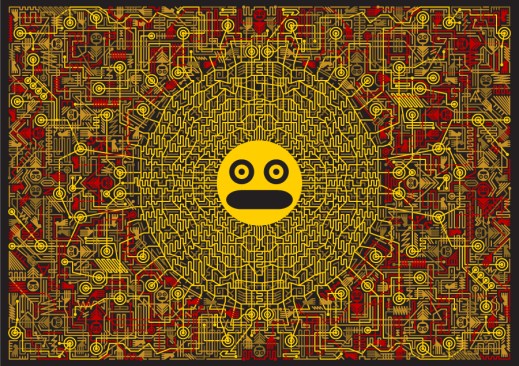
Featured image “Psychedelic Icon,” by Gwendal Uguen CC BY-NC-SA.
—

REWIND!…If you liked this post, you may also dig:
Papa Sangre and the Construction of Immersion in Audio Games- Enongo Lumumba-Kasongo
Sounding Out! Podcast #31: Game Audio Notes III: The Nature of Sound in Vessel- Leonard J. Paul
Experiments in Aural Resistance: Nordic Role-Playing, Community, and Sound- Aaron Trammell
—
Share this:

Beyoncé’s New Weave Swing, or How to Snatch Wigs With Hair Choreography


DOI: https://doi.org/10.59350/tmxye-1f965
This September, Sounding Out! challenged a #flawless group of scholars and critics to give Beyoncé Knowles-Carter a close listen, re-examining the complex relationship between her audio and visuals and amplifying what goes unheard, even as her every move–whether on MTV or in that damn elevator–faces intense scrutiny. Last week, Regina Bradley (writer, scholar, and freelance researcher of African American Life and Culture) introduced us to the sonic ratchetness of Baddie Bey; the week before you heard our Beyoncé roundtable podcast featuring our first two writers, Priscilla Peña Ovalle (English, University of Oregon) and Kevin Allred (Women and Gender Studies, Rutgers)–as well as Courtney Marshall (English, University of New Hampshire) and Liana Silva (Editor, Women in Higher Education, Managing Editor, Sounding Out!), who will close out our series next week. Today, madison moore gives us not only great face but killer hair choreo. Mic drop. Hair flip.–Editor-in-Chief Jennifer Stoever
—
“Which Beyoncé are you trying to do?,” a sale associate at Beauty Full, the largest beauty supply house in Richmond, Virginia, asked me. It was a good question, because the shop had whole rows of wigs and ponytails that conjured Beyoncé enough for what I needed to do. Choosing just one would be tough.
“This one is very Beyoncé,” he said, pointing to a style reminiscent of the huge, teased out curly Afro Beyoncé worked in the early 2000s. I wasn’t really feeling this particular style but I could tell my sales guy was living it. “It’s not fierce enough!” I told him. “I need something that really moves!” I’d been invited to give an hour-long lecture on Beyoncé at a university, one of my first gigs, and I was out at the last minute shopping for a wig to wear during my talk so that I could give the children a little sip of Beyoncé. That’s when I saw it: a long, black and dark brown two-toned wig with curls for eternity that I knew would look great on stage. Come on, wig!

I wanted to wear a wig “that really moves!” during this talk to demonstrate what I feel is the creative genius of Beyoncé’s performance persona: what I call “hair choreography.” Not unlike dance moves intended for the body, “hair choreography” is a mode of performance that uses hair to add visual drama to the overall texture of sound and it’s the special genius of Beyoncé’s stagecraft. On one occasion some friends and I were drinking wine and downing live Beyoncé videos on YouTube when one of us was like “I am living for her hair choreography!” I’m not sure we invented the concept but the phrase “hair choreography” has certainly stuck with me. Hair choreography is one of the secret weapons of the pop diva, those places in a live performance where she flips and whips her hair in exactly the right point, using “haircrobatics” to punctuate a moment, a feeling, raising the stakes, the sex appeal, and even the energy in the audience.
Hair choreography is exciting because it tells a story, but even more than telling a good story in performance “hair choreography” punctuates everything else happening on stage: the lights, the dance moves, the glitter, the sequins, the music. In this way, “hair choreography” becomes part of the spectacular offering of stage presence; a type of magnetism that, despite everything else happening on stage, draws us into a single performer – the star – whose single energy needs fill up the whole space. “Hair choreography” occurs in those moments of a live performance where the hair is flipped, whipped, dipped, spun and amplified during the most exciting, emotion-filled sounds and dance moves.
Even though many scholars still often approach them as separate practices, sound and motion are so fluidly entangled, as Jennifer Stoever has revealed. In this way, “hair choreography” builds on performance studies scholar Imani Kai Johnson’s call for the “aural-kinesthetic.” The “aural-kinesthetic” is not a method or a theory but simply a way for scholars to think about how music and movement happen at the same time. “Hair choreography” is about the relationship between sound, body and movement, and how each of those comes together to leave a visceral impact on an audience.
One video that shows the importance of hair choreography to Beyoncé’s package is her medley “If I Were A Boy/You Oughta Know,” a mélange of the soft hard rock her own track coupled up with the aggressive rock of Alanis Morissette’s iconic break-up jam of the same title. In the clip, as Beyoncé segues from “If I Were A Boy” into “You Oughta Know” the wind machines appear to blow her hair faster, and with every emotional note or beat she knocks her head to the side with attitude, forcing her straight hair with it. By the time Beyoncé sings “And I’m here, to remind you…,” the most emotional (and recognizable) transition of the song, the hair is already going full blast. Guitars and drums go off while strobe lights engulf the stage in a frenzy of chaos.
At “You, you, you oughta know” she falls to her knees and performs a choreographed head bang while sliding across the floor using only her knees. It’s important to note here that the singing has stopped because this is a moment of “hair choreography,” a transition indicating an impending change in mood.
Everyone loves Beyoncé’s hair. In her will the late comedian Joan Rivers requested “a wind machine so that even in the casket my hair is blowing just like Beyoncé’s.” There are countless YouTube tutorials showing young girls how they too can achieve that Beyoncé look with weaves, wigs and lace fronts. Even the comedian Sommore, who stared in the 2001 film Queens of Comedy , had something to say about Beyoncé’s hair:
Beyoncé is a bad motherfucker. Oh this bitch bad. Let me tell ya’ll how bad this bitch is. I went to see her concert in Atlantic City after she had her baby. I sat in the second row – this bitch was flawless. I mean I’m talking about the bitch was flawless. Only problem I had with Beyoncé…she had on too much hair! This bitch came out she had at least 18 packs of hair on. She came out I thought the bitch was the cowardly lion from The Wiz. I’m sitting there in awe of this bitch neck, I’m like, “This bitch neck is strong as a motherfucker!”
All jokes aside, the mystery of Beyoncé’s hair-–and all of the technologies involved in keeping it moving–is part of the genius of her brand image, particularly because it works to make her ethnically ambiguous.. Having various types of hairstyles allows her creole body to infinitely play with race, and this makes her marketable to nearly everyone. Is she black? Is she Spanish? Is she biracial? Could she be Brazilian or from Latin America? Yes. In this way, her hair choreography not only punctuates her sound, but it shapes the very way it is heard, enabling her to morph into more personalities and fit into more demographics than even Lady Gaga or Madonna. It’s why she’s able to sound sexy or inspirational, “hood” or “classy,” vampy or masculine, vocal or dance-y. Look at a video like “XO,” to me the most mass-marketable song on BEYONCE. First of all she looks fabulous, but I think it’s hard to watch that video and not feel like it’s specifically pitched to 15-year-old white girls in Connecticut. Everything about the video, especially her sweeping hair flourishes, positions Beyoncé as relatable to teenage girls all over the US.
As dance studies scholar Melissa Blanco Borelli sees it the mulatta body engages with a practice she calls “Hip(g)nosis,” or a type of hypnosis enacted by the yellow-bodied performer on fascinated audiences. This type of hypnotics, via the hips, “exposes the male gaze” by thinking through the “pleasure and consumption of the mulatta…” (She Is Cuba, forthcoming, Oxford University Press). Through hip(g)nosis Beyoncé has learned to use her ambiguous skin color and hair optics to her (monetary) advantage as a way to slide in and out of ethnic categories. Indeed, what does the fact that she is the lightest member of Destiny’s Child and also the groups’ most successful member have to do with her celebrity? The irony in all of this race play is that she was recently awarded the Michael Jackson Video Vanguard Award after her jaw-dropping 15-minute performance at the MTV Video Music Awards, and she is one of the few contemporary black pop singers who can play with race in the same way Michael Jackson did.

When I watched her recent MTV VMA performance I screamed a lot during her show, but the one moment I remember specifically, and still keep rewinding back to, happened right at the end of “Mine,” to me the best track on BEYONCE. She vamps “MTV, Welcome to My World,” and quickly spins and flips that hair back around baby, giving face to the camera, making millions of queens all over America scream YAASSS!!! at the top of their lungs. Beyoncé herself nodded back to queer performance and performers during a performance of “XO” this year on February 19th 2014 at the O2 Arena in London, after one overzealous fan threw a wig at Beyoncé as she sauntered off the stage and into the crowd (3:17).
When she turned around to pick the wig up she ad libbed “You got me snatching wigs, snatching wigs” into her microphone, knowing perfectly well that “Beyoncé snatching wigs” is one of the most popular fan-created Internet memes. In black gay male performance culture people often talk about “snatching wigs” or “coming for your wig,” and to this end scholars like E. Patrick Johnson and Marlon Bailey have done important work in theorizing the interplay between black gay colloquialisms and performance. If you’re “snatching wigs” then you’re performing better than everybody else while completely eradicating the competition. You’re seemingly indefatigable. Snatching a wig means a particular performance was highly effective or unique, and a snatched wig implies how an audience might surrender itself to a strong performer, as was the case with the aforementioned wig thrower. Beyoncé definitely understands the power of stage presence; a type of magnetism that, despite everything else happening on stage, draws us into a single performer – the star – whose single energy needs fill up the whole space. Filling up an empty stage with a single body is a lot of space to fill if you think about it. And making an audience focus on you when there are 10,000 other things are happening around you is an even more challenging task.

But “snatching wigs” can also mean you’re revealing someone’s deepest secrets, something you know they’re hiding. What’s underneath a wig but a secret – your real hair texture, a bald spot you don’t want anyone else to know about. A snatched wig can mean a break of the illusion. When I wore that wig during my Beyoncé talk to demonstrate hair choreography everyone knew it was fake – I put it on in front of them – but if the wig came off the illusion would have been broken nonetheless.
Part of Beyoncé’s monumental fame has to do with the fact that while she synchronizes, punctuates, captivates, and performs, she never lets us see underneath her wig. She just lets it whip.
—
madison moore (Ph.D., American Studies, Yale University, 2012) is a research associate in the Department of English at King’s College London. Trained in performance studies and popular culture, madison is a DJ, writer and pop culture scholar with expertise in nightlife culture, fashion, queer studies, contemporary art and performance, alternative subcultures and urban aesthetics. He is a staff writer at Thought Catalog, Splice Today, and his other writing has appeared in Vice, Interview magazine, Art in America, Dancecult: Journal of Electronic Dance Music Culture, the Journal of Popular Music Studies and Theater magazine. He is the author of the Thought Catalog original e-book How to Be Beyoncé. His first book, The Theory of the Fabulous Class, will be published by Yale University Press.
—
–

REWIND!…If you liked this post, check out:
Karaoke and Ventriloquism: Echoes and Divergences–Karen Tongson and Sarah Kessler
– Yvon Bonefant
“New Wave Saved My Life*”-Wanda Alarcon
—
Share this:




Current Top Posts





April 2021

January 2020

November 2019

October 2019

August 2019

April 2014

November 2017

March 2015

December 2017

October 2015


Recent Comments