
SO! Amplifies: Cities and Memory
 SO! Amplifies. . .a highly-curated, rolling mini-post series by which we editors hip you to cultural makers and organizations doing work we really really dig. You’re welcome!
—
Inspired by how sound and memory interact, Cities and Memory is a sound program with the aim of “remixing the world, one sound at a time,” existing on the (already quite blurred) line between documentary field recording and sound art.
Its primary manifestation is an online global sound map, on which every location boasts two sounds, the “city” and the “memory.” The “city” sound is the faithful, documentary field recording capturing that place at that time, as it existed and was heard. The “memory” sound is a reimagined, remixed, reinterpreted version of that sound: everything from oral reconstructions, full-on techno tracks built around a field recording, ambient reimaginings, and all the points in between, as summarized in this roundup of creative approaches from the site. The reimagined sounds represent how sound is remembered and experienced differently by each individual, and explore what happens in that magical period between sounds being physically experienced and their being mentally processed, interpreted, and above all felt.
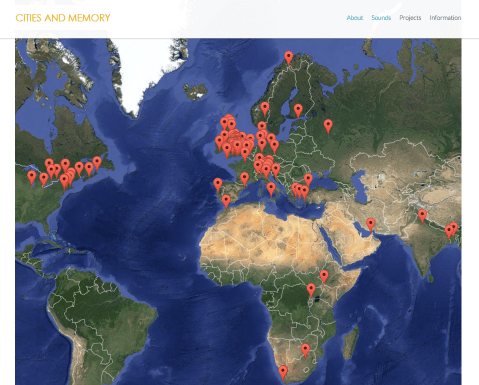
Starting from that basic premise, Cities and Memory has collected more than 600 sounds from around the world in just over a year, with more than 100 artists, musicians, field recordists and sound enthusiasts contributing anything from a field recording snatched on a mobile phone through to a complete musical reconstruction.
Over recent months, Cities and Memory has expanded with a series of projects each exploring a different avenue or window onto sound that has been opened up. For instance, last November saw #HamburgSounds, an ambitious project to sound map the vast city of Hamburg, Germany and to reimagine its sounds. A four-day recording session garnered enough recordings for forty sound artists each to give their take on a different aspect of Hamburg’s sounds and what they meant to them. The results were symbolically released over a 24-hour period, representing a day in the city’s life, and in the memories and imagination of its citizens. For more sounds from Hamburg, click here.

This year also saw a project using Brian Eno and Peter Schmidt’s Oblique Strategies cards as creative direction for reimagining field recordings. The reimagined sounds that came from more than 100 different creative strategies employed in the project were even more diverse than its locations, which covered everything from jungle in Thailand and Shanghai temples to the urban centres of Chicago, New York and London. Spectrum analysis, musical cryptograms, working simultaneously with artists in different countries, even TripAdvisor reviews(!) – every creative sonic technique in the book seems to have been used in one way or another.
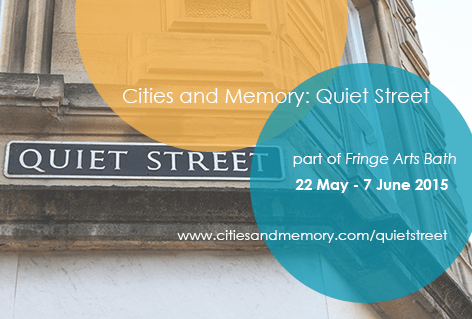
The latest project, called Quiet Street, takes the form of a simultaneous digital and physical exhibition, reimagining the sounds of the city of Bath as part of its Fringe Arts Bath Festival. The physical installation presents two sides of sonic memory – first, the documentary field recording of a location in Bath, and second the reimagined, or ‘memory’ version of the sound. The audience can navigate between two sonic ‘versions’ of Bath simultaneously on different sides of the space. One side broadcasts the “city” sound from a location, the other the matching “memory” sound, a remix or reinterpretation of the field recording, time-synced so that the sets of sounds shift in and out of one another in unison. The listener chooses – by his or her own physical proximity – to experience freely the two sound worlds.
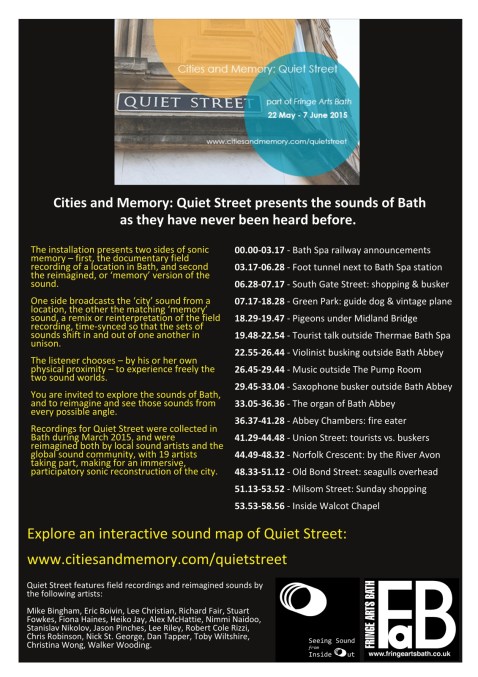
Visit the physical installation of Quiet Street at Fringe Arts Bath Festival, 22 May 2015 – 7 June 2015 at 8/9 New Bond Street Place, Bath
As the “city” and “memory” sounds are precisely time-synced in the installation, an additional creative challenge for the artists was to create reimagined version the same length as the source field recording. More importantly, they also needed consider not just how the reimagined sound stood on its own, but how it would live simultaneously in the same space as the field recording, creating a direct tension between “real” documentary sounds and the memory of those sounds in the same space.
The digital exhibition of Quiet Street allows the sounds to be explored through a map interface. It also allows listeners to simulate the installation experience with a series of installation mixes, presenting the field recording and reimagined sound on opposite sides of the stereo field. You can access playlists here and here as well as download the album documenting the event here.
As a curator, the most exciting thing to me is that the central idea behind Cities and Memory is so open; there are almost infinite possibilities for its application. A new angle on sound, place or memory can bring up a new project at any point, and every contributor brings their own experience and interpretation.
In the course of exploring hundreds of field recordings, examining them in detail and finding a creative angle from which to reinterpret them, I’ve developed a new appreciation not just of field recording as a practice, but of how to listen to whichever environment I find myself in. It’s given me a new perspective on sound and on music, and how utterly blurred the lines are between the two. I listen very differently to the world now. As Cities and Memory continues to grow, I hope many others will too.
—
Stuart Fowkes is the creator and curator of Cities and Memory, producing a large number of the source field recordings and reimagined ‘memory’ versions himself, as well as curating the project as a whole. Quiet Street runs from 22 May to 7 June at 8/9 New Bond Street Place, Bath, as part of Fringe Arts Bath, and digitally at www.citiesandmemory.com/quietstreet. Find out more about Cities and Memory and how to contribute: http://citiesandmemory.com/what-is-cities-and-memory-about/
—
 REWIND!…If you liked this post, you may also dig:
Toward A Civically Engaged Sound Studies, or ReSounding Binghamton–Jennifer Stoever
SO! Amplifies: Ian Rawes and the London Sound Survey–Ian Rawes
SO! Amplifies: Carleton Gholz and the Detroit Sound Conservancy–Carleton Gholz
Share this:

Workshopping the Derry Soundscape: Mobile technologies as Creative Tools for Third Age Adults
 This April forum, Acts of Sonic Intervention, explores what we over here at Sounding Out! are calling “Sound Studies 2.0”–the movement of the field beyond the initial excitement for and indexing of sound toward new applications and challenges to the status quo.
Two years ago at the first meeting of the European Sound Studies Association, I was inspired by the work of scholar and sound artist Linda O’Keeffe and her compelling application of the theories and methodologies of sound studies to immediate community issues. In what would later become a post for SO!, “(Sound)Walking Through Smithfield Square in Dublin,” O’Keeffe discussed her Smithfield Square project and how she taught local Dublin high school students field recording methodologies and then tasked them with documenting how they heard the space of the recently “refurbished” square and the displacement of their lives within it. For me, O’Keeffe’s ideas were electrifying, and I worked to enact a public praxis of my own via ReSounding Binghamton and the Binghamton Historical Soundwalk Project. Both are still in their initial stages; the work has been fascinating and rewarding, but arduous, slow, and uncharted. Acts of Sonic Intervention stems from my own hunger to hear more from scholars, artists, theorists, and/or practicioners to guide my efforts and to inspire others to take up this challenge. Given the exciting knowledge that the field has produced regarding sound and power (a good amount of it published here), can sound studies actually be a site for civic intervention, disruption, and resistance?
Acts of Sonic Intervention began with “Listening to and Through Need” by Assistant Director at Binghamton University’s Center for Civic Engagement, Christie Zwahlen, who argues that any act of intervention must necessarily begin with self-reflexivity and examination of how one listens. Last week, artist/scholar Luz María Sánchez gives us the privilege of a behind-the-scenes discussion of her latest work, detritus.2/ V.F(i)n_1–1st prize winner at the 2015 Biennial of the Frontiers in Matamoros, Mexico —which uses found recordings and images to break the deleterious silence created by narco violence in Mexico. Next week, we will close with from artist, theorist, and writer Salomé Voegelin, who will treat us to a multimedia re-sonification of the keynote she gave at 2014’s Invisible Places, Sounding Cities conference in Viseu, Portugal, “Sound Art as Public Art,” which revivified the idea of the “civic” as a social responsibility enacted through sound and listening. Today, Linda O’Keeffe catches us up with her newest public project, a pilot workshop with older people at the U3A (University of the Third Age) centre in Foyle, Derry, “grounded in an examination of the digital divide, social inclusion and the formation of artists collectives.”
–JS, Editor-in-Chief
—
In 2014, the Irish Research Council funded a project that looked to increase the access of older people to creative opportunities while at the same time generating interest in research examining the social implications of sound, music, and performance produced by older people. The project ran over a 9-month period and included a two-week workshop with a group of third age adults based in Derry, Northern Ireland. This fulltime workshop consisted of training three people aged between 65-70 in the area of gesture based audio technologies on iOS devices.
My initial impetus behind the project was to find different ways to engage older adults with technologies outside of the typical education programs which focus on internet training and learning how to use communication applications like email and VOIP software. I designed the workshop to introduce the participants to a range of audio-based applications designed specifically for an iPad. They learned how to use digital audio recorders, including the different file types associated with sound quality, such as compressed audio mp3 and mostly uncompressed audio WAV (windows audio video format). For clarity, I organized the audio applications into three distinct types: audio editing apps, gesture based performance apps and sound synthesis apps.

Participants working with Auria and Dropbox // Photo by author
Learning sound production, I felt, would offer elder people a different kind of value than basic workplace digital skills, something perhaps even more important for third age adults, what Fisher and Specht describe as a “positive sense of future” in “Successful Aging And Creativity In Later Life” (459). Training in digital activities such as multi-track editing, performance and synthesis applications, the use of digital audio recorders, soundscape recording, using cloud based applications for sound sharing, and mastering finished works of sound offered more than just a “skill” for workshop participants, it also held out a new sense of purpose, a means to continue engaging with community, continued intellectual stimulation, and the possibility of a new period of productivity in their lives.
Work Shopping Sound
One of the key components to the workshop involved talking about sound and sound art, and discussing the kinds of art made from sound, including work made for radio. Such conversation presented difficulties for people who were largely unfamiliar with fine art, a problem compounded by the fact that, as an emerging art form, sound is not always visible in mainstream cultural spaces.
To ease the transition, I centered our early discussions on important sounds in the participants’ lives: sounds remembered and now lost, the difference between rural and urban soundscapes, and unique perhaps for this particular group, the sounds of civil war. All of the participants had lived in Derry most of their lives and experienced some aspect of the violence within Northern Ireland; through our conversations, sound became an interesting way to memorialize and process this event. We then discussed how these soundscapes could be documented, changed and presented as works of art. Later, workshop conversation consisted of listening to sound art pieces. This helped the group get a sense of the potential of sound as an expressive art form.
Sound as Process
During the workshop, I emphasized the process and practice of sound making over the technology required to undertake the production of their art works. In this way, by focusing on an artistic concept, the technology just became the means in which they could be creative. Each participant was given a digital audio recorder (Zoom), which they brought home to record sounds they found interesting. Every meeting, the group discussed how–through the act of recording and listening–their perception of familiar sounds was being altered. They began also to experiment when recording, using their voices – singing – reading poetry etc. in different spaces, getting close up to sounds – exhaust pipes in cars, for example—and placing the microphone in unusual places such as a neighbours pig shed. Gradually, participants began to think of the sounds they collected as being part of a larger project and they became much more selective about what they would record. In addition, the group began to critique the sounds they recorded as well as sharing their sounds using Dropbox folders. These recordings became the basis for their final works; even if their sounds were eventually altered beyond recognition, the sounds inspired their artistic concepts.
The first Saturday of the two-week workshop included a soundscape recording day in Derry city. Each participant was asked to walk the city, recording sounds they found interesting. What emerged during the sound walks was unexpected. Members of the group began to engage with spaces and people, interviewing some, asking others to make sounds. For example, two participants went into a music store and asked the staff to sing or play an instrument so that they could record these sounds. They also went to the main cathedral in Derry and had the bells rung especially for them and a trainee organist play some traditional organ music. One participant, a poet, had different people read lines from a selection of his poems. He stated later that he was hoping to collect the sounds of women, children and men, as well as the multiple accents of Derry people, because his poetry was about Derry and therefore Derry should be its voice. I had not anticipated this engagement with community and space when I designed the workshop.

Participants recording water feature, Photo by author
During the focus group discussion after the sound walk, each participant talked primarily about how the recorder allowed them access to sounds and people. The technology acted as an interface between them and a sound that they wanted; it gave them the confidence to approach strangers, because they felt they were working on something important.
Gesture Based Performance Applications

Still from Auria, a gesture based performance app
In addition to conversation and artistic process, the first week of the workshop introduced participants to three applications: Auria audio editor, TC11 gesture based performance app and Animoog (a music synth app designed for iPad). A number of papers argue that it is the complexity of software applications, including the internet, which proves difficult to older users. Overlapping and contrasting colours are defined as difficult to engage with and can be distracting to users whose vision is in any way impaired through ageing. The Auria editor is as complex visually as most computer DAW’s, with one key difference: all interactions are gestural. This simple difference meant that each of the users found engaging with the application less difficult than if they had to deal with a mouse, keyboard, shortcuts and OS’s (see figure).  None of the participants felt that the screen and its multiple windows were so difficult that they could not engage. In fact, we had initially worked with a much simpler audio editing app, Hokusai, which they felt was too simple in its design and usability. By the end of the two-week workshop, the participants had produced at least one complete work of sound, with some creating up to 4. Selected works were compiled in a CD that was launched in November 2014 at the U3A in Derry. Listen to a sampling below.
.
Track Two: “Made in Belfast” by Sam Burnside, read by John Dunlop
Track Four: “The Haunted Valley,” by Florence Forbes
.
In a final focus group discussion, the participants all responded very positively to the experience while offering suggestions about future workshops. Most agreed that the digital audio recorders allowed them to open their ears to the possibility of working with sound, but from an ethnographic perspective. The recorders allowed the participants engage actively with people and spaces in a way that had not been anticipated, empowering them with a sense of purpose, and allowed them give voice to both their creative ideas and the voices and soundscapes of Derry. In addition, the iPADs and audio recorders allowed them a sense of technological and creative mobility; they could access sounds on the move, place and share them in the cloud, perform/compose and edit in different spaces.

Participants working with their iPads, Photo by the author
Working on this project altered a number of preconceptions I had inadvertently brought with me about older peoples’ capabilities, even though my proposed project challenged other assumptions about aging. For example, I chose some of the audio applications for their simple design, mostly because previous research had highlighted older adults’ limitations in regards to the digital, based on principles of design, where technology is often shaped for a younger, often male, user. The participants in this workshop proved they could learn and even be creative with complicated applications such for synthesis and sophisticated editing. Even though I have written about older peoples use of audio technologies dating back to the 1940s–and how they developed sophisticated hacked mechanisms in order to broaden their sound/media sphere (O’Keeffe 2015)–I failed to consider that my participants would also have a contemporary relationship to mobile technologies. Yet all three participants, in varying degrees, used some form of mobile technology, from tablets to android phones. But what was evidenced through our conversations was the limited way in which they used their tech. After the workshop, most talked about buying and using audio applications or recording technology for creative or documentary use.

The author, recording sounds in the workshop
Prior to the workshop, I myself rarely used iPad audio apps; for me, it required thinking differently about mobility and sound design, and it was only on seeing the very creative ways in which the participants used the iPad that I started to rethink how IOS apps could support my sound practice. Following from this project, I am now in the process of developing a performance collective with third age adults. We will examine ways in which sounds can be assigned meaning and then used in a performance setting. The project will take about a year to complete and the hope is that, when finished, the performance collective will continue, with a tool kit to sustain their practice.
—
Featured Image: “Workshop participant interviewing poetry readers,” photo by Author
—
Linda O Keeffe isis a lecturer in sound at Lancaster Institute of Contemporary Art. She is also secretary to the Irish Sound Science and Technology Association and editor of the Interference Journal. She has several papers and book chapters published and due for release in the fields of sound studies. Her practice is concerned with an exploration, both academic and creative, of the ways in which sound alters our experience of different spaces. Her art training was within the sculpture department of IADT under the tutelage of Finola Jones. She completed a Masters in Virtual Reality in NCAD with Kevin Atherton, and just finished a PhD in sociology in NUIM. Her research examined the urban of Dublin city soundscape as socially and technologically co-constructed. She has composed for dance, theatre, quartets, and new instrument performers, installed sound installations for commissions in Ireland, China and Holland, and has had radio works performed both nationally and internationally. In 2008 she was mentored under Eric Leonardson in Chicago, a sound artist and performer. More recently, she was commissioned by Resonance FM to create a work for radio for the 2013 Derry city of culture event. In November 2014 Linda had a solo exhibition called “Spaces of Sound and Radio Spaces” for the Limerick Sculpture Centre, a creative realization of her PhD research.She will be releasing an album next year with the composer Tony Doyle on spatialisation and sonified memories with Farpoint Recordings, her third album. You can find her at www.lindaokeeffe.com.
—
REWIND! . . .If you liked this post, you may also dig:
Of Sound Machines and Recording, Sharing that Transcends Time and Space–Maile Colbert
Audio Culture Studies: Scaffolding a Sequence of Assignments–Jentery Seyers
“We wanted to tell stories about sound”: Opening Ears Through the “Everything Sounds” Podcast–Craig Shank and George Drake Jr.
Share this:


Current Top Posts





April 2021

January 2020

November 2019

October 2019

August 2019

April 2014

November 2017

March 2015

December 2017

October 2015
 Sounding Out!
Recent Comments