
Future Memory: Womb Sound As Shared Experience Crossing Time and Space
This Month will feature a two-part post by SO! regular writer Maile Colbert. Look for Part Two on Monday, January 19th.
—
I was a child obsessed with time travel. Beyond favorites such as A Wrinkle in Time and Time Bandits, I perpetually daydreamed of the ability to pause, reverse, and fast-forward my life. I had a book on the “olden days” and it amazed me that my great-grandparents, whom I had the fortune to know, had lived them. I wanted to fast forward and see myself their current age, telling stories to the next generations of a good life lived. I used to entertain the thought that if I let my breath go and let myself sink to the bottom of a body of water, I could pause time, or at least slow it down, as the sound of the fluid world around me seemed to suggest. Whenever my family moved, I made a time capsule, and I always scanned the ocean for long lost bottled messages. These were the beginnings of my future in time-based media–both image and sound–my love for found footage, and my recent research and writing on sound back in time.
Now as a new mother, I am beginning to think about the future in a way I hadn’t before. I see my mother in my daughter, and I see her mother, and my partner’s mother. I recognize my grandfather’s eyebrow when furrowed, and her grandfather’s nose. My mouth when smiling, my partner’s mouth when in concentration.
And our ears. . .our very sensitive hearing, almost like a punch line. Our daughter is truly the daughter of sound artists. In this first post of a two part series on humans’ earliest interactions with sound, I document our work sounding and listening together, which began in a future-oriented past I am still learning about.
Womb
There was a study in which doctors gave babies only a day old pacifiers connected to tape recorders. Depending on the pattern of the new babies suck, the tape recorder would either switch on the sound of the mother’s voice, or a stranger’s.
“Within 10 to 20 minutes, the babies learned to adjust their sucking rate on the pacifier to turn on their own mother’s voice,” says the study’s coauthor William Fifer, Ph.D., an associate professor of psychiatry and pediatrics at Columbia University’s College of Physicians and Surgeons. “This not only points out a newborn’s innate love for his mother’s voice but also a baby’s unique ability to learn quickly.”
– “What Babies Learn in the Womb,” 2014, Lara Flynn Maccarthy, Parenting
My daughter Odette knew my voice the moment she was born. In a strange, bright, cold new world, it seemed one constant she could rely upon. When she was first placed upon my chest, I started to sing to her, and she was calming, staring at me, as much as her newborn eyes would let her, with an expression of surprised recognition, as this familiar voice sang a familiar song, one I sang her often in the womb. One I knew by heart because my mother would sing it to me when I was a child.
Are you going to Scarborough Fair
Parsley, sage, rosemary and thyme
Remember me to the one who lives there
She once was a true love of mine. . .
The mother’s voice comes to the fetus not solely as ambient sound through the abdomen, as other external sounds and voices would, but also through the vocal cords’ internal vibration. There is a direct connection, a shared space. As early as the seventh month, a fetal heartbeat will slow and calm to the sound of the mother’s voice, and research has shown newborns even prefer a similar version of their mother’s voice to what they heard in the womb, muffled and low. When Odette suffered colic in her early months, one sure way to help comfort her was to sing to her while she was on my chest. Aside from the close contact of skin, the familiar smell, the warmth, it could be that hearing my voice also through the chest mimicked the womb filter.
In the tape recorder study, researchers also noted that newborns would suck more intensely to recordings of people speaking in the language of their mothers, most likely picking up on the melody and rhythm. We are beginning to understand that learning starts in the womb.
Fetal Soap Addiction
Carmen Bank found her 1985 pregnancy rather boring. So, to pass the time, she started doing something she would never have dreamed of: watching a soap opera.
Unexpectedly, she found herself hooked. And so she spent almost every morning in front of her television set, ready for the familiar theme of “Ryan’s Hope.” After Melissa was born that October, Bank bought a videocassette recorder so she could tape the show when she was too busy to watch.
Bank isn’t sure when she discovered the behavior, but, shortly after Melissa was born, Bank realized that the baby seemed to recognize the “Ryan’s Hope” theme and would stop fussing when the program began.
“She’d just sit there and watch the whole introduction and then she would start imitating what they do on the show,” Bank said. “This has been going on forever.”
-The Very Young and Restless, Do Soaps Hook the Unborn? June 28, 1988, Allan Parachini, The New York Times
My third trimester was a rough one. I was a walking swimming pool of about forty pounds of baby and amniotic fluid. My pelvis had gone completely out of line, making even that pregnancy waddle slow and difficult. Needless to say, I was less and less mobile. I was lucky that much of my remaining work was writing and studio based, but often found myself having to take mental breaks as well. My body/mind chemistry was working overtime. Something that happens with pregnancy when preparing mentally for your new, shared life is to think a lot about your own childhood. I was lucky to have a happy one, and so strong nostalgic feelings and memories would come up, particularly around the television show Dr. Who. I used to spend a happy hour with my father once a week watching reruns from the 70’s in the 80’s.
Dr. Who returned to broadcast in the 2000s, in a few new successful regenerations. The new iteration uses a lot of the classic themes, characters, and even remixes and re-masters the the original opening score written by Ron Grainer and realized by the great Delia Derbyshire for the BBC Radiophonic Workshop in 1963; the Dr. Who theme was one of the very first signature electronic music tunes, and performed well before commercial synthesizers were even available. Derbyshire used musique concrete techniques, cutting each note individually on analogue tape, speeding up and slowing down to create the notes from recordings of a single plucked string, white noise, and the simple harmonic waveforms of test-tone oscillators. (Grainer was famous for asking after hearing Derbyshire’s magic, “Did I write that?”. Derbyshire replied “Most of it.” The BBC, who kept members of the Radiophonic Workshop anonymous, prevented Grainer from giving Derbyshire a co-composer credit and a share of the royalties.)
It is a really, really catchy tune:
While Odette was in the womb, I watched all of those decades addictively, one after another. When I came across the soap opera study after she was born, I decided my obsessive Who-watching had set up a perfect laboratory to try it out myself. We started in 1963 and moved through time with the Doctor. Odette looked up in surprise and her brow furrowed in concentration. She looked around slowly at first, then faster and faster. She smiled; she cooed; she laughed. She started to flap her arms.
.
When I finally turned it off, she stopped everything and looked concerned. I turned it on again and we danced together in clear recognition of this already-shared future past sonic moment, one I had with my father and now with her. Now I understood that as I consumed Dr. Who, Odette was not only hearing, she was learning, and beginning the act of listening.
Sounds have a surprising impact upon the fetal heart rate: a five second stimulus can cause changes in heart rate and movement which last up to an hour. Some musical sounds can cause changes in metabolism. “Brahm’s Lullaby,” for example, played six times a day for five minutes in a premature baby nursery produced faster weight gain than voice sounds played on the same schedule (Chapman, 1975)
-The Fetal Sense, A Classical View, David B. Chamberlain, Birth Psychology
Wombscapes
Odette’s very first movements, her first “quickening”, was in response to David Bowie’s “Starman”. This was around 16 weeks, often the time for first movements in the fetus, and interestingly also the time when the hearing has developed. The fetus floats in a rich and complex soundscape; it is anything but quiet. The womb filter…amniotic fluid, embryonic membranes, uterus, the maternal abdomen-low frequencies, and blood in veins whooshing, then Mother’s voice and body noises such as hiccups and the gurgles of digestion and of course, the heartbeat. The Mother’s heartbeat can be as loud as a vacuum cleaner and ultra sounds as loud as a subway car arriving in a train station.We can try to mimic the womb-scape, imagining sounds being filtered through the body. We can use a hydrophone–a pressure microphone designed to be sensitive to soundwaves through fluid matter–on the abdomen to get an idea and sample for our womb-scape.
Perhaps it would sound something like this…
…reactive listening begins eight weeks before the ear is structurally complete at about 24 weeks. These findings indicate the complexity of hearing, lending support to the idea that receptive hearing begins with the skin and skeletal framework, skin being a multireceptor organ integrating input from vibrations, thermo receptors, and pain receptors. This primal listening system is then amplified with vestibular and cochlear information as it becomes available. With responsive listening proven at 16 weeks, hearing is clearly a major information channel operating for about 24 weeks before birth.
-The Fetal Sense, A classical view
Sound artist and Acoustic Ecologist Andrea Williams has been recently working on a composition for Bellybuds, for her yet born nephew. Bellybuds are “a specialized speaker system that gently adheres to your belly & safely plays memory-shaping sound directly to the womb.” Much of her work is composed with space in mind, using room sounds in a live performance situation. Williams told me it was interesting thinking about the womb as a new “venue,” with her little developing nephew as her audience. “What is he hearing?” she asked, “will he recognize me right away upon meeting him for the first time if he only hears the sound of my voice through the Bellybuds while he is a fetus?” I love the idea that she could send a “hello” from one place to her nephew in the womb in another.
The more we understand and realize about fetal hearing and processing sound, the more we understand how fetuses can detect subtle changes and process complex information. Memory starts to form around 30 weeks, and it’s possible early sound interventions at this time could help babies with detected abnormal development. Speaking and singing to the unborn fetus, allowing them to experience different soundscapes while still in the womb, helps shape their brains. This is probably why the urge to do so is there.
. . .Odette’s first dance. Odette’s first songs. . . transcending time and space.
—
dedicated to Odette Helen, and to the family, daughter, and memory of Steven Miller
—
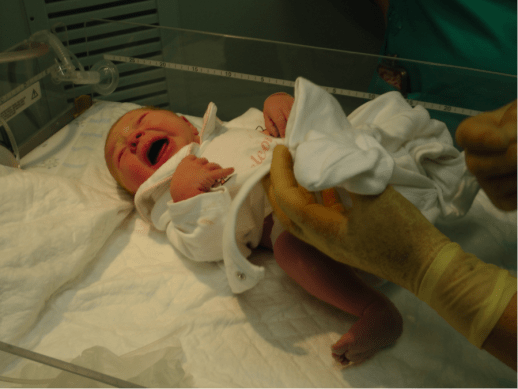
Featured Image: Odette’s Birth Cry, photo credit Rui Costa
The album Future Memory, for Odette will be released in 2015 through Wild Silence. A dedication album to a newborn daughter…a mix of her parents’ recorded and shared sounds, memories, hopes, and dreams towards a future with her. Sounds of her womb-scape, birth, and first year…music in collaboration with friends and family across oceans and land…an album of lullabies for Odette.
—
Maile Colbert is a multi-media artist with a concentration on sound and video who relocated from Los Angeles, US to Lisbon, Portugal. She is a regular writer for Sounding Out!
—
 REWIND! . . .If you liked this post, you may also dig:
On Sound and Pleasure: Meditations on the Human Voice– Yvon Bonenfant
This Is Your Body on the Velvet Underground– Jacob Smith
Sound Designing Motherhood: Irene Lusztig & Maile Colbert Open The Motherhood Archives– Maile Colbert
Share this:

LMGM’s “Lost: Choirboy” & El Jefe’s “Muñoz & La Mission: A Sermon. . .” (in memoriam José Esteban Muñoz)
 Come, let us sing of great men. Well, just one man, not men—and masculine gender is not essential for our purposes. Come to think of it, his greatness isn’t nearly as important as his fierceness, his queer significance, his brown sensibility. But we’re still committed to singing—or at least to music—well, to sound and noise, in any case. José Esteban Muñoz often wrote about queer scenes where music and sound were central to participants’ world-making activities. His archives buzzed with the sounds of West Coast punk, vogue-ball house, cruisy toilets, genderqueer burlesque, and salsa echoing down the barrio streets. And so, for this Round Circle of Resonance, we at La Mission are here to make some noise about a badass thinker who deeply impacted the way we dance/sing/talk/write/sweat about dance music, identity, and politics.
And this is just the beginning of our cacophonous, four-part response to Muñoz’s intellectual holler. The first installment, written by La Mission’s resident essayist / deranged propagandist LMGM (Luis-Manuel Garcia) provides a brief introduction to our collective, some reflections on Muñoz’s relevance to our activities, and a frame for the next three missives from our fellow cultists. It is backed with a rousing sermon-cum-manifesto from our charismatic cult-leader/prophet, El Jefe (Pablo Roman-Alcalá). In the coming weeks, our Naked Mennonite/randy dramaturge (Mandie O’Connell) will prepare and film a urinary performance piece; and our saucy Choir Boy/Linguist (Johannes Brandis) will compose a dirge to our dearly departed José (August 9, 1967- December, 4, 2013).
LMGM a.k.a. Luis-Manuel Garcia
—
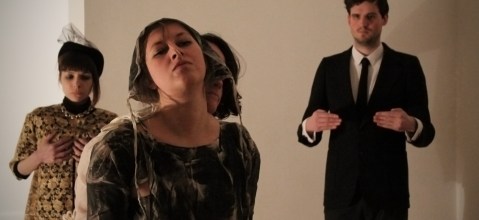
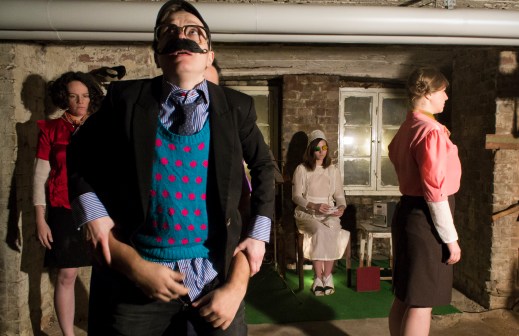
La Mission’s “(p/A)001: A non-Aristotelian Drama in Five Acts,” 2013, Image by Julien Barret
Lost: Choirboy (in memoriam José Esteban Muñoz)
La Mission
Named after San Francisco’s Latino barrio, La Mission is a satirical utopian doomsday cult, a music label, a queer situationist art-gang, a magazine, and a group of dancers with a very dirty sense of humor. We release music on vinyl, publish DIY ‘zines, and make performance art, aiming to re-politicize genres of dance music that have been important to queer people of color. La Mission’s identity is perhaps best summed up by cult-leader El Jefe’s manifesto-sermon, “The Sermon for the Steps of the Ziggurat in our Hearts,” published in our first La Mission magazine:
La Mission is a Community. La Mission is a Collective. La Mission is a Cult. La Mission is a Situationist Art Gang. La Mission is a Anarcho-Syndicalist terror cell. La Mission is a Family. La Mission is You. La Mission is Us. La Mission is gonna strip you butt nekkid, gonna check all your body cavities, gonna give you a shower, gonna give you a goodie bag, gonna give you a clean sheet and a towel. You at home with us now children, you understand me? You home with us now.

Founders Luis-Manuel, Pablo, and Mandie, caught on film at the performance for LM002, ‘a slow mutiny.'”
La Mission was first formed in 2012, in a small café in the Neukölln district of Berlin. The collective initially began with just three of us—Pablo Roman-Alcalá, Mandie O’Connell and Luis-Manuel Garcia—but like any good charismatic doomsday cult, it quickly expanded to include a broad network of lovers and collaborators, led by a core of four instigators (Johannes Brandis joined us later in the year). After a fundraising run in the fall of 2012 (witness our surrealist fundraising video here), we held our first two performances in the winter and spring of 2013, which involved experimental performance art pieces held in unusual spaces. The performances incorporated music and text from our vinyl EPs and their corresponding ‘zines, which were released at around the same time. These multi-channel productions were also conceptually coherent, with (kunst/WORK)001 introducing La Mission’s “mission” and (kunst/WORK)002 focusing on the relevance of utopianism to dance music. After a “quiet spell” where we released an out-of-series vinyl record of “lost remixes,” 2014 has been dedicated to preparing the next volume in the series (due in February 2015), which examines the depredations of capitalism, forced austerity, and false scarcity on music.
Hearing José
La Mission has no idols, but we do have influences—and José Esteban Muñoz is foremost among them. We share with Muñoz a focus on queer nightlife-worlds, a non-classical take on utopianism, a commitment to intellectual interventions outside of academic channels, and a certain brassy tone of voice. His revival of Ernst Bloch’s notion of a utopia based in real-life struggles was crucial in helping us reconcile revolutionary politics with dancefloor utopianism; or, put differently, Muñoz helped us find the critical politics latent in the queer, brown, sweaty gatherings that form the core of our scene of commitment. As “EDM” continues to blow up into a primarily white, hetero, cis, mainstream phenomenon, his insights have helped us maintain clarity and critical focus.
From the outset, we have also been profoundly influenced by Muñoz’s lifelong theorizations of brownness, affect, and (dis)identification. Since three of our four core members are Latina/os in varying states of stripped identity, we have been especially interested in Muñoz’s notion of the “brown commons,” as he was developing the concept in the last years of his life. In promotional texts that circulated ahead of his speaking engagements on the topic, he described brownness as “an expansive sense of the world, a feeling and being in common that surpasses the limits of the individual and the subject.” Notably, he understands brownness and the brown commons as being shaped not only by suffering and struggle, but also by thriving, providing a pool of resources for a better, more vibrant kind of life.
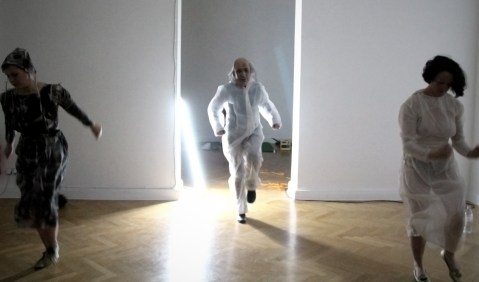
La Mission, (p/A)001: A non-Aristotelian Drama in Five Acts, 2013, Image by Julien Barret
The significance for La Mission’s project in dance music culture should be clear already, but we also take great inspiration in how Muñoz developed an expansive view of brownness and the brown commons, using Latina/o experience as an entry-point for “a vaster consideration of the ways in which people and things suffer and experience harm under the duress of local and global forces that attempt to diminish their vitality and degrade their value.” We here at La Mission are committed to exploring brownness for its potentials for lateral solidarities among people of color, who may have diverse cultural backgrounds but nonetheless share post-migrant experiences of struggle, devaluation, displacement, and inauthenticity. In fact, Muñoz’s work was a direct inspiration for the “Brown Corner” in our La Mission ‘zine (a parody of the “ladies’ corner” and “kid’s corner” of American mid-century lifestyle magazines). Published bilingually and featuring post-migrant authors, the Brown Corner reflects on aspects of brownness, as both specific to their contexts and generalizable to a wider “commons” of brown experience. In the process, we hope to highlight shared feelings, narratives, and resources for brown survival in a world of white supremacy.

A hand-drawn re-working of Frieda Kahlo’s own self-portrait, part of the Brown Corner for issue 001 of the La Mission ‘zine.
Singing into the Horizon
Brother Muñoz, what are we supposed to do with the vinyl records, the zines, the performance videos we had been accumulating for you? We’re trying to sing our way into a queer utopian horizon, and we had been counting on your voice. We know you’re not coming back. As a radical lefty utopian doomsday cult, we’re not so invested in the afterlife, anyway. But it still sucks for us and everyone else you left behind, left in the “here and now” that we struggle to turn into something less suffocating. The party was just getting started, dammit. Besides, we had such a kickass choirboy outfit picked out for you.
—
LUIS-MANUEL GARCIA aka “LMGM”: LMGM/Luis-ManuelLMGM/Luis-Manuel is a Canadian of Peruvian-Colombian origins, currently an Assistant Professor in Popular Music at the University of Groningen (NL), after migrating between Toronto, Berlin, Chicago, and Paris. He has managed to turn his love of electronic dance music into a PhD in Ethnomusicology at the University of Chicago, and into post-doctoral fellowships at the Max Planck Institute for Human Development and the Freie Universität Berlin. On the side, he writes about food and dances every chance he gets.
—

“Portrait of La Mission” by Ben Hammond, who has not seen any of its members naked
Muñoz & La Mission: A Sermon for the Imagined Sanctuary We Built Together
Welcome. La Mission is a family. A family of chosen comrades, chosen brethren, chosen hermanos, chosen сестры, chosen lovers, chosen students, chosen teachers, and chosen arms. Arms, linked and brandished through common thought, common feeling, common goals. It is with a heavy heart that we find ourselves here, remembering one of our family who (though never officially an acolyte or collaborator) was one who contributed to the ecstasy that we have felt and will feel for many years. José Esteban Muñoz was said to be a believer. Ernst Bloch and the New Revolutionary Epoch. Our utopias were described and imagined and realized and experienced. Rise up, my brown brethren, and let us celebrate Brother Muñoz’s legacy!

La Mission’s “(p/A)001: A non-Aristotelian Drama in Five Acts,” 2013, Image by Julien Barnet
The words and deeds of this fellow freedom-fighter, who infiltrated the bourgeois güero academy and infected it with a polylateral program for de- and reprogramming, has been our parallel and our inspiration. Colleague and comrade. A representative of our struggle. Not quite a patron saint—that honor we’ve reserved for communarde Louise Michel—but no less a visionary. As queers, as minorities stripped of identity, as angry and happy children in revolt for something better, we must all learn from each other as equals.
Brother Muñoz made utopia political again and located that utopianism in performance. La Mission’s performances bring forth utopias from our queer future through fleeting mindfuck happenings in the present. Through the work of Sister O’Connell and her band of terrorizing miscreants, we present a non-narrative and non-paternalistic path towards redemption, one of our own making. Can I get a “Fuck, yeah!”?

La Mission at Import Projects, 2013
Brother Muñoz loved music and dancing and life-worlds connected by the beat and said, “Take Ecstasy with Me.” He revealed to us the connections between collective dancing and feeling utopian. In his spirit, La Mission’s music strives to bring forth utopia through that ever-lasting beat. Through disassociation and reassociation, through transcendental repetition, and through getting the fuck down! Can I get a “Fuck, yeah!”?
Brother Muñoz believed in learning and critical thinking. Analysis and the great revolutionary trek through the jungle of our critically thinking minds. La Mission’s tracts enact utopia through a constant vomiting out of our recently digested learnings into the baby-bird mouths of those who read them. The brother was also a hilarious motherfucker, and from this we realize that it is not through the shrill screams of egoism disguised as activism that we will prevail. It is through the joy of laughter combined with thought that we will win our bread. Can I get a “Fuck, yeah!”?
Brother Muñoz loved fucking. La Mission’s fucking creates utopias through the ecstatic act in and of itself. If you aint fucking to make yourself a Temporary Autonomous Zone of happiness, then you aint doing it right. Can I get a copulatory “Fuck, yeah!”?
It is not all loss, though. The ideas live on. Caminamos juntos. On the dancefloor. In the reclaimed Torre David skyscraper and the Taller Tupac Amaru collective; in the informal classrooms and the sweaty bedrooms. Our hearts must burst after sagging, our heads must fill after hanging low, and our linked arms will raise! Oh honey, please don’t give your heart to a world system based on exploitation of the luckless, give your heart to US!
—

La Mission at Import Projects, Common Revilings Project, 2013, Image by Julien Barrat
—
All images courtesy of La Mission
—
PABLO ROMAN-ALCALA: Yo. I am Pablo aka “Beaner” aka “Skirtchaser” aka “El Frijolero” etc. I am an internationally working musician and dj who has enjoyed a modicum of success, but who doesn’t like what has happened to the musical landscape vis-a-vis “conservatism” in respect to both Money and Art. I mean the relationship of the two, okay? It sucks. And I want to change it.
—
 REWIND!…If you liked this post, check out:
Karaoke and Ventriloquism: Echoes and Divergences–Karen Tongson and Sarah Kessler
Freedom Back: Sounding Black Feminist History, Courtesy the Artists– Tavia Nyong’o
“New Wave Saved My Life*”-Wanda Alarcon
Share this:


Current Top Posts





April 2021

January 2020

November 2019

October 2019

August 2019

April 2014

November 2017

March 2015

December 2017

October 2015
 Sounding Out!
Recent Comments