
Head Games?: The Strategic View of Liveness and Performance
DOI: https://doi.org/10.59350/zc0jb-kgr76
When I tell people that I am an economist and a musician, they usually have one of two reactions. Either they tell me that I must be crazy, or conflicted—that the two things can’t possibly go together—or they immediately start talking about ticket prices, drops in CD sales, 360 deals. I however, refuse both stances. The connection that I see between what I study as an economist and how I perform as a musician is the element of strategy.
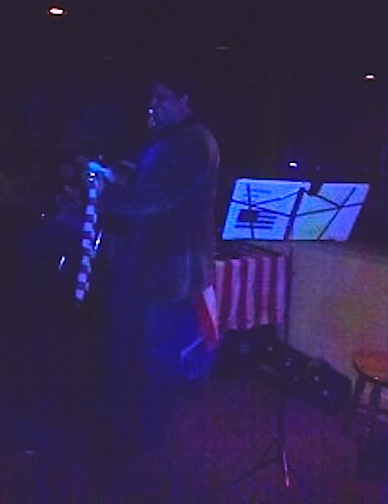
Performance, in my view, is the willful construction of a series of events to create a particular mental state for the witnesses. This is the strategic view of performance. I am a game theorist, and game theory is the foundation of the strategic view. Game theory is based on the idea that games are a metaphor for human interaction generally. It is essentially the study of strategy: the chess player imagines different actions he can take, and imagines how his opponent will respond in each case, and uses those forecasts to make his original choice; that’s strategic thinking. In “Singing to my Imagined Listener,” I describe rehearsal as playing to an imagined audience member, judging her response, and adjusting accordingly. That is exactly the strategic view.
I got the opportunity to explore this synergy between live musical performance and economics in an intimate and visceral way a couple of weeks ago—February 9th, 2011, to be exact—when I was asked to speak to a small group of students at Binghamton University who study live performance in an English course called “Representation and Popular Music” taught by Jennifer Stoever. I thought I would reproduce some of that talk here, via video clips, in order to breathe elements of aurality and liveness into the words that follow, which meditate on strategic differences between liveness and recording in the game that we call music.
But first, a song.
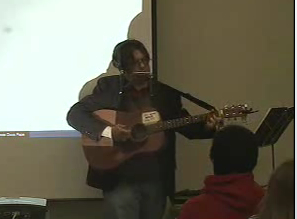
In this clip, I play the guitar and harmonica and sing a song of mine called “Sittin’ on the Mailtrain.” I strategically start off with a song that has a jarring chord in each line: my intent is to make the audience feel a bit uncomfortable with this shared live experience, so that they are more inclined to look at it with fresh eyes. At minute 7:45, I point out that I am giving a live performance to those in the room, and recording to those in the future. That’s you. As I say at minute 8:07: “There’s an audience here, in the room, and there is an audience out there in the future, who are experiencing this, but clearly in a different way than you are experiencing it.”
And, I think that you are. Even now. However self-aware and live-esque, this recorded object cannot reproduce the physicalness and immediacy of performance.
Performance is standing in front of people, feeling nervous or confident, holding a guitar, forming words, reading faces, projecting to the back of the room or getting quiet. Performance is hitting taut strings pulled across a wooden box at specific times and with a certain speed, vibrating vocal chords in a certain way, holding ones hands out to make a point, or inhaling a wail out of a blues harp. It is a series of events that are a part of a human life, in the sense that life is a series of physical moments. Agency in that visceral present moment is the essential difference between live performance and recording. Like Kathleen Hanna (frontwoman of Bikini Kill, Julie Ruin, and Le Tigre) wrote in “On Not Playing Dead” in 1999, “[O]ne thing I do as a performer is to stay physically present on stage, and that means being in the now. (Oh my god, I sound like such a hippie.)”
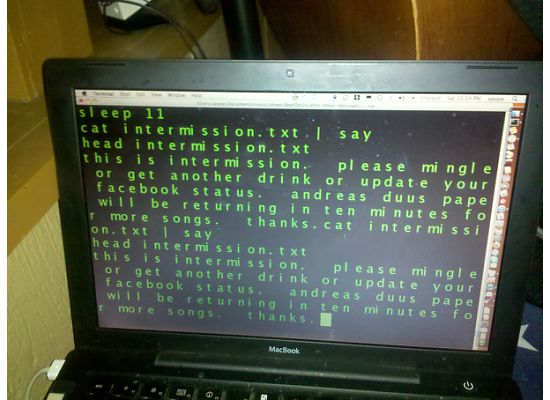
Halfway through my talk, however, my computer interjects with a pre-programmed dialogue that complicates Hanna’s claims. Watch here:
“Excuse me, I’d like to make a point,” my computer says aloud, for all to hear. “I felt it was important to point out that this is not exactly a live event. This is a recording, in some way.”
“Sure,” I reply, according to script.
“You typed this in to simulate this conversation that you’re having right now.”
“Yes,” I reply, “it’s scripted. Did anyone not know this was scripted?” I look questioningly at the students assembled in front of me.
“But this [lecture],” my computer points out, “is basically a recording. It’s an encoding of a particular process. So [the] physical body and mind [of the performer] decodes this script into a process, just like the CD player decodes the CD into a process! So how is this performance not a recording?”
“A recording encodes a performance, and a performance decodes a recording,” I say.
There is a strong way that any “live” performance has a recorded aspect to it and vice versa. The decoding of a CD is a performance, akin to my live performance. My computer worked from a script in the computer science sense—a set of essentially English-language commands that it followed to reconstruct a set of sounds. That is not a traditional recording, in that it is not direct storage of sound waves in magnetic tape or record grooves. However, it is functionally a recording: the user presses a button and a predictable and pre-specified series of sounds emerge.
If we agree that this computer script is a recording in this sense, then we are compelled to accept the next step—that if I, a human, am following a script, that I, too, am simply decoding a recording. That is, I had an idea about how “Sittin’ on the Mailtrain” would go and this idea was necessarily encoded in my mind; then I unpacked this encoding by arranging physical objects, namely my fingers and my voice, to create a song. The song followed an encoding in my head, like when you put a CD in a CD player. The encoding is unpacked, and ultimately results in the same thing: some vibrating object that vibrates the air which then vibrates the audience’s ears in a relentlessly physical way.
The future of performance lies in acknowledging the interrelationship of liveness and recording and further blurring the boundaries between them. The podcasts produced by the lo-fi movement are a key part of this new relationship. I am part of this artistic movement, which asserts the primacy of performance over recordings while also using recording technology to foster and promote liveness. Lo-fi’s hallmarks are: smaller numbers of performers in groups (often solo acts), an emphasis on live recordings complete with audience noise, low production quality (“Background hiss”), and a large number of recordings that often include many versions of the same song. The primacy of performance means the definitive versions of lo-fi songs are not located in recordings that live performances then try (and often fail) to recreate. Rather, the most recently performed version is the “master.” The performance you just watched of the song “Sittin’ on the Mailtrain” for example, was the most definitive version on February 9th. Today just may bring a new definitive version.
In the aesthetics of the lo-fi movement, the life of the performer is treated not as a series of objects, but rather a series of events, which can be attended or subscribed to, like a podcast. No doubt, each episode is recorded, and the audience receives it as a recording. However, these recordings are meant to be listened to once or twice and let go; they are intended to be ephemeral. A podcast, when viewed as a process over time rather than a possession, is no doubt a performance; the audience can respond from one episode to the next via comments, email, Twitter, etc. and the performer can react. What you are reading and viewing here is simultaneously a lo-fi recording event and a lo-fi performance. This. This blogpost, you reading it, the videos you can watch and listen to, my comments on it here, your comments below that you can post, you sharing it on Facebook or Twitter. You can even follow the traces of this performance through my own Twitter feed.
Strategically, I think the podcast model is the next logical step in the Lo-fi aesthetic. Standup comedy (one of my favorite kinds of live performance) is making this transition as we speak. The old model for the young comedian was to develop “an act” that one (hopefully) toured with, perhaps releasing a comedy CD or landing a role on a sitcom. The new model is a couple of comics releasing a conversational podcast once a week, responding to their biggest fans, giving a raw, intimate, unpolished performance of improvisational humor and riffing, and convincing their fans to become members; a membership that occasionally awards the listener with additional content, but more often only a sense of satisfaction that one gets from supporting something one loves. See, for example, the podcast “empire” of Jesse Thorn at maximumfun.org which includes live comedy podcasts, or the political humor of wearecitizenradio.com, which is also member-supported. What’s interesting, here, is that a pure donation podcast model is enough for some comics to make a living. Ironically, using recording to give primacy to performance, serves the artist. Yesterday’s recording can be taken away from the artist, but tomorrow’s performance cannot.
As for my own future? My own “tomorrow’s performance”? On February 25, 2011, at the Eastern Economics Association Meetings, I will perform a similar event, called this time “Rhetoric, Choice Theory, and Performance.” I will perform music and discuss the strategic view. Economists are not used to thinking seriously about performance nor are they used to thinking seriously about sound. I intend to change that, one strategic moment at a time.
Additional footage in which I define strategy and game theory, and discuss what the strategic view of performance has to say about my references to Dylan and Guthrie:
Andreas Duus Pape
—
Share this:

New Wave Saved My Life*
*The title of this piece is inspired by the short story, “Minnie Riperton Saved My Life,” by the poet & playwright, Luis Alfaro.
DOI: https://doi.org/10.59350/p857y-r1676
(Shuffle)
I watch you breathe,
I cannot sleep,
I touch your hair,
I kiss your skin,
And hope the morning sun won’t wake you too soon.
For when you wake,
and look at me,
You never know,
you just might see,
Another boy who crept in your room…
Take your time…(that’s what you told me),
Take your time…
But I fell head first, and I just don’t know what to do—“Nothing Looks the Same in the Light,” Wham!
I was a teenager in the 80’s. I grew up in South East Los Angeles, Huntington Park, to be exact, H.P. for short—home of the Huntington Park Senior High Spartans and the local after game hangout, Spartan Burgers. In those years, almost everyone in my school was Mexican and most kids were either preppy or cholos or Florentine Gardens disco-types—almost no one was “alternative.” That is, until we caught our first glimpse of Boy George on Video One with Richard Blade – that MTV style video show that came before MTV. If you remember, or have YouTubed it recently, a key scene in the video for Culture Club’s “Do You Really Want to Hurt Me?” begins with Boy George stepping out of a swimming pool, fully clothed and dry (a lo-tech effect even by 80’s standards), wearing a flowing tunic, white-boy dreadlocks, and expertly applied makeup. I remember being instantly fascinated watching him dance to a reggae beat and hearing him sing so longingly about a mysterious “you.” I had never seen anyone who looked or sounded like that before, and I went from listening to my brothers’ heavy metal records, my mom’s cumbias, and my grandpa’s Beethovens to listening to Culture Club, Eurythmics, Wham!, and Bow Wow Wow almost overnight.
Soon after, I started noticing in my neighborhood sprinklings of pink, purple and green hair, spikey egg white mohawks, brown boys in skirts and makeup, and the girls from St. Mathias High wearing black chunky combat boots with their proper, pleated, Catholic school uniforms–my personal favorite look. And when I bought my very own first pair of 8-hole lace-up Doc Marten’s, I was forever transformed. I sensed that crossing fashion lines somehow meant crossing other lines too, although, I was perhaps I bit too young to really cross anything. As a questioning adolescent, I embraced the freedom that music, fashion, and expression represented. It’s strange to think about how such a global phenomenon took shape in my little eastside town. That time of 80’s new wave, the “Second British Invasion,” told me something about who I would become. I learned fearlessness from the bold and transgressive acts of fashion and wit my favorite gender bending pop stars regularly deployed on American network TV. And I learned to “tune in” to the sexually ambiguous language of songs like “Time Clock of the Heart” or “Nothing Looks the Same in the Light.” All of those blurred lines felt “normal” to me. And it meant later on that I didn’t have to have an identity crisis when I was coming out. And I really didn’t. I didn’t really think about “identity” in this way again until much later.
(Shuffle)
I’m only sad in a natural way
And I enjoy sometimes feeling this way
The gift you gave is desire
The match that started my fire—“The Paris Match,” The Style Council
As I copy and sometimes re-purchase 25-year old lost albums for my new e-music library, I’ve started to wonder about some of my musical choices. Why did I still like what I liked? How do I trace my musical habitus? Culture Club, George Michael, The Style Council – they’re all on my iPod right now. And I ask myself, is my musical taste really so wrapped up in what I perceived to be my pop idols’ alternative sexuality so long ago? In this post-gender, post-queer, post-race (rhetorically speaking), trans-border era, is there even such a thing as “alternative” anymore?
Because when I listen to those old songs now, part of me still “hears” the skillful crossing of gender lines in every ambiguously phrased lyric, like the Pet Shop Boys’ clever line, “Which do you choose, a hard of soft option?” And I recall vivid images of Annie Lennox at once crossing and keeping those lines in the video for “Who’s That Girl?” which ends with an impossibly queer kiss. (She queered the Lacanian mirror long before Black Swan!) I still sense how all of these wildly public expressions of queer desire, with all of its spectacle and taboo, flowed into my childhood home through the sturdy Zenith television set that brought us together to “listen” to music anew. And this kind of hearing has to do with a particular way of remembering my adolescence – the memory of how felt for the first time to hear those songs and see the images of Boy George winking his long painted lashes at the video camera, seriously putting pressure on the word “Boy”; or seeing George Michael dancing with Andrew Ridgley in the macho ditty “Wham Rap”, their two beautiful and stylish female band mates conspicuously superfluous in that dance. And also remembering how the combined effect put something like the question about boys on hold for me in a really powerful way. There were options out there, is what I understood, and that was all I needed to survive – to save my queer soul.
(Shuffle)
Don’t make me feel any colder
Time is like a clock in my heart
Touch we touch, was the heat too much?
I felt I lost you from the start
In time it could have been so much more
The time is precious I know
In time it could have been so much more
The time has nothing to show because
Time won’t give me time
And time makes lovers feel like they’ve got something real
But you and me we know they’ve got nothing but time–“Time Clock of the Heart,” Culture Club
But I also detect another kind of crossing, or rather, multiple crossings in those same songs. Somewhere between the funk inspired bass line of “Nothing Looks the Same in the Light” and the soulful oohs and ahs of Helen Terry’s backup vocals in “Time Clock of the Heart,” I sense this music also crossed a race and a class line, however precariously treaded. From the perspective of a young, working class Chicana, quickly interested in all things British and gay, it seemed to me that these young white British boys took up a mic and pen and left their own working class accents behind for the promise of America. Clearly raised on a diet of soul and R&B, their eventual collaborations with Luther Vandross, Stevie Wonder, and Mary J. Blige – American musical royalty – seemed only natural on the Grammy stage. And I wondered in my youthful, pop star fantasies, how did they feel when they learned they could sing like that? What did it mean to be queer and black at the same time? Musically speaking. What was the bigger transgression? Because the 80’s were deadly years for many of us, on both sides of the Atlantic, who were confronted with the authority of the lines drawn by Reagan, Thatcher, and AIDS. Maybe the transgression is to survive. And to remember.
Listening as an adult now to George Michael’s greatest hits collection Twenty Five, it is easy to see that there is no longer any doubt about his sexual orientation. In songs like “An Easier Affair,” he celebrates that he’s “dancing with the freaks now/I’m having so much fun/I do my dance with everyone.” So I wonder, when your pop idols sex lives stop being curiosities or taboo, what still fascinates? Even their notorious falls from grace, and their celebrated “come backs” didn’t really provoke the public imagination in the same way again. But I detect there are still clues in the music. In his brilliant cover of “Feeling Good,” George Michael pays humble homage to Nina Simone saying: “It’s a new day, it’s a new dawn, it’s a new life, it’s a new low/Oh we all know it’s too much to expect a man, a white man, to do it like Nina” (my emphasis). That simple musical gesture, a crossing of many sorts, tells me something about what she means to him. And I think that it has ever been and ever will be music that will save our collective souls… I was seventeen when I left HP for a much larger Los Angeles. In some ways I was too young to leave home and sometimes I thought that I didn’t survive some things that came my way. But I always had a song to guide me and show me something new–a different way. I know I’ll never fully rebuild my archive on something like iTunes. But as I contemplate my growing digital library, I really do believe that new wave saved my life.
(Shuffle)
Wanda Alarcon
Share this:




Current Top Posts





April 2021

January 2020

November 2019

October 2019

August 2019

April 2014

November 2017

March 2015

December 2017

October 2015


Recent Comments