
Live Through This: Sonic Affect, Queerness, and the Trembling Body


Marginalized bodies produce marginalized sounds to communicate things that escape language. The queer body is the site of sounds that engage pleasure, repression, rage, isolation, always somehow outside of dominant language. Sound Studies tells us that we should trust our ears as much as our eyes, justifying our trust in sound, and of the resonating body. Affect Theory goes further, saying that all senses play into a body that processes input through levels of response, experience, and anticipation. Affect is the vibrational space that is both bodily memory and anticipation. So where do sound and affect meet in queer bodies? How do marginalized peoples use sound and the body to express liberation, objectification, joy, and struggle?
Our writers in Sound and Affect tackle these questions across a spectrum of the marginalized experience. Next week, Kemi Adeyemi, sloooooooows thingggggggggs doooooooooownnnnn so that we can hear the capitalist connections between the work expected of black bodies and the struggle for escape from this reality through the sonic affects, temporal shifts, and corporeal elsewhere of purple drank. Then, Maria Chaves explores the connection between voice, listening, and queer Chicana community formation: through space, across time, and with laughter. The series finishes with Justyna Stasiowska bringing the noise in a discussion of the trans body and the performance work of Tara Transitory. Today, I open by offering the concept of the tremble, a sonic form of affect that is necessarily queer in its affective reach. Live through this. Get life from this. —Guest Editor Airek Beauchamp
—
I first became interested in the intersections of sound studies and affect theory when, in graduate school, I began to research alternative rhetorics of the AIDS Crisis. ACT UP!, the noisiest and most politically effective of the AIDS advocacy groups from 1987 through 1995, posited noise as presence and silence as loss throughout their campaigns. ACT UP! was notorious for their actions in which they invaded public spaces, from the FDA to the White House and used militaristic chants to create a disruptive cacophony that ran counter to the official silence of government policy. The organization harnessed noise as powerful weapon to shake the status quo.
The ACT UP! equation led me to a critique of AIDS-era politics in which sound and affect became the predominant modes of inquiry, allowing me to investigate how the situated body and the senses experience and invoke rhetorics of marginialization. This maneuver proved to be intellectually difficult, particularly because my post-structuralist training stubbornly insisted on a discursively constructed universe in which only language constructed reality. Instead, what sound and affective rhetoric allow for is exactly that which is beyond the text, that which communicates without strictly-defined language. Theorizing the AIDS crisis as a social event might be necessary in terms of understanding how our culture processes or catalogues such an event, but as I engaged with its archive, I felt bereft when facing the limits of such an approach. It offered nothing to soothe the pain or express the terror of those whose bodies disintegrated in the cruel grasp of the disease.
Rather than relying on abstracted theory to force the affect of the plague into a logical form, I needed something like Antonin Artaud’s work on the plague to explore the cultural but embodied affect of the disease. When Artaud was invited to speak about his essay “The Theater and the Plague” at the Sorbonne, he decided to actually incorporate his ideas about ‘liquefying boundaries” into his speech. Artaud began with a standard oratory but slowly devolved into a theatrical performance of the plague, eventually ending in shrieks of physical pain. By the end of his speech, the only people left in the lecture hall were a minor contingent of his close friends, including Anais Nin, who recounted the tale (Eshleman, 12). Artaud’s shrieks and howls engaged the whole body in the process of making sound, while also erasing semantic and syntactical codes. Here is a video compilation of Artaud performances, to provide the smallest hint of his vocal performances:
To continue my research, I realized, I needed to understand bodies as instruments for processing, producing, and receiving sonic stimuli, while, at the same time, rethink how feeling, quite literally, moves bodies. Artaud led me to connect the sound and affect of AIDS in the 1980s through the unspeakable and the pre-semantic language of the body, deeply embedding these sound/feelings in a network of past experience, present and anticipatory states of being. His work gave me a different way to theorize, to grasp, to listen, to scream—to tremble and tremble in return.
I continued to connect the sinews between sound and affect in my February 2013 post for Sounding Out!, “Queer Timbres, Queered Elegy: Diamanda Galás’s The Plague Mass and the First Wave of the AIDS Crisis.” Through Galás’s visceral interactions with the unendurable pain embedded in history, I keenly felt the presence of the material body so lacking from post-structuralist critique of lived experience, alongside an urgent sense of agency. Galás’s performances made fascinating use of the “tactile effect of layered sound that is felt with the skin, in the bones, as well as with the ears, communicating a palpable experience that lies beyond the barely-nuanced music it is seductively easy to grow accustomed to.” The experience of listening to Galás helps us to realize that the body is a series of machines of input and output—processor and producer—systems that often forego semantic language and instead listen and speak in tremblings.
In what follows, I flesh out the notion of sonic tremblings: how it links what we call sound studies and affect studies, of course, but more importantly, how it speaks past the post-structuralist insistence on a world confined to text, and how we might build upon this notion in future theory and research. Our bodies’ materiality, a site of constant unfolding, engages with the world via a series of shimmers and impulses—such as the synesthetic vibration I am calling sonic tremblings—rather than with concrete events or objects in and of themselves. These tremblings, always intersectional, encompass past lived experiences, social and cultural constructions that restrict interpretation, and interpretations falling outside social or cultural codes. I understand the trembling body as both processor and producer of sound, a connection of trembling nodes eschewing the patriarchal structures of language. And, though I write through and about the particular tremblings of my own white, queer, cis male body, that experience is by no means universal or at the center of my theorizations. Instead, I hope that the way I experience and understand sound studies and affect theory will open up new ways of hearing the world, especially for people whose experiences are not mine and who can add depth, nuance, and texture to the conversation. It is in fact through their variety and unique resonances that tremblings speak simultaneously to and against the limitations placed on queer bodies.
My articulation of affect with sound studies is necessarily queer, as it rejects binaries and speaks without definitive vocabulary, syntax, or grammar. Marta Figlerowicz, in “Affect Theory Dossier: An Introduction,” offers a good primer on the widely divergent ways in which scholars use the idea of affect. In Figlerowitz’s explanation, affect is always a self in motion, be it “the self running ahead of itself,” “the self catching up with itself,” “the self as self-discursive and always constantly mutating and adapting to ambient stimuli,” and/or “celebrations of Proustian moments when the self and the sensory world, or the conscious and the unconscious self, or the self and another person, fall in step with each other… to make a sliver of experience more vivid and more richly patterned than willful analysis could ever have” (4). In all of these cases, the body’s perception and the discourse of the self remain in motion, trembling with identifications that are at best fleeting, though richly communicative and expressive. Sound, as an always-present stimulus, works affectively in such a form of communication.

Image by Flickr User Graham Campbell, “Goosebumps”
Queer bodies are inherently intertwined in theorizing sound and affect. The actual concept of affect itself is queer, implicating the unknowable, but concretely felt phenomena of the body. But rather than forming a linear narrative, affect is produced, and received, in a web of physical and neural processes that rejects the linear concept of time and instead are never static but self-referential and constantly evolving in response to our environment. To navigate this space I adopt the term “affective field,” used by Marie Thompson and Ian Biddle in their introductory essay to Sound, Music, Affect. An affective field describes a textural field of play between stimulus, meaning, and response; it relies on reproduction and broadcast, a field of listening/emitting/processing machines all working in a sort of continuous flow, always already present. The affective field model encourages the removal of emphasis on subject/object but instead focuses on interfacial relationships as a point of contact. Eradicating =the subject/object dualism is vital to exchange, as Yvon Bonenfant says in “Queer Listening to Queer Vocal Timbres“: “We cannot exchange with an object, only other subjects” (76).

Image From Flickr User Alvaro Sasaki, From Brasília Queer Fest!, 31 March 2013
Finding a theory that worked with the body and with subject/subject communication allowed me to make more sense of the ways in which ACT UP! used noise and silence as a way to build community, and allowed me to dig deeper into the idea of queer communication. The silent scream of the slogan Silence = Death succinctly articulated ACT UP!’s most definitive tactic: manipulation of the affective field. Their chants initially filled the streets, of New York, but by 1990 their actions had united them with Europe, creating world-wide noise in protest of the now-global epidemic, creating a distinct disjuncture to the silent death falling over gay communities. Noise offered the queer community both a form of protest and community, becoming an affective mechanism of agency. ACT UP!’s use of noise not only speaks to the dire need of queer bodies to exercise agency and demonstrate social worth, but it also helps break down the essential binary between encoded language and un-encoded sound. Rather than syntactical sound, noise communicates in trembles, resonating in both the psyche and in the actual body. Noise worked to unify disparate parts of identity–and disparate identities–a coalescing rather than normalizing process, a trembling vital to queer identity.
However, while ACT UP! worked to create noise—and to develop community through the trembling of their rage—they also communicated affectively with silence. Staging their now infamous die-ins, ACT UP! manipulated the affective field through the deafening buzz that accompanies silence, a somber quiet that refused to go ignored. These actions were not done to—but instead with—people, a disruption of the subject/object, or perhaps the subject/abject. But, it is the unexpected noise of the die-ins that I find most interesting. Not just the ambient noise of occupying bodies in space—people moving, coughing, breathing—but the loud silence created by the protest itself: a hushed roar that trembles through the room, the microphones, and the bodies of the listeners, a disruptive noise crafted from intentional silence. This silence itself resonates in the body, enabling them to erupt in tremblings of loss, of mourning, and of rage, the painfully loud silence of marginalized bodies at war with an epidemic about which no one in power seemed to care.
ACT-UP’s die-ins reclaimed agency within silence’s palpable materiality, using its noise to disrupt the affective field and reclaim space within it. Using the material body as both receptor and transmitter of the affective field, their noise created tremblings and spoke in associations both somatic and psychic. In the case of the die-ins, the silence mediated the noise of the voices of the dead, all talking at once through the trembling bodies of the living.
Adapting silence and the noise it brings, one of ACT UP!’s historical legacies, offers contemporary listeners agency over our marginalized bodies. We must make some noise, and then “listen out” for particular affects of noise and silence in turn, as Bonenfant suggests, seeking the tremblings that touch our skins and resonate in our brains, bone, and flesh. The affective field permeates queer communication and offers to the marginalized an opportunity, through sound, to make noise, establish self, and establish communities.
At once subversive and coalescent, noise resists the codification of what our culture might traditionally consider to be “music” or other codified sounds, making it a necessarily affective communication. The discordant, unruly strains of Throbbing Gristle’s “Discipline,” for example, jarred, shaken, and trembled me into a powerful feeling of community amid dissonance and difference, of community through difference at key moments in my life.
At other moments, the shriek, fuzz, and wail of riot grrrrl punk act Bikini Kill, in particular, Kathleen Hanna’s growl in “Suck My Left One,” has awakened in me a strain of tremblings that move freely associative in their rage against the marginalization of women and the ways in which socially constructed gender roles also marginalize and demonize queer folks. While post-structuralism maintains that the self is necessarily disunified and can only be defined by its difference to others, I have to disagree. While academic methodologies make it difficult to form an argument based on my lived experience, when I feel the tremblings connecting me to Genesis Breyer P-Orridge or Kathleen Hanna and to their audiences, I am hard pressed to feel them as anything but real.
In fact, it might just be in endurance that I can best articulate tremblings as a sonic, somatic, affective phenomenon. Born of present stimuli, always connected to past experiences and anticipatory of the future, tremblings are unruly, unable to be pinpointed. They do not just express the order or pleasure that we find in traditional music, though they can encompass this as well. Instead, tremblings are communicative, they move through the I, the subject, while unifying other subjects through their rich and unnamable identifications. It speaks simultaneously to and against the limitations placed on queer bodies, expressing joy, pain, pleasure.
—
Featured Image: Genesis P-Orridge by Flicker User Jessica Chappell
—
Airek Beauchamp is a Visiting Assistant Professor at Arkansas State University and a Ph.D. candidate at SUNY Binghamton, where he specializes in Writing Studies. Airek is currently working on his dissertation, which details ways that universities can offer social and academic writing support to graduate students to better help them professionalize in their fields. His other areas of research include queer theory, affect theory, and trauma in the LGBTQ community.
—
 REWIND!…If you liked this post, check out:
“Music to Grieve and Music to Celebrate: A Dirge for Muñoz”-Johannes Brandis
“Music Meant to Make You Move: Considering the Aural Kinesthetic”-Imani Kai Johnson
“Hearing Queerly: NBC’s ‘The Voice’”-Karen Tongson
“One Nation Under a Groove?: Music, Sonic Borders, and the Politics of Vibration“–Marcus Boon
Share this:

Unsettling the World Soundscape Project: The Bell Tower of False Creek, Vancouver

 Welcome back to Unsettling the World Soundscape Project, a series edited by Randolph Jordan that looks critically and creatively at early acoustic ecology along with the writings and subsequent compositions of WSP members, assessing its continuing role for sound studies today. This series follows strongly in the spirit of “Sound Studies 2.0,” a running theme here on SO! this year that Editor-in-Chief Jennifer Stoever has described as “the movement of the field beyond the initial excitement for and indexing of sound toward new applications and challenges to the status quo.”
In the first article of the series, Mitchell Akiyama unpacked the WSP’s monumental ten-hour Soundscapes of Canada of 1974, situating the broadcast’s innovative work historically while also pointing out problems of diversity and representation that could inform how we might listen and create in the future. In this second article, Guest Editor Randolph Jordan offers some of his own highly innovative research, drawing on the notion of “unsettled listening” that he described so vividly here last summer, and focusing on how sound calls attention to territorial boundaries and contested land appropriation from Native peoples of Vancouver.
—
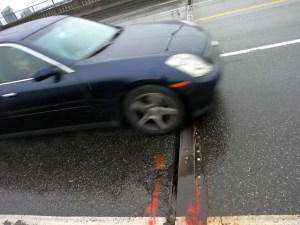 For a few months in 2013, an intense clanging sound emanated from Vancouver’s Burrard Bridge spanning False Creek. A pothole on the surface had opened up next to the metal connector sitting directly atop of the southwest concrete pillar on the shore, activated by passing traffic and intensified by the hollow concrete structures below.
By coincidence, the pothole’s acoustic profile, the “area over which it may be heard before it drops below the level of ambient noise,” was roughly equivalent to the east/west boundaries of Kitsilano Indian Reserve at its peak acreage established in 1877.

Detail of Vancouver map by Shell Oil, 1951, courtesy of the David Rumsey Map Collection
In the century to follow, the reserve would be carved up for a variety of uses and by 1965 it was gone. But in 2013, 100 years after the government – without securing official title to the land – paid the reserve’s residents to leave, the sound of the pothole set the past resonating as the rhythmic clanging reached out to draw the surrounding acoustic environments together while sounding out their roles in contesting indigenous claims to the area. Fitting, then, that the hole sounded loudest directly under the bridge on the south shore, site of newly restituted reserve lands awarded to the Squamish Nation in 2002 after the decommissioning of the railway passage that marked the original reserve’s first transgression in 1899.

People on Kitsilano Indian Reserve beach by Burrard Street Bridge, 1932. Photo credit: City of Vancouver Archives, Item AM54-S4-: Park N9.6
The sound of bridge traffic calling attention to contested land use challenges stereotypical notions about indigeneity in the modern city by upending biases against urban noise pollution typical in early acoustic ecology and exemplified by the work of the World Soundscape Project (WSP). The pothole sound became the locus of my investigation into the value of thinking longitudinally across the Vancouver archive of the WSP, the first assignment given to me by original member Barry Truax as supervisor of my postdoc at Simon Fraser University from 2012-14. I argue that if we use urban noise as a tool for mapping out uncomfortable and subordinated histories, we can rethink the effects of such urban noise on the articulation of cultural space across the WSP archive and imagine new possibilities for future iterations of the project’s Vancouver research.
First question: what documentation of traffic noise around Burrard Bridge exists in the WSP’s three major sets of documentation in Vancouver from the ‘70s, ‘90s and 2010s? Using the Google Map I created to plot recording locations across the archive, I listened to those from which bridge traffic might have been audible. Sure enough, the sound of bridge traffic is present on the original ’73 tapes recorded nearby. In fact, the ‘73 release of The Vancouver Soundscape LP addresses these bridge recordings in a conversation between project director R. Murray Schafer and the recordists, who describe this traffic noise as a source of frustration while attempting to capture the sound of tinkling masts from the boats in the marina beneath.
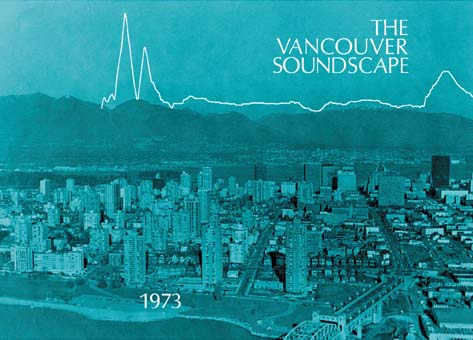
Here the message seems clear: traffic noise is blight upon more valued sounds in and around the city. This position is corroborated by the very cover of the LP that features a graphic representation of a soundwave from a recording of chirping frogs interrupted by a passing car, the example of urban imbalance with which Schafer concludes the final side of the album.
 A few years after the ’73 release, however, Hildegard Westerkamp and Bruce Davis wrote the catalog page for the original set of tapes in which they refer to the traffic sounds as a “noisy, broad wash” that “frames the delicate rigging tinkle of the moored boats.” This is a more aesthetically motivated take on urban din that Westerkamp explores to creative effect in her 1986 piece Kits Beach Soundwalk. A decade after that, Robert MacNevin wrote in the catalog notes for his recording under the bridge that the rhythm of the traffic was part of the “very beautiful” fabric of this sonic tapestry that included the masts swaying in the breeze. This shift in attitude also played into the presentation of the archive on the ’96 Soundscape Vancouver CD. Now under the direction of Barry Truax, this second release featured a selection of soundscape compositions that celebrated all manner of urban sounds as interesting in their own right.
It was very difficult to ascertain whether or not the traffic sounds in these recordings were in any way connected to potholes on the surface. Yet hearing Vancouver’s urban sound through the shifting perspectives of the WSP’s contributing members provided a framework for assessing the value of their work. So I turned to the next question: how might hearing urban noise like bridge traffic, as “staged” by the WSP, contribute to listening to the area in a way that can unsettle its appearance of stability and reveal the tense histories of contestation that have defined it since the time of first contact through to the present day?
On the issue of cultural politics we find less progress across the two official Vancouver releases. Both make some mention of indigenous presence in the land and tie these references to their concerns over urban noise pollution. The ’73 LP opens with the sound of the ocean primordial, lapping against the shore, with wind and birds following in short order. Amidst these, the voice of a Squamish man begins speaking in his native tongue, soon interrupted by an emerging seaplane flying low overhead, ushering in the era of Vancouver’s incorporation as a city and the ensuing industrial development. Only someone who understands the spoken language here will know if the WSP’s narrative runs counter to the story being told by the Squamish man, for no translation is offered either in the grooves or within the jacket.

Display Table for the British Columbia Indian Homemakers Association at Vancouver’s Pacific National Exhibition, 1971. Photo credit: City of Vancouver Archives, Item AM281-S8-: CVA 180-6851
Well-intentioned though they were, the WSP’s problematic construction of machine noise as despoiler of the wilderness is made worse by putting the only voice given to indigenous peoples in the service of this didactic construction. In so doing they contribute to relegating urban indigenous presence to a thing of the past rather than accounting for the consistent and continuing presence of First Nations communities in the city – a luxury they afford to the Greek and Chinese communities later on the disc when these are presented as vibrant and living parts of Vancouver’s modern fabric in a track entitled “The Music of Various City Quarters” (a multicultural gesture they would move away from on the trip across Canada that Mitchell Akiyama unpacked in the previous post in this series).
Similarly, in a brief documentary about Vancouver’s changing sounds on the ’96 release, Westerkamp comments on the intrusive presence of the air conditioning system in the Museum of Anthropology on the U.B.C. campus, marring visitors’ experience of “some of B.C.’s most fascinating Native artifacts.” Westerkamp’s respect for indigenous culture comes through clearly enough. Yet the WSP’s presentation of local indigeneity takes a step backward here as the living voice speaking a dying language heard in ’73 has given way to just plain old dead people in ’96, best contemplated in the quietude of Arthur Erikson’s high modernist design for the building.
 The WSP might just as easily have critiqued this space as an example what Schafer has called the “glazed soundscape” in which sound is cut off from the world visible through large windows, an architectural situation that emphasizes the disconnection between the indigenous culture on display within and the living Native presence in the city outside the museum walls. The fact that the building’s design heightens the perception of the ventilation sound is, like the pothole on the bridge, an example of how urban noise can be heard to mark out indigenous displacement in the city.
Standing under the bridge on the 40th anniversary of the 1973 recordings, and the 100th anniversary of the reserve payouts of 1913, I imagined the pothole as a recasting of the church bell as marker of territorial boundaries, sounding out the colonial encroachment of municipal infrastructure upon 19th Century reserve lands well into the 21st. And so in a multimedia work on the site, I dub the bridge the “Bell Tower of False Creek” for its power to unsettle ideas about the role of urban noise in articulating culture in the modern city, and I wonder what shape the next WSP release might take.
The key lies in deeper consideration of the intersection of soundscape composition and the WSP archive as mutually enriching sites of practice. The positive move on the ’96 release came in actively putting the ‘90s archival recordings in dialogue with the ‘70s material, creatively exploring longitudinal relationships in ways that move in the direction of the post-Foucauldian thrust for artists and researchers to “use archives in a more self-conscious way” as Jaimie Baron puts it (3). Yet they stopped short of “actively promot[ing] a critical attitude towards [the materials] and their uses within the institutions” from which they originate, a key characteristic of archival collage identified by William Wees (47).
The time is right for a critical investigation of the ways in which the WSP’s own construction of the archive itself has delimited its possible uses and how they have controlled the staging of its content these past four decades. In so doing, they might also become more culturally astute in assessing how their biases against certain kinds of urban sound have shaped their presentation of the cultures that live within earshot.
—
Randolph Jordan wanted to be a rock star. Now he teaches cinema and the humanities at Champlain College and Concordia University in Montreal. Draw your own conclusions. After completing his Ph.D. in the interdisciplinary Humanities program at Concordia in 2010 he took up a two-year postdoctoral research fellowship in the School of Communication at Simon Fraser University. There he investigated geographical specificity in Vancouver-based film and media by way of sound studies and critical geography, research that will inform the last chapter of his book An Acoustic Ecology of the Cinema (now under contract at Oxford University Press). If you can’t find him hammering away at his manuscript, or recording his three young children hammering away at their Mason & Risch, look for him under Vancouver’s Burrard Bridge where he spends his “spare time” gathering and shaping film and sound material for his multimedia project Bell Tower of False Creek. Or visit him online here: http://www.randolphjordan.com
—
All images provided by the author, unless otherwise noted.
—
 REWIND! . . .If you liked this post, you may also dig:
SO! Amplifies: Cities and Memory — Stuart Fowkes
Listening to Disaster: Our Relationship to Sound in Danger — Maile Colbert
Unsettled Listening: Integrating Film and Place — Randolph Jordan
Share this:


Current Top Posts





April 2021

January 2020

November 2019

October 2019

August 2019

April 2014

November 2017

March 2015

December 2017

October 2015
 Sounding Out!
Recent Comments