
The Noises of Finance
 What does finance sound like? Is it the clanging of the opening and closing bells at the New York Stock Exchange? The shouting of offers to buy or sell? The beeps made by cash registers as a credit card is swiped? The whirring of fans working overtime to cool computers? What is this noise?
Noise, however, is not purely a sonic phenomenon. Since the late 1940s, noise has been intimately linked with theories of communication and information, as Aaron Trammell discusses in Sounding Out! posts such as “What Mixtapes Can Teach Us About Noise.” My research attempts to bring these two aspects of noise—the sonic and informatic—into conversation. I trace the interferences noise makes within a set of disparate disciplines: I listen to the history of the impact of information theory on experimental and electronic music; investigate the interferences of “fearless speech,” artistic robotics, and the public; and examine how noises digital and sonic have impacted the development of finance. Rather than creating my own definition of noise, I follow how other disciplines deal with their encounters with noise as both a material phenomenon—something that interferes with a signal, or a sound that is deemed unwanted—and as something to be theorized, asking questions such as what are the meanings of these noises? or should we be controlling noise at all?
In this post, I discuss three vignettes that outline the different ways in which noise (sonic and informatic) interferes with different aspects of finance: the shouts of open-outcry pits and the information they may or may not convey; new forms of electronic trading and the noises of server farms and trading behavior; and the Flash Crash of May 6th, 2010 that provoked noises from both traders and artists. Each reflects a particular conjunction of the sonic and informatic aspects of noise. When we attend to both components simultaneously, we discover that financial noises are complex entities that are not inherently revolutionary nor regressive, but are rather an elusive combination of both.
Noisy Trading: The Pits
My interest in the noises of finance comes in part from listening to open-outcry trading, following the work of Caitlin Zaloom’s Out of the Pits: Traders And Technology from Chicago to London and the documentary Floored (2008). An open-outcry pit, such as that found on the floor of the Chicago Board of Trade (CBOT), pairs buyers and sellers through a bodily practice of trading involving the extremities of behavior. Shouting, pushing, and shoving occur on the steps of the pit as buyers and sellers work to match their orders through nearly whatever means necessary.

Chicago Board of Trade Corn pit, 1993, Image by Jeremy Kemp
In the wonderfully titled article “Is Sound Just Noise?”, the business school professors Joshua Coval and Tyler Shumway ask, in one of the few academic articles related to the sounds of the pits, whether or not the shouting might convey information that is not necessarily available on the computer screens that were then coming to dominate trading:
we ask whether there exists information that is regularly communicated across an open outcry pit but cannot be easily transmitted over a computer network. Any signals that convey information regarding the emotion of market participants—fear, excitement, uncertainty, eagerness, and so forth—are likely to be difficult to transmit across an electronic network (1890).
Coval and Shumway found that the ambient sound level of the pits did have predictive impact regarding various aspects of the market: in short, the louder the pits got, the higher the volatility in the prices of securities and the decrease in the likelihood of conducting a trade.
Noisy Trading, Redux: Datacenters
Yet changes in the structure of the market have not only shifted the location of activity to people behind computer screens and away from these types of sounds, it has also shifted the actual location of the exchanges themselves. No longer do most trades take place in the physical location of, for example, the NYSE; rather, they take place in buildings like this one, at 1700 MacArthur Boulevard in Mahwah, NJ.

Screen capture by author
This is the location of the NYSE’s new datacenter, a 400,000 square foot facility. (In the linked video, note the whirring of the fans, a new noise of finance beyond that of the pits.) The servers in these datacenters—run by highly-capitalized financial firms large and small alike—are able to respond much quicker to market information the closer they are to the computers that run the exchange. And what can be closer than being co-located in the same datacenter as the exchange? This need for speed has lead to all sorts of interesting situations, such as new fibre-optic lines being laid to shave off a millisecond or two in travel between New Jersey and Chicago, or the taking into account of special relativity effects in the location of future datacenters. The new High-Frequency Trading (HFT) algorithms run on these servers in these datacenters.
Noisy Trades, Sonified: May 6th 2010
The voice on this recording, made on May 6th, 2010, belongs to Ben Lichenstein, an employee of a firm called Trader’s Audio. Now, Trader’s Audio provides live coverage of market movements from a person on the floor of an exchange in order for day traders and others to get an idea of the “sentiment” of a market. It’s kind of like a play-by-play of market activity, a running commentary of major market movements that can’t be discerned soley by the watching of numbers on a screen. What, then, could have been going on for Ben Lichenstein to be in such a frenzy, for his voice to be inflected in such a way? What are we to make of this noise?
Well, May 6th, 2010 was the day of what has infamously become known as the Flash Crash. The full details of this day are beyond the scope of this post, so I will outline it schematically, following the findings of the official US report produced by the Commodity Futures Trading Commission (CFTC) and the Securities and Exchange Commission (SEC). (For a different take on this, see the sociologist of finance Donald MacKenzie’s “How to Make Money in Microseconds”.) In short, between the hours of 2 and 3PM Eastern Time the New York Stock Exchange (NYSE) had both its largest single day loss as well as its largest single day gain, a swing of over 600 points. A series of trades made by algorithms that failed to take into account their impact on the market caused the prices of securities to swing to extremes, excerbated by the activity of High-Frequency Trading (HFT) algorithms. While the market eventually recovered—in part due to the activity of the same algorithms that caused the problem in the first place—the event indicated the precariousness of the stock market, the potential for things to spiral quickly out of control, and the difficulty in forecasting the behavior of an ecosystem of opaque algorithms.
How do the HFT algorithms relate to the Flash Crash that took place on May 6th, 2010? While the report of the CFTC and the SEC regarding the Flash Crash does not lay blame on HFT in particular, it did indicate how these algorithms contributed to the large price swings, the immense number of shares traded, and the drying up of liquidity (that is, the ability to find buyers and sellers in the market). One of the reasons why the market swings were so severe on May 6th, 2010 was due to the fact that HFT algorithms react immediately to small fluctuations of price, a quality of markets that financial economists call microstructure noise, a fascinating topic that is unfortunately beyond the scope of this particular post. In general, HFT and these datacenters go hand-in-hand, as it is a truism that it will take longer for data to travel between a machine in New Jersey and one in Chicago, than it will to travel between two machines in the same data center in New Jersey. HFT works to take advantage of this shorter latency in order to exploit market movements on the timescale of milliseconds, accelerating trading far beyond the open-outcry pit.
Noisy Finance: The Sonic and the Informatic
.
Let’s conclude with a sonic artifact of the Flash Crash from the French collective rybn. Their work has explored the concept of “antidatamining,” that is, the use of the “data mining” techniques of computational capitalism in order to shed light on the intersection of data and society. Consider their piece FLASHCRASH SONIFICATION (one of the few artistic responses to the Flash Crash), where rybn took trading data from nine different exchanges on the afternoon of the Flash Crash and created an austere, digitally-sharp yet undulating soundscape that recalls the work of artists Ryoji Ikeda or Carsten Nicolai without the rhythmic precision. If you can, listen to their online-available, two-channel mix on headphones in order to appreciate the details of the piece.
The building towards the end of “FLASHCRASH SONIFICATION” was meant to “emphasize the moment of the crash, [by] adding an effect of resonance, which propagates slowly, making it more tense, as the krach goes on” (all quotes in this paragraph from author’s personal interview with rybn). Thus instead of merely transparently translating the data into sound, rybn constructed the sonification in order to bring out this resonance: “resonance is pointed [to] as one of the major risk[s] of HFT by many economists and the feedback phenomenon was in the center of our discussions when we were preparing the piece.” Isolating the Flash Crash was important for rybn as it was perhaps the “moment when people started to understand financ[ial] orientations more clearly” thereby highlighting the symptomatic nature of the “speculative short-term loop finance seems to be stuck in.”
In FLASHCRASH SONIFICATION, sonic noise becomes a translation of the data from the market—abstract yet eminently material—into a different abstract form that does not immediately signify. FLASHCRASH SONIFICATION suggests rather than indicates; listening to it cannot provide us with rational information regarding the dynamics of the Flash Crash. Instead it produces a dark foreboding of the mechanisms at work, the high-frequency pulses first recalling heartbeats that soon speed up beyond any ability for distinction. In FLASHCRASH SONIFICATION, rybn comments on the inability for computation—and by extension, the market—to be the perfectly rational, ordered space it is ideally understood to be.
In Noise We Cannot Trust
If there is one thing clear about the examples of noises heard and encountered in this post—the shouting in the pits, the fluctuations of prices, the whirring of air conditioning, the sonification of the Flash Crash—it is that noise cannot be counted upon for positive or negative disruption. Noise cannot be counted upon as a political exploit in the market, as it can signify the potential of a trade, or be recuperated into profit through the activity of HFT algorithms. Yet noise can also provide an alternative experience of the Flash Crash beyond that of bureaucratic reports and figures. It is thus through the interferences noise causes within the dynamics of finance that we come into contact with the equivocality of noise as a phenomenon, and thus become attuned to a particular need to not confine noise to preconceived notions of positivity or negativity.
—
Adriana Knouf (she/her/hers, sie/hir/hirs) is an Assistant Professor of Art + Design in the College of Arts, Media, and Design at Northeastern University. She is a media artist and scholar researching noise, interferences, boundaries, and limits in media technologies and communication.
Her current research project, tentatively entitled The Xenology Notebooks, is a transmedia, transdisciplinary corpus expansively considering the “xeno”. Her first book, How Noise Matters to Finance (University of Minnesota Press, 2016), traced how the concept of “noise” in the sonic and informatic domains of finance mutated throughout the late 20th century into the 21st.
Her current artistic research explores queer and trans futurities on earth and in the cosmos. Projects include Enredos Sónicos/Sonic Plots, a collaborative sonic exchange between the US and Cuba; they transmitted continuously / but our times rarely aligned / and their signals dissipated in the æther (2018-present), a 20 channel sound art installation with speakers made from handmade abaca paper and piezo electric elements, with sounds collected by custom antennas from satellite transmissions; and PIECES FOR PERFORMER(S) AND EXTRATERRESTRIAL ENTITIES (2017-present), event scores laser etched into handmade translucent abaca paper.
—
 REWIND! . . .If you liked this post, you may also dig:
Experiments in Agent-based Sonic Composition–Andreas Pape
Listening to Disaster: Our Relationship to Sound in Danger–Maile Colbert
SO! Reads: Jonathan Sterne’s MP3: The Meaning of a Format–Aaron Trammell
Share this:

One Nation Under a Groove?: Music, Sonic Borders, and the Politics of Vibration

 Welcome to week three of our February Forum on “Sonic Borders,” a collaboration with the IASPM-US blog in connection with this year’s IASPM-US conference on Liminality and Borderlands, held in Austin, Texas from February 28 to March 3, 2013. The “Sonic Borders” forum is a Virtual Roundtable cross-blog entity that will feature six Sounding Out! writers posting on Mondays through February 25, and four writers from IASPM-US, posting on Wednesdays starting February 6th and ending February 27th. For an encore of weeks one and two of the forum, click here. And now, get up and get ready for Marcus Boon, because there’s no parking on the dance floor at Sounding Out!–JSA
—
What borders remain when it comes to thinking about sound today? The field of sound studies has exploded in so many far-flung directions in the last few years. However, I argue that what is still somewhat off limits in the field is a consideration of the ontological status of sound: in other words, what it means to understand our own being in the world as a sonic phenomenon. Out of attempts to approach this sonic ontology, comes the realization that there are prohibitions, perhaps universal ones, on thinking about sound in this way, and from that emerges what I call the politics of vibration.
For those, such as myself, who have grown up as a part of sonic subcultures, it is not difficult to ponder sonic ontologies, for the simple reason that many of the most intense and powerful experiences we have had have occurred on dance floors or at clubs, as DJs, musicians, clubbers and/or listeners. I still remember the moment of first hearing Funkadelic’s “One Nation Under a Groove” blasting through the speakers at a Pop Group gig at the Electric Ballroom in London in the late 1970s: tumbling polyrhythms, polyphony, polysexuality, polyeverything. The feeling was: “wow, the universe contains this! And it contains other people who know what it is!” And contrary to the warnings of Slavoj Zizek concerning the “autistic jouissance” to be found at the limits of language, here we all were: high; the histories of Afrodiasporic displacement and solidarity echoing off the walls; our own implication in those histories illuminated; flickering between utopia and shame.
To quote Eric Satie: “When I was young they told me: You’ll see when you’re fifty. I’m fifty. I’ve seen nothing.” Me too. But I’ve heard a lot and I still experience that same power of sound in more or less the same way. If anything, sound’s power is more intense and surprising, each time it appears. Partly because I have learned how to be a social being through sound—how to love and be loved—enabling me to be more open to its impact than I was as an awkward youth. It makes me sad the way in Canada and elsewhere in el Norte people seem to lessen their involvement in the more intense aspects of sound cultures as they hit 30 or 40. It makes me sad that my four-year-old son rarely gets to hear a real sound system. I look for music at carnivals, weddings, community centers, on the beach. . .anywhere that those age barriers are ignored. Even as a DJ, I increasingly look for new or different kinds of publicness than that of club or dancehall.
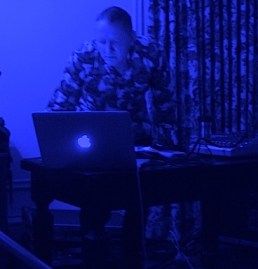
Marcus Boon DJ-ing, image by JSA
Still, I do wonder. Was the movement into sonic subcultures that my generation (and those that followed) made–especially in the UK where music (and intoxicants, and immigration) were one of the few escape routes from the brutalities of Thatcherism–a mistake, precisely because we accepted as ontological, a structure that in fact was smoothly integrated into the operations of late capitalism? From the Factory and Paradise Garage to Berghain or Ministry of Sound. . . how will history look on the era of the mega-club?
Although one could argue that the Internet put an end to the idea of subculture, since it breaks down the locality and secrecy around which particular subcultural communities grow, in fact what seems to be happening is an acceleration in the generation and dissolution of subcultural formations. Hip-hop has adapted very quickly to the internet. The cassettes or CD-Rs sold out of DJ Screw’s record store in Houston, Texas, for example, morph into the world of online mixtapes, Youtube clips and Twitter battles; the gray market availability of samples sounds a lacuna of time, appearing for a day on a hosting site rather than flying below the radar in some particular geographical location. At the same time, sonic subcultures are expanding around the world. If Jacques Attali was right that sound is prophetic, then #idlenomore was announced by Ottawa Native dubstep crew A Tribe Called Red; Tahrir Square by Chaabi and North African hip-hop.
In his book 1989, Joshua Clover describes popular music in the period of neo-liberal globalization as the sound of ideological containment. It’s true that popular music is full of ontological claims about sound, of music that celebrates setting us free. . .but which fails to actually do so. A quote from Ray Brassier just came up on my Twitter feed:

If true, this would suggest that the intensity of moments of sonic jouissance does not necessarily mean anything in terms of ontology or the truth about what’s Real. It could be entirely delusional.
All of which might be true. We might come to realize that, to put it in Heideggerian terms, we’ve been thrown into this, and that maybe there’s not much difference between being thrown and being played. But somehow I think people on dancefloors already know this. The dramas of seduction, commitment and loss are at the core of disco, and many other kinds of popular music too. To quote the disco classic “Lost in Music” by Sister Sledge (later covered by post-punks The Fall):
We’re lost in music; caught in a trap.
No turning back. We’re lost in music.
We’re lost in music. Feel so alive.
I quit my nine-to-five. We’re lost in music.
Other examples are not lacking.
Perhaps sound and music border on a vibrational ontology, rather than being truly the core of one. This is why, as Michael Taussig, Jayna Brown, and others have suggested, they can be concerned with healing. Perhaps any practice that is meaningful — and sonic subcultures are certainly a matter of practice, as Julian Henriques indicates in his book Sonic Bodies — must necessarily work at the boundary of a space that it can never entirely inhabit as a practice, but which it can push one towards, and also receive one from. The anticipation, fear, desire before one goes out, for example, but also the blinding daylight, the sensation of cool air on exposed skin when one leaves a dancehall or a party.

Lasers in a dance club, image by flickr user gabriel.jorby
Sound studies has not truly begin to explore these moments of exposure to and abjection from the vibrational core of sound. No doubt, Steve Goodman performed heroic work in Sonic Warfare—which sets out a proposal for a vibrational ontology in the midst of the commodification and militarization of the sonic —as have various explorations of the phenomenology of sound, such as those in Salome Voegelin‘s Listening to Noise and Silence. Yet in both cases, a full consideration of sonic ontology is in the end foreclosed. In Goodman’s case by Sonic Warfare’s emphasis on the militaristic applications of sound and vibration that are appropriated by sonic art and subcultures, which gives the violence of sound and vibration something like ontological status, while the aesthetic and cultural “uses” of the same have only a secondary, somewhat parasitic status. Conversely, in Voegelin’s work, an emphasis on the phenomenological rendering of the moment or event of sonic relationship forecloses a broader investigation of sonic ontology, because it “brackets” (to use Husserl‘s term) considerations beyond that of the subject-object relationship. In both cases, the sonic thing in itself, or indeed an ontology of vibration, risks being lost.
The recent turn to the speculative and to realism in philosophy has yet to make an impact in sound studies, despite the fact that the object of sound presents a provocative and very intimate entry point to that problematic. One of the more intriguing and improbable hypotheses emerging from the speculative realist movement is that of Quentin Meillassoux, who, in After Finitude, makes an argument that speculative knowledge of the real, unmediated by correlation with the Kantian subject, is possible through mathematics. It is roughly Alain Badiou‘s thesis in Being and Event too. As much as music is clearly about the contingency of sonic experience, there are strong arguments, going back to Pythagoras and beyond, about the relation of music to mathematics. Natural harmonics, rhythm: the elements of music express mathematical relationships. I am not interested in reducing music to a kind of vulgar scientism. But what if when we listen to music, we are exposed to a mathematical ontology and at the same time, the contingency of an unprecedented event? What if music is speculatively real? The word “speculative” here would refer not to philosophical propositions, but to the uncanny movement across subject/object individual/collective borders that the sonic matrix offers when “we” listen to “it.” Music not as the source of a speculative discourse on the real, but a speculative practice in which order and contingency meet.

A cymatic image, made by sound vibrations on a visible medium by flickr user evan grant
Genres, styles form around places of cohesion, of transport, of passage. Not an instrumental mathematics (though it can be that too), but a speculative one that seeks out locations of collective affect, of resonance between micro and macro spheres. It matters little whether a specific knowledge of mathematics is invoked here, since many traditional musics find their way to structures that, according to scholars such Alain Danielou, already express mathematical relationships. And in this way, music and musicians can be said to participate in a sonic ontology.
Reluctantly perhaps. Ready or not. The question remains: how many institutional, historical, disciplinary, intellectual, social and political barriers remain in order that a cultural artifact like “One Nation Under a Groove” can be considered to have ontological significance? That is what I mean by the politics of vibration, and in terms of borders, it’s an important set of borders for researchers in sound studies to consider.

Tyler, the Creator crowdsurfing, image by flicker user choe.brandon
Much of my current work focuses on tropes of abjection in recent hip-hop and RnB music, notably that of Odd Future members Tyler, the Creator and Frank Ocean, artists like Azealia Banks, and a new generation of queer rap MCs emerging out of New York City such as Zebra Katz, Le1f and Cakes Da Killa. All of their work is bracingly obscene, funny, violent. . .a tumbling deck of cards of performances of gender, race, sexuality, class and more. Of course, cursing to a beat is nothing particularly new, but the way in which these artists multiply and collapse identities to an ever more minimal, humming beat perhaps is.
Katz’s remarkable “Ima Read” and its equally remarkable video is a case in point. Although Katz occasionally claims dryly that the song is “pro education,” the “reading” in question mostly refers to the drag queen balls of the Harlem ballroom/voguing scene of the late 1980s/early 1990s, where to read meant to verbally trash, i.e. abject, someone at a ball. The song is rapped by male and female voices, crisply denouncing a “bitch” who they are going to “take to college.” The violence of the song is ironic, as much a marker of queer community and Eros as of sexual difference, of racial and trans-racial solidarity as much as racialized violence. It is performed over a minimal beat with a humming, in-your-face bass drum that is the only recognizable tonal element.
Why make the leap to talking about ontology in discussing this admittedly awesome Youtube clip? Both Judith Butler’s famous elaboration of the performativity of gender, one of the bases of queer theory, and Katz and friends play with taboos concerning gender, sexuality and race in contemporary hip-hop emerge from that moment of the ballroom scene.
But what if Butler’s emphasis on performance actually covered up or abjected the ontological nature of experiments at the balls? Perhaps we need to rethink why the ultimate ball anthem is Cheryl Lynn’s “Got To Be Real.” What is sonic ‘realness’? In restoring the sonic dimension to the ballroom scene, and learning, from Zebra Katz, to face that constitutive abjection that Kristeva amongst others has pointed us towards, we can begin to feel for ourselves what a vibrational ontology is.
—
My thanks to Catherine Christer Hennix, Steven Shaviro, Kevin Rogers and Ken McLeod for conversations that helped me in thinking this through, and to Jennifer Stoever-Ackerman for luminous remix skills.
—
Featured Image by Flickr User depinniped
—
Marcus Boon is associate professor of English at York University in Toronto, and was a Fellow at Cornell’s Society for the Humanities in 2011-12. He is the author of The Road of Excess: A History of Writers on Drugs (Harvard UP, 2002) and In Praise of Copying (Harvard UP, 2010). He writes about contemporary music for The Wire. He is currently co-editing a book on Buddhism and critical theory, and a new edition of William S. Burroughs and Brion Gysin’s The Third Mind. He is also working on a book entitled The Politics of Vibration.
Share this:


Current Top Posts





April 2021

January 2020

November 2019

October 2019

August 2019

April 2014

November 2017

March 2015

December 2017

October 2015
 Sounding Out!
Recent Comments