
“I Love to Praise His Name”: Shouting as Feminine Disruption, Public Ecstasy, and Audio-Visual Pleasure
Well, if you don’t believe in shouting,
That’s alright with me
Some folk don’t believe in shouting,
That’s alright with me…
Doubt and ignore it,
But I belong to the Lord’s crew.
David said rejoice in the Lord,
And that’s the way we Christians do.
If you don’t believe in shouting,
That’s alright with me.
–Dorothy Love Coates & the Gospel Harmonettes, “That’s Alright with Me”
DOI: https://doi.org/10.59350/e5fw9-cmr81
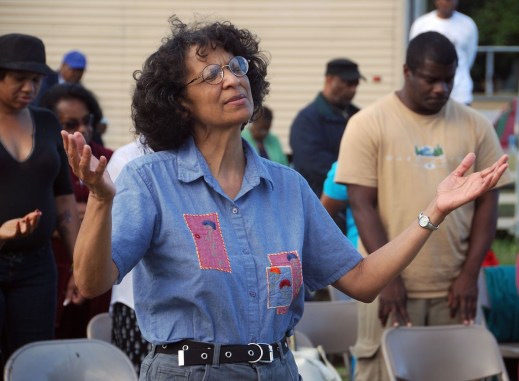
A handy catch-all term, “shouting” is actually a euphemism encompassing a range of ecstatic worship behaviors. These can include clapping, dancing, pacing, running, rocking, fainting, as well as using the voice in speaking, singing, laughing, weeping, yelling, and moaning. Certainly, there were men who shouted in the days of my childhood in church; there are men who shout today. The only shouts I can recall and even imitate to this day, however, are those of the women.
There is, in fact, a longstanding association between women and shouting. Perhaps because of the pronounced emotionality involved in the practice, the shouting sphere tends to be prefigured as feminine and in this bears great relevance to women. I am interested in the significances of shouting among black Christian women of struggling populations. In my view, shouting is not only a religious practice for these women, but is also a binary-breaking performance which confounds—if only fleetingly—the divisions which have so often oppressed, menaced, and harmed them. I argue that shouting has worked to codify the disruption of male-dominated services by women who have so often faced sharp sanctions by black church patriarchy. I also contend that shouting places its female practitioners and their observers within a sphere of public ecstasy and visual and auditory pleasure, which makes mischief for notions of what is proper for Christian women and for the entire church community.
.
The Shout, the Sound, and the Shriek: Black Feminine Disruption
In a 2011 post for Sounding Out! entitled “Pentecostal Song, Sound, and Authentic Voices,” Ashon Crawley posits the existence of a black church “public zone,” which serves as the conceptual, holy ground upon which “sound, song, and subject [function] as conduits for the exchange of ecstasy and ecstatics.” I’d like to track Crawley’s public zone into the shouting sphere, the very heart of ecstasy within the black worship experience.
Although culturally codified—even expected and welcomed—within the church community, the shout functions primarily as a disruption. The faces, bodies, and voices of shouting black women disrupt the flow of the service. A shout takes time and has the power to alter the program. Regarding such moments, worshippers—most often women and gay men—often proclaim in retrospect, “Baby, there was no more order!” This disruption of order through the use of the body and the voice has a distinct place within the Christian black feminine tradition of resistance to oppression.
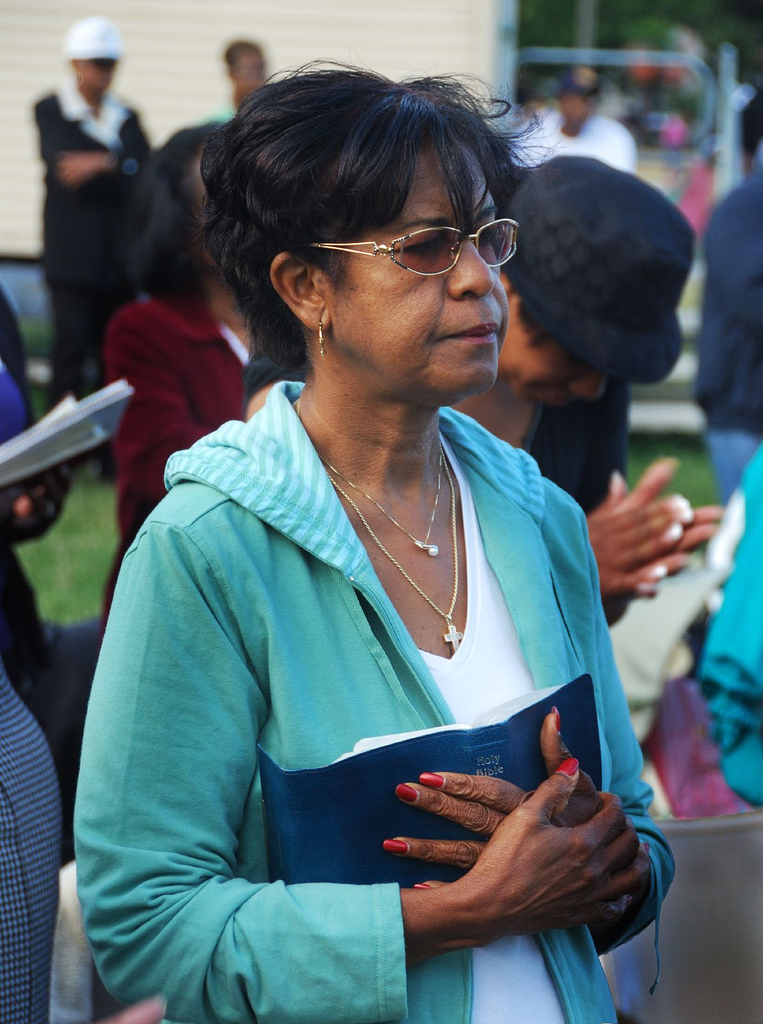
In the essay, “The Restorative Power of Sound,” womanist Roxanne Reed has examined the function of gendered sound within black Christianity. For Reed, the feminine “wordless cry, holler, moan, or wail” achieves “primacy over the written text,” “suggests a historical time with relying on a defined chronology,” and is legitimated by an African “ancestral heritage” which presages black musical forms (2). This distinctly feminine worship sound claims space from “patriarchal privilege,” which has often extended to black folk preaching, a tradition which excluded most black women for decades after slavery.
The sound of the black feminine in worship is thus a symbol for black women’s triumph over historically masculine arenas of writing, history, and form. The shout and the gendered worship sound can be placed in critical triangulation with Fred Moten’s “shriek,” as theorized in In the Break (2003) An expression of the distinct suffering of the black female, the shriek is a primal “phono-photo-porno-graphic disruption” of spirit and matter, and other binaries (14). The shout, the feminine worship sound, and the shriek all take center stage as black female performances which disrupt oppressive categories and assert the black woman’s voice as triumphant.
Shouting as Public Ecstasy, Scopophilia, and Sonophilia
Many observers have noted the shout’s resemblance to sexual ecstasy. The shout is often expressed through the sounds, movements, and facial expressions commonly associated with sex. Some shouters close their eyes and moan. Some hug themselves around the waist or bend over the pew in front of them, rubbing their own shoulders, bellies, or thighs. Some roll about the floor, hollering or speaking in tongues. Some whisper His Name, as in closest intimacy to a lover. Some dance with abandon before the altar or in the aisles before collapsing, spent and panting. Some quiver quietly in deepest distraction.
Shouters in the throes of their ecstasy are closely observed by all within the church community. Members of church communities often mark shared remembrances by who shouted, when, and how. Even young children can be called upon to reproduce the shouts of various church members. The conspicuousness of the shout provides reason to consider it as spectacle containing pleasure for both the shouter and those who gaze upon her.
.Laura Mulvey’s “Visual Pleasure and Narrative Cinema” discusses “scopophilia” as a phenomenon occurring in “circumstances in which looking itself is a source of pleasure, just as, in the reverse formation, there is pleasure in being looked at” (587). In the moment in which a shout goes forth, those shouters who are aware of being watched—not all are—and their gazers may be said to enter into mutual pleasure from being watched and from watching. For the observer, the pleasure arising from the sight-based stimulation is often compounded by the narcissism of the ego which seeks to identify with its source. This may explain why in highly charged church moments, shouts become highly communicable—“thriving in concert,” as Zora Neale Hurston once phrased it. Looking upon another in worship ecstasy can be understood to reinforce one’s own relation to the Holy and to stir desire to engage that relation through shouting.
There is sufficient cause to assign what I call a “sonophilic”aspect to shouting as well, as shouting never fails to take place but within a context of sound. This sonophilic component should be understood as the means by which the sounds of ecstasy coming from a shouter provide stimulation and identification in the listener, who may in turn become a shouter. It must be noted, however, that the sonophilia can emanate from sources other than the shouter. Shouts are often roused by a complex network of sounds. Within a service, preaching and verbal exhortations, prayers, congregational chants and songs, and instrumental music designed to buoy sermonic delivery or to capitalize on swells of emotion often work in tandem to provide the sound-based pleasure essential to shouting.

A Final Shout-Out to Shouting
From West Africa to North America, from slavery to emancipation, from the eighteenth century into the present day, the black ecstatic in the form of shouting has served several important purposes for black women. Black women’s general and persistent preoccupation with the relationship between the spiritual and the sensual, the cornerstone of black female intellectualism in my view, was first and foremost expressed in the practice of shouting. The shout can be understood as the primary site upon which black women made the spiritual physical and rendered the sensual holy.
.Furthermore, in eras in which black women were customarily denied the right to preach and were granted but limited authority within church communities, the shout communicated a woman’s ability to engage the Holy. This proven ability undoubtedly helped to open doors for the thousands of black women who now preach and pastor all over the country. Shouting has also provided much needed relief for the unique pressures of the black female in North America, absorbing and transforming her hurts and frustrations and replacing them, down through the centuries, with the hope and strength vital to her survival.
—
Featured Image Credit: Flickr User Steve Schwartz
—
Shakira Holt is a thirteen-year classroom veteran and currently teaches high school English in Los Angeles County. She earned a doctorate degree in English from the University of Southern California, and works primarily in the area of black women’s literature and culture. She is deeply concerned about the intersections of race, religion, gender, sexuality, class, and politics in the public sphere. She is a lazy poet, a latent novelist, an intermittent blogger, a retired songwriter, and a reluctant karaoke singer. A licensed Baptist minister, she is but slowly working her way back to the pulpit. “I Love to Praise His Name” is her first published piece.
—
Share this:

Listening to the A. D. White House: Cornell’s Society for the Humanities’ Year in Review
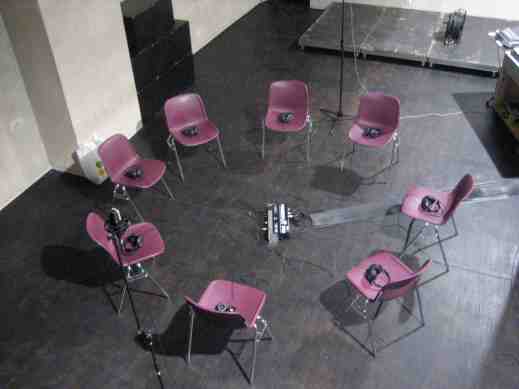

Today, Society for the Humanities Director Timothy Murray sings us back home with a meditation on the soundscapes of study at the A.D. White House this year, closing out our spring “Live from the SHC” series covering new research on “Sound: Culture, Theory, Practice, Politics.” The 2011-2012 Fellows have got to say goodbye for the summer–and sadly beyond–but we all hope that next years’ Fellows (2012-2013 Theme: Risk @ Humanities) enjoy all the good vibrations we will leave behind, and that you, Dear SO! readers, have enjoyed our broadcast! Our summer series, “Tuning In the Past,” on radio and legacy of broadcaster Norman Corwin, featuring Neil Verma, Shawn VanCour, and Alex Russo begins at the end of June. And, of course, every Monday in between and beyond, we’ll keep giving you something you can feel. –JS, Editor in Chief (and 2011-2012 SHC Fellow)
—
DOI: https://doi.org/10.59350/xfep8-syc96
Many thanks to Jennifer Stoever for hosting “Live from the SHC” on Sounding Out! What a fantastic experience it’s been to have Jennifer screening and tweaking Sounding Out! from her garret office overlooking the gardens behind the A.D. White House, the Cornell home of the Cornell’s Society for the Humanities. Readers of “Live from the SHC” have read various strains of this year’s focal theme, “Sound: Culture, Theory, Practice, Politics.” The aim of this year’s residential research project was to contemplate and analyze the resonance of historical and contemporary representations, movements, ideas, and negations of sound.
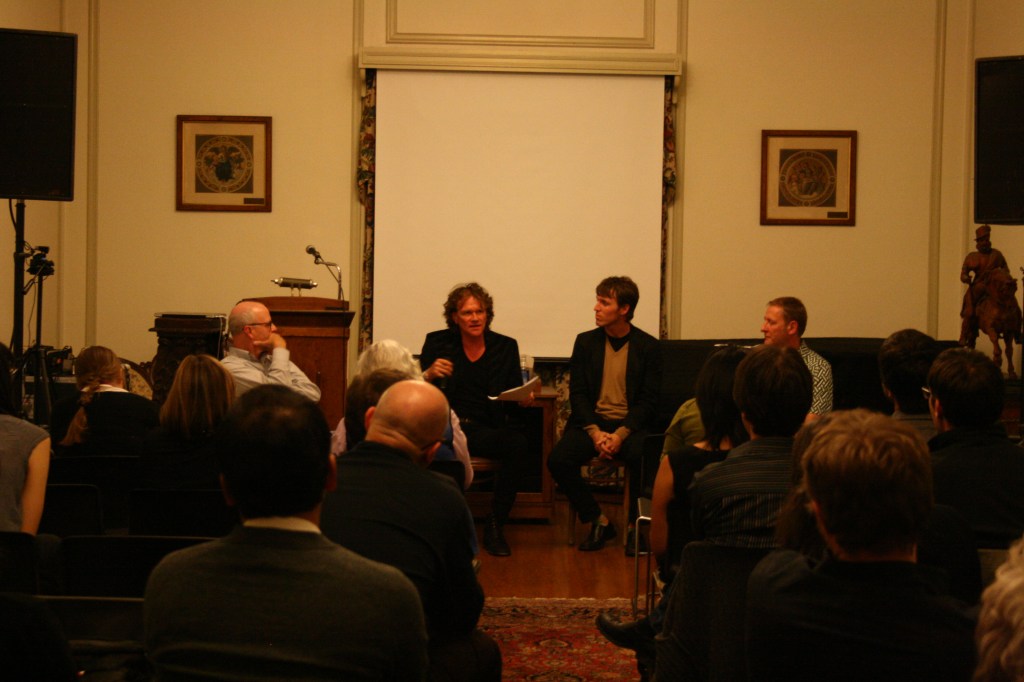
Open to study of the broadest cross-cultural range of contexts and media that cross the boundaries of time and space–from East and West/South and North–the Fellows’ research delved into the complex ways that sound abounds in visual, textual, and aural realms. From “voicing” to “listening,” sound shaped the framework of our critical and philosophical analyses of the body, affect, and social publics. Sound came to be appreciated for its shaping of the parameters of psycho-cultural imaginaries, social practice, religious ritual, and political regulation throughout history and across the globe. Just as sound differs in the global context of capitalism and cosmopolitanism, not to mention the specificities of ethnic difference and cultural diversity, “voice,” “hearing,” and “listening” frame the humanities disciplines in relation to their aesthetic properties and political ramifications.
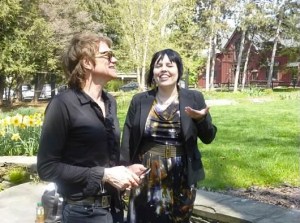
The Fellows found themselves reflecting on several key issues. Which criteria differentiates natural from artificial sounds? Does sound challenge disciplinary distinctions between the visual and the oral/aural/tactile? Can the loud noises of industrial culture be distinguished from the synthetic sounds of electronic music, the stammerings of performance and the vibrations of philosophical manifestos? It should come as no surprise to followers of Sounding Out! that sound marks the passage of time, the correlation of the aural to the movement of the body in dance and performance, the sonic promise of cartographic projects of social movements and migrations, and the cultural and ethnic specificities of acoustic fields and rhythms in the age of sampling and mixing, not to mention the gender, racial, and ethnic import of voice and spoken narrative.
Adding vibrant texture to our year-long discussions were the three weeks spent in extended dialogue with the Society’s Senior Invited Fellows. Emily Thompson (The Soundscape of Modernity) charted the histories of the architectonic sounds of cinema houses as well as the untraceable wealth of the historical sounds of New York City as its peripheries morphed from country estate to urban zone. Brandon LaBelle came from Norway to take us on a journey of artistic imagination and phenomenological hopefulness as he cruised his writings on Acoustic Territories and Site Specific Sound while sampling the background noises of his multimedia installations. Then Norie Neumark, fresh off the release of VOICE: Vocal Aesthetics in Digital Arts and Media (co-edited with Ross Gibson and Theo Van Leewen), arrived from Australia to follow up on our 2003 online seminar on Sound Cultures. She reminded us of the deep history of sound studies down under, while focusing our attention on voicings and her own multimedia art practice that blends spoken narrative, synthetic noise, mouthed breath, and shocks in the ear. [The “Live From the SHC” logo is a piece from Neumark and Maria Miranda’s “Shock in the Ear”–ED].
.
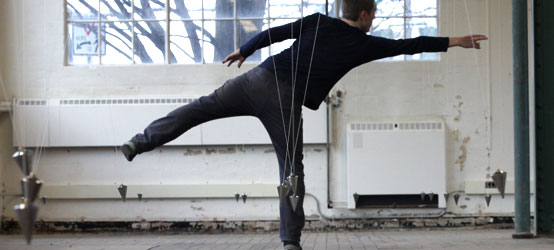
Various other visitors throughout the year included multimedia artists Mendi and Keith Obadike whose “not” Afrofuturism walked us through their exciting series of performance works,“Four Electric Ghosts,” Caitlin Marshall from Berkeley who brought cyborg speech to life with her prosthetic soundings, and renowned choreographer William Forsythe, whose four-hour choreography piece “Nowhere and Everywhere at the Same Time“–performed amidst amidst over 150 hanging pendulums–combined dance and environment as a means of physically manifesting the process of thought. Marjorie Garber from Harvard rode our acoustic wave to reflect on the future of the humanities while Norma Coates came down from Western Ontario to sensitize us to the mixes of pop sound and culture.
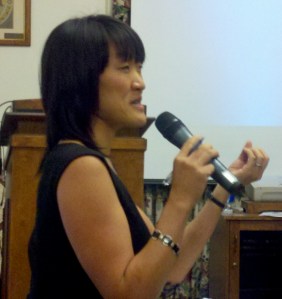
In listening back to the echoes of the year past, rather than here retracing the specific projects of our Fellows (you can consult the critical tales already Sound[ed] Out! by Damien Keane, Tom McEnaney, Nina Sun Eidsheim, Jonathan Skinner, Eric Lott, Jennifer Stoever, and Jeanette Jouili), I find myself sampling the sounds, noises, and glitches that provided unexpected reverbs for the academic writing happening behind closed office doors throughout the A. D. White House.
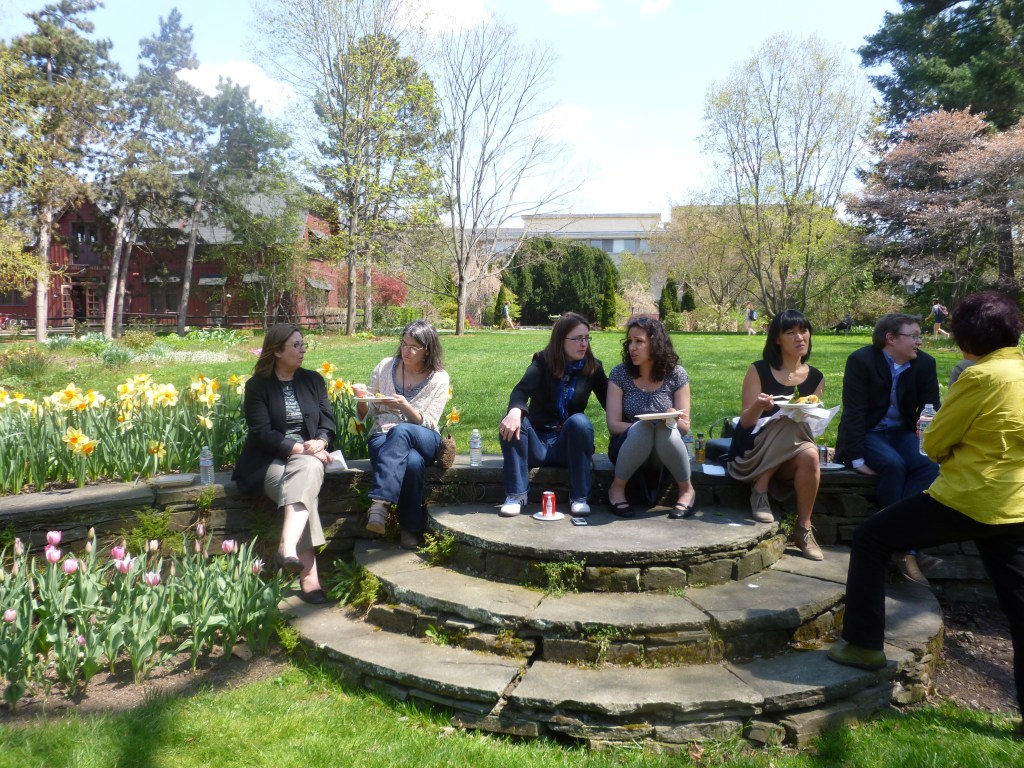
Sounds of glee, delight, and play first arrived on the scene at the end of August with gaggles of laughing and screaming kids running wild and climbing trees in the gardens, surrounded by bemused adults and envious dogs. Accompanying partners brought to the mix the diverse soundings of African film, suspicious packages, software beats, performance art, critical geography, and real estate hawking. No wonder the assembled Fellows strayed so readily, if not unconventionally, from the promised strictures of already exceptional research projects that brought to our weekly seminar table the street sounds of Egypt, Turkey, Korea, early modern Germany, contemporary Islam, American hip hop, contemporary art, circuit bending, gaming, German, Irish, U.S. and Latin American radio, voices of performers, animals, and posthumans, urban soundscapes, and, here making a loud call out to one Stoever-Ackerman, sonic color-lines.
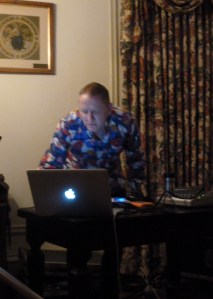
Resounding throughout the year to give cadence and timbre to our serious ponderings were the spontaneous soundings that seemed always to give ample depth to the provocative interstices of intellectual life. There were the noises of glitch, circuit-bending, and Guitar Hero that stretched and extended the purpose of music and machinics. There were spontaneous voice lessons that turned anxious performers into wild choreographic objects. Singing above in the hidden alcoves–when not streaming through the high Victorian ceilings of the A. D. White House–were our flying mammal friends whose echolocation extended beyond the reach of our mere human ears. Then were the sudden noisy reminders of the vulnerability of our corporeal organs. Who could forget the reported imaginary of the crunch of human leg against car as two of our Fellows found themselves under assault from a crazed pizza delivery guy – luckily no lasting damage?
Our fellows will carry away the subliminal lacings of the lighter sounds of improvisation and camaraderie. There were the poundings of feet and slappings of bodies dancing late into the night after hours of laborious conferencing to the beats of DJs Marcus Boon, Art Jones, and Earmuffs.
.
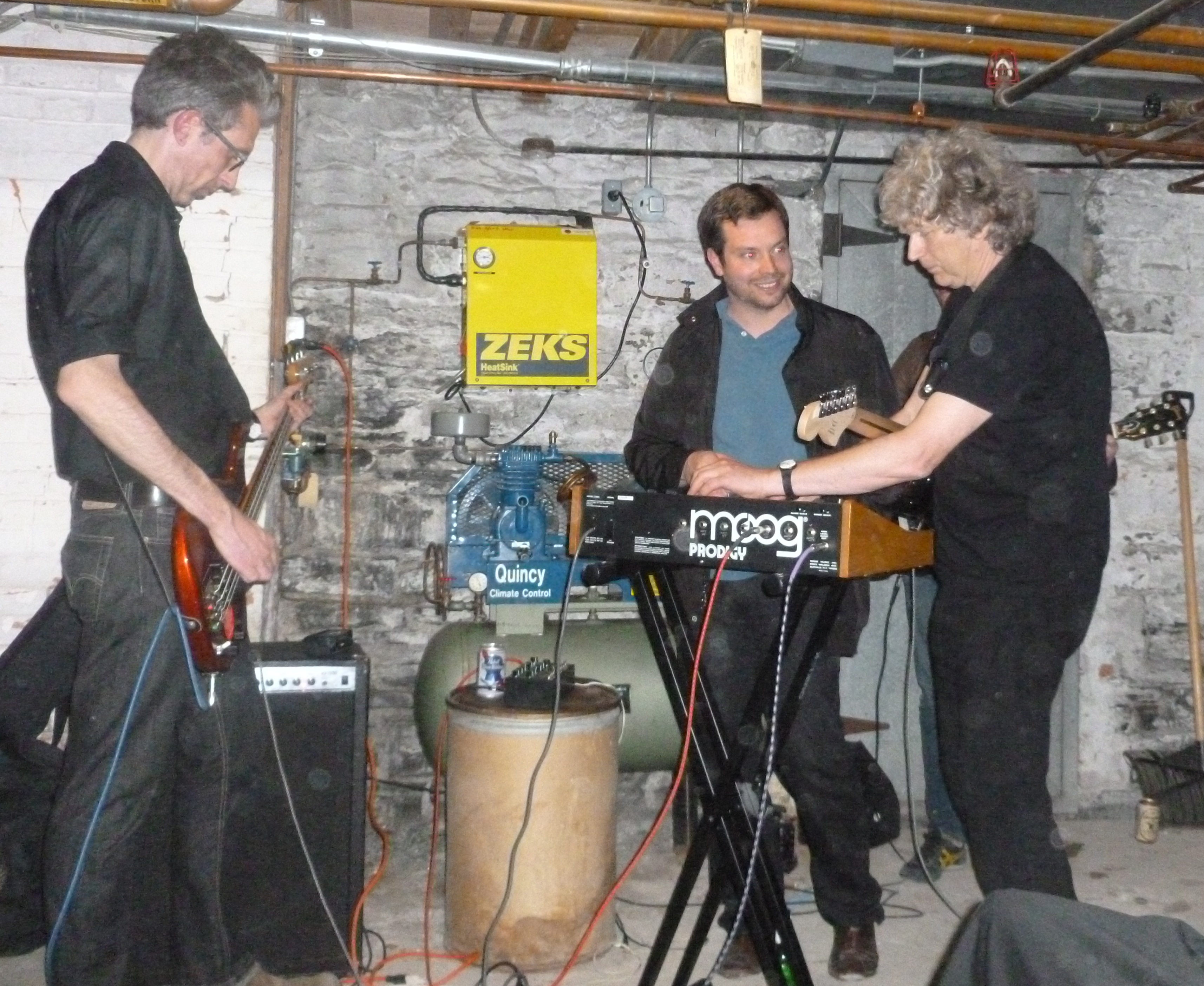
At the end of the year, Fellows grooved to the beat of Tom McEnaney playing bass with The Vix Krater out at the Rongo in Trumansburg, NY (down the road from the home of Moog), before retreating to the bowels of the A. D. White House basement for another dusty, late night jam session with drums, synthesizer, guitars, bass, and various acoustics, led by the ultimate sound blogger herself, the guitar heroesse, Jenny S-A. [Well, I’m learning. So far I know E-Minor. It was Trevor that really broke my strings in! –ED].
And, yes, there was always the accompaniment of the clinks of glasses and bottles bearing the liquid life blood of any noisy crew.
The French philososopher, Jean-Luc Nancy, reminds us in Listening (2007) that the shared space of noise and sound entails “a totality of referrals: from a sign to a thing, from a state of things to a quality, from a subject to another subject or to itself, all simultaneously. Sound is also made of referrals: it spreads in space, where it resounds while still resounding ‘in me'” (7). What resounded and referred this year at the Society for the Humanities was the very immaterial and inchoate touch of sound, which is a-live in intensity and force. But who would have imagined the intensity of the noise of referral that remained so constant throughout the year to envelop the solid academic work of our Fellows in the wilding vibrations of jouissance? Indeed, perhaps the best lesson of the year, at a moment when the humanities finds itself threatened and in transition by the supposed certainty of metric and assessment, is that the Society’s scholarship in sound was driven by the relentless noise of referral and the unpredictable delight of the commune.
—
Featured Image Credit: Brandon La Belle, Duck Duck Goose Installation, Ausland, Berlin
—
Timothy Murray is Professor of Comparative Literature and English and Curator of the Rose Goldsen Archive of New Media Art. He is the Cornell Principal Investigator of the Central Humanities Corridor, generously supported by a grant from the Andrew W. Mellon Foundation, and he sits on the International Advisory Board of the Consortium of the Humanities Centers and Institutes (CHCI) and the Steering Committee of the Humanities, Arts, Science, and Technology Advanced Collaboratory (HASTAC). He is Co-Moderator of the –empyre- new media listserv and the author of Digital Baroque: New Media Art and Cinematic Folds (Minnesota 2008); Zonas de Contacto: el arte en CD-ROM (Centro de la imagen, 1999); Drama Trauma: Specters of Race and Sexuality in Performance, Video, Art (Routledge, 1997); Like a Film: Ideological Fantasy on Screen, Camera, and Canvas (Routledge, 1993); Theatrical Legitimation: Allegories of Genius in XVIIth-Century England and France (Oxford, 1987). He is editor of Mimesis, Masochism & Mime: The Politics of Theatricality in Contemporary French Thought (Michigan, 1997) and, with Alan Smith, Repossessions: Psychoanalysis and the Phantasms of Early-Modern Culture (Minnesota, 1997). His curatorial projects include CTHEORY MULTIMEDIA and Contact Zones: The Art of the CD-Rom.
—
Share this:




Current Top Posts





April 2021

January 2020

November 2019

October 2019

August 2019

April 2014

November 2017

March 2015

December 2017

October 2015


Recent Comments