
In Search of Politics Itself, or What We Mean When We Say Music (and Music Writing) is “Too Political”

Music has become too political—this is what some observers said about the recent Grammy Awards. Following the broadcast last week, some argued that musicians and celebrities used the event as a platform for their own purposes, detracting from the occasion: celebration of music itself. Nikki Haley, the U.S. Ambassador to the United Nations, tweeted:
I have always loved the Grammys but to have artists read the Fire and Fury book killed it. Don’t ruin great music with trash. Some of us love music without the politics thrown in it.— Nikki Haley (@nikkihaley) January 29, 2018
I don’t know for sure, but I imagine that the daily grind of a U.N. ambassador is filled with routine realities we refer to as “politics”: bureaucracy, budget planning, hectic meetings, and all kinds of disagreements. It makes some sense to me, then, that Haley would demand a realm of life that is untouched by politics—but why music in particular?
The fantasy of a space free from politics resembles other patterns of utopian thought, which often take the form of nostalgia. “There was a time when only a handful of people seemed to write politically about music,” said Chuck Klosterman, a novelist and critic of pop culture, in an interview in June 2017. He continued:
Now everybody does, so it’s never interesting. Now, to see someone only write about the music itself is refreshing. It’s not that I don’t think music writing should have a political aspect to it, but when it just becomes a way that everyone does something, you see a lot of people forcing ideas upon art that actually detracts [sic] from the appreciation of that art. It’s never been worse than it is now.
He closed his interview by saying: “I do wonder if in 15 years people are going to look back at the art from this specific period and almost discover it in a completely new way because they’ll actually be consuming the content as opposed to figuring out how it could be made into a political idea.” Klosterman almost said it: make criticism great again.
Reminiscing about a time when music writing was free from politics, Klosterman suggests that critics can distinguish between pure content and mere politics—which is to say, whatever is incidental to the music, rather than central to it. He offers an example, saying, “My appreciation of [Merle Haggard’s] ‘Workin’ Man Blues’ is not really any kind of extension of my life, or my experience, or even my values. […] I can’t describe why I like this song, I just like it.” If Klosterman, an accomplished critic, tried to describe the experiences that lead him to like this particular song, he probably could—but the point is that he doesn’t make explicit the relationship between personal identity and musical taste.

Screen Capture of Merle Haggard singing “Workin’ Man Blues,” Live from Austin, Texas, 1978
The heart of Klosterman’s concern is that critics project too many of their own problems and interests onto musicians. Musician and music writer Greg Tate recently made a similar suggestion: when reviewing Jay-Z’s album 4:44, Tate focuses on how celebrities become attached to public affects. In his July 2017 review, “The Politicization of Jay-Z,” he writes:
In the rudderless free fall of this post-Obama void […] all eyes being on Bey-Z, Kendrick, and Solange makes perfect agitpop sense. All four have become our default stand-ins until the next grassroots groundswell […] Bey-Z in particular have become the ready-made meme targets of everything our online punditry considers positive or abhorrent about Blackfolk in the 21st century.
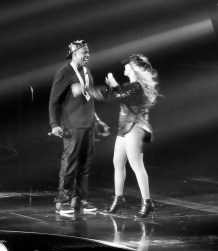
Jay and Bey perform live in 2013, by Flickr user sashimomura,(CC BY 2.0)
He suggests that critics politicize musicians, turning them into repositories of various projections about the culture-at-large. Although writing from a very different place than Klosterman, Tate shares the sense that most music criticism is not really about music at all. But whereas Klosterman implies that criticism resembles ideological propaganda too much, Tate implies that criticism is a mere “stand-in” for actual politics, written at the expense of actual political organizing. In other words, music criticism is not political enough.
In 1926, W.E.B. Du Bois wrote about this problem, the status of art as politics. In his essay “Criteria of Negro Art,” he dissects what he perceives to be the hypocrisy of any demand for pure art, abstracted from politics; he defends art that many others would dismiss as propagandistic—a dismissal revealed to be highly racialized. He writes:
Thus all Art is propaganda and ever must be, despite the wailing of the purists. I stand in utter shamelessness and say that whatever art I have for writing has been used always for propaganda for gaining the right of black folk to love and enjoy. I do not care a damn for any art that is not used for propaganda. But I do care when propaganda is confined to one side while the other is stripped and silent.
Du Bois’s ideas would be engaged extensively by later authors, including Amiri Baraka. In his 1963 essay “Jazz and the White Critic,” he addresses politics in terms of “attitude.” Then-contemporary white critics misunderstood black styles, he argued, because they failed to fully apprehend the attitudes that produced them. They were busy trying, and failing, to appreciate the sound of bebop “itself,” but without considering why bebop was made in the first place.
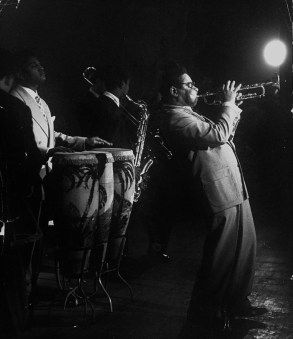
Dizzy Gillespie, one of BeBop’s key players, in Paris, 1952, Image courtesy of Flickr User Kristen, (CC BY 2.0)
As Baraka presents it, white critics were only able to ignore black musicians’ politics and focus on the music because the white critics’ own attitudes had already been assumed to be superior, and therefore rendered irrelevant. Only because their middle-brow identities had been so thoroughly elevated in history could these middle-brow critics get away with defining the object of their appreciation as “pure” music. Interestingly, as Baraka concludes, it was their ignorance of context that ultimately served to “obfuscate what has been happening with the music itself.” It’s not that the music itself doesn’t matter; it’s that music’s context makes it matter.
In response to morerecent concerns about the politicization of popular music, Robin James has analyzed the case of Beyoncé’s Lemonade. She performs a close reading of two reviews, by Carl Wilson and by Kevin Fallon, both of whom expressly seek the album’s “music itself,” writing against the many critical approaches that politicize it. James suggests that these critics can appeal to “music itself” only because their own identities have been falsely universalized and made invisible. They try to divorce music from politics precisely because this approach, in her words, “lets white men pop critics have authority over black feminist music,” a quest for authority that James considers a form of epistemic violence.
That said, James goes on to conclude that the question these critics ask—“what about the music?”—can also be a helpful starting point, from which we can start to make explicit some types of knowledge that have previously remained latent. The mere presence of the desire for a space free from politics and identity, however problematic, tells us something important.
 Our contemporary curiosity about identity—identity being our metonym for “politics” more broadly—extends back at least to the 1990s, when music’s political status was widely debated in terms of it. For example, in a 1991 issue of the queercore zine Outpunk, editor Matt Wobensmith describes what he perceived to be limitations of thinking about music within his scene. He laments what he calls “musical purism,” a simplistic mindset by which “you are what you listen to.” Here, he capitalizes his points of tension:
Suddenly, your taste in music equates you with working class politics and a movement of the disenfranchised. Your IDENTITY is based on how music SOUNDS. How odd that people equate musical chops with how tough or revolutionary you may be! Music is a powerful language of its own. But the music-as-identity idea is a complete fiction. It makes no sense and it defies logic. Will someone please debunk this myth?
Wobensmith suggests that a person’s “musical chops,” their technical skills, have little to do with their personal identity. Working from the intersection of Klosterman and Tate, Wobensmith imagines a scenario in which the abstract language of music transcends the identities of the people who make it. Like them, Wobensmith seems worried that musical judgments too often unfold as critiques of a musician’s personality or character, rather than their work. Critics project themselves onto music, and listeners also get defined by the music they like, which he finds unsettling.
 That same year, in an interview published in the 1991 issue of the zine Bikini Kill, musicians Kathleen Hanna and Jean Smith addressed a similar binary as Wobensmith, that of content and technique. But they take a different view: in fact, they emphasize the fallacy of this dualism in the first place. “You just can’t separate it out,” said Hanna, questioning the possibility of distinguishing between content—the “music itself”—and technique on audio recordings.
Female-fronted bands of this era were sometimes criticized for their lack of technique, even as terrible male punk bands were widely admired for their cavalier disregard of musical rules. Further still, disparagement of women’s poor technique often overlooked the reasons why it suffered: many women had been systematically discouraged from musical participation in these scenes. Either way, as Tamra Lucid has argued, it is the enforcement of “specific canons of theory and technique,” inevitably along the lines of identity, that cause harm if left unexamined.
All of these thinkers show that various binaries in circulation—sound and identity, personality and technique, music and politics—are gendered in insidious ways, an observation arrived at by the same logic that led Du Bois to reveal the moniker of “propaganda” to be racialized. As Hanna puts it, too many people assumed that “male artists are gonna place more importance on technique and female artists’ll place more on content.” She insists that these two concepts can’t be separated in order to elevate aspects of experience that had been implicitly degraded as feminine: the expression of righteous anger, or recollection of awkward intimacy.

Bikini Kill at Gilman Street, Berkeley, CA, 1990s, Image by Flickr User John Eikleberry, CC BY-NC 2.0
Punk had never pretended not to be political, making it a powerful site for internal critique. Since the 1970s, punk had been a form in which grievances about systemic problems and social inequality could be openly, overtly aired. The riot grrrls, by politicizing confessional, femme, and deeply private forms of expression within punk, demonstrated that even the purest musical politics resemble art more than is sometimes thought: “politics itself” is necessarily performative, personal, and highly expressive, involving artifice.
Even the act of playing music can be considered a form of political action, regardless of how critics interpret it. In another punk zine from c. 1990, for example, an anonymous author asks:
What impact can music have? You could say that it’s always political, because a really good pop song, even when it hasn’t got political words, is always about how much human beings can do with the little bag of resources, the limited set of playing pieces and moves and words, available […] Greil Marcus calls it ‘the vanity of believing that cheap music is potent enough to take on nothingness,’ and it may be cool in some places to mock him but here he’s dead-on right.
But music is never only political—that is, not in the elections-and-petitions sense of the word. And music is always an action, always something done to listeners, by musicians (singers, songwriters, producers, hissy stereo systems)—but it’s never only that, when it’s any good: no more than you, reader, are the social roles you play.
The author persuades us that music is political, even as they insist that it’s something more. Music as “pure sound,” as a “universal language” seems to have the most potential to be political, but also to transcend politics’ limitations—the trash, the propaganda. Given this potential, some listeners find themselves frustrated with music’s consistent failure to rise to their occasion, to give them what they desire: to be apolitical.

Kelly Clarkson performed at The Chelsea on July 27, 2012, image by Flickr User The Cosmopolitan of Las Vegas, CC BY-NC 2.0
In an interview during the recent Grammys broadcast, pop singer Kelly Clarkson said, “I’m political when I feel like I need to be.” It’s refreshing to imagine politics this way, like a light we turn on and off–and it’s a sign of political privilege to be able to do so. But politics are, unfortunately, inextricable from our lives and therefore inescapable: the places we go, the exchanges we pursue, the relationships we develop, the ways we can be in the world. Thinking with Robin James, it seems that our collective desire for a world free from all this reveals a deeper knowledge, which music helps make explicit: we wish things were different.
I wonder if those who lament the “contamination” of the Grammys with politics might be concerned that their own politics are unfounded or irrelevant, requiring revision, just as many white people who are allergic to identity politics are, in fact, aware that our own identity has been, and continues to be, unduly elevated. When Chuck Klosterman refuses to describe the reason why he likes “Workin’ Man Blues,” claiming that he “just does,” does he fear, as I sometimes do, not that there is no reason, but that this reason isn’t good enough?
Fortunately, there are many critics today who do the difficult work of examining music’s politics. Take Liz Pelly, for example, whose research about the backend of streaming playlists reminds us of music’s material basis. Or what about the astute criticism of Tim Barker, Judy Berman, Shuja Haider, Max Nelson, and others for whom musical thought and action are so thoroughly intertwined? Finally, I think of many music writers at Tiny Mix Tapes, such as Frank Falisi, Hydroyoga, C Monster, or Cookcook, for whom creation is a way of life—and whose creative practices themselves are potent enough to “take on nothingness.”
“Music is never only political,” as the anonymous ‘zine article author argues above, but it is always political, at least a little bit. As musicians and critics, our endeavor should not be to transcend this fact, but to affirm it with increasing nuance and care. During a recent lecture, Alexander Weheliye challenged us in a lecture given in January 2018 at New York University, when listening, “To really think: what does this art reflect?” Call it music or call it politics: the best of both will change somebody’s mind for real, and for the better.
—
Featured Image: Screen Capture from Kendrick Lamar’s video for “HUMBLE,” winner of the 2018 Grammy for “Best Music Video.”
—
Elizabeth Newton is a doctoral candidate in musicology. She has written for The New Inquiry, Tiny Mix Tapes, Real Life Magazine, the Quietus, and Leonardo Music Journal. Her research interests include musico-poetics, fidelity and reproduction, and affective histories of musical media. Her dissertation, in progress, is about “affective fidelity” in audio and print culture of the 1990s.
—
 REWIND!…If you liked this post, you may also dig:
SO! Reads: Jace Clayton’s Uproot–Elizabeth Newton
Re: Chuck Klosterman – “Tomorrow Rarely Knows”–Aaron Trammell
This is What It Sounds Like . . . . . . . . On Prince (1958-2016) and Interpretive Freedom–Ben Tausig
Share this:

“Don’t Be Afraid to Pogo!”: Chicana Hollywood Punks Negotiate ‘h/Home’ After Hardcore Takes L.A.

 For the full intro to the forum by Michelle Habell-Pallan, click here. For the first installment by Yessica Garcia Hernandez click here. For the second post by Susana Sepulveda click here. For the third post by by Wanda Alarcón click here. For last week’s post by Iris C. Viveros Avendaño click here.
The forum’s inspiring research by scholars/practioners Wanda Alarcón, Yessica Garcia Hernandez, Marlen Ríos-Hernández, Susana Sepulveda, and Iris C. Viveros Avendaño, understands music in its local, translocal and transnational context; and insists upon open new scholarly imaginaries. . .
Current times require us to bridge intersectional, decolonial, and gender analysis. Music, and our relationship to it, has much to reveal about how power operates within a context of inequality. And it will teach us how to get through this moment. –MHP
—
When did punk become white? Sound white? Sound male, even? The story of moshing–a dance where predominantly young men gather in a half circle aggressively pushing into each other –which is integral to how the history of punk is shaped, understood, and passed on, offers a window into investigating the outright erasure of Chicana punk from broader punk history which has generally centered cis-heterosexual men from either the U.K. or New York scenes.
Yet, the story of slam dancing, later known as moshing, was also not always a part of punk. In the early 80s slam dancing was introduced by Orange County punks to the Hollywood/ LA scene and through the advent of technologies such as the VHS and Betamax, punk then consequently becomes satirized, recorded, and archived as angry, white, and “Hardcore.”
I argue that the erasure of the Los Angeles punk scene and queer Chicanx youth from punk history can be mapped through the story of when and how the pogo was replaced by slamming. I position the Los Angeles punk scene of the late 1970s and early 1980s as a prime example of how the experiences of punk youth were deeply shaped by the conditions of possibility the pogo offered, creating a completely different scene than the ones more popularly archived as white, male, and devoid of queer people of color and women. Here, gentrification takes the noisy and rapid shape of upper- to middle-class OC Hardcore beach punks introducing slamming and eventually pushing out the pogo –– mirroring the co-optation of L.A. punk and finally cementing the story of US Punk as white. Therefore, the genealogies of these punk dances demonstrate the ways that dance and sound together can produce the gentrification and expulsion of an entire scene.
Pogoing, the predecessor to moshing, as a physical dance consisted of jumping up and down with varying degrees of contact danced usually by participants across venue space. The pogo’s movements embodied a kind of fun that was quite equitable across gender expressions and sexualities. I put this thesis into practice every time I ask my students to pogo with me in class, mainly because literature on the pogo is very scarce and recreating the pogo through movement serves as a pedagogical tool. The pogo was a common form of punk dancing in the earlier days of punk and can be seen more prominently in The Punk Rock Movie (1980), The Great Rock and Roll Swindle (1980), and Decline of Western Civilization (1981).
Though pogoing goes as far back at the U.K scene, it reached the L.A. scene last, just before it became slamming. Broader than a dance, the pogo signified a particular relationship between sound, community and a sense of belonging––a home for the outsider and their band of misfit friends, a home that created space for queer Chicanx/POC youth later forced to reckon with a new wave of punks wearing Swastika patches as eviction notices on their sleeves. The band X said it best on an interview with NPR’s Fresh Air.
X NPR Interview with Terry Gross, 2 May 2016, “A Personal History Of L.A. Punk: ‘It Was A Free-For-All For Outcasts'”
Singer Exene Cervenka explained how the pit formed following a trajectory of spontaneous punk dancing, which includes the pogo, that blurred the lines between audience and performer, particularly during a time where punk was not yet under the scrutiny or rubric of what it meant to be “punk.”
While the pogo was still relatively aggressive by many accounts, according to the late MTV program UltraSound, pogoing began as a response to mainstream Disco’s “the bump” or “the hustle.” These dances signified order and more broadly a celebration of U.S. mass consumer culture that punks from the U.K. and U.S. desired to resist. Though positioning the pogo as a direct response to disco can be deeply racialized–as disco initially was a queer, brown musical movement before mass marketing brought it beyond underground urban dance clubs to the white suburbs– I would rather look to to the pogo’s embodiment of an era of punk in the U.S., with a focused gesture to L.A. punk, that existed before hardcore. Susana Sepulveda defines hardcore as an intensified version of 1970s punk coming out of the local beach cities and commemorated by white cis men despite hardcore’s queer and POC ties from earlier scenes, especially via L.A. I would also add a class analysis, in which hardcore was welcome to upper to middle class punks unlike the scenes before that catered to poor whites and people of color. Yet, the question of how punk became white through the arrival of hardcore and the push back from Chicanx youth, I argue, meet in the pit.
Slam dancing, the predecessor to the mosh pit, is described by Joe Ambrose, as the accompaniment to hardcore shaped by its fast pace and as an expression of male youth aggression that includes a mix of the pogo, circle pitting, and stage diving. Slamming, unlike the pogo, is gendered as predominantly male and performed at the front and center of the stage. Ambrose maps the history of mosh pit by placing slamming as the main dance of the 1970s scenes, with very little attention to the pogo. Yet, I posit slamming as a variant of the pogo that was more violent and reflective of the anxieties and frustrations of upper to middle class white punks. And as a reactionary dance rooted in a bourgeois definition of boredom which punks before them could not afford, since boredom was for them rooted in poverty.
Yet, Ambrose’ erroneous conflation of slamming and the pogo is challenged by various L.A. punks, who have specifically pinpointed the moment they witnessed slamming taking over. Decline of Western Civilization, the aforementioned documentary featuring many queer/POC artists, allows the viewer to bear witness to the act of sound and dance used as a form of gentrification. The Bag’s performance of “Gluttony” and “Prowlers in the Night” alongside FEAR’s “I Don’t Care About You” demonstrates an evolving kind of bodily relationship with the sound of punk, one that began to incite and accommodate the sounds of hardcore through more violent touching and a gendered/racial divide on the dancefloor informed by the slam dance. I expand on Michelle Habell-Pallan’s analysis of Alice Bag’s performance in Decline by adding on how her hot pink mod dress is not just a marker of her unapologetic femininity but also as an unwavering reminder of the long time Chicana residency within L.A. punk unbothered by the misogyny and racism of hardcore, even as its encroachment intensified.
In the chapter “Hard To The Core” from her memoir Violence Girl, Bag recounts how the new wave of younger punks from the Southern California beach cities took over the scene and disinvested in punk as a creative and generally inclusive musical space. Just like Bag, Jello Biafra of the Dead Kennedys also recognized that slamming helped sever the connection between audience and performer, writing the song “Nazi Punks Fuck Off” to call out the dance’s connection between whiteness, heteromasculinity, and violence that was rapidly and radically changing the scene. As he told the LA Times in 2012:
I wrote that song in 1981, and at the time, it was aimed at people who were really violent on the dance floor; they didn’t call it mosh pits yet. It began to attract people showing up just to see if they could get in fights in the pit or jump off stage and punch people in the back of the head and run away.
Drawing from Bag and Biafra, I argue the pogo then also ceased to serve as a conduit for community and home for its LA initiators. OC/Beach punks finally drove out the Hollywood scene by relying on slamming as a classed expression of boredom, antipathy, and anti-patriotism fueled by the Reagan administration, which were all aspects later exploited within mainstream popular culture and through the advent of talk shows. As early as 1982, this wave of coverage created moral panics within conservative American white families about punk rock––finally cementing punk as white and violent.
The process of gentrification is most often perceived as a relatively quiet process where changes to an entire landscape are made against the demands of the community being affected. Yet, the threat and aftermath of gentrification also affects music, such as punk, that is particular to working class artistic spaces. Delinking gentrification as exclusively spatial and analyzing it as also a sonic force of expulsion can help us understand how public access to the arts and music making can be quickly demolished and replaced with new forms of expressive art symbolizing the modern day eviction notice. If the music, and its music makers, and its scene participants no longer have a home within the city, how then can any artistic expression survive in the face of displacement? How does the process of gentrification facilitate the pushing out of already existing music practices, the pogo, while simultaneously allowing windows for gentrification’s beneficiaries to replace and redefine an entire soundscape? Yet, the ways that dance in particular is also affected by gentrification are central to understanding how the eviction of the pogo, and its replacement replaced by slamming, reveals yet another gentrifying force that is not just physical demolition but a palpable vibrational form of sound and dance.

1980 flyer from the East LA punk club The Vex featuring The Brat and Los Illegals.
Although the legacy of care from the pogo has transcended into what we now know as “pit etiquette,” the mosh pit has made its home within punk and much like the process of gentrification, is secured at the expense of the communities that came before it. Thus, I look to the the current struggles of Mariachis in Boyle Heights to analyze gentrification as not just the displacement of a community or neighborhood, but also as a contemporary reminder that the attack on Latinx artistic practices is both ongoing and deeply rooted in Los Angeles history. The resilience of Chicana/Latina soundscapes today attests to our D.I.Y/Do It Yourself tools of recovery, testimonio, sonic and physical nepantlerisma or sonic in-betweenness that made it possible for me to share my interpretation of what happened to the pogo, a side of Chicanx L.A. history that neither physical demolition, hipsters, or even the current political climate can take away.
—
Featured Image: Alice Bag in mid-pogo, at Cinco de Mayo show, 2007. Lysa Flores on guitar.
—
Marlen Ríos-Hernández is a Ph.D. Candidate in the Ethnic Studies Department at the University of California, Riverside. Her current research revolves around queer Chicana/Mexicana punks in Mexico and Los Angeles from 1977-early 2000s. Her dissertation aims to theorize and argue how Alice Bag, an innovator of the 1970s Los Angeles punk scene alongside other Mexicana punks, utilized noise to correlate the systemic disenfranchisement of womxn of color with the desire for transformational change integral to the survival of Mexicanas and first generation Chicana womxn, especially during the Reagan and Bush Administrations. Via Ethnic Studies as her area of study along with her humanities and arts training as a Musicologist, Marlen investigates the relationship between unruly Chicana/Mexicana performing bodies and bisexuality, swapmeets, police brutality, photography, and film as instruments of noise-making necessary to invert normative gender and sexual politics in punk.
—
 REWIND! . . .If you liked this post, you may also dig:
If La Llorona Was a Punk Rocker: Detonguing The Off-Key Caos and Screams of Alice Bag – Marlen Ríos-Hernández
Riot-Grrrl, Punk and the Tyranny of Technique – Tamra Lucid
An Evening with Three Legendary Rebel Women at Le Poisson Rouge, January 27, 2017: Margot Olavarria, Bibbe Hansen, and Alice Bag –Elizabeth K. Keenan
Share this:


Current Top Posts





April 2021

January 2020

November 2019

October 2019

August 2019

April 2014

November 2017

March 2015

December 2017

October 2015
 Sounding Out!
Recent Comments