
Sonic Brownface: Representations of Mexicanness in an Era of Discontent

Image by Flickr User Thomas Hawk
In the current anti-immigrant climate, the visual, sonic, and textual modes of representation are becoming battlegrounds we must consider. Arizona, Georgia, and Alabama’s takes on immigration policy and eliminations of ethnic study course offerings from college and high school curricula, are signs of a climate fraught with discontent. However, these fights are not limited solely to the political sphere; in fact, the arena of cultural production—music, literature, theater, and film—facilitates a generalized outlook on Latinidad in the United States by representing Dreamers (the generations of children who were raised in the U.S. from a young age but are not citizens), and/or the thousands of undocumented immigrants who sustain an infrastructure of cheap labor. Within these often stereotypical representations, it is frequently sound that produces the strongest sense of social, cultural, and political difference for Latino subjects.
In this post, I analyze the 2006 film Nacho Libre, a comedy starring Jack Black as a friar who becomes a Lucha Libre fighter, as symptomatic of what I term “sonic brownface,” an aural performativity of Mexicanness. My interest on Nacho Libre is to elucidate how sonic brownface manifests on the big screen, and what is at stake through these seemingly innocent (re)presentations of Mexicanness. I characterize “sonic brownface” as a “speedification” of a Mexican accent, named after Speedy Gonzalez’ infamous call “¡Ándale! ¡Ándale! ¡Arriba! ¡Arriba! ¡Epa! ¡Epa! ¡Epa!” Although comedian Jack Black intends to present a respectful portrayal of a Mexican, his speech enables my analysis of “sonic brownface” within popular culture, a sound that reproduces ideologies about an invisible majority that is also perceived as non-American: Latinos, undocumented immigrants, and dreamers.

The May 1, 2006 protest in Los Angeles, Image by Flickr user The Korean Resource Center 민족학교
Voicing the Other…

Popular silent-era leading man Ramon Novarro (née José Ramón Gil Samaniego) as photographed by Carl Van Vechten in 1935
The last scene of the Academy Award winning film The Artist (2011), presents why the silent film Artist was against the industry’s move toward the “talkie.” His voice collided with the visual representation of the suave debonair cosmopolitan man—and audience expectations of what such privilege sounds like. Though French actor Jean Dujardin plays the lead character in the film The Artist, it must be noted that several Mexican and Latin American actors did quite well in those early years of Hollywood cinema. Their exotic looks made them desirable and allowed audiences to fantasize about the man or woman on the screen because they could not hear them speak. Moreover, their physicality allowed some actors to “pass” as white. When talkies became the norm, Latino actors began performing now familiar stereotypical characters because in the U.S., their voices were indelibly associated with their “foreignness.”
In the realm of popular culture, both Disney and Warner Brothers created their own “Mexican” characters. In 1944, Disney introduced a Mexican and a Brazilian in the animated film Three Caballeros. Joaquin Garay was a Mexican voice actor featured in the voice of Panchito Pistoles in the Three Caballeros.
.
His accent and his singing sounded like someone who is Mexican speaking English, as oppose to an exaggerated Mexican accent heard later in the cartoon character of Speedy Gonzalez. Panchito Pistolas showcases a pride in being Mexican as heard in the singing of a ranchera and wearing his gun like the Mexican Revolutionaries of the 1910s. In the 1950s, Warner Brothers introduced Speedy Gonzales to their pantheon of animated characters, coinciding with the next wave of anti-Mexican sentiment during the campaign of Operation Wetback.
In his essay “Autopsy of a Rat,” William Nericcio posits that viewers come to recognize a series of stereotypes about Mexicans through the animated character of Speedy Gonzales. Nericcio incorporates historical references that influenced the design and creation of Gonzalez. He stipulates that this animation creates visual cues which American audiences connect as qualities of Mexicanness, “how this popular animated star comes to function in a way that reinforces politically charged, visions/versions of the ‘Mexican’ on ‘American’ soil” (212). Nericcio emphasizes the “visuo-ethnic clues” to deconstruct the Speedy Gonzales cartoon, and his definition of the stereotype helps corroborates my interest in how “sonic brownface” manifests as a “Speedification” of a Mexican accent. “Strapped for existential input as to the dynamic of Mexican subjects, we turn to stereotypes to provide us with visuo-ethnic ‘clues’ that fill in for empirical data and satisfy the lazy desire of our collective curiosity (219). Whereas Nericcio emphasizes the visual, however, I argue that sound has also held a strong purchase on the American racial imaginary in the case of Latinos. When audiences see and hear Jack Black as Nacho Libre, for example, they already recognize the accent.
Nacho Libre, sonic brownface personified
I propose the concept of “sonic brownface,” which pairs auditory with visual signs of Mexicanness as mediated in popular culture, to characterize the Mexican as a perpetual foreigner within the national imaginary. My interest in a film like Nacho Libre is to elucidate how audiences already recognize “Speedification,” a voicing of Mexicanness that manifests as a performance of “sonic brownface.” This conceptualization of “sonic brownface” is informed by Jennifer Stoever-Ackerman’s work on the “sonic color-line.” In “Splicing the Sonic Color-Line: Tony Schwartz Remixes Postwar Nueva York,” she posits that “sound is not merely a scientific phenomenon—vibrations passing through matter at particular frequencies—it is also a set of social relations … the “sonic color-line” begins to theorize the mutually constitutive relationship between sound, listening, and race.” She elaborates how “aural signifiers of race are thoroughly enmeshed with the visuality of race [because] they never really lose their ultimate referent to different types of bodies” (65). In the case of “sonic brownface,” Jack Black does not need to be a Mexican actor, he just needs to sound “Mexican” to conjure a physical referent.
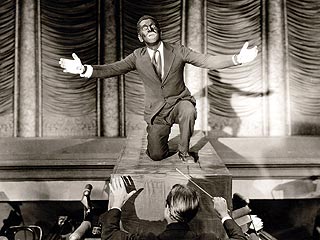
Still from The Jazz Singer
In utilizing the term “brownface,” I also reference minstrel entertainment in which blackness fetishized and simultaneously disavowed African American entertainers consequently framing racial codes onto a spectrum of racialized bodies. In his analysis of the first talkie The Jazz Singer (1927) “Blackface, White Noise,” Michael Rogin proposes that the “protagonist adopts a black mask and ventriloquiz[es]the black, sings through his mouth” (419). Through this masking, the Jazz Singer becomes Americanized through “appropriat[ing] an imaginary blackness” (421). Even as our contemporary sensibility would call out any form of contemporary blackface performance, we have yet to identify a similar masking when it occurs with Mexican or Latino characters. I contend that the models seen in blackface entertainment have already placed familiar scenarios of seeing White or Jewish actors performing an ethnic Other. When American audiences see Jack Black as “Nacho Libre,” they do not need to see him brown his skin; it is enough to hear a “speedification” of Spanish to have us entertain his believability. When “sonic brownface” occurs, it does not Americanize the performer, rather it perpetuates the Mexican and by extension Chicanos and Latinos as always already foreigners.
In order to recognize how “sonic brownface” is performed in the comedy Nacho Libre, it is also necessary to understand how its sound echoes a political climate that conflates “Mexican” with “Immigrant,” thereby representing Mexicans as undocumented people who have no right to be on this side of the U.S./Mexico border, and lumps all Latinos together as “Mexican.” The film was released a month after the nation’s largest immigrant rallies on May 1, 2006, occurring throughout many cities. The timing of the film also coincided with the first series of policy measures on immigration reform proposed by Congress. Whereas before the May Day marches, some members of congress discussed immigrants as criminals, after the big turnout Congress changed their tune, beginning to consider amnesty or easier paths to citizenship for undocumented immigrants, including generation Dreamers, already raised and finishing their schooling in the States. Cue Jack Black.

Image by Flickr User Thommy Browne
Speedification del Celluloid: “sonic brownface” in Nacho Libre
Nacho Libre, directed by Jared Hess (of Napoleon Dynamite fame) presents a comedic fictionalization of the story of Fray Tormenta, a career Lucha Libre fighter who was actually Reverend Sergio Gutiérrez Benitez. The film highlights Black’s strengths as a singer and presents him in a character that is the classic underdog trying to achieve his wrestling dream. As Nacho, the cook for the orphanage, he also wishes to provide the children a better meal, at least once in a while. I will highlight a few scenes in which Black’s sonic brownface performance stands in contrast to the other Mexican cinema actors who speak English. I will conclude with a proposition as to why sonic brownface is already so familiar to us.
From the opening sequence, we see the quaint orphanage located in a small Mexican pueblo. “Sonic brownface” is introduced in the film from Black’s first words “Be grateful Juan Pablo today is especially delicious.” In the next sequence, Hess films the Father saying mass in Spanish with no translation, or subtitles. I point this out because it sets up a type of authenticity with the Mexican orphanage, and that the film brings together both American actors speaking “Es-Pan-ish” and Mexican actors speaking in English. Ana de la Reguera, “Sister Encarnación,”–a nun who arrives to teach the children–also does not perform sonic brownface. She sounds like a Mexican actress speaking English, very much like other Mexican actors preceding her in Hollywood, adding a third later of sonic representation that actually works to heighten sonic brownface’s effects.
However, the sequence that most prominently presents the visual and auditory cues of sonic brownface appear in a twenty-minute segment when Nacho recruits his partner, Esquelito, and they transform into luchadores. In the midst of Nacho’s transformation, he must also contend with his carnal feelings for Sister Encarnación and to instruct the boys that wrestling is not good. Black goes from Italian in “taste of glory” (19:114-16); to Cuban “take it easy” (24:03); to urban Mexican American “my life is good, really good. It’s fantastic” (35:50). The sequence ends as Nacho cannot defend Sister Encarnación and blames Esqueleto for the mishap. Here sonic blackface culminates this performativity of Other with “get that corn outta my face. I looked like a fool last night. What took you so long?!” (39:54-40:29).
One could read this performativity of Otherness in the remix of accents as Black’s self-awareness that he is voicing something not of his experience. However, that he is Jewish and a comedian implies a privileged position already granted to him through blackface performances: the permission to co-opt ethnic and racial identities. When he inflects a Cubanesque accent, audiences can recall Al Pacino in Scarface, an earlier articulation of “sonic brownface.” Or the urban Chicano accent as seen in Born in East L.A. when Cheech Marin teaches the Mexicans waiting to cross the border how to blend in with Chicanos. By the time Black performs sonic blackface, as audiences we have been cued to these auditory references, thus we do not need him to alter his physicality to match the accent. It is enough to hear it to understand the referent. The sequence reaffirms Nacho as the luchador, since we also see his persona of the fighter come to life.
Rogin’s analysis can help us understand these slippages, as well as the role of “sonic brownface” in representations of Latinos by white actors. Rogin posits how Jolson’s performance in the first talkie simultaneously killed Vaudeville entertainment and reintroduced blackface into popular media (429). It is Rogin’s conclusion that it is with the appearance of “Jack Robin” in blackface, that the Jewish individual “Jakie Robinowitz” becomes white and thereby successful, mediating this success through visual codes of blackness. Similarly, in Nacho Libre, sonic brownface operates as both the visual and sonic cues of Mexicanness that enable Jack Black to become the luchador who doesn’t need to live behind a mask. As the film ends, Nacho is content, becoming a hero to the orphans who no longer bemoans his lot in life. This ending is contrary to the plight of immigrants from Latin America who must leave their home in search of better economic opportunities.
By identifying sonic brownface, we can see how American audiences fetishize the sounds of the Mexican/Latin Other yet simultaneously disavow their presence by placing non-Latino actors in these roles. Through the performativity of sonic brownface, popular media and film reify codes of Mexicanness as always foreign, silencing their accents because español is still an unwelcomed sound. Sonic brownface can also be a useful tool by which to investigate similar auditory articulations of Latino sounds. I’m thinking here of Rita Moreno in West Side Story (1961)—see Priscilla Peña Ovalle‘s Sounding Out! post “Aurally Other: Rita Moreno and the Articulation of ‘Latina-ness’” (January 2011)–George Lopez in Beverly Hills Chihuahua (2008), Wilmer Valderrama “Fez” in the television series That 70s Show, and the panoply of Latino actors in Machete (2010) by Richard Rodriguez. Given that media tends to recycle tropes and stereotypes, as audience members we have developed a keen awareness of these sonic markings of Otherness.
Most importantly, my intent in identifying sonic brownface concerns its re-appearance during another surge of anti-immigrant rhetoric. The rallies that occurred on May Day 2006 became synomous with immigrant rights. The release of Nacho Libre shortly after these rallies unknowingly silenced immigrant Spanish speaking voices in the popular imaginary until the film A Better Life (2011) staring Demián Bichir, connected undocumented immigrants with an empathetic experience. The strongest counteractions, however, have not been channeled through Hollywood. With the 2012 election, another surge of immigrant rallies happened at the Democratic National Convention with UndocuBus riders arriving in time to call attention to immigrant rights (start at 8:10-11:24).
As seen in this video clip, undocumented immigrants, Dreamers, Latina/s, and Chicana/os committed acts of civil disobedience because their voices will not be silenced.
—
reina alejandra prado saldivar is an art historian, curator, and an adjunct lecturer in the Social Science Division of Glendale Community College in Glendale, California.As a cultural activist, she focused her earlier research on Chicano cultural production and the visual arts. Prado is also a poet and performance artist known for her interactive durational work Take a Piece of my Heart as the character Santa Perversa (www.santaperversa.com) and is currently working on her first solo performance entitled Whipped!
—
 REWIND! . . .If you liked this post, you may also dig:
Sound and Curation; or, Cruisin’ through the galleries, posing as an audiophiliac-–reina alejandra prado saldivar
Chicana Radio Activists and the Sounds of Chicana Feminisms–Monica De La Torre
Listening to Modern Family’s Accent–Juan Sebastian Ferrada and Dolores Inés Casillas
Share this:

The Sounds of Anti-Anti-Essentialism: Listening to Black Consciousness in the Classroom

Image by Flickr User Pere Ubu
 In teaching the many interrelated and complicated aspects of the Civil Rights movement, Black Power, and the Black Arts Movement, the challenge for me is to help students understand the “facts” of this period, and to simultaneously destabilize the teleological historical narrative these “facts” seem to suggest. In a pedagogical context, sound helps fill in the gaps that fall outside of the knowledge produced–and contained within–certain archival accounts of black cultural and political history. While crucial, having students listen to the gaps, can be daunting, especially in our current historical moment, as the decades-long push against identity politics has been solidified by the recent (re)election of the nation’s first black president, Barack Obama. This point demands more elaboration than I can provide here, but the critical pedagogical issue it raises within the province of black studies, is that it is becoming increasingly difficult to consider black political culture outside of the sedimented lines of American pluralism and black radical thought.
I use sound as a pedagogical tool to help outline a middle ground–what Frantz Fanon refers to in The Wretched of the Earth as “zone of hidden fluctuation” (166)–based upon articulations of resistance and identity that refuse to be frozen in time. Building on Paul Gilroy’s conceptualization of anti-anti-essentialism in The Black Atlantic, an idea of black consciousness that is flexible and moves between the insufficient terms of “essentialist” and “anti-essentialist,” I use specific pedagogical examples to suggest that teaching about race and sound is a rich, evolving, and productively interactive continuum. The auditory sense opens up new terrains of knowledge and dynamically expands the possibilities for students to think through the intricate and multifaceted formations of black consciousness during the volatile years of the 1960s and the resonance of those years in our present.
The recorded presence of Martin Luther King, Jr., for example, represents an important aural site for engaging in reflexive pedagogy, because King’s tonality–the resonance of his voice–creates a certain familiarity and is pivotal to the construction of the American myth of the radical transformation of the civil rights movement and the idea of post-civil rights racial equality. For many students, King’s sound signals the dream of, and the pathway towards, a unified America. Conscious of how this idea of King reflects a linear understanding of civil rights as simply a desire for inclusion, I direct students’ attention to the sound of King’s last recorded speech in Memphis on April 3, 1968. Given the evening before his assassination, this speech resounds with King’s deepening critical perspective on black struggle through its haunting concluding notes. I point out to my classes that King’s final years (1965-1968) were marked by his increasing focus on ideas of black resistance outside of the Civil Rights mainstream, including his critique of U.S. involvement in the Vietnam War, and his radical rethinking of the possibilities for black economic and political self-determination.

Martin Luther King in 1968, Image courtesy of UIC Digital Collections
Centered on the economic injustice and dehumanization of Memphis’s striking black sanitation workers, King’s speech details the need for the Memphis black community do more than simply boycott municipal entities, but rather articulate their resistance by boycotting prominent national brands such as Wonder Bread and Coca-Cola. Against this background, I play segments (particularly the final minutes) of King’s speech, entitled, “I’ve Been to the Mountaintop.”
The acoustic dimensions of King’s final speech resonate with a social and political complexity that troubles the sonic memories many students have of King’s “I Have a Dream” speech, delivered on the steps of the Lincoln Memorial in 1963. The much more intimate and less overtly majestic soundscape of Memphis’ Mason Temple underlines King’s shift from national icon back to local, community activist. The frequent audience shifts–applause, extemporaneous interjections, and silence–create a reverberating sonic energy that accumulates throughout the speech. Rather than relying strictly on a call-and-response interpretation of the interactive exchanges between King’s voice and the audience’s response, I have students consider the non-linear ebbs and flows in King’s sound in this latest of moments (as Fred Moten would say, the totality of King’s tonality). For example, as King’s audience considers the weight of his analyses and what it means to articulate black resistance as “a dangerous unselfishness” that “puts pressure where it really hurts,” I identify moments of uncertainty, hesitation, and contemplative reflection that mark a non-linear interactive sonority between King and his audience.
Listening to King’s final thoughts offers a disturbing and disruptive emphasis on the stakes of breaking with entrenched modes of activist thinking. He concludes the speech with a series of prophetic thoughts on mortality as a cost of making a stand against “our sick white brothers.” Set within the historical and ideological context I have sketched above, the delivery distinguishes the sound of King’s words. As we listen I draw attention to King’s expression of a lack of fear in anything, any man, as King seems to convey an eerie foreknowledge of his murder and his irreverence in its face.
“I’ve Been to the Mountaintop” –Listen to the concluding two minutes
The apocalyptic sound of King’s concluding notes to this political sermon leaves much to contemplate. From the mention of the potential threat posed to his life by “our sick white brothers,” through the speech’s last line, there is a tonal, timbral shift in his voice and demeanor. Through sound and posture, and the reaction of the audience to those factors, King’s affect seems to convey something more momentous occurring beneath the event’s surface dynamics. King projects a confrontational edge through the sound of fearlessness in the face of mortality. Did he know he was going to be killed shortly after giving this speech? It’s a question that the peculiar tonality of his concluding lines raises for students. If so, what does it mean to use the sermon as a site of prophetic, aural documentation of the fact that a force of transformation exists beyond the flesh and blood of leadership, a force that assassination can’t kill? In the speech’s final synesthetic moment, I have the students listen and watch the shift that occurs in King’s demeanor as he closes, and the way that this shift culminates in an almost ecstatic moment as he delivers the final line: “Mine eyes have seen the glory of the coming of the Lord.” His defiant turning away from the microphone is crucial as it amplifies the meaning of the voice, letting those watching know that, much like an emcee, King has just “served” white power with a delivery that will outlast the sniper’s bullet the following evening.

Nina Simone, Image courtesy of Flickr User GlingG
I want to briefly point to two other examples that show additional ways in which sound complicates ideas of racial identity and expression during the 1960s. When I teach Nina Simone’s composition, “Mississippi Goddamn,” (recorded live at Carnegie Hall in 1964), I ask students to consider the relationship between the distinctive sound of her voice and the ironic and critical elements of her lyrical meaning as this interaction creates a complex idea of radical black consciousness. Composed in the aftermath of the murder of Medgar Evers and the bombing of the 16th Street Baptist Church in Birmingham, Alabama, Simone offers a musical, and more broadly sonic meditation on white supremacy.
Most students find the timbre of Simone’s voice, its grain (as Roland Barthes would say) and depth, immediately striking. Her unique sonority and its context, greatly influence attempts by students to understand her reference to the song as simply a tune: “The name of this tune is Mississippi Goddamn” she says, and “This is a show tune, but the show for it hasn’t been written yet.” Clearly it isn’t simply a tune, and the caustic quality of lines such as, “Oh but this country is full of lies/ You’re all gonna die and die like flies,” creates a critical depth through the sound of Simone’s commitment to a black radical perspective. What does it mean, for instance, that Simone projects such sarcasm and biting critique to a predominately white audience at Carnegie Hall? How might we hear the specific grain of her voice in this setting? How does Simone’s projection of critical black sonic resistance, emerge at the conjuncture of anti-black racism and the beginning of legislative efforts under the Johnson administration to rectify racial inequality through civil rights bills? What can be taken from the simultaneity and contrast that Simone projects her sound within? I pose such questions to my students as a way of considering what it means to be committed to critical thought and social transformation that falls outside of the dominant lines of American national consciousness, and how the sound of such commitment, heard in the pitch and tenor of Simone’s voice, matters as a different kind of historical documentation.
In considering how the sound of music can offer an intervention within the formation of black political consciousness in the Black Arts Movement, I often use the 1966 recording of Amiri Baraka’s signal poem, “Black Art,” as it set to the experimental musical sounds of Sonny Murray’s ensemble (Murray-drums, Albert Ayler-tenor saxophone, Don Cherry-trumpet, Henry Grimes, Lewis Worrell-bass). Having first read the poem, students then are able to hear it set to– and against–the unconventional instrumentation of Murray’s ensemble.
The musicians create an unconventional sonic context for Baraka’s reading that de-emphasizes and re-situates the apparent dimensions of black rage that seem to arise from verse that can “shoot guns,” through an almost carnivalesque, comedic, and off-kilter sound that troubles the linear expectations one might have of instrumentation amplifying the words on the page. The dissonance between page and sound allows for useful pedagogical opening, in that it underlines the non-conformist, avant-garde aspects of the movement, and the fine line that artists such as Baraka were imagining between the intensity of black radical consciousness and the ability to articulate that standpoint outside of the expected forms of black cultural nationalism.

Image Courtesy of UIC Digital Collections
As these examples have shown, I incorporate sound into my pedagogical framings of black cultural and political identity as an opening through which students may expand their understandings of black consciousness and black political culture well beyond stagnant ideas of racial authenticity, while still preserving an understanding of the transformative and often radical possibilities that have been projected through black expression during the period. It is the open space of sound that invests the project of black radical thought with the uncanny spontaneity of experimentation. Having students understand ideas of expansiveness, asymmetry, and non-linearity as central to black cultural expression and critique–even as artists refuse to sacrifice an expressed political commitment to black resistance–begins to suggest ways for students to contemplate the intersection of identity politics with the unexpected, fantastic elements of expression that lie outside of more recent flattened diagnoses of black nationalism. Teaching at the intersections of race and sound opens up new terrains of knowledge, dynamically expanding students’ abilities to think through the intricate and multifaceted formations of black consciousness during the volatile years of the 1960s and the resonance of those years in our present.
—
Carter Mathes is an assistant professor of English at Rutgers University. He has completed a book manuscript entitled, Imagine the Sound: Experimental Form in Post-Civil Rights African American Literature, that focuses on the relationship between sound and literary innovation during the 1960s and 1970s. He is co-editing a volume of essays on Black Arts Movement writer and critic Larry Neal; and also has essays in print or forthcoming on Toni Cade Bambara, Peter Tosh, and James Baldwin. At Rutgers, he regularly teaches classes focusing on African American literature, Twentieth-century literature, music and literature, and experimental writing.
—
REWIND! . . .If you liked this post, you may also dig:
Audio Culture Studies: Scaffolding a Sequence of Assignments–Jentery Sayers
They Do Not All Sound Alike: Sampling Kathleen Cleaver, Assata Shakur, and Angela Davis–Tara Betts
Freedom Back: Sounding Black Feminist History, Courtesy the Artists–Tavia Nyong’o
Share this:


Current Top Posts





April 2021

January 2020

November 2019

October 2019

August 2019

April 2014

November 2017

March 2015

December 2017

October 2015
 Sounding Out!
Recent Comments