
A Tribe Called Red Remixes Sonic Stereotypes


Welcome back to “The Wobble Continuum,” a three part series here on Sounding Out!. When we last left you, Mike D’Errico had brought us to the intersection of patriarchal cultural norms, music production practices and aesthetics, and the Military Entertainment Complex. His particular focus was on the sounds and practices of brostep (be sure to check out D’Errico’s SO! Comment Klatsch from last week on gendered sounds, too), and some of those sounds leak through to today’s post from Christina Giacona. Giacona turns her ear to the group A Tribe Called Red in order to hear how they reappropriate and redress the sounds of colonization and racism.
As the series’ title suggests, her essay entails another journey to the low end, where things will once again get wobbly.
Guest Editor Justin D. Burton
—
Since first contact, Native Americans have consistently needed to combat the European stereotypes that portray them as inferior and uncivilized. Barraged with echoes of the same handful of Native tropes since Buffalo Bill’s Wild West Shows, contemporary American society often treats the stereotypical Native American princess, chief, and savage as historical truths, represented recently in Johnny Depp’s portrayal of Tonto in The Lone Ranger. But it is not just the visual image of the Native American that has been stereotyped, so has their sonic sensibility. As documented in the film Reel Injun, Native languages and musics have consistently been “faked” by Hollywood with tricks like backwards English, pig-Latin, and Westernized imaginings of a ubiquitous Native music based on a pan-Indian society that never actually existed. Hollywood often uses Native American music to show a “primitive” society where music’s sole function is to prepare for war. However, the “Indian” drumbeat that accents the first beat of a group of four cannot be found in any traditional Native American or Aboriginal music.
While Native American-directed motion pictures such as Smoke Signals, Powwow Highway, and Atanarjuat: The Fast Runner finally gave agency to Natives in film, it was the all-Native DJ collective A Tribe Called Red’s self-released album and popularization of the Electric Powwow that directly challenges the perception of Native American music in modern society. In this post, I analyze the sonic composition of ATCR’s song “Braves,” exploring how A Tribe Called Red challenges North American stereotypes of Native Americans through the cultural re-appropriation of racist sounds.

“A Tribe Called Red – Hall 4 (1)” by Flickr user Trans Musicales, CC BY-NC 2.0
After World War I, intertribal powwow gatherings served as a place to celebrate newfound unity among Native Nations returning home from the war. By the 1950s intertribal powwows had spread throughout North America. With the continued strength and importance of the powwow in contemporary Native society, urban Natives in locations like New York City and Ottawa, Canada, have begun to search for ways to create the same sense of unity in urban venues. In 2008, DJs NDN and Bear Witness formed the DJ collective “A Tribe Called Red” and began curating performances in Ottawa the second Saturday of every month called the Electric Powwow: a “wild party” focused on showcasing native talent and aboriginal culture. ATCR’s website describe the music as “ the soundtrack to the contemporary evolution of the powwow.“ Bear elaborates in an interview with NOW magazine, “[the Electric Powwow] was also about creating a space for our community within the club environment.” Hip-hop DJ and turntable champ DJ Shub was invited to join the group in 2010, and the trio spent the next two years evolving the sound of the Electric Powwow into a mash-up of powwow and First Nations music with contemporary club sounds including hip-hop, dubstep, and dance hall.

“Tribe Called Red” by Flickr user Dav Yaginuma, CC BY-NC-SA 2.0
Much like Fela Kuti’s popularization of Afrobeat in the 1970s, made up of a combination of traditional Nigerian Yoruba polyrhythms with a blend of Western jazz and funk, and Reggaeton’s fusion of Caribbean rhythms with the aesthetics of American hip-hop in the 1990s, the Electric Powwow merges a historically traditional and non-syncretic music with popular and cosmopolitan music in a way that both honors cultural heritage and makes it relevant to a new generation. As NDN points out on Noisey, even their name follows this trend, simultaneously referencing the introduction of Nations at powwows and famous Afrocentric hip-hop group A Tribe Called Quest. The Electric Powwow events are not just about the creation of a new genre of music, but they also serve as a site for ATCR to speak publicly about aboriginal issues and represent themselves as a contemporary face for the urban Native youth renaissance. ATCR’s music videos and live-show projections extensively sample racist imagery from movies and cartoons including old westerns, Back to the Future III, Bugs Bunny, and Disney’s Peter Pan. As a result of their audio-visual activism, the group has become the unofficial soundtrack for the Idle No More movement, which is attempting to reassert Indigenous sovereignty rights and previously signed treaties in Canada.
By taking both visual and sonic symbols that depict racist stereotypes out of their cultural contexts, ATCR draws attention to both the specific racism of each individual image and the ubiquity of racist stereotypes. In their track “Braves,” A Tribe Called Red takes on the U.S. baseball team the Atlanta Braves by remixing the baseball organization’s Tomahawk Chop anthem, itself adopted from Florida State University.
ATCR’s version transforms the innocuous-sounding chant by showcasing its core as a Hollywood-esque stereotype of Native American song. By re-contextualizing the anthem, “Braves” prompts listeners to reinterpret this facet of American sports culture as a racist pageantry of “savage violence.”
The association of the “war chant,” the motion of the Tomahawk Chop, and the fact that these actions call for one team to attack all make it clear that American sports culture appropriates Native Culture as an example of “savagery” and “uncivilized” behavior. The Tomahawk Chop also forgoes the use of a language-based text entirely and instead chooses to use vocables that cannot be attributed to any particular Native nation, ceremony, or meaning. Like Hollywood’s use of backwards English and the war drumbeat to represent “Indians,” the Tomahawk Chop bears no resemblance to any real Native Nation’s music, acting as yet another imagined primitive stereotype that marginalizes actual Native American music.
On A Tribe Called Red’s SoundCloud page, “Braves”’s description reads, “We wanted to make a song for all the racist and culturally inappropriate sports teams that are still used today!” The group accomplishes this by creating dissonance between contemporary electronic drumbeats and the “traditional” paramilitary marching band arrangement of the “Tomahawk Chop.” “Braves” utilizes a standard dubstep song structure in 4/4 at 140 beats per minute that includes an intro, two main sections that include melodic materials, a breakdown/buildup section, a vocal “drop” which announces and is followed by the climax of the piece, and an outro that brings the track to a close. However, “Braves” does differ from other dubstep songs in the marked separation and interaction between the Tomahawk Chop samples performed by voices and marching band and the composed elements of the song performed as the Wub—a deep, wobbly synthesized sound—and accompanied by a HiHat cymbal pecking away at syncopated rhythms. Even though all the melodic content of “Braves” is based on variations of the Tomahawk Chop melody, ATCR never fully integrates actual samples of the Tomahawk Chop into the composition. The marching band and chant samples are treated as an unwanted and unexpected visitor to a party; they seem important at the entrance, but they are given an increasingly diminished role until they finally exit with a whimper.
Written as a protest against racist sports organizations to help convince them to stop using characterized ceremonies and mascots, “Braves” contains that struggle within the composition itself: dubstep, sounded as the Wub and HiHat, eventually renders the Tomahawk Chop sonically impotent. The “Tribe” drop, when ATCR marks the song by saying “tribe,” acts as the turning point in “Braves.” After this point the Wub and HiHat consistently overwhelm the sampled material. In a standard dubstep song, the tribe drop would be followed by the climax: the strongest, most complex musical section of the piece. However, the Tomahawk Chop sample that follows this drop is immediately swallowed up by a low-pass filter that rubs out the tune, starting with the highest pitched sounds, over the course of sixteen measures, heightening the lower end of the sonic spectrum. Only then does the true climax occur. The Wub and HiHat appear here for the first time without the sample band or vocalizations. After the “Tribe” drop, the samples of the Tomahawk Chop are either dominated by the Wub or swallowed up by low-pass filters and fades.

“Tomahawk” by Flickr user Lorianne DiSabato, CC BY-NC-ND 2.0
In this way, “Braves” acts as a three-minute sonic story of reappropriation. The marching band arrangement and vocables represent the common stereotypes of Native American music perpetuated by Western Culture. The Wub and HiHat act as disapproving commentary on these stereotypes. “Tribe,” the only word used in the entire song, not only sounds ATCR as a group, but also marks the point in the song when ATCR begins to create their own image of Native music while simultaneously disempowering the strength of the marching band.
Just like the rebel American marching band’s reappropriation of the song Yankee Doodle in the Revolutionary War, A Tribe Called Red employs irony: in order to get the song the audience has to understand the racism, and while that sort of understanding seems to represent a steep learning curve for a culture so saturated in racist stereotypes, it is also exactly the sort of understanding a multicultural nation needs in order to thrive. Like Afrobeat, Reggaeton, and the more recent alternative hip-hop group Das Racist, ATCR is an underground voice within American popular culture that speaks with reverence for its own traditions while challenging the popular perception of race relations and breaking new ground in contemporary art. “Braves” proves that the reappropriation of sonic space is a powerful tool in the fight for cultural agency.
—
Featured image: “ATCR 4” by Flickr user MadameChoCho, CC BY-NC-SA 2.0
—
Christina Giacona is the Director of the Los Angeles New Music Ensemble and Instructor of Music at the University of Oklahoma. Dedicated to performing and researching the music of her generation, Christina teaches courses in Native American, World, and Popular Music. Since founding the Los Angeles New Music Ensemble in 2007, Christina has commissioned and premiered over twenty new works for the ensemble; run an international composers competition, recorded three albums, and collaborated with DJs, MCs, animators, choreographers, projectionists, and film producers.
—
 REWIND!…If you liked this post, you may also dig:
“One Nation Under a Groove?: Music, Sonic Borders, and the Politics of Vibration”-Marcus Boon
“Live Electronic Performance: Theory and Practice”-Primus Luta
“Remixing Girl Talk: The Poetics and Aesthetics of Mashups”-Aram Sinnreich
Share this:

The Acoustics of Passing: Harriet Beecher Stowe’s Uncle Tom’s Cabin as Supremacist Remix
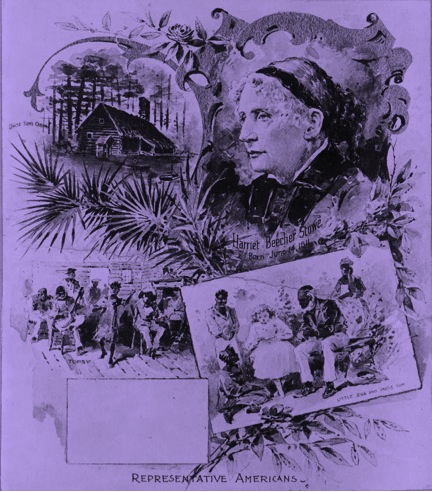
 Editor’s Note: Sound Studies is often accused of being a presentist enterprise, too fascinated with digital technologies and altogether too wed to the history of sound recording. Sounding Out!‘s last forum of 2013, “Sound in the Nineteenth Century,” addresses this critique by showcasing the cutting edge work of three scholars whose diverse, interdisciplinary research is located soundly in the era just before the advent of sound recording: Mary Caton Lingold (Duke), Caitlin Marshall (Berkeley), and Daniel Cavicchi (Rhode Island School of Design). In examining nineteenth century America’s musical practices, listening habits, and auditory desires through SO!‘s digital platform, Lingold, Marshall, and Cavicchi perform the rare task of showcasing how history’s sonics had a striking resonance long past their contemporary vibrations while performing the power of the digital medium as a tool through which to, as Early Modern scholar Bruce R. Smith dubs it, “unair” past auditory phenomena –all the while sharing unique methodologies that neither rely on recording nor bemoan their lack. Last week, the series began with Mary Caton Lingold‘s exploration of the materialities of Solomon Northup’s fiddling as self-represented in 12 Years a Slave. This week, Caitlin Marshall treats us to a fascinating new take on Harriet Beecher Stowe’s listening practice and dubious rhetorical remixing of black sonic resistance with white conceptions of revolutionary independence. —Jennifer Stoever-Ackerman, Editor-in-Chief
—
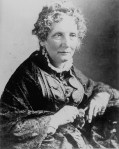
Harriet Beecher Stowe. Courtesy of Flickr Creative Commons
Harriet Beecher Stowe: novelist, anti-slavery agitator, antebellum DJ? In 1852, Stowe penned one of the most famous works of fiction in American history: Uncle Tom’s Cabin. A sentimental work, the novel dramatized the lives of fictional slaves searching for freedom. Eager to achieve a national hearing of her anti-slavery agenda, Stowe’s novel required a voice that could “speak” in morally efficacious tones against slavery. To stage this voice, one that hinged on a sonic appeal to inter-racial sympathy, Stowe sampled and mixed two powerfully persuasive, if diametrically opposed, cultures of speaking and listening in the United States.
The first of these cultures revolved around revolutionary American understandings of political rhetoric. According to Jay Fliegelman, this tradition of republican oratory drew upon 18th century philosophical principles to recast Declaring Independence as a speech act. In his Declaration, Jefferson announced the ‘self-evidence’ of an American people by performing a nationally specific common sense in two important ways. First, he displayed a breed of American moral feeling in direct contrast to that of the colonial British; second, he did so through an oratorical style that inaugurated a common, American modality for articulating and hearing truth. The felt and sounded show of a common ‘self’ evidenced Americans’ natural rights to independence, and installed a markedly white revolutionary acoustics of freedom.
Stowe’s second sample was a misappropriation of a new mode of hearing in the 1845 Narrative of the Life of Frederick Douglass, An American Slave. As Sounding Out! Editor in Chief Jennifer Stoever-Ackerman has argued in “The Word and the Sound: Listening to the Sonic Colour-line in Frederick Douglass’s 1845 Narrative,” Douglass’s narrative was a direct attempt to bend and subvert what she terms “the sonic colour-line” (21). An acoustic schema that racialized sound and recruited the ear in black subjection, the sonic color line was epitomized by the republican oratorical tradition wherein meaning was linked to white articulation, and meaninglessness to black utterance, heard simply as ‘noise.’
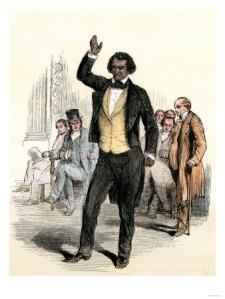
Image of Fredrick Douglass speaking in England regarding his experiences as an American slave
Contrastingly, the reformed sonic model presented in the Narrative sought to position black sound as a site of meaning and resistance, and challenged Northern readers to question and remap both their hearing of such sounds and their ethical relationship to black meaning. Jonathan Cruz, in Culture on the Margins, terms this new mode of hearing “ethnosympathy” and defines it as an “interpretive ethos of pathos” (3). Importantly, Stoever-Ackerman highlights that Douglass did not seek to cast black sound as “a sentimental appeal to truth,” but “rather [as] a challenge to dominant notions of truth produced and disseminated through the ear” (31). Stowe however, did not hear Douglass’s message so subtlety, and like many Abolitionists, was quick to commandeer black sound for a white social justice platform wherein it served as the innately moral (and romantically racialized) sound of sentimental suffering. Thus, it was this mishearing of the strains of black resistance that Stowe remixed with the white tones of revolutionary independence to spin a brand new soundtrack for the antebellum era. I term this soundtrack the acoustics of passing.
A vocal melodrama (a literal speech act) in black and white, the acoustics of passing was an amalgamated grid of sonic intelligibility invested in the political power of voice that encapsulated the seemingly antithetical (to white America) tones of republican virtue and black experience, and was deployed by Stowe to narrate the fantastical passage of African Americans from bondage to freedom. Composed first through Uncle Tom’s Cabin, and propagated later in her paternalistic relationships with black female artists, Stowe’s acoustics was ostensibly a powerful tool in the fight against slavery, but was ultimately used by the author to recapitulate her whitewashed vision of America.
Stowe’s acoustics appear in Uncle Tom’s Cabin in novel’s first passing scene: George Harris’s Spanish masquerade. Stowe frames this scene prominently with the fugitive slave advertisement that George’s master, Mr. Harris, has posted. Many scholars have pointed to the way in which the visual organizes the practice of passing, but it is important to note that in this scene, the oral/aural is equally emphasized as key to a passing performance; Mr. Harris, for one, notes in his advertisement that George’s keen eloquence and literacy are the fugitive’s distinguishing features. Moreover, the advertisement seems to warn, in combination with George’s European complexion, he is rendered seemingly indistinguishable from a white man. Mr. Harris expects George to attempt such a passing ruse, and therefore clearly identifies the marks that will testify to George’s slave status. George
is deeply scarred on his back and shoulders; has been branded in his right hand with the letter H (95).
Contrary to Mr. Harris’ predictions, however, George enters the roadhouse disguised as a Spanish gentleman. To pull off this guise George darkens his skin and hair. In the essay, “Spanish Masquerade and the Drama of Racial Identity in Uncle Tom’s Cabin,” Julia Stern argues that George’s third term identity, “nonblack, nonwhite,” is radical because it upsets the logic of the antebellum racial dichotomy. However, we should note that this dark masquerade allows Stowe to symbolically align George, a mixed race man, with both his black and white parentage. In darkening his skin George pays tribute to his slave mother, while by adopting a well-known Anglican slaveholding surname, Henry Butler, George references his absentee father. Thus, the Spanish disguise is Stowe’s reminder that George is passing for who he claims to be.

Tailpiece illustration by Hammat Billings for Uncle Tom’s Cabin; or, Life Among the Lowly, by Harriet Beecher Stowe. Illustrated Edition. Original Designs by Billings; Engraved by Baker and Smith. (Boston: John P. Jewett and Company, 1853). George Harris, Mr. Wilson. Clifton Waller Barrett Collection, University of Virginia.
Yet before George can break from the tavern on his way towards Canada, he must reveal himself to his former employer, Mr. Wilson, who, George believes, has recognized him. In the long speech that follows, George must convince Mr. Wilson to discard a juridical sense of right in favor of an ethical one. Carefully arranged through Stowe’s acoustics of passing, George’s oratory presents equal parts white republican sentiment and black pathos, sentimentally persuading Wilson (and a listening America) of the moral justice in permitting him to pass to freedom.
Well aware that her readers at home would have been reciting the text of Uncle Tom’s Cabin aloud, Stowe is careful score George’s speech for both sonic whiteness and blackness–leaving intertextual clues that act like dynamic musical notation to indicate how George’s performance should sound. To begin, Stowe spells out her source material for George’s speech by directly citing Jefferson’s “Declaration” in a footnote to George’s opening salvo. Stowe wants readers to hear George’s speech as the realization of the American Republican promise. Americans, Stowe argues, are in a state no better than the British of the 1770’s: like the tyrannical father/monarch King George, Americans are “deaf to the voice of justice & of consanguinity.” A lengthy address, George’s monologue is an account of the domestic crimes of slavery, and, like the Declaration, is a complaint of personal injury at the hands of a nation that has been as negligent in looking after its blood kin as has George Harris’s father. Concluding with the passionate exclamation, “I’ll fight for my liberty to the last breath I breathe! You say your fathers did it; if it was right for them, it is right for me!” (102), George’s Declaration claims the rhetorical, and therefore natural, rights that are his white, paternal inheritance.
The sonic difference in George’s speech however, is the pathos of it, the “tears, and flashing eyes, and despairing gesture,” here meant to index the orator’s audible black suffering. Though setup as racially inscrutable in this scene, Stowe takes great pains to ‘out’ George’s hidden blackness. Not only does Stowe symbolically darken George to cite his mother’s race, but she draws attention to the black body through repeated citation of his scars. This figuration of speaking wounds was prevalent in the popular imagination of Stowe’s day, and represented the white fantasy that black speech was the ‘playback’ of slave experience as recorded in the grooves of the traumatized and marked black body. Frederick Douglass, for example, recounts in My Bondage and My Freedom that he was first introduced as a speaker to the Abolitionist lecture circuit as a “graduate from the peculiar institution…with my diploma written on my back!” (359).
Miraculously, at the climax of George’s sonically mixed oration, Mr. Wilson is overcome with a revised sense of justice, one consonant with George’s bid for freedom. In this overdetermined acoustic schema, Stowe aligns progressive white ethos and republican sentiment with the distinct sounds of black pathos, and positions any mode of hearing contrary to this inter-racial sonic sympathy as un-Christian, un-patriotic, and detrimental to the future of the Union.
Yet Stowe’s acoustics of passing is decidedly supremacist. To begin, George’s mixed sound is haunted by the specter of forced conception and familial alienation ubiquitous to slavery. Additionally, while Stowe deploys the acoustics of passing towards an anti-slavery platform, her sonic schema ultimately preserves the social and political function of whiteness. Thus, while George’s sonic blackness is essential for playing out the moral justice of Stowe’s cause, it is this same audible blackness that permits Stowe to ultimately write the political problem of inter-racial integration off to Liberia with the entire Harris family.

Freedom to Africa. Headpiece illustration by Hammat Billings for Uncle Tom’s Cabin; or, Life Among the Lowly, by Harriet Beecher Stowe. Illustrated Edition. Original Designs by Billings; Engraved by Baker and Smith. (Boston: John P. Jewett and Company, 1853). Courtsey of Clifton Waller Barrett Collection, University of Virginia
Herein is the problem of Stowe’s acoustics: its sonic inter-racial sympathy at once promised speakers of color the agency of a sounded path to freedom (that which George performs and narrates) while ultimately deploying white practices of containment. And Stowe indeed dramaturged the lives of several mixed race artists through these acoustics, most notably the Dramatic Reader, Mary Elizabeth Webb and the concert vocalist Elizabeth Taylor Greenfield.

Elizabeth Taylor Greenfield, Courtesy of the New York Historical Society
As I continue to investigate the careers of women of color like Greenfield and Webb, I think about how Stowe’s acoustics could have empowered and constrained their bids for resistance, rights and recognition.
—
Featured Image: “Representative Americans” Image of Harriet Beecher Stowe surrounded by characters from Uncle Tom’s Cabin, 1893, Remixed by Jennifer Stoever-Ackerman
—
Caitlin Marshall is a PhD Candidate in Performance Studies at UC Berkeley. A vocalist herself, Caitlin applies her practice-based knowledge of voice towards the study of what it meant to ‘sound American’ during the nation’s first independent century. Focusing on ‘Othered’ American vernaculars at the intersections of race, disability, gender, and ethnicity, her dissertation, ‘Power in the Tongue’: Crippled Speech & Vocal Culture in Antebellum America, takes seriously the metaphor of voice in American democracy, and works at the confluence of Performance, Sound, and Disability Studies to mobilize speech impairment as a broad material and theoretical category for investigating how American citizenship was established as an exclusionary vocal limit in the antebellum era.
—
REWIND! . . .If you liked this post, you may also dig:
“Como Now?: Marketing ‘Authentic’ Black Music,” –J. Stoever-Ackerman
Hearing the Tenor of the Vendler/Dove Conversation: Race, Listening, and the “Noise” of Texts –Christina Sharpe
How Svengali Lost His Jewish Accent––Gayle Wald
Share this:


Current Top Posts





April 2021

January 2020

November 2019

October 2019

August 2019

April 2014

November 2017

March 2015

December 2017

October 2015
 Sounding Out!


Recent Comments