
“Hey Google, Talk Like Issa”: Black Voiced Digital Assistants and the Reshaping of Racial Labor

.
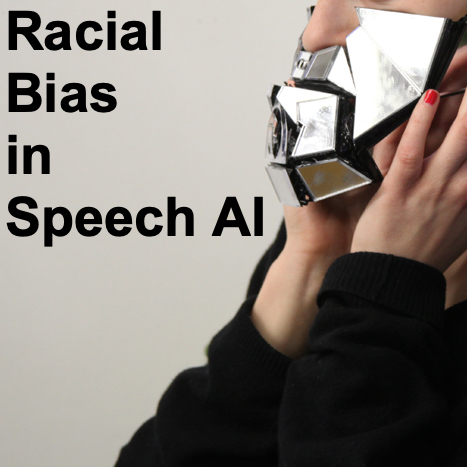
In summer 2021, sound artist, engineer, musician, and educator Johann Diedrick convened a panel at the intersection of racial bias, listening, and AI technology at Pioneerworks in Brooklyn, NY. Diedrick, 2021 Mozilla Creative Media award recipient and creator of such works as Dark Matters, is currently working on identifying the origins of racial bias in voice interface systems. Dark Matters, according to Squeaky Wheel, “exposes the absence of Black speech in the datasets used to train voice interface systems in consumer artificial intelligence products such as Alexa and Siri. Utilizing 3D modeling, sound, and storytelling, the project challenges our communities to grapple with racism and inequity through speech and the spoken word, and how AI systems underserve Black communities.” And now, he’s working with SO! as guest editor for this series (along with ed-in-chief JS!). It kicked off with Amina Abbas-Nazari’s post, helping us to understand how Speech AI systems operate from a very limiting set of assumptions about the human voice. Today Golden Owens explored what happens when companies sell Black voices along with their Intelligent Virtual Assistants. Tune in for a deep historical dive into the racialized sound of servitude in America. Even though corporations aren’t trying to hear this absolutely critical information–or Black users in general–they better listen up. –JS
—
In October 2019, Google released an ad for their Google Assistant (GA), an intelligent virtual assistant (IVA) that initially debuted in 2016. As revealed by onscreen text and the video’s caption, the ad’s announced that the GA would soon have a new celebrity voice. The ten-second promotion includes a soundbite from this unseen celebrity—who states: “You can still call me your Google Assistant. Now I just sound extra fly”— followed by audio of the speaker’s laughter, a white screen, the GA logo, and a written question: “Can you guess who it is?”
Consumers quickly speculated about the person behind the voice, with many posting their guesses on Reddit. The earliest comments named Tiffany Haddish, Lizzo, and Issa Rae as prospects, with other users affirming these guesses. These women were considered the most popular contenders: two articles written about the new GA voice cited the Reddit post, with one calling these women Redditors’ most popular guesses and the other naming only them as users’ desired choices. Those who guessed Rae were proven correct. One day after the ad, Google released a longer promo revealing her as the GA’s new voice, including footage of Rae recording responses for the assistant. The ad ends with Rae repeating the “extra fly” line from the initial promo, smiling into the camera.
Google’s addition of Rae as an IVA voice option is one of several recent examples of Black people’s voices employed in this manner. Importantly, this trend toward Black-voiced IVAs deviates from the pre-established standard of these digital aides. While there are many voice options available, the default voices for IVAs are white female voices with flat dialects. This shift toward Black American voices is notable not only because of conversations about inclusion—with some Black users saying they feel more represented by these new voices—but because this influx of Black voices marks a spiritual return to the historical employment of Black people as service-providing, labor-performing entities in the United States, thus subliminally reinforcing historical biases about Black people as uniquely suited for performing this type of work.
Marketed as labor-saving devices, IVAs are programmed to assist with cooking and grocery shopping, transmit messages and reminders, and provide entertainment, among other tasks. Since the late 2010s they have also been able to operate other technologies within users’ homes: Alexa, for example, can control Roomba robotic vacuums; IVA-compatible smart plugs or smart home devices enable IVAs to control lights, locks, thermostats, and other such apparatuses. Behaviorally, IVAs are designed and expected to be on-call at all times, but not to speak or act out of turn—with programmers often directed to ensure these aides are relatable, reliable, trustworthy, and unobtrusive.
Far from operating in a vacuum, IVAs eerily evoke the presence of and parameters set for enslaved workers and domestic servants in the U.S.—many of whom have historically been Black American women. Like IVAs, Black women servants cooked, cleaned, entertained children, and otherwise served their (predominantly white) employers, themselves operating as labor-saving devices through their performance of these labors. Employers similarly expected these women to be ever-available, occupy specific areas of the home, and obey all requests and demands—and were unsettled if not infuriated when maids did not behave according to their expectations.
White women being the default voices of IVAs has somewhat obfuscated the degree to which these aides have re-embodied and replaced the Black servants who once predominantly executed this work, but incorporating Black voices into these roles removes this veil, symbolically re-implementing Black people as labor-performing entities by having them operate as the virtual assistants who now perform much of the labor Black workers historically performed. Enabling Black people to be used as IVAs thus re-aligns Black beings with the performance of service and labor.

While Black women were far from the only demographic conscripted into domestic labor, by the 1920s they comprised a “permanent pool of servants” throughout the country, due largely to the egress of white American and immigrant women from domestic service into fields that excluded Black women (183). Black women’s prominence in domestic service was heavily reflected in early U.S. media, which overwhelmingly portrayed domestic servants not just as Black women, but as Black Mammies—domestic servant archetypes originally created to promote the myth that Black women “were contented, even happy as slaves.” Characters like Gone with the Wind’s “Mammy” pulled both from then-current associations of Black women with domestic labor and from white nostalgia for the Antebellum era, and specifically for the archetypal Mammy—marking Black women as idealized labor-performing domestics operating in service of white employers. These on-screen servants were “always around when the boss needed them…[and] always ready to lend a helping hand when times were tough” (36). Historian Donald Bogle dubbed this era of Hollywood the “Age of the Negro Servant,” referenced in this reel from the New York Times.
—-
.
Cinema and television merely built from years of audible racism on the radio—America’s most prominent form of in-home entertainment in the first half of the 20th century—where Black actors also played largely servant and maid roles that demanded they speak in “distorted dialect, exaggerated intonation, rhythmic speech cadences, and particular musical instruments” in order to appear at all (143). This white-contrived portrayal of Black people is known as “Blackvoice,” and essentially functions as “the minstrel show boiled down to pure aurality” (14). These performances allowed familiar ideals of and narratives about Blackness to be communicated and recirculated on a national scale, even without the presence of Black bodies. Labor-performing Black characters like Beulah, Molasses and January, Aunt Jemima, and Amos and Andy were prominent in the Golden Age of Radio, all initially voiced by white actors. In fact, Aunt Jemima’s print advertising was just as dependent on stereotypical representations of her voice as it was on visual “Mammy” imagery.

When Black actors broke through white exclusion on the airwaves, many took over roles once voiced by white men and/or were forced by white radio producers and scriptwriters to “‘talk as white people believed Negroes talked’” so that white audiences could discern them as Black (371). This continuous realignment undoubtedly informs contemporary ideas of labor, labor performance, and laboring bodies, further promoted by the sudden influx of Black voice assistants in 2019.
Specifically, these similarities demonstrate that contemporary IVAs are intrinsically haunted by Black women slaves and servants: built in accordance with and thus inevitably evoking these laborers in their positioning, programming, and task performance. Further facilitating this alignment is the fact that advertisements for Black-voiced IVAs purposefully link well-known Black bodies in conjunction with their Black voices. Excepting Apple’s Black-sounding voice options for Siri, all of the Black IVA voice options since 2019 have belonged to prominent Black American celebrities. Prior to Issa Rae, GA users could employ John Legend as their digital aide (April 2019 until March 2020). Samuel L. Jackson became the first celebrity voice option for Amazon’s Alexa in December 2019, followed by Shaquille O’Neal in July 2021.
The ads for Black-voiced IVAs thus link these disembodied aides not just to Black bodies, but to specific Black bodies as a sales tactic—bodies which signify particular images and embodiments of Blackness. The Samuel L. Jackson Alexa ad utilizes close-ups of Jackson recording lines for the IVA and of Echo speakers with Jackson’s voice emitting from them in response to users. John Legend is physically absent from the ad announcing him as the GA; however, his celebrity wife directs the GA to sing for her instead, after which she states that it is “just like the real John”—thus linking Legend’s body to the GA even without his onscreen presence. Amazon has even explicitly explored the connection between the Black-voiced IVA and the Black body, releasing a 2021 commercial called “Alexa’s Body” that saw Alexa voiced and physically embodied by Michael B. Jordan—with the main character in the commercial insinuating that he is the ideal vessel for Alexa.
By aligning these bodies with, and having them act as, labor-performing devices in service of consumers, these advertisements both re-align Blackness with labor and illuminate how these devices were always already haunted by laboring Black bodies—and especially, given the demographics of the bodies who most performed the types of labors IVAs now execute, laboring Black women’s bodies. That the majority of the Black celebrities employed as Black IVA voices are men suggests some awareness of and attempt to distance from this history and implicit haunting—an effort which itself exposes and illuminates the degree to which this haunting exists.
In some cases, the Black people lending their voices to these IVAs also speak in a way that sonically suggests Blackness: Issa Rae’s “Now I’m just extra fly,” for example, incorporates Black American slang through the use of the word “fly. As part of African American Vernacular English (AAVE), the term “fly” dates back to the 1970s and denotes coolness, attractiveness, and fashionableness. Because of its inclusion in Hip Hop, which has become the dominant music genre in the United States, the term, its meaning, and its racial origins are widely known amongst consumers. By using the word “fly,” Rae nods not only at these qualities but also at her own Blackness in a manner that is recognizable to a mainstream American audience. Due in part to Hip Hop’s popularity, U.S.-based media outlets, corporations, and individuals of varying races and ethnicities regularly appropriate AAVE and Black slang terms, often without regard for the culture that created them or the vernacular they stem from. The ad preceding Issa Rae’s revelation as the GA specifically invited users to align the voice with a celebrity body, and users’ predominant claims that the voice was a Black woman’s suggest that something about the voice conjured Blackness and the Black female body.

This racial marking was also likely facilitated by how people naturally listen and respond to voices. As Nina Sun Eidsheim notes in The Race of Sound, “voices heard are ultimately identified, recognized, and named by listeners at large. In hearing a voice, one also brings forth a series of assumptions about the nature of voice” (12). This series of assumptions, Eidsheim asserts in “The Voice as Action,” is inflected by the “multisensory context” surrounding a given voice, i.e., “a composite of visual, textural, discursive, and other kinds of information” (9). While we imagine our impressions of voices as uniquely meaningful, “we cannot but perceive [them] through filters generated by our own preconceptions” (10). As a result, listening is never a neutral or truly objective practice.
For many consumers, these filters are informed by what Jennifer Lynn Stoever terms the sonic color line, “a socially constructed boundary that racially codes sonic phenomena such as vocal timbre, accents, and musical tones” (11). Where the racial color line allows white people to separate themselves from Black people on the basis of visual and behavioral differences, the sonic color line allows people “to construct and discern racial identities based on voices, sounds, and particular soundscapes” and to assign nonwhite voices with “differential cultural, social, and political value” (11). In the U.S., the sonic color line operates in tandem with the American listening ear, which “normalizes the aural tastes and standards of white elite masculinity as the singular way to interpret sonic information” (13) and therefore marks-as-Other not only the voices and bodies of Black people, but also those of non-males and the non-elite.

Ironically, the very listening practices which make consumers register particular voices and vocal qualities as Black also make Black voices inaccessible to Alexa and other IVAs. Scholarship on Automated Speech Recognition (ASR) systems and Speech AI observes that many Black users find it necessary to code-switch when speaking to IVAs, as the devices fail to comprehend their linguistic specificities. A study by Christina N. Harrington et al. in which Black elders used the Google Home to seek health information discovered that “participants felt that Google Home struggles to understand their communication style (e.g., diction or accent) and language (e.g., dialect) specifically due to the device being based on Standard English” (15). To address these struggles, participants switched to Standard American English (SAE), eliminating informal contractions and changing their tone and verbiage so that the GA would understand them. As one of the study’s participants states,
You do have to change your words. Yes. You do have to change your diction and yes, you have to use… It cannot be an exotic name or a name that’s out of the Caucasian round. …You have to be very clear with the English language. No ebonic (15).
This incomprehension extends to Black Americans of all ages, and to other IVAs. A study by Allison Koenecke et al. on ASR systems produced by Amazon, Google, IBM, Microsoft and Apple discovered that these entities had a harder time accurately transcribing Black speech than white speech, producing “an average word error rate (WER) of 0.35 for black speakers compared with 0.19 for white speakers.” (7684). A study by Zion Mengesha et al. on the impact of these errors on Black Americans—which included participants from different regions with a range of ages, genders, socioeconomic backgrounds and education-levels—discovered that many felt frustrated and othered by these mistakes, and felt further pressure to code-switch so that they would not be misunderstood. Koenecke et al. concluded that ASR systems could not understand the “phonological, phonetic, or prosodic characteristics of” AAVE (7687), and that this ignorance would make the use of these technologies more difficult for Black users—a sentiment that was echoed by participants in the study conducted by Mengesha et al., most of whom marked the technology as working better for white and/or SAE speakers (5).
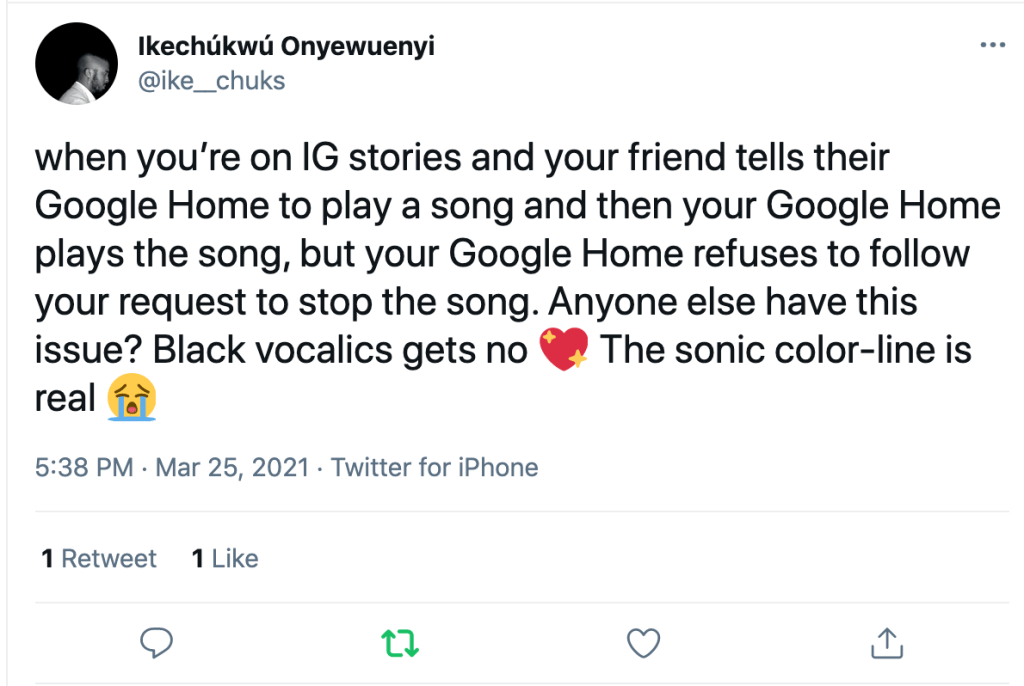
The speech recognition errors these technologies demonstrate—which also extend to speakers in other racial and ethnic groups—illuminate the reality that despite including Black voices as IVAs, these assistant technologies are not truly built for Black people, or for any person that does not speak Standard American English. And where AAVE is largely associated with Blackness, SAE is predominantly associated with whiteness: as a dialect widely perceived to be “lacking any distinctly regional, ethnic, or socioeconomic characteristics,” it is recognized as being “spoken by the majority group or the socially advantaged group” in the United States—both groups which are solely or primarily composed of white people. SAE is so identified with whiteness that Black people who only speak Standard English are often told that they sound and/or “talk” white, and Black people who deliberately invoke SAE in professional and/or interracial settings (i.e., code switching) are described as “talking white” or using their “white voice” when doing so. That IVAs and other ASR systems have such trouble understanding AAVE and other non-standard English dialects suggests that these technologies were not designed to understand any dialect other than SAE—and thus, given SAE’s strong identification with whiteness, were designed specifically to assist, understand, and speak to white users.
Writing on this phenomena as a woman with a non-standard accent, Sinduja Rangarajan highlights in “Hey Siri—Why Don’t You Understand More People Like Me?” that none of the IVAs currently on the market offer any American dialect that is not SAE. And while users can change their IVA’s accents, they are limited to Standard American, British, Irish, Australian, Indian, and South African—which Rangarajan rightly highlights as revealing who the IVAs think they are talking to, rather than who their user actually is. That most of these accents belong to Western, predominantly white countries (or to countries once colonized by white imperialists) strongly suggests that these devices are programmed to speak to—and perform labor for—white consumers specifically.
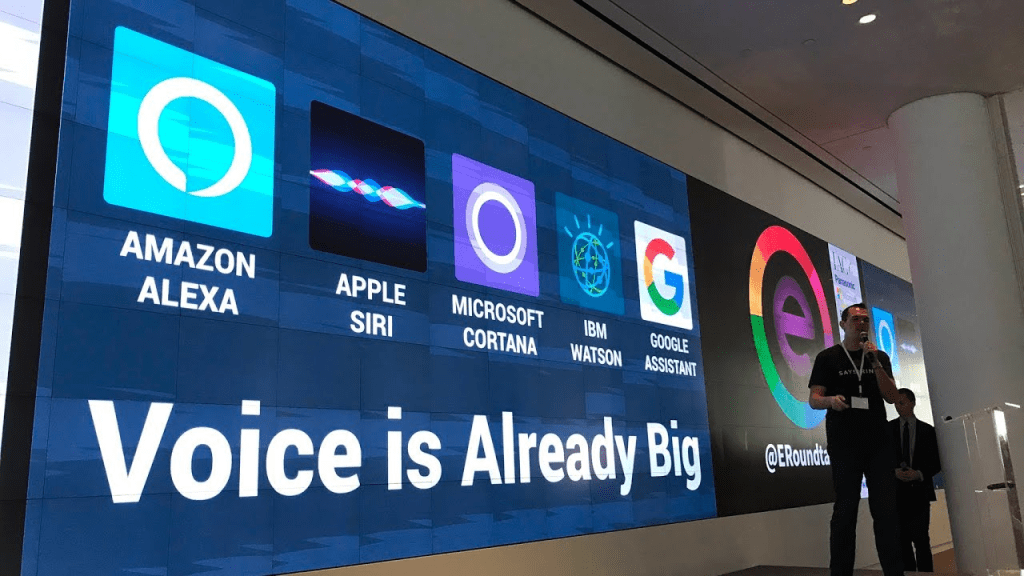
When considering the primary imagined and target users of IVAs, the sudden influx of Black-voiced IVAs becomes particularly insidious. Though they may indeed make some Black users feel more represented, cultivating this representation is merely a byproduct of their actual purpose. Because these technologies are not built for Black consumers, Black-voiced IVAs are meant to appeal not to Black users, but to white ones. Rae, Jackson, and the other Black celebrity voices may provide a much-needed variety in the types of voices applied to IVAs, but they primarily operate as “further examples of technology companies using Black voices to entertain white consumers while ignoring Black consumers.” Black-voiced assistants, after all, no better understand Black vernacular English than any of the other voice options for IVAs, a reality marking Black speech patterns as enjoyable but not legitimate.
By excluding Black consumers, the companies behind these IVAs insinuate that Blackness is only acceptable and worthy of consideration when operating in service of whiteness. Where Black people as consumers have been delegitimized and disregarded, Black voices as labor-saving assistants have been welcomed and deemed profitable—a reality which further emphasizes how historical constructions of Black people as labor-performing devices haunts these contemporary technologies. Tech companies reinforce historical positionings of white people as ideal consumers and Black people as consumable products—repeating historical demarcations of Blackness and whiteness in the present.
In imagining the futures of IVAs, the companies behind them would need to reconsider how they interact—or fail to interact—with Black users. Both Samuel L. Jackson and Shaquille O’Neal, the last of the Black-celebrity-voiced IVAs still currently available to users, will be removed as Alexa voice options by September 2023, presenting an opportunity for these companies to divest. Whether or not the brands behind these IVAs take this initiative, consumers themselves can be critical of how AI technologies continue to reestablish hierarchical systems, of their own interactions with these devices, and of who these technologies are truly made for. In being critical, we can perhaps begin to envision alternative, reparative modes of AI technology—modes that serve and support more than one kind of user.
—
Featured Image: Issa Rae gif from the 2017 Golden Globes
—
Golden Marie Owens is a PhD candidate in the Screen Cultures program at Northwestern University. Her research interests include representations of race and gender in American media and popular culture, artificial intelligence, and racialized sounds. Her doctoral dissertation, “Mechanical Maids: Digital Assistants, Domestic Spaces, and the Spectre(s) of Black Women’s
Labor,” examines how intelligent virtual assistants such as Apple’s Siri and Amazon’s Alexa evoke and are haunted by Black women slaves, servants, and houseworkers in the United States. In her time at Northwestern, she has had internal fellowships through the Office of Fellowships and the Alice Kaplan Institute for the Humanities. She currently holds an MMUF Dissertation Grant through the Institute for Citizens and Scholars and Ford Dissertation Fellowship through the National Academy for Sciences, Engineering, and Medicine.
—

REWIND! . . .If you liked this post, you may also dig:
Beyond the Every Day: Vocal Potential in AI Mediated Communication –Amina Abbas-Nazari
Voice as Ecology: Voice Donation, Materiality, Identity–Steph Ceraso
Mr. and Mrs. Talking Machine: The Euphonia, the Phonograph, and the Gendering of Nineteenth Century Mechanical Speech – J. Martin Vest
Echo and the Chorus of Female Machines—AO Roberts
Black Excellence on the Airwaves: Nora Holt and the American Negro Artist Program —Chelsea Daniel and Samantha Ege
Spaces of Sounds: The Peoples of the African Diaspora and Protest in the United States–Vanessa Valdes
On Whiteness and Sound Studies–Gus Stadler
Share this:

The Sound of What Becomes Possible: Language Politics and Jesse Chun’s 술래 SULLAE (2020)

“To this day I think about all the strange words I missed out on, all the losses I’m still carrying from faraway…I still think of the time when I spoke one language, and that language was whole.”
Chun 2020
Language can be a site of loss, a wholeness with which one, due to migration, has never really known. In the above passage, artist, Jesse Chun, reflects on how her grandmother spoke words in a language she did not understand, but yearned to hear and feel those sounds after her passing. There is a sonic residue that sticks to diasporic experiences. There are sounds that can stir up a blend of affect and ideation that is comforting when whiteness is unsettling. It is this disjuncture between words, meaning, and their sounds, that drew me to Chun’s work, 술래 SULLAE (2020). This piece reminded me of how sound, in its most ambiguous and queer forms, can hold the contingencies of history, language, memory, family, and the genealogies of loss that mark these sites of colonial dispossession.
술래 SULLAE (2020) is a single channeled video that draws from ganggang sullae, a Korean seasonal harvest and fertility ritual that integrates song and dance and is typically performed by women under the glow of moonlight. The participants hold hands forming a circle that through their movement, expands, disassembles, and changes its form. The songs can be both impromptu or pre-determined and encourages the participants to express their feelings in chorus with one another.
Diana Seo Hyung Lee (2020) suggests that historically ganggang sullae was meant to provide a forum for its participants to express emotions connected to living within patriarchal systems of power and oppression. She writes: “the women participating would not have been able to, in their everyday lives, sing, speak loudly, nor leave the house at night, in the patriarchal society of ancient Korea. This dance was a license for their one release.” In 술래 SULLAE, the dance proves to be a defiant presence. The women flash on screen as an unbreakable chain reinscribing a gendered history with new sounds and images that gesture to emancipatory possibilities.
술래 SULLAE combines archival clips of ganggang sullae, index pages from intonation books, images of Hangul and English consonants and audio splices from YouTube tutorials on how to pronounce English correctly. In the video, language becomes unhinged from expectation but at the same time, given form through history. The sound of the English language is disembodied and spliced into phonemic pulses. In 술래 SULLAE, Chun has created an encounter with the grammars of polyphony; a simultaneity of sounds that are both restrained by and resistant to the imposition of English on the Korean diaspora. Through what Chun has described as a form of “unlanguaging” following Rey Chow, her audience is witness to new meanings produced through the abstraction, manipulation, and redaction of sounds and symbols from the English language.

Chun’s editing and manipulation of English sounds is intentional. In an interview with Art Forum, Chun shares: “Taking the sound apart but still keeping it within the conceptual framework of English made me think about what else is embedded in making a language. English is tied up with legacies of imperialism; there’s so much unseen violence that is part of how this language is institutionalized.” What remains after the edits is an inventory of sounds that disrupts the primacy of the vowel as central to English word construction and thus, central to colonial imagination.
Like Chun, I realize that my conceptualizing of language is within an English framework, but my hope is that when we turn to the affective and when we begin to pull language a part, something different, something resistant, is produced. I am neither an expert in English nor Korean linguistics, it was the sounds in this work that pulled me into it. In thinking with 술래 SULLAE, I’m interested in what becomes possible in the absence of the vowel. I turn to the interruptive potential of consonant sounds to affect and incite methods of communication outside of those steeped in colonial dominance. What does it mean to de-emphasize the function of vowel sounds in language and reorient our listening to the consonant? What do consonant sounds teach us about the sonics of race that underwrite hierarchies of language? What methods of communication become possible when we do away with words and are left with only their sonic substance?
Through her assemblage of consonant sounds in 술래 SULLAE, Chun is making a deliberate choice to describe and animate a politics of language through refusing its colonial enclosures and turning to the aesthetic in order hold the excesses of description. She refuses the vowel in this piece, not by denying its presence, but instead relegating it to the soundless and the unfamiliar, a space of, in her words, “untranslatability.” In this undoing, consonants become the emotive force where new meanings and orientations to the sounds that mark our words are forged.
술래 SULLAE opens with the sound ssshhh; a pairing of consonant sounds that is often associated with insisting on silence, a sound meant to reprimand. Chun extracts and emplaces this sound in a new aesthetic landscape that is independent and unregulated by colonial schemas of enunciation and translation. The prominent soundscapes of the video are consonant sounds and when removed from their phonetic relations to vowels these sounds undo the presumptive structuring or potential reprimand of English. In 술래 SULLAE, we are meant to experience the fullness of the consonants’ timbre…ssshhh, ppp, ddd, tttt, kkkk…these edited clips of sound originally meant to instruct and assimilate speech into English pronunciations now serve a different function. For me, they secure Chun’s political orientation: one that is about the crafting of a world that involves the careful consideration of the logistics, function, and embedded emotions of the sounds that inhabit it.

graphite, watermarks, paper, aluminum frame, 13 x 16 inches
All languages contain their own unique set of vowels and consonants, but, Anne Carson reminds us that: “The importance of vowels to human speech has remained. There are words in English without consonants, but so central are vowels to word construction that there isn’t a word in English that doesn’t include a vowel.” In speech, consonants sounds are meant to break up the intended agenda of vowels. The ssshhh, ppp, ddd, tttt, kkkk, are antithetical to the circle or the rounded mouth needed to voice a vowel sound. Unlike the openness of a vowel, producing consonant sounds involves a narrowing of the vocal tract. This narrowing is referred to as constriction or the obstruction of breath whereby sound is produced by a form of corporeal tension. Consonant sounds also demand all the mechanics of the mouth: the lips, the teeth, the tongue, and the palette. Shhhh, requires the corners of the lips to lower and rather than rounding, the lips become pursed, and teeth become exposed. Parts of the mouth are drawn in. The soft palate is raised, and the tongue reaches upwards towards the roof of the mouth without touching it and then the tip of the tongue lowers behind the teeth.
Consonants emerge out of collectivity. Where a vowel is sounded without vocal constraint, consonants require more effort. Their sounds are produced through intricate bodily choreographies in the mouth that involve both constriction and collaboration. Ganggangsullae likewise relies on effort and interdependence. Participants collectively determine the speed and/or shape of their dance. They may even become serpentine or separate into smaller circles depending on what the group decides. The dance also provides an aesthetic space for its participants to voice frustration, anger, and tension through song with the hopes of producing reprieve from gendered hardships. Chun has decided to withhold these songs from her audience; we never hear the women singing. Through this erasure, Chun embeds the consonant sound with affective force whereby a politics of language and gendered presence is enunciated through and beyond a form of silencing. The dance redirects trajectories of dominance whereby the shushing takes on a new voice imbued with agency and hope. Because of how Chun isolates and amplifies its sound, ssshhhh is free to take on different meanings and associations. For me, I was reminded of rushing water or gusts of wind, or the sound used to lull my child to sleep. I was brought into another index of knowing and relating.
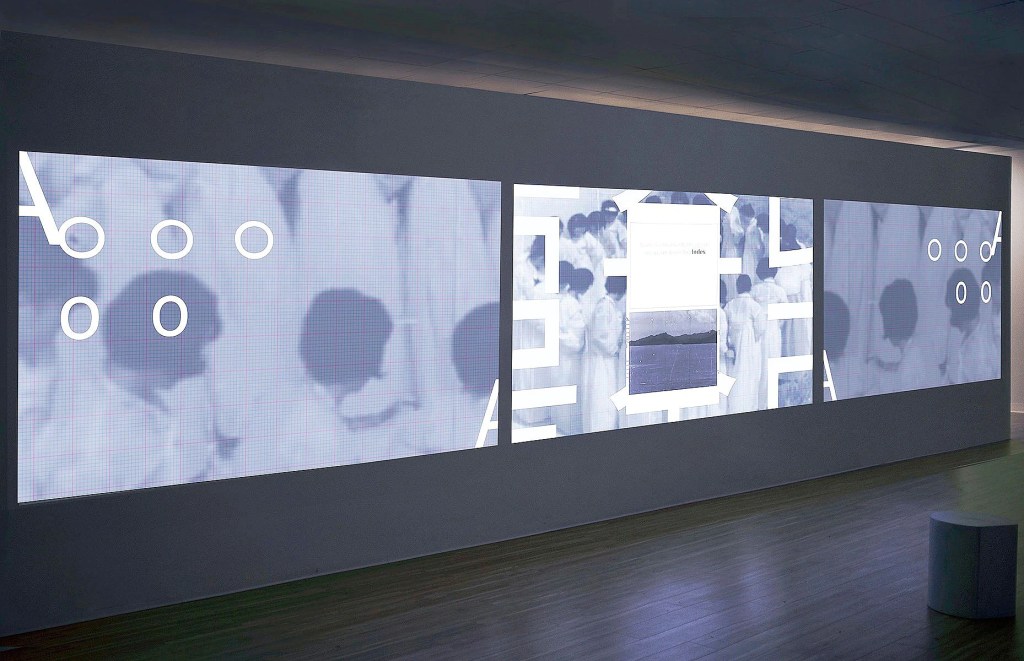
The sounds of language hold erasures and layered histories often obfuscated by our mundane encounters with them. Largely understood as the most sonorous part of the syllable, vowels produce the loudest speech sounds and their capacity for holding larger amplitudes or louder volumes have been linked to the sonic expression of emotion. Consonant sounds are more pragmatic than vowels. They are known for their functionality, for the ways in which they assemble the semantic structure of words and for their capacities to hold vowels in place or as Anne Carson describes as “delineating meaning amid the flow of open vowel sounds.” Consonant and vowel sounds map out different functional trajectories by virtue of the shape of mouth and orientation of breath that these sounds demand. Like Chun, I’m interested in what political orientations become possible when we source emotion elsewhere, beyond the confines of spoken words imposed upon us.
The word consonant is a noun, a word used to identify or classify, a semantic enclosure that establishes a subject or object. But unlike the word vowel, consonant is also an adjective. A consonant possesses the capacity to describe, to name, to tell us more. Adjectives parcel out description on states of being, in this way, they are inherently phenomenological. In 술래 SULLAE, Chun empties vowels of their sonic substance leaving behind traces of fragmented characters and differently shaped circles in their wake. They are stripped of breath and their symbolic value forming a new method of communication that reroutes expectations of what language, as we know it, can do and sound like. Like, ganggang sullae, the vowel is premised on the shape of a circle, but in 술래 SULLAE, Chun provokes us to think about what becomes possible beyond the circular structuring device, what becomes possible beyond the purview of the violent embeddedness of English and its colonial exigencies.

untitled (ㄷ), 2020, a functional concrete stool, courtesy of artist
Chun has noted that the moon that hovers above the ganggangsullae is yet another site of imperial conquest. In Art Forum, Chun states: “when I look up at it to feel comforted or to find solace, I’m reminded of colonial violence and an agenda that’s projected onto it. In that way, the moon also reflected how I see language.” Chun’s turn to consonants signals a reshaping of the colonial frame that does not disavow or idealize the legacies of imperialism on systems of communication, but instead highlights the tensions and obstructions produced in its shadows.
—
Featured image: 술래 SULLAE, 2020, single-channel version, courtesy of artist
—
Casey Mecija is an Assistant Professor in the Department of Communication & Media Studies at York University. Her current research examines sound as a mode of affective, psychic and social representation, specifically in relation to diasporic experience. Drawing on sound studies, queer diaspora studies and Filipinx Studies, her research considers how sensorial encounters are enmeshed and disciplined by social and psychic conditions. She is also a musician and filmmaker, whose work has received a number of accolades and has been presented internationally.
—
REWIND! . . .If you liked this post, you may also dig:
Blank Space and “Asymmetries of Childhood Innocence” –Casey Mecija
Re-orienting Sound Studies’ Aural Fixation: Christine Sun Kim’s “Subjective Loudness”–Sarah Mayberry Scott
Tape Hiss, Compression, and the Stubborn Materiality of Sonic Diaspora–Chris Chien
Share this:


Current Top Posts





April 2021

January 2020

November 2019

October 2019

August 2019

April 2014

November 2017

March 2015

December 2017

October 2015
 Sounding Out!
Recent Comments