
Vocal Gender and the Gendered Soundscape: At the Intersection of Gender Studies and Sound Studies

DOI: https://doi.org/10.59350/c66e0-sdz16
Editor’s Note: Welcome to Sounding Out!‘s annual February forum! This month, we’re wondering: what ideas regarding gender and sound do voices call forth? To think through this question, we’ve recruited several great writers who will be covering different aspects of gender and sound. Regular writer Regina Bradley will look at how music is gendered in Shonda Rhimes’ hit show Scandal. A.O. Roberts will discuss synthesized voices and gender. Art Blake will share with us his reflections on how his experience shifting his voice from feminine to masculine as a transgender man intersects with his work on John Cage. Robin James will return to SO! with an analysis of how ideas of what women should sound like have roots in Greek philosophy. Me? I’ll share a personal essay/analysis of what it means to be called a “loud woman.”
Today we start our February forum on gender and sound with Christine Ehrick‘s selections from her forthcoming book Radio and the Gendered Soundscape in Latin America. Below, she introduces us to the idea of the gendered soundscape, which she uses in her analysis on women’s radio speech from the 1930s to the 1950s. She will make you think twice about the voices you hear on the radio, in podcasts, over the phone…
In the meantime, lean in, close your eyes, and let the voices whisk you away.–Liana M. Silva, Managing Editor
—
Several years ago, while aboard a commercial airline awaiting take off, I heard the expected sound of a voice emerging from the cockpit, transmitted via the plane’s P.A. system. The voice gave passengers the usual greeting and general information about weather conditions, flight time, etc. What was unusual, and caught the otherwise distracted passengers’ attention, was the fact that the voice speaking was female. People looked up from their magazines and devices not because of the “message” but because of the “medium”: a voice that deviated from the standard soundscape of commercial aviation, a field comprised mostly of men.
For this historian, interested in vocal gender and the female voice in particular, the incident was a fascinating demonstration of both the voice as performance of the gendered body, and the fact that the human voice can and often does communicate beyond (and sometimes despite) the words being spoken. In this essay I want to briefly discuss some of the ideas I explore more fully in my forthcoming book, a study of women/gender and golden age radio titled Radio and the Gendered Soundscape in Latin America: Women and Broadcasting in Argentina and Uruguay, 1930-1950 (forthcoming, Cambridge 2015). In this book, I use the stories of five women and one radio station to explore the possibilities and limits for women’s radio speech, and to pose some larger questions about vocal gender and the gendered soundscape. For this post, I present the conceptual framework that I use to understand how gender is constructed through the voice.
Gender and sound have both been explored as categories of historical analysis, but largely in isolation from one another. The historiographical impact of gender analysis is almost too obvious to mention; suffice to say that attention to gender has altered the very questions historians ask of the past and the way we understand structures of power and historical change. More recently, historians have begun to incorporate R. Murray Schafer’s concept of the soundscape and what Jonathan Sterne has called “sonic thinking” into their analysis of the past (The Sound Studies Reader, 3). But not enough consideration has been given within the field of history to the ways sound may be gendered and gender sounded.
I bring these three threads together – gender, sound, and history – via the concept of the gendered soundscape. Helmi Järviluoma, Pirkko Moisala and Anni Vilkko introduce the term in their book Gender and Qualitative Methods (2004), which asks readers to contemplate the way gender – and gendered hierarchies – may be projected and/or heard in sound environments. We not only “learn gender through the total sensorium,” as they put it; gender is also represented, contested and reinforced through the aural (85). Thinking historically about gendered soundscapes can help us conceptualize sound as a space where categories of “male” and “female” are constituted within the context of particular events over time, and by extension the ways that power, inequality and agency might be expressed in the sonic realm—in other words, tuning in to sound as a signifier of power. Although many of us have been well-trained to look for gender, I consider what it means to listen for it.
The soundscape, of course, is not only gendered; other aspects of social hierarchy, such as race, class and sexuality, are also performed and perceived in the aural realm. Greg Goodale’s analysis in Sonic Persuasion: Reading Sound in the Recorded Age (2011) of “the race of sound,” which argues that sound constructs rather than simply reiterating race, provides a useful framework for understanding both what we might call the gender of sound and the ways gender and race might intersect in the soundscape (76-105). As we learn to become more “ear-oriented” scholars, in other words, we come to perceive power, oppression, and agency in entirely new ways.
One of the most immediately gendered sound categories is the human voice, a richly historical convergence of human biology, technology and culture. We can and do hear gender in most human vocalizations; linguists seem to agree that, when listening to adult (non-elderly) voices speaking above a whisper “gender determination is usually a simple task” (See, for example, David Puts, Steven Gaulin and Katherine Verdolini in “Dominance and the Evolution of Sexual Dimorphism in Human Voice Pitch” and Michael Jessen in “Speaker Classification in Forensic Phonetics and Acoustics”). When we hear a voice without visual referent, as in the airplane example above or when listening to the radio, we immediately tend to classify the voices as “male” or “female.”

Voice differences have roots in biological sex difference. With the onset of puberty, the larynx is enlarged and vocal folds increase in length and in thickness, resulting in a decrease in frequency (Hz) of vocal fold vibration and thus a lowering of voice pitch. But while bodies classified as biologically female experience about a one-half octave average drop in voice pitch with puberty, biological males tend to experience a full octave average drop in pitch, with the result being that adult male voices tend to operate within a lower frequency range than female voices. However, gendered constructions of the human voice vary widely over time and place.
Biology (body size, hormonal secretions, age, and other physiological factors) is no way destiny when it comes to the human voice. Linguists distinguish between “anatomical voice quality features,” which in essence set the parameters of comfortable pitch range given a person’s vocal anatomy (the range outside of which is difficult to easily maintain one’s speaking voice) and “voice quality settings,” which refers to where someone places their voice within that range (See Monique Adriana Johanna Biemans’ thesis, Gender variation in voice quality.) Bound to some degree by these physiological parameters, humans can and do place their voices in ways that are consistent with the performative aspects of gender, and voice pitch is both highly variable and subject to cultural/historical framing and self-fashioning (For more on this subject, see Anne Karpf, The Human Voice: How this Extraordinary Instrument Reveals Essential Clues About Who We Are, 2006). Thus like other aspects of gender, voice is culturally and historically constructed and performative.
Conceptualizing the voice as a sonic expression of the gendered body requires revisiting both the tendency of feminist scholars to equate “women’s voice” with writing or discourse, and the tendency of some media scholars to refer to voices without immediate visual referent (in film, radio) as “disembodied.” In their Introduction to Embodied Voices: Representing Female Vocality in Western Culture (1997), Leslie C. Dunn and Nancy A. Jones concisely articulate the challenge for scholars interested in the sonic/acoustic dimensions of women’s voices:
Feminists have used the word “voice” to refer to a wide range of aspirations: cultural agency, political enfranchisement, sexual autonomy, and expressive freedom, all of which have been historically denied to women. In this context, “voice” has become a metaphor for textual authority…This metaphor has become so pervasive, so intrinsic to feminist discourse that it makes us too easily forget (or repress) the concrete physical dimensions of the female voice upon which this metaphor was based. (1)
Thinking about voice in terms of vocal gender brings us to the complex relationship between voice and body. The concept of disembodiment conveys the sometimes uncanny effect of hearing (especially female) voices without an immediately discernible source. It also underscores the destabilizing effect of these unseen female voices liberated thus from patriarchy’s specular regime. Yet to refer to voices from an unseen source as “disembodied” is to suggest that the voice is somehow separate from the body, a problematic formulation.
Simply: if the voice is not the body, what is it? Even when it travels over long distances (via telephone or radio, for example) and/or if its source remains out of sight, the body is there, present via the sound vibrations it produces. Stepping away from concepts like disembodiment frees us to explore the nuances of the relationship between the voice and the body, and the presence of gendered bodies in the soundscape, particularly with regard to the vertiginous relationships between bodies and voices that are gendered female.
Gender and history impact how we read the tone, velocity and pitch of the voice, but they also shape parameters of where and when particular voices are invited to speak or expected to remain silent. And here of course we encounter the ways gender hierarchy is expressed and constructed in the acoustic/vocal arena, as well as racial categorization. Kathleen Hall Jamieson puts it succinctly in Eloquence in an Electronic Age: The Transformation of Political Speechmaking (1990): “History has many themes. One of them is that women should be quiet” (67). While by no means absent, women’s voices have remained largely outside of the realm of what Schafer calls “signal”: sounds listened to consciously and that often convey messages and/of authority. Just as other aspects of gender inequality become naturalized, patriarchy tunes our ears to listen to certain voices differently. In these formulations, women’s voices are thus subject to categorization as “noise” or “unwanted sound” (see Mike Goldsmith, Discord: The Story of Noise) and therefore dissonant, disruptive, and potentially dangerous.
The discomfort (or dissonance) with women’s voices, especially women’s voices speaking publicly and/or with authority, carried over into and shaped the history of radio, making early and golden age broadcasting an ideal venue for an historical exploration of gender and voice. What did it mean to hear women’s voices on the radio? How did radio rework the gendered dimensions of public and private space, and by extension the place of the female voice in the public sphere?
The emergence of radio in the early twentieth century was part of a larger revolution in human communication which Walter Ong termed in Orality and Literacy: The Technologizing the Word (1983) a “secondary orality,” an historical moment which reawakened older oral traditions and communal listening in a very different historical and technological context (3). It also reawakened a focus on the human voice, with all of its implications for the gendered soundscape.
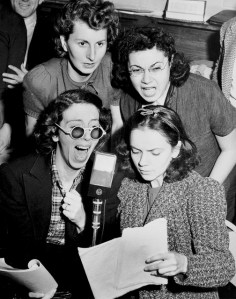
In many parts of the world, the rise of radio also coincided with an upsurge in feminist politics and discourses calling for women’s full citizenship and other related matters. As Kate Lacey notes in Feminine Frequencies: Gender, German Radio and the Public Sphere 1923-1945 (1997), “the arrival of radio heralded the modern era of mass communication, while women’s enfranchisement confirmed the onset of mass politics in the twentieth century.” Researching the history of women and radio – and particularly the sometimes hostile reactions to women’s radio voices – led me to appreciate the ways gender is performed and perceived via the voice, and from there into larger questions about the way social hierarchies – of gender, but also of race/ethnicity, class and sexuality – are reproduced and challenged within the sonic realm.
In this way we can better begin to contemplate the historical significance of women’s radio speech in understanding the sonic construction of gender. Depending on content and context, these voices carried the potential to not only challenge taboos on women’s oratory, but to assert the female body into spaces from which it had previously been excluded—like the cockpits (can’t help but note the name here) of commercial airliners.
–
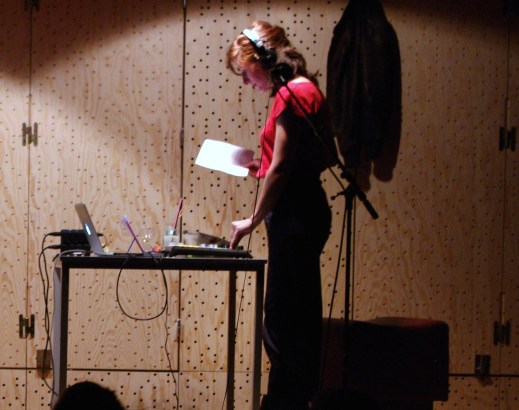
Featured image: “ateliers claus – 140522 – monophonic – Radio Femmes Fatales” by Flickr user fabonthemoon, CC BY-NC-SA 2.0
–
Christine Ehrick is an Associate Professor in the Department of History at the University of Louisville. Her second book, Radio and the Gendered Soundscape in Latin America: Women and Broadcasting in Argentina and Uruguay, 1930-1950 will be published by Cambridge University Press in Fall 2015. This book explores women’s presence and especially their voices – on the airwaves in the two leading South American radio markets of Buenos Aires and Montevideo. Her current work looks at comedy, gender and voice, with a focus on mid-twentieth century Argentine comedians Niní Marshall and Tomás Simari.
Thanks to Cambridge UP for allowing me to use some excerpts from the forthcoming book in this essay.
–

REWIND! . . .If you liked this post, you may also dig:
Look Who’s Talking, Y’all: Dr. Phil, Vocal Accent and the Politics of Sounding White– Christie Zwahlen
On Sound and Pleasure: Meditations on the Human Voice– Yvon Bonefant
Heard Any Good Games Recently?: Listening to the Sportscape–Kaj Ahlsved
—
Share this:

SO! Reads: Shana Redmond’s Anthem: Social Movements and the Sound of Solidarity in the African Diaspora

DOI: https://doi.org/10.59350/h0g6f-m3e21
To follow a song, to trace its roots and genealogy, to consider the context of its emergence as well as its lineage. To consider how sound and song propels political movement. To trace histories and concepts through the enunciative force of sound, of song. This is the work of Shana L. Redmond’s Anthem: Social Movements and the Sound of Solidarity in the African Diaspora (NYU Press, 2014). Redmond is Associate Professor of American Studies and Ethnicity at University of Southern California and the 2014-2015 Ella Baker Visiting Associate Professo of Black Studies at UC Santa Barbara, with research interests in music and popular culture, history and social movements, labor and working-class studies and critical ethnic studies. And this is to say nothing of her interests inAfrican Diaspora and Black political and social life. All these interests are made explicit within Anthem, a book that compels readers and listeners not only to ask questions about bygone eras, but to consider the soundscapes and beat drops of their own milieus. Redmond’s work, in other words, causes readers to consider the efficacy of sound and song making as the vibratory force that inheres in any social mood and movement. Anthem‘s power lies in the attention Redmond gives the circulation of sound and song: how each emerges from specific contexts as well as how songs end up being contested sonic sites wherein an intellectual practice of justice organizing can be articulated and Black sociality and personhood asserted and contended.
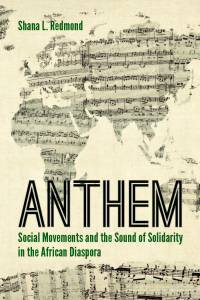
In particular, Redmond utilizes the concept of the Black anthem as a theoretical tool in order to consider the efficacy of organizing and fighting against practices of racism, sexism and imperialism. Redmond documents Black anthems as “sonic productions” that “were not ancillary, background noise” but “were absolutely central to the unfolding politics because they held within them the doctrines and beliefs of the people who participated in their performance” (8). That sounds, that songs, have so much potential to enunciate otherwise modes of living; that sounds, that songs, have within them the capacity to announce otherwise worlds, is something well known to those violently excluded from modernity and its epistemologies of the human, the citizen, the subject. We know this otherwise mode of living, this otherwise modality of world, affectively. And this affectivity is born out in aesthetic practice. Thus, to attend to the organizing of sound – as song – and how such musics made their way from, for example, Harlem to Cuba in the case of the Universal Negro Improvement Association’s “Ethiopia” or from women’s singing in Charleston to international stages, is all within the analysis and the archives offered by Redmond. What pleases is how her historical archival work is inflected by sonic analyses of songs; Redmond discusses the musicality of songs, how chord changes, harmonies, and melodies offer fresh insight into ways to think sonically about the movement of sound and song.
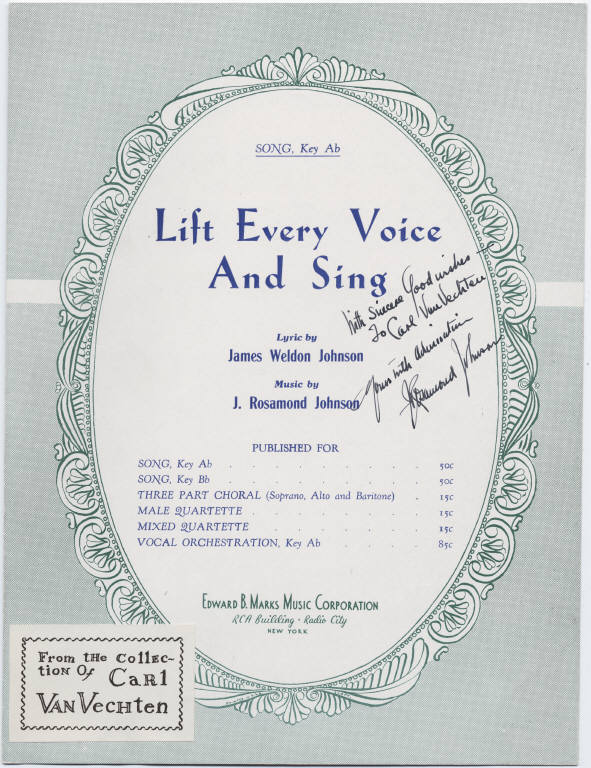
Anthem appeals to those interested in Black social movements of the twentieth-century, to be sure. But the book also makes musicological argumentation central to its thesis. So, for example, readers not only learn about lyrical content and history of brothers James Weldon and John Rosamond Johnsons’ “Lift Ev’ry Voice and Sing,” but they are also compelled to think about the song in its sonic registers, with its musicological features. For example,
The first measure of the vocal line is a half measure and offers a running start to the A-flat major key signature, with the text ‘lift ev’-ry’ notated by three eight notes in the 6/8 time signature. While the song was written in 6/8, its performance follows a 12/8 phrasing, placing it alongside the Black gospel tradition, which…was growing in dynamic ways at this very moment. The quick introduction leads the vocalist to a strong tonic chord on the downbeat of measure 2. The melodic emphasis lands on the word ‘voice’ with ‘and sing’ (measures 10 and 11) following as long notes (72-3).
This so say that Redmond takes seriously the ways songs are constructed as part of the argument she wants to put forward about the efficacy of the Black anthem. Her work models how to attend to the musicological as a fundamental feature of sound and song-making in Black sociality.
In considering the context of emergence for sounds and songs, Redmond produces a text that fits squarely within Black performance theory, since she is less concerned with the rightness or wrongness and much more with the efficacy of performance. The concern and the question of efficacy displaces the necessity for results-driven analyses in Black performance theory, placing emphases on how the production of sound and song proliferates, how it finds life, how it creates – while also being created by – worlds. Impressively, Redmond’s thorough sonic-historical approach to her archive gives her method resonance beyond even its richness. Anthem can be radicalized through generalizing its treatment of to songs as objects that are both part of and propel movements, enabling us to consider the context of emergence for any song and performance. Generalizing Anthem means that readers would take seriously the attempt to move from the specific sonic moment to the general, from various, plural moments of emergence to considering how sounds and songs move, how they create otherwise temporalities and spatial zones. Anthem produces a new theory of thinking relation between specific performances and their history and social movements, both in local and in global diasporic contexts.
In addition, Redmond analyzes how songs–and sounds within such songs–can at times be utilized to further racialist, sexist, imperialist impulses and practices. For example, Redmond analyzes “Ol’ Man River” in multiple forms and contexts, including the performance changes produced by Paul Robeson. Here Redmond begins the tension in the dialect as written by Oscar Hammerstein II and Robeson’s deployment of the song in performance.
The dialect demonstrates a particular version of blackness out of sync with the ‘fine intelligence’ of Robeson, a Phi Beta Kappa scholar at Rutgers University and Columbia Law School graduate. Hammerstein’s dialect not only distinguishes Black from white in the musical but also serves to contain the Black characters in their natural state as uneducated and simple laborers and confidants (105).
Thus, sound and song can also be deployed otherwise, can be used in order to critique, to produce an intervention into such normative conceptions of blackness. And from Redmond’s text, readers learn something of Robeson’s radicalizing, of his deep engagement with thinking global blackness, through the way he changed the lyrical content, and thus the dialect and mood, of “Ol’ Man River.”
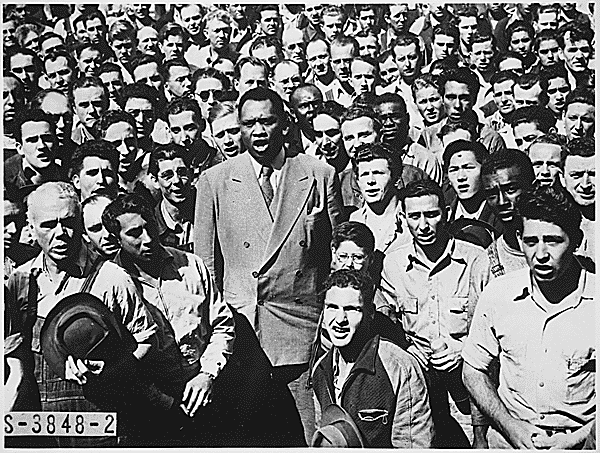
Oakland, CA, September 1942, Image courtesy of the National Archives and Records Administration
Still Picture Branch, Record Group 208, National Archives Identifier: 535874
Ultimately, Anthem produced for me the occasion to wonder if we can think the very concept of diaspora otherwise, as a following of vibrational moods and movements, as antiphonal participation in an ongoing call. And as an ongoing call that is resistive in its enunciation, that is ongoing and open-ended. If we did so, perhaps we would also come to understand Black sociality otherwise. In other words, perhaps we can think of it as making a claim on us, a ceaseless and performative ceaseless pulse that beckons and convokes. We are then forced to consider what our response will be to this ongoing call, what reply and resolve we give. In such a response, reply and resolve will have been irreducible, will have had no grounds, will have been constant. Sound and song are resistant to any desire for capture because of the internal disruptive capacities of vibration. Whatever the sound, whatever the song, it has within it vibration, vibration as the materiality that makes anything audible, that gives anything over to its possibly being heard. And if vibration is the grounds from which sound and song emerge, if thoughts of diaspora and blackness and sociality were inflected through such vibration, what we are called to consider is the ongoing sound, the ongoing echo, the ongoing verve and materiality of otherwise modes of living into the world.
As vibrational, Anthem forces readers to think of possibilities for sociality not grounded in categorical distinction as pure or as possibly maintained. “Through anthems,” Redmond argues, “the delineation between art and politics as well as listener and actor is blurred” (2). This blurring can be radicalized as a generalized feature of Black performance as theory and critical intervention into the normative world that depends upon invented–and distinct–categories in order to produce ongoing violence. In their accounting, the sounds, songs, and sonicity of blackness, Black sociality and Black antiphonal force demand a radical rethinking of categorical distinctions of racial classifications, gender binaries, and nation-states. And their vibrations resonate outward. On and on and on and on.
—
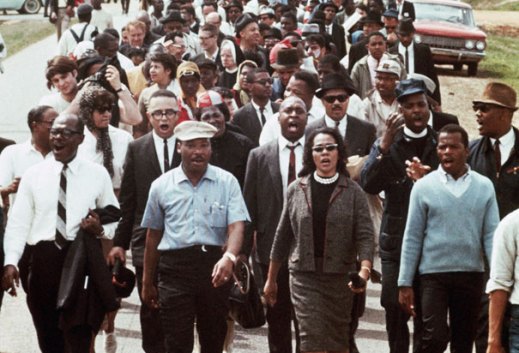
Featured Image: American Civil Rights Movement leaders singing on the 1965 March from Selma to Montgomery, Alabama, Photo Credit: Bettman/Corbis
—
Ashon Crawley is Assistant Professor of African American Studies in the Ethnic Studies Department of University of California, Riverside. He earned his doctoral degree from Duke University in the English Department with a certificate in African and African American Studies. Before Duke, he attended the Candler School of Theology at Emory University, earning a Master of Theological Studies degree with a concentration in feminist thought and queer theology. His research and teaching experiences are in the areas of Black Studies, Performance Theory and Sound Studies, Philosophy and Theology, Black Feminist and Queer theories. He has published work in Current Musicology; Souls: A Critical Journal of Black Politics, Culture and Society; The Journal of Theology and Sexuality; Black Theology: An International Journal and in Pneuma: The Journal of the Society for Pentecostal Studies. He is completing my first manuscript, titled Blackpentecostal Breath: The Aesthetics of Possibility, which investigates the relationship of aesthetic productions to modes of collective intellectual practice. this work contributes to interdisciplinary scholarship by engaging queer theory, sound studies, literary theory, theological studies, continental philosophy and visual studies.
—

REWIND! . . .If you liked this post, you may also dig:
SO! Reads: Deborah R. Vargas’s Dissonant Divas in Chicana Music: The Limits of La Onda– Wanda Alarcon
Pentecostal Song, Sound, and Authentic Voices– Ashon Crawley
Quebec’s #casseroles: on participation, percussion and protest– Jonathan Sterne
—
Share this:




Current Top Posts


April 2021

January 2020
November 2019

October 2019

August 2019

April 2014

November 2017
March 2015
December 2017

October 2015


Recent Comments