
Introduction: Medieval Sound

A text arrives and the buzz of a cell phone jolts you from your idle thoughts. The sound–like an alarm, another kind of bell to mark out the day–shifts you from one audition to another. The spatiality of competing sounds fills our consciousness and shapes our attitudes towards music and noise, privacy and pollution. These themes surround the issue of sound and articulate a variety of questions and problems. How does one delineate between noise and sound? How does sound individualize us within the community? How does sound create space? Why is the scopic the privileged sense?
Sound studies is the name for an interdisciplinary field encompassing the study of noise, music, vibrations, and what T.S. Eliot called “auditory imagination” in The Use of Poetry and The Use of Criticism (111). It is a capacious field, encompassing examinations of the individual sonic space of iPod use and the historical sound of rural and urban life. Sound (or the lack thereof) immerses a subject in worlds that may not be, or can distance the listener from the world that is. To put on headphones, to lose oneself in chant, to be awakened by an alarm, to lose the sound of voices in the crashing waves, transfers us, immerses us, and connects us in a variety of sonic worlds.

Medieval musician reinactment. Image borrowed from Byronv2 @Flickr CC BY-NC.
Each of the essays in this month’s “Medieval Sound” forum focuses on sound as it, according to Steve Goodman’s essay “The Ontology of Vibrational Force,” in The Sound Studies Reader, “comes to the rescue of thought rather than the inverse, forcing it to vibrate, loosening up its organized or petrified body (70). These investigations into medieval sound lend themselves to a variety of presentation methods loosening up the “petrified body” of academic presentation. Each essay challenges concepts of how to hear the Middle Ages and how the sounds of the Middle Ages continue to echo in our own soundscapes.
The posts in this series begins an ongoing conversation about medieval sound in Sounding Out!. Our opening gambit in April 2016, “Multimodality and Lyric Sound,” reframes how we consider the lyric from England to Spain, from the twelfth through the sixteenth centuries, pushing ideas of openness, flexibility, and productive creativity. We will post several follow-ups throughout the rest of 2016 focusing on “Remediating Medieval Sound.” And, HEAR YE!, in April 2017, look for a second series on Aural Ecologies of noise!
Multimodality and Lyric Sound
The essays clustered in the group “Lyric Sound” re-center lyric soundscapes—onomatopoeia, mashups, music box, witnesses to queer temporalities—in order to reorient the critical terrain of our understanding of the medieval lyric. Recent criticism on digital rhetoric has defined multimodality as the process of creating, rather than the product. In Daniel Anderson et al’s “Integrating Multimodality into Composition Curricula: Survey Methodolgy and Results from a CCCC Research Grant” (2006), multimodality, “acknowledges the practices of human sign-makers, who select from a number of modalities for expression (including sound, image, and animation, for example), depending on the rhetorical and material contexts within which the communication is being designed and distributed.” In this body of criticism, the term “multimedia” becomes condensed to the “integration of multiple forms of media” (59-84).
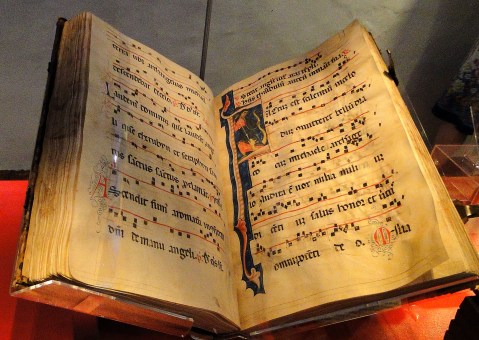
An illuminated music manuscript. Image by Richard White @Flickr CC BY-NC-SA.
This interest in semiotics is, however, not a new one; rather, it is one that has deep roots in medieval rhetoric, especially with regard to music. The two medieval writers most important to the discussion of rhetoric and music in the thirteenth century are John of Salisbury, particularly his twelfth-century work Metalogicon, and Gilbert of Crispin’s well-known debate Disputatio Iudei et Christiani from the late eleventh century. John of Salisbury’s Metalogicon, lays out the relation between symbols, sounds, and notation, writing:
Letters, that is, written symbols, in the first place represent sounds (voce). And secondly they stand for things, which they conduct into the mind through the windows of the eyes. Frequently, they even communicate, without emitting a sound, the utterances of those who are absent (Book 1, Chapter 3, 59).
John of Salisbury also links the notation of music with the notation of writing under the rubric of grammar, noting:
That such great import has existed in such tiny notations should not seem strange, for singers of music likewise indicate by a few graphic symbols numerous variations in the acuteness and gravity of tones. For which reason such characters are appropriately known as “the keys of music” (Book 1, Chapter 13, 59).
Gilbert of Crispin also considers the semiotics of visual notes. In the Disputatio Iudei et Christiani, he writes:
Just as letters stand in one way as images and notations of words, so also pictures exist as likenesses and notation of things written (qtd. in Michael Clanchy’s From Memory to Written Record 290).
Therefore what Isaiah saw, said and wrote, what Ezechiel saw, said and wrote, may after them be said and written and signified by some pictorial notation (290).
Both of these writers rework material from Isidore of Seville, and both describe correlations between reading “nota” in relation to music and images in post-Conquest Britain.
The elision between writing down letters and writing down musical notes is furthered by the slippery quality of the Latin from which the term “note” is derived. The Latin word “notare” means “to record writing,” while the second most common meaning of the noun “nota” [noter] means “to sing, to interpret musically.” The resulting duality of the term “note” survives today in both English and French, as Ardis Butterfield has pointed out in a November 2009 conference paper “A Note on a Note,” writing that “a note is both a sound and a sign.” The ambiguity of the term in Latin also indicates that the distinctions between the two meanings—“to record in writing” and “to interpret musically”—are constantly in flux.
The issues of the development of musical notation—a recording technology of sound—and the interface issues at stake in medieval manuscripts mean that our view of the medieval lyric comes primarily through the eyes. In other words, the medium—the manuscript page—in which the medieval lyric is recorded explains how our interpretations are deeply ocularcentric. However, we believe that we can think of the medieval manuscript as a flexible recording medium that allows for a “mise-en-système,” what Joanna Drucker describes as “an environment for action” in Graphesis: Visual Forms of Knowledge Production (139). A digital mise-en-système is a digital ecology in which the main question posed is how the interface can create the subject/user/reader. Interface then becomes a “border zone between cultural systems and human subjects;” it is the co-dependent space where “speaker and spoken are created. (148, 158-59).

“The Story of the Written Word” from the NY Public Library McGraw Rotunda. Photo by Wally Gobetz @Flickr CC BY-NC-SA.
Drucker tackles the theoretical stakes of digital visuality by explaining that “all images are encoded by their technologies of production and embody the qualities of the media in which they exist. These qualities are part of an image’s informations” whether this be illuminated manuscript, daguerreotype, painting, photograph, or digital image (21). The issues of layout, marginalia, paratext, columns, table of contents, indexes, chapter headings, are as Malcolm Parkes discusses in Scribes, Scripts, and Readers, a development of the medieval scholarly book (121-142). These experimental page structures became standard in printed books and eventually in digital texts.
In this series, we push back a bit on Drucker’s idea that the manuscript page is actually just a static mise-en-page. If the codex (as it developed in the Middle Ages) is one of the earlier kinds of informational “interfaces” then we should consider it as a mediating apparatus: one in which the mise-en-page and material features, its myriad graphic cues explain how to read, use, navigate, and access information in the codex book. We argue today with the example of the medieval English lyric as it emerges, that manuscripts are functionally an interactive media ecosystem, a mise-en-système where subject/user/reader can pull different threads and create and recreate meaning.
Over the next six weeks, the writers featured in our forum on Lyric Sound–Christopher Roman, Dorothy Kim, David Hadbawnik, Marla Pagán-Mattos, Katherine Jager--examine the different forms that medieval lyrics take and how the lyric is ensounded in terms of the mouth, recording medium, as well as the performance. Historical sound is always about negotiating the past through the present. Silence in the Middle Ages would not be our silence, just as music or noise today may not be defined as such then. These essays ask us to listen, create, make noise, open our senses in multimodal and multitudinous ways. We close with Andrew Albin‘s meditation on what it means to remediate medieval sounds in our contemporary moment, an intellectual call to the present as well as the future, as we will return with more on “Remediating Medieval Sounds” in April 2017. –Forum Guest Co-Editors Dorothy Kim and Christopher Roman
—
Dorothy Kim is an Assistant Professor of English at Vassar College. She is a medievalist, digital humanist, and feminist. She has been a Fulbright Fellow, a Ford Foundation Fellow, a Frankel Fellow at the University of Michigan. She has been awarded grants from the National Endowment for the Humanities, Social Science and Humanities Research Council of Canada, and the Mellon Foundation. She is a Korean American who grew up in Los Angeles in and around Koreatown.
Christopher Roman is Associate Professor of English at Kent State University His first book Domestic Mysticism in Julian of Norwich and Margery Kempe deals with the creation of queer families within mystical theology. His forthcoming book Queering Richard Rolle deals with the intersection of queer theory and theology in the work of the hermit, Richard Rolle. His research also deal with quantum theory and Bede, ecocritical theory, and medieval soundscapes. He has published on medieval anchorites, ethics in Games of Thrones, and death and the animal in the works of Geoffrey Chaucer.
—
 REWIND! . . .If you liked this post, you may also dig:
Musical Encounters and Acts of Audiencing: Listening Cultures in the American Antebellum–Daniel Cavicchi
Sounds Difficult: James Joyce and Modernism’s Recorded Legacy–Damien Keane
The Amplification of Muted Voices: Notes on a Recitation of the Adhan––David Font-Navarrete
Share this:

Reflective Sound Gathering via the New England Soundscape Project

Beyond the confines of recording studios, stages, and music classrooms, a vast and shifting sonic canvas exists for field recorders. This personal essay explores my awakening to a new creative recording process through the New England Soundscape Project , an ongoing sound-gathering mission whereupon I use small digital recorders—paired with various microphones, an iPhone, and a genuine sonic curiosity—to record brief moments throughout New England’s rich coastal, urban, and rural landscapes across six U.S. states. I received a modest seed grant from my University to pursue some creative work in field recording and sound studies. Over the next year, my travels will take me to the National Parks, cities, and historic landmarks in Connecticut, Vermont, Rhode Island, Maine, New Hampshire, and Massachusetts.
While near limitless possibilities on where and how to produce sonic and electroacoustic musical compositions endure, starting theNew England Soundscape Project challenged me to hone my listening skills while simultaneously dealing with nature’s unpredictability. Moreover, as a budding sound artist, I had to contend with the cognitive and emotional issues affecting a brand-new and unexplored creative practice. I came to believe that a holistic method of field recording offered me certain advantages—enabling an emerging sound artist to detach from rigidly defined agendas and instead focus on reflection, deep breathing, environmental awareness, gratitude, and an observational spirit. The listening exercises I detail in this post made me a newly introspective practitioner—one capable of a heightened sensitivity that improved my production and composition skills across multiple media.

Merrimack River, New Hampshire, USA. All images by author.
Field Recording: An End Goal in Mind?
Field recording involves a delicate balance of technical skill, careful planning, and patience. Stepping away from a controlled environment, capturing audio on location presents many random and often erratic trials. From wind noise and poor site accessibility to recording malfunctions and user error—a host of issues arise once the recordist enters unfamiliar territory. Here, unfamiliar territory includes both new places and nascent approaches to research-based production and artistic data collection. Where do I situate a project like the New England Soundscape Project among new media production, sound studies, and music composition? Does that issue even matter?

Otter Brook Dam/Edward MacDowell Lake, Keene, New Hampshire, USA. All images by author.
The notion of practice-based work usually implies an end goal in mind. What if there is not an end goal in sight? What happens then? Would the New England Soundscape Project be “enough” of a contribution to creative scholarship when approached as a type of audio ethnography—much like the immersive storytelling recently curated by Leonardo Cardoso? The New England region is lush and robust, with many diverse landscapes. I hoped to document these in some way, but wondered how to continue. Truthfully, I had some hesitation on where to start.
Media artists and music composers learn the mechanics of their craft in colleges, universities, conservatories, at home, and on the job. Some of these techniques include audiovisual production, computer programming, coding, editing, and arranging using digital software. I am both self-taught and a product of an academic and Eurocentric, conservatory training system. This presents some tension, as I discuss below. Although traditional audio engineers and music composers often work towards completing a project without a predefined trajectory, how can budding sound artists develop and hone an inner acuity to find the “right” material during their creative processes?
While the process remains largely subjective, I found it helpful to begin by answering the following questions:
- What kind of project is this?
- How is the sound to be used?
- Where and how will the project be displayed?
- Who is the intended audience?
- What are the sound artist’s intentions?
- What tools are needed?
I draw inspiration from the Sound Studies Lab’s position that this type of work is diverse, fluid, and balances technical, artistic, and theoretical aims. The challenge is that the answers to the questions above are not immediately clear and require me to look inward at who I really am.

Boot Mill Threading Machine, Lowell, Massachusetts, USA. All images by author.
Following the Sonic Muse
Beyond the obvious technical and aesthetic factors affecting an expansive multisite recording project, we know little about how a nascent sound artist begins. Whom do they emulate? Should they take notes? pictures? What should they pay attention to onsite?
If the project is exploratory, the recordist may experience hesitation—as I did— and frustration that can block their creative process, especially because the pathways toward a finished sound project aren’t as established as those of a sound engineer, for example, or a songwriter. Nevertheless, my experiences have shown me that a nascent sound artist/recordist can also find intrinsic meaning and realize their mission—particularly by establishing a detached yet perceptive listening ethos, as I did to begin my work on the New England Soundscape Project.
For me, framing a detached and perceptive mindset involved:
- Remaining sensitive to my surroundings at each location;
- Focusing on stillness, deep breathing, and a quiet mind while recording;
- Adopting a respectful, unobtrusive manner at each site—taking care not to disrupt or distract others;
- Calmly monitoring my technology and its use;
- Trusting that I am intended to be in that exact moment at that exact time;
- Avoiding being overly concerned with the “end game” of their practice;
- Embracing the role of a sound gatherer and observer;
It is perhaps the final objective—adopting the philosophy of sound gatherer and observer—where truly sensitive listening begins. Here, the recordist aims to remove their personal goals and agenda from the field recording process. Before proceeding, the attentive recordist looks around them, focuses on quiet breathing, and views their microphones as lenses and without fear of what the result should be. To what or whom am I observing?
Here’s the problem. It dawned on me that I know little about who I am as a sound artist, and how my voice positively contributes to the world, if at all. I need to learn to listen—not just to the sounds in nature, but also to the sounds of the voices of the persons with whom I interact. Could solitude and introspective listening lead me to listen through a newly formed self, capable of deeper connections with my peers and environment? I found that my detachment involved investigating, acknowledging, and, whenever possible, setting aside my own biases, fears, and, importantly, my own agendas. By removing my ego and cluttered mind from the process, I could start to be an inclusive practitioner—one whom cultivates positive relationships daily and is capable of crafting a deeper sonic art that embraces rather than one that marginalizes.

Merrimack River, Lowell Massachusetts, USA. All images by author.
The Art of Meditative Listening
Rather than taking on a stringent approach with little flexibility, I practice observational recording by gathering audio as my muse and as environmental conditions dictate. By remaining attentive to my recording levels, I gather source materials up close, from afar, and for any length of time. Meanwhile, as this creative progression unfolds, I stay quiet—bringing almost meditative quality to my practice. Moreover, concentrating on deep breathing and stillness allows me to adopt a grateful mindset—one that is appreciative of my surroundings and for being present at that precise moment. It is then that the environment becomes the focus of sound gathering and not notions of a “final product.”

Scarborough State Beach, Newport, Rhode Island, USA. All images by author.
I found an artistic renewal—even healing—by adopting this meditative practice. As the New England Soundscape Project takes shape over the coming months and years, I hope to document the beauty of the Northeast through music, sound, and images. Yet, it is enough simply to be present in each location while aspiring to produce thoughtful and reflective sound art. Although there is no overarching method that best describes every aspect of a multisite field recording process, the “art” in the sound can truly emerge by striving to banish fear and doubt from the recording process. Addressing the “why” during each moment is just as important as addressing the “how” and the “why” in pre- and post-production. The recordist’s humanity plays a key role in determining how creative decisions are made, and the ability to remove the need for control determines how free—and freeing—the process can be.
This Thursday, SO! will feature my podcast on reflective listening with audio examples from the New England Soundscape Project thus far. I look forward to producing future episodes (and essays) on this project in the coming months. I hope you can tune in on Thursday and thank you for listening!
—
Featured Image: Scarborough State Beach, Newport, Rhode Island, USA. All images by author.
—
Acknowledgements
An Internal Seed Grant from the University of Massachusetts Lowell supports the New England Soundscape Project.
—
Daniel A. Walzer is an Assistant Professor of Composition for New Media at the University of Massachusetts Lowell. Walzer’s research and reviews appear in the Leonardo Music Journal, the Journal of Music, Technology & Education, the Journal of Radio & Audio Media and forthcoming articles in TOPICS for Music Education Praxis, and the Music Educators Journal. Walzer received his MFA in Music Production and Sound Design for Visual Media from Academy of Art University, his MM in Jazz Studies from the University of Cincinnati and his BM in Jazz Studies from Bowling Green State University. Walzer is currently pursuing doctoral studies in education at the University of the Cumberlands. Read more at http://www.danielwalzer.com
—
REWIND!…If you liked this post, you may also dig:
SO! Amplifies: Ian Rawes and the London Sound Survey–Ian Rawes
SO! L.A.: Sounding the California Story–Bridget Hoida
Sound-politics in São Paulo, Brazil–Leonardo Cardoso
Share this:


Current Top Posts





April 2021

January 2020

November 2019

October 2019

August 2019

April 2014

November 2017

March 2015

December 2017

October 2015
 Sounding Out!
Recent Comments