
Listening to Modern Family’s Accent
**This piece is co-authored by Juan Sebastian Ferrada and Dolores Inés Casillas

The Cast of ABC
Since debuting in 2009, American audiences have fallen in love with ABC’s Modern Family, a mockumentary comedy starring Ed O’Neill, Julie Bowen, and Colombian actress Sofía Vergara who plays the curvaceous, gorgeous, and ”accented” Gloria. Clearly a satirical comedy, the show presents three interrelated modern day versions of nuclear families. The patriarch Jay (O’Neill, formerly of Married With Children) marries Gloria, a much younger Latina who has an eleven-year-old son from her previous marriage (the wise-beyond-his-years Manny, played by Rico Rodriguez). The heterosexual suburban nuclear family is represented through Claire (Jay’s daughter, played by Bowen) and Phil (Ty Burrell) who have three children. The homosexual nuclear family is fashioned through the characters of Mitchell (Jay’s son, Jesse Tyler Ferguson), his partner Cameron (Eric Stonestreet) and their adoptive daughter, Lily, from Vietnam. The show follows the tried-and-true conventions of family sitcoms, complete with exaggerated portrayals of their characters and a feel good message delivered in 22 minutes. Our current fascination is Gloria—arguably the most popular character on the show (see her lucrative Pepsi deal here)—and the use of her “accent” to mark her Latina body. Visually audiences may be ogling over her curves, but it is her vocal body – her “accent,” tone, and staged grammatical blunders – that work to racialize her character as much as sexualize it.
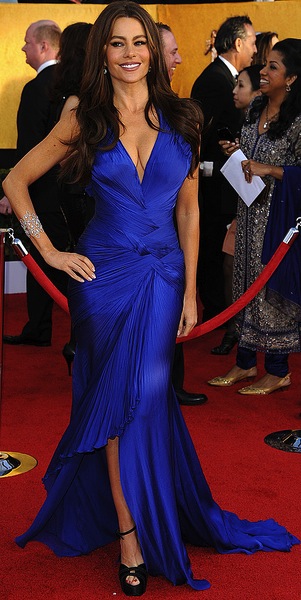
Vergara at the 2011 SAG Awards
Vergara’s character Gloria hails from the same township of Barranquilla, Colombia as the actress herself. Despite her emerging star status in the U.S., Vergara is no stranger to Spanish-language television viewers. (Wilson Valentín-Escobar refers to such English-language media discoveries as “Columbus effects”). Vergara rose to fame through the immensely popular telenovela format and in recent years has gained popularity through various comedic roles type cast as the “sexy Latina.” Visually, the spitfire Latina is characterized by her red-painted lips, seductive clothing, curvaceous hips, long brunette hair, extravagant jewelry, and an inherent ability to dance. (See Priscilla Peña Ovalle’s fabulous SO! blog piece on Latinas, dance, and the “aural Otherness” of Rita Moreno). Vergara, in her personification of Gloria, embodies many of these attributes quite well. For instance, a natural blond, Vergara was forced to color her hair in order for American viewers to imagine her as an “appropriate” brown Latina.
In an equivalent vocal vein, Vergara showcases the required Spanish “accent.” Case in point, from the pilot episode:
Phil: Hi Gloria. How are you? Oh, what a beautiful dress.
Gloria: Ay, thank you Phil [Ph-eee-l].
Phil: Okay. [Proceeds to touch Gloria]
Claire: [Slaps Phil’s hand] No, honey. That’s how she says Phil. Not feel, Phil!
The communication mishap serves as the underlying funny because of Gloria’s accent and at the expense of Gloria’s body; her voice and her body are both subjected to gratuitous scrutiny. Phil, once again in episode 5 of season 1, does understand Gloria’s “accent” but seems to confuse the context. He greets Gloria upon arriving to his house to watch a football game:
Phil: Hey, for you! [Gives Gloria a bottle of wine] Nice to see you, Gloria. [Hugs Gloria]
Gloria: Two times today.
Phil: Okay. [Proceeds to hug her again]
Claire: Phil! She means we’ve seen them two times today.
In this case Phil is confused by Gloria’s inflection and repeatedly mistakes Gloria’s unintentional statements as personal invitations to her body. These acts sexualize and racialize Gloria as a desired “other” because of her apparent “accent.” Once again, repeated in this scene, Claire (Phil’s wife) is required to intervene or harness her husband’s sexual prowess by announcing what Gloria means, stripping Gloria of her voice to defend herself.

Vergara and Co-Star O
Perhaps most frustrating and audibly apparent feature of Gloria lies in her incessant grammatical errors scripted within her English-language lines. Yes, scripted. Vergara certainly has an audible “accent,” especially to Americans not accustomed to Latino-speak (although there are 35 million Latinos in the U.S.) or to those in denial that we all carry some sort of accent influenced by our social locations – class, race, and in this case, migration. But to Vergara’s own admission, she is bilingual and biliterate, which means the grammatical blunders that serve as punch lines or as a means of laughing at her, are largely owed to the script itself. Gloria’s grammar, like her “brown” hair, is an important false feature that helps make her a true Latina immigrant character.
Listeners have always struggled to make sense of one’s accent and speech style especially if the speaker’s body does not match stereotypical perceptions based on race and gender. A key study showed, for instance, that when participants were shown a recorded lecture by an Asian American woman voiced over with a white woman’s voice, they overwhelmingly insisted that the Asian American woman spoke with an Asian accent. A classic case of what sociolinguists refer to as “accent hallucination.” Listeners truly have a hard time believing what they hear or believe they hear.
In the case of comedian Margaret Cho, audiences laugh their heads off with her signature act – vocal reenactments of her immigrant Korean mother. Elaine Chun offers a brilliant analysis of Margaret Cho’s revoicings of her immigrant Korean mother (Chun refers to this as “Asian speech”). According to Chun, Cho’s comedic routines are not only incredibly funny but they offer a critique of racist mainstream ideologies precisely because Margaret Cho is read as an Asian American.
Which makes us wonder, how is Sofia Vergara read within a U.S. context and to non-Latino audiences? Ideally, folks would see her as a U.S. Latina role playing a recently arrived immigrant and offer viewers a critique of accented Latina spitfire. But alas, Vergara’s vocal performance of an immigrant Latina wrought with grammatical errors only helps her character Gloria become the quintessential racialized Other (or a true U.S. Latina).


Share this:

What Are You Listening to When youarelistening.to/losangeles ?
 Earlier last week I came across this post by GOOD regarding a new site called youarelisteningtolosangeles.com. Eric Eberhardt’s (http://twitter.com/url2la) web creation uses an LAPD radio feed and plays Creative Commons-licensed music in the background. (According to Olsen Bright at NBC Los Angeles, the URL was registered only last week, but since it went live it has gone viral. As of this post, it has links for New York, Chicago, San Francisco, and Montreal). The site that has gotten more news coverage has been, by far, the Los Angeles site. Nicola Twilley from GOOD calls it “hypnotic, beautiful, and utterly compelling.” When I first tuned in, I couldn’t stop listening. It is certainly haunting and leaves behind a feeling of uncanniness: the disembodied voices of police dispatchers far away mesh with the soothing sounds of ambiance music.
What caught my eye about the article was Twilley’s description of what it was like to listen to LAPD’s radiofeed:
“To listen to it is to be plugged into the pulse of the city; lost in fragments of someone else’s story. Urgency alternates with frustration and low-level routine; some incidents are reported while others are resolved; and jaywalking tickets are issued in the same breath as lives are lost.”
I like her idea that the site allows you to tune into “the pulse of the city.” The feed is a sonic representation of what is happening on LA’s streets. I had the feeling that I was listening to some subversive channel of LA life, narrated by a police dispatcher. However, there are two things that come to mind: a) the sounds of urban life are being filtered through the police department, and b) what are the sounds we hear on the feed telling us about the sonic dimensions of cities?
This online radio station of sorts mashes up city sounds with background music, but once you pause the music what we get are conversations between police officers. The result is that those sounds (voices, codes, numbers, addresses) filter the soundtrack of the city. When we click on youarelisteningtolos angeles.com we are actually listening to the keepers of peace and order on the city streets. The city has already been distilled for us through a radio dispatcher and officers.
The sounds are haunting. Interestingly, what attracts some listeners is the fact that they can eavesdrop on the police feeds, like we’re tuning into what our neighbors are doing. Others point out how soothing the sounds meshed with the dispatcher feed can be. However, the site serves as an example of how city sounds are filtered to us. We don’t hear the actual people who the dispatchers talk about, but the stories of their actions. In that sense, what we hear about them is really a narrative of order, chaos, authority, and traffic violations. Who is stepping outside of the lines?
But…can we ever really listen to The City? This is why audio projects such as soundwalks are important, because they make that aural experience multisonoral. The same way we must reject single stories (like Chimamanda Ngozi Adichie pointed out in her TED talk) we must also bring to light different soundtracks of the city around us, lest the radio feed of a police dispatcher become the one that stands out.
This brings me to my second concern: what are we actually listening to? What was initially problematic for me was that we don’t actually hear urban sounds. We hear voices talking about citizen activity on the streets. Once you mute the music, what you get are voices narrating what is happening on the street level. But then I realized that I was be limiting what sounds are classified as city sounds. In that sense, youarelistening.to is opening up what it means to listen to cities. The citizens also make sounds; their voices are part of the soundscape of the city.
I’d love to hear from our readers from these different cities, see what their reaction to listening to the transmission is.
By the way: can we get a youarelistening.to/kansascity?
Bonus tracks:
Here is Soul Coughing’s “Screenwriter’s Blues,” whose line “You are listening to Los Angeles” provided inspiration for the title. (via laist.com)


Share this:


Current Top Posts





April 2021

January 2020

November 2019

October 2019

August 2019

April 2014

November 2017

March 2015

December 2017

October 2015
 Sounding Out!
Recent Comments