
Love and Hip Hop: (Re)Gendering The Debate Over Hip Hop Studies
Today’s post from Cornell professor Travis Gosa (Africana Studies) marks the return of our “Sound and Pedagogy” Forum for a spring semester refresher course. It’s a hard time of the school year–fatigue can creep up in exponential relation to the sudden increase in sunshine. We at SO! want to put some spring back into your classroom with Gosa’s discussion of the relationship between hip hop and the university classroom–to sample De La Soul, stakes is high–followed up next week with Emmanuelle Sonntag and Bronwen Low‘s (McGill) exploration of hip hop pedagogies in the urban classroom in their joint post on “The Student as Broadcaster and DJ of Her Listening,” and rounded out with a hands-on self-assessment of how sound media can be a productive classroom tool in teaching black political history by Carter Mathes (Rutgers). Grab a new notebook, sharpen some pencils, and enjoy some (funky) fresh perspectives this spring. And now, I pass the mic to Dr. Travis Gosa–Editor-in-Chief Jennifer Stoever-Ackerman
—
The three-year appointment of DJ Afrika Bambaataa at Cornell University has caused me to think about the sexual politics of sound created by the artist-centered hip hop studies movement. College students have been reading hip hop textbooks since the early 1990s, and Arizona University students can now earn a minor in hip hop studies. However, the recent professorial appointments of artists like Bambaataa, Bun-B of UGK (Rice University), M1 of dead prez (Haverford College), Wyclef Jean (Brown University), and 9th Wonder (Harvard University) is shaping how hip hop is heard.
The embodied collision of instrumentation, lyricism, and experience in the artist-centered classroom can create spaces for empowerment and emancipatory learning. There is also a risk, however, that the artist-professors trend will reproduce the same sexist logic about hip hop and women that recirculates in mass-mediated rap music.
Since Common’s 1994 song “I Used to Love H.E.R,” the bodies of women of color have served as the sonic battlefield for wars over the authentic boundaries of hip hop culture. On the track, Common falls out of love with H.E.R (“hip hop”) when White corporations and West-Coast emcees gangbang his once virgin, “untampered” girl, and turn her into a promiscuous, weed-smoking “gangsta bitch.”
.
Compared to Lil’ Wayne’s lyrics about “beating the pussy up like Emmett Till,” or Rick Ross’ molly-infused date rap anthem, Common’s nostalgic back-in-the-day rhymes are tame. The love affair is sonically wrapped in the thick intertexuality of George Benson’s mellow jazz guitar of “The Changing World,” timeless emcee clichés like “yes yes ya’ll,” and classic quotables like Easy-E’s “Easily I approach…” (minus the punchline about having sex with your momma).
Rap legends Scarface and Nas use the H.E.R. trope to frame the appropriation of hip hop by colleges. On the DJ Khaled assisted track “Hip Hop,” they describe hip hop as a “middle-aged cougar,” and threaten to murder the “bitch” for being a gold digging “whore.”
.
According to Scarface, he has fallen out of love with Ms. Hip Hop because she is sleeping around with everyone, including college professors:
Now you all in the lectures
Being studied by the college’s professors
Now I regret the day I met ya, Bitch
I’ll be the first one to say it
She ain’t the one you want to play with
I fucked Hip Hop
When the imaginary borders of hip hop are expanded or violated by academia, Scarface defends hip hop by slut shaming Black women. The hegemonic masculine frame perpetuates the virgin/whore dichotomy of womanhood, justifies violence against women, and evaluates women (“hip hop”) according to their ability to fulfill the needs of men. DJ Khaled’s production reinforces the message by sampling Mott The Hoople’s “She Does It.” The 1975 British glam rock song is a little ditty about cocaine and/or rough sex with groupies.
Too often, loving hip hop involves remaining uncritical about sexualized violence and the silencing of women in the culture. “Sentimental attachment” to music, as Barry Shank described at the 2013 IASPM conference, is not the same as “interrogative listening,” the recognition that musical pleasure can involve dominance and oppression. Interrogative listening begins by acknowledging that being a member of a musical community comes with responsibility.
Hip hop studies professors face the monumental task of reeducating students in the art of interrogative listening. As scholar Tricia Rose noted in her keynote address at the opening of the Cornell Hip Hop Collection in 2008, the commercial rap industry has trained young people to nod to the beat while passively accepting misogyny and oppression. Rose writes in her book The Hip Hop Wars that pointing to real life “tricks” and “hoes” is often a strategy used to absolve male hip hop artists of their culpability in profiting from rape culture.
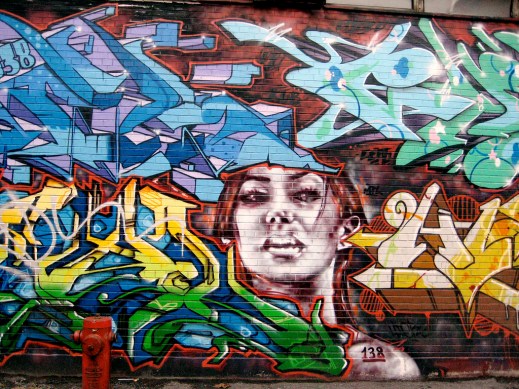
I have been impressed by the ability of pre-rap, 1970s hip hop artists to demonstrate a love for the culture without reproducing the woman-hating narrative found in rap music. The South Bronx DJs (i.e., BreakBeat Lou), graffiti artists (i.e., Carlos “Mare 139” Rodriguez), photographers (i.e., Joe Conzo, Jr.), and break-dancers (i.e., Richard “Crazy Legs” Colon and Jorge “Popmaster Fabel” Pabon) who make guest appearances in my courses explicitly disassociate themselves from the logic of commercial rap industry. Not surprisingly, it has been most intriguing to listen to the sexual politics created by the Afro-futuristic DJ Bambaataa.
Bambaataa is known for transforming the notorious Black Spades gang into the fledgling 1970s South Bronx hip hop scene. His Universal Zulu Nation has forcibly removed drug dealers from neighborhoods, rallied around political prisoners, and just last month, warned WorldStarHipHop.com to stop pandering violent and sexual images to youth.

Image by Pete Best, Courtesy of Cornell News
Less obvious is Bambaataa’s political work through sound performance. His signature soulsonic soundspace mocks the boundaries of music genre and the specificities of race, social class, and place, in favor of the universal. For example, when asked to explain early hip hop to my undergraduate class last fall, he sat back and played Ray Steven’s 1969 hit “Gitarzan” and The Music Man’s “Ya Got Trouble.” Hilarity and cognitive dissonance ensued, as the country-rock and Broadway tunes shattered the commonsense of hip hop as “rap music,” “black,” “youth,” or “urban.”
His universalism is not meant to obscure the contributions of women with a generic masculine narrative. Bambaataa has spent the first year of his appointment mapping out the centrality of women’s role in creating hip hop culture. Like Kyra Gaunt in Games Black Girls Play: Learning The Ropes from Double-Dutch to Hip Hop, Bambaataa traced rap and dance to double-dutch, hand-clipping, and rhythm games played by Black girls. To demonstrate how women pioneered rapping, he played Shirley Ellis’ The Name Game and The Clapping Song. During his first official sound lecture, a DJ set at an Ithaca nightclub, the music of Aretha Franklin and Miriam Makeba were interwoven into the more recognizable hip hop staples like James Brown.
Observing Bambaataa’s musical performances at Cornell gives me hope that sound and listening can be used to disrupt dominant modes of gender politics in the hip hop classroom. However, the ability of Black male artists to articulate the contributions of women is in no way a replacement for creating spaces which are actually inhabited by those who are not Black, male, or heterosexual. There is nothing universal about male bodies, thoughts, or voices. Unfortunately, this new trend of artists in the classroom is being constructed almost exclusively around Black/Brown, heterosexual men.
To date, no “b-girls,” “femcees,” or “flygirls” have been appointed to high profile positions in the academy. I struggle with this at my home institution, as Cornell’s “Born in the Bronx” archival project risks perpetuating the myth of a woman-less birth. This gender-limited vision of hip hop’s roots has been compounded by the silencing of legendary battle emcee Roxanne Shanté, whose relationship with Cornell ended after a witch-hunt surrounding her academic credentials back in 2009. MC Sha-Rock, an early female emcee, will end the four-year estrogen drought when she participates in Cornell’s 2013 Unbound From the Underground hip hop celebration on April 4-7, 2013.
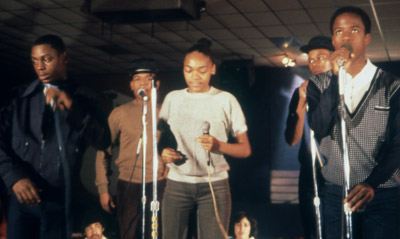
MC Sha-Rock in 1982’s Wild Style, Charlie Ahearn/Cornell Hip Hop Collection
Our efforts to connect academic hip hop studies to its cultural practitioners must honor women and empower female agency. The critical praxis has already been constructed by Black feminist scholars, such as Tricia Rose, Joan Morgan, Patricia Hill-Collins, Gwen Pough, Kyra Gaunt, Ruth Nichole Brown, and countless others. Hip hop feminism or “Crunk feminism” dictates that academic spaces support emancipatory gender politics, which starts with teaching and celebrating a truthful history focused on the agency of women of color. It does not involve participating in Black male violence under the guise of loving hip hop.
Every university that claims to teach or “preserve” hip hop should appoint female/feminist/queer artists. No doubt, fierce emcees like Yo-Yo, MC Lyte, Missy Elliott, and Lauryn Hill should be on the short list at many colleges. Still, we have to be wary of gender tokenism; the end-game should not be finding a honorary female artist to provide “a woman’s point of view.” Rather, the goal should be to create opportunities for women to narrate history, redefine the spaces occupied by hip hop, and to rearticulate the logic of critical listening.
Regendering hip hop studies will require a paradigm shift and a new soundtrack about love. Perhaps we can begin the work by replacing the H.E.R. tracks with Akua Naru’s “The World is Listening.” It is a dope, feminist homage to women’s journey through hip hop history, without all the slut shaming.
—
Featured Image by Flickr User LizSpikol
—
Travis L. Gosa is an Assistant Professor at Cornell University’s Africana Studies & Research Center. He teaches courses on hip hop culture, African American families, and education. He is an advisory board member of Cornell’s Hip Hop Collection, the largest archive on early hip hop culture in the United States. He can be reached at tlg72@cornell.edu and on Twitter @basedprof.
—
 REWIND! . . .If you liked this post, you may also dig:
“‘I’m on my New York s**t’: Jean Grae’s Sonic Claims on the City”––Liana Silva
“Ill Communication: Hip Hop Studies & Sound Studies @ Show And Prove”— J. Stoever-Ackerman
“The Victoria’s Secret Fashion Show and the Soundtrack of Desire“— Marcia Dawkins
Share this:

Something’s Got a Hold on Me: ‘Lingering Whispers’ of the Atlantic Slave Trade in Ghana

Interior of Men’s Slave Cells – Cape Coast Castle – Ghana, Image by Flickr User Adam Jones, PhD
I am standing in the mouth of the female dungeon. I hesitate to breathe for fear the hole will swallow me. It is competing with a rising tide of anguish that also threatens to eat me alive. The hole is dark, dank and noisome yet oddly comforting. After all, this is why I, and others, come to this site of torture—to fill in the gaps of our history, to make better sense of our lives, to find some comfort. But how does one find home in throbbing loss? Why must one dig for answers—that, ultimately, produce new questions—within the locus of pain? I run my fingers across the length of the thick, cavernous rock. It is brown like my skin…I can’t tell where it ends or begins.
In a 2010 interview with FADER Magazine, poet Gil Scott-Heron declared, “The spirit should be material. It’s your blood. Inside your bloodstream is your parents and their parents and their parents and their parents and they want you to make it, because when you do what you do and you’re successful, then they’re happy you made it. You’re the link with immortality” (88). What Scott-Heron articulates here is an ontological claim to spirit as inherently material and always already an eternal force over life’s struggles. The answers to the puzzle are embedded underneath the skin in an internal dialogue between spirit, mind, blood, bone and mass. This same ideological force is what pulls so many African American tourists back to Elmina and Cape Coast Castles in Ghana, in search of what Anne Bailey calls “lingering whispers” in African Voices of the Atlantic Slave Trade (3). We spin back the wheel of time to re-trace its deep grooves and recover the loss/lost in dungeons, burial sites, Donkor Nsuo (The Slave River), and the Atlantic Ocean.

Marks made by slaves in the Cape Coast Castle slave dungeons, Image by Flickr user Floris van Halm
Perhaps one’s DNA is a recording that is not only biological and racial but cultural and cosmological. Carolyn Cooper, in Noises In the Blood: Orality, Gender, and the “Vulgar” Body of Jamaican Popular Culture discusses “noises in the blood and reverberating echoes in the bone” as genealogical discourses of race. Can one’s DNA be an embedded and embodied soundtrack that charts particular and interconnecting nodes of history? Are those memories, experiences, dreams and longings then “recorded on my body,” as Nancy Frey suggests in “Stories of the Return: Pilgrimage and Its Aftermaths” (101) ? If we broke down the strands into coherent codes, or notes, or rearranged them into other combinations, what would they sound like? Would it produce a series of mixtapes, like hip hop records that sample older Black music—blues, R&B, funk, soul and jazz—and re-articulate them with new and emerging sounds? Perhaps it’s like Nathaniel Mackey muses in Bedouin Hornbook, “The last thing I remember is coming to the realization that what I was playing already existed on a record” (5). The slave forts become the ontological point of racial and cultural identity because, according to Saidiya Hartman’s Lose Your Mother: A Journey Along the Atlantic Slave Route, “the dungeon was a womb in which the slave was born” and where, by the performance of walking through the “Door of Return” one’s social life can be recovered, revitalized or remade (111).
I strain to hear any forms of life. As Slavoj Žižek suggests in “‘I Hear You With My Eyes’; or, The Invisible Master,” “ultimately we hear things because we cannot see everything” (90 and 92). According to tour guides at Elmina and Cape Coast Castles, the brick slave pens reverberate with the loss/lost of life, particularly at night, where bodiless moans, sobbing, screams and litanies can be heard rocking through the forts. But I can only detect distant sounds of activity beyond the back of the castle doors and “The Door of No Return.” The predominant noise is the Atlantic Ocean, crashing against the seashore. I hear the fishermen speak in rapid, hushed tones as their bodies struggle against the tiny canoes, their oars pulse against the waves as nets are thrown in with great precision. At the entrance of the castle, teenaged boys patronize African American tourists with “Sister! Brother!,” “Akwaaba”(Welcome), or “Welcome Home” as they pass folded letters with requests for contact information, money, or school donations, colorfully braided bracelets or other trinkets for sale. Market women pierce the air with unique calls for customers to try their products of bagged ice water, oranges, sugarcane, pineapple, and groundnuts. Cab drivers compete for tourists’ attention with loud, intermittent honks, verbal petitions or hisses.

Outside Cape Coast Castle, Image by Flickr User Abby Flatcoat
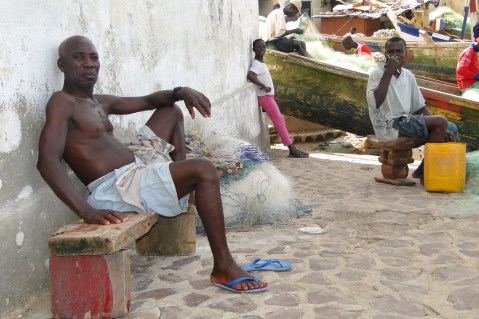
Outside the Door of No Return – Cape Coast Castle – Ghana, Image by Flickr User Adam Jones, PhD
The shops in the courtyard just beyond the reception area are now filled with traditional instruments—drums, guitars, piano boxes, and rattles—beads, cloth, masks, paintings, rugs and postcards. It is no longer a market in Black flesh but of “African” objects, or cultural artifacts that amplify the racial identity of diasporic visitors, and make them more “real” once they return home. Shop owners busy themselves making crafts, passing the day chatting with one another and potential customers.
This cell in which I stand is one of many at the Twin Castles, the gargantuan fortresses that after five hundred years continue to hold fast to the southern coast of Ghana. The intersecting trails of fine cracks rupture the once-pristine white paint on the walls. . .possibly one for every person stolen out of the dungeons. The hull is transfixing, the hold captivating. For some reason, I am suddenly reminded of Rev. James Cleveland’s gospel song, “Something’s Got A Hold On Me” where he proclaims, “Something hit me/Up over my head/And run right to my feet.”
.
Cleveland is talking about the power of the Holy Ghost to re-fashion his troubled life through spiritual re-birth. He sings of transformation from a life of misery to a brand new liberation that is manifested like a shock through his entire being and body. This new shock counters the crisis he regularly experiences “in the world.” This new bodily sensation permeates his entire being and acts as a shield against daily strife. Similarly, Etta James’ secular version, “Something’s Got A Hold On Me” attests, “My heart feels heavy/my feet feel light/I shake all over/ but I feel alright.”
.
James’ something is more possessive of her person; it is the overwhelming yoke of romantic love that seeps into her pores and won’t let up. This occupation of James’ senses is so startlingly pleasurable that she longs for and needs it. Similarly, The Miracles’, “You’ve Really Got A Hold On Me” pronounces, “Don’t want to leave you/don’t want to stay here/don’t want to spend another day here/oh, oh, oh, I wanna sit now/I just can quit now.”
.
Robinson expresses the ambivalence of love and longing—frustration, disappointment, ecstasy and desire—that crowds the senses with the sheer torture of being powerless over this structure of feeling. The protagonist is unable to shake hold of the beloved object, which makes him question his own capacity.
The “hold” becomes embodied and acts out in ways the mind cannot comprehend or prevent. It is the same hold the castles have on many African American visitors—an enigmatic narrative of love, loss and longing that the progeny of slaves refuse to relinquish and attempt to retell by inserting their bodies into slave histories. African Americans tour the castles as a way of tracing what Ralph Ellison calls “the grooves of history” in Invisible Man (443). Like a phonograph record, grooves are meant to be linear and progressive, but diasporic African history is awkward, uneven and full of odd ruptures, gaps and distortions. As James Clifford insists in “Diasporas,” “Diaspora discourse articulates, or bends together, both roots and routes” (251). These grooves consist of a series of complex and overlapping relationships that are multi-directional and non-linear. Like an album record, the records of history indicate particular events of static (crisis), interludes (junctures), and rhythms (discourse).

78 Record grooves by Flickr User Roger Smith
“The music is mysteriously ‘in’ these physical recesses, pressed into the vinyl,” Steven Feld argues in Music Grooves: Essays and Dialogues, “and listeners may imagine journeying there to merge right ‘into the groove’” (111). Grooves are doubly intentioned as: 1) the tracing of deep historical roots through specific routes of migration and 2) a physical and/or psychic space where utopic possibilities are imagined, alternative choices can be sought out, and past and future events are persistently contextualized within the present moment. To be “in a groove” is to be in tune with multiple realities simultaneously, to compress or stretch out time and space and one’s capacity in extraordinary ways.
Strangely, this cell is absent of all sound, even the static, white noise of silence. But it refuses to sound for me and tell me its history. I hear nothingness in the emptied hole. All that remains is a heavy vastness of what once was. As Mackey so profoundly articulates, “I wept for the notion of kin, as though the very idea were an occasion for tears, a pitiful claim to connection, a bleeding socket whose eye’d been plucked out” (21).
Over time, the cold stone has absorbed the blood, sweat, feces and bones of its inhabitants. It is the only material trace that proves the enslaved were once there.
—
Sionne R. Neely received her Ph.D. in August 2010 in American Studies & Ethnicity from the University of Southern California. Her dissertation examines how music artists in Ghana create transnational work alliances in response to shifting political regimes under independence, from Kwame Nkrumah’s administration to the present. Since 2005, Dr. Neely has recorded and archived more than 150 interviews with creative artists and industry professionals based in Ghana. In 2010, Dr. Neely co-founded ACCRA [dot] ALT, a cultural organization that promotes the alternative work of emerging Ghanaian artists through innovative programming and international exchange with artists worldwide. In 2011, she co-produced the Accra homecoming concert and documentary film for hip hop artist Blitz the Ambassador and Afro-Pean soul duo, Les Nubians. She is co-producer of Gbaa Mi Sané (Talk To Me), a short documentary film that explores the creative process of young visionary artists in Ghana (to be released in Summer 2013). Dr. Neely will also publish an article on hip hop practices in Ghana in the forthcoming Cambridge Companion Series (Fall 2013).
Share this:


Current Top Posts





April 2021

January 2020

November 2019

October 2019

August 2019

April 2014

November 2017

March 2015

December 2017

October 2015
 Sounding Out!
Recent Comments