
SO! Amplifies: Allison Smartt, Sound Designer of MOM BABY GOD and Mixed-Race Mixtape
 SO! Amplifies. . .a highly-curated, rolling mini-post series by which we editors hip you to cultural makers and organizations doing work we really really dig. You’re welcome!
—
Currently on the faculty and the associate technical director of California Institute of the Arts Sharon Lund Disney School of Dance, Allison Smartt worked for several years in Hampshire’s dance program as intern-turned-program assistant. A sound engineer, designer, producer, and educator for theater and dance, she has created designs seen and heard at La MaMa, The Yard, Arts In Odd Places Festival, Barrington Stage Company, the Five College Consortium, and other venues.

Allison Smartt
She is also the owner of Smartt Productions, a production company that develops and tours innovative performances about social justice. Its repertory includes the nationally acclaimed solo-show about reproductive rights, MOM BABY GOD, and the empowering, new hip-hop theatre performance, Mixed-Race Mixtape. Her productions have toured 17 U.S. cities and counting.
Ariel Taub is currently interning at Sounding Out! responsible for assisting with layout, scoping out talent and in the process uncovering articles that may relate to or reflect work being done in the field of Sound Studies. She is a Junior pursuing a degree in English and Sociology from Binghamton University.
__
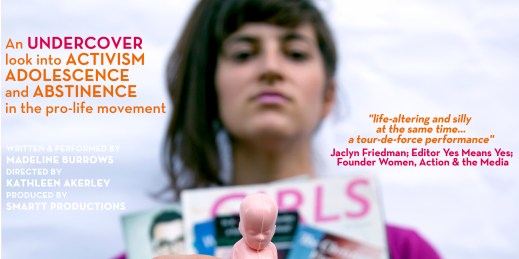
Recently turned on to several of the projects Allison Smartt has been involved in, I became especially fascinated with MOM BABY GOD 3.0, of which Smartt was sound designer and producer. The crew of MOM BABY GOD 3.o sets the stage for what to expect in a performance with the following introduction:
Take a cupcake, put on a name tag, and prepare to be thrown into the world of the Christian Right, where sexual purity workshops and anti-abortion rallies are sandwiched between karaoke sing-alongs, Christian EDM raves and pro-life slumber parties. An immersive dark comedy about American girl culture in the right-wing, written and performed by Madeline Burrows. One is thrown into the world of the Christian Right, where sexual purity workshops and anti-abortion rallies are sandwiched between karaoke sing-alongs, Christian EDM raves and pro-life slumber parties.
It’s 2018 and the anti-abortion movement has a new sense of urgency. Teens 4 Life is video-blogging live from the Students for Life of America Conference, and right-wing teenagers are vying for popularity while preparing for political battle. Our tour guide is fourteen-year-old Destinee Grace Ramsey, ascending to prominence as the new It-Girl of the Christian Right while struggling to contain her crush on John Paul, a flirtatious Christian boy with blossoming Youtube stardom and a purity ring.
MOM BABY GOD toured nationally to sold-out houses from 2013-2015 and was the subject of a national right-wing smear campaign. In a newly expanded and updated version premiering at Forum Theatre and Single Carrot Theatre in March 2017, MOM BABY GOD takes us inside the right-wing’s youth training ground at a more urgent time than ever.
I reached out to Smartt about these endeavors with some sound-specific questions. What follows is our April 2017 email exchange [edited for length].
Ariel Taub (AT): What do you think of the voices Madeline Burrows [the writer and solo actor of MOM BABY GOD] uses in the piece? How important is the role of sound in creating the characters?
Allison Smartt (AS): I want to accurately represent Burrows’s use of voice in the show. For those who haven’t seen it, she’s not an impersonator or impressionist conjuring up voices for solely comedy’s sake. Since she is a woman portraying a wide range of ages and genders on stage and voice is a tool in a toolbox she uses to indicate a character shift. Madeline has a great sense of people’s natural speaking rhythms and an ability to incorporate bits of others’ unique vocal elements into the characters she portrays. Physicality is another tool. Sound cues are yet another…lighting, costume, staging, and so on.
I do think there’s something subversive about a queer woman voicing ideology and portraying people that inherently aim to repress her existence/identity/reproductive rights.
Many times, when actors are learning accents they have a cue line that helps them jump into that accent. Something that they can’t help but say in a southern, or Irish, or Canadian accent. In MOM BABY GOD, I think of my sound design in a similar way. The “I’m a Pro-Life Teen” theme is the most obvious example. It’s short and sweet, with a homemade flair and most importantly: it’s catchy. The audience learns to immediately associate that riff with Destinee (the host of “I’m a Pro-Life Teen”), so much so that I stop playing the full theme almost immediately, yet it still commands the laugh and upbeat response from the audience.
AT: Does [the impersonation and transformation of people on the opposite side of a controversial issues into] characters [mark them as] inherently mockable? (I asked Smartt about this specifically because of the reaction the show elicited from some people in the Pro-Life group.)
AS: Definitely not. I think the context and intention of the show really humanizes the people and movement that Madeline portrays. The show isn’t cruel or demeaning towards the people or movement – if anything, our audience has a lot of fun. But it is essential that Madeline portray the type of leaders in the movement (in any movement really) in a realistic, yet theatrical way. It’s a difficult needle to thread and think she does it really well. A preacher has a certain cadence – it’s mesmerizing, it’s uplifting. A certain type of teen girl is bubbly, dynamic. How does a gruff (some may say manly), galvanizing leader speak? It’s important the audience feel the unique draw of each character – and their voices are a large part of that draw.
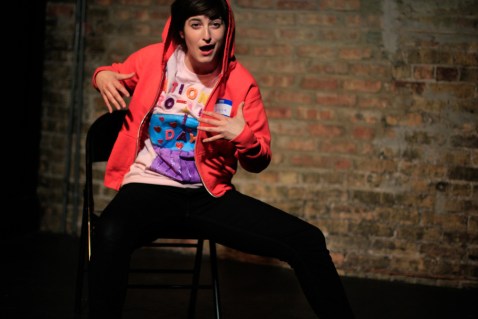
Madeline Burrows in character in MOM BABY GOD (National Tour 2013-2015). Photos by Jessica Neria
AT: What sounds [and sound production] were used to help carry the performance [of MOM BABY GOD]? What role does sound have in making plays [and any performance] cohesive?
AS: Sound designing for theatre is a mix of many elements, from pre-show music, sound effects and original music to reinforcement, writing cues, and sound system design. For a lot of projects, I’m also my own sound engineer so I also implement the system designs and make sure everything functions and sounds tip top.
Each design process is a little different. If it’s a new work in development, like MOM BABY GOD and Mixed-Race Mixtape, I am involved in a different way than if I’m designing for a completed work (and designing for dance is a whole other thing). There are constants, however. I’m always asking myself, “Are my ideas supporting the work and its intentions?” I always try to be cognizant of self-indulgence. I may make something really, really cool but that ultimately, after hearing it in context and conversations with the other artistic team members, is obviously doing too much more than supporting the work. A music journalism professor I had used to say, “You have to shoot that puppy.” Meaning, cut the cue you really love for the benefit of the overall piece.
I like to set myself limitations to work within when starting a design. I find that narrowing my focus to say…music only performed on harmonica or sound effects generated only from modes of transportation, help get my creative juices flowing (Sidenote: why is that a phrase? It give me the creeps)[. . .]I may relinquish these limitations later after they’ve helped me launch into creating a sonic character that feels complex, interesting, and fun.
AT: The show is described as being comprised of, “karaoke sing-alongs, Christian EDM raves and pro-life slumber parties,” each of these has its own distinct associations, how do “sing alongs” and “raves” and our connotations with those things add to the pieces?
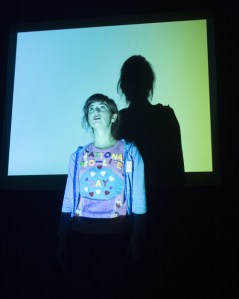
Madeline Burrows in character in MOM BABY GOD (National Tour 2013-2015). Photos by Jessica Neria
AS: Since sound is subjective, the associations that you make with karaoke sing-alongs are probably slightly different from what I associated with karaoke sing-alongs. You may think karaoke sing-along = a group of drunk BFFs belting Mariah Carey after a long day of work. I may think karaoke sing-alongs = middle aged men and women shoulder to shoulder in a dive bar singing “Friends In Low Places” while clinking their glasses of whiskey and draft beer. The similarity in those two scenarios is people singing along to something, but the character and feeling of each image is very different. You bring that context with you as you read the description of the show and given the challenging themes of the show, this is a real draw for people usually resistant to solo and/or political theatre. The way the description is written and what it highlights intentionally invites the audience to feel invited, excited, and maybe strangely upbeat about going to see a show about reproductive rights.
As a sound designer and theatre artist, one of my favorite moments is when the audience collectively readjusts their idea of a karaoke sing-along to the experience we create for them in the show. I feel everyone silently say, “Oh, this is not what I expected, but I love it,” or “This is exactly what I imagined!” or “I am so uncomfortable but I’m going with it.” I think the marketing of the show does a great job creating excited curiosity, and the show itself harnesses that and morphs it into confused excitement and surprise (reviewers articulate this phenomenon much better that I could).
AT: In this video the intentionally black screen feels like deep space. What sounds [and techniques] are being used? Are we on a train, a space ship, in a Church? What can you [tell us] about this piece?
AS: There are so many different elements in this cue…it’s one of my favorites. This cue is lead in and background to Destinee’s first experience with sexual pleasure. Not to give too much away: She falls asleep and has a sex dream about Justin Bieber. I compiled a bunch of sounds that are anticipatory: a rocket launch, a train pulling into a station, a remix/slowed down version of a Bieber track. These lead into sounds that feel more harsh: alarm clocks, crumpling paper…I also wanted to translate the feeling of being woken up abruptly from a really pleasant dream…like you were being ripped out of heaven or something. It was important to reassociate for Destinee and the audience, sounds that had previously brought joy with this very confusing and painful moment, so it ends with heartbeats and church bells.
I shoved the entire arc of the show into this one sound cue. And Madeline and Kathleen let me and I love them for that.
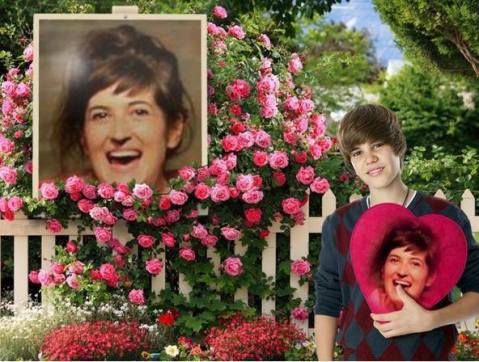
from madelineburrows.com
AT: What do individuals bring of themselves when they listen to music? How is music a way of entering conversations otherwise avoided?
AS: The answer to this question is deeper than I can articulate but I’ll try.
Talking about bias, race, class, even in MOM BABY GOD introducing a pro-life video blog – broaching these topics are made easier and more interesting through music. Why? I think it’s because you are giving the listener multiple threads from which to sew their own tapestry…their own understanding of the thing. The changing emotions in a score, multiplicity of lyrical meaning, tempo, stage presence, on and on. If you were to just present a lecture on any one of those topics, the messages feel too stark, too heavy to be absorbed (especially to be absorbed by people who don’t already agree with the lecture or are approaching that idea for the first time). Put them to music and suddenly you open up people’s hearts.
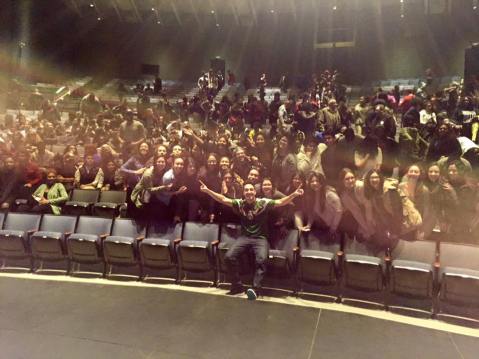
Post- Mixed-Race Mixtape love, William Paterson University, 2016 Photo credit: Allison Smartt
As a sound designer, I have to be conscious of what people bring to their listening experience, but can’t let this rule my every decision. The most obvious example is when faced with the request to use popular music. Take maybe one of the most overused classics of the 20th century, “Hallelujah” by Leonard Cohen. If you felt an urge just now to stop reading this interview because you really love that song and how dare I naysay “Hallelujah” – my point has been made. Songs can evoke strong reactions. If you heard “Hallelujah” for the first time while seeing the Northern Lights (which would arguably be pretty epic), then you associate that memory and those emotions with that song. When a designer uses popular music in their design, this is a reality you have to think hard about.

Cassette By David Millan on Flickr.
It’s similar with sound effects. For Mixed-Race Mixtape, Fig wanted to start the show with the sound of a cassette tape being loaded into a deck and played. While I understood why he wanted that sound cue, I had to disagree. Our target demographic are of an age where they may have never seen or used a cassette tape before – and using this sound effect wouldn’t elicit the nostalgic reaction he was hoping for.
Regarding how deeply the show moves people, I give all the credit to Fig’s lyrics and the entire casts’ performance, as well as the construction of the songs by the musicians and composers. As well as to Jorrell, our director, who has focused the intention of all these elements to coalesce very effectively. The cast puts a lot of emotion and energy into their performances and when people are genuine and earnest on stage, audiences can sense that and are deeply engaged.
I do a lot of work in the dance world and have come to understand how essential music and movement are to the human experience. We’ve always made music and moved our bodies and there is something deeply grounding and joining about collective listening and movement – even if it’s just tapping your fingers and toes.
AT: How did you and the other artists involved come up with the name/ idea for Mixed-Race Mixtape? How did the Mixed-Race Mixtape come about?
AS: Mixed-Race Mixtape is the brainchild of writer/performer Andrew “Fig” Figueroa. I’ll let him tell the story.
Andrew “Fig” Figueroa, Hip-Hop artist, theatre maker, and arts educator from Southern California
A mixtape is a collection of music from various artists and genres on one tape, CD or playlist. In Hip-Hop, a mixtape is a rapper’s first attempt to show the world there skills and who they are, more often than not, performing original lyrics over sampled/borrowed instrumentals that compliment their style and vision. The show is about “mixed” identity and I mean, I’m a rapper so thank God “Mixed-Race” rhymed with “Mixtape.”
The show grew from my desire to tell my story/help myself make sense of growing up in a confusing, ambiguous, and colorful culture. I began writing a series of raps and monologues about my family, community and youth and slowly it formed into something cohesive.

AT: I love the quote, “the conversation about race in America is one sided and missing discussions of how class and race are connected and how multiple identities can exist in one person,” how does Mixed-Race Mixtape fill in these gaps?
AS: Mixed-Race Mixtape is an alternative narrative that is complex, personal, and authentic. In America, our ideas about race largely oscillate between White and Black. MRMT is alternative because it tells the story of someone who sits in the grey area of Americans’ concept of race and dispels the racist subtext that middle class America belongs to White people. Because these grey areas are illuminated, I believe a wide variety of people are able to find connections with the story.
AT: In this video people discuss the connection they [felt to the music and performance] even if they weren’t expecting to. What do you think is responsible for sound connecting and moving people from different backgrounds? Why are there the assumptions about the event that there are, that they wouldn’t connect to the Hip Hop or that there would be “good vibes.”
AS: Some people do feel uncertain that they’d be able to connect with the show because it’s a “hip-hop” show. When they see it though, it’s obvious that it extends beyond the bounds of what they imagine a hip-hop show to be. And while I’ve never had someone say they were disappointed or unmoved by the show, I have had people say they couldn’t understand the words. And a lot of times they want to blame that on the reinforcement.
I’d argue that the people who don’t understand the lyrics of MRMT are often the same ones who were trepidatious to begin with, because I think hip-hop is not a genre they have practice listening to. I had to practice really actively listening to rap to train my brain to process words, word play, metaphor, etc. as fast as rap can transmit them. Fig, an experienced hip-hop listener and artist amazes me with how fast he can understand lyrics on the first listen. I’m still learning. And the fact is, it’s not a one and done thing. You have to listen to rap more than once to get all the nuances the artists wrote in. And this extends to hip-hop music, sans lyrics. I miss so many really clever, artful remixes, samples, and references on the first listen. This is one of the reasons we released an EP of some of the songs from the show (and are in the process of recording a full album).
.
The theatre experience obviously provides a tremendously moving experience for the audience, but there’s more to be extracted from the music and lyrics than can be transmitted in one live performance.
AT: What future plans do you have for projects? You mentioned utilizing sounds from protests? How is sound important in protest? What stands out to you about what you recorded?
AS: I have only the vaguest idea of a future project. I participate in a lot of rallies and marches for causes across the spectrum of human rights. At a really basic level, it feels really good to get together with like minded people and shout your frustrations, hopes, and fears into the world for others to hear. I’m interested in translating this catharsis to people who are wary of protests/hate them/don’t understand them. So I’ve started with my iPhone. I record clever chants I’ve never heard, or try to capture the inevitable moment in a large crowd when the front changes the chant and it works its way to the back.
.
I record marching through different spaces…how does it sound when we’re in a tunnel versus in a park or inside a building? I’m not sure where these recordings will lead me, but I felt it was important to take them.
—

REWIND! . . .If you liked this post, you may also dig:
Beyond the Grandiose and the Seductive: Marie Thompson on Noise
Moonlight’s Orchestral Manoeuvers: A duet by Shakira Holt and Christopher Chien
Aural Guidings: The Scores of Ana Carvalho and Live Video’s Relation to Sound
Share this:

St Erkenwald: The Spectacle of Noise


series co-editors Dorothy Kim and Christopher Roman
Here is a distilled introduction to the latest installment of Medieval Sound, Aural Ecology, by series co-editors Dorothy Kim and Christopher Roman. To read their previous introduction, click here. To read the first run of the series in 2016, click here. To read the full introduction to “Aural Ecology” and to read last week’s post by Thomas Blake, click here.
Aural Ecology
What is considered music, noise, or harmony is historically and culturally contingent. [. . .] The essays in “Aural Ecologies” address the issue of unharmonious sounds, sounds that often mark dissonant critical identities—related to race, religion, material—that reverberate across different soundscapes/landscapes. In this way, this group of essays begins to open up the stakes of Medieval Sound in relation to what contemporary sound studies has begun to address in relation to cultural studies, architectural and environmental soundscapes, and the marking of race through the vibrations of the body. —Dorothy Kim and Christopher Roman
We don’t always listen to medieval poetry in the same way that we listen to contemporary verse, despite its many sonic features. This article addresses the central role of sound in a Middle English alliterative poem, St Erkenwald, which recounts a meruayle (158) that takes place in St Paul’s cathedral. Through listening to the aural texture of the poem, to the voices in the text listeners/ readers can interact with events as they unfurl.
Indeed John Scattergood has been argued that this work is a “conversation poem, a poem of transformations” (181), wherein things, legends are re-invented. Its central concerns are with the nature of salvation and history, how the past confronts the present and is obscured through the mists of time, with lay folk requiring the mediation of the clergy in order to comprehend its significance. The pagan judge’s discourse can be seen as representing living history, revealing what artifacts, writing, documents cannot. The poem’s highlighting of the limitations of memory, written records and commemoration, creates an enigma as P. Vance Smith phrases it, with the dead body left to recount its own place in the scheme of events (59-60, 74). It is through dialogue and sound, the poem’s sonorous fabric that the events are finally resolved, and their potential meaning extracted.
St Erkenwald opens with an account of the physical, historical and religious setting of the tale, which evolves into a description of the re-building of the cathedral. The mery (39) stone masons, whilst engaged in their work, uncover a splendid tomb, lavishly decorated. The description of the digging and carving of stone conveys jarring, bustling activity. News of the tomb with its indecipherable text spreads rapidly (58-62).
Voice File: lines 58-100
Click here to view transcript of Lines 58-100

Etching of Old St. Paul’s Cathedral, London, from Francis Bond’s Early Christian Architecture, 1913.
Apart from the explicit references to noise, the verbs are evocative of clamour and urgency. Far from proceeding calmly and in an orderly fashion to the tomb, the people highid, boghit, lepen and ronnen. A powerful sense of speed and movement is evoked, heightened by the numbers of people involved. Something extremely unusual has happened and everyone desires to see it. The event develops into a spectacle of noise, a lively social occasion, as layers of details and elements are accumulated.
Noise does not signify in itself, it has meaning only in relation to other modes of signification. Michelle R. Warren, in her analysis of “The Noise of Roland”, argues that from the “combined perspectives of acoustics, information theory, and philology” it is possible to view noise and signals or messages as interdependent and that what distinguishes something as meaningful, a signal or message, or disruptive, is “intent” (283). This is particularly evident in literature, which can be viewed as the “noise of culture,” a disturbance in the dissemination of information and thus literary texts can be viewed as “various forms of mixed signals” (304). Sound, like time and space helps to delineate boundaries between the self and other and in order for identity to be established the noisy other must be silenced.
However, there is no hint of violence, unease or alterity in all of this haste in the cathedral to see the wonder with which the pilgrims have been presented. The opening of the tomb is carefully and courteously organized by the mayor and the sacristan and skillfully enacted by the workmen. The body unearthed is as fresh as he is “sounde sodanly were slippid opon slepe”(92). There is a child-like innocence, an enthusiasm for the marvelous, the new. Even the mayor, civic and religious leaders are anxious to investigate the find. Each person questions what lies before him and endeavours to make sense of it.
To this end, they search for records and memories of this seemingly important individual (96-100). The discussion works from the materiality of the body outwards in an attempt to unravel the underlying meaning. This referral to documentation to find a rationale for what is happening proves ineffectual. The questioning of texts and modes of recording draws in the receivers of St. Erkenwald, who possess a similar level of knowledge of the events, witnessing them unfurl, just as the folk in the poem, uniting both the internal and external audiences.

Erkenwald teaching monks in a historiated initial from the Chertsey Breviary (c.1300)
News reaches Bishop Erkenwald of these happenings whilst he is visiting an abbey in Essex, and losing no time, he buskyd þiderwarde bytyme (112). Erkenwald spends the night reciting his canonical hours, beseeching God’s help to solve the mystery in order to confirm the people’s faith. His prayers prefigure the closure of the poem, functioning as an expression of desire, which through supplication is fulfilled leading to celebration as his wish and the wishes of the people are fulfilled in that the mystery of the body and divine workings are revealed.
Once he assumes control of proceedings all clamour and commotion cease, at his behest (131-2).
Voice File 2 lines 131-145
Click here to read a transcript of likes 131-145
The exquisite notes of the choir are an instance of that important element of medieval cultures, music, with every aspect of medieval life and experience and embodiment being musically significant. Lords gather, not rush to herken (134) the beautiful, intricate singing. After this carefully designed performance of sound in honour of God, the bishop processes to the tomb location. We learn of all the great, good and ordinary souls who follow the bishop as the area is unlocked with a great bundle of keys. The keys probably jangle in the echoing confines of the cloister, a naturalistic detail that draws the listener/ reader into the scene. Having negotiated the cloister the focus then narrows to a moving conversation between the bishop and the corpse. All is silence now (218-20).
Voice File 3 lines 193-220
Click here to read a transcript of lines 193-220
The crowd is as large as before, with a crush forming behind the bishop as he passes through it, yet it is becalmed through sheer amazement. The contrast between the calmness and silence of the crowd now and its previous frenetic noisy activity is quite arresting. Boisterous garrulous behavior evident amongst those attending religious worship is widely attested and, as Diana Wood notes, the church court records contain references to louts disrupting worship and bear testament to widespread chattering with warnings issued upon occasion (207).

University of Leicester Special Collections. The Shrine of Saint Erkenwald, which was in the shape of a pyramid, with an offering-table before it, and was adorned with gold, silver and precious stones. From SCT 00908, William Dugdale, The History of St. Pauls Cathedral in London : From its Foundation Untill these Times …, (London, 1818)
The dean recounts to Erkenwald all their attempts to unearth the identity of the body (159-62). Erkenwald responds by counselling the need to draw inspiration from God and to trust in their faith and to emphasize that only with divine aid can miracles be comprehended. Thereafter follows a dialogue between the bishop and the body in which we learn of the circumstances of the latter’s life and death. We are presented with performance history, the dead speaking to the living, to us, rather than information having to be gleaned from dusty monuments, texts and documents. These living words reveal God’s plan and their underlying significances are mediated by Erkenwald for the deceased judge and spectators. The poem in turn translates these events for later readers/listeners. The focus remains firmly fixed on the bishop and the corpse, with the crowd quietly observing and listening, in the same manner as those who hear/read the text.
Indeed, throughout this section the references to noise are limited to verbs and phrases which suggest sorrow. The corpse hummyd (281) and gefe a gronyng (283). One can almost hear the silence as Erkenwald pauses and looks at the tomb with flowing tears. As he warpyd the words of baptism wete (321) drips from his eyes and trillyd adoun (322). A drop falls on the judge’s face, facilitating his having a vision of paradise. His sadde soun (324) sounds out in that place for the last time for a final time as he describes what he sees and “wyt this cessyd his sowne, sayd he no more” (341). The judge is miraculously received into heaven and his body instantaneously decomposes, in the midst of great tranquility.
The climax of the poem is a crescendo of sound, as the crowd rejoices at the happy fate of the judge, but it is a happiness inevitably tinged with sadness in the face of death (350-2).
Voice File 4 lines 309-352
Click here to read a transcript of lines 309-352

A sermon at Paul’s Cross
(from the Society of Antiquaries of London)
All are involved in the procession with bells ringing out throughout the town. The bells call not only the folk of Erkenwald’s London to participate in this joyful spectacle; they invite later audiences to join the celebration. Thus childlike innocence and enthusiasm combined with the direction of the church in tangible situations are deemed beneficial. This is paralleled in the positivity of silence and the three correct usages of human speech as explicated in a fifteenth-century sermon by an Oxford student monk on the gospel reading for the third Sunday in Lent, Luke II:14-28. An individual, especially a cleric, must be silent and meditate before he can graciously address the Lord. Quiet study is necessary prior to exhorting people to leave their sinful ways, with the final purpose of rightful speech being confession, which should only be exercised after the silent acquiring of wisdom (41-51).
The poem’s narrative voice adds that physicality is merely vainglorious, and what is fundamental is the soul’s achieving of bliss through the expression of love for Our Lord who makes this feasible. Such explicit comments are comparatively rare in St. Erkenwald with the role of the church and lay folk, and their obligations performed, expressed, rather than stated. The poem provides a model of the religious culture of a cathedral with the roles of clergy and laity carefully delineated. Through a spectacle of sound, ordered and disordered, of human and divine orchestration, pastoral care and guidance is enacted for the audience in and of the poem.
—
Featured Image: Image from the Crusader Bible, Morgan Library M.638, fol. 3r.
—
Bonnie Millar, Ph.D., Researcher at the University of Nottingham holds degrees from Trinity College Dublin, and the University of Nottingham. She has authored a critical study of the Siege of Jerusalem, and also publishes regularly on alliterative poetry, medieval romances, gender theory and myths. Publications include a paper entitled “Hero or Jester: Gawain in Middle English Romances and Ballads” in Le Personnage de Gauvain dans la literature européenne du Moyen Âge ed. Marie-Françoise Alamichel, a chapter on “Key Critics, Concepts & Topics” in the Continuum Handbook of Medieval British Literature, “A Measure of Courtliness: Sir Gawain and the Carl of Carlisle” in Cultures Courtoises en Mouvement: Proceedings of the Thirteenth Congress of the International Society of Courtly Literature and contributions to the Facts on File Companion to Pre-1600 British Poetry. Current projects include a full length study of the figure of Gawain entitled Gawain: From Hero to Anti-Hero in late Middle English and Early Modern Romances and Ballads.
—
REWIND!…If you liked this post, you may also dig:
The Amplification of Muted Voices: Notes on a Recitation of the Adhan–David Font-Navarette
Wayback Sound Machine: Sound Through Time, Space, and Place–Maile Colbert
“Playing the Medieval Lyric”: Remixing, Sampling and Remediating “Head Like a Hole” and “Call Me Maybe”–Dorothy Kim
Share this:


Current Top Posts





April 2021

January 2020

November 2019

October 2019

August 2019

April 2014

November 2017

March 2015

December 2017

October 2015
 Sounding Out!
Recent Comments