
Death Wish Mixtape: Sounding Trayvon Martin’s Death
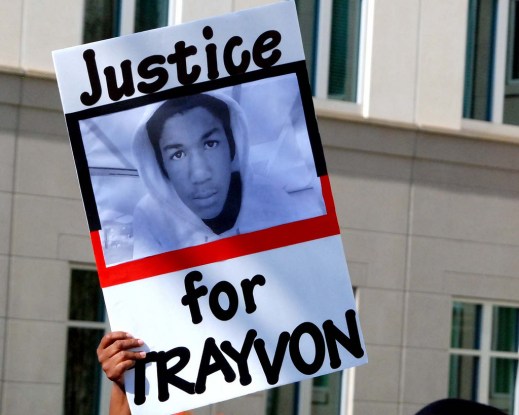
“Many men wish death up on me/ blood in my eye dog and I can’t see/ I’m trying to be what I’m destined to be/ and niggas tryna take my life away” –50 Cent, “Many Men (Death Wish)”
After hearing about the murder of Trayvon Martin, the unarmed teenager who was shot to death by George Zimmerman in a gated community in Sanford, Florida on February 26, 2012, I grappled with the urge to grab my godsons, nephews, cousins, brothers, and husband and never let go. I grappled with the Du Boisian question of the color-line, redressing it to consider “what does it feel like to be not only a problem but a target?” With these thoughts in my mind, I especially grappled with listening to the audio records of the 911 calls documenting the death of Trayvon Martin, just released late Friday March 16thby the Sanford police department.
I have mixed reasoning as to why I listened to the tapes. Part of me was just being nosy, but there was a deeper, far reaching curiosity stemming from my southern roots. As a Georgia girl, I was raised by Georgia men. My grandfather vividly recounted horrific stories of lynchings and beatings that happened “at the hands of persons unknown.” My mindset, like that of many, shifted to thinking about Trayvon’s death as a lynching. These tapes gave sonic urgency to a historically silent crime. In a word, Trayvon’s desperate screams gave voice to the countless men and women before him who died at the hands of white vigilantism.
As I listened to the distraught callers—and Trayvon’s final screams and pleas for his life—my mind became a mosh pit of emotions. Pissed, my mental playlist shuffled to 50 Cent’s “Many Men (Death Wish).”
.
I imagine Trayvon walking as the haunting piano and strings at the start of “Many Men” accompany his steps. He anxiously questions Zimmerman– “Why are you following me?” – in a similarly anxious way as 50 Cent can be heard asking “what’s taking homie so long, son?” and the shot rings out. As Trayvon screams and falls, the hard hitting boom fills the silent void. His lifeless body lays face down in the dirt, a lone piano softly signifying vulnerability as 50 Cent’s chorus starts: “many men wish death upon me/blood in my eye dog and I can’t see/I’m trying to be what I’m destined to be/and niggas tryna take my life away.” Situating Trayvon Martin’s final moments in a song by 50 Cent is discomforting, yet speaks to the reality and imaginative scripts of black masculinity as violent. The physical gunshot to Martin’s chest echoes the allegorical shots heard in the “Many Men” track and those in songs like Notorious B.I.G.’s “Who Shot Ya,” as another example, simultaneously blur and re-enforce black death as fantasy and normative. The 911 calls documenting Trayvon Martin’s death heard in concert with 50 Cent’s song sonically reify (gun) violence as a dominant discourse of black male identity. Indeed, Trayvon, I know who shot ya and gave you a death wish. I cannot, however, understand why.
.
The sonic surveillance of Trayvon Martin and George Zimmerman’s run-in—documented by the numerous accounts of neighbors who heard something but did not go outside—presents a juxtaposition of expected black male identity with the vulnerability of a horrified child forced into a criminalized space of black masculinity. In Zimmerman’s 911 call–listen via the Huffington Post here–he nonchalantly and at time heavily sighs about Martin’s blackness and its associated threat – “he’s black,” “he looks suspicious,” “he’s up to no good.” The passivity of Zimmerman’s voice reflects his bridging of (young) black masculinity as threatening. The panicked callers’ voices, however, represent reprieve and reinstate Trayvon’s humanity. The Trayvon Martin 911 recordings, then, are a mixtape of his final moments, sampling the voices of the various callers to construct Trayvon’s fatal narrative. Ultimately, the callers give voice to the vulnerabilities that Trayvon was deemed unable to evoke or possess by default as a black male.
 I use the word “mixtape” here to argue that the frequencies of trauma in which the (white) listener situates Trayvon Martin’s death must be heard within a larger understanding of sound as a commodified and racialized space. Ultimately, the recordings of Trayvon’s death are a sonic reflection of a long history of white America’s treatment of black bodies as capital. In negotiating the black (male) body as a commodity – which is historically and culturally significant – sounding the black male body as a commodity contextualizes this moment of expected black masculine performance for nonblack listeners. It needs to be noted how pathological black masculinity is profitable and mutually invested in by black men and white consumers alike. Briefly referring back to 50 Cent, he performs and is validated by the violence his narrative possesses. He knowingly invests in the exaggeration of his experience – he really was shot – and builds his image upon that paranoia. In In the Break, Fred Moten discusses the sonic commodification of blackness as “not what the commodity says but that the commodity says or, more properly, that commodity in its ability to say, must be made to say” (9). Situating black rappers’ narratives and, extensively, black men’s narratives as a commodity speaks to how the ambiguity of such narratives relegate blackness to a position of profitable, essentialized discourse. Moten suggests sounding blackness as a commodity is an effort to address these ambiguities, linking the privilege of speaking and constructing black (masculine) narrative, not content, as culturally and capitalistically recognizable and significant.
Trayvon’s political agency is invested in the violence placed upon his body by public scrutiny as a black man before there is any vulnerability as a child. Thrust instead into the position of ‘suspicious’ black man in a predominately white middle-class gated community, Trayvon the child bears the public scripts of expected black masculine performance, which are both visual and sonic. These expectations of popular culture and public opinion distort Trayvon’s sonic imprint, rendering him unable to vocalize and physically relay his desperate need for help.
As Mark Anthony Neal points out in a his March 19th New Black Man post “Hearing Trayvon Die” linking hearing Trayvon Martin’s death to a scene of a grieving Muddy Waters (Jeffrey Wright) from the 2008 film Cadillac Records, in which Waters’s pain is heard but not seen: “part of the reason that Jeffrey Wright’s howling had to be experienced off screen is that we have little understanding of Black males, as vulnerable, in pain, under duress, in terror and confronting death.” The impact of the lack Neal describes emphasizes the necessity for a sonic imposition of such vulnerabilities. In this case, the agency of this need is heightened by the audience being forced to listen to Trayvon’s frantic screams for help on tapes, thus humanizing him before racializing his body.
Yet it is Trayvon’s alleged screams – which I undoubtedly believe ARE his screams– that also sonically invoke his humanity. On the recording, heart-wrenching screams for help are silenced by the forceful pop of a gunshot, the silence signifying multi-layered historical and cultural indicator of Trayvon’s worth as a black boy in American society. Trayvon’s screams vocalize the agonizing silent demise of the murdered black boys before him. . .Oscar Grant. . .Amadou Diallo. . .Emmett Till. His screams are an echo of Frederick Douglass’s Aunt Hester’s screams, recorded in his 1845 Narrative, acknowledgement of the cruelty and continued viability of longstanding—even foundational—racial prejudice and violence that exists within the contemporary ‘postracial’ American agenda.

The Million Hoodies Union Square protest in New York against the shooting of Trayvon Martin in Sanford, Florida, by Flick'R User David Shankbone
Moreover, Trayvon’s scream also concisely signifiy the ongoing “upheaval” and chaotic existence of black men that Moten suggests “pressures the assumption of the equivalence of personhood and subjectivity” (1). Trayvon’s screams amplify a tragic dimension of what I theorize as “sonic cool pose,” where black masculinity is only cool if accompanied – instrumentally, lyrically, and otherwise – with violence. In this regard, the sonic signifiers that mark death—like the gunshots and screams that introduce 50 Cent’s “Many Men,” for example—are Trayvon’s. Both built upon the traumatic condition frequently faced by men and boys of color, Trayvon and 50 Cent’s lived experiences can be heard as sonically interchangeable despite obvious differences in class position. Through sound and the American popular imagination, black manhood is virulently fluid. There is a universal, stereotypical understanding that black masculinity resorts to identical markers of lived experience. This awareness is especially heightened and dominant in sound, where 50 Cent’s shooting on the corner parallels Trayvon’s shooting in a gated townhome community.
The release of the 911 audio of Trayvon Martin’s death is a powerful intervention in maneuvering black masculinity and violence in American (popular) culture. There is a delicate and simultaneous reading of the recordings as a sonic realization of black masculine violence and a fetishizing of a violated black male body. The sounds they contain amplify a continued American investment and interest in the black pathological narrative while doubly intervening as an alternative reading of such negotiations of black manhood. Whether sounded across a courtyard in a gated suburban neighborhood in Sanford, Florida, or on the streets of South Jamaica, Queens—or in the isolation booth in a recording studio—these frantic and desperate screams are sonic imprints of his social-cultural relevance. They may bleed into one another, but they won’t fade away.
 —
—
R.N. Bradley is a PhD candidate in African American Literature at Florida State University. She writes about African American literature, race and pop culture, Hip Hop, and her own awesomeness. She earned her BA in English from the Unsinkable Albany State University (GA) and a MA in African American and African Diaspora Studies from Indiana University Bloomington. Her dissertation project looks at negotiations of white hegemonic masculinity and race consciousness in 21st century African American literature and popular culture. You can read her work atAllHipHop, Newsone, TheLoop21, or her monthly column “The Race to Post” over atPopMatters. Scholar by day, unapologetic Down South Georgia Girl 24/7/365. Catch up with her awesomeness via twitter:@redclayscholar and her blog Red Clay Scholar (http://redclayscholar.blogspot.com).
Share this:

President Obama: All Over But the Shouting?
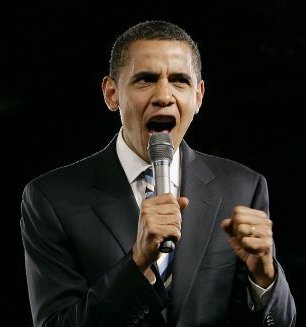
Ishmael Reed’s 12/12/2010 op-ed for the New York Times, “What Progressives Don’t Understand About Obama,” certainly struck a nerve amongst the Left. In the piece, Reed calls out far-Lefters for their misplaced–and dangerous–desire for President Obama to essentially “bust a can of whup ass” out on the Republicans over the tax cut debacle. Citing a lifetime of being labeled rhetorically “rowdy” by white teachers and peers, Reed calls attention to a deeply embedded and racialized double standard for the public expression of anger in the United States. Beyond turning a deaf ear their own pleas for a “sane” national debate back in October–see Mark Brantner‘s Sounding Out! analysis of the rhetorical logic of John Stewart’s Rally to Restore Sanity here–Reed argues that white liberals are also disregarding the racialized difference between white perceptions of their own anger (represented as righteous and authoritative) and their characterizarions of black anger (as a loud, dangerous “whup ass”–or as Reed phrases it “paranoid,” “bitter,” “rowdy,” “angry,” [and] “bull[ying]”). In other words, behind the cries in Reed’s comments for Obama to regain his “drama and passion” and to “stand up and tell these idiots to stuff it” lies a flirtation with and fear of “black anger,” which has a long history in the United States. As Reed mentions, black intellectuals have “been accused of tirades and diatribes for more than 100 years.”
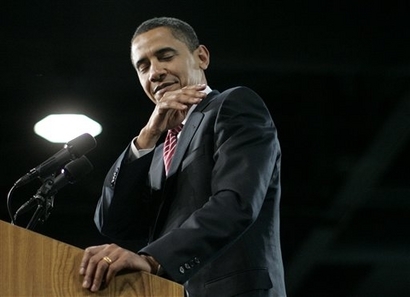
As someone who researches the racialization of sound and listening, I have been tracking Obama’s struggle with sonic stereotypes for quite some time now, and I think it is important to connect Reed’s recent thoughts with the utterance of another man named Reid almost a year ago. Woven into comments supposedly intended as praise of President Obama’s political prowess, Former Senate Majority Leader Harry Reid (D-Nevada) told two political journalists that he had known Obama would be elected president in 2008 because he was “light skinned” and had “no Negro dialect, unless he wanted to have one.” In this brief sound bite, the other Reid acknowledged the increased role that vocal grain and diction would play in a “post-racial” or “colorblind” world, linking the racialization of skin pigmentation with its less acknowledged yet perhaps more insidious counterpart, the racialization of sounds, voices and speech. Unfortunately, incendiary media coverage focused bluntly on Reid’s alleged racism for using the antiquated term “Negro” rather than sparking a more nuanced conversation about the role that race plays in perception and the multifaceted ways in which this racialized perception affects American politics and culture, down to the very level of the senses.
What was most disturbing about Reid’s comments (and the least talked about) was how they showed aural markers of race aligning with—and even superseding—visual codes of race, exposing the seeming comfort Americans have developed with this “sonic color-line,” as I have termed it. Inspired by and indebted to W. E. B. Du Bois’s concept of the visual color-line in The Souls of Black Folk (1903) and his later reimagining of that color-line as a suffocating plate-glass enclosure in Dusk of Dawn (1940), my notion of the sonic color-line posits listening as an interpretive site where racial difference is coded, produced, and policed. In short, we hear race in addition to (and sometimes even before) seeing it. As I have argued elsewhere, the socially constructed division between “sound/noise” marks one border of the sonic color-line; the hierarchies pointed out by Reed (quiet/loud) and exacerbated by Reid (proper/improper) mark still others. The sonic markers of whiteness (“sound”/”quiet”/”proper”) are culturally associated with both intellect and full citizenship privileges; the sonic markers representing blackness (“noise”/”loud”/”improper”) are repeatedly trotted out as signs of deviance, danger, and deserved abjection.
Though I very rarely find myself agreeing with Conservative linguist John McWhorter, I couldn’t help concede to the sentiment expressed in his January 9, 2010, blog for the The New Republic, “Reid’s Three Little Words; The Log in Our Own Eye”: “And who among us—including black people—thinks someone with what I call a ‘black-cent’ who occasionally popped up with double negatives and things like aks could be elected President, whether it’s fair or not?” Both Reid’s statement and McWhorter’s embellishment imply an unspoken sonic color-line, a racial “common sense” that African Americans are not only identifiable by a particular type of sound—the so-called “Negro dialect” or “black-cent” and its attendant loudness—but are aberrant and unelectable because of it, a sonic standard that does not appear to apply to white people. After all, the preceding two white presidents were known for their distinctive dialects and the ways in which they used them to mobilize their respective electorates; Bill Clinton’s soft-spoken Southern drawl was often read as smooth, intimate, and reassuring during the 1990s and George Bush’s folksy Texas-by-way-of-Andover twang attempted to sonically bridge the gaping class divides in the Republican coalition. But even before the recent debates that have pitted Obama’s “coolness”–itself a racialized jazz form of “quiet revolution” a la Miles Davis–against the imagined explosive heat of his anger, contemporary pundits heard the sound of Obama’s crisp, cosmopolitan voice with anxious and divisive ears, leading some to question his “blackness” and his political commitment to black people (Salon,“Colorblind,” 1.22.07)while still others called his baritone “magic” and immediately connected its resonant qualities with Martin Luther King Jr.’s, despite clear differences of tone, cadence, and regional inflection (Salon,“Does Obama’s Baritone Give Him an Edge?”2.28.2008).
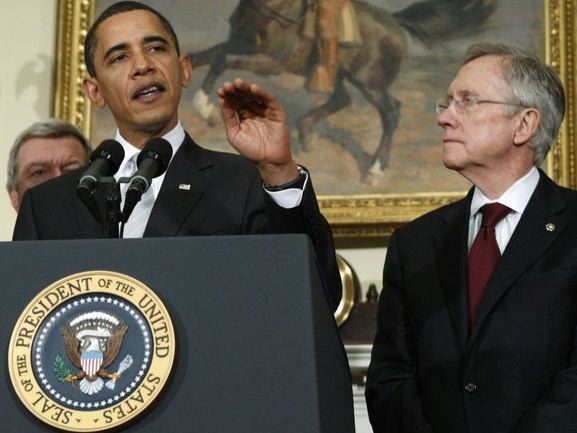
Senator Harry Reid (D-Nevada) Listens to Obama Speak
In other words, Americans continue to hear Obama’s voice through the historical filter of “loudness” and the so-called “Negro dialect” whether or not Obama wants them to and whether or not he “wanted to have one.” While Reid’s prompt and profuse apologies to Obama may have pulled the story from the news cycle—the President called the remarks “unfortunate”—the phenomenon Reid’s clumsy words exposed remains an invisible yet palpable cultural force in the U.S., one whose longer historical genealogy has yet to be reckoned with. Sure to be labeled “rowdy” for beginning to do so, Reed’s recent commentary suggests that Obama’s social and historical knowledge has led him to an astute awareness of “when not to shout” that white Liberals need to recognize. I offer a perhaps less consoling conclusion, that we need to concentrate less on the sound of Obama’s voice and more on the racialized listening practices that can radically distort public discourse in this country. Unless we understand (and eventually dismantle) the relationship between the dominant American “listening ear” and the sonic color-line that shapes it for many (white) liberals and conservatives alike, we will continue to shout into the wind.


Share this:


Current Top Posts





April 2021

January 2020

November 2019

October 2019

August 2019

April 2014

November 2017

March 2015

December 2017

October 2015
 Sounding Out!
Recent Comments