
LMGM’s “Lost: Choirboy” & El Jefe’s “Muñoz & La Mission: A Sermon. . .” (in memoriam José Esteban Muñoz)
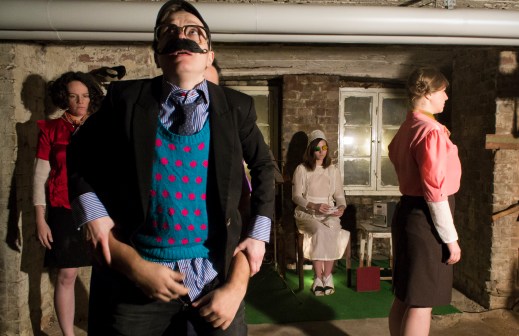
 Come, let us sing of great men. Well, just one man, not men—and masculine gender is not essential for our purposes. Come to think of it, his greatness isn’t nearly as important as his fierceness, his queer significance, his brown sensibility. But we’re still committed to singing—or at least to music—well, to sound and noise, in any case. José Esteban Muñoz often wrote about queer scenes where music and sound were central to participants’ world-making activities. His archives buzzed with the sounds of West Coast punk, vogue-ball house, cruisy toilets, genderqueer burlesque, and salsa echoing down the barrio streets. And so, for this Round Circle of Resonance, we at La Mission are here to make some noise about a badass thinker who deeply impacted the way we dance/sing/talk/write/sweat about dance music, identity, and politics.
And this is just the beginning of our cacophonous, four-part response to Muñoz’s intellectual holler. The first installment, written by La Mission’s resident essayist / deranged propagandist LMGM (Luis-Manuel Garcia) provides a brief introduction to our collective, some reflections on Muñoz’s relevance to our activities, and a frame for the next three missives from our fellow cultists. It is backed with a rousing sermon-cum-manifesto from our charismatic cult-leader/prophet, El Jefe (Pablo Roman-Alcalá). In the coming weeks, our Naked Mennonite/randy dramaturge (Mandie O’Connell) will prepare and film a urinary performance piece; and our saucy Choir Boy/Linguist (Johannes Brandis) will compose a dirge to our dearly departed José (August 9, 1967- December, 4, 2013).
LMGM a.k.a. Luis-Manuel Garcia
—
La Mission’s “(p/A)001: A non-Aristotelian Drama in Five Acts,” 2013, Image by Julien Barret
Lost: Choirboy (in memoriam José Esteban Muñoz)
La Mission
Named after San Francisco’s Latino barrio, La Mission is a satirical utopian doomsday cult, a music label, a queer situationist art-gang, a magazine, and a group of dancers with a very dirty sense of humor. We release music on vinyl, publish DIY ‘zines, and make performance art, aiming to re-politicize genres of dance music that have been important to queer people of color. La Mission’s identity is perhaps best summed up by cult-leader El Jefe’s manifesto-sermon, “The Sermon for the Steps of the Ziggurat in our Hearts,” published in our first La Mission magazine:
La Mission is a Community. La Mission is a Collective. La Mission is a Cult. La Mission is a Situationist Art Gang. La Mission is a Anarcho-Syndicalist terror cell. La Mission is a Family. La Mission is You. La Mission is Us. La Mission is gonna strip you butt nekkid, gonna check all your body cavities, gonna give you a shower, gonna give you a goodie bag, gonna give you a clean sheet and a towel. You at home with us now children, you understand me? You home with us now.

Founders Luis-Manuel, Pablo, and Mandie, caught on film at the performance for LM002, ‘a slow mutiny.'”
La Mission was first formed in 2012, in a small café in the Neukölln district of Berlin. The collective initially began with just three of us—Pablo Roman-Alcalá, Mandie O’Connell and Luis-Manuel Garcia—but like any good charismatic doomsday cult, it quickly expanded to include a broad network of lovers and collaborators, led by a core of four instigators (Johannes Brandis joined us later in the year). After a fundraising run in the fall of 2012 (witness our surrealist fundraising video here), we held our first two performances in the winter and spring of 2013, which involved experimental performance art pieces held in unusual spaces. The performances incorporated music and text from our vinyl EPs and their corresponding ‘zines, which were released at around the same time. These multi-channel productions were also conceptually coherent, with (kunst/WORK)001 introducing La Mission’s “mission” and (kunst/WORK)002 focusing on the relevance of utopianism to dance music. After a “quiet spell” where we released an out-of-series vinyl record of “lost remixes,” 2014 has been dedicated to preparing the next volume in the series (due in February 2015), which examines the depredations of capitalism, forced austerity, and false scarcity on music.
Hearing José
La Mission has no idols, but we do have influences—and José Esteban Muñoz is foremost among them. We share with Muñoz a focus on queer nightlife-worlds, a non-classical take on utopianism, a commitment to intellectual interventions outside of academic channels, and a certain brassy tone of voice. His revival of Ernst Bloch’s notion of a utopia based in real-life struggles was crucial in helping us reconcile revolutionary politics with dancefloor utopianism; or, put differently, Muñoz helped us find the critical politics latent in the queer, brown, sweaty gatherings that form the core of our scene of commitment. As “EDM” continues to blow up into a primarily white, hetero, cis, mainstream phenomenon, his insights have helped us maintain clarity and critical focus.
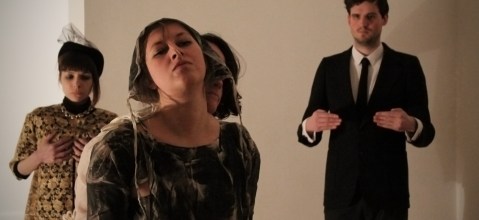
From the outset, we have also been profoundly influenced by Muñoz’s lifelong theorizations of brownness, affect, and (dis)identification. Since three of our four core members are Latina/os in varying states of stripped identity, we have been especially interested in Muñoz’s notion of the “brown commons,” as he was developing the concept in the last years of his life. In promotional texts that circulated ahead of his speaking engagements on the topic, he described brownness as “an expansive sense of the world, a feeling and being in common that surpasses the limits of the individual and the subject.” Notably, he understands brownness and the brown commons as being shaped not only by suffering and struggle, but also by thriving, providing a pool of resources for a better, more vibrant kind of life.
La Mission, (p/A)001: A non-Aristotelian Drama in Five Acts, 2013, Image by Julien Barret
The significance for La Mission’s project in dance music culture should be clear already, but we also take great inspiration in how Muñoz developed an expansive view of brownness and the brown commons, using Latina/o experience as an entry-point for “a vaster consideration of the ways in which people and things suffer and experience harm under the duress of local and global forces that attempt to diminish their vitality and degrade their value.” We here at La Mission are committed to exploring brownness for its potentials for lateral solidarities among people of color, who may have diverse cultural backgrounds but nonetheless share post-migrant experiences of struggle, devaluation, displacement, and inauthenticity. In fact, Muñoz’s work was a direct inspiration for the “Brown Corner” in our La Mission ‘zine (a parody of the “ladies’ corner” and “kid’s corner” of American mid-century lifestyle magazines). Published bilingually and featuring post-migrant authors, the Brown Corner reflects on aspects of brownness, as both specific to their contexts and generalizable to a wider “commons” of brown experience. In the process, we hope to highlight shared feelings, narratives, and resources for brown survival in a world of white supremacy.

A hand-drawn re-working of Frieda Kahlo’s own self-portrait, part of the Brown Corner for issue 001 of the La Mission ‘zine.
Singing into the Horizon
Brother Muñoz, what are we supposed to do with the vinyl records, the zines, the performance videos we had been accumulating for you? We’re trying to sing our way into a queer utopian horizon, and we had been counting on your voice. We know you’re not coming back. As a radical lefty utopian doomsday cult, we’re not so invested in the afterlife, anyway. But it still sucks for us and everyone else you left behind, left in the “here and now” that we struggle to turn into something less suffocating. The party was just getting started, dammit. Besides, we had such a kickass choirboy outfit picked out for you.
—
LUIS-MANUEL GARCIA aka “LMGM”: LMGM/Luis-ManuelLMGM/Luis-Manuel is a Canadian of Peruvian-Colombian origins, currently an Assistant Professor in Popular Music at the University of Groningen (NL), after migrating between Toronto, Berlin, Chicago, and Paris. He has managed to turn his love of electronic dance music into a PhD in Ethnomusicology at the University of Chicago, and into post-doctoral fellowships at the Max Planck Institute for Human Development and the Freie Universität Berlin. On the side, he writes about food and dances every chance he gets.
—

“Portrait of La Mission” by Ben Hammond, who has not seen any of its members naked
Muñoz & La Mission: A Sermon for the Imagined Sanctuary We Built Together
Welcome. La Mission is a family. A family of chosen comrades, chosen brethren, chosen hermanos, chosen сестры, chosen lovers, chosen students, chosen teachers, and chosen arms. Arms, linked and brandished through common thought, common feeling, common goals. It is with a heavy heart that we find ourselves here, remembering one of our family who (though never officially an acolyte or collaborator) was one who contributed to the ecstasy that we have felt and will feel for many years. José Esteban Muñoz was said to be a believer. Ernst Bloch and the New Revolutionary Epoch. Our utopias were described and imagined and realized and experienced. Rise up, my brown brethren, and let us celebrate Brother Muñoz’s legacy!

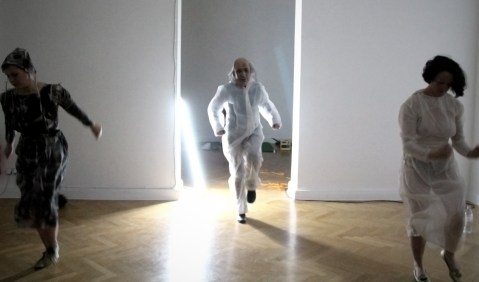
La Mission’s “(p/A)001: A non-Aristotelian Drama in Five Acts,” 2013, Image by Julien Barnet
The words and deeds of this fellow freedom-fighter, who infiltrated the bourgeois güero academy and infected it with a polylateral program for de- and reprogramming, has been our parallel and our inspiration. Colleague and comrade. A representative of our struggle. Not quite a patron saint—that honor we’ve reserved for communarde Louise Michel—but no less a visionary. As queers, as minorities stripped of identity, as angry and happy children in revolt for something better, we must all learn from each other as equals.
Brother Muñoz made utopia political again and located that utopianism in performance. La Mission’s performances bring forth utopias from our queer future through fleeting mindfuck happenings in the present. Through the work of Sister O’Connell and her band of terrorizing miscreants, we present a non-narrative and non-paternalistic path towards redemption, one of our own making. Can I get a “Fuck, yeah!”?

La Mission at Import Projects, 2013
Brother Muñoz loved music and dancing and life-worlds connected by the beat and said, “Take Ecstasy with Me.” He revealed to us the connections between collective dancing and feeling utopian. In his spirit, La Mission’s music strives to bring forth utopia through that ever-lasting beat. Through disassociation and reassociation, through transcendental repetition, and through getting the fuck down! Can I get a “Fuck, yeah!”?
Brother Muñoz believed in learning and critical thinking. Analysis and the great revolutionary trek through the jungle of our critically thinking minds. La Mission’s tracts enact utopia through a constant vomiting out of our recently digested learnings into the baby-bird mouths of those who read them. The brother was also a hilarious motherfucker, and from this we realize that it is not through the shrill screams of egoism disguised as activism that we will prevail. It is through the joy of laughter combined with thought that we will win our bread. Can I get a “Fuck, yeah!”?
Brother Muñoz loved fucking. La Mission’s fucking creates utopias through the ecstatic act in and of itself. If you aint fucking to make yourself a Temporary Autonomous Zone of happiness, then you aint doing it right. Can I get a copulatory “Fuck, yeah!”?
It is not all loss, though. The ideas live on. Caminamos juntos. On the dancefloor. In the reclaimed Torre David skyscraper and the Taller Tupac Amaru collective; in the informal classrooms and the sweaty bedrooms. Our hearts must burst after sagging, our heads must fill after hanging low, and our linked arms will raise! Oh honey, please don’t give your heart to a world system based on exploitation of the luckless, give your heart to US!
—

La Mission at Import Projects, Common Revilings Project, 2013, Image by Julien Barrat
—
All images courtesy of La Mission
—
PABLO ROMAN-ALCALA: Yo. I am Pablo aka “Beaner” aka “Skirtchaser” aka “El Frijolero” etc. I am an internationally working musician and dj who has enjoyed a modicum of success, but who doesn’t like what has happened to the musical landscape vis-a-vis “conservatism” in respect to both Money and Art. I mean the relationship of the two, okay? It sucks. And I want to change it.
—
 REWIND!…If you liked this post, check out:
Karaoke and Ventriloquism: Echoes and Divergences–Karen Tongson and Sarah Kessler
Freedom Back: Sounding Black Feminist History, Courtesy the Artists– Tavia Nyong’o
“New Wave Saved My Life*”-Wanda Alarcon
Share this:

A Brief Review of Australian Radio Art

Welcome to the second part of Radio Art Reflections, a series on radio art that brings together the thoughts of three practitioners who have been researching the field from Canada, Australia and the UK.
In the first part Canadian sound and radio artist Anna Friz discussed how transmission art has shaped her practice and how it has become an important current within the expanded territory of radio art. Following this, musician and sound artist Colin Black reflects on the particularities of Australia’s radio art history, analyzing the effects of ongoing cutbacks at the Australian Broadcasting Corporation. Black fears a distinctive Australian soundscape-based radio art is in danger of being lost, while identifying a current renaissance in narrative based radio features which currently shape ABC radio output, and considers the potential of ABC’s new Creative Audio Unit.
– Guest Editor Magz Hall
—
As an artist growing up in rural Australia, I was hugely influenced by how state-owned radio engaged with sound-based practitioners. For decades, radio not only gave voice to some of the more exploratory artists and their works, it allowed artists and audiences from all over this vast continent to find a space in which experimental works could, with financial support, gestate, be realized and propelled onto a world stage, often receiving international acclaim for their distinctive perspective.
In recent years I have come back to those works as a PhD researcher, interviewing thirty five international practitioners, theorists and producers on Australian radio art thereby gaining a new appreciation of its particular aesthetic practices and approaches. This article draws on some of these interviews to highlight national and international perceptions about where Australian radio art has been, while also demonstrating its potential to influence a new generation of artists to explore beyond mainstream media formats.

Murray Higgins, ABC Adelaide Drama supervising engineer recording various armaments on the deck of a Royal Australian Navy ship. This actuality was used for a live broadcast of a radio play scheduled for broadcast on the same day of recording. (Photo taken April 8, 1945 by an unknown photographer)
THE LISTENING ROOM
While there are a few early examples of Australian radio art, consistant programming and commissioning of radio art effectively commenced in the 1980s with the formation of the ABC Arts Unit during 1984-85 and the acoustic arts programme The Listening Room, which aired from 1988 to 2003. Although long-decommissioned, The Listening Room was still one of a very few signposts that my interviewees cited when trying to understand the properties of Australian radio art. The Listening Room’s founding executive producer Andrew McLennan, who expanded the boundaries of ABC radio from 1976 onwards, had a clear take on the aesthetic framework of the show, stating in one internal ABC report (c1990) that the programme was a:
… venue for the exploration, the cross-pollination of radio forms. … you can hear new radio plays, audio essays, acoustic features, sound documentaries, new music, sound-scapes and sculptures, audio installations, acoustic art forms …
This approach was broader than that of other international radio art programs. Here is a quote from the formative executive producer of Deutschlandradio Kultur, Götz Naleppa, who took a much more “aesthetic” approach for his well-known Klangkunst programmes in Germany:
The difference to other radio-art-forms like radio-play is simple: sound-composition [a term Naleppa prefers to radio art] shares with them the same elements: sound, text (voice) and music. But in radio-play text (dialogue) is in the foreground and the other elements SERVE it (often in an illustrative way). And in (radio)sound-composition we have the same elements – but they are EQUAL, they are simply MATERIAL in the hands of the composer [Götz Naleppa, e-mail message to author July 28, 2005].
Of the two, The Listening Room clearly had a wider scope. Thus a number of ABC works, like On the Raft, All at Sea (by Robyn Ravlich and Russell Stapleton), placed the text in the foreground as the narrative is primarily driven by the use of spoken dialogue and the other elements are used to serve the text in a chiefly illustrative fashion. By definition Naleppa would call this a “radio-play” and not necessarily neues hörspiel or radio art, and definitely not a radio “sound-composition.”
.
Extract from On the Raft, All at Sea (2002) by Robyn Ravlich and Russell Stapleton (courtesy Robyn Ravlich and ABC Radio)

Figure Two: The Listening Room, program logo postcard designed by Antart (c 1990).
“AUSTRALIAN” RADIO ART
Alongside this inclusiveness of a wide scope of work, my research uncovered a range of other ideas about the identifiable properties of Australian radio art. Austrian Elisabeth Zimmerman claims that with Australian work there is “a certain tradition” that favours the “use of environmental sounds … but in a very composed way.” Andrew McLennan supports Zimmerman’s viewpoint and states: “it’s always hard to say and it is probably a bit of a cliché … [however he] often think[s] of it as quite environmentally driven.” Douglas Kahn, an American, is more skeptical, observing that “The Australian stuff was much broader range … I don’t think you can say that there was an Australian aesthetic because there were so many different artists that were brought in to do things.” Although later Kahn does state that a common thread heard in Australian work was its “really high quality production values … really nice complex mixes … people playing the mixing board like it was a piano in a really sophisticated way.” Kaye Mortley from her Australian French background describes Australian work as “radiophonic art, of various sorts, more experimental in nature, some produced by composers.” While not a composer, Australian Virginia Madsen supports Mortley’s viewpoint when she describes her own work as “experimental … it combines music, theatre performance, and documentary really.” The common theme that emerges from my research is the openness and commitment to experimentation that exists alongside a highly professional approach to the art form within Australian radio art culture.
My interviews also indicated that radio art plays a role in the perceived amorphous and multi-faceted notion of national identity, while confirming Kahn and Nicholas Zurbrugg’s earlier observations that radio art has critically contributed to the overall arts ecology in Australia. As a practitioner, I would also describe my own work as having an experimental approach that is influenced by the high quality production levels of programs like The Listening Room. While much of my work is environmentally driven, my artistic focus is to create multi-faceted, intimate aural geographies in which human imprint is present.
.
Extract from Alien In The Landscape (2007) by Colin Black (courtesy DeutschlandRadio Kultur). This extract features synchronous field recordings made by a Rodes NT4, X-Y configured stereo microphone and Fender Stratocaster with additional strings attached as pictured below.

Figure Three: The author conducting field recordings at the edge of the Great Sandy Desert in Australia, 2006.
THE CREATIVE AUDIO UNIT AND AUSTRALIAN RADIO TODAY
When The Listening Room was decommissioned in 2003, explorative radio was forced in two directions: ABC Radio National programmed some word-based works, while ABC Classic FM aired another set of works that Kate Dundas (Director of ABC Radio) has called “Shorter-form pieces, maybe perhaps down the sound-based acoustic end or radiophonic end of the spectrum.”Budgets were dramatically reduced and diverted, resulting in the effective abandonment of regular commissions and airtime for long-form sound-based works. In 2012 ABC management decommissioned book readings and Creative Instinct (a “feature program that reflects and explores the creative world”) and The Night Air (described as “aural equivalents of the avant-garde cut-up: a montage of interviews, location sound, music and found audio”). Moreover management oversaw the dismantling of the Airplay programme, which included “hour-long dramatic fictions [sic] experiment with form” effectively ending an 80-year tradition of Australian radio drama. In replacing these programmes, the Creative Audio Unit (CAU) was planned and American-style low budget radio production techniques for dramatic short stories (as championed at the 2012 ABC run Radio Beyond Radio conference) were put on the table as the future of radio.
In 2013 the ABC recruited a whole new team (who collectively had very little direct engagement with prior radio drama and The Listening Room production budgets and procedures), to setup, oversee and run the CAU. This transition was so atypical of past ABC changes that it raises questions as to whether this was an orchestrated act of cultural amnesia. It is perhaps not surprising that one of the major challenges this new team faces is the lack of resources, which impedes the magnitude of new works commissioned. This also raises questions as to how the previous budgets from Airplay, The Night Air and Creative Instinct have been reassigned. Another challenge is this unit’s extremely wide area of responsibility (that was previously spread across a number of ABC Units) ranging from radio drama and essays on the Radiotonic programme (effectively replacing the entire radio drama department) to what it claims to be a “portal into radio art, performance, soundscapes and composed audio features” on its Soundproof programme.
While Soundproof makes gestures to re-stimulate radio art activities in Australia, in sampling its first twenty episodes it becomes apparent that a very large percentage of airtime is heavily driven by the spoken dialogue narrative, more in line with radio drama or documentary. Furthermore, the episodes that contain the more interesting sound works seem to be frequently interrupted by extended contextual dialogue and therefore, for the most part, present only extracts or shorter form radio art works. Therefore, as a practitioner who runs the risk of being excluded from future CAU activities, I would nevertheless argue that for the most part, the CAU is doubling up on its focus on radio drama and documentary style productions and has not to date reached its goal of fully exploring and presenting sound rich radio art features, as it claims (please see Soundproof episode mp3 downloads dated between 11 May to 21 September 2014). Moreover, Soundproof is much more constrained, even backward-looking, when compared to its predecessors and is therefore aiming to attract a much less adventurous radio audience. More glaringly, the first twenty episodes lack a strong presence for new Australian works when compared to The Listening Room that broadcast sixty-four Australian works with a total duration of fifty hours in its first year of operation. As an inquisitive listener it seems that, to date, Soundproof has forgotten its own lineage without offering anything new or innovative and in doing so, has also forgotten audience members like myself in Australia and throughout the world.
I sometimes wonder what the conclusions from my research study would be if it were only focused on current practice. Would today’s Australian radio art still play a role in the perceived multi-faceted notion of Australian national identity? Would it still be perceived to have an experimental approach with high quality production levels that favour the use of environmental sounds? Is it still a critical contributor to the overall arts ecology in Australia? Audience members who have little prior knowledge of Australian radio art, may think so or may not conceive of its potential to do so. However, given sustained support, the space for experimentation and a clear inventive vision for the future, building on the legacy of past achievements, Australian radio art clearly has the potential to regain its status on a world stage.
—
Featured Image: Beastman mural on Brisbane Radio by Flickr User JAM Project
—
Dr Colin Black is an internationally acclaimed composer/sound artist having won the 2003 Prix Italia Award and achieving the final round selection in the 2010 and 2011 Prix Phonurgia Nova for his creative feature length works. As a result of this acclaim, Black has received multiple national and international commissions to create innovative long-form works for broadcast across major Australian and European networks. Black’s curator credits include, international festival/showcases of award winning Australian acoustic art and radio art at London’s Resonance104.4fm, Kunstradio (ÖRF, Austria) and Toronto’s New Adventures In Sound Art. In 2013 he also curated the Australian Broadcasting Corporation’s Sound Fix: Your Weekly Dose of Transmitted Audible Art series. He is a PhD graduate of the Sydney Conservatorium of Music where he was a recipient of the University of Sydney Postgraduate Awards Scholarship. More recently Black has been engaged as an academic lecturing at the University Technology, Sydney; moreover he has authored a number of conference papers and peer reviewed journal articles including “An Overview of Spatialised Broadcasting Experiments With a Focus on Radio Art Practices” in Organised Sound. Black is also the founding member of The International Radio Art (and Creative Audio for Trans-media) Research Group. For more information see: www.colinblack.com.au
—

REWIND! . . .If you liked this post, you may also dig:
Unsettled Listening — Randolph Jordan
Radio Ambulante: A Radio that Listens — Carolina Guerrero
Everything Sounds Podcast — Craig Shank
Share this:


Current Top Posts





April 2021

January 2020

November 2019

October 2019

August 2019

April 2014

November 2017

March 2015

December 2017

October 2015
 Sounding Out!
Recent Comments